Aggregation with Strong Regularities and Alternatives
Helmut Horacek
Universität des Saarlandes
FB 6.2 Informatik
[email protected]
Abstract
Aggregation is typically treated in NLG as a local optimization measure, and methods exist only for building conjoined expres-sions with 'and'. In contrast to that, solu-tions to logical problems are characterized by regularly occurring commonalities, in-cluding complete subsets of possible value combinations and alternatives. In order to address constellations of this kind, we extend current aggregation techniques, envisioning high degrees of condensation. In particular, we define novel constructs that can express sets of propositions with highly regular variations on slot values concisely, including special forms of dis-junctions. Our methods enable the gener-ation of expressions with semantically complex operators, such as 'vice-versa' and 'each', and they support various aspects in interpreting solutions produced by formal systems, such as highlighting commonal-ities among and differences across solution parts, supporting the inspection of depen-dencies and variations, and the discovery of flaws in problem specifications.
1
Introduction
Aggregation is a central concept in NLG that is relevant for practically all applications. It is typi-cally treated as an opportunistic optimization measure addressing locally occurring commonal-ities. In contrast to that, solutions to logical problems are characterized by regularly occurring commonalities, including complete subsets of value combinations and alternatives.
In order to address constellations of this kind, we extend current aggregation techniques, envisioning high degrees of condensation. In particular, we define novel constructs that can express sets of propositions with highly regular variations on slot values concisely, including special forms of dis-junctions. Among others, this method enables the generation of expressions with semantically com-plex operators and disambiguation markers, such as 'vice-versa', 'each', 'remaining', and 'distinct'.
The paper is organized as follows. First we review aggregation techniques. Then we define new aggregation constructs. We describe a proce-dure for building compositions of these constructs, including syntactic realization. Finally, we discuss the application potential of our approach.
2
Previous Approaches
The term aggregation was first used in (Mann and Moore, 1980). It is relevant in all processing phases of NLG (Reape and Mellish, 1999). Its most common form, structural aggregation, con-cerns compositions of several logical assertions that share information into a single natural langu-age utterance with coordinated or omitted parts, yielding conjunction reduction (“Foxes and wolves are animals”) and ellipsis or gapping (“Foxes are larger than birds and _ smaller than wolves”).
be(Pete,boxer,<2,4,5,7,9-11,13-16>) be(Steve,actor,<3,5,13>) be(Thelma,actor,<4,8-10,15>) be(Pete,guard,<1,3,6,8,12,15,16>) be(Steve,boxer,<8,12>) be(Thelma,boxer,<1,3,6>) be(Pete,operator,<1-14>) be(Steve,guard,<9,14>) be(Thelma,chef,<1-16>) be(Roberta,actor,<1,2,6,7,11,12,14,16>) be(Steve,nurse,<1-16>) be(Thelma,guard,<2,5,7>) be(Roberta,guard,<4,10,11,13>) be(Steve,officer,<6,7,10,11>) be(Thelma,teacher,<11-14,16>) be(Roberta,officer,<1-5,8,9,12-16>) be(Steve,operator,<15,16>)
be(Roberta,teacher,<3,5-10,15>) be(Steve,teacher,<1,2,4>)
Figure 1. Solutions to the puzzle – alternatives in assigning persons to jobs
Souza, 1990) and hypotactic aggregation with detailed lexical decisions (Robin, 1995). However, all these approaches operate on some local level.
The only systematic approach, which has also inspired our method, is Shaw's staged process (1998a; 1998b), which separates heuristic order-ings followed by recurrence markorder-ings from lingu-istically justified sentence boundary decisions and reduction operations.
3
The Running Example
We present solutions to a puzzle: “There are four people: Roberta, Thelma, Steve, and Pete. Among them they hold eight different jobs, each exactly two. The jobs are: chef, guard, nurse, telephone operator, police officer, teacher, actor, and boxer. The job of the nurse is held by a male. The hus-band of the chef is the telephone operator. Roberta is not a boxer. Pete has no education past the ninth grade. Roberta, the chef, and the police officer went golfing together. Who holds which jobs?”
This is a fully regular assignment problem. 16 solution variants consist of eight assignments each, which amounts to 128 propositions if unaggregat-ed. In Figure 1, the solution variants are referred to by numbers, as an extra slot. All propositions with the same value of this slot must be true at the same time, those with different values holding alter-natively. To save space, variant numbers for the same fact are enclosed between '<' and '>'.
4
New Aggregation Constructs
The solutions to this puzzle consist of highly regular assignments, which is typical for machine-generated solutions to these kind of problems
(consider, for example, solutions produced by the model generator KIMBA (Konrad and Wolfram, 1999), presented in (Horacek and Konrad, 1999)). For expressing these constellations concisely and elegantly in natural language, semantically com-plex operators, such as 'each' and 'vice-versa' prove useful. For generating these expressions, we define novel “2-dimensional” coordinations. Normally,
coordination is done in a pairwise fashion. For the
new constructs, aggregation is done by building the
cross product of the values of two slots, including
special forms of disjunctions for commonalities across variants (Choice, Except, and Assign):
• The Permut construct
It expresses a set of predications in which the values of two slots comprise all combinations out of the two sets of slot fillers, within the
same variant. An example sentence is “Each
of Pete, Steve, and Thelma can be boxer and guard,” expressing six of the facts in Figure 1, when abstracting from the variant slot.
• The Choice and the Except constructs
(1) base(P,a1,…,an) ::= P(a1,…,an)
(2) λxi,xj. base(…,xi,…,xj,…) (ai) (aj) ::= base(…,ai,…,aj,…)
(3) <Ain> ::= <ai1,…,ain>
(4) Coord(base(…,<Ain>,…,<Ajn>,…)) ::= ∀k(1≤k≤n): λxi,xj. base(…,xi,…,xj,…) (aik) (ajk)
(5) Permut(base(…,<Ain[/aid]>,…,<Ajm[/aje]>,…,ac)) ::=
∀k,l(1≤k≤n,1≤l≤m; (k,l)≠(d,e)): λxi,xj. base(…,xi,…,xj,…,ac) (aik) (ajl)
(6) Choice(base(…,a,…,<Ain>,…,<Ajn>)) ::= ∀l(1≤k≤n): λxi,xj. base(…,a,…,xi,…,xj) (aik) (ajl)
(7) Except(base(…,a,…,<Ain>,…,<Ajn>)) ::= ∀k,l(1≤k,l≤n,k≠l): λxi,xj. base(…,a,…,xi,…,xj) (aik) (ajl)
(8) Assign(base(…,<Ain[/aid]>,…,<Ajn[/aje]>,…,<Akn>)) ::=
∀l,m(1≤l,m≤n; (l,m)≠(d,e)) ∀p(1≤p≤n!): Choice(base(…,<Ail>,…,<Ajm>,…,<Akp>))
where jm = f(il,kp) with f(x,z) ≠ f(y,z) (mutually exclusive)
Figure 2. Formal definitions of aggregation constructs
• The Assign construct
It comprises a special set of Choice constructs which express the set of all bijective functions between two sets of individuals, each in one variant, without repetitions. An example is “Roberta, Steve, and Thelma each hold one
distinct job out of the set actor, guard, and
teacher,” expressing their job assignments in variants 2, 4, 5, 9, 13, and 14 (see Figure 1).
In order to define these constructs, we apply λ -expressions with some special notations (see Figure 2). Assertions can be reexpressed with the predicate as an additional slot (1), to allow the building of λ-expressions (2), that is, the extraction of variables bound by λ, for which constants can be substituted. Moreover, slots can be filled by lists, expressed by capital letters. The first index indicates the slot position, and the second the number of elements in the list (3). Moreover, square brackets indicate optionality, and a dash marks an element as an exception. Based on that, operators are used to express the way composition
is done in each case, defined by implicitly con-joined λ-expressions. The Coord operator handles pairwise coordination where the substitutions run over the same index, defined for two slots in (4). The Permut operator is similar, but both indexes are varied separately, within one variant ac (5). In
addition, one specific combination can be excluded optionally (the pair ai d and aj e). The Choice
operator is identical to Coord, but for the fact that the variant slot is aggregated (6); for Choice, how-ever, aggregated assertions hold alternatively and not simultaneously. The complementing Except operator (7) is defined analoguously. The Assign operator is defined as a specific composition of
Choice operators, with one assignment optionally
excluded (8). The variant numbers expressing alternatives are included as an extra slot in the pro-minent last position, in order to keep the aggre-gation procedures uniform. Examples for these constructs are given in Figure 3.
In order for these constructs to be meaning-fully applicable, three conditions about the corres-ponding lexical expressions must hold in addition
(9) Coord(be(<Steve,Thelma>,<nurse,chef>,all))
(10) Permut(be(<Pete,Steve,Thelma>,<boxer,guard>)) (abstracting from variants) (11) Choice(be(Thelma,<actor,guard,teacher>,<10,7,11>))
(12) Except(be(Roberta,<actor,guard,teacher>,<10,7,11>))
(13) Assign(be(<Roberta,Steve,Thelma>,<actor,guard,teacher>,<2,4,5,9,13,14>))
to the proper constellation of regularities (for
Coord constructs, the second condition is
suffi-cient): (1) slot values aggregated in a cross product fashion must be expressed by NPs, (2) the sentence predicate must not allow collective readings, and (3) the sentence pattern must make reference to the object's category (e.g, “holding a position”), to anchor disambiguation markers (e.g., “distinct”). These requirements are special forms of express-ibility conditions, and they are tested by advance lexicon look-ups. Note that these expressions are underspecified in terms of scoping. This represen-tation is justified by the fact that all scopings conform with the above conditions are semanti-cally equivalent due to the explicit enumeration of slot fillers and the restriction to distributive reading (only the variant slot has a specific semantic).
5
A Procedure for Aggregation
In order to achieve maximal condensation, which is the intuitively most plausible optimization criter-ion, investigating a considerable search effort would be required. The results are very sensitive to the ordering imposed on the facts to be aggregated. Therefore, all possible orderings need to be tested to find the maximally condensed text, with reord-ering applied to aggregated structures for obtaining further condensation. To achieve a balance betw-een optimality and efficiency, we confine ourselves to a linear procedure. Hence, aggregation is per-formed in a staged process with internal recursions: (5.1) Intermediate structures with single coordi-nations are built. (5.2) For disjunctions, all variants are expressed compactly and unambiguously, if possible, otherwise (5.3) the set of variants is split, repeating step (5.2) for each subset. (5.4) Multiple coordinations are built out of intermediate struct-ures. (5.5) Linguistic realization is carried out.
5.1 Coordination with a Single Difference
First, propositions are ordered by the following heuristics: (1) The variant slot is the last slot sorted, to support efficient aggregation across variants. (2) The remaining slots are sorted by starting from the element with the least number of distinct values, which tends to keep together “regular” substruc-tures, contrasting to the heuristic applied by Shaw.
Coord constructs are built across propositions that
differ in a single slot value (one-slot distinct). This is done by testing the first two propositions for identity in all but one of their slots, building a
Coord construct with a list for the slot with
non-equal values. This is repeated incrementally for the next pair of adjacent propositions, or with the
Coord construct just built and the proposition
following. If a set contains all individuals in the given context, it is replaced by 'all'. In the puzzle, condensation is done across variants, yielding the propositions in Figure 1 within Coord operators.
5.2 Condensing Disjunctions
In order to express a set of facts holding in
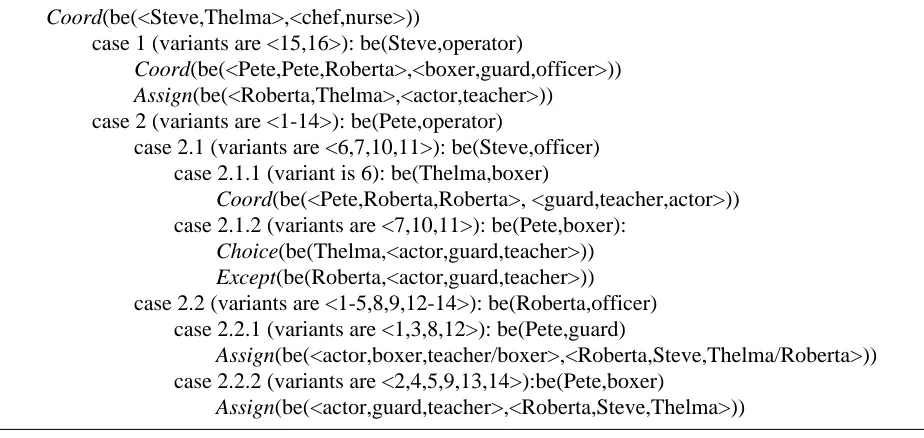
several variants concisely, coordination constructs must be built that convey all dependencies among these variants unambiguously. This means that a subset of the propositions must be condensed into one construct expressing disjunctions, with the remaining propositions being independent of the set of variants considered – otherwise, the set of variants is split and condensation attempts are made for each subset separately. In order to test whether this is possible, Choice constructs are built by condensing adjacent propositions that differ by their variant slot only. Three constellations are possible (examples appear under variant subsets in which the set of propositions is partitioned and marked as cases in Figure 4):• There are two Choice constructs, Choice(x, <a1,a2>,<i1,i2>) and Choice(y,<a2,a1>, <i1,i2>).
They are condensed into an Assign construct of the form Assign(<x,y>,<a1,a2>,<i1,i2>). In the
puzzle, this step applies to assigning 'Roberta' and 'Thelma' and 'actor' and 'teacher', variants 15 and 16 (case 1).
• There is one Choice construct, Choice(x,<An>,
<In>). If no further propositions are left, or
there are n Coord constructs Coord(y,ai,<Im>),
where Im is equal to In with ii missing, then
these Coord constructs are condensed into an
Except construct Except(y,<An>,<In>). In the
Coord(be(<Steve,Thelma>,<chef,nurse>))
case 1 (variants are <15,16>): be(Steve,operator)
Coord(be(<Pete,Pete,Roberta>,<boxer,guard,officer>)) Assign(be(<Roberta,Thelma>,<actor,teacher>))
case 2 (variants are <1-14>): be(Pete,operator)
case 2.1 (variants are <6,7,10,11>): be(Steve,officer) case 2.1.1 (variant is 6): be(Thelma,boxer)
Coord(be(<Pete,Roberta,Roberta>, <guard,teacher,actor>))
case 2.1.2 (variants are <7,10,11>): be(Pete,boxer):
Choice(be(Thelma,<actor,guard,teacher>)) Except(be(Roberta,<actor,guard,teacher>))
case 2.2 (variants are <1-5,8,9,12-14>): be(Roberta,officer) case 2.2.1 (variants are <1,3,8,12>): be(Pete,guard)
Assign(be(<actor,boxer,teacher/boxer>,<Roberta,Steve,Thelma/Roberta>))
case 2.2.2 (variants are <2,4,5,9,13,14>):be(Pete,boxer)
Assign(be(<actor,guard,teacher>,<Roberta,Steve,Thelma>))
Figure 4. Aggregation constructs for the puzzle (with variants slots omitted, corresponding to cases)
• There is no Choice construct. In this case, a specific set of Coord constructs must be pre-sent so that they can be condensed into an
Assign construct. This is an effective way to compose an Assign construct, whereas the one
in Figure 2 is more convenient for defining it. To start with, there must be exactly n! or n!-(n-1)! variants for some n, and exactly n indi-viduals in the slots varied (without the variant slot) in n2 or n2-1 Coord constructs. With
indexing over individuals, checking the conditions is cheap. Only in case of success, expensive conditions for building an Assign construct must be checked. For each i of n (or
n-1) Coord constructs Coord(x,ai,<Im>), the
sets of variants must be pairwise disjoint, which means that each x is assigned to exactly one individual in each variant. Similarly, in each i of the n (or n -1) Coord constructs
Coord(xi,a,<Im>), the sets of variants must be
pairwise disjoint, too, so that each xi is
assigned differently in each variant. If all this is fulfilled, an Assign construct comprising all these individuals is built. If the number of intermediate Coord constructs is n!-(n-1)! and not n!, the missing fact must be incorporated in the Assign construct as an exception. In the puzzle, such a constellation occurs twice. In
variants 1, 3, 8, and 12 (4 = 3!-2! variants), all combinations assigning 'Roberta', 'Steve', and 'Thelma' to 'actor', 'boxer', and 'teacher' occur, except that 'Thelma' is not assigned to 'boxer' (case 2.2.1). Similarly, variants 2, 4, 5, 9, 13, and 14 (6 = 3! variants) contain all combi-nations assigning 'Roberta', 'Steve', and 'Thel-ma' to 'actor', 'guard', and 'teacher' (case 2.2.2).
5.3 Splitting Sets of Variants
After Coord constructs that hold across all variants are extracted, splitting is done along a set of predi-cations that are two-slot distinct from one another and appear in each variant exactly once. Due to the ordering imposed, finding such a set can be done locally. If there is none, no splitting is attempted, since it might appear unmotivated and computati-onally expensive – each variant is then presented separately. In case of several candidates, the selec-tion is oriented on economy criteria, preferring smaller sets of facts, and fewer splits of facts aggregated over variants. Moreover, uneven distri-butions of variants are favored, since smaller parts are more likely to contain regular substructures.
Assign (general form) <MARK(POSITION)> <LIST(SLOT1)> "each" <P-CAT(CAT)> "one distinct" <N-CAT (CAT)> "out of the set of" <LIST(SLOT2)> [<EXCEPTION(TOP)>]
Assign (for list length 2) <COORD (TOP)> "or vice-versa"
Figure 5: Example TG/2 patterns, two variants of expressing Assign constructs
cases 1 and 2, 'operator' and 'officer' yield binary partitions, 'operator' causing a more uneven parti-tioning. Case 2 is split again, according to the assignment variants for 'officer'. Its first partition, case 2.1, needs to be split further. All candidate jobs except 'guard' yield binary splits, and 'boxer' is chosen because this requires only two aggregated facts to be split instead of three for 'actor' and 'teacher'. The other partition resulting after the second split, case 2.2, is split again, the only binary choice being the jobs taken by Pete.
5.4 Coordination with Two Distinct Slots
Within subsets of variants, it is attempted to compose facts that hold across all of these variants into larger structures, preferably Permut constructs or at least Coord constructs with two-slot distinct facts. Building P e r m u t constructs is done by composing Coord constructs that have identical lists <Ain> in position i, non-equal atomic values ajk
in position j (k indexing m Coord constructs), and identical atomic values in other positions, to yield
Permut(base(…,<Ain>,…,<Ajm>,…)). At most once,
one value ax from <Ain> may be missing yielding
Permut(base(…,<Ain[/ax]>,…,<Ajm[/ay]>, …)) for a
Coord construct with ay in position j. For the
remaining facts and one-slot distinct Coord con-structs, condensation into two-slot distinct Coord constructs is attempted. This is done similarly to the building of one-slot distinct Coord constructs, and lists are built in the positions of two slots with distinct values. If a one-slot distinct Coord con-struct is incorporated, the atomic value in the other slot is copied as many times as the list in the slot with distinct values has elements. Repetitions in one of the slots lead to mixed coordinations in the linguistic realization, where coordinated conjunc-tions are combined with predicate gapping. This advance over previous approaches is due to our staged coordination procedure. However, the
dis-advantage is the restriction to two-slot distinct coordinations (Shaw handles multiple distinctions).
5.5 Linguistic Realization
In order to express the aggregation constructs by natural language text, these specifications are pro-cessed by the linguistic realization component TG/2 (Busemann, 1996). TG/2 is a pragmatically motivated system that has been used for several kinds of applications, including multi-lingual re-ports of air pollution data (Busemann and Horacek, 1996). Its most unique feature is its capability to process specifications from several levels of lingu-istic elaboration, integrating canned text, template techniques and context-free grammars into a single formalism. This enables a user of TG/2 to express specifications only as detailed as needed to handle the distinctions required for the application at hand. This feature allows us to model linguistically com-plex coordination phenomena by defining simpli-fied grammar rules for schematic sentence patterns (unlike Shaw's repertoire of linguistic constructs).
The proper application of TG/2 is preceeded by a conversion procedure that reexpresses the position-based encodings in terms of predicate-argument structures. In addition, specifications with case splits are reorganized. Blocks with predi-cates of one category or propositions within cases that result from splitting are headed by an intro-ductory statement about their commonality, and markers expressing, for example, positions in enumerations, are added. Moreover, nested case structures are converted into lists where each case is labeled explicitly with its distinctive feature, except subcases of minimal size (one sentence).
Subsequently, TG/2 maps aggregation con-structs via rules onto sentence patterns, such as those listed in Figure 5. For the first variant of the
Assign construct, the pattern accesses substructures
Thelma is the chef and Steve the nurse. Then we have three cases to consider. Case 1: Steve is the operator.
Then Pete is the boxer and the guard, and Roberta the officer.
Moreover, Roberta is the actor and Thelma the teacher, or vice-versa. Case 2: Pete is the operator and Steve the officer.
One alternative here is that Thelma is the boxer.
Then Roberta is the teacher and the actor, and Peter the guard. The other alternative is that Pete is the boxer.
Then Thelma takes one of the positions teacher, guard, and actor, and Roberta the remaining positions. Case 3: Pete is the operator and Roberta the officer.
One alternative here is that Pete is the guard.
Then Roberta, Thelma, and Steve each take one distinct position out of the set teacher, actor, and boxer, but Roberta is not the boxer.
The other alternative is that Pete is the boxer.
Then Roberta, Thelma, and Steve each take one distinct position out of the set guard, teacher, and actor.
Figure 6: Natural language text for the puzzle
SLOT2), and the whole structure (TOP), and it has further references to rules for a discourse marker (MARK), lists (LIST), a function verb for the predicate (P-CAT), the associated noun (N-CAT), and an optional exception (EXCEPTION). The se-cond variant, which is treated as a Coord construct followed by a canned text portion, is only applic-able to lists of length 2 without an exception. There are two variants for expressing Except constructs, one using “remaining” when following a suitable
Choice construct (see Figure 6, Case 2, fourth
sentence). 'Mixed' coordinations may require local reordering, to group together sublists (see Figure 6, Case 1, first sentence). When applied to the subject, the predicate must be repeated when plural changes to singular or vice-versa.
6
Conclusion and Discussion
In this paper, we have developed extensions to existing aggregation techniques that address con-stellations with regularly occurring commonalities, as typically found in problem solutions produced by formal systems. We have defined novel con-structs that can express sets of propositions with highly regular variations on slot values concisely, including special forms of disjunctions. Moreover,
we have described a systematic process in which compositions of these constructs are built.
alternatives compactly. The major problem, how-ever, would be their effective integration into the overall generation process, since testing their applicability conditions might be expensive and not easy to manage.
Finally, we have limited the use of the new operators to simple cases, without interference with other constructs. For example, our procedures are set up in such a way that a Choice operator is built only if all its assignments are distinct from one another. However, there may be constellations where a distinction between alternatives is made elsewhere, and the use of a Choice operator would still be possible and effective, as in “Thelma takes one of the positions teacher, guard, and actor, and Roberta is the teacher or the actor if Thelma is the guard”. This constellation comprises four alter-natives, with Thelma being the guard in two of them. Despite the extra condition involved, we believe that the aggregated form above conveys the underlying situation in a more natural and better understandable way than a mere enumeration.
In the future, we intend to investigate practical demands for extended uses of the new operators. Moreover, we will examine the adequacy of the pattern-based approach for expressing these oper-ators in lexical terms by considering non-European languages, such as Arabic. Finally, we extend the use of these operators to formulas (Horacek, 2002).
References
Busemann, S. 1996. Best-First Generation. In Proc. of the 8th International Workshop on Natural
Langu-age Generation,pp.101-110,Hearstmonceaux, UK.
Busemann, S. and Horacek, H. 1998. A Flexible Shallow Approach to Text Geneartion. In Proc. of the 9th International Workshop on Natural Langu-age Generation, pp. 238-247, Niagara-on-the-Lake, Canada.
Dalianis, H. 1999. Aggregation in Natural Language Generation. Computational Intelligence 15(4).
Dalianis, H.; and Hovy, E. 1996. Aggregation in Natural Language Generation. In G. Adorni, M. Zock (eds.), Trends in Natural Language Gener-ation – An Artificial Intelligence Perspective, pp.
88-105, Springer.
Horacek, H. 1992. An Integrated View of Text Planning. In R. Dale, E. Hovy, D. Rösner, O. Stock (eds.), Aspects of Automated Natural Language Generation, pp. 29-44, Springer.
Horacek, H. 2002. Presenting Sets of Problem Solutions Concisely. Submitted.
Horacek, H.; and Konrad, K. 1999. Presenting Herbrand Models with Linguistically Motivated Techniques. In Proc. of CIMCA-99, Vienna, Austria.
Konrad, K.; and Wolfram, D. 1999. System Descrip-tion: Kimba, A Model Generator for Many-Valued First-Order Logics. In Proc. of the 16th Internati-onal Conference on Automated Deduction (CADE-16), pp. 282-286 Trento, Italy.
Mann, B.; and Moore, J. 1980. Computer as Author – Results and Prospects. Research Report ISI/ RR-79-82, University of Southern California, Information Sciences Institute, Marina del Rey.
Mann, B.; and Moore, J. 1981. Computer Generation of Multiparagraph English Text. American Journal of Computational Linguistics 8(2), pp. 17-29.
Reape, M.; and Mellish, C. 1999. What is Aggregation Anyhow? In Proc. of 7th European Workshop on Natural Language Generation, pp. 20-29, Toulouse, France.
Robin, J. 1995. Revision-Based Generation of Natural Language Summaries Providing Historical Back-ground. PhD thesis, Columbia University.
Scott, D.; and de Souza C. 1990. Getting the Message Across in RST-Based Text Generation. In R. Dale, C. Mellish, M. Zock (eds.), Current Research in Natural Language Generation, pp. 47-73, Academic Press, New York.
Shaw, J. 1998a. Segregatory Coordination and Ellipsis in Text Generation. In Proc. of the 36th Association for Computational Linguistics and the 17th Interna-tional Conference on ComputaInterna-tional Linguistics, pp. 1220-1226, Montreal, Canada.