Corpus-trained text generation for summarization
Min-Yen Kan and Kathleen R. McKeown
Department of Computer Science Columbia University New York, NY 10027, USA
fmin,[email protected]
Abstract
We explore how machine learning can be employed to learn rulesets for the tradi-tional modules of content planning and surface realization. Our approach takes advantage of semantically annotated cor-pora to induce preferences for content planning and constraints on realizations of these plans. We applied this methodology to an annotated corpus of indicative sum-maries to derive constraint rules that can assist in generating summaries for new, unseen material.
1 Introduction
Traditional natural language generation (NLG) ap-proaches rely heavily on human experts to code dis-course, semantic, and lexical resources. These re-sources are used by systems to determine the dis-course and sentential structure of the text, and its word choice. This process can be very time con-suming, involving experts that examine target docu-ments and distill proper discourse plans and lexicons that can produce the desired text.
In this paper, we investigate a novel approach which automatically acquires such knowledge using an annotated training corpus. Our method constructs summarization system components by first learning high-level content planning patterns and then learn-ing low-level constraints on how to realize these content plans in natural language. By applying this approach to a training corpus consisting of docu-ments belonging to the same domain and genre, the system can generate a model for production of
sim-ilar texts. We show how this framework can be ap-plied to automatic text summarization by using a corpus of annotated bibliography entries as the train-ing corpus to produce a model of indicative sum-maries (Cremmins, 1982). These entries discuss dif-ferent books but express the same reoccurring types of information using different surface forms.
While the corpus from which plans and realiza-tion patterns are acquired is restricted to input doc-uments of the same genre that exhibit structural reg-ularity, the learned plans can be applied to other do-mains and genres. In this paper, we draw on input from the genre of annotated bibliography entries, but will apply the learned plans to generate summaries of web-available consumer health texts.
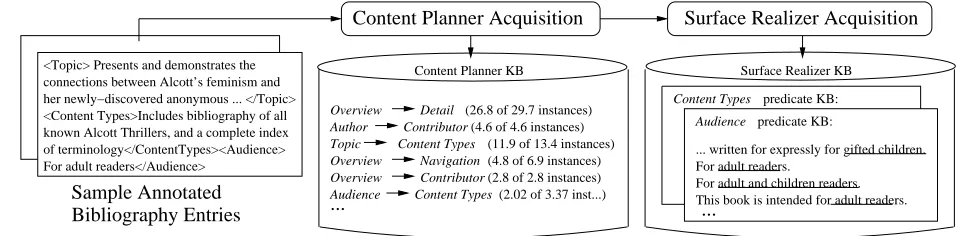
A content plan consists of predicates specifying what kind of information should occur in what order in a generated summary. Each predicate will ulti-mately be realized by one of the lexicalized phrases that are associated with it. The research we present focuses on learning rules that can predict the order of predicates in a text and acquiring the lexicalized phrases associated with each predicate, and is illus-trated in Figure 1.
The acquisition of the content planning ruleset works by finding occurrence patterns of predicates in manually annotated training corpora. This mod-ule determines what predicates are required or op-tional in the plan, and uncovers ordering constraints between them. Our approach in acquiring content planning rules differs from related work in its inte-gration of contextual constraints.
as predicate realizations and uncovers constraints governing their usage. These patterns distinguish between constituents that determine the semantics of a predicate (which we call a predicate’s attributes) as well as other associated text constituents that are used to convey the information (e.g., surrounding common phrases) in different surface forms.
In this paper, we first describe the role of indica-tive summaries and show how their generation can be viewed as an instance of our task. We then ex-plain how our two acquisition algorithms function, drawing examples from indicative summary genera-tion. We examine the acquisition process for content planning first, and partial surface realization second. We show how these learned constraints can be ap-plied to generate new summaries in the conclusion.
2 Application to summarization
Automatic Text Summarization (ATS) is the process of using a computerized algorithm to condense doc-uments into a shorter form (for a current overview, see (Mani and Maybury, 1999)). A particular type of document summary that is the focus of our studies is the indicative summary, a type of summary that hints at a document’s content and does not substitute for the full text. Card catalog entries from a library cata-log and annotated bibliography entries are examples of this type, and typically summarize a book in the span of a few sentences. Such texts fall within a single genre and thus fulfill our input prerequisite. We have applied our corpus-trained technique to a corpus of annotated bibliography entries and learned what kinds of content (i.e., predicates) are included and their ordering (the content planning module), as well as learned how these predicates are expressed (the partial surface realization module).
In a generation phase not detailed here, these trained modules will produce multidocument sum-maries for sets of consumer health texts that vary greatly in discourse structure, length, topic and wording (Kan et al., 2001b). The learned plans are used to determine how to present these indicative differences using text generation, in contrast to other systems that use sentence extraction. Unlike other generation systems that generate text from seman-tic input, our summarization system uses the plans to select content from full text and to generate
vari-ability in syntax and phrasing by choosing wordings from variants of full phrases.
To investigate the viability of producing indica-tive summaries using this approach, we collected a corpus consisting of 2000 bibliography entries that have been collected from various websites over var-ious domains of knowledge. We processed the cor-pus with Collins’ lexical dependency based parser (Collins, 1996), and also added word stem informa-tion using the Porter algorithm.
3 Semantic annotation of summary corpora
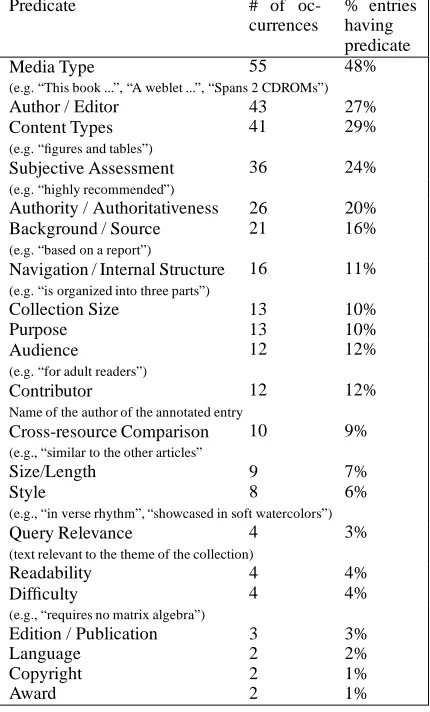
Automatic semantic tagging of the corpus allows us to infer what predicates are typically included in in-dicative summaries. In our corpus of 2000 sum-maries, we annotated a random 5% (= 100) of the entries. We used the decision tree learner, rip-per (Cohen, 1995), to induce a decision tree that was used to automatically label a new corpus with predicates, and used 5-fold cross validation to ensure results were stable. We expanded on our previous in-dicative summary tagset from (Kan et al., 2001a) to a total of 24 predicates, detailed in Tables 1 and 2.
Sample Annotated Bibliography Entries
<Topic> Presents and demonstrates the connections between Alcott’s feminism and her newly−discovered anonymous ... </Topic> <Content Types>Includes bibliography of all known Alcott Thrillers, and a complete index of terminology</ContentTypes><Audience> For adult readers</Audience>
Content Planner Acquisition Surface Realizer Acquisition
Content Planner KB Surface Realizer KB
Topic Content Types (11.9 of 13.4 instances)
Overview
Author Contributor
Detail (26.8 of 29.7 instances)
Overview Overview
Navigation
Contributor (2.8 of 2.8 instances)
(4.6 of 4.6 instances)
(4.8 of 6.9 instances)
Audience Content Types
... (2.02 of 3.37 inst...) ...
For adult readers.
For adult and children readers.
... written for expressly for gifted children.
Audience
This book is intended for adult readers.
Content Types predicate KB: predicate KB:
Figure 1: The content plan is a collection of probabilistic ordering constraints, while the surface realizer consists of attribute values (underlined), and associated text that convey the predicate’s semantics.
Predicate # of
occur-rences
% entries hav-ing predicate
Detail 139 47%
Quotations, extracted sentences, parts of a chronology, conclu-sions
Overview 72 64%
(Generalized description of the entire resource, “This book is about Louisa Alcott’s life.”)
Topic 34 28%
(High-level list of topics, e.g., “Topics include symptoms, treat-ment ...”)
Table 1: Distribution of content-based topicality predicates in the 100-entry annotated corpus.
Further analysis reveals that certain predicates are recovered more often than others. For example, top-icality predicates occur with less regularity and dis-play more variability in their expression and thus are more difficult to recover. Tags that occur sel-domly are also not recovered by the current set of features because of data sparseness. We feel that an expansion of the fully annotated corpus or addi-tional annotation with respect to these more sparse tags would improve performance here.
4 Learning for the content planner
The semantically annotated corpus is the basis for learning the rule base for content planning. These rules determine what the text and discourse structure should look like, both in terms of a) content (“what to say”) and b) its ordering (“where to say it”). We examine each of these two tasks in turn.
Content determination. Documents in our
in-dicative summary corpus discuss different books and thus have different predicate attribute values. In addition, some predicates are present in some
sum-maries and not in others (e.g., author or editor). Ta-bles 1 and 2 list the predicates and their frequency in the training corpus. The presence of the predi-cate may also be dependent on its value (e.g., Edi-tion only occurs after the first ediEdi-tion).
Content ordering. The presence or absence of
particular predicates depends greatly on the pres-ence or abspres-ence of its peers. Thus it is important to encode content structuring information, represented as local preferences rather than predefined schemas. Duboue and McKeown (2001) detail an approach for this problem which we initially tried that uses techniques from computational biology, but which is best suited for summaries with multiple instances of the same predicate. Instead, we calculated bigram statistics on pairs of adjacent predicates, recording which occurred before another. These statistics are used to find an ordering of the predicates that max-imizes agreement with training observations. This approach was also utilized in work done on premod-ifier ordering (Shaw and Hatzivassiloglou, 1999), in which pairs of premodifiers were observed and used to find ordering constraints. The technique is also referred to as Majority Ordering in (Barzilay et al., 2001), in which bigram orderings were elicited from human subjects.
(BackgroundjLanguage)Overview Topic Size Media Types Authority
Collection Size(ComparisonjDetailjContent TypesjNavigationj
Query Relevance)Subjective Difficulty Author Purpose Style(Publisherj
AwardjReadabilityjAudiencejContributorjCopyright)
Figure 2: Highest agreement full orderings of the predicates using harmonic penalties. Predicates are swappable where “j” occurs.
expand-Predicate # of oc-currences
% entries having predicate
Media Type 55 48%
(e.g. “This book ...”, “A weblet ...”, “Spans 2 CDROMs”)
Author / Editor 43 27%
Content Types 41 29%
(e.g. “figures and tables”)
Subjective Assessment 36 24%
(e.g. “highly recommended”)
Authority / Authoritativeness 26 20%
Background / Source 21 16%
(e.g. “based on a report”)
Navigation / Internal Structure 16 11%
(e.g. “is organized into three parts”)
Collection Size 13 10%
Purpose 13 10%
Audience 12 12%
(e.g. “for adult readers”)
Contributor 12 12%
Name of the author of the annotated entry
Cross-resource Comparison 10 9%
(e.g., “similar to the other articles”
Size/Length 9 7%
Style 8 6%
(e.g., “in verse rhythm”, “showcased in soft watercolors”)
Query Relevance 4 3%
(text relevant to the theme of the collection)
Readability 4 4%
Difficulty 4 4%
(e.g., “requires no matrix algebra”)
Edition / Publication 3 3%
Language 2 2%
Copyright 2 1%
Award 2 1%
Table 2: Distribution of metadata and document-derivable predicates in the 100-entry corpus.
ing the statistic to account for longer distance co-occurences. Our statistic better models the fading strength of context farther from the decision point by utilizing information provided in all previousn predicates. We constructed two backoff schemes: one based on the harmonic series, the other based on the quadratic. In both, a precedence relationship of distance one (e.g. adjacent) is given a full strength score, but a distancen relationship is given
1 n
unit score in the harmonic and 1
2
n in the quadratic. Each particular pair of different predicates acculmulate these weights as instances are found in the training corpus, and a randomized hill-climbing algorithm is used to find a maximally compliant ordering.
We use both the content determination and con-tent ordering algorithms to generate a new summary discourse plan. To do this, we examine which
pred-Accuracy Feature Type
majority + lexical + parse node + contextual
baseline &positional &genericity
24 predicates 0% 9% 66% 67%
24 + “none” 99.47% 99.51% 99.82% 99.83%
Table 3: Summary semantic annotation accuracy, using 5-fold C.V. Features are cumulative l to r.
icates are found in the library cataloguing database. We use the content determination probabilities to pickmnumber of predicates to be realized, wherem is the user-defined desired summary length. A ran-domized algorithm selects n predicates from both topicality (multiple selection allowed) and metadata (selectable once only) catagories, biased for the per-centages shown in Tables 1 and 2. The predicates are ordered using either the harmonic or quadratic penalized version of the algorithm and result in a discourse plan for the summary.
5 Learning for partial surface realization
While content planning concerns itself with the pres-ence or abspres-ence of predicates and their ordering, the task of surface realization is to convey the predi-cates as natural language. In traditional NLG, sur-face realization is often broken down into three sep-arate tasks: (1) sentence planning, which takes in-dividual messages or propositions and assigns them to specific sentences and determines the sentences’ basic syntactic structure; (2) lexical choice, which determines the words used, and (3) syntactic realiza-tion, which uses a grammar to produce the sentence. We are concerned with tasks 1 and 2. While there has been work concentrating on inducing syntactic generators (Langkilde, 2000; Bangalore and Ram-bow, 2000; Ratnaparkhi, 2000; Varges and Mellish, 2001), for specific domains and general language, there has been less work on other generation com-ponents (Oh and Rudnicky, 2000).
Audi-ence). We focus on these metadata predicates, as they comprise a large portion (57%) of the entries.
In our framework, a predicate has two compo-nents (also shown in right hand side of Figure 1): the attribute value itself (“adult readers”) and the associated text that is used to cast this information in the semantic role dictated by the predicate (“This book is meant for<attribute value>” for the
Audi-ence predicate)1. In a stemmed dependency frame-work, the attribute value is the child and the associ-ated text the head of a dependency relationship (e.g., stemmed: “this book be mean for”head
! “adult reader”child). In this framework, surface realization begins with the process of choosing the most appro-priate associated text among alternatives found in the training text, given input attribute values. The associated text and attributes are then realized as sentences, phrases or words, which are combined to form a new text by a sentence planner.
The first task is to differentiate attribute val-ues from the associated text in the training corpus. Our starting point is the collection of sentences or phrases in the annotated corpus that are instances of the same predicate (e.g., a collection of Audi-ence sentAudi-ences). Our analysis of these texts indi-cates that attribute values are highly flexible in lo-cation within the texts and in grammatical struc-ture. In order to encode this flexibility, we capital-ize on the stemmed, lexical dependency framework used in parsing the entries. The framework conflates phrases such as “index included”, “includes an in-dex” and “inclusion of indices” (found in instances of the Content Types predicate) together into a single stemmed lexical dependency pair of “include”head
!“index”
child. For each collection of predicate in-stances, our strategy first identifies highly frequent (threshold = ¯x+2
x) stemmed lexical dependency pairs. Frequent child lexical items in the depen-dency pair are potential attribute values in the sen-tence (“index”child as an attribute value for Content
Types, as seen in Figure 3, #3). From this set, we remove frequent dependency pairs that occur with other predicates; this prevents frequent, corpus-wide dependencies such as “book”head
!“this”
childfrom appearing as potential attribute values, as they are
1
Our notion of “predicate” is identical to (Varges and Mel-lish, 2001) notion of “slots” or “tags”; similarly, our “attribute values” are equivalent to their term “fillers”.
not exclusively frequent within a single predicate (so #1 and #2 are not attribute values for any of the 24 semantic predicates).
#1, Topicality, bookhead!thischild:
(e.g., “This book discusses Alcott’s works ...”, “this book covers the theories”)
#2, Content Types, bookhead!thischild:
(e.g., “This book also comes with a biography”, “is discussed in this book”)
#3, Content Types, includehead !index
child:
(e.g.,“Indices are included”, “includes an index”, “The book includes an index”)
...
[below threshold]
#30, Content Types, includehead
!figure child:
(e.g., “Includes figures”, “figures and tables are included”)
...
Figure 3: A portion of the list of stemmed lexical dependencies for various predicates, sorted by fre-quency. Source snippets are given after the depen-dency pair.
This method gave good (94.8%) precision, but poor recall, due to the high threshold. To increase recall, we noted that heads of these frequent de-pendency pairs also served as heads in dependen-cies with other less frequent child words (depen-dency head “include” supports the frequent attribute value “index” in #3, but also less frequent one such as “figure” in #30). Including such pairs recovered these less frequent attribute values (95% additional attributes were recovered) with a minimal increase in error (92.2% precision). Thus, in the simplified example in Figure 3, “index” and “figure” are at-tribute values for the Content Types predicate.
Text not identified as attribute values are labeled associated text. From our perspective, these lexical dependencies embody lexical choice and resulting syntactic choices internal to the predicate: the alter-native forms of the associated texts help to convey the same semantic information (the attribute value) but with different words and syntactic structures. Which alternative is selected is subject to a number of parameters, including stylistic ones. For the sur-face realizer to make these decisions thus requires that we learn stylistic constraints and apply them in the generation process. We break this process down into three subtasks:
work on descriptive appositive language reuse (Radev, 1998), and genre identification (Biber, 1989; Karlgren and Cutting, 1994; Kessler et al., 1997) defines a large set of basic features to use such as character and word-level features, and positional and contextual features. We im-plemented a total of 27 of these features in our work to test their efficacy in identifying appro-priate constraints.
Our problem is related to these previous stud-ies, but differs in some key respects. Choosing descriptions often involves choosing between descriptions that convey different semantic in-formation (“Clinton” as “senator” versus “pres-ident”), whereas our associated texts generally convey the same information but realize it dif-ferently, similar to paraphrasing (Barzilay and McKeown, 2001). Genre identification differs from our problem mostly in scale; whereas whole texts are input to the genre categoriza-tion process, in our problem we have access mostly to single sentences or clauses.
Genre identification work primarily focuses on surface level features rather than assuming a full parse of the text. Since we have access to a full parse, we also model features that we believe have a stylistic impact. We introduce an additional 8 features that look for different types of adjunct constructions, relative clause construction, and passive constructions.
Use machine learning to predict linguistic
features for the target predicate. We em-ployed the decision tree learner, ripper, to determine which features play a role in pre-dicting the characteristics of the target associ-ated text. We compute values of all 35 (27 + 8 new) features for four different contexts sur-rounding the target predicate: the (1) previous and (2) next predicates, as well as (3) global and (4) composite features that combine other basic features (e.g., difference between previ-ous and next sentence length). This total of 4 x 35 = 140 features, are used to predict the val-ues of the same features in the target predicate. Since there are a total of 35 features, this results in 35 different machine learners that separately
predict one of the 35 features of the target pred-icate, shown graphically in Figure 4.
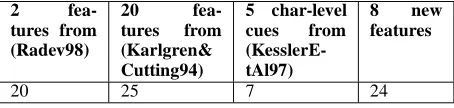
Table 4 counts the occurrences of these 35 fea-tures in the induced ripper ruleset that is used to structure the target predicate. This mea-sure can be used to assess their relative impor-tance. These results show that our additional features are useful in modeling stylistics but that the literature contributes significant fea-tures as well.
2 fea-tures from (Radev98)
20 fea-tures from (Karlgren& Cutting94)
5 char-level cues from (KesslerE-tAl97)
8 new features
20 25 7 24
Table 4: The number of features used byripper
to determine the output feature of target predicates.
Find best possible match between predicted
features and candidate predicate. The final
step is to use the predicted features of the predi-cate to match a most appropriate associated text to convey the predicate.
If the predicted features exactly match a train-ing example’s associated text then the selec-tion is trivial. However in practice this rarely occurs and we must select from the avail-able associated texts. As the choice is limited to whole associated texts and not constituents as in other stochastic approaches (Langkilde, 2000; Varges and Mellish, 2001), this search process is constrained and does not present an efficiency problem. For numerical features (e.g., number of words), we use a normalized difference between the desired value and avail-able values from the training associated text to calculate its goodness of fit. For set valued fea-tures (e.g. parse node type: NP versus PP), the feature either matches or does not (1 or 0).
. . .
prevSentLen, prevMaxDpth, prevNumWds, ... metaDiffNumAdvs, prevSentLen, prevMaxDpth, prevNumWds, ... metaDiffNumAdvs, SentLen.
NumAdvs.
35 machine learners 140 input features: 35 from each of four contexts
Summary
Machine Learning Vectors
classes: a feature of the target semantic slot
Figure 4: Machine learning architecture for the features of the target predicate, with sample tuples shown.
Sentence Extractor
Lexical Dependency Surface KB Acquirer
Topicality
predicates
Generic predicates
Topics : Ch. 1 − Introduction, 2
: Dr. Lowenstein : 3
Author Edition
Dr. Lowenstein discusses the symptoms and treatment of leukemia in this popular third edition of the The Leukemia Handbook... Surface
Realizer KB
Sentence Planner Extracted topical sentences
: discusses the symptoms and treatm ...
Author
Edition : third edition
: Dr. Lowenstein
Topics
Audience : for adult readers
Target Generated Summary Realized Predicates
Cataloguing DB
Content Plan
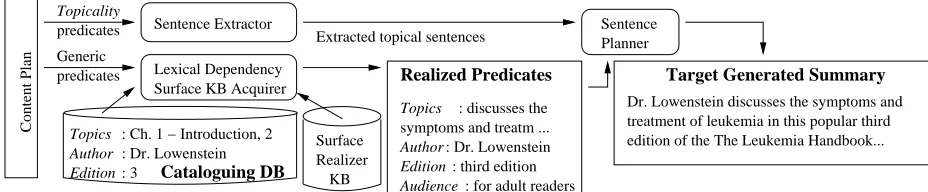
Figure 5: Post content planner architecture with summary
6 Using the rulesets for generation
This approach in this paper constructs rulesets that capture patterns at both the content planning and sur-face realization levels. While the work here does not constitute an end-to-end generation system, the al-gorithms for learning these knowledge bases are im-plemented, and can be applied along with a source of predicate attributes to generate new texts. In our application of indicative summarization genera-tion, cataloging records (such as the U.S. Machine Readable Cataloging (MARC) guidelines (Library of Congress, 2000)) can provide these predicate at-tributes. Attribute values from the resource’s cata-loguing record would interact with the surface real-ization constraints to produce a set of sentences or phrases that correspond to each predicate. A sen-tence planning module could take the realized frag-ments and organize them into sentences (accord-ing to the content plan) to form a final generated text. Figure 5 shows how this portion of the process would work in conjunction with sentence extraction to find sentences for any topicality predicates.
7 Conclusion
In previous work, we performed a task-based eval-uation of a rule-based indicative summary genera-tion system. The study suggested that users were
more satisfied with this approach to presenting in-formation retrieval results over other visualization approaches (Kan and Klavans, 2002). The current system described in this paper improves the system with additional flexibility and variability in genera-tion that is a key characteristic of human-produced natural language. Task-based evaluation of this cur-rent generation system is curcur-rently being done to as-sess its effectiveness.
In this paper, we have described a new architec-ture for NLG that takes advantage of annotated cor-pora. Our method takes a new approach to NLG by using machine learning to capture semantic and stylistic constraints that are traditionally hand coded by human experts. The induced constraints can be used by traditional content planning and surface re-alization in making their decisions.
gen-erate new summaries of unseen material.
We feel that this approach can be used to generate texts in other domains where the target texts exhibit strong regularity in content and its ordering, and that this approach can be paired with other techniques (such as heuristic-based sentence extraction) to ap-ply to a wide range of texts.
References
Srinivas Bangalore and Owen Rambow. 2000. Exploit-ing a probabilistic hierarchical model for generation. In Proc. of the 18th Intl. Conf. on Computational
Lin-guistics (COLING 2000), Saarbrucken, Germany.
Regina Barzilay and Kathleen R. McKeown. 2001. Ex-tracting paraphrases from a parallel corpus. In Proc.
of ACL/EACL 01.
Regina Barzilay, Noemie Elhadad, and Kathleen McKe-own. 2001. Sentence ordering in multidocument sum-marization. In Proc. of Human Language Technology
’01, San Diego, CA, USA.
Douglas Biber. 1989. A typology of English texts.
Lin-guistics, 27:3–43.
William W. Cohen. 1995. Fast effective rule induction. In Proc. 12th Intl. Conf. on Machine Learning, pages 115–123. Morgan Kaufmann.
Michael John Collins. 1996. A new statistical parser based on bigram lexical dependencies. In Proc. of the
34th ACL, Santa Cruz.
Edward T. Cremmins. 1982. Art of Abstracting. ISI Press.
Pablo A. Duboue and Kathleen R. McKeown. 2001. Em-pirically estimating order constraints for content plan-ning in generation. In Proc. of the ACL-EACL 2001, Toulouse, France.
Min-Yen Kan and Judith L. Klavans. 2002. Using librar-ian techniques in automatic text summarization for in-formation retrieval. In Proc. of Joint Conf. on Digital
Libraries, Portland, Oregon, USA, July.
Min-Yen Kan, Kathleen R. McKeown, and Judith L. Klavans. 2001a. Applying natural language genera-tion to indicative summarizagenera-tion. In Proc. of 8th
Eu-ropean Workshop on Natural Language Generation,
Toulouse, France.
Min-Yen Kan, Kathy McKeown, and Judith Klavans. 2001b. Domain-specific informative and indicative summarization for information retrieval. In Proc.
of the Document Understanding Conference (DUC),
pages 19–26, New Orleans, USA.
Jussi Karlgren and Douglass Cutting. 1994. Recogniz-ing text genres with simple metrics usRecogniz-ing discriminant analysis. In Proc. of COLING ’94, Kyoto, Japan.
Brett Kessler, Geoffrey Nunberg, and Hinrich Sch¨utze. 1997. Automatic detection of text genre. In
Proceed-ings of the 35th Association of Computational Linguis-tics (ACL ’97), pages 32–38, Madrid, Spain.
Irene Langkilde. 2000. Forest-based statistical sentence generation. In 6th Applied Natural Language
Pro-cessing Conf. (ANLP’2000), pages 170–177, Seattle,
Washington, USA.
Library of Congress. 2000. Marc 21 format for classifi-cation data : including guidelines for content designa-tion. Washington, D.C., USA. ISN 0660179903.
Elizabeth Liddy. 1991. The discourse-level structure of empirical abstracts: An exploratory study.
Informa-tion Processing and Management, 27(1):55–81.
Inderjeet Mani and Mark Maybury, editors. 1999.
Ad-vances in Automatic Text Summarization. MIT Press.
Alice Oh and A Rudnicky. 2000. Stochastic lan-guage generation for spoken dialogue systems. In
Proc. of the ANLP/NAACL 2000 Wrkshp. on Conver-sational Systems, pages 27–32, Seattle, Washington,
USA, May.
Dragomir R. Radev. 1998. Learning correlations be-tween linguistic indicators and semantic constraints: Reuse of context-dependent descriptions of entities. In
Proc. of COLING/ACL 98, Montreal, Canada.
D. V. Rama and Padmini Srinivasan. 1993. An investi-gaton of content representation using text grammars.
ACM Transactions on Information Systems, 11(1):51–
75, January.
Adwait Ratnaparkhi. 2000. Trainable methods for sur-face natural language generation. In Proc. of the 6th
Applied Natural Language Processing Conf. (ANLP-NAACL 2000), pages 194–201, Seattle, Washington,
USA.
James Shaw and Vasileios Hatzivassiloglou. 1999. Or-dering among premodifiers. In Proc. of the 37th
Asso-ciation for Computational Linguistics, pages 135–143,
College Park, Maryland, USA, June.
Sebastian Varges and Chris Mellish. 2001. Instance-based natural language generation. In Proc. of NAACL