Using Co-Composition for Acquiring Syntactic and Semantic
Subcategorisation
Pablo Gamallo Alexandre Agustini
Department of Computer Science New University of Lisbon, Portugal
gamallo,aagustini,gpl @di.fct.unl.pt
Gabriel P. Lopes
Abstract
Natural language parsing requires ex-tensive lexicons containing subcategori-sation information for specific sublan-guages. This paper describes an unsuper-vised method for acquiring both syntac-tic and semansyntac-tic subcategorisation restric-tions from corpora. Special attention will be paid to the role of co-composition in the acquisition strategy. The acquired in-formation is used for lexicon tuning and parsing improvement.
1 Introduction
Recent lexicalist Grammars project the subcat-egorisation information encoding in the lexicon onto syntactic structures. These grammars use accurate subcategorised lexicons to restrict potential syntactic structures. In terms of parsing devel-opment, it is broadly assumed that parsers need such information in order to reduce the number of possible analyses and, therefore, solve syntactic ambiguity. Over the last years various methods for acquiring subcategorisation information from corpora has been proposed. Some of them induce syntactic subcategorisation from tagged texts (Brent, 1993; Briscoe and Carrol, 1997; Marques, 2000). Unfortunately, syntactic information is not enough to solve structural ambiguity. Consider the following verbal phrases:
(1) [peel [ the potato] [ with a knife]]
(2) [peel [ [ the potato] [ with a rough stain]]]
The attachment of “with PP” to both the verb “peel” in phrase (1) and to the NP “the potato” in (2) does not depend only on syntactic requirements. Indeed, it is not possible to attach the PP “with a knife” to the verb “peel” by asserting that this verb subcategorises a “with PP’. Such a subcate-gorisation information cannot be used to explain the analysis of phrase (2), where it is the NP “the potato” that is attached to the “with PP”. In order to decide the correct analysis in both phrases, we are helped by our world knowledge about the action of peeling, the use of knifes, and the attributes of potatoes. In general, we know that knifes are used for peeling, and potatoes can have different kinds of stains. So, the parser is able to propose a correct analysis only if the lexicon is provided with, not only syntactic subcategorisation information, but also with information on semantic-pragmatic requirements (i.e., with selection restrictions).
Other works attempt to acquire selection restric-tions requiring pre-existing lexical ressources. The learning algorithm requires sample corpora to be constituted by verb-noun, noun-verb, or verb-prep-noun dependencies, where the verb-prep-nouns are semanti-cally tagged by using lexical hierarchies such as WordNet (Resnik, 1997; Framis, 1995). Selection restrictions are induced by considering those depen-dencies associated with the same semantic tags. For instance, if verb ratify frequently appears with nouns semantically tagged as “legal documents” in the di-rect object position (e.g., article, law, precept, . . . ), then it follows that it must select for nouns denot-ing legal documents. Unfortunately, if a pre-defined
set of semantic tags is used to annotate the training corpus, it is not obvious that the tags available are the more appropriate for extracting domain-specific semantic restrictions. If the tags were created specif-ically to capture corpus dependent restrictions, there could be serious problems concerning portability to a new specific domain.
By contrast, unsupervised strategies to acquire selection restrictions do not require a training cor-pus to be semantically annotated using pre-existing lexical hierarchies (Sekine et al., 1992; Dagan et al., 1998; Grishman and Sterling, 1994). They re-quire only a minimum of linguistic knowledge in or-der to identify “meaningful” syntactic dependencies. According to the Grefenstette’s terminology, they can be classified as “knowledge-poor approaches” (Grefenstette, 1994). Semantic preferences are in-duced by merely using co-occurrence data, i.e., by using a similarity measure to identify words which occur in the same dependencies. It is assumed that two words are semantically similar if they appear in the same contexts and syntactic dependencies. Con-sider for instance that the verb ratify frequently ap-pear with the noun organisation in the subject po-sition. Moreover, suppose that this noun turns to be similar in a particular corpus to other nouns: e.g., secretary and council. It follows that ratify not only selects for organisation, but also for its simi-lar words. This seems to be right. However, suppose that organisation also appears in expressions like the organisation of society began to be disturbed in the last decade, or they are involved in the actual organ-isation of things, with a significant different word meaning. In this case, the noun means a particu-lar kind of process. It seems obvious that its sim-ilar words, secretary and council, cannot appear in such subcategorisation contexts, since they are re-lated to the other sense of the word. Soft clusters, in which words can be members of different clusters to different degrees, might solve this problem to a certain extent (Pereira et al., 1993). We claim, how-ever, that class membership should be modeled by boolean decisions. Since subcategorisation contexts require words in boolean terms (i.e., words are either required or not required), words are either members or not members of specific subcagorisation classes. Hence, we propose a clustering method in which a word may be gathered into different boolean
clus-ters, each cluster representing the semantic restric-tions imposed by a class of subcategorisation con-texts.
This paper describes an unsupervised method for acquiring information on syntactic and semantic subcategorisation from partially parsed text corpora. The main assumptions underlying our proposal will be introduced in the following section. Then, sec-tion 3 will present the different steps -extracsec-tion of candidate subcategorisation restrictions and concep-tual clustering- of our learning method. In section 4, we will show how the dictionary entries are pro-vided with the learned information. The accuracy and coverage of this information will be measured in a particular application: attachment resolution.
The experiments presented in this paper were per-formed on 1,5 million of words belonging to the P.G.R. (Portuguese General Attorney Opinions) cor-pus, which is a domain-specific Portuguese corpus containing case-law documents.
2 Underlying Assumptions
Our acquisition method is based on two theoretical assumptions. First, we assume a very general no-tion of linguistic subcategorisano-tion. More precisely, we consider that in a “head-complement” depen-dency, not only the head imposes constraints on the complement, but also the complement imposes lin-guistic requirements on the head. Following Puste-jovsky’s terminology, we call this phenomenon “co-composition” (Pustejovsky, 1995). So, for a particu-lar word, we attempt to learn both what kind of com-plements and what kind of heads it subcategorises. For instance, consider the compositional behavior of the noun republic in a domain-specific corpus. On the one hand, this word appears in the head position within dependencies such as republic of Ireland, re-public of Portugal, and so on. On the other hand, it appears in the complement position in dependencies like president of the republic, government of the re-public, etc. Given that there are interesting semantic regularities among the words cooccurring with re-public in such linguistic contexts, we attempt to im-plement an algorithm letting us learn two different subcategorisation contexts:
"!$#&%'(*)$+
where preposition
,
republic in the role of “head” (role noted by ar-row “%
”), and those words that can be their “com-plements” (the role complement is noted by arrow “
”). This subcategorisation context semantically requires the complements referring to particular na-tions or states (indeed, only nana-tions or states can be republics).
% % '-.&"!$# )$+
this represents a subcategorisation context that must be filled by those heads denoting specific parts of the republic: e.g., institutions, organisations, functions, and so on. Note that the notion of subcategorisation restric-tion we use in this paper embraces both syntactic and semantic preferences.
The second assumption concerns the procedure for building classes of similar subcategorisation con-texts. We assume, in particular, that different sub-categorisation contexts are considered to be seman-tically similar if they have the same word distribu-tion. Let’s take, for instance, the following contexts:
/02143 5768*9143;:<=">2?A@CBEDGF$HJIGKL/0214325768*9143;:M$NPOJNP=QHRIGK
/021 H 5TSUM968482DGF$= 3 :1 H IUKL/021 H 57DU6Q@PV 6QW9@C=JX(DGWFC?4YZ@C=$W*N3 :1 H IGK
All of them seem to share the same semantic pref-erences. As these contexts require words denot-ing the same semantic class, they tend to possess the same word distribution. Moreover, we also as-sume that the set of words required by these simi-lar subcategorisation contexts represents the exten-sional description of their semantic preferences. In-deed, since words minister, president, assembly, . . . have similar distribution on those contexts, they may be used to build the extensional class of nouns that actually fill the semantic requirements of the con-texts. Such words are, then, semantically subcate-gorised by them. Unlike most unsupervised methods to selection restrictions acquisition, we do not use the well-known strategy for measuring word simi-larity based on distributional hypothesis. Accord-ing to this assumption, words cooccurrAccord-ing in similar subcategorisation contexts are semantically similar. Yet, as has been said in the Introduction, such a no-tion of word similarity is not sensitive to word poly-semia. By contrast, the aim of our method is to mea-sure semantic similarity between subcategorisation contexts. This allows us to assign a polysemic word to different contextual classes of subcategorisation.
This strategy is also used in the Asium system (Faure and N´edellec, 1998; Faure, 2000).
3 Subcategorisation Acquisition
To evaluate the hypotheses presented above, a soft-ware package was developed to support the auto-matic acquisition of syntactic and semantic subcat-egorisation information. The learning strategy is mainly constituted by two sequential procedures. The first one aims to extract subcategorisation can-didates, while the second one leads us to both iden-tify correct subcategorisation candidates and gather them into semantic classes of subcategorisation. The two procedures will be accurately described in the remainder of the section.
3.1 Extraction of Candidates
We have developed the following procedure for ex-tracting those syntactic patterns that could become later true subcategorisation contexts. Raw text is tagged (Marques, 2000) and then analyzed using some potentialities of the shallow parser introduced in (Rocio et al., 2001). The parser yields a single partial syntactic description of sentences, which are analyzed as sequences of basic chunks (NP, PP, VP, . . . ). Then, attachment is temporarily resolved by a simple heuristic based on right association (a chunk tend to attach to another chunk immediately to its right). Following our first assumption in section 2, we consider that the word heads of two attached chunks form a binary dependency that is likely to be split in two subcategorisation contexts. It can be easily seen that syntactic errors may appear since the attachment heuristic does not take into account dis-tant dependencies.1 For reasons of attachment er-rors, it is argued here that the identified subcategori-sation contexts are mere hypotheses; hence they are mere subcategorisation candidates. Finally, the set of words appearing in each subcategorisation con-text are viewed as candidates to be a semantic class. For example, the phrase
emanou de facto da lei ([it] emanated in fact from the law)
1
would produce the following two attachments:
57DU6Q@PV [J=J9=$YZOJWOJ<3;:C82ORFCNP6-H I\5G[J=R9"82ORF]NP6Q34:"BT=$DUHJI
from which the following 4 subcategorisation candi-dates are generated:
/04143;5TDU6-@PV [J=R9143;:82ORF]NP6QH&IGK^/0414H 5TDU6-@PV [J=R9=$YZOJWOJ<32:14HJIUK /041 3 57[J=R91 3 :BE=_DH IGK^/021 H 57[R=J982O&FCNP6 3 :1 H IUK
Since the prepositional complement de facto
represents an adverbial locution interpolated be-tween the verb and its real complement da lei, the two proposed attachments are odd. Hence, the four subcategorisation contexts should not be ac-quired. We will see how our algorithm allows us to learn subcategorisation information that will be used later to invalidate such odd attachments and propose new ones. The algorithm basically works by com-paring the similarity between the word sets associ-ated to each subcategorisation candidate.
Let’s note finally that unlike many learning ap-proaches, information on co-composition is avail-able for the characterization of syntactic subcate-gorisation contexts. In (Gamallo et al., 2001b), a strategy for measuring word similarity based on the co-composition hypothesis was compared to Grefensetette’s strategy (Grefenstette, 1994). Ex-perimental tests demonstrated that co-composition allows a finer-grained characterization of “meaning-ful” syntactic contexts.
3.2 Clustering Similar Contexts
According to the second assumption introduced above (section 2), two subcategorisation contexts with similar word distribution should have the same extensional definition and, then, the same selection restrictions. This way, the word sets associated with two similar contexts are merged into a more gen-eral set, which represents their extensional seman-tic preferences. Consider the two following sub-categorisation contexts and the words that appear in them:
041 H 5768*9DGW,8;<-D7W*`R=_Ya=_WbN3 :1 H I +4cLd
OJ<-NUDUF]BE=eBTOJfgW*6Q<-Yh>4<-=QF]=">2Nijijik 0414H;57[J6-@PV49DGW8;<-DGW*`R=_3 :14HJI
+ c^d
OJ<-NUDUF]BE=eBEORfgW*6Q<-Yl<-DG`Rm2Nijijik
Since both contexts have a similar word dis-tribution, it can be argued that they share the same selection restrictions. Furthermore, it
must be inferred that the words associated to them are all co-hyponyms belonging to the
same context-dependent semantic class. In
our corpus, context ( n-o(p!$q % ' )$+
(to infringe) is not only considered similar
to context r%n,p!$q
c¸ ˜ab%'*)$+
(infringe-ment of ) , but also to other contexts such as:
((%n,-obs4!]t-q*%'(*)$+
(to respect) and
( n,-oJqA"!$#;q % ' )$+
(to apply) .
In this section, we will specify the procedure for learning context-dependent semantic classes by comparing similarity between the previously ex-tracted contextual word sets. This will be done in two steps: filtering and clustering.
3.2.1 Filtering
As has been said in the introduction, the cooper-ative system Asium also extract similar subcategori-sation contexts (Faure and N´edellec, 1998; Faure, 2000). This system requires the interactive partici-pation of a language specialist in order to the contex-tual word sets be filtered and cleaned when they are taken as input of the clustering strategy. Such a co-operative method requires manual removal of those words that have been incorrectly tagged or analyzed from the sets. Our strategy, by contrast, attempts to automatically remove incorrect words from the con-textual sets. Automatic filtering requires the follow-ing subtasks:
First, each word set is associated with a list of its most similar contextual sets. Intuitively, two sets are considered as similar if they share a significant number of words. Various similarity measure co-efficients were tested to create lists of similar sets. The best results were achieved using a particular weighted version of the Jaccard coefficient, where words are weighted considering both their disper-sion and their relative frequency for each context (Gamallo et al., 2001a).
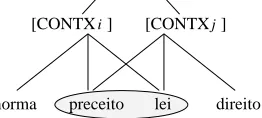
[CONTXi]
lei norma preceito
[CONTXj] [CONTXij]
direito
Figure 1: Clustering step
which we call basic class. Let’s take an example. In our corpus, the most similar set extracted from
((np!$q
c¸˜a4%'(*)$+
(infringement of )) is the set extracted from ( n,Qo(p!$q % ' )$+
(infringe) . Both sets share the following words:
sigilo princ´ıpios preceito plano norma lei estatuto disposto disposic¸˜ao direito
(secret principle precept plan norm law statute dis-position disdis-position right)
This basic class does not contain incorrect
words such as vez, flagrantemente,
obrigac¸˜ao, interesse (time, notoriously,
obligation, interest), which were oddly associated to
the context (np!$q
c¸ ˜a4%'(b)$+
, but which do not appear in context (n,-op!$"q*%'(*)$+
. This class seems to be semantically homogeneous be-cause it contains only co-hyponym words referring to legal documents. Once basic classes have been created, they are used by the conceptual clustering algorithm to build more general classes.
3.2.2 Conceptual Clustering
We use an agglomerative (bottom-up) cluster-ing for successively aggregatcluster-ing the previously cre-ated basic classes. Unlike most research on con-ceptual clustering, aggregation does not rely on a statistical distance between classes, but on empir-ically set conditions and constraints (Talavera and B´ejar, 1999). These conditions are discussed in (Gamallo et al., 2001a). Figure 1 shows two ba-sic classes associated with two pairs of similar sub-categorisation contexts. uwv\xzy^{ D+
represents a pair of similar subcategorisation contexts sharing the
words preceito, lei, norma (precept, law,
norm, while uwv\xzy^{
V
+
[image:5.612.76.207.67.126.2]represents another pair of similar contexts sharing the words preceito,
Table 1: Class Membership oftrabalho Cluster 1 contrato execuc¸˜ao exerc´ıcio prazo
pro-cesso procedimento trabalho (agreement execution practice term/time process procedure work)
Cluster 2 contrato exerc´ıicio prestac¸˜ao recurso servic¸o trabalho (agreement practice installment appeal service work)
Cluster 3 actividade atribuic¸˜ao cargo exerc´ıcio func¸˜ao lugar trabalho (activity attribution post practice function post work/job)
lei, direito(precept, law, right). Both basic
classes are obtained from the filtering process de-scribed in the previous section. This figure illus-trates more precisely how the basic classes are ag-gregated into more general clusters. If two classes fill the clustering conditions, they can be merged into a new class. The two basic classes of the ex-ample are clustered into the more general class
con-stituted by preceito, lei, norma,
dire-ito. At the same time, the two pairs of contexts
uwv\xzy^{
D
+
and uwv\xzy^{
V
+
are merged into the cluster uwv\xzyL{
DjV
+
. Such a generalization leads us to induce syntactic data that does not appear in the corpus. Indeed, we induce both that the word
normamay appear in the syntactic contexts
repre-sented by uwv|x}yL{
V
+
, and that the word dire-itomay be attached to the syntactic contexts rep-resented by uhv|x}yL{
D
+
.
3.2.3 Polysemic Words Representation
Polysemic words are placed in different clus-ters. For instance, consider the word trabalho
(work/job). Table 1 situates this word as a member of at least three different contextual classes. Clus-ter 1 aggregates words referring to temporal objects. Indeed, they are co-hyponyms because they appear in subcategorisation contexts sharing the same selec-tion restricselec-tions: e.g., n,RsAsJ4~sqrb%*)$+
, (in-terruption of ), % C4 % 'J# sb )$+
(in course). Cluster 2 represents the result of an action. Such a meaning becomes salient in contexts like for in-stance ( "!_-o be4#2b 4 % ' )$+
co-Table 2: Dictionary entries
abono (loan)
% n, % 'Jqe&*~ )$+g
aplicac¸˜ao caso fixac¸˜ao montante pagamento t´ıtulo (diligence case fixing amount payment bond)
n,Jqe *~A%'(*)$+g
ajuda despesa pens˜ao quantia remunerac¸˜ao subs´ıdio suple-mento valor vencisuple-mento
(assistance expense pension amount remuneration subsidy additional tax value salary)
%"!$,Qo n,%'Jqe&*~bb)$+g
conceder conter definir determinar fixar manter prever
(concede comprise define determine fix maintain foresee)
emanar (emanate)
"!$,Qo n,R4zq~q % ' )$+g
al´ınea artigo c´odigo decreto diploma disposic¸˜ao estatuto legislac¸˜ao lei norma regulamento
(paragraph article code decree diploma disposition statute legislation law norm regulation)
"!$,Qo n,R4zq~q % ' )$+g
administrac¸˜ao autoridade comiss˜ao conselho direcc¸˜ao es-tado governo ministro tribunal ´org˜ao
(administration authority commission council direction state government minister tribunal organ)
presidente (president)
n,,bs4!_n2~t;%'(*)$+g
assembleia cˆamara comis˜ao conselho direcc¸˜ao estado em-presa gest˜ao instituto regi˜ao rep´ublica secc¸˜ao tribunal (assembly chamber council direction state enterprise man-agement institute region republic section tribunal)
%n,%'AsA!$nr2~t;*)$+g
cargo categoria func¸˜ao lugar remunerac¸˜ao vencimento (post rank function place/post remuneration salary)
hyponyms can appear in subcategorisation contexts such as: ( % n!]~s.4# tQ* % )$+
, (of the inspector),
((%n,-oJnrAs*24~(q*%'(*)$+
(to accomplish).
4 Application and Evaluation
The acquired classes are used in the following way. First, the lexicon is provided with subcategorisa-tion informasubcategorisa-tion, and then, a second parsing cycle is performed in order to syntactic attachments be cor-rected.
4.1 Lexicon Update
Table 2 shows how the acquired classes are used to provide lexical entries with syntactic and semantic subcategorisation information. Each entry contains
both the list of subcategorisation contexts and the list of word sets required by the syntactic contexts. As we have said before, such word sets are viewed as the extensional definition of the semantic pref-erences required by the subcategorisation contexts. Consider the information our system learnt for the verbemanar(see table 2). It syntactically subcat-egorises two kinds of “de-complements”: the one semantically requires words referring to legal doc-uments (emana da lei- emanate from the law; law prescribes), the other selects words referring to institutions (emana da autoridade- emanate from the authority; authority proposes). The seman-tic restrictions enables us to correct the odd attach-ments proposed by our syntactic heuristics for the
phrase emanou de facto da lei (emanated
in fact from the law). As wordfactodoes not be-long to the semantic class required by the verb in the “de-complement” position, we test the follow-ing “de-complement”. Aslei does belong, a new correct attachment is proposed.
Consider now the nouns abono (loan) and
presidente(president). They subcategorise not
only complements, but also different kinds of heads. For instance, the nounabonoselects for “de-head nouns” like fixac¸˜ao (fixac¸˜ao do abono -fixing the loan), as well as for verbs likefixarin the direct object position: fixar o abono(to fix the loan).
4.2 Attachment Resolution Algorithm
The syntactic and semantic subcategorisation infor-mation provided by the lexical entries is used to check whether the subcategorisation candidates pre-viously extracted by the parser are true attachments. The degree of efficiency in such a task may serve as a reliable evaluation for measuring the soundness of our learning strategy.
attachment n-o(R4n!$tQq2%r'JqtQ!Cb*)
to be corrected by the system. Correction is performed by ac-cepting or rejecting the proposed attachment. This is done looking for the subcategorisation informa-tion contained in the lexicon dicinforma-tionary, informainforma-tion which has been acquired by the clustering method described above. Four tasks are performed to check the attachment heuristics:
Task 1a - Syntactic checking ofartigo: check
wordartigoin the lexicon. Look for the
syntac-tic restriction %n-o((%'Jqt_!CrA*)$+
. Ifartigo
has this syntactic restriction, then, pass to the seman-tic checking. Otherwise, pass to task 2a.
Task 1b - Semantic checking of artigo: check the semantic restriction associated with
((%n,-o%'Jq*tQ!Cb*)$+
. If word editar
be-longs to that restricted class, then we can infer that
n,-oRAn!]t-qb%r'JqtQ!Cb*)
is a binary relation. At-tachment is then confirmed. Otherwise, pass to task 2a.
Task 2a - Syntactic checking ofeditar: check
wordeditarin the lexicon. Look for the
syntac-tic restriction ( n,-oRAn!]t-q % ' )$+
. Ifeditar
has this syntactic restriction, then, pass to the seman-tic checking. Otherwise, attachment cannot be con-firmed.
Task 2b - Semantic checking of editar: check the semantic restriction associated with
((n,-oRAn!]t-qb%'(*)$+
. If word artigo
be-longs to that restricted class, then we can infer that
n,-oRAn!]t-qb%r'JqtQ!Cb*)
is a binary relation. At-tachment is then confirmed. Otherwise, atAt-tachment cannot be confirmed.
Semantic checking is based on the
co-specification hypothesis stated above. According to this hypothesis, two chunks are syntactically attached only if one of these two conditions is verified: either the complement is semantically required by the head, or the head is semantically required by the complement.
4.3 Evaluating Performance of Attachment Resolution
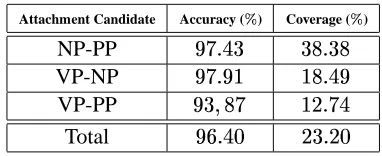
Table 3 shows some results of the corrections pro-posed by the diagnosis parser. Accuracy and cover-age were evaluated on three types of attachment can-didates: NP-PP, VP-NP, and VP-PP. We call accu-racy the proportion of corrections that actually
[image:7.612.330.521.220.298.2]cor-respond to true dependencies and, then, to correct attachments. Coverage indicates the proportion of candidate dependencies that were actually corrected. Coverage evaluation was performed by randomly se-lecting as test data three sets of about 100-150 oc-currences of candidate attachments from the parsed corpus. Each test set only contained one type of can-didate attachments. Because of low coverage, accu-racy was evaluated by using larger sets of test can-didates. A brief description of the evaluation results are depicted in Table 3.
Table 3: Evaluation of Attachment Resolution on NP-PP, VP-NP, and VP-PP attachment candidates
Attachment Candidate Accuracy ( ) Coverage ( )
NP-PP j ,rE,
VP-NP Ee 4rj
VP-PP ,
'
4rTb
Total ,rj ,rE
Even though accuracy reaches a very promising value (about , ), coverage merely achieves , .
There are two main reasons for low coverage: on the one hand, the learning method needs words to have significant frequencies through the corpus; on the other hand, words are sparse through the corpus, i.e., most words of a corpus have few occurrences. How-ever, the significant differences between the cover-age for NP-PP attachments and that for verbal at-tachments (i.e., VP-NP and VP-PP), leads us to be-lieve that the values reached by coverage should in-crease as corpus size grows. Indeed, given that verbs are less frequent than nouns, verb occurrences are still very low in a corpus containing
'R
millions of word occurrences. We need larger annotated corpora to improve the learning task, in particular, concern-ing verb subcategorisation.
5 Future Work
syntactic analysis. We are currently working on the specification of new analysis cycles in order to long distance attachments be solved. Consider again the phraseemanou de facto da lei. At the sec-ond cycle, the diagnoser proposed that the first PP
de facto is not corrected attached to emanou.
At the third cycle, the system will check whether the second PPda leimay be attached to the verb. We will perform n-cycles of attachment propositions, until no candidates are available. At the end of the process, we will be able to measure in a more accu-rate way what is the degree of robustness the parser may achieve.
6 Acknowledgement
This work is supported in part by grants of Fundac¸˜ao para a Ciˆencia e Tecnologia, Portugal; Federal Agency for Post-Graduate Education (CAPES), Brazil; Pontifical Catholic University of Rio Grande do Sul (PUCRS), Brazil; and the MLIS 4005 Euro-pean project TRADAUT-PT.
References
Michael Brent. 1993. From grammar to lexicon: un-supervised learning of lexical syntax. Computational
Linguistics, 19(3):243–262.
Eric Brill and Philip Resnik. 1994. A rule-based ap-proach to prepositional phrase attachment disambigua-tion. In COLING.
Ted Briscoe and John Carrol. 1997. Automatic extrac-tion of subcategorizaextrac-tion from corpora. In ANCP’97, Washington, DC, USA.
Ido Dagan, Lillian Lee, and Fernando Pereira. 1998. Similarity-based methods of word coocurrence prob-abilities. Machine Learning, 43.
David Faure and Claire N´edellec. 1998. Asium: Learn-ing subcategorization frames and restrictions of selec-tion. In ECML98, Workshop on Text Mining.
David Faure. 2000. Conception de m ´ethode
d’aprentissage symbolique et automatique pour
l’acquisition de cadres de sous-cat ´egorisation de verbes et de connaissances s´emantiques `a partir de textes : le syst`eme ASIUM. Ph.D. thesis, Universit´e
Paris XI Orsay, Paris, France.
Francesc Ribas Framis. 1995. On learning more appro-priate selectional restrictions. In Proceedings of the
7th Conference of the European Chapter of the Asso-ciation for Computational Linguistics, Dublin.
Pablo Gamallo, Alexandre Agustini, and Gabriel P. Lopes. 2001a. Selection restrictions acquisition from corpora. In EPIA’01, pages 30–43, Porto, Portugal. LNAI, Springer-Verlag.
Pablo Gamallo, Caroline Gasperin, Alexandre Agustini, and Gabriel P. Lopes. 2001b. Syntactic-based meth-ods for measuring word similarity. In TSD-2001, pages 116–125. Berlin:Springer Verlag.
Gregory Grefenstette. 1994. Explorations in Automatic
Thesaurus Discovery. Kluwer Academic Publishers,
USA.
Ralph Grishman and John Sterling. 1994. Generalizing automatically generated selectional patterns. In
COL-ING’94.
Donald Hindle and Mats Rooth. 1993. Structural ambi-guity and lexical relations. Computational Linguistics, 19(1):103–120.
Martin Kay. 1980. Alghorith schemata and data
struc-tures in syntactic processing. Technical report,
XE-ROX PARK, Palo Alto, Ca., Report CSL-80-12.
Hang Li and Naoki Abe. 1998. Word clustering and dis-ambiguation based on co-occurrence data. In
Coling-ACL’98), pages 749–755.
Nuno Marques. 2000. Uma Metodologia para a Modelac¸˜ao Estat´istica da Subcategorizac¸ ˜ao Verbal.
Ph.D. thesis, Univ. Nova de Lisboa, Lisboa, Portugal.
Fernando Pereira, Naftali Tishby, and Lillian Lee. 1993. Distributional clustering of english words. In ACL’93, pages 183–190, Ohio.
James Pustejovsky. 1995. The Generative Lexicon. MIT Press, Cambridge.
Philip Resnik. 1997. Selectional preference and sense disambiguation. In ACL-SIGLEX Workshop on
Tag-ging with Lexical Semantics, Washinton DC.
V. Rocio, E. de la Clergerie, and J.G.P. Lopes. 2001. Tabulation for multi-purpose partial parsing. Journal
of Grammars, 4(1).
Satoshi Sekine, Jeremy Carrol, Sofia Ananiadou, and Jun’ichi Tsujii. 1992. Automatic learning for seman-tic collocation. In Applied Natural Language
Process-ing, pages 104–110.
Luis Talavera and Javier B´ejar. 1999. Integrating declar-ative knowledge in hierarchical clustering tasks. In