1246
Dialogue-act-driven Conversation Model: An Experimental Study
Harshit Kumar IBM Research,
Delhi, India
Arvind Agarwal IBM Research,
Delhi, India
Sachindra Joshi IBM Research,
Delhi, India
Abstract
The utility of additional semantic information for the task of next utterance selection in an auto-mated dialogue system is the focus of study in this paper. In particular, we show that additional information available in the form of dialogue acts –when used along with context given in the form of dialogue history– improves the performance irrespective of the underlying model being generative or discriminative. In order to show the model agnostic behavior of dialogue acts, we experiment with several well-known models such as sequence-to-sequence encoder-decoder model, hierarchical encoder-decoder model, and Siamese-based models with and without hier-archy; and show that in all models, incorporating dialogue acts improves the performance by a significant margin. We, furthermore, propose a novel way of encoding dialogue act information, and use it along with hierarchical encoder to build a model that can use thesequentialdialogue act information in a natural way. Our proposed model achieves an MRR of about84.8%for the task of next utterance selection on a newly introduced DailyDialog dataset, and outperform the baseline models. We also provide a detailed analysis of results including key insights that explain the improvement in MRR because of dialogue act information.
1 Introduction
In the last decade, natural language processing and machine learning –in particular deep learning– have come a long way towards building an automated dialogue system. In a fully automated dialogue sys-tem, the goal is to predict an appropriate response given the dialogue history. This problem of response prediction can be formulated in two ways. One is purely generative, where the task is togenerate a text response, i.e. generating a sentence or utterance from scratch, whereas the other is Next Utterance Selection, where the task is to select an appropriate response from a set of given candidates. Despite significant research in text generation, a pure generative model capable of generating syntactically and semantically correct text still remains a distant reality. There have been several efforts such as (Vinyals and Le, 2015; Serban et al., 2016a; Serban et al., 2016b; Serban et al., 2017b) for the task of dialogue generation, however these models still do not seem to work in practice (Liu et al., 2016). This is partic-ularly true for open domain dialogue systems. Dialogue generation in a task-oriented oriented dialogue system, such as flight-booking and troubleshooting, is much easier than in a non-task oriented dialogue system. This level of difficulty arises because a non-task-oriented dialogue system has no predefined goal (or domain), and the vocabulary and possibilities of the dialogues could be endless. Given these challenges, researchers have defined a simpler problem for conversation modeling based on retrieval, i.e. next utterance selection. In this paper we use this second formulation of the problem, and show that using additional information available in the form of dialogue acts help in improving the performance of the underlying model.
Dialogue acts (DA) are higher level semantic abstractions assigned to utterances in a conversation. An example of a dialogue act for an utterancei’ll give you a call tonightisInformsince speaker is providing information. In a traditional dialogue system, where dialogues are formulated by first sentence planning
and then by surface realization, the first step is to understand the dialogue act of the utterance that needs to be generated, and then plan and realize the dialogue accordingly. To better understand the importance of dialogue acts, consider an example of a simple conversation, where if the previous utterance is of type Questionthen the next utterance is most likely going to be of the type, i.e.Inform, providing information to that question. Knowing that the next utterance is of typeInform, a conversation system with support of dialogue act information can filter a set of candidate responses, and select the most appropriate one. Driven by this intuition, we hypothesize that understanding dialogue acts and using them in the task of next utterance selection should improve the performance irrespective of the underlying model.
Driven by this intuition, we hypothesize that understanding dialogue acts and using them in the task of next utterance selection should improve the performance irrespective of the underlying model.
Most of the existing literature for the task of next utterance selection can be classified into two cate-gories. First is based on Sequence-to-sequence models (generative models) (Serban et al., 2016a; Serban et al., 2017a; Vinyals and Le, 2015), where a model is trained togeneratea response given context; and the other is Siamese models (discriminative models) (Lowe et al., 2017), where a model is trained to discriminatebetween positive and negative responses for a similar context. In both types of models, at test time, a set of candidate responses is provided consisting of one correct response and several incorrect responses, and the model is evaluated on its ability to assign a higher rank to the true response.
In this paper, through the experimentation with both generative and discriminative types of models, we validate the hypothesis that additional information available in the form of dialogue act significantly improves the performance irrespective of the underlying model. In addition to showing the utility of dialogue acts, we propose a novel model that can use the sequential dialogue act information in a natural way. More specifically, we propose a dialogue-act-driven hierarchical Siamese model. Hierarchical models have shown to perform better than non-hierarchical models for the task of dialogue generation, whereas Siamese models have been shown to outperform the encoder-decoder based models for the task of next utterance selection. In this paper, we combine both of these models, and further enhance them with a dialogue act encoder. The proposed model has a hierarchical encoder which encodes the past utterances, and combine them with the representation of additional contextual information, obtained from the dialogue acts associated with the past utterances, to discriminate the correct response from the incorrect ones. Our proposed model provides us the best of both worlds and outperforms the baseline models by a significant margin. Among others, a key contribution of this paper is that we do a deeper analysis of the reasons for the performance improvement due to inclusion of dialogue act and draw several important key insights such as, dialogue acts induce uniformity in the data, they aid in learning the right patterns. We believe that these insights would inspire new research in this field and push the boundary even further. The main contributions of this paper are as follows:
1. For the task of next utterance selection, we validate the hypothesis that additional information avail-able in the form of dialogue acts improves the performance irrespective of the underlying models.
2. We propose a novel model that combines the strength of Siamese network with strengths of hierar-chical structure inherent in the conversations and dialogue act information. The model gives us the best of all, and outperforms the baseline models by a significant margin on the DailyDialog Dataset.
3. We perform a deeper analysis of the utility of the dialogue act information and draw three key insights: models learn dominant dialogue act patterns; dialogue acts induce uniformity; dialogue acts reinforce correct dialogue act patterns.
4. We modify the DailyDialog (Li et al., 2017b) dataset for the task of next utterance selection, and release it publicly along with the code-base of the proposed model1. We believe that this dataset will work as a benchmark dataset for further research on this problem. Similar benchmark datasets have been released earlier(Lowe et al., 2015; Serban et al., 2015), however they do not come with dialogue act information.
2 Approach
In this section, we provide details of several existing models that we will use to validate our hypothesis. These models include generative models (such as encoder-decoder model and its hierarchical version i.e., hierarchical encoder-decoder) and discriminative model (Siamese-based model). Next, we provide details of the proposed model that adds the hierarchical structure to the Siamese model along with the dialogue act information. To set the notations, we are given a set D of N conversations, i.e. D = (C1, C2, . . . CN), with each conversationCibeing a sequence ofRiutterances,Ci = (u1, u2, . . . uRi). Each utteranceuj in turn is itself a sequence ofSj words, i.e.uj = (w1, w2, . . . wSj).
2.1 Generative Model
Generative models are the most widely used models for conversation modeling. These models include encoder-decoder model and hierarchical encoder-decoder model.
2.1.1 Encoder-decoder Model
An encoder-decoder is a generativemodel that works on the idea of obtaining a representation of an input and use it for generating an output. It has two main components, encoder and decoder. The encoder encodes the firstKutterances, and the decoder uses that encoding to generate the nextK+ 1th
utterance. In a conversation, all words in firstKutterances can be stringed together to form a single long chain and passed to an RNN encoder as following:
ek =fembed1 (wk) ∀k∈1,2, . . .
hek =frnn1 (hek−1, ek) ∀k∈1,2, . . .
(1)
where, fembed1 represents the embedding layer, whereasfrnn1 is the encoder (RNN). Let v be the final output of the encoder which is considered as a representation of the entire context, and used to initialize the decoder (another RNN). Mathematically, the sequence of operations at the decoder are as follows:
hd0 =v
hkd =frnn2 (hdk−1, fembed2 (wk)) ∀k∈1,2, . . . n−1
Pk =Logistic(hdk).
(2)
Here,f2
embedrepresents the embedding layer. Logisticis the final layer, which outputs the probability
distribution over the vocabulary. Encoder-decoder models are trained to maximize the likelihood of generating the next utterance, however, for the task of next utterance selection, they are tested based on the probability of generating the candidate utterances.
2.1.2 Hierarchical Encoder-decoder Model
A simple encoder-decoder treats the firstK utterances as a single long chain of words, and therefore fails to leverage the hierarchical structure, which is an inherent part of a conversation. Hierarchy is im-portant for conversation modeling since it captures the natural dependency among utterances. Several researchers (Sordoni et al., 2015; Serban et al., 2016b; Serban et al., 2017b; Dehghani et al., 2017; Kumar et al., 2017) have shown that hierarchical models outperform standard non-hierarchical models. Hierarchical models use two encoders to capture the hierarchical structure. The first encoder, referred as utterance encoder, operates at the utterance level, encoding each word in each utterance. The second encoder, referred as conversation encoder, operates at the conversation level, encoding each utterance in the conversation, based on the representations of the previous encoder. These two encoders make sure that the output of the conversation encoder captures the dependencies among utterances. For a given con-versation, each wordwkof each utteranceuj is processed by an embedding layer, followed by an RNN
which serves as the utterance encoder. Similar to the encoder in equation (1), an utterance encoder gives us a sequence of representationsv1, v2, . . . vK, corresponding to the firstKutterancesu1, u2, . . . uK in
conversation-level encoder i.e.gKis considered as the representation of the entire conversation and used
to initialize the decoder which works in the same way as Equation 2.
2.2 Discriminative Model
A decoder in the encoder-decoder model generates the next word given the context, and though it has several valid and reasonable choices, it is burdened with the task of generating exactly a particular choice that matches the ground truth. For example, for a contextI am enjoying the day, it is warm and sunny, if decoder generatesyes, it is. and the ground truth dictatesyes, indeed, it is a lovely day, the decoder has failed, though it is a valid response. Due to these challenges with generative models, discriminative mod-els are trained directly to discriminate between positive and negative utterances. A typical discriminative model, or in particular Siamese model, consists of two encoders, one encoder encoding the context, while another encoding the candidate utterance, i.e utteranceK+ 1. These two representations are passed to a final layer that computes the probability of candidate being a valid response given the context. Leth(1) andh(2)be the representations obtained from the first encoder and second encoder, respectively, then the probability of their association can be computed using the following expression.
p(s|h(1), h(2)) =σ h(1)TAh(2)+b
(3)
where, the bias b and matrix A are learned model parameters.
2.3 Dialog-act-driven Models
Dialogue acts are higher level abstractions assigned to utterances. In our problem setting, we are given a list of dialogue actsda1, da2, . . . daK, corresponding to firstK utterances in the conversation. These
dialogue acts are treated as an additional sequence of signals that can aid in the learning process, and are passed through an encoder, denoted as Dialog-Act encoder (DA-encoder). The DA-encoder works on the same principle as the utterance encoder. It builds a dialogue act vocabulary and uses that to learn dialogue act embeddings. Similar to the utterance encoder, the input to the DA-encoder are one hot encodings of the dialogue acts, which are then passed through an embedding layer to learn DA embeddings. These DA embeddings are sent to an RNN to learn dialogue act representations. The sequence of operations for the DA-encoder are as follows:
edak =f 3
embed(dak) ∀k∈1,2, . . . K
hdak =f 4
rnn(hdak−1, edak) ∀k∈1,2, . . . K. qK=hdaK
(4)
The output of the DA-encoder at the last time step (qK) gives us the representation of the entire DA
sequence which is then used in the further modeling process in generative and discriminative models. In generative models, it is used in the decoder by concatenatinggK andqK, whereas in discriminative
models, it is used along with encoder’s output by combininggK withqK through a linear combination.
2.4 Dialog-act-driven Hierarchical Siamese - Proposed Model
Our proposed model, i.e. Dialog-act-driven Hierarchical Siamese Model (HSiamese-DA), uses the fol-lowing three components: a hierarchical encoder to obtain a representation that captures the dependen-cies among K utterances; an utterance encoder to obtain a representation of the candidate response,
(K+ 1)thutterance; a DA-encoder (Equation 4) that captures the dependencies among the dialogue acts of the firstKutterances. Let the representation obtained from the hierarchical encoder, DA-encoder and utterance encoder begK,qK andvK+1, respectively. The two representations,gK andqK, are linearly
combined to obtained a compositional representation of the context, which is then used along with can-didate representation to compute the probability of associating the cancan-didate response with the context using following expression:
dK=α∗gK+ (1−α)∗qK
p(s|dK, vK+1) =σ(dTK·A·vK+1+b)
The model is trained by minimizing the cross-entropy of all labeled conversations including positive and negative examples. At the test time, each conversation hasK utterances followed by a set of 10
candidates responses. The system is tested in its ability to assign a higher rank to the true response.
3 Experiments
In this section, we describe the details of the experiments, i.e. dataset and its preparation, baseline models, experimental setup, and analysis of results.
3.1 Dataset
In our problem setting, we require a dataset that is of reasonable size2and has utterances annotated with the corresponding dialogue acts. Although there are several available datasets(Serban et al., 2015), such as SwDA (Switchboard Dialogue Act Corpus (Jurafsky, 1997)), MRDA (Meeting Recorder Dialogue Act corpus (Janin et al., 2003)), Ubuntu(Lowe et al., 2015), OpenSubtitles(Tiedemann, 2009), etc., they are not really suitable for our problem setting. Most of these datasets do not come with dialogue acts, and the ones which do (i.e. SWDA and MRDA) are small in size. Note that the SwDA and MRDA datasets contain 1003 and 51 conversations, respectively. To the best of our knowledge, a recently released dataset, DailyDialog(Li et al., 2017b), is the only dataset that has utterances annotated with dialogue acts and is large enough for conversation modeling methods to work. Furthermore, in this dataset, conversations are non-task oriented, and each conversation focuses on one topic. Each utterance is annotated with four dialogue acts as described in Table 1. The dataset has train, validation, and test splits of 11118, 1000, and 1000 conversations, respectively. We evaluate and report our results on the DailyDialog dataset.
In this paper, we hypothesize that dialogue acts improve conversation modeling. However, it is not always possible that such dialogue acts are available in practice, and it would be ideal to predict dialogue acts first (Kumar et al., 2017), and then use them for next utterance generation/retrieval; having a model where both tasks, i.e. prediction and generation, are performed simultaneously may not be ideal for validating the hypothesis. Note that the error from the dialogue act prediction may propagate to the next utterance generation/retrieval. Therefore, we intentionally did not use the predicted dialogue acts (rather used the available dialogue acts) to make sure that the insights about the usefulness of the dialogue acts are not corrupted due to the error in the upstream prediction model.
Dialogue Act Description
Inform A speaker is providing information by means of a question or statement Question A speaker intends to obtain information by asking a question
Directive A speaker is requesting, accept/reject offer, or making a suggestion Comissive A speaker accept/reject a request or suggestion
Table 1: Dialogue Acts and their description available in the DailyDialog Dataset.
3.1.1 Dataset Preparation for Next Utterance Selection Task
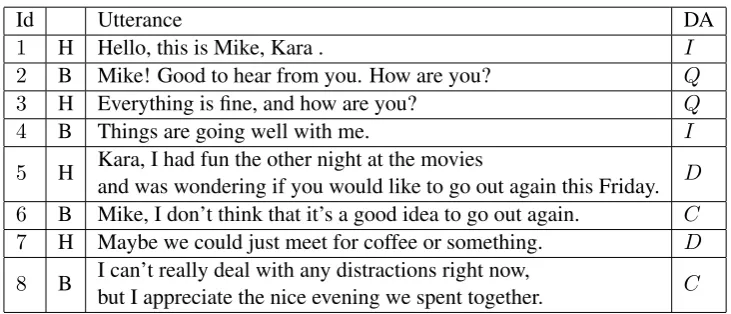
The DailyDialog dataset in its original form is not directly useful for the task of next utterance selection, and hence requires preparation. The dataset has the dialogues from both the speakers. Owing to the different conversational style of human and conversation agent, our objective is to build a model that is specific to the agent, i.e. bot. Therefore, we need to modify the dataset in such a way that we only consider those turns where we need to predict the bot’s utterance. To clarify further, consider the example conversation given in Table 2. The conversation has8 utterances, and each utterances is marked with the speaker, i.e. human (H) and bot (B). Since we are only interested in building bot-specific model, we only pick those subsequences from this conversation where the last utterance is “B”. This gives us three subsequences: 1,2,3,4;3,4,5,6;5,6,7,8for a context of size3. In each of these sub-conversations,
2Generative models such as sequence-to-sequence or discriminative models such as Siamese only perform better when there
the first three utterances constitute the context, while the last utterance is the true response. Our training data consists of such subsequences made up of 4 utterances. In the test data, each subsequence, in addition to these 4 utterances, has9 more utterances selected randomly from the test pool, therefore a total of13 utterances. These9 utterances along with the4th response (i.e., true response) utterance constitute the candidate pool. With this data preparation exercise, the total number of conversations in train, test, and valid are 30515, 2849, and 2695, respectively. This version of dataset is used for training and testing generative models. For discriminative models, data required is a bit different. The training of discriminative models require positive examples and an equal number of negative examples. Note that training data of the generative models did not have any negative examples. In-order to prepare negative examples, we replicate each conversation by replacing the last utterance with a random utterance from the test data. The test and valid dataset remain as in the generative models. Thus, with this data preparation exercise, the total number of conversations in train, test, and valid are61030,2849, and2695, respectively.
Id Utterance DA
1 H Hello, this is Mike, Kara . I
2 B Mike! Good to hear from you. How are you? Q
3 H Everything is fine, and how are you? Q
4 B Things are going well with me. I
5 H Kara, I had fun the other night at the movies
and was wondering if you would like to go out again this Friday. D
6 B Mike, I don’t think that it’s a good idea to go out again. C
7 H Maybe we could just meet for coffee or something. D
8 B I can’t really deal with any distractions right now,
[image:6.595.116.482.247.404.2]but I appreciate the nice evening we spent together. C
Table 2: A snippet of a conversation showing few dialogues between a Human (H) and Bot (B).
3.2 Baseline models and Proposed Model
Here we list the baseline models, their modified version enhanced with dialogue act information, and the proposed model.
Generative Models:
• ED- It is a vanilla sequence to sequence model that uses an utterance encoder to obtain a represen-tation of firstK utterances which is then used in a decoder to generate next utterance.
• HRED- An extension of sequence to sequence model that uses a hierarchical encoder to obtain a representation of firstKutterances, which is then used in decoder to generate next utterance.
• ED-DA- An extension of the ED model which uses dialogue act information. It has a conditional decoder, that conditions the generation of each word on the dialogue acts representation.
• HRED-DA- An extension of the HRED model which uses dialogue act information. Similar to ED-DA, it also has a conditional decoder that conditions the generation of each word on the dialogue acts representation.
Discriminative Models
• Siamese- Also known as Dual-Encoder, it uses two encoders (both utterance encoders) with shared weights, to produce the representation for theKutterances and the(K+ 1)utterance.
• Siamese-DA- An extension of Siamese model that uses the additional dialogue act information ob-tained through DA-encoder. The representation obob-tained from the DA-encoder is linearly combined with the representation of theKutterances obtained from an utterance encoder.
• HSiamese-DA- The proposed model uses a Hierarchical Encoder and a DA-Encoder. The repre-sentation obtained from the DA-Encoder is linearly combined with the reprerepre-sentation obtained from the hierarchical encoder.
3.3 Hyper-parameter Tuning
In our experiments, the parameters are tuned on validation set while the results are reported on test set. Each utterance in a mini-batch was padded to the maximum length for that batch. The maximum batch size allowed was 32. The word vectors were initialized with the 300-dimensional Glove embed-dings (Pennington et al., 2014), and were also updated during training. For the generative models, the utterance encoder, conversation encoder, DA-Encoder and decoder are all GRUs withrnn sizeset to
1000(optimized over100to1200in steps of100). For the discriminative model, the utterance encoder, conversation encoder, and DA-Encoder are all GRUs withrnn sizeset to300(optimized over100to
500in steps of100). Dropout of0.1(optimized over0.0to0.7in steps of 0.1) was applied to embeddings obtained from the output of conversation encoder. Note that, dropout was not used in the discriminative model and its variations. Models were trained to minimize cross entropy using Adam optimizer with learning rate of0.0003(optimized over0.0001,0.0003,0.0005,0.0007,0.001). We found that a higher learning rate up-to0.0005helps the model to learn quickly, whereas learning rate greater than0.0005
leads to oscillations.
3.4 Results and Discussion
In this section, we present results of our experimental study, followed by its analysis.
3.4.1 Performance Evaluation
Since our problem formulation is retrieval based, we use standard IR metrics such as Mean Reciprocal Rank (MRR) and Recall@k as our evaluation metrics. MRR is calculated as the mean of the reciprocal rank of the true candidate response among other candidate responses. Recall@kmeasures whether the true candidate response appears in a ranked list ofkresponses.
In this work, our hypothesis is that additional information about utterances available in the form of dialogue acts helps irrespective of the underlying model, i.e. generative or discriminative. Results in Table 3 support our hypothesis. These results clearly indicate that the MRR of the true candidate response improves when dialogue acts of previous utterances are provided. From these tables we see that for all underlying models, the dialogue act version performs better than non dialogue act version. These results furthermore indicate that hierarchical version performs better than non-hierarchical version for both generative and discriminative models. In the generative case, the plain ED has an MRR of0.474, whereas the same model, when conditioned with DA-Encoder, has an MRR of 0.54, an improvement of 13.9%. The hierarchical encoder-decoder HRED and HRED-DA has an MRR of0.523and0.583, respectively, an improvement of 11.4%. Generative models are sequence-to-sequence models and rather complex in nature, so it is interesting to note that even a much simpler discriminative model, i.e. plain Siamese model, without any dialogue act information, has an MRR of 0.8 compared to 0.58 of the best performing generative model, i.e. HRED-DA. This observation demonstrates the strength of the discriminative models, and therefore is a motivation behind the proposed model. The proposed model improves these baseline numbers by incorporating hierarchy and dialogue act information, and pushes the MRR to0.848.
3.4.2 Performance Analysis
MRR R@1 R@2 R@5
ED 0.474 0.327 0.405 0.639
ED-DA 0.54 0.407 0.478 0.690
HRED 0.523 0.384 0.471 0.676
HRED-DA 0.583 0.448 0.542 0.742
(a) Generative Models
MRR R@1 R@2 R@5 Siamese 0.800 0.711 0.785 0.949
Siamese-DA 0.844 0.784 0.824 0.944
HSiamese 0.817 0.743 0.792 0.948
HSiamese-DA 0.848 0.795 0.821 0.932
[image:8.595.104.498.61.126.2](b) Discriminative Models
Table 3: Comparison of different models with and without dialogue acts
uses the pairs of dialogue acts, i.e. dialogue acts ofKth and(K+ 1)th utterances. Tables 4(a), 4(b) and 4(c) show the distribution of such dialogue act pairs for test data, HSiamese, and HSiamese-DA models respectively. Here, rows indicate the dialogue act ofKth utterance, whereas columns indicate
the dialogue act of (K + 1)th utterance. A cell value indicates the count of utterance pairs with the respective dialogue act combinations where(K+ 1)thutterance was ranked 1. Note that in the test data,
(K+ 1)th utterance is the true candidate response and always have the rank 1. For instance, there are
742utterance pairs in the test data, whereKth and(K+ 1)th utterances have dialogue actsQandI, respectively, however, out of those742instances, HSiamese ranked only605as 1 while HSiamese-DA ranked638as 1. From these tables, we draw following observations.
I Q D C
I 600 336 176 16 Q 742 73 87 2 D 26 75 56 305 C 69 50 76 6
(a) Ground-truth test data
I Q D C R@1
I 403 208 115 9 0.65 Q 605 34 64 2 0.78 D 16 41 42 192 0.63 C 48 33 56 4 0.70
(b) HSiamese
I Q D C R@1
I 446 253 121 12 0.74 Q 638 43 61 2 0.82 D 17 58 42 243 0.78 C 52 39 68 5 0.82
(c) HSiamese-DA
Table 4: Number of rank-1 conversations and theie DAs forKthand(K+ 1)thutterances.
Models Learn Dominant Patterns: The first is that there are certain dominant communication patterns that we observe in both, test data and model outputs (See Table 4), suggesting that models are able to learn these patterns and retain them in their outputs . We observe that aQuestionis often followed by an Information, whereas anInformationcan be followed by anotherInformationor aQuestion. ADirective tends to be followed byCommissive. These communication patterns not only make sense intuitively but they are also in agreement with previous studies (Li et al., 2017b; Ribeiro et al., 2015).
[image:8.595.78.522.310.378.2]task, even for the model that does not use the dialogue act information. This performance difference reduces when we provide the dialogue act information along with the textual content (See Table 4(c)). Inclusion of dialogue act information within a non-uniform class such asDirectivebrings in uniformity, and therefore, results in significant performance improvement. In the case ofDirective, we see as much as 15 percentage point improvement. Similar improvement pattern has been observed for DA-class Information andComissive. Similar to Directive, utterances belonging to Comissive have rather non-uniform construct, and with the availability of dialogue acts, this DA-class is able to gain much more than theInformationDA-class.
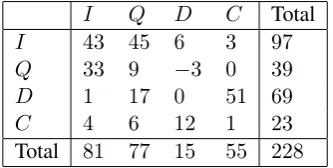
I Q D C Total
I 43 45 6 3 97
Q 33 9 −3 0 39
D 1 17 0 51 69
C 4 6 12 1 23
[image:9.595.216.383.183.267.2]Total 81 77 15 55 228
Table 5: Difference of number of rank-1 conversations between HSiamese-DA and HSiamese.
Dialogue Acts Help Model Learn the Right Patterns: In Table 5, we show the relative improvement of HSiamese-DA model over HSiamese. From this table, we observe that there are a total of228 conver-sations where the proposed model was able to improve the ranking of true candidate response to 1. We further observe that the biggest improvement is inI → I,I → Q,Q → I, andD → C, which make sense intuitively. These are dominant patterns observed in the training data which should be preserved in the model output as well, however these patterns will only be preserved when model is able to capture the correctdialogue act information. Since in many casesDandQhave similar construct, without explicit dialogue act information, a model may get confused and may learn patterns not observed in the training data. For example,Q→IandD→Care the dominant and right patterns in the training data, however in the absence of explicit dialogue act information, the model may get confused betweenDandQand may learnD→IandQ→Cinstead of the dominant patterns i.e.Q→IandD→C. With the explicit dialogue act information, this ambiguity is alleviated and model learns the right patterns as demonstrated by Table 5. Similar observations are true for other two constructs, i.e.InformationandCommisive. Both are rather similar in construct, ‘I: No, thank you’, ‘I: It doesn’t matter. it happens to everyone .’ and ‘C: I knew you’d see it my way .’, ‘C: Ok , i am ready to think of other things .’, and there is no obvious distinguishing factor. However, providing explicit DA information helps in disambiguation, and learn the patterns that are observed in the training data such asI →I,I →Q.
4 Related Work
In conversation modeling, the most basic problem is to generate a response given a context. Several efforts have been made towards solving the problem of dialogue generation(Vinyals and Le, 2015; Liu et al., 2016; Li et al., 2015), however, due to the inherent difficulty of the problem, these efforts have only had limited success and are known to have issues like generating repetitive and generalized responses such asI don’t knoworOk.
proposed model builds upon the strengths of generative and discriminative models, and uses hierarchy along with the dialogue act information to achieve the best performance. A recent work by (Zhao et al., 2017) has used dialogue acts for the task of dialogue generation. Our work complements their find-ings, and further show that dialogue acts improve the model performance across the board irrespective of underlying model (i.e. generative or discriminative models) and for the task of next utterance selection.
5 Conclusion
For the task of next utterance selection, we show that dialogue acts helps achieve better performance irrespective of the underlying model, be it generative or discriminative. We also propose a novel discrim-inative model that leverages the hierarchical structure in a conversation and dialogue act information to produce much improved results, an MRR of 0.848. Our results not only show the improvement in per-formance, but we also present key reasons for it by doing a detailed analysis and drawing key insights that the inclusion of dialogue act information induces uniformity and removes ambiguity.
References
Mostafa Dehghani, Sascha Rothe, Enrique Alfonseca, and Pascal Fleury. 2017. Learning to attend, copy, and generate for session based query suggestion. InCIKM.
Adam Janin, Don Baron, Jane Edwards, Dan Ellis, David Gelbart, Nelson Morgan, Barbara Peskin, Thilo Pfau, Elizabeth Shriberg, Andreas Stolcke, et al. 2003. The icsi meeting corpus. InICASSP.
Dan Jurafsky. 1997. Switchboard swbd-damsl shallow-discourse-function annotation coders manual. www. dcs. shef. ac. uk/nlp/amities/files/bib/ics-tr-97-02. pdf.
Anjuli Kannan, Karol Kurach, Sujith Ravi, Tobias Kaufmann, Andrew Tomkins, Balint Miklos, Greg Corrado, L´aszl´o Luk´acs, Marina Ganea, Peter Young, et al. 2016. Smart reply: Automated response suggestion for email. InProceedings of the 22nd ACM SIGKDD International Conference on Knowledge Discovery and Data Mining, pages 955–964. ACM.
Harshit Kumar, Arvind Agarwal, Riddhiman Dasgupta, Sachindra Joshi, and Arun Kumar. 2017. Dialogue act sequence labeling using hierarchical encoder with crf.arXiv preprint arXiv:1709.04250.
Jiwei Li, Michel Galley, Chris Brockett, Jianfeng Gao, and Bill Dolan. 2015. A diversity-promoting objective function for neural conversation models. InNAACL.
Jiwei Li, Will Monroe, Tianlin Shi, Alan Ritter, and Dan Jurafsky. 2017a. Adversarial learning for neural dialogue generation. arXiv preprint arXiv:1701.06547.
Yanran Li, Hui Su, Xiaoyu Shen, Wenjie Li, Ziqiang Cao, and Shuzi Niu. 2017b. Dailydialog: A manually labelled multi-turn dialogue dataset. arXiv preprint arXiv:1710.03957.
Chia-Wei Liu, Ryan Lowe, Iulian V Serban, Michael Noseworthy, Laurent Charlin, and Joelle Pineau. 2016. How not to evaluate your dialogue system: An empirical study of unsupervised evaluation metrics for dialogue response generation. arXiv preprint arXiv:1603.08023.
Ryan Lowe, Nissan Pow, Iulian V Serban, and Joelle Pineau. 2015. The ubuntu dialogue corpus: A large dataset for research in unstructured multi-turn dialogue systems. In16th Annual Meeting of the Special Interest Group on Discourse and Dialogue, page 285.
Ryan Thomas Lowe, Nissan Pow, Iulian Vlad Serban, Laurent Charlin, Chia-Wei Liu, and Joelle Pineau. 2017. Training end-to-end dialogue systems with the ubuntu dialogue corpus.Dialogue & Discourse, 8(1):31–65.
Jeffrey Pennington, Richard Socher, and Christopher D. Manning. 2014. Glove: Global vectors for word representation. In EMNLP.
Eug´enio Ribeiro, Ricardo Ribeiro, and David Martins de Matos. 2015. The influence of context on dialogue act recognition. arXiv preprint arXiv:1506.00839.
Iulian Vlad Serban, Ryan Lowe, Peter Henderson, Laurent Charlin, and Joelle Pineau. 2015. A survey of available corpora for building data-driven dialogue systems.arXiv preprint arXiv:1512.05742.
Iulian Vlad Serban, Ryan Lowe, Laurent Charlin, and Joelle Pineau. 2016a. Generative deep neural networks for dialogue: A short review.arXiv preprint arXiv:1611.06216.
Iulian Vlad Serban, Tim Klinger, Gerald Tesauro, Kartik Talamadupula, Bowen Zhou, Yoshua Bengio, and Aaron C Courville. 2017a. Multiresolution recurrent neural networks: An application to dialogue response generation. InAAAI, pages 3288– 3294.
Iulian Vlad Serban, Alessandro Sordoni, Ryan Lowe, Laurent Charlin, Joelle Pineau, Aaron C Courville, and Yoshua Bengio. 2017b. A hierarchical latent variable encoder-decoder model for generating dialogues. InAAAI.
Alessandro Sordoni, Yoshua Bengio, Hossein Vahabi, Christina Lioma, Jakob Grue Simonsen, and Jian-Yun Nie. 2015. A hierarchical recurrent encoder-decoder for generative context-aware query suggestion. InCIKM.
J¨org Tiedemann. 2009. News from opus-a collection of multilingual parallel corpora with tools and interfaces. InRecent advances in natural language processing, volume 5, pages 237–248.
Oriol Vinyals and Quoc Le. 2015. A neural conversational model.arXiv preprint arXiv:1506.05869.