On Identifying Sets
Matthew Stone
D e p a r t m e n t o f C o m p u t e r S c i e n c e & ,Center f o r C o g n i t i v e S c i e n c e
R u t g e r s U n i v e r s i t y
110 F r e l i n g h u y s e n Road, P i s c a t a w a y NJ 0 8 8 5 4 - 8 0 1 9
m d s t o n e @cs. r u t g e r s , edu
Abstract
A range of research has explored the problem of generating referring expressions that uniquely iden- tify a single entity from the shared context. But what about expressions that identify sets of enti- ties? In this paper, I adapt recent semantic re- search on plural descriptions--using covers to ab- stract collective and distributive readings and us- ing sets of assignments to represent dependencies among references--to describe a search problem for set-identifying expressions that largely mirrors the search problem for singular referring expressions. By structuring the search space only in terms of the words that can be added to the description, the proposal defuses potential combinatorial explosions that might otherwise arise with reference to sets.
1
Introduction
Natural language interaction lends itself to tasks like generalization, abstraction, comparison, and sum- marization which call for SETS of objects to be picked out using definite referring expressions.
For example, consider the concrete function of describing the elements of a figure. In (1 b), we find a pair of elements from (1 a); imagine that some no- table relationship leads to an intention to identify and comment on just THOSE elements.
• . . , . "
I
( 1 ) a . . .
• . . .
The intersecting dotted segments.
116
As (lc) records, these are the intersecting dotted segments of (1 a), and can be designated as such.
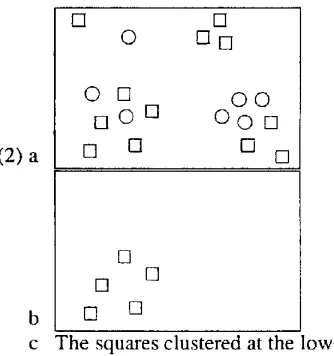
Or again, we find distinguished in (2b) five ele- ments of (2a), which might hold some independent interest. So we can and should identify these ele- ments, and (2c), the squares clustered at the lower left, will do the trick.
(2) a
b
c
[] []
0 • •
0 [] O 0
[ 3 0 [] 0 0 [ 3
[] [] []
[]
[] [] [] [] []
The squares clustered at the lower left.
Concrete problems like those of (1) and (2) cast into relief the potential difficulty of identifying sets. The world provides sets with embarrassing abun- dance, yet we are able to call attention to any of these sets at will, and to describe it at will both by prop- erties its members .have o n their .own---,the mem- bers individually may be square or dotted--and b y properties or relationships that the set enjoys as a collection--the set as a whole may be intersecting, or clustered in a certain region•
[image:1.596.344.511.352.530.2](3) a b C
Only [Mary] F passed. Well, [I]F passed. Another student passed.
According to (Rooth, 1992), the inte!rpretation of fo- cusingadverbs such as ~anly~relates,an.'instance ~-to a set of alternatives C: the adverb describes a prop- erty that makes ~ unique in C. Thus in (3a) Mary is unique among some set C of individuals in passing. Likewise, scalar implicature, as illustrated in (3b), depends on distinguishing one claim--my passing, say--as the strongest claim that can be supported among some salient set of claims C--students in the class passing, for (3b). Rooth formalizes the focus marking in these examples as contributing a presup- position that helps to identify these alternative sets. More generally, a range of lexical items, including the morpheme other from (3c), carry discourse pre- suppositions that relate their referent to salient al- ternatives from the context--like the students we accommodate in understanding (3c) (Bierner and Webber, 2000).
Overtly, all the examples in (3) involve singu- lar noun phrases that specify isolated individuals. Nevertheless, representing and reasoning about ref- erence to sets is required for faithful account of how such sentences are interpreted, and thus how such sentences can achieve the communicative goals of a system for natural language generation (NLG).
So how are expressions that refer to sets to be con- structed? In this paper, I will argue that identifying sets of individuals is not as forbidding as it may at first appear. The extensive literature in NLG on sin- gular references starting with (Dale and Haddock, 1991) tells us what to do. We must use the I N T E R - PRETATION o f provisional descriptions in context to assemble a combination of descriptive elements which identifies the intended target. Take (2), where we used the descriptive elements square, c l u s t e r e d
s o m e w h e r e , and at thel l o w e r :left:. Tracking the in-
cremental interpretation of these descriptors should lead to a sequence like that in (4).
[] []
O 0
(4) a
b The squares.
[] []
[] []
[] [] []
[]
C
d
[]
O 0
[] []
[] []
O 0 • [] []
• k •
The squares clustered somewhere.
[] [] []
e [] []
f The squares clustered at the lower left.
This high-level story leaves us on familiar ground. The project of this paper is to realize this high- level story in formal terms. I begin in Section 2 by framing the problem of singular noun phrase gener- ation more precisely. The sequel extends this frame- work with a formal account of plural interpreta- tion and generation. Section 3 introduces the two independently-motivated observations from formal semantics which form the basis of this account.
The ASSIGNMENT-SET semantics for reference to plurals provides a way to evoke and describe collections with variables that range only over individuals (van den Berg, 1993; van den Berg, 1996). By using the assignment-set semantics, we can dispense with explicit collections in for- malizing an interpretation such as that schema- tized in (4c); we represent only the individuals involved.
The COVER semantics for predications about pluralities provides a simple scheme of im- plicit quantification to abstract collective and distributive predication (Gill•n, 1987; Verkuyl and van der Does, 1991; Schwarzschild, 1994; Schwarzschild;. 1996). :T.he cover semantics of- fers an elegant, and convenient, definition o f what it means for the set distinguished in (4c) to be characterized as the s q u a r e s c l u s t e r e d s o m e - where.
Section 4 presents the computational model of plu- ral descriptions based on these principles. In keep- ing with (4), this model simply and naturally extends
," the models used to generate-singular references. In
the words that can be added to the description and to arrive at corresponding interpretations by constraint satisfaction over individuals. In so doing, the pro- posal defuses the potential combinatorial explosions that might otherwise arise with reference to sets.
• , . . :
2 Background
At a high level, we can characterize generation pro- cedures like that of (Dale and Haddock, 1991 ) or its successors as manipulating linguistic data structures that link together
FORMS,
MEANINGS and INTER- PRETATIONS.(5)
illustrates such a data structure, as it might be entertained in identifying a uniquely identifiable element of (2a).(5) a F: /the square in the upper left/ b M:
{square(x), in(x,
r),upper-left(r) }
g3x
. . . r
c I:
(5a) proposes the form
the square in the upper left--
a syntactic structure represented to some degree of abstraction. (5b) records the semantics for the de- scription as a set of constraints--each constraint is an atomic formula with free variables that speci- fies the requirement that some lexical meaning con- tributes to the description; the variables are place- holders for the discourse entities that the descrip- tion identifies. And (5c) anticipates how the hearer could process the description, by outlining the pos- sible candidate referents for it; in (5c) we find the element of the figure which x must represent, along with the corresponding (vaguely delimited) region r in the upper left where x is located.Any data structure linking form, meaning and interpretation combines two kinds of information. Form and meaning are related by_the g e n e r a t o r ' s model of linguistic resources. In the concrete case, this model is a grammar; LEXICAL semantics de- termines the separate constraints that can go into a description and COMPOSITIONAL semantics deter- mines how these constraints can share variables and so describe common objects. Meaning and interpre- tation, meanwhile, are related by a model of the con- text in which the form is to be uttered. In interpreting referring expressions,we appeal "to a
CONTEXT
SET enumerating the salient individuals at some point in the discourse and a COMMON GROUND listing the118
instances of constraints that can be presumed to be mutually known at that point. To determine the in- terpretation from the meaning, we must instantiate the free variables to individuals in the context set and match the instantiated constraints against the el- ements:~of the1 c o m m o n . g r o u n d . , In, practice, c o n - straint satisfaction heuristics (Mackworth, 1987) are required to accomplish the process of instantiation and matching with any hope of efficiency.
With an understanding of what data structures such as (5) represent and how to carry out reasoning over them, solving descriptive problems becomes a matter of search. In practice, this search is typi- cally managed quite simply: for example, (Dale and Haddock, 1991) select transitions among states ac- cording to a greedy heuristic, while (Dale and Re- iter, 1995) select alternatives by exploring differ- ent kinds of constraints in a fixed order. In any case, the search starts with a structure defining an empty description, which means nothing and could refer to anything. Structures are then extended and considered in turn until the interpretation satisfies the system's goals (for example because it allows only a specified value, the intended referent, for a particular variable). The process of extension sim- ply consists of deriving a more elaborate form with a richer meaning using the generator's linguistic resources--it is useful to think of obtaining this by carrying out a step of derivation in a lexicalized grammar (Stone and Doran, 1997)--and then con- sulting the model of the context to obtain an updated interpretation.
To extend these data structures to sets, we cannot introduce set variables and maintain the alternative candidate set values those variables might ultimately refer to--for one thing, there are just too many sets to represent an interpretation this way.
3 A n i n t u i t i o n a n d s o m e s e m a n t i c s
Here. is a suggestion: REINTERPRET_data.structures like (5) as compatible with descriptions of collec- tions as well as singletons. This should have some intuitive appeal. After all, we always thought that a form like (5a) abstracted out details of syntax and morphology; there's no difficulty then in seeing it as short for a family of singular and plural expres- sions like/the
square(s) in the upper left~.
Similarly, the interpretation is already defined in terms of a set ofinstances that satisfy the description; why not use this as THE set that the description refers to?for both DISTRIBUTIVE predicates, which character- team, so both the collective and distributive readings ize collections based on properties of the individuals are false.
involved, and COLLECTIVE predicates, which de- We will follow Schwarzschild's proposal most scribe collections that jointly participate in some re- closely. Schwarzschild argues that we establish that lation. If we have collective predicates, how can we a linguistic predicate applies to a plural argument get away without explicit set variables which c o u l d . , ~ by reeoyeringa.salient~cover of:~that:~gumentf~r0m ~,- take on any set as a possible value? the context. A cover here means a set of plurali-
Van den Berg's treatmen t o f dependent plurals in dynamic semantics provides the first half o f the an- swer(van den Berg, 1993; van den Berg, 1996). Van den Berg's starting observation is that discourse can set up and maintain dependencies between the indi- viduals in one set and the individuals in another.
(6) a Every man loves a woman.
b They prove this by giving them flowers.
In (6) for example, the first sentence introduces a set o f men and a set of women, where each man in the one set is related to a woman in the other set (by love); the second sentence builds on that relation- ship, indicating another connection (of giving) be- tween each man and the corresponding woman.
For van den Berg, data like (6) show that dis- courses describe sets o f CASES generally. Each case involves a sequence of entities that stand in vari- ous relationships to one another, sometimes directly as individuals and sometimes indirectly through their membership in larger, related groups. Some sentences in discourse aggregate cases together, to express relationships that hold collectively among groups. Other sentences, like (6), zoom in on in- dividual cases, and describe distributive properties which hold of isolated individuals. In zooming in on cases, rather than individuals, these sentences main- tain and extend the dependencies and other relation- ships that define a case.
The second half of the answer derives from the observation, made in (Gillon, 1987; Verkuyl and van der Does, 1991; Schwarzschild, 1994; S c h w a r z s c h i l d , 1996),,-that :the c o l l e c t i v e and dis- tributive readings of plurals represent only the ex- tremes in a larger space of readings. Take (7):
(7) Rogers, Hammerstein and Hart wrote musicals.
This sentence is true, but only in virtue of the joint action o f Rogers and Hammerstein in writing some musicals and thezioint--ac~fion..of.Rogers and Hart in , . writing other musicals. As a matter of fact, the three never wrote a musical individually or as a single
ties whose union or sum is the overall plural argu- ment. Given the cover, the overall plural predication holds just in case the basic property denoted by the predicate is true (collectively)of each of the sets (or CELLS) in the cover. For example, the sets consist- ing of Rogers and Hammerstein and o f Rogers and Hart form the salient cover o f Roger, Hammerstein and Hart in (7); the example is true because each of the cells in this cover directly enjoys the property of having written a musical.
Schwarzschild's covering proposal and van den Berg's assignment-set proposal are perfectly com- patible. Following van den Berg, we interpret dis- courses in terms o f sets of cases, where these cases spell out dependencies among related individuals. But now, following Schwarzschild, we zoom in on those cases flexibly, by covering them. Sometimes we consider all the cases together and describe rela- tionships among aggregated groups; sometimes we consider cases separately and describe individuals distributively; and sometimes, as in (7), we take an intermediate step and cluster the cases into some salient subgroups.
Now let us return to (4c), repeated as (8a), and consider informally what this proposal amounts to:
[] ~ [ ]
[] []
[] []
(8) a [] [] [] [] b The squares clustered.somewhere.
The assignment-set cover semantics fits the descrip- tion to the figure this way. As in (5c), the figure schematizes a set of cases; here each case involves two entities, a square and the location of the cluster to which the square belongs. The description applies because we can look at the individual cases to see that we have squares, and we can group the cases to- gether by. r e g i o n i n t o a cover so,that i n e a c h cell the squares are indeed clustered at the location.
ceed with the development. We'll use assignment variables like g to range over cases; gx is the value o f g for variable x.t Interpretations are defined in terms of sets of cases, naturally; we'll use F to range over a set o f cases and write F(x) for { g x : g E F}. Most constraints will involve several variables; we can abstract this in terms o f a sequence Of {,~iable~'x .... and the tuple of collections that those variables take on across a set of cases, F(x). (We can define this explicitly as F(x) = G where Gxi = F(xi).)
Now, consider an atomic constraint F(x). In gen- eral, F ( x ) will have multiple known instances, and each instance will relate collections of individuals to one another. Thus the c o m m o n ground will asso- ciate F ( x ) with a set o f tuples o f sets, which we write as ~F(x)~. An interpretation F will fit one of those instances directly iff F(x) E ~F(x)~. In this case we say F ( x ) DESCRmES F.
For example, consider the constraint clustered(x,r). Let us say a set X is clustered around R if R is a singleton spatial location {r} and X is a group of sufficient cardinality and density located together at r. Then we might find three tuples o f [[clustered(x, r)]] in the explicit depiction o f (8). If we define Fl as in (9) then clustered(x,r) describes F i .
(9) { (x, r) : x a square in the lower left region r}
O f course, we are principally interested in the ability to zoom in to particular cases, using covers. We represent a cover using a reflexive binary rela- tion that links each assignment to any assignment in its cell. Given such a relation C, the constraint @ c P - - r e a d "covered by C, p " - - s a y s that p is true on each o f the cells of the cover specified by C. We will only consider the case where p is an atomic con- straint F ( x ) .
(10) @ c F ( x ) DESCRIBES F ifffor all g E F,
Then with C defined as in (12), @cclustered(x, r) describes Fi U F2 U F3.
(12)
C = ( F ,xr,)u(r2xr2)u(r3xr3).
Observe the close connection between this formal .jiidgment'and 'the-info,mat-disenssion' o f " ( 8 ) pre- sented earlier. We have a set of cases involving a square and the location o f the cluster to which the square belongs; we cover the cases together by re- gion and find that the resulting groups define a spec- ified cluster at a specified location.
Schwarzschild's proposal is that the salient cover C is supplied from context. In the case of definite reference to tuples F, we can regard the tuples in any predicate as defining the appropriate salient cover for plural predication; a n y tuples that help to iden- tify F must be prominent parts of the shared context. Meanings of referring expressions should therefore appeal to a condition @ p which describes F iff there is a C for which @ c P describes F.
Clearly, if @ p describes F and @ p describes F' then @ p describes F U I '~. This in turn entails that any condition © p describes a maximal set of cases from the current context; the same goes for any con- junction o f conditions o f this form. We can treat this set o f cases as the interpretation of a description. In particular, consider a description L that consists of a list o f constraints @ L i ( x ) formulated in terms o f a tuple o f variables x and atomic conditions on those variables Li(x). Assume a context set D defin- ing a domain of salient individuals, so that candidate cases to interpret L are given by I" : = {a : ai E D}. The development thus far leads us to define the IN- TERPRETATION of I_,---l(L)--as:
(13) I ( L ) : = m a x r c r V i : @Li(x) describes F
Drawing on our running discussion, we can apply this definition to the description F ( x ) describes {h E F : C(g,h)}.
Continuing from (9), define F2 and F3 in (1 ta) and (11 b) respectively.
( l l ) a {(x.r) : x a square in the center top r} b {(x,r) : x a square in the lower right r}
I I adopt the notation throughout that v is a tuple and v i is c o m p o n e n t i o f v, where c o m p o n e n t s may be indexed equiva-
. . . L . ~_ . . { @ s q u a r e ( x ) , @ c l u s t e r e d ( x , r ) } and the context schematized by (2a). O f course, we find I(L) = Fi U F2 U F3. The fully distributive cover shows that the square condition is satisfied; the cover o f (12) shows that the clustered condition is satisfied. Meanwhile, no further cases can be considered without adding either a circle or the unclustered square.
The reader will already have recognized I(L) = lently by variables or numbers..Lower case Roman letters are
for ordinary individuals and tuples thereof; upl~er case Ronl.an FI U:F2I'3 F 3 as~the set o f cases:that-goes'with (8a). letters are for sets of individuals and tuples thereof; upper case Thus, we have reconciled the informal picture o f (4) Greek letters are for sets of tuples, with the concrete data structures of form, meaning
and interpretation that NLG demands. For (8) we can now read (14).
(14)a F: /the squares(s) clustered __ / b M: {(~) square(x), (~) cluster(x, r)}
] . . .
c I:
[] [] [] [] []
[ ] []"
[] []
[]
4 Computing referring expressions
At this point, we have an understanding of what kinds of representations we can use to describe the derivation of plural referring expressions. But we still must devise appropriate reasoning methods for these representations. The problem is the subject of this section.
4.1 Collective Constraints
The first step is to formulate a constraint-satisfaction heuristic that accounts for cover-constraints on col- lections. In general, constraint-satisfaction heuris- tics provide a technique for approximating the inter- pretation of a description. The key notion is that of a CONSTRAINT NETWORK for a description L, which determines a tuple C of CONSTRAINED VALUES. This tuple specifies a generous set of possible val- ues Ci for each variable xi in x; it is obtained by con- servatively eliminating values that are determined to be inconsistent with L according to heuristic tests. For example, the usual arc-consistency heuristic for a constraint over individuals K(x) is to eliminate a value v for variable z unless some g E ~K(x)~ has g: -- v and gk E Ck for all k.
We will adapt this to the case of cover constraints with the following test of consistency. An individ- ual value v for a variable xi maintains its member- ship in C i in the.presence~oLa,collective,constraint
© L j ( x ) whenever v belongs to a SUBSET Gi of Ci which participates directly in the relation denoted by Lj(x) with sets of possible values for the other vari- ables. This criterion is spelled out formally in the definition in (15).
(15)
Value v for variable xi isCOVER-CONSISTENT (C-CONSISTENT)
with constraint (~)Lj(x)~under, constrained values C if there is an G E ~Lj(x)]] with v E
Gi
and Gt. C Ck for all k.All values of xi
with constraint Q L j ( x ) may be deleted from Ci, as they will not satisfy the constraint. Doing so makes Ci ARC c-consistent with respect to (~)Lj(x), and provides the basic step in a network-based arc- .consistency .constraint-satisfier. As with. ordinary constraint satisfaction, we arrive at a final tuple of values for x by starting with an initial tuple Co of values---often an assignment Dx giving each vari- able D - - a n d a queue of arcs linking each Ci with any Q L j ( x ) that constrains it. Until the queue is empty, we select an arc and enforce the arc c-consistency by pruning Ci; if Ci changes we requeue all arcs that might no longer be arc c-consistent after the deletion. I will refer to the final tuple of values as P(L; Co), for the PLURAL constraint network on de- scription L and domains Co.
The properties of this algorithm are in line with ordinary constraint satisfaction. The output will not provide all and only solutions to the constraints without further assumptions about the constraints. However, we can show, as usual, that the network converges on consistent values for variables in the ordinary linguistic case where the constraint graph is a tree--a semantic property, that there are no dis- joint sets of constraints that overlap on the same two variables, that follows under plausible assump- tions about the derivation of semantics from a tree- structured syntax. We can show further that these values, together with the tuples in [[Li(x)~ that cover these values, determine precisely the collection of assignments I(L).
4.2 Search for Referring Expressions
The second step is to formalize the task of construct- ing a description as a state-space search task. Sup- pressing details of form for exposition, each state is a tuple E as set out in (16).
(16) E---- ( L , r , R , x , P ( L ; R , D x ) , P ( L ; D r , D x ) )
The state represents:
(17)a a description L;
b a tuple r of distinguished free variables in the description for which we must identify specific intended values;
c a tuple R of sets describing the value
Ri
which we intend for the corresponding
- v a r i a b l e r i ; . . . . . • -
d the remaining free variables of the description x;
e a constraint network P(L; R, Dx) describing
the values for all the free variables in the
description, on the assumption that the distinguished variables take on the values we intend; andf a constraint network p(L; Dr, Dx)
describing the values for all the free variables in the description, on theassumption that the distinguished variables may, like other variables, take on any values from the context set.
The distinction between the variables whose in- tended reference is fixed and those for which it is de- rived as a byproduct of the search process is due to Horacek (Horacek, 1995; Horacek, 1996); the dis- tinction derives increased importance when relating one collection to another as the choice of collections need not give rise to explicit branching in search.
The initial state involves an empty description and so has the form given in (18).
(18) Y~= (®,r,R, 0 , P ( Q ; R ) , P ( Q ; D r ) )
A state such as (16) represents a final state that suc- cessfully resolves the generation task when each variable x from r and x is associated with the same set
Cx
in both P ( L ; R , D x ) and P ( L ; D r , D x ) . This simply means that the hearer's interpretation of the referring expression matches the speaker's intended interpretation.At any state Z, the grammar defines a set of con- straints of the form (~) L(rx; y) that could potentially be added to the description to obtain L~--L is some domain relation, r and x name the old variables from L while y names fresh variables. Of course, we want to restrict our attention to constraints that are compatible with our intended interpretation. To achieve this restriction, we begin by computing the new constraint network C ~ = P(L~;R;Dxy). We check, whenever R assigns a value to x, that Rx C C' x. If this test admits .the_new constraint, the n e w s t a t e obtained from state E is computed as in (19).
(19) (L', r, R, xy, P(L'; R, Dxy), P(L'; Dr, Dxy)}
4.3 An Example
I return to (1) to provide an illustration of the final scheme; the goal is to identify the segments in (20f), R, from among those in (20a). I use figures and ref- erences to figures, .in .place-of=.eonstraint, networks; the description uses the variable r. The states pro- ceed, perhaps, thus:
(20)a
bC
° • ° ° • • °
(o, r,g, l), (20a), (20f))
({ Qsegment(r) . ;r,R,
0 , (20/1), (20ff))" ° , .
* ~ % ' .
° • ° • •
• • ° •
d
e ({Qsegment(r), Qintersecting(r)},
r,R, (),
(20d), (20f))
• , . . .
• ° °
g ({Qsegment(r),Qintersecting(r),
Qdotted(r)
}, r, R, {), (20f), (20f) }5
Closing thoughts
Descriptions of sets obviously have much in com- mon with expressions that describe a single entity from the shared context• In particular, adopting the standard view of NLG as goal-directed activity (Ap- pelt, 1985; Dale, 1992; Moore, 1994; Moore and Paris, 1993), singular and plural descriptions agree both in the kinds of intentions that they can achieve and the stages of generation at which they can be for- mulated. We cannot expect a single process to be re- sponsible for set descriptions across all intentions or stages of NLG.
For example, as with a singular description, a description of a set may appeal to properties that play a role in the argument the speaker is trying to make, and may therefore address goals above and beyond simple identification of discourse entities. (Se e .(Donellan, ..! 966;: Kx~0nfeld, 1986) on the dis- .- tinction.) (Green et al., 1998a; Green et al., 1998b) show how such descriptions may be represented and formulated in NLG at a high-level process of con- tent or rhetorical planning. At the same time, plu- rals and singulars are alike in offering resources for reference--such as pronouns, one-anaphora or ag- gregated expressions--that bypass explicit descrip- tion altogether• The use of these resources may be .... ~quite-closety dependent o n t h e surface 'form being generated and so could reflect a relatively late deci- sion in the generation process (Dale and Haddock,
1991; Reiter, 1994; Dalianis, 1996).
These complexities notwithstanding, we can ex- pect many descriptions o f sets, like descriptions of individuals, to be formulated from scratch to achieve purely referential goals during the SEN- TENCE PLANNING. plaase: o f .NLG, io:.he:tween ~gon=. tent planning and surface realization (Rainbow and Korelsky, 1992; Reiter, 1994). I have shown that using covers to abstract collective and distributive readings--and using sets of assignments to repre- sent plural references--yields a search space for this problem which largely mirrors that for singu- lars, and which avoids computation and search over sets o f collections. Although sets proliferate explo- sively, it is no surprise that the search space for plu- rals set up by (19) is, like that for singulars, ulti- mately defined by the sequences of elements that make up descriptions. NLG involves search to use words effectively--choices of words should be the only decisions a referring expression generation sys- tem has to make.
Acknowledgments
This paper benefits from the comments of anonymous referees and from discussions with Kees van Deemter, Roger Schwarzschild, Bonnie Webber, the Edinburgh generation group, and the participants of the GNOME workshop where a preliminary version was presented; it was supported by a postdoctoral fellowship from RuCCS.
R e f e r e n c e s
Douglas Appelt. 1985. Planning English Sentences. Cambridge University Press, Cambridge England. Gann Bierner and Bonnie Webber. 2000. Inference
through alternative-set semantics. Journal of Lan- guage and Computation.
Robert Dale and Nicholas Haddock. 1991. Content de- termination in the generation of referring expressions. Computational Intelligence, 7(4): 252-265.
Robert Dale and Ehud Reiter. 1995. Computational in- terpretations of the Gricean maxims in the generation of referring expressions. Cognitive Science, 18:233- 263.
Robert Dale. 1992. Generating Referring E~pressions: Constructing Descriptions in a Domain of Objects and Processes. MIT Press, Cambridge MA.
Hercules Dalianis. 1996. Concise Natural Language Generation .from Formal Specifications. Ph.D. thesis, Royal Institute of Technology. Stockholm.
K. Donellan. 1966. Reference and definite description. Philosophical Review, 75:281-304.
Brendan-Gillon. 1987. The readings of plural noun phrases in english. Linguistics and Philosophy, 10(2): 199-299.
Nancy Green, Giuseppe Carenini, Stephan Kerpedjiev, Steven Roth, and Johanna Moore. 1998a. A media- independent content language for integrated text and graphics generation. In CVIR '98- Workshop on Con- tent Visualization and lntermedia Representations. Nancy Green, Giuseppe Carenini, and Johanna Moore. ... ~ v~ t998b~ k,p~ineipted~representafiort . of attributive de- scriptions for generating integrated text and informa- tion graphics presentations. In Proceedings of In- ternational Natural Language Generation Workshop, pages 18-27.
Helmut Horacek. 1995. More on generating referring ex- pressions. In Proceedings of the Fifth European Work- shop on Natural Language Generation, pages 43-58, Leiden.
Helmut Horacek. 1996. A new algorithm for generating referring expressions. In ECAI 8, pages 577-581. Amichai Kronfeld. 1986. Donellan's distinction and a
computational model of reference. In Proceedings of ACL, pages 186.--191.
Alan Mackworth. 1987. Constraint Satisfaction. In S.C. Shapiro, editor, Encyclopedia of Artificial Intel- ligence, pages 205-211. John Wiley and Sons. Johanna D. Moore and C6cile L. Paris. 1993. Plan-
ning text for advisory dialogues: capturing intentional and rhetorical information. Computational Linguis- tics, 19(4):651-695.
Johanna Moore. 1994. Participating in Explanatory Di- alogues. MIT Press, Cambridge MA.
Owen Rainbow and Tanya Korelsky. 1992. Applied text generation. In ANLP, pages 40-47.
Ehud Reiter. 1994. Has a consensus NL generation architecture appeared, and is it psycholinguistically plausible? In Seventh International Workshop on Nat- ural Language Generation, pages 163-170, June. Mats Rooth. 1992. A theory of focus interpretation. Nat-
ural Language Semantics, 1 ( 1 ): 75- I 16.
Roger Schwarzschild. 1994. Plurals, presuppositions, and the sources of distributivity. Natural Language Semantics. 2:201-248.
Roger Schwarzschild. 1996. Pluralities. Kluwer, Dor- drecht.
Matthew Stone and Christine Doran. 1997. Sentence planning as description using tree-adjoining grammar. :: In ProceedingsofACL, pages_198-205.
M. H. van den Berg. 1993. Full dynamic plural logic. In K. Bimb6 and A. Mfit6, editors, Proceedings of the Fourth Symposium on Logic and Language, Budapest. M. H. van den Berg. 1996. Generalized dynamic quanti- tiers. In J. van der Does and J. van Eijk, editors, Quan- tifiers, Logic and Language. CSLI.