RED: A Reference Dependency Based MT Evaluation Metric
Hui Yu†§ Xiaofeng Wu‡ Jun Xie† Wenbin Jiang† Qun Liu‡† Shouxun Lin††Key Laboratory of Intelligent Information Processing
Institute of Computing Technology, Chinese Academy of Sciences
§University of Chinese Academy of Sciences
{yuhui,xiejun,jiangwenbin,sxlin}@ict.ac.cn
‡CNGL, School of Computing, Dublin City University
{xiaofengwu,qliu}@computing.dcu.ie
Abstract
Most of the widely-used automatic evaluation metrics consider only the local fragments of the references and translations, and they ignore the evaluation on the syntax level. Current syntax-based evaluation metrics try to introduce syntax information but suffer from the poor pars-ing results of the noisy machine translations. To alleviate this problem, we propose a novel dependency-based evaluation metric which only employs the dependency information of the ref-erences. We use two kinds of reference dependency structures: headword chain to capture the long distance dependency information, and fixed and floating structures to capture the local con-tinuous ngram. Experiment results show that our metric achieves higher correlations with human judgments than BLEU, TER and HWCM on WMT 2012 and WMT 2013. By introducing extra linguistic resources and tuning parameters, the new metric gets the state-of-the-art performance which is better than METEOR and SEMPOS on system level, and is comparable with METEOR on sentence level on WMT 2012 and WMT 2013.
1 Introduction
Automatic machine translation (MT) evaluation plays an important role in the evolution of MT. It not only evaluates the performance of MT systems, but also makes the development of MT systems rapider (Och, 2003). According to the type of the employed information, the automatic MT evaluation metrics can be classified into three categories: lexicon-based metrics, syntax-based metrics and semantic-based metrics.
The lexicon-based metrics, such as BLEU (Papineni et al., 2002), TER (Snover et al., 2006), METEOR (Lavie and Agarwal, 2007) and AMBER (Chen and Kuhn, 2011; Chen et al., 2012), are good at capturing the lexicon or phrase level information, e.g. fixed phrases or idioms. But they cannot adequately reflect the syntax similarity. Current efforts in syntax-based metrics, such as the headword chain based metric (HWCM) (Liu and Gildea, 2005), the LFG dependency tree based metric (Owczarzak et al., 2007) and syntactic/semantic-role overlap (Gim´enez and M`arquez, 2007) , suffer from the parsing of the potentially noisy machine translations, so the improvement of their performance is restricted due to the serious parsing errors. Semantic-based metrics, such as MEANT (Lo et al., 2012; Lo and Wu, 2013), have the similar problem that the accuracy of semantic role labeling (SRL) can also drop due to the errors in translations. To avoid the parsing of potentially noisy translations, the CCG based metric (Mehay and Brew, 2007) only uses the parsing result of reference and employs 2-gram dependents, but it did not achieve the state-of-the-art performance.
In this paper, we propose a novel dependency tree based MT evaluation metric. The new metric only employs the reference dependency tree, leaving the translation unparsed to avoid the error propagation. We use two kinds of reference dependency structures in our metric. One is the headword chain (Liu and Gildea, 2005) which can capture long distance dependency information. The other is fixed and floating structure (Shen et al., 2010) which can capture local continuous ngram. When calculating the matching score between the headword chain and the translation, we use a distance-based similarity. Experiment
This work is licenced under a Creative Commons Attribution 4.0 International License. Page numbers and proceedings footer are added by the organizers. License details:http://creativecommons.org/licenses/by/4.0/
results show that our metric achieves higher correlations with human judgments than BLEU, TER and HWCM on WMT 2012 and WMT 2013. After introducing extra resources and tuning parameters on WMT 2010, the new metric is better than METEOR and SEMPOS on system level and comparable with METEOR on sentence level on WMT 2012 and WMT2013.
The remainder of this paper is organized as follows. Section 2 describes our new reference dependency based MT evaluation metric. In Section 3, we introduce some extra resources to this new metric. Section 4 presents the parameter tuning for the new metric. Section 5 gives the experiment results. Conclusions and future work are discussed in Section 6.
2 RED: A Reference Dependency Based MT Evaluation Metric
The new metric is a REference Dependency based automatic evaluation metric, so we name it RED. We present the new metric detailedly in this section. The description of dependency ngrams is given in Section 2.1. The method to score the dependency ngram is presented in Section 2.2. At last, the method of calculating the final score is introduced in Section 2.3.
2.1 Two Kinds of Dependency Ngrams
[image:2.595.306.528.342.439.2]To capture both the long distance dependency information and the local continuous ngrams, we use both the headword chain and the fixed-floating structures in our new metric, which correspond to the two kinds of dependency ngram (dep-ngram), headword chain ngram and fixed-floating ngram.
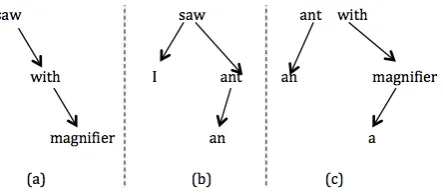
Figure 1: An example of dependency tree. Figure 2: Different kinds of structures extractedfrom the dependency tree in Figure 1. (a): Head-word chain. (b): Fixed structure. (c): Floating struc-ture.
2.1.1 Headword chain
Headword chain is a sequence of words which corresponds to a path in the dependency tree (Liu and Gildea, 2005). For example, Figure 2(a) is a 3-word headword chain extracted from the dependency tree in Figure 1. Headword chain can represent the long distance dependency information, but cannot capture most of the continuous ngrams. In our metric, headword chain corresponds to the headword chain ngram in which the positions of the words are considered. So the form of headword chain ngram is expressed as(w1pos1, w2pos2, ..., wnposn), wherenis the length of the headword chain ngram. For example, the
headword chain in Figure 2(a) is expressed as(saw2, with5, magnifier7).
2.1.2 Fixed and floating structures
Figure 3: An example of calculating matching score for a headword chain ngram (saw2, with5, magnifier7). dis r1 and dis r2 are the distances between the corresponding two words in the reference.dis h1anddis h2are the distances between the corresponding two words in the hypothesis.
fixed-floating ngram. For example, the fixed structure in Figure 2(b) and the floating structre in Figure 2(c) can be expressed as(I, saw, an, ant)and(an, ant, with, a, magnifier)respectively.
2.2 Scoring Dep-ngrams
Headword chain ngrams may not be continuous, while fixed-floating ngrams must be continuous. So the scoring methods of the two kinds of dep-ngrams are different, and we introduce the two scoring methods in Section 2.2.1 and Section 2.2.2 respectively.
2.2.1 Scoring headword chain ngram
For a headword chain ngram(w1pos1, w2pos2, ..., wnposn), if we can find all thesenwords in the string
of the translation with the same order as they appear in the reference sentence, we consider it a match and the matching score is a distance-based similarity which is calculated by the relative distance, otherwise it is not a match and the score is 0. The matching score is a decimal value between 0 and 1, which is more suitable than just use integer 0 and 1. For example, if the distance between two words in reference is 1, but the distance in two different hypotheses are 2 and 5 respectively. It’s more reasonable to score them 0.5 and 0.2 rather than 1 and 0.
The relative distancedis ribetween every two adjacent words in this kind of dep-ngram is calculated
by Formula (1), where poswi is the position of word wi in the sentence. In Formula (1), we have 1 ≤ i ≤ n−1 andnis the length of the dep-ngram. Then a vector (dis r1, dis r2, ..., dis rn−1)is obtained. In the same way, we obtain vector(dis h1, dis h2, ..., dis hn−1)for the translation side.
dis ri =|posw(i+1)−poswi| (1)
The matching score p(d,hyp) for a headword chain ngram (d) and the translation (hyp) is calculated according to Formula (2), wheren >1. When the length of the dep-ngram equals 1, the matching score equals 1 if the translation has the same word, otherwise, the matching score equals 0.
p(d,hyp) = exp(−
Pn−1
i=1 |dis ri−dis hi|
n−1 ) if match
0 if unmatch (2)
For this dep-3gram, the words are represented with underline in the reference dependency tree and the reference sentence in Figure 3. We can also find all the same three underlined words in the translation with the same order as they appear in the reference. Therefore, there is a match for this dep-3gram. To compute the matching score between this dep-3gram and the translation, we have:
• Calculate the distance
dis r1 =|poswith−possaw|=|5−2|= 3 dis r2 =|posmagnifier−poswith|=|7−5|= 2
dis h1 =|poswith−possaw|=|5−2|= 3 dis h2 =|posmagnifier−poswith|=|6−5|= 1
• Get the matching score as Formula (3) according to Formula (2). d denotes
(saw2, with5, magnifier7)andhypdenotes the translation in the example.
p(d,hyp) =exp(−|dis r1−dis h1|+|dis r2−dis h2|
3−1 ) =exp(−
|3−3|+|2−1|
3−1 ) =exp(−0.5)
(3) We also tried other methods to calculate the matching score, such as the cosine distance and the absolute distance, but the relative distance performed best. For a headword chain ngram with more than one matches in the translation, we choose the one with the highest matching score.
2.2.2 Scoring fixed-floating ngram
The words in the fixed-floating ngram are continuous, so we restrict the matched string in the translation also to being continuous. That means, for a fixed-floating ngram(w1, w2, ..., wn), if we can find all these nwords continuous in the translation with the same order as they appear in the reference, we think the dep-ngram can match with the translation. The matching score can be obtained by Formula (4), whered stands for a fixed-floating ngram andhypstands for the translation.
p(d,hyp)=
(
1 if match
0 if unmatch (4)
2.3 Scoring RED
In the new metric, we use Fscore to obtain the final score. Fscore is calculated by Formula (5), whereα is a value between 0 and 1.
F score= α·precisionprecision+ (1·recall−α)·recall (5)
The dep-ngrams of the reference and the string of the translation are used to calculate the precision and recall. In order to calculate precision, the number of the dep-ngrams in the translation should be given, but there is no dependency tree for the translation in our method. We know that the number of dep-ngrams has an approximate linear relationship with the length of the sentence, so we use the length of the translation to replace the number of the dep-ngrams in the translation dependency tree. Recall can be calculated directly since we know the number of the dep-ngrams in the reference. The precision and recall are computed as follows.
precision= P
d∈Dnp(d,hyp)
lenh , recall= P
d∈Dnp(d,hyp)
countn(ref)
The final score of RED is achieved using Formula (6), in which a weighted sum of the dep-ngrams’ Fscore is calculated.wngram(0≤wngram ≤1) is the weight of dep-ngram with the length ofn. Fscoren
is the Fscore for the dep-ngrams with the length ofn.
RED=XN n=1
(wngram×F scoren) (6)
3 Introducing Extra Resources
Many automatic evaluation metrics can only find the exact match between the reference and the transla-tion, and the information provided by the limited number of references is not sufficient. Some evaluation metrics, such as TERp (Snover et al., 2009) and METOER, introduce extra resources to expand the reference information. We also introduce some extra resources to RED, such as stem, synonym and paraphrase. The words within a sentence can be classified into content words and function words. The effects of the two kinds of words are different and they shouldn’t have the same matching score, so we introduce a parameter to distinguish them. The methods of applying these resources are introduced as follows.
• Stem and Synonym
Stem(Porter, 2001) and synonym (WordNet1) are introduced to RED in the following three steps. First, we obtain the alignment with Meteor Aligner (Denkowski and Lavie, 2011) in which not only exact match but also stem and synonym are considered. We use stem and synonym together with exact match as three match modules. Second, the alignment is used to match for a dep-ngram. We think the dep-ngram can match with the translation if the following conditions are satisfied. 1) Each of the words in the dep-ngram has a matched word in the translation according to the alignment; 2) The words in dep-ngram and the matched words in translation appear in the same order; 3) The matched words in translation must be continuous if the dep-ngram is a fixed-floating ngram. At last, the match module score of a dep-ngram is calculated according to Formula (7). Different match modules have different effects, so we give them different weights.
smod= Pn
i=1wmi
n , 0≤wmi ≤1 (7)
miis the match module (exact, stem or synonym) of theith word in a dep-ngram.wmi is the match
module weight of theith word in a dep-ngram.nis the number of words in a dep-ngram.
• Paraphrase
When introducing paraphrase, we don’t consider the dependency tree of the reference, because paraphrases may not be contained in the headword chain and fixed-floating structures. First, the alignment is obtained with METEOR Aligner, only considering paraphrase. Second, the matched paraphrases are extracted from the alignment and defined as paraphrase-ngram. The score of a paraphrase is1×wpar, wherewparis the weight of paraphrase-ngram.
• Function word
We introduce a parameterwfun (0 ≤wfun ≤1) to distinguish function words and content words.
wfunis the weight of function words. The function word score of a dep-ngram or paraphrase-ngram
is computed according to Formula (8).
sfun = Cfun×wfunC +Ccon×(1−wfun)
fun+Ccon (8)
Cfun is the number of function words in the dep-ngram or paraphrase-ngram. Ccon is the number
of content words in the dep-ngram or paraphrase-ngram.
We use RED-plus (REDp) to represent RED with extra resources, and the final score are calculated as Formula (9), in whichF scorep is obtained usingprecisonp andrecallpas Formula (10).
REDp= N X
n=1
(wngram×F scorepn) (9)
F scorep = α·precisionprecisionp·recallp
p+ (1−α)·recallp (10)
precisionpandrecallP in Formula (10) are calculated as follows.
precisionp = scoreparnlen+scoredepn
h , recallp=
scoreparn+scoredepn
countn(ref) +countn(par)
lenhis the length of the translation. countn(ref) is the number of the dep-ngrams with the length ofn in the reference. countn(par)is the number of paraphrases with length ofnin reference. scoreparn is
the match score of paraphrase-ngrams with the length ofn. scoredepn is the match score of dep-ngrams
with the length ofn.scoreparn andscoredepnare calculated as follows.
scoreparn =
X
par∈Pn
(1×wpar×sfum), scoredepn =
X
d∈Dn
(p(d,hyp)×smod×sfun)
Pnis the set of paraphrase-ngrams with the length ofn.Dnis the set of dep-ngrams with the length ofn.
4 Parameter Tuning
There are several parameters in REDp, and different parameter values can make the performance of REDp different. For example,wngram represents the weight of dep-ngram with the length of n. The
effect of ngrams with different lengths are different, and they shouldn’t have the same weight. So we can tune the parameters to find their best values.
We try a preliminary optimization method to tune parameters in REDp. A heuristic search is employed and the parameters are classified into two subsets. The parameter optimization is a grid search over the two subsets of parameters. When searching Subset 1, the parameters in Subset 2 are fixed, and then Subset 1 and Subset 2 are exchanged to finish this iteration. Several iterations are executed to finish the parameter tuning process. This heuristic search may not find the global optimum but it can save a lot of time compared with exhaustive search. The optimization goal is to maximize the sum of Spearman’sρ rank correlation coefficient on system level and Kendall’sτ correlation coefficient on sentence level. ρ is calculated using the following equation.
ρ= 1− 6
P
d2
i
n(n2−1)
wheredi is the difference between the human rank and metric’s rank for systemi. nis the number of
systems.τ is calculated as follows.
τ = number of concordant pairsnumber of concordant pairs−+number of discordant pairsnumber of discordant pairs
The data of into-English tasks in WMT 2010 are used to tune parameters. The tuned parameters are listed in Table 1.
5 Experiments 5.1 Data
Parameter α wfun wexact wstem wsyn wpar w1gram w2gram w3gram
[image:7.595.95.508.61.93.2]tuned values 0.9 0.2 0.9 0.6 0.6 0.6 0.6 0.5 0.1
Table 1: Parameter values after tuning on WMT 2010. αis from Formula (10). wfun is the weight of
function word.wexact,wstemandwsynare the weights of the three match modules ‘exact stem synonym’
respectively. wpar is the weight of paraphrase-ngram. w1gram, w2gramandw3gramare the weights of
dep-ngram with the length of 1, 2 and 3 respectively.
Language pairs cz-en de-en es-en fr-en ru-en
WMT2012 6 16 12 15
-WMT2013 12 23 17 19 23
Table 2: The number of translation systems for each language pair on WMT 2012 and WMT 2013.
We parsed the reference into constituent tree by Berkeley parser2 and then converted the constituent tree into dependency tree by Penn2Malt3. Presumably, the performance of the new metric will be better if the dependency trees are labeled by human. Reference dependency trees are labeled only once and can be used forever so it will not increase costs.
5.2 Baselines
In the experiments, we compare the performance of our metric with the widely-used lexicon-based met-rics such as BLEU4, TER5and METEOR6, dependency-based metric HWCM and semantic-based metric SEMPOS (Mach´aˇcek and Bojar, 2011) which has the best performance on system level according to the published results of WMT 2012.
The results of BLEU are obtained using 4-gram with smoothing option. The version of TER is 0.7.25. The results of METEOR are obtained by Version 1.4 with task option ‘rank’. We re-implement HWCM which employs an epsilon value of 10−3 to replace zero for smoothing purpose. The correlations of SEMPOS are obtained from the published results of WMT 2012 and WMT 2013.
5.3 Experiment Results
The experiments on both system level and sentence level are carried out. On system level, the correlations are calculated using Spearman’s rank correlation coefficientρ (Pirie, 1988). Kendall’s rank correlation coefficientτ(Kendall, 1938) is employed to evaluate the sentence level correlation. Our method performs best when the maximum length of dep-ngram is set to 3, so we only present the results with the maximum length of 3. RED represents the new metric with exact match and the parameter values are set as follows. α = 0.5. w1gram = w2gram =w3gram = 1/3. REDp represents the new metric with extra resources
and tuned parameter values which are listed in Table (1). 5.3.1 System level correlations
The system level correlations are shown in Table 3. RED is better than BLEU, TER and HWCM on average on both WMT 2012 and WMT 2013, which reflects that using syntactic information and only parsing the reference side are helpful. REDp gets the best result on all of the language pairs except cz-en on WMT 2012. The significant improvement from RED to REDp illustrates the effect of extra resources and the parameter tuning. Stem, synonym and paraphrase can enrich the reference and provide extra knowledge for automatic evaluation metric. There are several parameters in REDp, and different parameter values can make the performance of REDp different. So the performance can be optimized through parameter tuning. SEMPOS got the best correlation according to the published results of WMT
2http://code.google.com/p/berkeleyparser/downloads/list 3http://stp.lingfil.uu.se/˜nivre/research/Penn2Malt.html 4ftp://jaguar.ncsl.nist.gov/mt/resources/mteval-v13a.pl 5http://www.cs.umd.edu/˜snover/tercom
[image:7.595.173.427.167.211.2]2012, and METEOR got the best correlation according to the published results of WMT 2013 on into-English task on system level. REDp gets better result than SEMPOS and METEOR on both WMT 2012 and WMT 2013, so REDp achieves the state-of-the-art performance on system level.
data WMT 2012 WMT 2013
[image:8.595.79.521.114.243.2]Metrics cz-en de-en es-en fr-en ave cz-en de-en es-en fr-en ru-en ave BLEU .886 .671 .874 .811 .811 .936 .895 .888 .989 .670 .876 TER .886 .624 .916 .821 .812 .800 .833 .825 .951 .581 .798 HWCM .943 .762 .937 .818 .865 .902 .904 .886 .951 .756 .880 METEOR .657 .885 .951 .843 .834 .964 .961 .979 .984 .789 .935 SEMPOS .943 .924 .937 .804 .902 .955 .919 .930 .938 .823 .913 RED 1.0 .759 .951 .818 .882 .964 .951 .930 .989 .725 .912 REDp .943 .947 .965 .843 .925 .982 .973 .986 .995 .800 .947
Table 3: System level correlations on WMT 2012 and WMT 2013. The value in bold is the best result in each column.avestands for the average result of the language pairs on WMT 2012 or WMT 2013.
5.3.2 Sentence level correlations
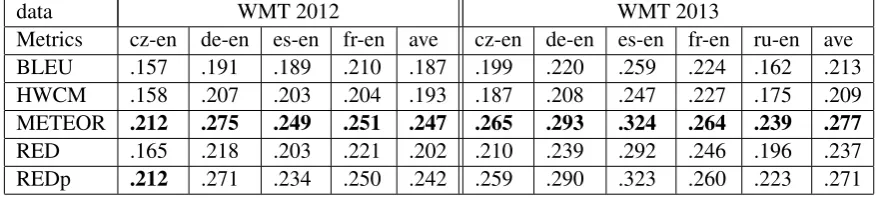
The sentence level correlations on WMT 2012 and WMT 2013 are shown in Table 4. RED is better than BLEU and HWCM on all the language pairs, which reflects the effectiveness of syntactic information and only parsing the reference. By introducing extra resources and parameter tuning, REDp achieves significant improvement over RED. Stem, synonym and paraphrase can enrich the reference and provide extra knowledge for automatic evaluation metric. There are several parameters in REDp, and different parameter values can make the performance of REDp different. A better performance can be exploited through parameter tuning. From the results of REDp and METEOR, we can see that REDp gets the comparable results with METEOR on sentence level on both WMT 2012 and WMT 2013.
data WMT 2012 WMT 2013
Metrics cz-en de-en es-en fr-en ave cz-en de-en es-en fr-en ru-en ave BLEU .157 .191 .189 .210 .187 .199 .220 .259 .224 .162 .213 HWCM .158 .207 .203 .204 .193 .187 .208 .247 .227 .175 .209 METEOR .212 .275 .249 .251 .247 .265 .293 .324 .264 .239 .277 RED .165 .218 .203 .221 .202 .210 .239 .292 .246 .196 .237 REDp .212 .271 .234 .250 .242 .259 .290 .323 .260 .223 .271
Table 4: Sentence level correlations on WMT 2012 and WMT 2013. The value in bold is the best result in each column.avestands for the average result of the language pairs on WMT 2012 or WMT 2013.
6 Conclusion and Future Work
In this paper, we propose a reference dependency based automatic MT evaluation metric RED. The new metric only uses the dependency trees of the reference, which avoids the parsing of the potentially noisy translations. Both long distance dependency information and the local continuous ngrams are captured by the new metric. The experiment results indicate that RED achieves better correlations than BLEU, TER and HWCM on both system level and sentence level. REDp, the improved version of RED through adding extra resources and preliminary parameter tuning, gets state-of-the-art results which are better than METEOR and SEMPOS on system level. On sentence level, REDp gets the comparable performance with METEOR.
[image:8.595.79.521.437.536.2]Acknowledgements
The authors were supported by National Natural Science Foundation of China (Contract 61202216) and National Natural Science Foundation of China (Contract 61379086). Qun Liu’s work was partially supported by the Science Foundation Ireland (Grant No. 07/CE/I1142) as part of the CNGL at Dublin City University. Sincere thanks to the three anonymous reviewers for their thorough reviewing and valuable suggestions.
References
Boxing Chen and Roland Kuhn. 2011. Amber: A modified bleu, enhanced ranking metric. InProceedings of
the Sixth Workshop on Statistical Machine Translation, pages 71–77, Edinburgh, Scotland, July. Association for Computational Linguistics.
Boxing Chen, Roland Kuhn, and George Foster. 2012. Improving amber, an mt evaluation metric. InProceedings
of the Seventh Workshop on Statistical Machine Translation, WMT ’12, pages 59–63, Stroudsburg, PA, USA. Association for Computational Linguistics.
Michael Denkowski and Alon Lavie. 2011. Meteor 1.3: Automatic metric for reliable optimization and evaluation of machine translation systems. InProceedings of the Sixth Workshop on Statistical Machine Translation, pages 85–91. Association for Computational Linguistics.
Jes´us Gim´enez and Llu´ıs M`arquez. 2007. Linguistic features for automatic evaluation of heterogenous mt systems. In Proceedings of the Second Workshop on Statistical Machine Translation, pages 256–264. Association for Computational Linguistics.
Maurice G Kendall. 1938. A new measure of rank correlation. Biometrika, 30(1/2):81–93.
Alon Lavie and Abhaya Agarwal. 2007. Meteor: an automatic metric for mt evaluation with high levels of correlation with human judgments. InProceedings of the Second Workshop on Statistical Machine Translation, StatMT ’07, pages 228–231, Stroudsburg, PA, USA. Association for Computational Linguistics.
Ding Liu and Daniel Gildea. 2005. Syntactic features for evaluation of machine translation. InProceedings of the ACL Workshop on Intrinsic and Extrinsic Evaluation Measures for Machine Translation and/or Summarization, pages 25–32.
Chi-kiu Lo and Dekai Wu. 2013. MEANT at WMT 2013: A tunable, accurate yet inexpensive semantic frame based MT evaluation metric. InProceedings of the Eighth Workshop on Statistical Machine Translation, pages 422–428, Sofia, Bulgaria, August. Association for Computational Linguistics.
Chi-kiu Lo, Anand Karthik Tumuluru, and Dekai Wu. 2012. Fully automatic semantic mt evaluation. In
Pro-ceedings of the Seventh Workshop on Statistical Machine Translation, pages 243–252, Montr´eal, Canada, June. Association for Computational Linguistics.
Matouˇs Mach´aˇcek and Ondˇrej Bojar. 2011. Approximating a deep-syntactic metric for mt evaluation and
tun-ing. In Proceedings of the Sixth Workshop on Statistical Machine Translation, pages 92–98. Association for
Computational Linguistics.
Dennis Mehay and Chris Brew. 2007. BLEUTRE: Flattening Syntactic Dependencies for MT Evaluation. In
Proceedings of the 11th Conference on Theoretical and Methodological Issues in Machine Translation (TMI). F.J. Och. 2003. Minimum error rate training in statistical machine translation. InProceedings of the 41st Annual
Meeting on Association for Computational Linguistics-Volume 1, pages 160–167. Association for Computa-tional Linguistics.
Karolina Owczarzak, Josef van Genabith, and Andy Way. 2007. Dependency-based automatic evaluation for
machine translation. InProceedings of the NAACL-HLT 2007/AMTA Workshop on Syntax and Structure in
Sta-tistical Translation, SSST ’07, pages 80–87, Stroudsburg, PA, USA. Association for Computational Linguistics. K. Papineni, S. Roukos, T. Ward, and W.J. Zhu. 2002. BLEU: a method for automatic evaluation of machine
translation. In Proceedings of the 40th annual meeting on association for computational linguistics, pages
311–318. Association for Computational Linguistics.
Martin F Porter. 2001. Snowball: A language for stemming algorithms.
Libin Shen, Jinxi Xu, and Ralph Weischedel. 2010. String-to-dependency statistical machine translation.
Compu-tational Linguistics, 36(4):649–671.
Matthew Snover, Bonnie Dorr, Richard Schwartz, Linnea Micciulla, and John Makhoul. 2006. A study of trans-lation edit rate with targeted human annotation. InProceedings of Association for Machine Translation in the Americas, pages 223–231.
Matthew Snover, Nitin Madnani, Bonnie J Dorr, and Richard Schwartz. 2009. Fluency, adequacy, or hter?:
exploring different human judgments with a tunable mt metric. In Proceedings of the Fourth Workshop on