Rapid Development of a Corpus with Discourse Annotations
using Two-stage Crowdsourcing
Daisuke Kawahara†‡ Yuichiro Machida† Tomohide Shibata†‡ Sadao Kurohashi†‡ Hayato Kobayashi§ Manabu Sassano§
†Graduate School of Informatics, Kyoto University ‡CREST, Japan Science and Technology Agency
§Yahoo Japan Corporation
{dk, shibata, kuro}@i.kyoto-u.ac.jp, [email protected],
{hakobaya, msassano}@yahoo-corp.jp Abstract
We present a novel approach for rapidly developing a corpus with discourse annotations using crowdsourcing. Although discourse annotations typically require much time and cost owing to their complex nature, we realize discourse annotations in an extremely short time while retaining good quality of the annotations by crowdsourcing two annotation subtasks. In fact, our experi-ment to create a corpus comprising 30,000 Japanese sentences took less than eight hours to run. Based on this corpus, we also develop a supervised discourse parser and evaluate its performance to verify the usefulness of the acquired corpus.
1 Introduction
Humans understand text not by individually interpreting clauses or sentences, but by linking such a text fragment with another in a particular context. To allow computers to understand text, it is essential to capture the precise relations between these text fragments. This kind of analysis is called discourse parsing or discourse structure analysis, and is an important and fundamental task in natural language processing (NLP). Systems for discourse parsing are, however, available only for major languages, such as English, owing to the lack of corpora with discourse annotations.
For English, several corpora with discourse annotations have been developed manually, consuming a great deal of time and cost in the process. These include the Penn Discourse Treebank (Prasad et al., 2008), RST Discourse Treebank (Carlson et al., 2001), and Discourse Graphbank (Wolf and Gibson, 2005). Discourse parsers trained on these corpora have also been developed and practically used. To create the same resource-rich environment for another language, a quicker method than the conventional time-consuming framework should be sought. One possible approach is to use crowdsourcing, which has actively been used to produce various language resources in recent years (e.g., (Snow et al., 2008; Negri et al., 2011; Hong and Baker, 2011; Fossati et al., 2013)). It is, however, difficult to crowdsource the difficult judgments for discourse annotations, which typically consists of two steps: finding a pair of spans with a certain relation and identifying the relation between the pair.
In this paper, we propose a method for crowdsourcing discourse annotations that simplifies the proce-dure by dividing it into two steps. The point is that by simplifying the annotation task it is suitable for crowdsourcing, but does not skew the annotations for use in practical discourse parsing. First, finding a discourse unit for the span is a costly process, and thus we adopt a clause as the discourse unit, since this is reliable enough to be automatically detected. We also limit the length of each target document to three sentences and at most five clauses to facilitate the annotation task. Secondly, we detect and annotate clause pairs in a document that hold logical discourse relations. However, since this is too complicated to assign as one task using crowdsourcing, we divide the task into two steps: determining the existence of logical discourse relations and annotating the type of relation. Our two-stage approach is a robust method in that it confirms the existence of the discourse relations twice. We also designed the tagset of discourse relations for crowdsourcing, which consists of two layers, where the upper layer contains the following three classes: “CONTINGENCY,” “COMPARISON” and “OTHER.” Although the task
This work is licenced under a Creative Commons Attribution 4.0 International License. Page numbers and proceedings footer are added by the organizers. License details:http://creativecommons.org/licenses/by/4.0/
settings are simplified for crowdsourcing, the obtained corpus and knowledge of discourse parsing could be still useful in general discourse parsing.
In our experiments, we crowdsourced discourse annotations for Japanese, for which there are no pub-licly available corpora with discourse annotations. The resulting corpus consists of 10,000 documents, each of which comprises three sentences extracted from the web. Carrying out this two-stage crowd-sourcing task took less than eight hours. The time elapsed was significantly shorter than the conventional corpus building method.
We also developed a discourse parser by exploiting the acquired corpus with discourse annotations. We learned a machine learning-based model for discourse parsing based on this corpus and evaluated its performance. An F1 value of 37.9% was achieved for contingency relations, which would be roughly comparable with state-of-the-art discourse parsers on English. This result indicates the usefulness of the acquired corpus. The resulting discourse parser would be effectively exploited in NLP applications, such as sentiment analysis (Zirn et al., 2011) and contradiction detection (Murakami et al., 2009; Ennals et al., 2010).
The novel contributions of this study are summarized below:
• We propose a framework for developing a corpus with discourse annotations using two-stage crowd-sourcing, which is both cheap and quick to execute, but still retains good quality of the annotations.
• We construct a Japanese discourse corpus in an extremely short time.
• We develop a discourse parser based on the acquired corpus.
The remainder of this paper is organized as follows. Section 2 introduces related work, while Section 3 describes our proposed framework and reports the experimental results for the creation of a corpus with discourse annotations. Section 4 presents a method for discourse parsing based on the corpus as well as some experimental results. Section 5 concludes the paper.
2 Related Work
Snow et al. (2008) applied crowdsourcing to five NLP annotation tasks, but the settings of these tasks are very simple. There have also been several attempts to construct language resources with complex annotations using crowdsourcing. Negri et al. (2011) proposed a method for developing a cross-lingual textual entailment (CLTE) corpus using crowdsourcing. They tackled this complex data creation task by dividing it into several simple subtasks: sentence modification, type annotation and sentence translation. The creative CLTE task and subtasks are quite different from our non-creative task and subtasks of discourse annotations. Fossati et al. (2013) proposed FrameNet annotations using crowdsourcing. Their method is a single-step approach to only detect frame elements. They verified the usefulness of their approach through an experiment on a small set of verbs with only two frame ambiguities per verb. Although they seem to be running a larger-scale experiment, its result has not been revealed yet. Hong and Baker (2011) presented a crowdsourcing method for selecting FrameNet frames, which is a part of the FrameNet annotation process. Since their task is equivalent to word sense disambiguation, it is not very complex compared to the whole FrameNet annotation process. These FrameNet annotations are still different from discourse annotations, which are our target. To the best of our knowledge, there have been no attempts to crowdsource discourse annotations.
In recent years, there have been many studies on discourse parsing on the basis of the above hand-annotated corpora (e.g., (Pitler et al., 2009; Pitler and Nenkova, 2009; Subba and Di Eugenio, 2009; Hernault et al., 2010; Ghosh et al., 2011; Lin et al., 2012; Feng and Hirst, 2012; Joty et al., 2012; Joty et al., 2013; Biran and McKeown, 2013; Lan et al., 2013)). This surge of research on discourse parsing can be attributed to the existence of corpora with discourse annotations. However, the target language is mostly English since English is the only language that has large-scale discourse corpora. To develop and improve discourse parsers for languages other than English, it is necessary to build large-scale annotated corpora, especially in a short period if possible.
3 Development of Corpus with Discourse Annotations using Crowdsourcing
3.1 Corpus Specifications
We develop a tagged corpus in which pairs of discourse units are annotated with discourse relations. To achieve this, it is necessary to determine target documents, discourse units, and a discourse relation tagset. The following subsections explain the details of these three aspects.
3.1.1 Target Text and Discourse Unit
In previous studies on constructing discourse corpora, the target documents were mainly newspaper texts, such as the Wall Street Journal for English. However, discourse parsers trained on such newspaper corpora usually have a problem of domain adaptation. That is to say, while discourse parsers trained on newspaper corpora are good at analyzing newspaper texts, they generally cannot perform well on texts of other domains.
To address this problem, we set out to create an annotated corpus covering a variety of domains. Since the web contains many documents across a variety of domains, we use the Diverse Document Leads Corpus (Hangyo et al., 2012), which was extracted from the web. Each document in this corpus consists of the first three sentences of a Japanese web page, making these short documents suitable for our discourse annotation method based on crowdsourcing.
We adopt the clause as a discourse unit, since spans are too fine-grained to annotate using crowdsourc-ing and sentences are too coarse-grained to capture discourse relations. Clauses, which are automatically identified, do not need to be manually modified since they are thought to be reliable enough. Clause identification is performed using the rules of Shibata and Kurohashi (2005). For example, the following rules are used to identify clauses as our discourse units:
• clauses that function as a relatively strong boundary in a sentence are adopted,
• relative clauses are excluded.
Since workers involved in our crowdsourcing task need to judge whether clause pairs have discourse relations, the load of these workers increases combinatorially as the number of clauses in a sentence increases. To alleviate this problem, we limit the number of clauses in a document to five. This limitation excludes only about 5% of the documents in the original corpus.
Our corpus consists of 10,000 documents corresponding to 30,000 sentences. The total number of clauses in this corpus is 39,032, and thus the average number of clauses in a document is 3.9. The total number of clause pairs is 59,426.
3.1.2 Discourse Relation Tagset
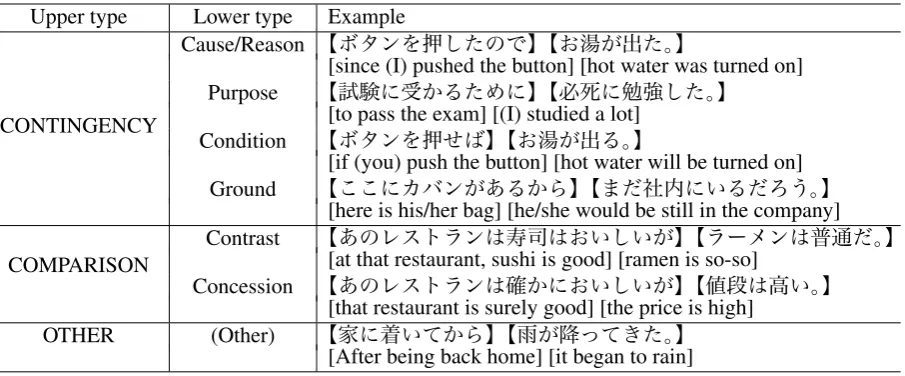
Upper type Lower type Example
CONTINGENCY
Cause/Reason 【ボタンを押したので】【お湯が出た。】
[since (I) pushed the button] [hot water was turned on]
Purpose 【試験に受かるために】【必死に勉強した。】
[to pass the exam] [(I) studied a lot]
Condition 【ボタンを押せば】【お湯が出る。】
[if (you) push the button] [hot water will be turned on]
Ground 【ここにカバンがあるから】【まだ社内にいるだろう。】
[here is his/her bag] [he/she would be still in the company]
COMPARISON Contrast
【あのレストランは寿司はおいしいが】【ラーメンは普通だ。】 [at that restaurant, sushi is good] [ramen is so-so]
Concession 【あのレストランは確かにおいしいが】【値段は高い。】
[that restaurant is surely good] [the price is high]
OTHER (Other) 【家に着いてから】【雨が降ってきた。】
[image:4.595.78.531.62.250.2][After being back home] [it began to rain] Table 1: Discourse relation tagset with examples.
by referring to the Penn Discourse Treebank. This tagset consists of two layers, where the upper layer contains three classes and the lower layer seven classes as follows:
• CONTINGENCY
– Cause/Reason (causal relations and not conditional relations)
– Purpose (purpose-action relations where the purpose is not necessarily accomplished)
– Condition (conditional relations)
– Ground (other contingency relations including pragmatic cause/condition)
• COMPARISON (same as the Penn Discourse Treebank)
– Contrast
– Concession
• OTHER (other weak relation or no relation)
Note that we do not consider the direction of relations to simplify the annotation task for crowdsourcing. Table 1 shows examples of our tagset.
Therefore, our task is to annotate clause pairs in a document with one of the discourse relations given above. Sample annotations of a document are shown below. Here, clause boundaries are shown by “::” and clause pairs that are not explicitly marked are allocated the “OTHER” relation.
Cause/Reason 気がつけば::梅雨も明けてました。::毎日暑い日が続きますね。::【父の手術も無
事に終わり、】::【少しだけほっとしてます。】
... [the surgery of my father ended safely] [(I) am relieved a little bit]
Contrast 今日とある企業のトップの話を聞くことが出来た。::経営者として何事も全てビ
ジネスチャンスに変えるマインドが大切だと感じた。::【生きていく上で追い風
もあれば、】::【逆風もある。】
... [There is tailwind to live,] [there is also headwind.]
3.2 Two-stage Crowdsourcing for Discourse Annotations
Probability Number
=1.0 64
[image:5.595.244.353.61.215.2]>0.99 554 >0.9 1,065 >0.8 1,379 >0.5 2,655 >0.2 4,827 >0.1 5,895 >0.01 9,068 >0.001 12,277 >0.0001 15,554
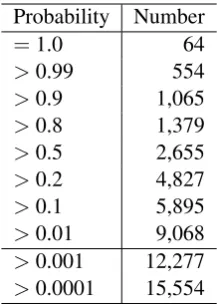
Table 2: Number of clause pairs resulting from the judgments of discourse relation existence.
3.2.1 Stage 1: Judgment of Discourse Relation Existence
This subtask determines whether each clause pair in a document has one of the following discourse relations: Cause/Reason, Purpose, Condition, Ground, Contrast, and Concession (that is, all the relations except “OTHER”). Workers are shown examples of these relations and asked to determine only the existence thereof.
In this subtask, an item presented to a worker at a particular time consists of all the judgments of clause pairs in a document. By adopting this approach, each worker considers the entire document when making his/her judgments.
3.2.2 Stage 2: Judgment of Discourse Relation Type
This subtask involves ascertaining the discourse relation type for a clause pair that passes the first stage. The result of this subtask is one of the seven lower types in our discourse relation tagset. Workers are shown examples of these types and then asked to select one of the relations. If a worker chooses “OTHER,” this corresponds to canceling the positive determination of the existence of the discourse relation in stage one.
In this subtask, an item is the judgment of a clause pair. That is, if a document contains more than one clause pair that must be judged, the judgments for this document are divided into multiple items, although this is rare.
3.3 Experiment and Discussion
We conducted an experiment of the two-stage crowdsourcing approach using Yahoo! Crowdsourcing.1
To increase the reliability of the produced corpus, we set the number of workers for each item for each task to 10. The reason why we chose this value is as follows. While Snow et al. (2008) claimed that an average of 4 non-expert labels per item in order to emulate expert-level label quality, the quality of some tasks increased by increasing the number of workers to 10. We also tested hidden gold-standard items once every 10 items to examine worker’s quality. If a worker failed these items in serial, he/she would have to take a test to continue the task.
We obtained judgments for the 59,426 clause pairs in the 10,000 documents of our corpus in the first stage of crowdsourcing, i.e., the subtask of determining the existence of discourse relations. We calculated the probability of each label using GLAD2 (Whitehill et al., 2009), which was proved to
be more reliable than the majority voting. This probability corresponds to the probability of discourse relation existence of each clause pair. Table 2 lists the results. We set a probability threshold to select those clause pairs whose types were to be judged in the second stage of crowdsourcing. With this threshold set to 0.01, 9,068 clause pairs (15.3% of all the clause pairs) were selected. The threshold was set fairly low to allow low-probability judgments to be re-examined in the second stage.
1http://crowdsourcing.yahoo.co.jp/
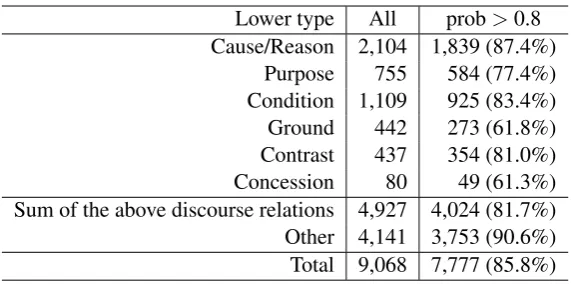
Lower type All prob>0.8 Cause/Reason 2,104 1,839 (87.4%)
[image:6.595.156.442.60.202.2]Purpose 755 584 (77.4%) Condition 1,109 925 (83.4%) Ground 442 273 (61.8%) Contrast 437 354 (81.0%) Concession 80 49 (61.3%) Sum of the above discourse relations 4,927 4,024 (81.7%) Other 4,141 3,753 (90.6%) Total 9,068 7,777 (85.8%) Table 3: Results of the judgments of lower discourse relation types.
Upper type All prob>0.8 CONTINGENCY 4,439 3,993 (90.0%)
COMPARISON 516 417 (80.8%) Sum of the above discourse relations 4,955 4,410 (89.0%) OTHER 4,113 3,753 (91.2%) Total 9,068 8,163 (90.0%) Table 4: Results of the judgments of upper discourse relation types.
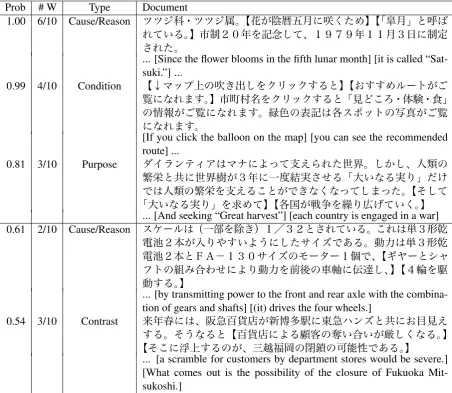
The discourse relation types of the 9,068 clause pairs were determined in the second stage of crowd-sourcing. We extended GLAD (Whitehill et al., 2009) for application to multi-class tasks, and calculated the probability of the labels of each clause pair. We assigned the label (discourse relation type) with the highest probability to each clause pair. Table 3 gives some statistics of the results. The second column in this table denotes the numbers of each discourse relation type, while the third column gives the numbers of each type of clause pair with a probability higher than 0.80. Table 4 gives statistics of the results when the lower discourse relation types are merged into the upper types. Table 5 shows some examples of the resulting annotations.
Carrying out the two separate subtasks using crowdsourcing took approximately three hours and five hours with 1,458 and 1,100 workers, respectively. If we conduct this task at a single stage, it would take approximately 33 (5 hours / 0.153) hours. It would be four times longer than our two-stage approach. Such single-stage approach is also not robust since it does not have a double check mechanism, with which the two-stage approach is equipped. We spent 111 thousand yen and 113 thousand yen (approx-imately 1,100 USD, respectively) for these subtasks, which would be extremely less expensive than the projects of conventional discourse annotations.
For the examples in Table 5, we confirmed that the discourse relation types of the top four examples were surely correct. However, we judged the type (Contrast) of the bottom example as incorrect. Since the second clause is an instantiation of the first clause, the correct type should be “Other.” We found such errors especially in the clause pairs with a probability lower than 0.80.
4 Development of Discourse Parser based on Acquired Discourse Corpus
Prob # W Type Document
1.00 6/10 Cause/Reason ツツジ科・ツツジ属。【花が陰暦五月に咲くため】【「皐月」と呼ば れている。】市制20年を記念して、1979年11月3日に制定 された。
... [Since the flower blooms in the fifth lunar month] [it is called “Sat-suki.”] ...
0.99 4/10 Condition 【↓マップ上の吹き出しをクリックすると】【おすすめルートがご
覧になれます。】市町村名をクリックすると「見どころ・体験・食」 の情報がご覧になれます。緑色の表記は各スポットの写真がご覧 になれます。
[If you click the balloon on the map] [you can see the recommended route] ...
0.81 3/10 Purpose ダイランティアはマナによって支えられた世界。しかし、人類の
繁栄と共に世界樹が3年に一度結実させる「大いなる実り」だけ
では人類の繁栄を支えることができなくなってしまった。【そして
「大いなる実り」を求めて】【各国が戦争を繰り広げていく。】 ... [And seeking “Great harvest”] [each country is engaged in a war]
0.61 2/10 Cause/Reason スケールは(一部を除き)1/32とされている。これは単3形乾
電池2本が入りやすいようにしたサイズである。動力は単3形乾
電池2本とFA−130サイズのモーター1個で、【ギヤーとシャ
フトの組み合わせにより動力を前後の車軸に伝達し、】【4輪を駆 動する。】
... [by transmitting power to the front and rear axle with the combina-tion of gears and shafts] [(it) drives the four wheels.]
0.54 3/10 Contrast 来年春には、阪急百貨店が新博多駅に東急ハンズと共にお目見え
する。そうなると【百貨店による顧客の奪い合いが厳しくなる。】 【そこに浮上するのが、三越福岡の閉鎖の可能性である。】
[image:7.595.73.526.63.456.2]... [a scramble for customers by department stores would be severe.] [What comes out is the possibility of the closure of Fukuoka Mit-sukoshi.]
Table 5: Examples of Annotations. The first column denotes the estimated label probability and the second column denotes the number of workers that assigned the designated type. In the fourth column, the clause pair annotated with the type is marked with【】([ ] in English translations).
discourse parser. Of these, 4,024 (6.9%) and 4,410 (7.5%) instances, respectively, had one of the types besides “OTHER.” We conducted experiments using five-fold cross validation on these instances.
To extract features of machine learning, we applied the Japanese morphological analyzer, JUMAN,3
and the Japanese dependency parser, KNP,4to the corpus. We used the features listed in Table 6, which
are usually used for discourse parsing.
We adopted Opal (Yoshinaga and Kitsuregawa, 2010)5for the machine learning implementation. This
tool enables online learning using a polynomial kernel. As parameters for Opal, we used the passive-aggressive algorithm (PA-I) with a polynomial kernel of degree two as a learner and the extension to multi-class classification (Matsushima et al., 2010). The numbers of classes were seven and three for the lower- and upper-type discourse parsers, respectively. We set the aggressiveness parameter C to 0.001, which generally achieves good performance for many classification tasks. Other parameters were set to the default values of Opal.
To measure the performance of the discourse parsers, we adopted precision, recall and their harmonic mean (F1). These metrics were calculated as the proportion of the number of correct clause pairs to the
Name Description
clause distance clause distance between two clauses sentence distance sentence distance between two clauses bag of words bag of words (lemmas) for each clause
predicate a content word (lemma) of the predicate of each clause conjugation form of predicate a conjugation form of the predicate of each clause conjunction a conjunction if it is located at the beginning of a clause word overlapping ratio an overlapping ratio of words between the two clauses
clause type a lexical type output by KNP for each clause (about 100 types) topic marker existence existence of a topic marker in each clause
topic marker cooccurrence existence of a topic marker in both clauses
Table 6: Features for our discourse parsers.
Type Precision Recall F1
Cause/Reason 0.623 (441/708) 0.240 (441/1,839) 0.346 Purpose 0.489 (44/90) 0.075 (44/584) 0.131 Condition 0.581 (256/441) 0.277 (256/925) 0.375 Ground 0.000 (0/12) 0.000 (0/273) 0.000 Contrast 0.857 (6/7) 0.017 (6/354) 0.033 Concession 0.000 (0/0) 0.000 (0/49) 0.000 Other 0.944 (53,702/56,877) 0.992 (53,702/54,111) 0.968
Table 7: Performance of our lower-type discourse parser.
Type Precision Recall F1
[image:8.595.93.512.61.213.2]CONTINGENCY 0.625 (1,084/1,735) 0.272 (1,084/3,993) 0.379 COMPARISON 0.412 (7/17) 0.017 (7/417) 0.032 OTHER 0.942 (53,454/56,769) 0.988 (53,454/54,111) 0.964
Table 8: Performance of our upper-type discourse parser.
number of all recognized or gold-standard ones for each discourse relation type. Tables 7 and 8 give the accuracies for the lower- and upper-type discourse parsers, respectively.
From Table 8, we can see that our upper-type discourse parser achieved an F1 of 37.9% for contingency relations. It is difficult to compare our results with those in previous work due to the use of different data set and different languages. We, however, anticipate that our results would be comparable with those of state-of-the-art English discourse parsers. For example, the end-to-end discourse parser of Lin et al. (2012) achieved an F1 of 20.6% – 46.8% on the Penn Discourse Treebank.
5 Conclusion
We presented a rapid approach for building a corpus with discourse annotations and a discourse parser using two-stage crowdsourcing. The acquired corpus is made publicly available and can be used for research purposes.6 This corpus can be used not only to build a discourse parser but also to evaluate
its performance. The availability of the corpus with discourse annotations will accelerate the develop-ment and improvedevelop-ment of discourse parsing. In the future, we intend integrating automatically acquired knowledge from corpora into the discourse parsers to further enhance their performance. We also aim to apply our framework to other languages without available corpora with discourse annotations.
References
Steven Bethard, William Corvey, Sara Klingenstein, and James H. Martin. 2008. Building a corpus of temporal-causal structure. InProceedings of the 6th International Conference on Language Resources and Evaluation, pages 908–915.
Or Biran and Kathleen McKeown. 2013. Aggregated word pair features for implicit discourse relation disam-biguation. InProceedings of the 51st Annual Meeting of the Association for Computational Linguistics (Volume 2: Short Papers), pages 69–73.
Lynn Carlson, Daniel Marcu, and Mary Ellen Okurowski. 2001. Building a discourse-tagged corpus in the framework of rhetorical structure theory. InProceedings of the Second SIGdial Workshop on Discourse and Dialogue.
Iria da Cunha, Juan-Manuel Torres-Moreno, and Gerardo Sierra. 2011. On the development of the RST Spanish treebank. InProceedings of the 5th Linguistic Annotation Workshop (LAW V), pages 1–10.
Rob Ennals, Beth Trushkowsky, and John Mark Agosta. 2010. Highlighting disputed claims on the web. In
Proceedings of the 19th international conference on World Wide Web, pages 341–350.
Vanessa Wei Feng and Graeme Hirst. 2012. Text-level discourse parsing with rich linguistic features. In Proceed-ings of the 50th Annual Meeting of the Association for Computational Linguistics (Volume 1: Long Papers), pages 60–68. Association for Computational Linguistics.
Marco Fossati, Claudio Giuliano, and Sara Tonelli. 2013. Outsourcing FrameNet to the crowd. InProceedings of the 51st Annual Meeting of the Association for Computational Linguistics, pages 742–747.
Sucheta Ghosh, Sara Tonelli, Giuseppe Riccardi, and Richard Johansson. 2011. End-to-end discourse parser evaluation. InFifth IEEE International Conference on Semantic Computing (ICSC), pages 169–172.
Masatsugu Hangyo, Daisuke Kawahara, and Sadao Kurohashi. 2012. Building a diverse document leads corpus annotated with semantic relations. InProceedings of 26th Pacific Asia Conference on Language Information and Computing, pages 535–544.
Hugo Hernault, Helmut Prendinger, David duVerle, and Mitsuru Ishizuka. 2010. HILDA: A discourse parser using support vector machine classification.Dialogue & Discourse, 1(3):1–33.
Jisup Hong and Collin F. Baker. 2011. How good is the crowd at “real” WSD? InProceedings of the 5th Linguistic Annotation Workshop, pages 30–37.
Shafiq Joty, Giuseppe Carenini, and Raymond Ng. 2012. A novel discriminative framework for sentence-level discourse analysis. InProceedings of the 2012 Joint Conference on Empirical Methods in Natural Language Processing and Computational Natural Language Learning, pages 904–915.
Shafiq Joty, Giuseppe Carenini, Raymond Ng, and Yashar Mehdad. 2013. Combining intra- and multi-sentential rhetorical parsing for document-level discourse analysis. InProceedings of the 51st Annual Meeting of the Association for Computational Linguistics, pages 486–496.
Kimi Kaneko and Daisuke Bekki. 2014. Building a Japanese corpus of temporal-causal-discourse structures based on SDRT for extracting causal relations. InProceedings of the EACL 2014 Workshop on Computational Approaches to Causality in Language (CAtoCL), pages 33–39.
Man Lan, Yu Xu, and Zhengyu Niu. 2013. Leveraging synthetic discourse data via multi-task learning for implicit discourse relation recognition. InProceedings of the 51st Annual Meeting of the Association for Computational Linguistics (Volume 1: Long Papers), pages 476–485.
Ziheng Lin, Hwee Tou Ng, and Min-Yen Kan. 2012. A PDTB-styled end-to-end discourse parser. Natural Language Engineering, pages 1–34.
Shin Matsushima, Nobuyuki Shimizu, Kazuhiro Yoshida, Takashi Ninomiya, and Hiroshi Nakagawa. 2010. Exact passive-aggressive algorithm for multiclass classification using support class. InProceedings of 2010 SIAM International Conference on Data Mining (SDM2010), pages 303–314.
Koji Murakami, Eric Nichols, Suguru Matsuyoshi, Asuka Sumida, Shouko Masuda, Kentaro Inui, and Yuji Mat-sumoto. 2009. Statement map: Assisting information credibility analysis by visualizing arguments. In Pro-ceedings of the 3rd Workshop on Information Credibility on the Web, pages 43–50.
Matteo Negri, Luisa Bentivogli, Yashar Mehdad, Danilo Giampiccolo, and Alessandro Marchetti. 2011. Divide and conquer: Crowdsourcing the creation of cross-lingual textual entailment corpora. InProceedings of the 2011 Conference on Empirical Methods in Natural Language Processing, pages 670–679.
Thiago Alexandre Salgueiro Pardo, Maria das Grac¸as Volpe Nunes, and Lucia Helena Machado Rino. 2004. Dizer: An automatic discourse analyzer for Brazilian Portuguese. InAdvances in Artificial Intelligence–SBIA 2004, pages 224–234. Springer.
Emily Pitler and Ani Nenkova. 2009. Using syntax to disambiguate explicit discourse connectives in text. In
Proceedings of the ACL-IJCNLP 2009 Conference Short Papers, pages 13–16.
Emily Pitler, Annie Louis, and Ani Nenkova. 2009. Automatic sense prediction for implicit discourse relations in text. InProceedings of the Joint Conference of the 47th Annual Meeting of the ACL and the 4th International Joint Conference on Natural Language Processing of the AFNLP, pages 683–691.
Rashmi Prasad, Nikhil Dinesh, Alan Lee, Eleni Miltsakaki, Livio Robaldo, Aravind Joshi, and Bonnie Webber. 2008. The Penn discourse treebank 2.0. In Proceedings of the 6th International Conference on Language Resources and Evaluation, pages 2961–2968.
Tomohide Shibata and Sadao Kurohashi. 2005. Automatic slide generation based on discourse structure analysis. InProceedings of Second International Joint Conference on Natural Language Processing, pages 754–766. Rion Snow, Brendan O’Connor, Daniel Jurafsky, and Andrew Ng. 2008. Cheap and fast – but is it good? evaluating
non-expert annotations for natural language tasks. InProceedings of the 2008 Conference on Empirical Methods in Natural Language Processing, pages 254–263.
Manfred Stede. 2004. The Potsdam commentary corpus. InProceedings of the 2004 ACL Workshop on Discourse Annotation, pages 96–102.
Rajen Subba and Barbara Di Eugenio. 2009. An effective discourse parser that uses rich linguistic information. In
Proceedings of Human Language Technologies: The 2009 Annual Conference of the North American Chapter of the Association for Computational Linguistics, pages 566–574.
Jacob Whitehill, Paul Ruvolo, Ting fan Wu, Jacob Bergsma, and Javier Movellan. 2009. Whose vote should count more: Optimal integration of labels from labelers of unknown expertise. In Y. Bengio, D. Schuurmans, J. Lafferty, C. K. I. Williams, and A. Culotta, editors,Advances in Neural Information Processing Systems 22, pages 2035–2043.
Florian Wolf and Edward Gibson. 2005. Representing discourse coherence: A corpus-based study. Computational Linguistics, 31(2):249–287.
Naoki Yoshinaga and Masaru Kitsuregawa. 2010. Kernel slicing: Scalable online training with conjunctive fea-tures. InProceedings of the 23rd International Conference on Computational Linguistics (COLING2010), pages 1245–1253.