GREY RELATIONAL ANALYSIS FEATURE SELECTION FOR CANCER CLASSIFICATION USING SUPPORT VECTOR MACHINE
SHARIFAH HAFIZAH BINTI SY AHMAD UBAIDILLAH
GREY RELATIONAL ANALYSIS FEATURE SELECTION FOR CANCER CLASSIFICATION USING SUPPORT VECTOR MACHINE
SHARIFAH HAFIZAH BINTI SY AHMAD UBAIDILLAH
A thesis submitted in fulfillment of the requirements for the award of the degree of
Master of Science (Computer Science)
“This thesis is special dedicated to my adored parents, Sy Ahmad Ubaidillah and Sharifah Jamaliah, my infinitely encouraging sisters, Sharifah Nadzirah and Sharifah
ACKNOWLEDGEMENTS
All praise to Allah, the Almighty, most Gracious and most Merciful. I would like to express my sincere gratefulness to my supervisors, Assoc. Prof. Dr Roselina bt Sallehuddin for always guiding, support and inspiring me throughout this study. A million thanks for giving me endless guidance, idea and comments that improved this research until the final form.
ABSTRACT
ABSTRAK
TABLE OF CONTENTS
CHAPTER TITLE PAGE
DECLARATION ii
DEDICATION iii
ACKNOWLEDGEMENT iv
ABSTRACT v
ABSTRAK vi
TABLE OF CONTENTS vii
LIST OF TABLES xiv
LIST OF FIGURES xvii
LIST OF ABBREVIATIONS xviii
LIST OF APPENDICES xx
1 INTRODUCTION 1
1.1 Introduction 1
1.2 Problem Background 3
1.3 Problem Statement 10
1.4 Research Aim 12
1.5 Research Objectives 12
1.6 Research Scope 13
1.7 Significant of the Study 13
1.8 Organization of The thesis 14
2 LITERATURE REVIEW 16
2.1 Introduction 16
2.2 Cancer 16
2.2.1 Origins of Cancer 17 2.2.2 Type of Cancer 18 2.2.3 Symptoms of Cancer 21 2.2.4 Analysis of Cancer by
Researchers
22
2.2.5 Diagnosis of Cancer 23 2.2.6 Importance of Using Machine
Learning for Cancer Diagnosis
25
2.3 Classification 27
2.3.1 Type of Classifier 27 2.3.2 Advantages of Non-
Parametric Classifier
29
2.4 Support Vector Machine (SVM) Classifier
30
2.4.1 Support Vector Machine (SVM) Algorithm
30
2.4.2 Advantages of using Support Vector Machine (SVM) as Classifier
33
2.5 Data Quality Issues and the
Importance of using Feature Selection Approach
34
2.5.1 Previous Study on the Feature Selection Approaches for Cancer Classification
35
2.6 Feature Selection 41
2.6.1 Type of Feature Selection 41 2.6.2 Advantages of Filter Feature
Selection
2.6.3 Advantages of Grey Relational Analysis (GRA)
44
2.7 Grey Relational Analysis (GRA) 45 2.7.1 Grey Relational Analysis
(GRA) Algorithm
46
2.7.2 Limitations of Traditional Grey Relational Analysis (GRA)
49
2.8 Improved Grey Relational Analysis (IGRA)
49
2.8.1 Improved Grey Relational Analysis (IGRA) Algorithm
50
2.8.2 Properties for Newly Define TRD
50
2.8.3 Comparison between Triangle Relational Degree (TRD) and Grey Relational Degree (GRD) Implementation
52
2.9 Summary 54
3 RESEARCH METHODOLOGY 55
3.1 Introduction 55
3.2 Operational Framework 55
3.3 Problem Definition 57
3.4 Development of the Proposed GRA- SVM Classification Model
58
3.4.1 Phase 1: Data Preprocessing 58 3.4.2 Phase 2: Data Partitioning 59
3.4.3 Phase 3: Setting of kernel function and parameter
60
3.4.4 Phase 4: Model Implementation
3.5 Development of the Proposed IGRA-SVM Classification Model
62
3.6 Dataset Description 64
3.6.1 Standard Data 64 3.6.2 Gene Expression Data 65
3.7 Imbalanced Data Problem 67
3.8 Performance Measurement 68
3.8.1 Performance Evaluation 68 3.8.2 Performance Validation 71
3.9 Benchmark Model 72
3.9.1 Standard SVM Classification Model Development
72
3.9.2 Initial Findings on Standard SVM Classification Model
74
3.10 Summary 75
4 GREY RELATIONAL ANALYSIS
FEATURE SELECTION USING SUPPORT VECTOR MACHINE CLASSIFIER
76
4.1 Introduction 76
4.2 GRA-SVM Classification Model Development
76
4.3 Results Analysis of GRA-SVM Classification Model
84
4.3.1 Result of GRA-SVM Classification Model on WBCD Dataset
85
4.3.2 Result of GRA-SVM
Classification Model on BUPA Dataset
4.3.3 Result of GRA-SVM
Classification Model on JNCI 7-3-02 Dataset
86
4.3.4 Result of GRA-SVM Classification Model on Ovarian 8-7-02 Dataset
87
4.4 Summary 88
5 IMPROVED GREY RELATIONAL
ANALYSIS FEATURE SELECTION USING SUPPORT VECTOR MACHINE CLASSIFIER
90
5.1 Introduction 90
5.2 IGRA-SVM Classification Model Development
90
5.3 Results Analysis of IGRA-SVM Classification Model
98
5.3.1 Result of IGRA-SVM Classification Model on WBCD Dataset
99
5.3.2 Result of IGRA-SVM Classification Model on BUPA Dataset
100
5.3.3 Result of IGRA-SVM
Classification Model on JNCI 7-3-02 Dataset
101
5.3.4 Result of IGRA-SVM Classification Model on Ovarian 8-7-02 Dataset
102
6 RESULT EVALUATION AND VALIDATION
104
6.1 Introduction 104
6.2 Comparative Performance between the Benchmark Model (Standard SVM) with the Proposed
Classification Models
104
6.2.1 Result Comparison for WBCD Dataset
105
6.2.2 Result Comparison forBUPA Dataset
106
6.2.3 Result Comparison forJNCI 7-3-02 Dataset
107
6.2.4 Result Comparison for Ovarian 8-7-02 Dataset
109
6.3 Comparative Performance between the Proposed Classification Models with Previous Studies
110
6.3.1 Result Comparison for WBCD Dataset
111
6.3.2 Result Comparison forBUPA Dataset
112
6.3.3 Result Comparison forJNCI 7-3-02 Dataset
113
6.3.4 Result Comparison for Ovarian 8-7-02 Dataset
114
6.4 Overall Performance Evaluation 115
6.5 Significant Test 118
6.5.1 One Sample T-Test for WBCD Dataset
118
6.5.2 One Sample T-Test for BUPA Dataset
6.5.3 One Sample T-Test for JNCI 7-3-02 Dataset
120
6.5.4 One Sample T-Test for Ovarian 8-7-02 Dataset
121
6.6 Summary 122
7 CONCLUSION AND FUTURE WORK 123
7.1 Introduction 123
7.2 Findings of the Research 123 7.2.1 GRA-SVM Classification
Model
124
7.2.2 IGRA-SVM Classification Model
125
7.3 Research Contributions 127
7.3.1 An Accurate and Robust Hybrid Classification Models
128
7.3.2 Better Quality of Cancer Diagnosis Process
128
7.4 Recommendations for Future Work 129
REFERENCES 130
LIST OF TABLES
TABLE NO. TITLE PAGE
2.1 The application of features selection approach on cancer classification
36
2.2 Range influence factor based on GRD values 48 2.3 Comparison between TRD method and GRD
method
53
3.1 The summary of standard data 65
3.2 The summary of gene expression data 66
3.3 Confusion matrix representation 69
3.4 Data division 72
3.5 The best values of parameters C and 73 3.6 The overall performance of standard SVM
classification model
74
4.1 GRD value of WBCD dataset features 78
4.2 GRD value of BUPA dataset features 78
4.3 The nine feature subsets for WBCD dataset 79 4.4 The six feature subsets for BUPA dataset 80 4.5 The ten gene subsets for JNCI 7-3-02 dataset 80 4.6 The ten gene subsets for Ovarian 8-7-02 dataset 81 4.7 The best pairs of parameters C and for
WBCD dataset
82
4.8 The best pairs of parameters C and for BUPA dataset
4.9 The best pairs of parameters C and for JNCI 7-3-02 dataset
83
4.10 The best pairs of parameters C and for Ovarian 8-7-02 dataset
84
4.11 The value of performance measure for each feature subset of WBCD dataset
85
4.12 The value of performance measure for each feature subset of BUPA dataset
86
4.13 The value of performance measure for each gene subset of JNCI 7-3-02 dataset
87
4.14 The value of performance measure for each gene subset of Ovarian 8-7-02 dataset
88
5.1 TRD value of WBCD dataset features 92
5.2 TRD value of BUPA dataset features 92
5.3 The nine feature subsets for WBCD dataset 94 5.4 The six feature subsets for BUPA dataset 94 5.5 The ten gene subsets for JNCI 7-3-02 dataset 95 5.6 The ten gene subsets for Ovarian 8-7-02 dataset 95 5.7 The best pairs of parameters C and for
WBCD dataset
96
5.8 The best pairs of parameters C and for BUPA dataset
97
5.9 The best pairs of parameters C and for JNCI 7-3-02 dataset
97
5.10 The best pairs of parameters C and for Ovarian 8-7-02 dataset
98
5.11 The value of performance measure for each feature subset of WBCD dataset
99
5.12 The value of performance measure for each feature subset of BUPA dataset
100
5.13 The value of performance measure for each gene subset of JNCI 7-3-02 dataset
5.14 The value of performance measure for each gene subset of Ovarian 8-7-02 dataset
102
6.1 The comparison of the classification models for WBCD dataset
106
6.2 The comparison of the classification models for BUPA dataset
107
6.3 The comparison of the classification models for JNCI 7-3-02 dataset
107
6.4 The comparison of the classification models for Ovarian 8-7-02 dataset
110
6.5 The comparison of the proposed models and other methods for WBCD dataset
112
6.6 The comparison of the proposed models and other methods for BUPA dataset
113
6.7 The comparison of the proposed models and other methods for JNCI 7-3-02 dataset
114
6.8 The comparison of the Proposed Models and other methods for Ovarian 8-7-02 dataset
115
6.9 The overall performance evaluation for all datasets
117
6.10 One Sample Test for WBCD dataset 119
6.11 One Sample Test for BUPA dataset 120
LIST OF FIGURES
FIGURE NO. TITLE PAGE
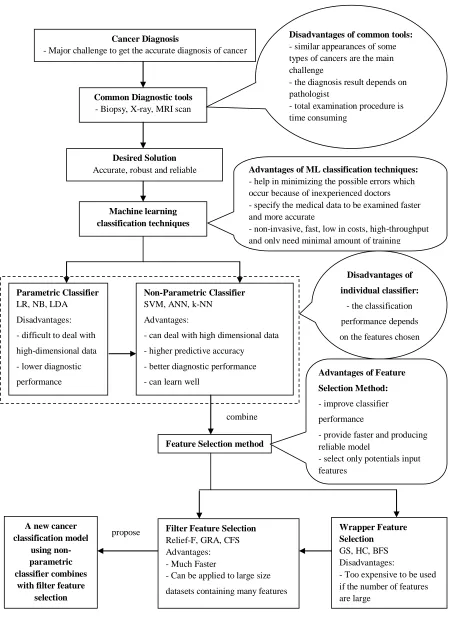
1.1 Scenario leading to the research problem and research solution
8
2.1 The uncontrolled growth of cells 18
2.2 The percentage of research paper based on different type of cancer diagnosis (2003-2013)
19
2.3 Total number of research paper using machine learning in cancer diagnosis per year
26
3.1 Operational framework 56
LIST OF ABBREVIATIONS
ML Machine Learning
GRA Grey Relational Analysis
IGRA Improved Grey Relational; Analysis
SVM Support Vector Machine
GRA-SVM Grey Relational Analysis-Support Vector Machine
IGRA-SVM Improved Grey Relational Analysis-Support Vector Machine
G-Mean Geometric Mean
AUC Area under Receiving Operating Characteristic Curve
ROC Receiving Operating Characteristic CT Scan Computerized Axial Tomography MRI Magnetic Resonance Image (MRI) ANN Artificial Neural Network
FL Fuzzy Logic
LDA Linear Discriminant Analysis
DT Decision Tree
k-NN k-Nearest Neighbour
RF Random Forest
NB Naïve-Bayes
LR Logistic Regression
CBR Case-based Reasoning
PSO Particle Swarm Optimization
RFE Recursive Feature Elimination HGA Hybrid Genetic Algorithm
LMNN Levenberg-Marquardt Neural Network RBFNN Radial Basis Function Neural Network AIRS Artificial Immune Recognition System SSVM Smooth Support Vector Machine DFA Discrete Firefly Algorithm
CFS Correlation based Feature Selection
GA Genetic Algorithm
WBCD Wisconsin Breast Cancer Dataset
RBF Radial Basis Function
FS_SFS Filter and Supported Sequential Forward Search
LIST OF APPENDICES
APPENDIX TITLE PAGE
A Sample Result of GRA for WBCD dataset 138
B Sample Result of IGRA for WBCD dataset 141
C Sample Result From MATLAB for WBCD Dataset
144
CHAPTER 1
INTRODUCTION
1.1 Introduction
Cancer is one of the leading causes of death in most countries, and the number of patients survives from cancer diseases are decreasing. The survival rate is strongly influenced by the stage of the malignancy (malignant tumour) at the point of diagnosis. Therefore, a method that allows early diagnosis is desirable to increase the survival rate (Sattlecker, 2011). However, the similar appearances of some types of cancer are the main challenge for common diagnostic tools used by the medical expert such as biopsy; x-ray and MRI scan (Chen, 2011). Furthermore, the diagnosis results are subjective because they depend on the opinion of the medical experts. Thus, the results can vary even when the same sample is examined at different times either by the same medical experts or others. In addition, the total examination procedure is also time consuming (Sattlecker, 2011). Therefore, a better diagnostic approach is needed.
Potdukhe and Karule, 2009; Subashini et al, 2009; Chen et al, 2011; Keyvanfard et al, 2011; Ren, 2012;). In terms of cancer diagnosis, classification method is used by the researchers in order to classify tumour into two different types which are malignant tumour (cancerous) and benign tumour (non-cancerous). Classification method helps minimizing the possible errors which may occur due to inexperienced doctors. Besides, the classification method also specifies the medical data to be examined faster and more accurate (Akay, 2009). Classification methods are non-invasive, fast, low in costs, high-throughput, and only need minimal amount of training (Sattlecker, 2011).
1.2 Problem Background
Cancer is a type of disease that needs early treatment in order to increase the survival rate of the patient. Nowadays, there is still no single test which can accurately diagnose and determine the cancer stage. Patients who are suspected of developing a malignant tumour are examined using common diagnostic techniques such as biopsy, X-ray, MRI and CT scan (Weissleder and Pittet, 2008). However, these diagnostic techniques have some limitations such as high cost and the limited capability to identify the pattern of cancers for each patient. In order to overcome the limitations, a method that is accurate and robust, which is easier and cheaper to implement is needed. Classification method has been proposed by many researchers to determine the cancerous tumour in human body. The classification method is proven to precisely classify tumours and produce a successful diagnosis of cancer.
data. The results showed that classification method could produce excellent performance in diagnosis cancer.
A learning algorithm that performs classification process is known as a learner or a classifier. The classifier is split into two types; parametric classifier and non-parametric classifier (Kumar and Sahoo, 2012). The widely used non-parametric classifiers for cancer diagnosis are Naïve-Bayes (NB), Logistic Regression (LR) and Liner Discriminant Analysis (LDA) while the well-known non-parametric classifiers for cancer diagnosis are Artificial Neural Network (ANN), K-Nearest Neighbour (k-NN) and Support Vector Machine (SVM) (Fischer et al, 2004; Heshmati, 2011; Cınar et al, 2009; Statnikov, 2005; Kumar and Sahoo, 2012). Previous studies showed that the non-parametric classifier had outperformed the non-parametric classifier in terms of the percentage of correctly classified tumour. Moreover, the non-parametric classifiers can learn well and deal efficiently with high dimensional data (Enachescu, 2005; Regnier-Coudert et al, 2011).
Akay, 2009; Cinar et al, 2009; Chen et al, 2012). Based on the advantages mentioned above, SVM is used as the classifier in this study to conduct the cancer diagnosis test.
However, for the past few years, cancer classification problems have been extensively studied. Cancer classification problems generally involve a number of variables. Not all of these varibales are equally important for a specific task. Some of them may be redundant or even irrelevant. Better performance may be achieved by discarding some variables. In other circumstances, the dimensionality of input space may be decreased to save some computation effort, although this may slightly lower classification accuracy (Lin et al, 2008). Therefore, the classification process must be fast and accurate, using the smallest number of variables. This objective can be achieved using feature selection approach. Feature selection strategies are often implied to explore the effect of irrelevant variables on the performance of classifier systems (Valentini, Muselli, & Ruffino, 2004; Zhang, Guo, Du, & Li, 2005; Acir, O¨ zdamar, & Guzelis, 2006; Akay, 2009; Chen, 2011). Furthermore, getting more information such as the most and the least significant factors that influence the cancer classifier performance is very important. However, identifying the relationship among the contributing variables is always grey particularly when the information is not clear, incomplete and uncertain. Therefore, a feature selection model that can handle the incomplete cancer data is needed.
Mat Deris et al, 2013). GRA is a multiple criteria decision support approach which develop ranking and suggest the best choice from a set of alternatives (Huang et al, 2008; Li et al, 2010). GRA has some advantages such as requiring less data, does not rely on data distribution and more applicable to a numeric data value (Zhang and Li, 2006). Besides that, GRA approach is flexible to model complex nonlinear relationships and it is proven to be an accurate and simple method for selecting factors especially for problems with unique characteristic (Sallehudin et al, 2010; Nagpal, 2012). Thus, for this study, the GRA feature selection method is used to select the potential variables and improved the performance of the SVM classifier in cancer data classification.
Despite the fact that GRA could be a good feature selection method for cancer classification, there are some limitations in the traditional GRA proposed by Deng (1989). Grey Relational Degree (GRD), used to determine the GRA ranking value, is mostly affected by the distinguishing rate between the compared sequences. Therefore, it can change substantially when the number of sequences to be compared changes. Thus, the GRD value can be fluctuating because of the slight changes in the compared sequences (Ip et al, 2009). In order to improve the performance of traditional GRA, Ip et al (2009) has proposed the improved GRA (IGRA) method. The IGRA method used the original recorded data without the need of converting them and the level of the computed variable is seen to give a better-quality grading (Ip et al, 2009). For that reason, the IGRA method approach is also used in this study as feature selection method to examine whether it can further improved the performance of the SVM classifier.
Machine learning classification techniques
Cancer Diagnosis
- Major challenge to get the accurate diagnosis of cancer
Desired Solution
Accurate, robust and reliable
Common Diagnostic tools
- Biopsy, X-ray, MRI scan
Disadvantages of common tools:
- similar appearances of some types of cancers are the main challenge
- the diagnosis result depends on pathologist
- total examination procedure is time consuming
Machine learning classification techniques
Advantages of ML classification techniques:
- help in minimizing the possible errors which occur because of inexperienced doctors - specify the medical data to be examined faster and more accurate
- non-invasive, fast, low in costs, high-throughput and only need minimal amount of training
Non-Parametric Classifier
SVM, ANN, k-NN
Advantages:
- can deal with high dimensional data
- higher predictive accuracy
- better diagnostic performance
- can learn well
Parametric Classifier
LR, NB, LDA
Disadvantages:
- difficult to deal with
high-dimensional data
- lower diagnostic
performance
Disadvantages of
individual classifier:
- the classification
performance depends on the features chosen
Feature Selection method
Filter Feature Selection
Relief-F, GRA, CFS Advantages: - Much Faster
- Can be applied to large size
datasets containing many features
Advantages of Feature
Selection Method:
- improve classifier
performance
- provide faster and producing reliable model
- select only potentials input features
Wrapper Feature Selection
GS, HC, BFS Disadvantages:
- Too expensive to be used if the number of features are large
A new cancer classification model
using non-parametric classifier combines
with filter feature selection
combine
Figure 1.1 Scenarios leading to the research problem and research solution (continue)
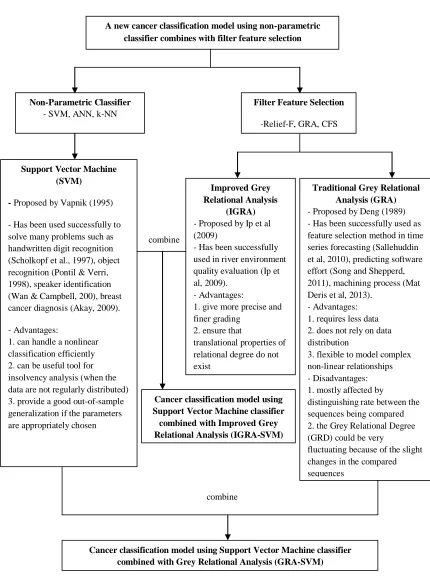
combine
A new cancer classification model using non-parametric classifier combines with filter feature selection
Non-Parametric Classifier
- SVM, ANN, k-NN
Filter Feature Selection
-Relief-F, GRA, CFS
Support Vector Machine (SVM)
- Proposed by Vapnik (1995)
- Has been used successfully to solve many problems such as handwritten digit recognition (Scholkopf et al., 1997), object recognition (Pontil & Verri, 1998), speaker identification (Wan & Campbell, 200), breast cancer diagnosis (Akay, 2009).
- Advantages:
1. can handle a nonlinear classification efficiently 2. can be useful tool for insolvency analysis (when the data are not regularly distributed) 3. provide a good out-of-sample generalization if the parameters are appropriately chosen
Traditional Grey Relational Analysis (GRA)
- Proposed by Deng (1989) - Has been successfully used as feature selection method in time series forecasting (Sallehuddin et al, 2010), predicting software effort (Song and Shepperd, 2011), machining process (Mat Deris et al, 2013).
- Advantages: 1. requires less data 2. does not rely on data distribution
3. flexible to model complex non-linear relationships - Disadvantages: 1. mostly affected by
distinguishing rate between the sequences being compared 2. the Grey Relational Degree (GRD) could be very
fluctuating because of the slight changes in the compared sequences
Improved Grey Relational Analysis
(IGRA)
- Proposed by Ip et al (2009)
- Has been successfully used in river environment quality evaluation (Ip et al, 2009).
- Advantages:
1. give more precise and finer grading
2. ensure that
translational properties of relational degree do not exist
Cancer classification model using Support Vector Machine classifier combined with Improved Grey Relational Analysis (IGRA-SVM)
Cancer classification model using Support Vector Machine classifier combined with Grey Relational Analysis (GRA-SVM)
1.3 Problem Statement
Cancer has been one of the leading causes of death in the world. However, it can be cured if it is diagnosed early. An accurate and reliable diagnosis procedure is required in early diagnosis to distinguish the benign tumour and the malignant tumour. The common diagnostic techniques that had been used by the medical expert are lacking the ability to accurately classify both tumour and are depended on the decision from the medical expert. Therefore, new diagnostic technique is needed in order to get a more accurate diagnosis on cancer.
Machine learning classification techniques are proven to provide excellent performance in cancer diagnosis. Although classification techniques are a good choice in diagnosing cancer, the performance of the classifiers can be affected if they used irrelevant and insignificant variables. For the purpose of getting an accurate diagnosis, the feature selection method is needed to remove the irrelevant and insignificant variables in order to select the only optimal variables to be processed by the classifier. However, the selection of significant variables is a big challenge in cancer classification since most of the data are incomplete
Therefore the problem statement of this research is,
“A new and robust classification model with feature selection method that is able to
identify the optimum variables which affect the performance of the classifier in order to get higher percentage of correctly classified tumour”
The followings are the research questions that will be addressed to answer the above problem statement:
1. How to design a new classification model?
2. How to find the least and the most important variables that affect the classifier performance?
3. How to find the optimum variables that can signify the whole pattern in cancer data in order to sustain high percentage of correctly classified tumour? 4. How to identify the efficiency of the proposed classification model?
5. Can the proposed classification model perform better than the individual models and the existing classification models with feature selection approach?
1.4 Research Aim
The aim of this research is to propose an accurate and robust feature selection approach for cancer classification that is able to provide better percentage of correctly classified tumour by using only potential variables which can influence the classifier performance in diagnosing cancer data.
1.5 Research Objectives
This study is conducted to achieve the above aim and the following objectives:
1. To propose Grey Relational Analysis (GRA) feature selection for cancer classification using Support Vector Machine (SVM) classifier in order to identify the potential variables to distinguish between benign tumour and malignant tumour.
1.6 Research Scope
The scope of this research is limited to the following:
1. The research only focuses on two types of cancer data which are standard cancer data (breast cancer dataset and liver cancer dataset) and gene expression cancer data (prostate cancer dataset and ovarian cancer dataset). 2. The classifier used in this research is a Support Vector Machine (SVM)
classifier.
3. The approaches used for feature selection are Grey Relational Analysis (GRA) method and Improved Grey Relational Analysis (IGRA) method.
1.7 Significant of the Study
it has no ability to classify different types of cancer data. Therefore, the proposed classification models, GRA-SVM and IGRA-SVM are developed to satisfy the needs of an accurate, robust and reliable classification model that can be applied in various types of cancer data.
1.8 Organization of the Thesis
This section describes how this thesis is organized. There are seven chapters include in this thesis. The first chapter (Introduction) described the background of the research problems and justification of the proposed feature selection approaches. The research aim, objectives, scope and significances are also expressed in this chapter. Next, Chapter 2 which is the literature review of this study presents the overview about cancer disease, the limitation of using common diagnostic tools for cancer diagnosis, the advantages of machine learning classification techniques, feature selection approach and the advantages of using feature selection approach in classification models. The selected techniques used in this study are also discussed.
Chapter 6 (Result Evaluation and Validation) gives detail on the evaluation and validation of the proposed GRA-SVM and IGRA-SVM results of four different types of cancer datasets. The evaluation process are done in two categories; the comparative performance between both proposed classification models with standard SVM classification model and the comparative performance of the proposed classification models with the previous studies. The validation process of the proposed classification models are done by using significant test. Finally, Chapter 7 (Discussion and Conclusion) discusses the findings and contributions from this study. Future directions of the research are also mentioned.
1.9 Summary
.
REFERENCES
Anthony, G., Gregg, H., & Tshilidzi, M. (2008). An SVM multi classifier approach to land cover mapping. ASPRS Annual Conference.
Assareh, A. (2008). A hybrid random subspace classifier fusion approach for protein mass spectra classification. EvoBIO'08 Proceedings of the 6th European conference on Evolutionary computation, machine learning and data mining in bioinformatics, pp 1-11.
Akay, M. F. (2009). Support vector machine combined with feature selection for breast cancer diagnosis. Expert System Appl., 36(2), 3240-3247.
Bertsekas, D. P. (1999). Nonlinear programming.
Brown, D., N. (2010). Breast Cancer Classification: A New Perspective from the Supervised Analysis of aCGH Data. Master Thesis, University of Mauritius, Mauritius.
Chang, C. C., & Lin, C. J. LIBSVM: A library for support vector machine, 2001.Software available at http://www. csie. ntu. edu. tw/~ cjlin/libsvm. Chang, P. C., Lin, J. J., & Liu, C. H. (2011). An attribute weight assignment and
particle swarm optimization algorithm for medical database classifications. Comput. Methods Programs Biomed, 107(3), 382-392.
Chen, H.L., Liu, D. Y., Yang, B., Liu, J. & Wang, G. (2011). A new hybrid method based on local fisher discriminant analysis and support vector machines for hepatitis disease diagnosis. Expert System Appl., 38(9), 11796-11803.
Chen, H. L. (2011). A support vector machine classifier with rough set-based feature selection. Expert System Appl., 38(7), 9014-9022.
Cho, Y. S., Chin, C. L., & Wang, K. C. (2011). Based on Fuzzy Linear Discriminant Analysis for Breast Cancer Mammography Analysis. Conference on Technologies and Applications of Artificial Intelligence, pp. 57 - 61.
Choi, H., Yeo, D., Kwon, S., & Kim, Y. (2011). Gene selection and prediction for cancer classification using support vector machines with a reject option. Computational Statistics and Data Analysis, 55, 1897–1908.
Chu, F., Xie, W., & Wang, L. (2004). Gene selection and cancer classification using a fuzzy neural network, IEEE Annual Meeting of the Fuzzy Information, 2, 555 – 559.
Chuang, L.Y., Wu, K. C., & Yang, C. H. (2008). Hybrid Feature Selection Method using Gene Expression Data, Ninth IEEE International Conference on Bioinformatics and BioEngineering, pp. 100-106. .
Cinar, M., Mehmet, E., Erkan, Z. B., & Ziya, Y. A. (2009). Early prostate cancer diagnosis by using artificial neural networks and support vector machines. Expert Systems with Applications, 36, 6357-6361.
Deng, J. L. (1989). Control problems of grey systems. Systems and Control Letters, 1(5), 288-294.
Enachescu, D., & Enachescu, C. (2005). Learning vector quantization for breast cancer prediction. In portuguese conference on Artificial intelligence, pp. 177-180
Evgeniou, T., Pontil, M., Papageorgiou, C., & Poggio, T. (2003). Image representation and feature selection for multimedia database search, IEEE Trans. Knowledge Data Eng., 15 (4), 911–920.
Fischer, E. A., Lo, J. Y., & Markey, M. K. (2004). Bayesian networks of BI-RADS™ descriptors for breast lesion classification. 26th Annual International Conference of the IEEE Engineering in Medicine and Biology Society, 2, pp. 3031-3034.
Guyon, I., Weston, J., & Barnhill, S. (2002). Gene Selection for Cancer Classification using Support Vector Machines. Machine Learning, 46, 389-422.
Hasan, H., & Tahir, N. M. (2010). Feature selection of breast cancer based on Principal Component Analysis. In 6th International Colloquium on Signal Processing and Its Applications, pp. 1-4.
Heshmati, A., Amjadifard, R., & Shanbehzadeh, J. (2011). ReliefF-based feature selection for automatic tumor classification of mammogram images. In Machine Vision and Image Processing (MVIP), pp. 1-5.
Holland, J. H. (1975). Adaptation in natural and artificial systems: An introductory analysis with applications to biology, control, and artificial intelligence. U Michigan Press.
Hsu, H. H., Hsieh, C. W., & Lu, M. D. (2011). Hybrid feature selection by combining filters and wrappers. Expert Systems with Applications, 38(7), 8144-8150.
Huang, T. M., & Kecman, V. (2005). Gene extraction for cancer diagnosis by support vector machines--an improvement. Artificial Intelligence in Medicine, 35, 185-194.
Huang, C. L., Liao, H. C., & Chen, M. C. (2008). Prediction model building and feature selection with support vector machines in breast cancer diagnosis. Expert Systems with Applications, 34(1), 578-587.
Huang, J., Cai, Y., & Xu, X. (2007). A hybrid genetic algorithm for feature selection wrapper based on mutual information. Pattern Recognition Letters, 28, 1825– 1844.
Ip, W. C., Hu, B. Q., Wong, H., & Xia, J. (2009). Applications of grey relational method to river environment quality evaluation in China. Journal of Hydrology, 379(3), 284-290.
Jaganathan, P., Rajkumar, N., & Kuppuchamy, R. (2013). A Comparative Study of Improved F-Score with Support Vector Machine and RBF Network for Breast Cancer Classification. International Journal of Machine Learning and Computing, 2 (6), 741-745.
Jong, K., Marchiori, E., Sebag, M., & Van Der Vaart, A. (2004). Feature selection in proteomic pattern data with support vector machines. IEEE Symposium on Computational Intelligence in Bioinformatics and Computational Biology, pp. 41-48.
Kannan, S. S., & Ramaraj, N. (2010). A novel hybrid feature selection via Symmetrical Uncertainty ranking based local memetic search algorithm. Knowledge-Based Systems, 23, 580-585.
Kasabov, N. (2002). Evolving connectionist systems: Methods and applications in bioinformatics, brain study and intelligent machines. Springer.
Keyvanfard, F., Shoorehdeli, M. A., & Teshnehlab, M. (2011). Feature selection and classification of breast cancer on dynamic magnetic resonance imaging using ANN and SVM. American Journal of Biomedical Engineering 1, 20-25. Kira, K., & Rendell, L. A. (1992). A practical approach to feature selection.
In Proceedings of the ninth international workshop on Machine learning (pp. 249-256). Morgan Kaufmann Publishers Inc..
Kononenko, I. (1994). Estimating attributes: analysis and extensions of RELIEF. In Machine Learning: ECML-94 (pp. 171-182). Springer Berlin Heidelberg.
Kumar, Y., & Sahoo, G. (2012). Analysis of Parametric & Non Parametric Classifiers for Classification Technique using WEKA. I.J. Information Technology and Computer Science, 7, 43-49.
Laura A. and Rouslan A. (2008). Support Vector Machines (SVM) as a technique for solvency analysis.
Li, F., Lung, T., & Yeh, C. (2010). Comparison of filter approaches based on RVFL classifier. Seventh International Conference on Fuzzy Systems and Knowledge Discovery (FSKD), 4, pp. 1520-1524
Lisboa, P. J., & Taktak, A. F. (2006). The use of artificial neural networks in decision support in cancer: a systematic review. Neural networks, 19(4), 408-415.
Liu, Y. (2009). Feature extraction and dimensionality reduction for mass spectrometry data. Computers in Biology and Medicine, 39(9), 818-823.
Liu, Y., & Zheng, Y. F. (2006). FS_SFS: A novel feature selection method for support vector machines. Pattern recognition, 39(7), 1333-1345.
Liu, Y., An, A., & Huang, X. (2006). Boosting prediction accuracy on imbalanced datasets with SVM ensembles. In Advances in Knowledge Discovery and Data Mining (pp. 107-118). Springer Berlin Heidelberg.
Makinacı, M. (2005). Support vector machine approach for classification of cancerous prostate regions. World Academy of Science, Engineering and Technology, 166-169.
Mao, K. Z. (2004). Feature subset selection for support vector machines through discriminative function pruning analysis, IEEE Trans. Syst. Man, Cybern. 34(1), 60–67.
Mat Deris, A., Mohd Zain, A., & Sallehuddin, R. (2013). Hybrid GR-SVM for prediction of surface roughness in abrasive water jet machining. Meccanica. 1937-1945.
Mazlan, U. H., & Saad, P. (2012). Classification of breast cancer microarray data using Radial Basis Function Network. In International Conference on Statistics in Science, Business, and Engineering (ICSSBE), pp. 1-4.
Meng, Y. (2006). A swarm intelligence based algorithm for proteomic pattern detection of ovarian cancer. IEEE Symposium on Computational Intelligence and Bioinformatics and Computational Biology, pp. 1-7.
Mousa, R., Munib, Q., & Moussa, A. (2005). Breast cancer diagnosis system based on wavelet analysis and fuzzy-neural. Expert systems with Applications,28(4), 713-723.
Nagpal, G., Uddin, M., & Kaur, A. (2012). A Hybrid Technique using Grey Relational Analysis and Regression for Software Effort Estimation using Feature Selection. International Journal of Soft Computing and Engineering (IJSCE), ISSN, 2231-2307.
Ngai, E. W. T., Hu, Y., Wong, Y. H., Chen, Y., & Sun, X. (2011). The application of data mining techniques in financial fraud detection: A classification
framework and an academic review of literature. Decision Support Systems, 50(3), 559-569.
Pan, S. M., & Lin, C. H. (2010). Fractal features classification for liver biopsy images using neural network-based classifier. In International Symposium on Computer Communication Control and Automation (3CA), 2, pp. 227-230. Polat, K., & Güneş, S. (2007). Breast cancer diagnosis using least square support
vector machine. Digital Signal Processing, 17(4), 694-701.
classification of EEG signals. Expert Systems with Applications, 34(3), 2039-2048.
Pontil M, Verri A (1998) Support vector machines for 3-D object recognition. IEEE Transactions on Pattern Analysis and Machine Intelligence, 20, 637-646. Potdukhe, M. R., & Karule, P. T. (2009). MLP NN based DSS for analysis of
ultrasonic liver image and diagnosis of liver disease. Second International Conference on Emerging Trends in Engineering and Technology, pp. 67-72. Purnami, S. W., Rahayu, S. P., & Embong, A. (2008). Feature selection and
classification of breast cancer diagnosis based on support vector machines. In International Symposium on Information Technology, 1, pp. 1-6.
Regnier-Coudert, O., McCall, J., Lothian, R., Lam, T., McClinton, S., & N’Dow, J. (2012). Machine learning for improved pathological staging of prostate cancer: a performance comparison on a range of classifiers. Artificial Intelligence in Medicine, 55(1), 25-35.
Ren, J. (2012). ANN vs. SVM: Which one performs better in classification of MCCs in mammogram imaging. Knowledge-Based Systems, 26, 144-153.
Russell, S. J., Norvig, P., Canny, J. F., Malik, J. M., & Edwards, D. D. (2003). Artificial intelligence: a modern approach (Vol. 74). Englewood Cliffs: Prentice hall.
Sallehudin, R. (2009). Grey relational with BP_PSO for time series foreasting. IEEE International Conference on Systems, Man and Cybernetics pp. 4895-4900. Sallehuddin, R., & Shamsuddin, S. M. (2009). Hybrid grey relational artificial neural
network and auto regressive integrated moving average model for forecasting time-series data. Applied Artificial Intelligence, 23(5), 443-486.
Sallehuddin, R., Shamsuddin, S. M., & Hashim, S. Z. M. (2010). Forecasting small data set using hybrid cooperative feature selection. In 12th International Conference on Computer Modelling and Simulation (UKSim), pp. 80-85.
Samui, P., & Dixon, B. (2012). Application of support vector machine and relevance vector machine to determine evaporative losses in reservoirs.Hydrological Processes, 26(9), 1361-1369.
Scholkopf B, Kah-Kay S, Burges CJ, Girosi F, Niyogi P, Poggio T (1997) Comparing support vector machines with gaussian kernels to radial basis function classifiers. IEEE Transactions on Signal Processing 45(11), 2758-2765.
Setiono, R. (2000). Generating concise and accurate classification rules for breast cancer diagnosis. Artificial Intelligence in medicine, 18(3), 205-219.
Song, Q., & Shepperd, M. (2011). Predicting software project effort: A grey relational analysis based method. Expert Systems with Applications, 38(6), 7302-7316.
de Souza, J. T. (2004). Feature selection with a general hybrid algorithm. Doctoral dissertation, University of Ottawa.
Srivastava, A., Chakrabarti, S., Das S., Ghosh, S., & Jayaraman, V. K. (2013). Hybrid Firefly Based Simultaneous Gene Selection and Cancer Classification Using Support Vector Machines and Random Forests. Advances in Intelligent Systems and Computing, 201, 485-494.
Statnikov, A. (2005). Automatic cancer diagnostic decision support system for gene expression domain. Doctoral dissertation, Vanderbilt University.
Subashini, T. S., Ramalingam, V., & Palanivel, S. (2009). Breast mass classification based on cytological patterns using RBFNN and SVM. Expert Systems with Applications, 36(3), 5284-5290.
Tan, T. Z., Quek, C., Ng, G. S., & Razvi, K. (2008). Ovarian cancer diagnosis with
complementary learning fuzzy neural network. Artificial intelligence in medicine, 43(3), 207-222.
Vapnik, V. (1995). The nature of statistical learning theory. Springer.
Vu, T. N., Ohn, S. Y., & Kim, C. W. (2007). RISC: A New Filter Approach for Feature Selection from Proteomic Data. Medical Biometrics, 4901, 17-24. Wahid, C. (2011). Microarray gene selection for cancer classification using support
vector machine. Doctoral dissertation, Faculty of Arts, Business, Informatics and Education, CQUniversity Australia.
Wan V, Campbell WM (2000) Support Vector Machines for Speaker Verification and Identification. IEEE Workshop Neural Networks for Signal Processing, 775-784.
Wu, Y., Wang, N., Zhang, H., Qin, L., Yan, Z., & Wu, Y. (2010, August). Application of artificial neural networks in the diagnosis of lung cancer by computed tomography. In Sixth International Conference on Natural Computation, 1, pp. 147-153.
Xuerui, T., & Yuguang, L. (2004). Using grey relational analysis to analyze the medical data. Kybernetes, 33(2), 355-362.
Yang, C. S., Chuang, L. Y., Ke, C. H. & Yang, C. H. (2008). A hybrid feature selection method for microarray classification, IAENG International Journal of Computer Science, 35(3).