ABSTRACT
HANNA, BOTROS NASEIF HANNA BISHARA. Coarse-Grid Computational Fluid Dynamics (CG-CFD) Error Prediction using Machine Learning. (Under the direction of Dr. Nam T. Dinh and Dr. Igor A. Bolotnov).
Nuclear reactor safety research requires analysis of a broad range of accident scenarios.
One of the major safety barriers against nuclear fission products release is the containment
structure. Modeling and simulation are essential tools to identify parameters affecting Containment
Thermal Hydraulics (CTH) phenomena. The thermal-hydraulic modeling approaches used in the
nuclear industry can be classified into two categories: system-level codes and Computational Fluid
Dynamics (CFD) codes. System codes are not as capable as CFD of capturing and giving detailed
knowledge of the multi-dimensional behavior of CTH phenomena. However, CFD computational
cost is high when modeling complex accident scenarios, especially the ones which involve
longtime transients. The high expense of traditional CFD is due to the need for computational grid
refinement to guarantee that the solutions are grid independent.
To mitigate the computational expense, it is proposed to rely on coarse-grid CFD
(CG-CFD). Coarsening the computational grid makes the computation significantly more affordable for
practical applications, but it also increases the discretization (grid-induced) error which depends
on the grid size and varies with space and time. Hence, a method is developed to produce a
surrogate model, that predicts the distribution of the CG-CFD local error, to correct the flow
variables of interest. Given high-fidelity simulations (sufficiently fine-mesh simulations), a
surrogate model is trained to predict the CG-CFD local errors as a function of the coarse-grid local
flow features. The surrogate model is constructed using machine learning regression algorithms
This proposed method is applied to a three-dimensional turbulent flow inside a lid-driven
cavity domain. A set of scenarios that test the proposed method are studied. These scenarios
investigate the capability of the surrogate model to interpolate and extrapolate outside the training
data range. These scenarios also cover a range of Reynolds number in the turbulent flow and
transitional flow range plus a range of grid sizes, aspect ratios and different variables of interest.
Based on the investigated cases: it was found that the random forest regression technique is
predicting the grid-induced error better than the neural network although random forest technique
is computationally cheaper. The proposed method maximizes the benefit of the available data and
shows a potential for a good predictive capability.
The proposed CG-CFD approach is different from conventional CFD for two reasons: (1)
Typically, for each new fluid flow problem, a new simulation is needed, and a grid-independent
solution is required, even if the new flow problem is only slightly different from old one. In the
proposed CG-CFD method, the available data are utilized to predict the variable of interest for the
new flow problem (that is simulated by a coarse grid) given the available high-fidelity data. The
success of this approach is based on the assumption that the available high-fidelity data and the
new flow problem have similar physics. (2) In conventional turbulence modeling, turbulence
models typically rely on incorporating more physics and using empirical models for some
parameters based on the available validation data. For different flow conditions, new turbulence
models may be constructed. The proposed method is data driven so each new experimental data or
© Copyright 2018 by Botros Naseif Hanna Bishara Hanna
Coarse-Grid Computational Fluid Dynamics (CG-CFD) Error Prediction using Machine Learning.
by
Botros Naseif Hanna Bishara Hanna
A dissertation submitted to the Graduate Faculty of North Carolina State University
in partial fulfillment of the requirements for the degree of
Doctor of Philosophy
Nuclear Engineering
Raleigh, North Carolina
2018
APPROVED BY:
_______________________________ _______________________________ Dr. Nam T. Dinh Dr. Igor A. Bolotnov
Committee Co-Chair Committee Co-Chair
ii DEDICATION
To my Father, Mikhaeel Hanna Who always supported me.
iii BIOGRAPHY
The author, Botros N. Hanna was born in March 1988 in Athribis in lower Egypt. His given
name (Botros) means the stone. He is the first child of his father, Mikhaeel Hanna and his mother,
Sonia Samaan. He has one younger brother (Pemen). Botros was married to Monika Attia in
January 2016.
Botros earned the bachelor’s degree in Nuclear Engineering with a degree of honors from
Alexandria University in 2010. In Fall 2012, Botros joined the Department of Nuclear Engineering
in North Carolina State University as a graduate student. He started his graduate studies with Dr.
Igor A. Bolotnov and Dr. Nam T. Dinh in Fall 2013 to get his Master of Science degree in 2015.
His research areas include computational fluid dynamics for nuclear engineering applications plus
application of machine learning algorithms to develop big-data-driven physics-informed models.
He successfully defended his PhD dissertation in April 2018.
iv ACKNOWLEDGMENTS
I give my ultimate thanks to God who has given me the power and persistence to get where
I am today. I cannot thank enough my beloved spouse, Monika who has been my beautiful wife,
life companion and stayed by my side in good and hard times. I am incredibly thankful for my
family; my mother who always believed in me, my father for his limitless love and support and
my brother who is always the best friend. I also acknowledge the guidance of those who
encouraged me to pursue my studies in USA (Dr. Hanaa Abou Gabal and Dr. Alya Badawi in
Alexandria University, Egypt).
I would like to express my gratitude to Dr. Igor A. Bolotnov and Dr. Nam T. Dinh for their
consistent support throughout my Ph.D. journey. They always provided me with their insightful
discussions about the research. They encouraged me to be an independent researcher and they were
always great examples to follow in academic research. I also acknowledge the advice and
recommendations by Dr. Robert Youngblood and Dr. Tiegang Fang.
I also acknowledge the support of the Idaho National Laboratory through its National
University Consortium and Laboratory Directed Research & Development (LDRD) Program
under DOE Idaho Operations Office and the Nuclear Engineering Department at NC State
University.
v TABLE OF CONTENTS
LIST OF TABLES ... viii
LIST OF FIGURES ... ix
ABBREVIATIONS ... xii
NOMENCLATURE ... xiv
1. INTRODUCTION ... 1
1.1. Objectives ... 2
1.2. An Overview of System Codes for Nuclear Thermal Hydraulics ... 2
1.3. An Overview of CFD Codes for Nuclear Thermal Hydraulics ... 4
1.4. Motivation: The Need for Data-Driven Models ... 5
1.5. Progress in Data-Driven Models in Fluid Dynamics ... 6
1.5.1. Autonomic sub-grid Large Eddy Simulation (ALES) ... 6
1.5.2. Autonomic sub- Closure Term in a Bubbly Flow Equation ... 7
1.5.3. RANS Model Discrepancy ... 8
1.5.4. Smoothed Particle Hydrodynamics... 11
1.6. CG-CFD for Simulating CTH ... 11
1.7. The Scope of This Work ... 14
1.7.1. Present Approach vs. Traditional CFD ... 15
1.7.2. Present Research vs. Turbulence Modeling Error Reduction ... 16
1.7.3. This Work vs. Reduced Order Modeling (ROM) ... 17
1.8. The Structure of This Dissertation ... 18
1.9. Definitions ... 18
1.10. Chapter Summary ... 19
2. TURBULENCE MODELING ... 21
2.1. Objectives ... 21
2.2. Basics of the Turbulence Theory ... 21
2.3. Large Eddy Simulation (LES) ... 23
2.4. Reynolds Averaged Navier-Stokes (RANS) Equations ... 27
2.5. Grid-Induced Error in LES, RANS, and CG-CFD ... 30
2.5.1. LES ... 30
2.5.2. RANS ... 31
vi
2.6. Chapter Summary ... 32
3. NUMERICAL SOLUTION ERROR ... 34
3.1. Objectives ... 34
3.2. Discretization Methods ... 34
3.2.1. Finite Difference Method (FDM) ... 35
3.2.2. Finite Element Method (FEM) ... 36
3.2.3. Finite Volume Method (FVM) ... 37
3.3. Iterative Methods... 40
3.4. Discretization Error ... 41
3.5. Iterative Convergence Error ... 42
3.6. Chapter Summary ... 43
4. MACHINE LEARNING ... 45
4.1. Objectives ... 46
4.2. Clustering ... 47
4.3. Dimensionality Reduction ... 48
4.4. Classification ... 49
4.5. Regression ... 51
4.5.1. Artificial Neural Network (ANN) ... 51
4.5.2. Deep Learning ... 54
4.5.3. Random Forest Regression ... 55
4.6. Chapter Summary ... 57
5. COARSE-GRID ERROR PREDICTION METHOD ... 59
5.1. Objectives ... 59
5.2. Problem Statement ... 59
5.3. Research Hypothesis ... 60
5.4. Proposed Approach ... 62
5.4.1. CG-CFD Error Prediction Method ... 62
5.4.2. Features Selection ... 64
5.4.3. Data Comparison (Mapping) ... 65
5.4.4. Data Normalization ... 66
5.4.5. Machine Learning Error Assessment... 67
5.5. Case Study ... 68
5.5.1. Numerical Simulations ... 69
vii
5.6. Summary ... 73
6. RESULTS AND DISCUSSIONS ... 74
6.1. Objectives ... 74
6.2. Validation ... 74
6.3. Training and Testing Cases ... 75
6.3.1. Scenario I: Reynolds Number Interpolation ... 77
6.3.2. Scenarios II and III: Reynolds Number Extrapolation. ... 81
6.3.3. Scenarios IV, V and VI: Grid Size Interpolation and Extrapolation. ... 91
6.3.4. Scenarios VII, VIII and IX: Reynolds Number and Grid Size Interpolation and Extrapolation. ... 91
6.3.5. Other Variables 𝑈𝑦 and 𝑈𝑧 ... 91
6.3.6. Computational Time for Big Data ... 98
6.3.7. Data Convergence ... 98
6.3.8. Scenario X: Different grid spacing in different directions. ... 104
6.3.9. Scenario XI, XII and XIII (Extrapolation to Aspect Ratio =1.2). ... 105
6.3.10. Scenario XIV, XV, XVI, XVII and XVIII (Aspect Ratio Interpolation and Extrapolation up to Aspect Ratio = 4). ... 105
6.4. Chapter Summary ... 119
7. CONCLUSIONS... 121
7.1. Contributions ... 121
7.2. Future Work ... 123
viii LIST OF TABLES
Table 1 A Comparison between two approaches for data-driven turbulence modeling. ... 9
Table 2 Different RANS turbulence models ... 29
Table 3 Taxonomy of ML algorithms. ... 46
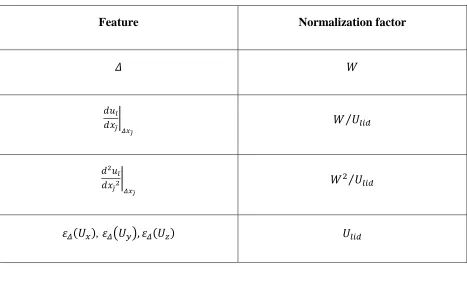
Table 4 Normalization factors for different variables.s ... 67
Table 5 Training and testing data (first set of scenarios in terms of Re and ∆). Re and Δ are the Reynolds number and the grid spacing, respectively. ... 71
Table 6 Training and testing data (second set of scenarios in terms of 𝑅𝑒, ∆, and 𝐻/𝑊). 𝑅𝑒, 𝛥, and 𝐻/𝑊 are the Reynolds number, grid spacing and aspect ratio,respectively ... 72
Table 7 A comparison between different scenarios in terms of ML error and computational time. ... 86
Table 8 Data convergence study. ... 104
ix LIST OF FIGURES
Figure 1 A conceptual framework for simulating CTH with CG-CFD. The focus of
this work is highlighted in yellow. ... 12
Figure 2 A snapshot of the velocity (𝑈𝑦) profile in a three-dimensional quasi- steady state turbulent flow in a lid-driven cavity. The lid is moving in 𝑥- direction. The profile is computed with a fine grid (left) and a coarse- grid (right). The fine-grid result is mapped to a coarse-grid (in the middle). ... 13
Figure 3 CFD sources of error. ... 15
Figure 4 Distribution of turbulent energy in wavenumber space. ... 22
Figure 5 Computational expense (of DNS, LES, and RANS) as a function of Reynolds number. ... 27
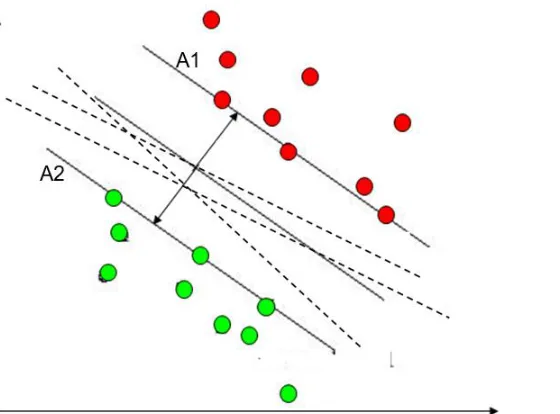
Figure 6 Illustration of the classification problem: various dashed lines separating two groups of data. ... 50
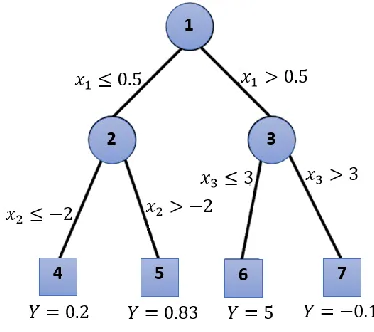
Figure 7 Regression tree. ... 56
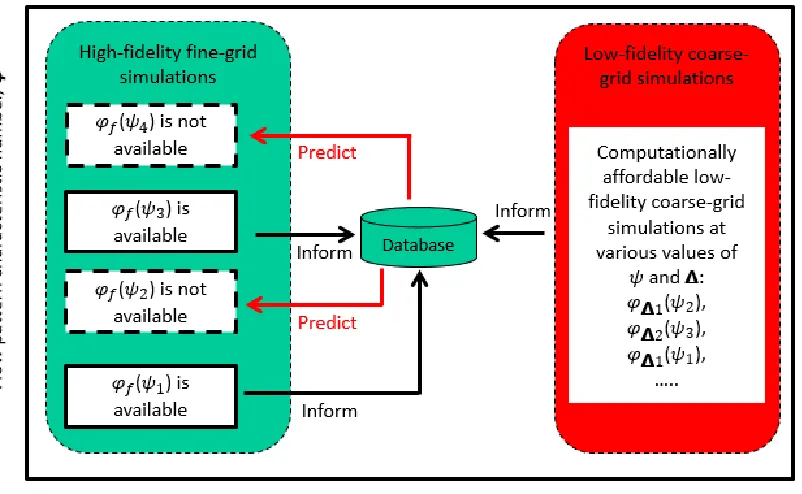
Figure 8 Workflow for data generation in the CG-CFD problem. ... 60
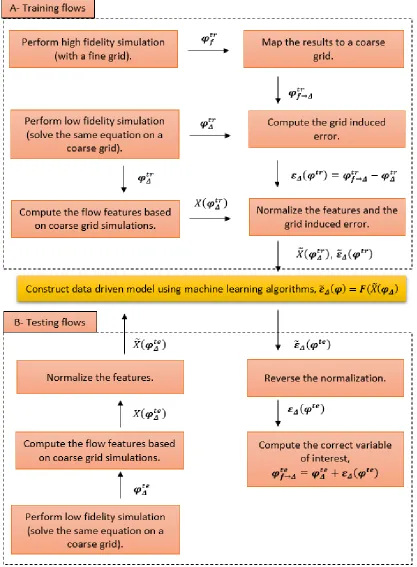
Figure 9 The proposed method to predict CG-CFD error using ML algorithms. ... 63
Figure 10 Mapping flow variable, computed by a fine grid onto a coarse grid by one of two approaches: point to point (top) or cell to cell (bottom). ... 66
Figure 11 Lid-driven cubic cavity. The lid velocity is parallel to the 𝑥-axis. ... 69
Figure 12 The axial profile (𝑦 direction) for velocity, 𝑈𝑥 (top) and the axial profile (𝑥 direction for the velocity, 𝑈𝑦 (bottom) at 𝑅𝑒 = 12000. ... 76
Figure 13 A representation of one-hidden-layer ANN with 37 inputs, 20 neurons and one output as represented by MATLAB [25]. 𝑤 and 𝑏 represent the weights and biases as presented in Section 4.5.1. ... 77
Figure 14 ANN performance in scenario I (training flows). MSE vs. the number of iterations (epochs) (above). 𝜀𝛥𝑈𝑥 expected by ANN vs. the actual 𝜀𝛥𝑈𝑥 (below). ... 78
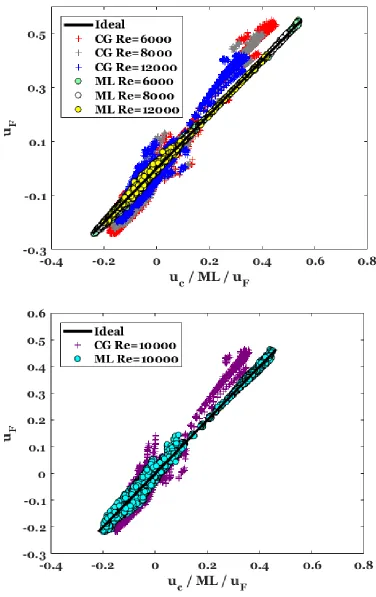
Figure 15 Scenario I (Reynolds number interpolation) for 𝑈𝑥 (by ANN). ∆= 0.033𝑚. Training data (above) and testing data (below). CG: Coarse grid predictions. ML: Machine learning predictions. ... 80
Figure 16 RFR OOB error decreases with increasing number of trees. ... 82
x Figure 18 Scenario II (Reynolds number extrapolation to a higher value) for 𝑈𝑥 (by
ANN). ∆= 0.033𝑚. Training data (above) and testing data (below). ... 84
Figure 19 Scenario II (Reynolds number extrapolation to a higher value) for 𝑈𝑥 (by
RFR). ∆= 0.033𝑚. Training data (above) and testing data (below). ... 85
Figure 20 A representation of Three-hidden-layer ANN with 37 inputs, 20 neurons
for each layer and one output as represented by MATLAB [25]. ... 87
Figure 21 Effect of increasing the number of neural network layers on ML error for
the scenario I (above) and the scenario II (below). ... 88
Figure 22 Effect of increasing the number of neural network layers on the
computational time. ... 89
Figure 23 Scenario III (Reynolds number extrapolation to a lower value) for 𝑈𝑥 (by
RFR). ∆= 0.033𝑚. Training data (above) and testing data (below). ... 90
Figure 24 Scenario IV (grid size interpolation) for 𝑈𝑥 (by RFR). 𝑅𝑒 = 12000.
Training data (above) and testing data (below). ... 92
Figure 25 Scenario V (grid size extrapolation to a finer grid) for 𝑈𝑥 (by RFR).
𝑅𝑒 = 12000. Training data (above) and testing data (below). ... 93
Figure 26 Scenario VI (grid size extrapolation to a coarser grid) for 𝑈𝑥 (by RFR).
𝑅𝑒 = 12000. Training data (above) and testing data (below). ... 94
Figure 27 Scenario VII (Reynolds number and grid size interpolation) for 𝑈𝑥 (by
RFR). Training data (above) and testing data (below). ... 95
Figure 28 Scenario VIII (extrapolation to a higher Reynolds number and a finer grid)
for 𝑈𝑥 (by RFR). Training data (above) and testing data (below). ... 96
Figure 29 Scenario IX (extrapolation to a lower Reynolds number and a coarser grid)
for 𝑈𝑥 (by RFR). Training data (above) and testing data (below). ... 97
Figure 30 Scenario VII (Reynolds number and grid size interpolation) for 𝑈𝑦 (by RFR).
Training data (above) and testing data (below). ... 99
Figure 31 Scenario VIII (extrapolation to a higher Reynolds number and a finer grid)
𝑈𝑦 (by RFR). Training data (above) and testing data (below). ... 100
Figure 32 Scenario VII (Reynolds number and grid size interpolation) for 𝑈𝑧 (by RFR).
Training data (above) and testing data (below). ... 101
Figure 33 Scenario VIII (extrapolation to a higher Reynolds number and a finer grid) for
𝑈𝑧 (by RFR). Training data (above) and testing data (below). ... 102
Figure 34 Big-data computational cost using random forest regression. ... 103
Figure 35 Scenario X (different grid spacing in different directions) for 𝑈𝑥 (by RFR).
xi Figure 36 Scenario XI (aspect ratio extrapolation) for 𝑈𝑥 (by RFR). Training data
(above) and testing data (below). ... 107
Figure 37 Scenario XII (aspect ratio and Reynolds number extrapolation) for 𝑈𝑥
(by RFR). Training data (above) and testing data (below). ... 108
Figure 38 Scenario XIII (aspect ratio, Reynolds number, and grid size extrapolation)
for 𝑈𝑥 (by RFR). Training data (above) and testing data (below). ... 109
Figure 39 Scenario XIV (aspect ratio interpolation) for Ux (by RFR). Training data
(above) and testing data (below). ... 111
Figure 40 Scenario XIV (aspect ratio interpolation), after adding new features, for 𝑈𝑥
(by RFR) Training data (above) and testing data (below). ... 112
Figure 41 Scenario XV (aspect ratio extrapolation to a lower ratio), for 𝑈𝑥 (by RFR).
Training data (above) and testing data (below). ... 113
Figure 42 Scenario XVI (aspect ratio extrapolation to a higher ratio), for 𝑈𝑥 (by RFR).
Training data (above) and testing data (below). ... 114
Figure 43 Velocity profile in x-direction inside the lid-driven cavity flow for different
aspect ratios at 𝑅𝑒 = 6000. ... 115
Figure 44 Training data from different aspect ratios and grid sizes for scenario XVII
and XVIII for 𝑈𝑥 (by RFR) at 𝑅𝑒 = 12000. ... 116
Figure 45 Testing data for scenario XVII (aspect ratio extrapolation) for 𝑈𝑥 (by RFR)
at 𝑅𝑒 = 12000. ... 117
Figure 46 Testing data for scenario XVIII (aspect ratio and grid size extrapolation) for
𝑈𝑥 (by RFR) at 𝑅𝑒 = 12000. ... 117
Figure 47 Velocity profile in 𝑥 direction inside the lid-driven cavity flow for different
xii ABBREVIATIONS
ALES Autonomic sub-grid Large Eddy Simulation
ANN Artificial Neural Network
BD Blended Difference
BWR Boiling Water Reactor
CD Central Difference
CFD Computational Fluid Dynamics
CG Coarse Grid
CG-CFD Coarse-Grid Computational Fluid Dynamics
CTH Containment Thermal Hydraulics
DL Deep Learning
DNS Direct Numerical Simulation
FDM Finite Difference Method
FEM Finite Element Method
FVM Finite Volume Method
HF High Fidelity
KDE Kernel Density Estimation
LES Large Eddy Simulation
LF Low Fidelity
MATLAB Matrix Laboratory
MD Mahalanobis Distance
ML Machine Learning
xiii
NPP Nuclear Power Plant
NS Navier – Stokes
OOB Out Of Bag
OpenFOAM Open source Field Operation And Manipulation
PC Principal Component
PCA Principal Component Analysis
PDE Partial Differential Equation
PIML Physics Informed Machine Learning
PISO Pressure Implicit Splitting of Operators
QOI Quantity Of Interest
RANS Reynolds Averaged Navier-Stokes
RFR Random Forest Regression
RISMC Risk-Informed Safety Margin Characterization
ROM Reduced Order Modeling
SGS Sub-Grid Scale
SVM Support Vector Machines
TE Truncation Error
TH Thermal Hydraulics
TKE Turbulence Kinetic Energy
xiv NOMENCLATURE
𝐶𝑠 Smagorinsky constant
𝐸(𝜅𝑙) The energy contained in the eddies of size 𝑙 𝐸𝑀𝑙 Machine learning algorithm error
𝐹 Surrogate function
𝐻/𝑊 The aspect ratio (height to width ratio)
𝐿 Discrete operator
𝐿𝑓 Discrete operator computed by a fine grid
𝐿𝑠 The mixing length for sub-grid scales
𝐿𝛥 Discrete operator computed by a grid, 𝛥
𝑃 The rate of turbulence energy production
𝑄 The second invariant of the velocity gradient tensor
𝑅 Correlation coefficient
𝑅𝑒 Reynolds number
𝑅𝑒𝜏 Wall-shear stress-based Reynolds numbers
𝑅𝑒𝑡 Turbulent Reynolds number
𝑅𝑒∆ Cell Reynolds number
𝑆𝑖 Silhouette value
T Target
𝑼 Velocity vector
xv
𝑉 Volume
W Cavity width (or cavity lid width)
X Features (inputs) in machine learning algorithm
𝑋̃ Normalized features
𝑌+ 𝑌+ = 𝑢∗𝑑
ν , dimensionless wall distance
𝑑 Distance to the nearest wall
𝑘 Turbulent kinetic energy
𝑙 Length scale
𝑙𝑚 Mixing length
𝑛 Control volume surface normal
𝑝𝑘 Kinematic pressure
𝑡 Time
𝑢∗ Friction velocity at the nearest wall x, y, z Cartesian coordinates
Greek letters
∆ Grid spacing or cell length
∆𝑥, ∆𝑦, ∆𝑧 Grid spacing in the three Cartesian directions: x, y, z
𝛿𝑖𝑗 Kronecker delta
𝜀 The rate of dissipation of the turbulence kinetic energy
xvi
𝜀̃𝛥 Normalized grid-induced error
𝜂 Kolmogorov length scale
𝜅𝑙 The wavenumber of an eddy of size is 𝑙
𝜈 Kinematic viscosity
𝜈𝑠𝑔𝑠 Sub-grid scale viscosity
𝜈𝑡 Turbulent kinematic viscosity
𝜈̃𝑡 Spalart-Allmaras model variable (viscosity like variable)
𝜎 Standard deviation
𝜏 Reynolds stress
𝜏𝑖𝑗
̅̅̅ Sub-grid scale stress tensor
𝜏𝜂 Kolmogorov time scale
𝜑 Flow variable
𝜑̅ Filtered variable
𝜑𝒄 Variable computed by a coarse-grid
𝜑𝒇 Variable computed by a fine grid
𝜑𝑓→𝛥 Flow variable computed by a fine grid and mapped onto a coarse-grid ∆ 𝜑𝑡𝑟 Flow variable distribution corresponding to the training data
𝜑𝑡𝑒 Flow variable distribution corresponding to the testing data
𝜑𝛥 Flow variable computed by a grid, 𝛥
1
1. INTRODUCTION
Nuclear reactor safety analysis has received more attention since the Fukushima Daiichi
accident in 2011. Safety and design of Nuclear Power Plants (NPPs) imply studying Thermal
Hydraulics (TH) phenomena that may evolve during normal operation, design-basis accidents (that
NPP is designed to withstand) or severe accidents (that involve core melting) [1]. If an accident
occurs, the role of the reactor containment is vital as the major and final safety barrier. Hence,
predicting the Containment Thermal Hydraulics (CTH) phenomena impacts is needed to maintain
the integrity of the containment. Experiments that mimic the potential CTH phenomena are
necessary, but it is almost impossible to gain experimental full-scale data the cover all CTH
phenomena. Hence, for a complex system such as NPP, modeling and simulation are necessary
for performing safety analysis. There are various codes that are used to achieve this purpose: the
system TH codes (see Section 1.2) and Computational Fluid Dynamics (CFD) codes (see Section
1.3).
The system TH codes can model the entire reactor and its components as they include
multiple physics (fluid flow, heat transfer, neutron diffusion equations, etc.). However, system
codes have some limitations as they cannot capture the local three-dimensional complex
phenomena and they rely on many empirical correlations and parameters that are required due to
the lack of full understanding of the complex governing physics. Hence, CFD codes are needed to
capture the multi-dimensional behavior of the phenomena of interest. However, CFD approach is
computationally expensive for simulating complex systems with large computational domains.
The high expense of traditional CFD is due to the need for computational grid refinement to
guarantee that the solutions are grid-independent. To reduce the CFD computational cost, there is
2 It is proposed that the numerical error, which arises because of the coarse grids, can be
reduced/recovered using data-driven models. The need of data-driven CFD models, which benefit
from the available experimental and high-fidelity simulations, is emphasized in Section 1.4.
Currently, there is an increasing attention to the necessity of data-driven fluid dynamics’ models
that can be less expensive and more adaptable to the data (see Section 1.5).
This work proposes a framework to use a data-driven CG-CFD method in CTH field
(described in Section 1.6). To clarify the difference between the proposed data-driven CG-CFD
method and other approaches that aim to mitigate the complexity of CFD, the scope of this work
is presented in Section 1.7. Finally, the structure of the rest of the dissertation is described in
Section 1.8.
1.1.Objectives
The objectives of this chapter can be summarized as follows:
• Evaluating the capabilities and limitation of potential codes in CTH fields (system codes and
CFD).
• Introducing the motivation behind this research.
• Discussing the current research in data-driven CFD modeling.
• Developing a general framework to use CG-CFD simulations in CTH field.
1.2.An Overview of System Codes for Nuclear Thermal Hydraulics
System codes are designed to simulate the phenomena that are involved in design basis and
severe accidents. These codes utilize control volume approach to perform affordable computations.
Large control volumes are used to perform economic simulations. For instance, control volumes,
that are bigger than a one-meter cube, are used in phenomena-dominating regions (reactor vessel
3 bigger in other less-important regions in the nuclear system [2, 3]. Within each volume, time and
space dependent conservation equations for mass, momentum, and energy are solved for a
homogenous two-phase (steam-water) mixture. Phenomena are modeled with different degrees of
dimensionality [2]. Zero-dimensional (lumped parameter) models are used where the velocities
are low (e.g. reactor lower plenum). One-dimensional models are used where the flow has a
uniform direction (e.g. pipe flow). Three-dimensional models were developed for the components
with three-dimensional velocity (e.g. pressure vessel) with a coarse grid. Examples of system
codes include RELAP5 [3], MELCOR [4] and GOTHIC [5].
System codes are recognized in the nuclear industry as useful tools for analyzing accidents
and transients on the reactor system level. They represent the currently available knowledge and
can predict the figure of merit with computationally affordable simulations. However, system
codes still have some limitations. Among these limitations is the coarse-space resolution so the
small-scale phenomena are not resolved; Simulating highly turbulent flows requires fine-grid
resolution to resolve a broad range of turbulence spatial scales (See Chapter 2). Additionally, mesh
convergence to get a mesh independent solution is not expected with such a coarse resolution. A
lot of closure laws, empirical equations and parameters also introduce uncertainty.
The complex geometries in the nuclear reactor system are replaced by simple models which
introduce uncertainty as well. Therefore, system codes cannot properly model the complex
multi-dimensional behavior of CTH phenomena (e.g. mixing and natural circulation) and therefore,
cannot provide information to understand certain phenomena [6, 7]. Analyzing local phenomena
4 1.3.An Overview of CFD Codes for Nuclear Thermal Hydraulics
The second type is Computational Fluid Dynamics (CFD) codes, such as Fluent [8],
STAR-CCM+ [9] and OpenFOAM [10]. CFD simulations are based on solving Navier-Stokes (NS)
equations. CFD approach is different from system codes (in Section 1.2) due to different reasons
[11]: 1. CFD approach can fully predict phenomena which are multi-dimensional, local, transient,
and geometry dependent (this is not possible with system codes). 2. CFD can provide insights to
understand the physics (not expected with system codes). 3. It is typical, in system codes, to solve
simplified balance equations for control volumes bounded by the solid walls while CFD approach
is based on NS equations solved for each cell in the computational grid. 4. In CFD, mesh
convergence study is performed by reducing the mesh size to a fixed value (not possible with the
computational domain coarse nodalization in system codes).
The majority of flows in nuclear thermal hydraulics are turbulent. Simulation of turbulent
flows with CFD requires capturing a broad range of turbulence length and time scales. Because of
the complex geometry and high Reynolds number (highly turbulent) flow, it is computationally
very expensive to simulate CTH flows by solving NS equations directly. Instead, the most common
method is solving the Reynolds Averaged Navier-Stokes (RANS) equations. RANS modeling [12]
implies solving the time-averaged NS equations while the turbulence stresses (resulting from the
averaging procedures) are modeled with closure models. However, RANS approach also has its
limitations. For example, in a recent study [13], OpenFOAM (CFD package) [10] was used to
simulate high-pressure blowdown from the reactor cooling system and containment convective
mixing. The simulation needed a week of computing time with 128 processors to simulate 10
seconds of steam blowdown. It is important to mention that a coarse-grid (cell length ranges from
5 Considering the coarseness of the grid plus the low resolution of the RANS approach results
compared to solving NS equations directly (Direct Numerical Simulation (DNS)), it is clear that
applying CFD would be a huge computational challenge. The challenge becomes even more
formidable when modeling more complex accidents with long transient scenarios. The fine grid
requirements often drive down the computational time step size, which makes the solution of
long-transient problems prohibitively expensive. The need for sensitivity analysis, uncertainty
quantification, and analysis of multiple scenarios required by Risk-Informed Safety Margin
Characterization (RISMC) also exacerbates the issue of high computational expense [14]. CFD
simulation of a full reactor core, with its fuel rods, spacer grids, and other components, is not yet
practical [15].
To mitigate the computational expense, it is proposed to rely on CFD models.
CG-CFD simulations increase the discretization error which depends on the grid size and varies with
space and time. This grid-induced error can be predicted to correct the variable of interest using
data-driven models. The need for data-driven models and the progress in data-driven modeling in
fluid dynamics field are discussed in Sections 1.4 and 1.5 respectively.
1.4.Motivation: The Need for Data-Driven Models
In CFD, high-fidelity results can be obtained by simulating all the turbulence length and
time scales using DNS [12], which is accurate but computationally challenging for many
applications (turbulent flows with high Reynolds number). A computationally cheaper alternative
approach is Large Eddy Simulation (LES) [16] that requires a computational grid that is coarser
than the grid needed in DNS. In LES, the large-scale motions (energy-containing eddies) are
6 model or implicitly modeled using the numerical dissipation associated with the computational
scheme knows as Implicit LES (ILES) (see [17, 18]).
Despite the progress in LES methods, the Reynolds Averaged Navier-Stokes (RANS)
equations [12] approach is still more popular and computationally efficient in industrial
applications. RANS approach requires a coarse grid (compared to LES and DNS) as it resolves the
mean flow variables only, not the detailed instantaneous flow. However, RANS models (such as
𝑘 − 𝜀 [19] and Spalart-Allmaras [20] model) lack adaptability, i.e. RANS models perform well
only for specific flow conditions and geometries. This gives an advantage to data-driven surrogate
statistical models as they could adapt via data assimilation as more data becomes available. The
availability of high-fidelity simulations provides an opportunity to inform data-driven coarse-grid
models. Currently, as discussed below, several groups of researchers are pursuing the development
of data-driven methods to perform coarse grid simulations (see Section 1.5).
1.5.Progress in Data-Driven Models in Fluid Dynamics
Traditionally, fluid flow models (for turbulence or multiphase flow, etc.) were developed
based on physical understanding of the phenomena often with certain empirical assumptions.
Recently, data-driven models have been developed based on data processing and analysis
(data-driven), to make more use of the available data. An overview of recent data-driven models is
presented below. These data-driven models are either utilized in the context of CFD (to correct
LES or RANS simulations or compute closure terms for averaged variables’ equations) or in the
context of Smoothed Particle Hydrodynamics (SPH) [21].
1.5.1. Autonomic sub-grid Large Eddy Simulation (ALES)
Autonomic Sub-grid Large Eddy Simulation (ALES) [22] can be regarded as a data-driven
7 must be relatively fine to resolve turbulence kinetic energy (TKE) in the inertial range of the
turbulence energy spectrum. The ALES method expresses the local sub-grid scale stress tensor as
a non-linear function of the resolved variables at all locations and all times with a Volterra series
(which is similar to a Taylor series). The series coefficients are computed by minimizing the error
in sub-grid scale stresses at a test filter scale. Then, coefficients are mapped to the LES scale
assuming scale similarity (noting that both LES scale and test scale lie in the self-similar inertial
range of the turbulence energy spectrum). The ALES method is a general model-free
self-optimizing approach for closure of turbulence simulations. The ALES method needs neither
previous training based on DNS results nor user-specified parameters. Preliminary results with
simple problems (homogenous turbulence and sheared turbulence) showed high accuracy in
computing turbulent stresses compared to current turbulence models [23]. However, the scale
similarity assumption, upon which ALES is based, is valid only in the inertial range (in the TKE
spectrum). Therefore, applying ALES approach is still impractical in simulating large domains /
long transients.
1.5.2. Autonomic sub- Closure Term in a Bubbly Flow Equation
Another example [24] from the multiphase flow field is finding the closure term in an
averaged simple equation for bubbly flow using an Artificial Neural Network (ANN) [25], given
accurate results obtained by DNS. In that problem, the initial vertical velocity and the average
bubble density are uniform except in one of the horizontal directions. As the transient develops,
the bubble density and velocity become uniform. It was assumed that the unknown closure term
depends on the void fraction, the void fraction gradient, and the liquid velocity gradient. ANN
learns the correlation between the closure term and these three variables from one simulation
8 case study was quite simple (the averaged equation is one dimensional, and the boundary
conditions are periodic).
1.5.3. RANS Model Discrepancy
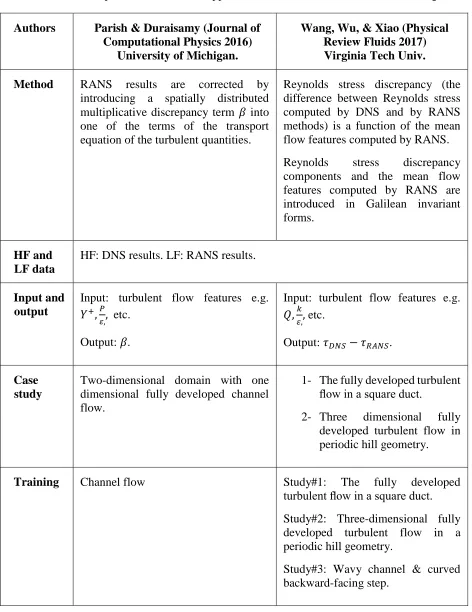
To reduce the RANS model discrepancy by learning from data, research groups from the
University of Michigan and Virginia Tech University utilized ML techniques to predict or reduce
the error in RANS simulation results [26, 27]. A comparison that summarizes these efforts is
presented in Table 1. Both groups made use of High-Fidelity (HF) simulation results from DNS to
correct the Low-Fidelity (LF) model results from RANS. In [26], RANS results are corrected by
spatially distributed multiplicative discrepancy term, 𝛽, into one of the terms of the transport
equation of turbulent quantities; in [27], the Reynolds stress discrepancy is directly based on mean
flow features computed by RANS.
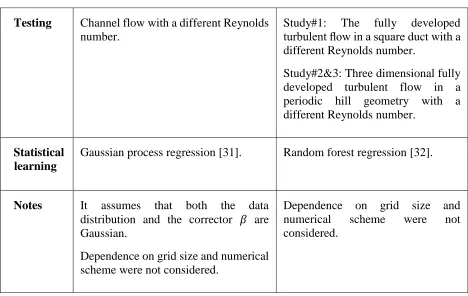
The statistical model in both cases is trained based on the available high-fidelity data and
then tested on other cases, which have a different Reynolds number or a different flow geometry.
Recently, the Virginia Tech University research group suggested that [28] the group of input
features could be increased to more than 50 flow features to improve the prediction capability of
the statistical model. It was also shown that not only could Reynolds stress discrepancy, computed
by RANS, be improved by predicting Reynolds stress discrepancy, but also the improved Reynolds
stress results in a more accurate velocity field. Similarly, Barone et al. [29] used deep neural
9 Table 1. A Comparison between two approaches for data-driven turbulence modeling.
Authors Parish & Duraisamy (Journal of Computational Physics 2016)
University of Michigan.
Wang, Wu, & Xiao (Physical Review Fluids 2017) Virginia Tech Univ. Method RANS results are corrected by
introducing a spatially distributed multiplicative discrepancy term 𝛽 into one of the terms of the transport equation of the turbulent quantities.
Reynolds stress discrepancy (the difference between Reynolds stress computed by DNS and by RANS methods) is a function of the mean flow features computed by RANS.
Reynolds stress discrepancy components and the mean flow features computed by RANS are introduced in Galilean invariant forms.
HF and LF data
HF: DNS results. LF: RANS results.
Input and output
Input: turbulent flow features e.g.
𝑌+,𝑃
𝜀,, etc. Output: 𝛽.
Input: turbulent flow features e.g.
𝑄,𝑘
𝜀,, etc.
Output: 𝜏𝐷𝑁𝑆− 𝜏𝑅𝐴𝑁𝑆.
Case study
Two-dimensional domain with one dimensional fully developed channel flow.
1- The fully developed turbulent flow in a square duct.
2- Three dimensional fully developed turbulent flow in periodic hill geometry.
Training Channel flow Study#1: The fully developed
turbulent flow in a square duct.
Study#2: Three-dimensional fully developed turbulent flow in a periodic hill geometry.
10 Table 2 (continued). A Comparison between two approaches for data-driven turbulence
modeling.
Statistical data-driven models are usually trained on a set of data and then tested with
another group of data that are “close” to the training data in some sense. The “closeness” between
the training data and the testing data can be used to assess the prediction confidence a priori [33].
This closeness could be quantified by metrics like the Mahalanobis Distance [34] or the Kernel
Density Estimation technique [35]. This approach was successful in most cases except when the
training and testing cases are too close or too far apart [33].
ML model predictions, for RANS Reynolds stress anisotropy, for flows of similar physics,
should be similar. ML model predictions should not change with changing the orientation of
coordinate frame. In other words, ML predictions should be Galilean invariant. Based on this
principle, a multi-layer (deep) ANN (also called “deep learning”), with invariant tensor basis, was
proposed [36]. This way, Reynolds stress anisotropy tensor can be predicted with an embedded Testing Channel flow with a different Reynolds
number.
Study#1: The fully developed turbulent flow in a square duct with a different Reynolds number.
Study#2&3: Three dimensional fully developed turbulent flow in a periodic hill geometry with a different Reynolds number.
Statistical learning
Gaussian process regression [31]. Random forest regression [32].
Notes It assumes that both the data distribution and the corrector 𝛽 are Gaussian.
Dependence on grid size and numerical scheme were not considered.
11 Galilean invariance. The proposed tensor-basis ANN proved to have more accurate prediction
compared to both RANS models and conventional ANN.
1.5.4. Smoothed Particle Hydrodynamics
Data-driven models, for fluid simulations, are used not only in mesh-based CFD but also
in Smoothed Particle Hydrodynamics (SPH) (where Navier-Stokes equations are approximated on
fluid particles instead of a computational grid [21]). Random Forest Regression (RFR) [32] was
trained to predict the velocity and position of the fluid particle in the next time step based on the
velocity and the position in the previous time step [37]. This approach aims to “learn” the behavior
of fluid from the training examples and provides an alternative for real-time fluid simulations.
1.6.CG-CFD for Simulating CTH
Typical accident scenarios may include long transients, CTH multi-physics phenomena,
and the flow regime may change over the computational domain or over time. CG-CFD approach
can be used to deal with such a complex situation, as presented in Figure 1. In Figure 1, a
conceptual framework is proposed to benefit from the fine-grid simulation results, to correct the
CG-CFD results for every single phenomenon, while the multiple-phenomena scenario is
simulated with coarse grids.
In Figure 1, the boxes are numbered from 1 to 8 to refer to 8 steps. In the 1st step, the flow
of every single phenomenon of interest is simulated with a grid which is coarse relative to the grid
requirement of DNS. This coarse-grid simulation is not expected to obtain accurate results, but it
is still expected to show a flow pattern similar to the high-fidelity simulation result. For instance,
in Figure 2, the difference between the coarse-grid and the fine-grid results is clear, both results
show similar flow pattern. Repeating this step with a variety of potential phenomena will result in
12 Figure 1. A conceptual framework for simulating CTH with CG-CFD. The focus of this work is
highlighted in yellow.
. Since the number of nodes in a fine gird is much larger than in a coarse grid, it is hard to
compare the fine and coarse grid results directly. Instead, coarse-grid results (1st step) are compared
to the fine-grid results (3rd step) mapped on the coarse grid (4th step). Figure 2 gives an example
13 profile is not perfectly similar to the fine-grid results (especially near the corners of the cavity),
the mapped profile is much more accurate than the coarse-grid one. In this work, machine learning
algorithms are utilized to get a statistical data-driven model that models a correction term (7th step)
that compensates for the information lost due to the coarseness of the grid.
Figure 2. A snapshot of the velocity (𝑈𝑦) profile in a three-dimensional quasi-steady state turbulent flow in a lid-driven cavity. The lid is moving in 𝑥-direction. The profile is computed with a fine grid (left) and a coarse-grid (right). The fine-grid result is mapped to a coarse-grid (in the middle).
Based upon the success of the first 4 steps, simulating a realistic nuclear accident scenario
that involves multi-phenomena with a coarse grid can be beneficial (5th step). Given the
non-accurate predictions coming out of the 5th step plus the library created in the 2nd step, different
phenomena involved in a containment scenario can be identified (6th step: pattern recognition).
Pattern recognition is a process of classifying the features into groups. It may help to distinguish
14 If each phenomenon is identified correctly, it may be possible to benefit from the correction
term computed in the 7th step to correct different group of results corresponding to different
phenomena. It would be challenging to use correction terms computed by different data-driven
models for different groups of interacting phenomena. Therefore, blending functions may be
needed to deal with a mixture of models (8th step).
1.7.The Scope of This Work
Since the traditional high-resolution (mesh-independent) CFD solution is computationally
expensive and using of a coarse grid would result in high grid-induced errors, the present work
focuses on predicting the errors of the coarse-grid solution. While the previous research aimed
largely to reduce the model form error, in this work, the sub-grid effect is compensated for by a
surrogate statistical model that is trained by using high-fidelity simulation results (fine-grid CFD).
The objective of this work is to investigate the feasibility of obtaining a correction for the
CG-CFD simulation results using machine learning algorithms. Numerical experiments are
designed and performed to study the feasibility of utilizing machine learning tools to get a
correlation between the ‘correct’ solution informed by fine grid simulation results and the
coarse-grid variables. Among the different sources of error in CFD simulation (see Figure 3), the
turbulence modeling error and the discretization error are the most challenging ones. Below, in
Subsections 1.7.1, 1.7.2 and 1.7.3, the present work is compared to other CFD approaches in terms
15 Figure 3. CFD sources of error.
1.7.1. Present Approach vs. Traditional CFD
RANS turbulence models are popular because of the reduced computational expense while
representing three-dimensional flow behavior. RANS turbulence models typically rely on
incorporating more physics and using empirical models for some parameters based on the available
16 study), but this grid convergence study should be applied within the range of grids that satisfy the
turbulence model grid requirements. Typically, for each new case, a new simulation is needed,
even if the new case is only slightly different from old cases.
In the present work, the “No model” approach (where NS equations are solved numerically
without any turbulence model) is utilized with coarse grids (discretization grids that are expected
to produce non-accurate results). However, instead of investigating the turbulence modeling error,
we use the same “No model” approach with different grids (fine and coarse grids) to train a
surrogate model to compute this grid-induced error. The CG-CFD error is predicted by comparing
the high-fidelity results (with fine grids) against CG-CFD results. With this surrogate model, the
grid-induced error can be predicted for other cases that have different grid sizes, Reynolds
numbers, etc. The surrogate model is adaptive with the available data, so each new set of
experimental data or high-fidelity computations will be reflected in the automatically-improved
model, without the need for developing other models that capture the new data.
1.7.2. Present Research vs. Turbulence Modeling Error Reduction
Recently, research has been pursued in the direction of taking advantage of the ML
algorithms to develop surrogate models that can compute the turbulence modeling error (for
instance, [26, 27]). This approach is known as Physics Informed Machine Learning (PIML)
approach. Both the present work and PIML method benefit from ML algorithms to produce
data-driven statistical models. PIML recent research assumes that one of the RANS models is used and
the grid convergence criterion for this model is satisfied. Through PIML, the difference between
RANS flow variables profile and DNS profile is computed. On the other side, the present work
depends on the same NS equations used with both fine and coarse grids. After that, the error
17 1.7.3. This Work vs. Reduced Order Modeling (ROM)
ROM techniques can be categorized in two classes: dimensionality reduction and surrogate
modeling [38]. The first class is the dimensionality reduction techniques which aim to reduce the
number of inputs or (dimensions) of the model without changing the original function. CG-CFD
approach discussed in this work does not involve any dimensionality reduction because the same
flow variables are included in both fine and coarse-grid simulations.
The second class is the surrogate modeling which leads to substituting the original model
with another approximate more simplified function. This simplification is either based on physics
or based on statistics (data). For instance, LES and RANS method can be regarded as
physics-based approaches because both methods were developed physics-based on some physical assumptions and
are considered as approximations of the original NS equation. On the other side, the
statistics-based surrogate functions are selected heuristically by regression methods or ML algorithms. To
classify the current work, the proposed CG-CFD approach is described symbolically as follows:
The discretized NS equations solved on a sufficiently fine grid is written as: 𝐿𝑓(𝜑) = 0.
𝜑𝑓 is the flow variables computed by the fine grid and 𝐿𝑓 is the discrete operator computed by a fine grid. The discretized CG-CFD equations can be written as 𝐿𝛥(𝜑𝛥) = 0. 𝛥 is the cell length of the coarse grid. The grid-induced error, when computing a variable 𝜑, is 𝜀𝛥(𝜑) = 𝜑𝑓→𝛥− 𝜑𝛥, while 𝜑𝑓→𝛥 is the 𝜑𝑓 field mapped on a coarse grid. Using ML, a surrogate function 𝐹 is computed:
𝜀𝛥(𝜑) = 𝐹(𝑋(𝜑𝛥)) (1-1)
where X(𝜑𝛥) is the features set (new variables) computed given 𝜑𝛥. The process of obtaining
18 1.8.The Structure of This Dissertation
Sources of uncertainty in CFD are mainly turbulence modeling error and numerical error
(see Chapters 2 and 3, respectively). The numerical error (in particular, the grid-induced error) is
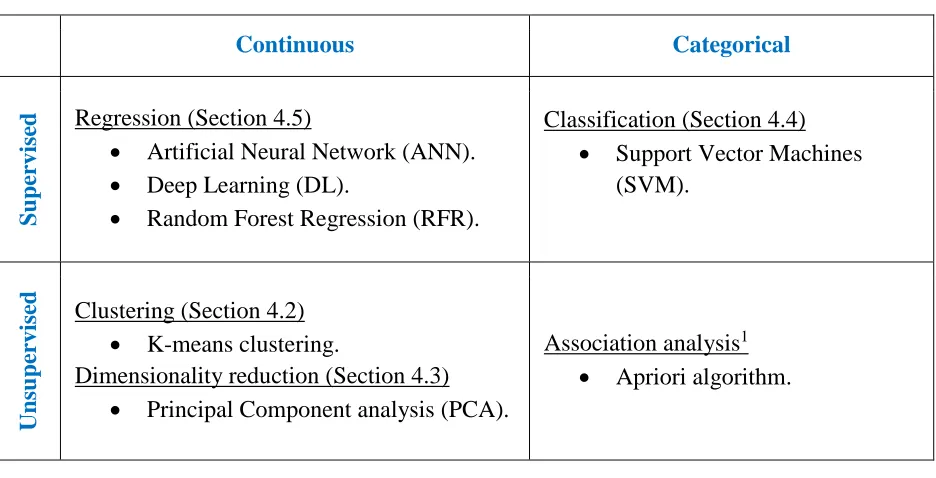
recovered using data-driven techniques based on ML. Different ML algorithms are listed in
Chapter 4. These ML algorithms are utilized to produce a statistical model that can predict the
CFD coarse-grid-induced error, given the flow features computed by a coarse grid (see Chapter
5). The capability of the statistical model to predict the grid-induced error in different cases is
illustrated and assessed in Chapter 6. The conclusion of this dissertation and the future work plan
are provided in Chapter 7. The following section (Section 1.9) is presented to clarify the meaning
of some terms used in the context of this work.
1.9. Definitions
• Training data: A set of data needed to discover the relationship between different variables.
For instance, this group of data is used to find the regression function which relates the output
and input.
• Testing data: After training the statistical model given the “training data”, this model is
assessed using the testing data. Testing data are totally independent of the training data.
• Features: (or attributes or inputs) are the input variables which characterize the problem. For
instance, fluid flow features can be the velocity or the pressure and so on.
• Discretization error: the difference between the exact solution of the discretized equation and
the exact solution of the original Partial Differential Equations (PDEs). It includes both
truncation error (locally generated) and the pollution error (transported component).
• Truncation error: when approximating a function by a summation (for instance, Taylor series),
19 and it occurs when truncating the infinite series used to approximate a PDE (when discretizing
PDEs). This error is eliminated by refining the grid. Truncation error is the local source of the
discretization error.
• Pollution error: It is another component of the discretization error. It is not produced locally
but transports from elsewhere in the computational domain. This error is transported through
the domain similar to the solution transport (the error can be convected or diffused).
• Round-off error: Difference between the actual number and its approximation (rounding)
stored on the computer. This error is assumed to be small compared to other errors.
• Iterative convergence error: it is an error that results from the iterative algorithm that is used
during the simulation. Typically, this iteration is stopped based on a criterion (typically the
residual). It is the difference between the solution of the discretized equation with the stopping
criterion and the exact solution of the discretized equation with a zero residual.
1.10. Chapter Summary
Modeling and simulation of Containment Thermal Hydraulics (CTH) phenomena are
achieved either by system codes or Computational Fluid Dynamics (CFD). Affordable
computations on the reactor-system level are performed by system codes using large control
volumes (larger than one cubic meter). Using System codes, CTH phenomena are modeled
with different degrees of dimensionality. Although system codes represent the currently
available knowledge in the nuclear industry, they cannot properly model the complex
multi-dimensional behavior of CTH phenomena because of the uncertainty related to the used
empirical equations, empirical parameters, simplified geometries and coarse-mesh resolution.
On the other side, CFD codes can model phenomena which are multi-dimensional, local,
20 applying CFD would be a huge computational challenge when modeling complex accidents
with long transient scenarios.
This work is motivated by the need to mitigate CFD computational expense and the
current progress in data-driven modeling using machine learning algorithms that can benefit
from the available high-fidelity simulations and experimental data. Hence, it is proposed to
rely on the coarse-grid CFD simulations (which are affordable) while the grid-induced error
can be predicted using data-driven models.
Currently, data-driven models (trained by Direct Numerical Simulations (DNS) data)
are utilized in the context of CFD to correct Large Eddy Simulations (LES), Reynolds
Averaged Navier-Stokes (RANS) simulations or to compute closure terms for averaged
variables’ equations. On the other side, the present work investigates the feasibility of
correcting coarse-grid solutions computed by Navier-Stokes equations, without turbulence
modeling, using data-driven models that are trained with sufficiently fine-grid simulations.
A method that predicts the grid-induced error given the coarse-grid solution features is
proposed. Currently, this method is applied to a turbulent three-dimensional flow inside a
cavity. A General framework that benefits from the proposed method to simulate CTH
phenomena using coarse-grid CFD is also proposed in this work.
21
2. TURBULENCE MODELING
CFD approach is used in CTH analyses to capture the relevant multi-dimensional
phenomena in detail. CFD implies solving Navier-Stokes equations numerically and this requires
finer grid resolution especially if the flow is highly turbulent. CTH phenomena typically include
turbulent flows, therefore, solving NS equation directly will be computationally expensive due to
fine-resolution requirements. After clarifying the objectives of this chapter (Section 2.1), basic
turbulence theory is introduced briefly (Section 2.2). The methods which are typically used to
model turbulence are presented (namely, LES (Section 2.3) and RANS (Section 2.4)). This chapter
gives the reader an overview of the traditional mechanistic turbulence model used to mitigate the
need for high-resolution grids. The confidence in either LES or RANS simulations is related to
reducing CFD sources of error (See Figure 3). Among these sources of error, grid induced-error is
the focus of this work as we propose to rely on coarse-grid simulations. Hence, the grid-induced
error, in the simulations performed by LES, RANS and the proposed CG-CFD method, is
discussed in Section 2.5 and the whole chapter is summarized in Section 2.6.
2.1.Objectives
The objectives of this chapter can be summarized as follows:
• Discussing the traditional mechanistic turbulence models.
• Providing an overview of the grid-induced error treatment in the proposed CG-CFD
method vs. the corresponding error when applying traditional turbulence modeling.
2.2.Basics of the Turbulence Theory
Turbulence is unsteady and chaotic fluid motion in which the three velocity components
fluctuate mixing matter, momentum, and energy. Turbulent flows always occur at higher Reynolds
22 eddies of different sizes. There are large scales where the energy enters the flow through mean
shear; there is an inertial range (intermediate scales) where energy flows to the smaller scales of
the dissipation range where the energy dissipates into heat due to molecular viscosity effects [12].
A typical example of the distribution of turbulence energy contained in the eddies of size 𝑙
(corresponding to wavenumber 𝜅𝑙 = 2𝜋
𝑙) is illustrated in Figure 4.
Figure 4. Distribution of turbulent energy in wavenumber space.
In order to represent the eddies belonging to various energy ranges, NS equations can be
solved directly on a sufficiently fine grid using a small-time step to capture length scales down to
Kolmogorov length scale (𝜂) and time scales down to 𝜏η:
𝜂 = (𝜈3⁄ )e 1 4⁄ (2-1)
23 This method (Direct Numerical Simulation, DNS) is the most accurate method of solving
turbulent flows. It results in accurate three-dimensional instantaneous velocity and pressure
numerical data. It is accurate for simple flows, but it is computationally challenging for real-world
applications (turbulent flows with higher Reynolds number, Re). The number of grid points needed
for DNS simulation is proportional to Re9/4 [12] (see Figure 5). For most applications, it is unnecessary to resolve all the turbulence scales. It suffices to predict the effect of turbulence on
mean flow behavior. Therefore, turbulence models are developed to close the system of the mean
flow equations. Different turbulence modeling methods are described in Sections 2.3 and 2.4. It is
worth noting that the averaged flow pattern is a statistical flow property (cannot be directly
observed in nature for turbulent flows).
2.3.Large Eddy Simulation (LES)
LES method was proposed by Smagorinsky [16]. In this method, turbulent flow large
eddies are resolved directly while the sub-grid scale eddies (the ones which cannot be resolved
using the coarser grid) are modeled. This results in the reduced computational cost of LES
compared to DNS. LES requires the smallest resolved spatial and temporal scales to lie in the
inertial subrange of turbulence (see Figure 4). Large eddies contain most of the turbulent kinetic
energy and are responsible for turbulent mixing and momentum transfer while the small eddies are
isotropic (universal and less dependent on boundary conditions) which allows developing a nearly
universal sub-grid model for them. The computational cost of LES (for free shear flow simulations)
varies weakly with Reynolds number and is proportional to 𝑅𝑒0.4 [39]. For wall-bounded flows, LES computational cost (number of grid points) scales with 𝑅𝑒1.76 [39] (this computational cost is comparable to DNS as illustrated in Figure 5) . Thus, LES method allows to perform simulations
24 In LES, any variable in NS equation, 𝜑 is spatially filtered to resolve the large turbulent
eddies whose scales range from domain size to filter width while the eddies of scales between filter
size and grid width are modeled. The filters are localized functions that include Gaussian filtering,
box filtering (simple average over volume) and cutoff filtering (Fourier coefficients belonging to
wavenumbers above the cutoff are eliminated). For example, using a box filter, the filtered variable
𝜑̅ is given by:
𝜑̅(𝑥) = 1
𝑉∫𝑣𝜑(𝑥′)𝑑𝑥′, 𝑥′ ∈ 𝑣 (2-3)
where 𝑉 is the volume of a computational cell. The filtered NS equation (for incompressible flow)
is: 𝜕𝑢̅𝑖 𝜕𝑡 + 𝜕𝑢̅ 𝑢𝑖̅𝑗 𝜕𝑥𝑗 = 𝜕 𝜕𝑥𝑗 (𝜕𝜎̅̅̅̅𝑖𝑗 𝜕𝑥𝑗 ) −𝜕𝑝̅̅̅𝑘 𝜕𝑥𝑖 −𝜕𝜏̅̅̅𝑖𝑗 𝜕𝑥𝑗 (2-4) 𝜎𝑖𝑗 ̅̅̅̅ = 𝜈 (𝜕𝑢̅𝑖 𝜕𝑥𝑗+ 𝜕𝑢̅𝑗 𝜕𝑥𝑖) − 2 3𝜈 𝜕𝑢̅𝑖
𝜕𝑥𝑙𝛿𝑖𝑗 (2-5)
𝜏𝑖𝑗
̅̅̅ = 𝑢̅̅̅̅̅ − 𝑢𝑖𝑢𝑗 ̅ 𝑢𝑖̅𝑗 (2-6)
where 𝑝𝑘 and 𝜈 are the kinematic pressure and kinematic viscosity. 𝜏̅̅̅𝑖𝑗 is the Sub-Grid Scale (SGS) stress tensor. One of the earliest models to solve 𝜏̅̅̅𝑖𝑗 is the Smagorinsky turbulence model [16]. Similar to the dissipation due to dynamic fluid viscosity in a laminar flow, the concept of SGS
viscosity, 𝜈𝑠𝑔𝑠, is introduced to represent the dissipation effect of small scales as following:
𝜏𝑖𝑗 ̅̅̅ −1
25
𝑆𝑖𝑗
̅̅̅̅ = 0.5 (𝜕𝑢̅𝑖
𝜕𝑥𝑗
+𝜕𝑢̅𝑗 𝜕𝑥𝑖
) (2-8)
𝜈𝑠𝑔𝑠 = 𝐿2𝑠𝐶𝑠2|𝑆| (2-9)
𝑆 = √2𝑆̅̅̅̅𝑆𝑖𝑗̅̅̅̅𝑖𝑗 (2-10)
𝐿𝑠 = 𝑚𝑖𝑛 [𝜅𝑦
𝐶∆(1 − 𝑒
−𝑦+
𝐴+) , 𝑉1/3] (2-11)
where 𝑆̅̅̅̅𝑖𝑗 is the strain rate of the resolved velocity field, 𝐿𝑠 is the mixing length for sub-grid scales and 𝐶𝑠 is a model constant (proposed to be 0.18) [40]. The SGS viscosity value is large near the wall because of the high velocity gradient at the wall. Near wall turbulent fluctuations go to zero
so 𝜈𝑠𝑔𝑠 must go to zero as well. Therefore, Van Driest damping [41] is added (Eq. (2-11)). In this equation, 𝜅 is the von Karman constant, 𝑦 is the closest distance to the wall, 𝐶∆ and 𝐴+ are model constants, 𝑉 is the computational cell volume. This model has some limitations because 𝐶𝑠 value needs to be changed for different flow patterns. It may take values from 0.065 to 0.25 [42].
To eliminate the need for tuning Smagorinsky constant, a dynamic model is developed by
Germano and Lilly to [40] compute the Smagorinsky constant dynamically. In this model, the flow
variables are filtered by 2 filters (grid filter and test filter) while the test filter is larger than the grid
filter width. Filtering with a grid filter results in SGS tensor, 𝜏̅̅̅𝑖𝑗 (see Equation (2-6)). Computing the SGS tensor based upon test filter gives 𝜏𝑖𝑗𝑡. Applying both filters (grid filter and test filter) yields another SGS tensor, 𝑇𝑖𝑗:
26
𝐿𝑖𝑗 = 𝑇𝑖𝑗 − 𝜏𝑖𝑗𝑡 (2-13)
𝑀𝑖𝑗 = −2∆2(𝛼2𝑆 𝑖𝑗
̿̿̿̿ |𝑆|̿̿̿̿ − 𝑆̅̅̅̅|𝑆|̅̅̅̅̅̅̅)𝑖𝑗̅̅̅̅ (2-14)
𝐶𝑠2 = 〈𝐿𝑖𝑗 𝑀𝑖𝑗〉
〈𝑀𝑖𝑗𝑀𝑖𝑗〉 (2-15)
where ∆ the test is scale and 𝛼∆ is the resulted scale from applying the two filters. This model
assumes that Smagorinsky constant value at ∆ and 𝛼∆ is the same (scale invariance). In this way,
𝐶𝑠 can be computed for each grid cell and each time step. However, this may cause 𝜈𝑠𝑔𝑠 value to be negative in some locations [43]. In general, LES is capable of simulating separated flow but it
is not affordable when simulating near-wall flow at high Reynolds numbers. The filtered variables
are not averaged over time, so the flow variables are functions of time. Therefore, LES can
compute transient flows. LES is still much more expensive than RANS which is the most used
approach in industrial CFD (see Section 2.4). As depicted in Figure 5, the number of grid points
27
Figure 5. Computational expense (of DNS, LES, and RANS) as a function of Reynolds number.
2.4.Reynolds Averaged Navier-Stokes (RANS) Equations
RANS is the workhorse tool in turbulence modeling in industry. Reynolds decomposition
of the velocity into a mean velocity component and a turbulent fluctuating component is written
as:
𝑢 = 𝑢 + 𝑢′ (2-16)
The same way of decomposition is applied to pressure. Applying Reynolds decomposition on NS
Equation (2-17) results in RANS Equation (2-18).
1.E+00 1.E+02 1.E+04 1.E+06 1.E+08 1.E+10 1.E+12 1.E+14
1.E+04 1.E+05 1.E+06 1.E+07
28 𝜕𝑢𝑖 𝜕𝑡 = −𝑢𝑗 𝜕𝑢𝑖 𝜕𝑥𝑗 −1 𝜌 𝜕𝑝𝑘 𝜕𝑥𝑖 + 𝜈 𝜕 2𝑢 𝑖 𝜕𝑥𝑗𝜕𝑥𝑗 (2-17) 𝜕𝑢𝑖 𝜕𝑡 = −𝑢𝑗 𝜕𝑢𝑖 𝜕𝑥𝑗− 1 𝜌 𝜕𝑝̅̅̅𝑘 𝜕𝑥𝑖 + 𝜈
𝜕2𝑢 𝑖
𝜕𝑥𝑗𝜕𝑥𝑗−
𝜕𝑢𝑖′𝑢𝑗′
̅̅̅̅̅̅̅̅̅
𝜕𝑥𝑗 (2-18)
NS Equation (2-17) is expressed in tensor notation (for incompressible Newtonian fluid). The right
side of the equation is the momentum time rate of change while the right-hand side is the
summation of the inertial force term (momentum transport because of the bulk fluid motion), the
pressure force and the viscous force. In RANS Equation (2-18), the last term of the right-hand side
is called Reynolds stresses [12]. This term is modeled according to Boussinesq approximation that
Reynolds stresses are proportional to the velocity gradient of the mean flow:
𝑢𝑖′𝑢 𝑗′ ̅̅̅̅̅̅ = 𝜈𝑡(𝜕𝑢𝑖 𝜕𝑥𝑗+ 𝜕 𝑢𝑗 𝜕𝑥𝑖) − 2
3𝑘𝛿𝑖𝑗 (2-19)
𝛿𝑖𝑗 = {
1, 𝑖 = 𝑗
0, 𝑖 ≠ 𝑗 (2-20)
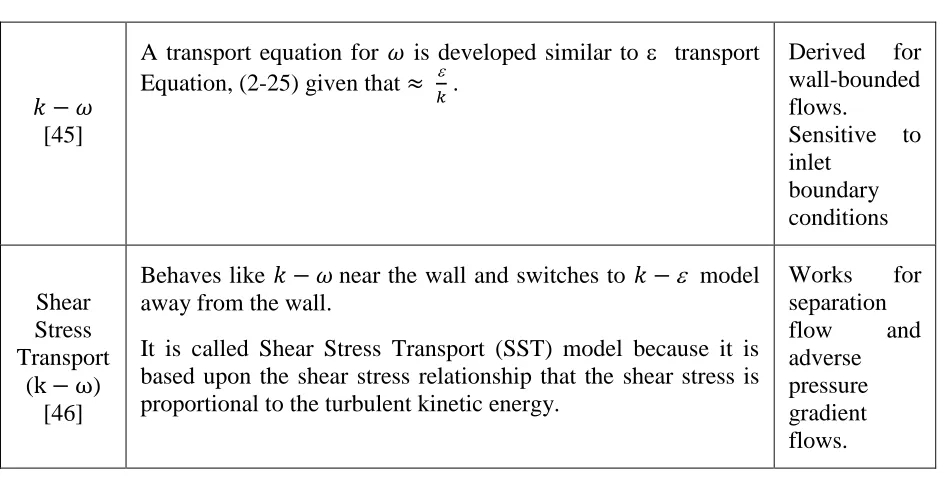
where 𝑘 is the turbulent kinetic energy and 𝜈𝑡 is the turbulent viscosity. The closure problem is to model 𝜈𝑡. An overview of the common RANS turbulence models that predict 𝜈𝑡 are listed in Table 3. All these models (LES or RANS) still lack accuracy or/and affordability when simulating
complex long transient flows similar to CTH flows. These models are also calibrated on limited
data. Hence, data-driven statistical models developed by ML algorithms (see Chapter 4) are