GAMIFICATION: POTENTIALS AND CHALLENGES IN
TEACHING AND LEARNING IN SCIENCE
Mageswaran A/L Sanmugam1, Baharuddin bin Aris2, Hasnah bt. Mohammed3, Norasykin bt. Mohd. Zaid4, Zaleha bt. Abdullah5
1
Faculty of Education, Universiti Teknologi Malaysia (UTM), Johor Bahru, Malaysia
2Faculty of Education, Universiti Teknologi Malaysia (UTM), Johor Bahru, Malaysia
3
Faculty of Education, Universiti Teknologi Malaysia (UTM), Johor Bahru, Malaysia [email protected]
4Faculty of Education, Universiti Teknologi Malaysia (UTM), Johor Bahru, Malaysia
5
Faculty of Education, Universiti Teknologi Malaysia (UTM), Johor Bahru, Malaysia [email protected]
ABSTRACT
Educational technology plays an important part in the growth of education in the 21st century. Yet the absence of infusion between technology and education in schools, has led to the de-motivation among many students and teachers with the current education system. Therefore with the evolution in technology, especially with the arrival of android devices, interaction with games has been on the rise; making it a daily routine and addictive part of people‟s lives. By using the game design elements in non-game contexts, gamification is created. These elements are points, badges and leader board. In the corporate world, gamification has been used as a motivational pull in achieving goals. These qualities relate to the instigators of motivation; purpose, autonomy and mastery. So we can deduce that the capabilities of game in causing a change in human lives go beyond its intended purpose of fun. As students are familiar with the usage of technology, infusing gamification to improve teaching and learning in schools may reap favourable results. Yet there has been lacking research in the effectiveness of gamification in learning and teaching. This creates an opening for a research to be carried out in this field. The aim of this paper is to explore the potentials as well as challenges of using gamification to enhance the teaching and learning in Malaysia schools.
Keywords: Gamification, Educational Technology, Motivation
1. INTRODUCTION
As the world progresses further into the age of technology, not only is it necessary for tools and devices to be advanced, but also the way we live, work and study. Technology will eventually become a way of life for all. The advancement in Information and Communication Technologies (ICTs) has brought changes in the society through the field of communication, work and education. Students nowadays are more familiar with video games as they are designated by as „„digital natives‟‟ (Prensky, 2001). For them, these technologies have always been a part of their lives (Johnson et al., 2011). Thus they have become detached with school and its curriculum with effects on their levels of motivation, which affects their learning outcomes.
some, it has become a daily routine and addictive part of their lives. This is supported by McGonigal (2010), who states that people use three billion hours playing online games a week. She also speculates that multiplayer adventure games, for instance World of Warcraft, reproduce the perfect environment for human performance where the player sets out on a journey, with complete controls over movements and is furnished with everything important to get proficient in the required skills. These qualities relate precisely to the essential precursors of motivation; which is purpose, autonomy and mastery. This further contends that updating real world social structures to copy those of adventure games will enhance profitability and ability to take care of issues faced worldwide. So we can deduce that the capabilities of game in causing a change in human lives go beyond its intended purpose of fun.
2. BACKGROUND OF STUDY
In the field of education, gamification is used in applications and processes to improve learning (Bellotti et al., 2012). This is supported by Zichermann (2011), who states that “in education, game mechanics are proving to be very useful tools within the classroom”; as proven by Ananth Pai, a former business executive who took up teaching at an elementary school. He found that by incorporating games into the curriculum by using leaderboards and social challenges. The results showed a noticeable improvement in reading and math within 18 week. Therefore it is identified through these results; gamification does not have to be implemented in virtual world as the game mechanics can be transferred and used through real life. Yet there is no clear model or framework stated in this research to be a referral for others. The existence of the key elements in gamification which are, (i) Points, (ii) Badges and (iii) Leader boards; has long been in and out of a student‟s life recently, with the implementation of School Based Assessment (S.B.A). Despite the abolishment of points in assessing the students, the existence of Bands‟ or Level of achievement compensate the point‟s element, whilst badges still exist in co-curriculum. Meanwhile, leader board, despite being overlooked in classes nowadays, do exist when one looks at which student whom have achieved the higher level of Bands or Levels of achievement.
Therefore successful implementation of gamification has the potential to not only set
out in enjoyment for students, but also assist teachers to evaluate their students in a more constructive manner as opposed to just using worksheets or observation based assessment.
3. REVIEW OF LITERATURE 3.1 What Is Gamification?
bored. Another issue is whether the engagement factor will exist if the reward system is discontinued.
Gamification differs from other, similar advances in a few important means (Hamari & Koivisto, 2013):
1) Gamification tries to create experiences that relates to playing a video game, as opposed to offering “immediate hedonic experiences by method for example through audio visual content or economic incentives as seen in loyalty marketing” (Huotari & Hamari, 2012).
2) Gamification attempts to “influence motivations as opposed to demeanour and/or
behaviour specifically, as is the situation in convincing innovations” (Oinas-kukkonen & Harjumaa, 2009; Hamari, 2013).
3) Gamification refers to the inclusion of „gamefulness‟ to existing systems as opposed to creating an entirely new game as carried out with „serious games‟ (Deterding et al., 2011; Huotari & Hamari, 2012).
Therefore based on the developments, the gamification is a process that needs to be thought of properly and carried out systematically for a longer time frame. It cannot be assumed that results via gamification are an instant success. Gamification can create a state of flow in a person that enables or pushes one to be in the zone to carry out certain tasks. Meanwhile the aspects of mastery, will exist if the users can get immersed in the gamified system thus is willing to repeat the tasks given. This is so that they are used to it or that they become expert in the system; en route to achieving the goals intended. A person will continue carrying out the tasks until they have achieved the intended goal that allows the users to feel complete or satisfied. Whilst autonomy allows the users to feel in control of how or why they play the gamified system, thus not feel coerced by the gamified system. This is a key element as one important element of any games is fun. Besides that, it is concluded that gamification can induce motivations on a person via the game mechanics; and not the behaviour. Thus gamification creates the extra push to achieve the motivational factors, yet it cannot do miracles by completely changing the way a person is.
Gamification, as compared to serious games; is a method of where gamified system is infused into an existing system. For example; the game of “Zombie Run”, which turns the normal task of jogging into a form of game by making the users feel that they have to run to escape from the zombies. Thus indirectly the user is exercising while being motivated to get away from the zombie. Meanwhile serious games involve creating a game that serves the
purpose or the intended aim. For example; Playing History: The Plague
(http://www.playinghistory.eu), a role playing game that allows the user to explore the medieval Florence in search of a cure for the plague, thus experiencing history and the living conditions from that time(Arnab et al., 2014).
3.2 Gamification Literature Review
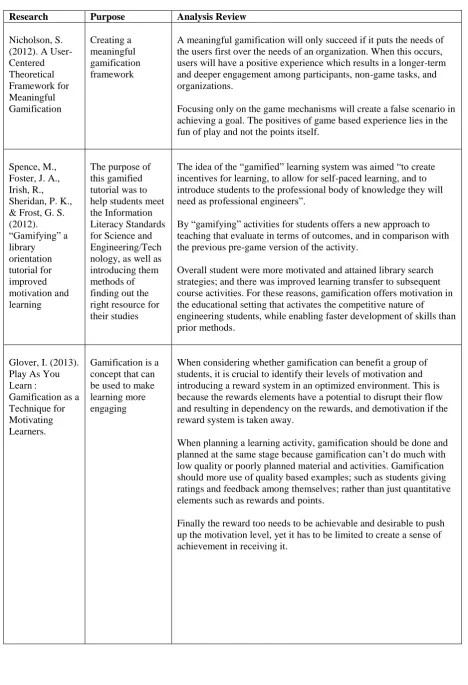
Table 1: Gamification literature analyses
Research Purpose Analysis Review
Nicholson, S. (2012). A User-Centered Theoretical Framework for Meaningful Gamification Creating a meaningful gamification framework
A meaningful gamification will only succeed if it puts the needs of the users first over the needs of an organization. When this occurs, users will have a positive experience which results in a longer-term and deeper engagement among participants, non-game tasks, and organizations.
Focusing only on the game mechanisms will create a false scenario in achieving a goal. The positives of game based experience lies in the fun of play and not the points itself.
Spence, M., Foster, J. A., Irish, R., Sheridan, P. K., & Frost, G. S. (2012). “Gamifying” a library orientation tutorial for improved motivation and learning
The purpose of this gamified tutorial was to help students meet the Information Literacy Standards for Science and Engineering/Tech nology, as well as introducing them methods of finding out the right resource for their studies
The idea of the “gamified” learning system was aimed “to create incentives for learning, to allow for self-paced learning, and to introduce students to the professional body of knowledge they will need as professional engineers”.
By “gamifying” activities for students offers a new approach to teaching that evaluate in terms of outcomes, and in comparison with the previous pre-game version of the activity.
Overall student were more motivated and attained library search strategies; and there was improved learning transfer to subsequent course activities. For these reasons, gamification offers motivation in the educational setting that activates the competitive nature of engineering students, while enabling faster development of skills than prior methods.
Glover, I. (2013). Play As You Learn :
Gamification as a Technique for Motivating Learners.
Gamification is a concept that can be used to make learning more engaging
When considering whether gamification can benefit a group of students, it is crucial to identify their levels of motivation and introducing a reward system in an optimized environment. This is because the rewards elements have a potential to disrupt their flow and resulting in dependency on the rewards, and demotivation if the reward system is taken away.
When planning a learning activity, gamification should be done and planned at the same stage because gamification can‟t do much with low quality or poorly planned material and activities. Gamification should more use of quality based examples; such as students giving ratings and feedback among themselves; rather than just quantitative elements such as rewards and points.
Dominguez, A., Saenz-De-Navarrete, J., De-Marcos, L., Fernandez-Sanz, L., Pages, C., & Martinez-Herraiz, J. J. (2013). Gamifying learning experiences: Practical implications and outcomes
Empirical study at the tertiary level of education in the subject of
“Qualification for users of ICT” where
gamification was used in giving the students optional exercises that is meant to help the students grade in the final exams
Although gamification impact on the cognitive aspects of educative content is limited, yet changing content design and structure to make it more fun can have great motivational impact.
As per suggested by Deterding, Dixon, Khaled & Nacke (2011), that design educative exercises embracing from the very beginning the concept of gameful design to make them more interesting for students. The quantitative analysis suggests that cognitive impact of gamification over students is not very significant. This is because the students who followed traditional exercises and gamified exercises performed similarly in overall score.
The researcher also pointed out that adaptation of cognitive characteristics of video games cannot be infused in the traditional educative content without entering in the field of edutainment or serious games.
Morrison, B. B., & DiSalvo, B. (2014). Khan academy gamifies
computer science
Analyzing how successful is Khan academy in gamifying their site.
Khan Academy addresses the issues of short-term engagement and uses gamification to keep users involved and progressing to more difficult tasks.
Though Khan Academy has the qualities that make it perfect for the casual learners that are self-inspired yet it has not managed to create desired motivational effect. Utilizing external rewards such as points without matching them to the underlying exercises makes an empty gamification experience and instills a negative feeling in the users. A meaningful gamification involves “adding elements of pure play to the system”; not just scoring systems. The researchers state that combining gaming with an informal learning environment is very difficult whilst it‟s even more difficult to create a user-centered meaningful gamification learning environment.
It is concluded the successful gamification of the site can be achieved by altering the implementation of the badges and points system by allowing more well-defined goals and expanding the social aspects of the gaming elements.
4. DISCUSSION
the students a star for his effort or even the use of the written praise such as good or excellent. Though electronically implementation are lacking in schools, yet clear planning and infusion of gamification in teaching and learning can hopefully help in the creation of a meaningful gamification system.
Creating a gamified system with reward needs to be reflected on the underlying exercises. Therefore any rewards given to the students should represent the task in hand so that the students will feel appreciated and strife for the next task. For instance, when conducting a class in the science laboratory, the teacher can award badges to the students that do the experiment procedure in the proper manner or the most cooperative group or lab partners in the class. Meanwhile points can be given to the students whom achieve the intended results, and prepare a good report. Additional points can be given for any students who can get other relevant findings related to the experiment. Therefore, a simple change in the structure and method of teaching brings in gamification into the traditional laboratory classes.
Implementation of gamification in the school level has to be planned and carried out by teachers whom teach the subject and are familiar with the students; with guidance from specialist teacher in the field or subject. Whilst if there is an incorporation of technology, the programmer or designer should work side by side with the teacher and students to create the gamified system. The biggest problems will arise when the implementation looks into another key aspect discussed about the researcher; that gamification has to bypass the needs of the organization and look at the needs of the users. The organization in the context of Malaysian education is the Ministry of Education, and the schools, while the users are the students. Though it may have been a problem with the old education system; yet with the current school based assessment that allows the teachers to implement and carry out teaching and learning process unimpeded and also allows the students to study at their own pace. Thus, the current changing landscape of the Malaysian education may pave an unhindered road towards the implementation of gamification in teaching and learning.
REFERENCE
Arnab, S., Lim, T., Carvalho, M. B., Bellotti, F., de Freitas, S., Louchart, S., Suttie, N., Berta, R., & De Gloria, A. (2014). Mapping learning and game mechanics for serious games analysis. British Journal of Educational Technology, n/a–n/a. doi:10.1111/bjet.12113 Bellotti, F., Berta, R., De Gloria, A., Lavagnino, E., Dagnino, F., Ott, M., Romero, M.
Usart,M., & Mayer, I.S. (2012). Designing a Course for Stimulating Entrepreneurship in
Higher Education through Serious Games. Procedia Computer Science, 15, 174-186.
Deterding, S., Dixon, D., Khaled, R., & Nacke, L. (2011). From Game Design Elements to
Gamefulness : Defining “ Gamification .” In MindTrek ’11 Proceedings of the 15th
International Academic MindTrek Conference: Envisioning Future Media Environments, 9–15.
Deterding, S., Dixon, D., Sicart, M., Nacke, L., & O‟Hara, K. (2011). Gamification : Using
Game Design Elements in Non-Gaming Contexts. In PART 2-Proceedings of the 2011
Dominguez, A., Saenz-De-Navarrete, J., De-Marcos, L., Fernandez-Sanz, L., Pages, C., & Martinez-Herraiz, J. J. (2013). Gamifying learning experiences: Practical implications and outcomes. Computers and Education, 63, 380–392.
doi:10.1016/j.compedu.2012.12.020
Glover, I. (2013). Play As You Learn : Gamification as a Technique for Motivating Learners.
Ed Media 2013, 1999–2008.
Hamari, J. (2013). Transforming homo economicus into homo ludens: A field experiment on gamification in a utilitarian peer-to-peer trading service. Electronic Commerce Research and Applications, 12(4), 236–245. doi:10.1016/j.elerap.2013.01.004
Hamari, J., & Koivisto, J. (2013). Social Motivations To Use Gamification : An Empirical
Study Of Gamifying Exercise. In Proceedings of the 21st European Conference on
Information Systems SOCIAL, 1–12.
Huotari, K., & Hamari, J. (2012). Defining Gamification - A Service Marketing Perspective. In Proceeding of the 16th International Academic MindTrek Conference,17–22.
Johnson, L., Smith, R., Willis, H., Levine, A., & Haywood, K. (2011). The 2011 Horizon Report. Austin, Texas: New Media Consortium.
McGonigal, J. E. (2010). Gaming can make a better world. Palm Springs, California, U.S.A.
Retrieved from
http://www.ted.com/talks/jane_mcgonigal_gaming_can_make_a_better_world.html
Morrison, B. B., & DiSalvo, B. (2014). Khan academy gamifies computer science. In
Proceedings of the 45th ACM technical symposium on Computer science education - SIGCSE ’14 ,39–44. doi:10.1145/2538862.2538946
Nicholson, S. (2012). A User-Centered Theoretical Framework for Meaningful Gamification. In Games+ Learning+ Society ,1–7.
Oinas-kukkonen, H., & Harjumaa, M. (2009). Communications of the Association for Information Systems Persuasive Systems Design : Key Issues , Process Model , and System Features Persuasive Systems Design : Key Issues , Process Model , and System Features. Communications of the Association for Information Systems, 24(28), 485–500. Prensky, M. (2001). Digital Natives, Digital Immigrants Part 1. On the Horizon, 9(5), 1–6.
doi:10.1108/10748120110424816
Rughiniș, R. (2013). Gamification for Productive Interaction Reading and Working with the
Gamification Debate in Education. In The 8th Iberian Conference on Information
Systems and Technologies CISTI 2013,1–5.