PENG, PAI. Active Timing Based Techniques for Attack Attribution through Stepping Stones. (Under the direction of Dr. Peng Ning).
The purpose of the research is to study the active timing based techniques used for attack attribution through stepping stone computers, where attackers sequentially connect through multiple intermediate hosts to hide their traces. The difficulties of tracing back such attacks come from not only the normal operations of networks and stepping stones, but also the intentional interference of the attackers. Encryption, repacketization, timing perturbation, and meaningless chaff packets could all significantly affect attribution result.
In this dissertation, I have investigated multiple research problems related to the active timing based attack attribution. First, I present a correlation scheme that can successfully identify stepping stone connections even if both chaff packets and timing perturbations are introduced by attackers simultaneously. In this scheme, we enhance the existing active watermark schemes and focus on identifying the possible corresponding packets in the flows to be correlated. We develop a series of algorithms to effectively and efficiently decode the embedded watermarks when chaff packets are inserted, and use theoretical analysis and experimental evaluation to validate these algo-rithms. We also investigate how our correlation scheme can be used to deal with the countermeasure when stepping stone connections are split and then merged, and propose an approach to mitigate the problem of packet loss and retransmission.
Next, I present the research on the secrecy issues of the quantization based watermark scheme. We propose an attacking approach based on analyzing the one-way packet transit delays between adjacent stepping stones. Our attack contains several techniques that can infer important watermark parameters and remove/duplicate the embedded watermarks. These techniques enable an attacker to defeat the watermarking system in certain cases by removing watermarks from the stepping stone connections, or replicating watermarks to non-stepping stone connections. We have also developed techniques to detect in realtime whether a stepping stone connection is being wa-termarked for trace-back purpose. Experiments using real-world data are performed and the results demonstrate that for the quantization based watermark scheme, (1) embedded watermarks can be successfully recovered and duplicated when the watermark parameters are not chosen carefully, and (2) the watermark existence in a network flow can be quickly detected.
watermark to effectively defeat the watermark scheme. We also investigate the problem of realtime watermark recovery and removal, and propose an online attacking algorithm. Experiments are then conducted to validate our analysis.
by
PAI PENG
A dissertation submitted to the Graduate Faculty of North Carolina State University
in partial fulfillment of the requirements for the Degree of
Doctor of Philosophy
COMPUTER SCIENCE
Raleigh
2006
Approved By:
Dr. S. Purushothaman Iyer Dr. Ting Yu
Dr. Peng Ning Dr. Douglas S. Reeves
I dedicate this dissertation to my parents for always believing in me and supporting me in
everything I do. Without their encouragement, understanding, and most of all love, the
Biography
Acknowledgements
There are a lot of people I would like to thank for making all of this possible. First, I am deeply grateful to my advisor, Dr. Peng Ning. Without his knowledge, perceptiveness, instruction and support, I would have never finished. I would like to thank Dr. Douglas S. Reeves for giving me numerous advice on my research, paper writing and presentation skills. Thanks to my committee members, Dr. Purush Iyer and Dr. Ting Yu, for their valuable suggestions to my dissertation. Also, thanks to Dr. Xinyuan Wang, Feng Fang, Young June Pyun and Young Hee Park for their generous help on my research.
I would like to thank all my officemates and friends at North Carolina State University. I am only able to list a few here: Kun Sun, Dingbang Xu, Yan Zhai, Donggang Liu, Pan Wang, and Qinghua Zhang. Many thanks to them for their inspiration to my study, and their help to my life here in North Carolina.
Contents
List of Figures viii
List of Tables x
1 Introduction 1
1.1 Problem Statement: Attack Attribution through Stepping Stones . . . 3
1.2 Motivation . . . 5
1.2.1 Robust Correlation Scheme against Possible Countermeasures . . . 5
1.2.2 Secure Correlation Scheme against Possible Attacks . . . 7
1.3 Summary of Research Results . . . 7
1.4 Dissertation Organization . . . 10
2 Background 11 2.1 Trace-Back Techniques through Stepping Stones . . . 11
2.1.1 Host Based Approaches . . . 12
2.1.2 Packet Content Based Approaches . . . 13
2.1.3 Packet Timing Based Approaches . . . 14
2.1.4 A Related Correlation Approach in Wireless Network . . . 17
2.2 Related Work in Anonymous Systems . . . 18
2.3 Related Work in IP Trace-Back . . . 19
2.4 Related Work in Digital Watermarking . . . 20
2.5 Active Timing Based Watermark Schemes . . . 21
2.5.1 Quantization Based Watermark Scheme . . . 21
2.5.2 Probabilistic Watermark Scheme . . . 23
2.5.3 Interval Based Watermark Scheme . . . 26
3 Active Timing Correlation Scheme of Traffic Flows with Chaff Packets 28 3.1 Problem Statement . . . 29
3.2 Proposed Approach . . . 31
3.2.1 Overview . . . 31
3.2.2 Phase 1: Packet Mapping . . . 32
3.2.4 Algorithm 0: Brute Force Algorithm . . . 34
3.2.5 Algorithm 1: Greedy Algorithm . . . 34
3.2.6 Algorithm 2: Improved Greedy Algorithm Using Order Constraint . . . 35
3.2.7 Algorithm 3: Improved Greedy Algorithm with Heuristics . . . 36
3.2.8 Algorithm 4: Decoding the Best Watermark For Quantization Based Water-mark Scheme . . . 38
3.3 Analysis . . . 39
3.3.1 False Positive Rate of Packet Mapping . . . 39
3.3.2 Algorithms for Probabilistic Watermark . . . 40
3.3.3 The Algorithm for Quantization Based Watermark . . . 41
3.3.4 Computation Complexity . . . 42
3.4 Compensation for Packet Loss . . . 43
3.5 Correlation Under Flow Split & Merge . . . 44
3.6 Experiments . . . 45
3.6.1 Flow Correlation under Chaff and Timing Perturbation . . . 45
3.6.2 Correlation Under Flow Split & Merge . . . 50
3.7 Summary . . . 51
4 On the Secrecy of the Quantization Based Watermark Scheme 53 4.1 Basis of the Timing Analysis Attack . . . 54
4.1.1 Normal Network Delays . . . 56
4.1.2 Watermark Delays . . . 57
4.1.3 The Combination of Watermark Delay and Normal Network Delay . . . . 58
4.1.4 Attacking the Quantization Based Watermark Scheme . . . 59
4.2 Inferring Watermark Parameters . . . 59
4.2.1 Estimating the Quantization StepS and the Proportion Parameterθ . . . . 60
4.2.2 Identifying Watermark Delayed Packets . . . 61
4.2.3 Watermark Recovery and Duplication . . . 62
4.3 Detecting Watermark Existence . . . 68
4.3.1 The Watermark Capability and the Minimum Number of Watermark De-layed Packets . . . 69
4.3.2 Detecting Watermark through Sequential Probability Ratio Test . . . 71
4.4 Experiments . . . 73
4.4.1 EstimatingSandθ . . . 73
4.4.2 Watermark Recovery for Case I . . . 74
4.4.3 Watermark Recovery for Case II . . . 74
4.4.4 Watermark Duplication for Case III . . . 75
4.4.5 Watermark Duplication and Removal for Case IV . . . 75
4.4.6 Detecting Watermark Existence . . . 76
4.5 Summary . . . 78
5 On the Secrecy of the Probabilistic Watermark Scheme 79 5.1 Capability and Packet Number . . . 80
5.2 Watermark Detection Using the SPRT Algorithm . . . 81
5.2.2 The SPRT Algorithm . . . 83
5.3 Recover Watermark Parameters . . . 86
5.3.1 Recover the Delay Valuea . . . 86
5.3.2 Identify Watermark Embedding Packets . . . 87
5.3.3 Recover Other Parameters . . . 87
5.4 Removing Watermark . . . 87
5.5 Duplicate Wateramrk into Normal Flows . . . 88
5.6 Experiments . . . 89
5.7 Attack the Watermark Schemes in Realtime . . . 90
5.7.1 Realtime Algorithm for The Probabilistic Watermark Scheme . . . 90
5.7.2 Realtime algorithm for The Quantization Based Watermark Scheme . . . . 92
5.8 Summary . . . 92
6 The Secrecy and Enhancements of the Interval Based Watermark Scheme 93 6.1 Basis of Timing Analysis Attacks . . . 94
6.2 Detecting Watermark Existence . . . 96
6.2.1 The Selection ofθ1 . . . 96
6.2.2 Detecting Watermark by Sequential Probability Ratio Test . . . 97
6.3 Watermark Parameter Recovery . . . 99
6.3.1 Recover the Watermark Packet Delayδ . . . 100
6.3.2 Identifying Packets Delayed by Watermark . . . 101
6.3.3 Recovering the Interval and Offset . . . 101
6.3.4 Recovering Watermark Bits . . . 104
6.4 Watermark Removal and Duplication . . . 106
6.4.1 Watermark Removal . . . 106
6.4.2 Watermark Duplication . . . 106
6.5 Security Improvements over the Original Scheme . . . 108
6.5.1 Enhancement 1: Security Improvements for Watermark Detection . . . 108
6.5.2 Security Improvements to Resist Watermark Recovery . . . 110
6.5.3 The Improved Encoding and Decoding Algorithm . . . 111
6.6 Experiment . . . 111
6.6.1 Attacking the Interval Based Watermark Schemes . . . 111
6.6.2 Computation Overhead of Timing Analysis Attacks . . . 115
6.6.3 The Performance of Improved Interval Based Watermark Scheme . . . 116
6.6.4 Parameter Selection for the Improved Watermark Scheme . . . 119
6.7 Summary . . . 119
7 Conclusion and Future Work 121 7.1 Conclusion . . . 121
7.2 Future Work . . . 122
Bibliography 125
List of Figures
1.1 Attack through a single stepping stone . . . 3
1.2 Attack through a chain of stepping stones . . . 3
1.3 The illustration of flow split and merge . . . 7
2.1 Quantization based watermarking: embed 1 watermark bit . . . 22
2.2 Quantization based watermarking: embed anL-bit watermark . . . 23
2.3 Probabilistic watermarking: IPD differences . . . 25
2.4 Interval based watermark scheme: embedding bit 0 . . . 27
2.5 Interval based watermark scheme: embedding bit 1 . . . 27
3.1 Determining packet mappings . . . 32
3.2 The largest and smallest IPDs . . . 35
3.3 Retransmission over one stepping stone (no perturbation) . . . 44
3.4 The illustration of flow split and merge . . . 45
3.5 (a) True positive rate changing withλc, ∆ = 7s; (b) True positive rate changing with∆,λc= 3. . . 47
3.6 False positive rate in the second case: (a) changing withλc,∆ = 7s; (b) changing with∆,λc= 3. . . 47
3.7 Computation overhead: (a) for correlated flows changing withλc,∆ = 7s; (b) for correlated flows changing with∆,λc= 3. . . 49
3.8 Computation overhead (a) for uncorrelated flows changing withλc,∆ = 7s; (b) for uncorrelated flows changing with∆,λc= 3. . . 49
3.9 True positive rate for flow split & merge . . . 50
4.1 Overview of our attacks to the watermark scheme . . . 55
4.2 Packet delays before clock skews are removed. (a) MIT; (b) Hong Kong . . . 57
4.3 A typical distribution of one-way packet delays after the clock skew is removed . . 57
4.4 Probability density for normal and the sum of normal and uniform distributions . . 57
4.5 Watermark delay distributions . . . 58
4.6 Clusters of embedding packets . . . 64
4.7 Hierarchical cluster tree . . . 64
4.9 1-bit duplication rate (M = 4) . . . 67
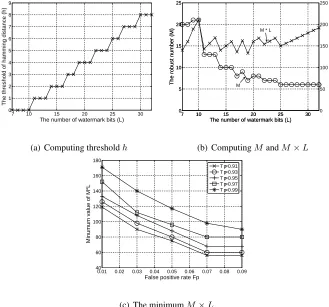
4.10 The watermark capability for different watermark parameters . . . 70
4.11 Duplication rate for Case III (M-K) . . . 76
4.12 Duplication rate for Case III (L-K) . . . 76
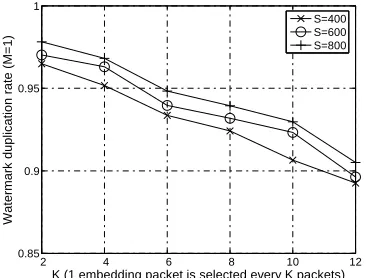
4.13 Watermark duplication rate (M = 4) . . . 76
4.14 Watermark duplication rate changing with M and K . . . 76
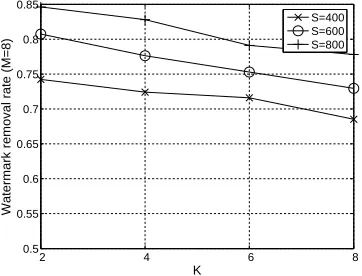
4.15 Watermark removal rate (M = 8) . . . 77
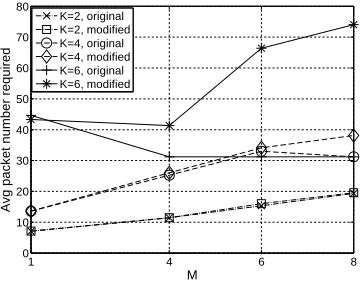
4.16 Packets processed . . . 78
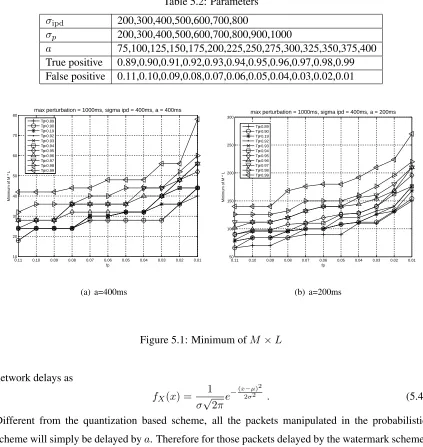
5.1 Minimum ofM ×L . . . 82
5.2 SPRT results (d∗=4) . . . 84
5.3 SPRT false positive when actualσis different from estimatedσ . . . 85
6.1 Distributions offX andfY . . . 95
6.2 SPRT detection rate (guessed watermark delay used in SPRT is 200ms) . . . 98
6.3 The number of packets processed by SPRT before SPRT terminates . . . 98
6.4 SPRT false positive rate . . . 99
6.5 Nconf changing withOwhenI = 1000ms . . . 103
6.6 Nconf changing withI whenO = 2000ms . . . 103
6.7 Divide the flow into embedding/non-embedding areas . . . 103
6.8 Difficulty in watermark duplication . . . 107
6.9 Watermark duplication result . . . 107
6.10 Reduce packet delays . . . 109
6.11 Using random packet delays . . . 109
6.12 SPRT watermark detection rate . . . 113
6.13 The number of packets processed by SPRT before it terminates . . . 113
6.14 Estimation error ofδusing EM algorithm . . . 113
6.15 Nconf changing with differentI for correctO . . . 114
6.16 Nconf changing with differentOfor correctI . . . 114
6.17 Watermark removal for the original and the improved schemes . . . 115
6.18 WM duplication using the heuristic algorithm on both schemes . . . 115
6.19 True positive rate with enhancement 2 (Imin= 700ms,Imax= 1300ms) . . . 117
6.20 True positive rate with enhancement 2 (Imin= 500ms,Imax= 1500ms) . . . 117
6.21 True positive rate with enhancement 1 . . . 117
6.22 True positive rate with enhancement 3 . . . 117
6.23 True positive rates with all 3 enhancements (Imin = 700ms,Imax= 1300ms) . . . 118
6.24 True positive rates under both timing perturbation and repacketization . . . 118
6.25 False positive rate,Imin= 700ms andImax= 1300ms . . . 119
List of Tables
1.1 Frequently used notations . . . 4
2.1 Parameters for quantization based watermarking . . . 24
2.2 Parameters for probabilistic watermarking . . . 25
2.3 Parameters for interval based watermarking . . . 27
3.1 Parameters for probabilistic scheme . . . 46
3.2 Parameters for quantization scheme . . . 46
4.1 SPRT simulation result . . . 72
4.2 GEM estimation ofS . . . 74
4.3 GEM estimation ofθ . . . 74
4.4 Watermark recovery rate for Case I . . . 75
4.5 Recovery rate for Case II (S-L) . . . 75
4.6 Recovery rate for Case II (S-M) . . . 75
4.7 SPRT detection rate . . . 77
5.1 Parameters for probabilistic watermarking . . . 80
5.2 Parameters . . . 82
5.3 SPRT false positive . . . 85
5.4 EM result . . . 87
5.5 EM result - collateral delay . . . 87
5.6 Watermark removal result . . . 88
5.7 Watermark removal result - collateral delay . . . 88
5.8 Duplication Result . . . 89
5.9 Duplication Result - collateral delay . . . 89
5.10 Parameters used in experiment . . . 90
5.11 Realtime WM removal (Probabilistic) . . . 92
5.12 Realtime WM removal (Quantization) . . . 92
6.1 SPRT detection rate . . . 98
6.2 The estimation ofδusing EM algorithm . . . 101
6.4 SPRT detection rate . . . 110
6.5 Parameters for the improved scheme . . . 111
6.6 Parameters for watermark encoding/decoding . . . 116
A.1 Symbols used in stepping stone connections . . . 132
Chapter 1
Introduction
Network based intrusions have been growing rapidly in recent years, despite the huge amount of resources that have been put into network and information security. The Internet makes every computer connected to it a potential target for malicious attacks, which could come from any location around the world. Even the most secure Internet sites, such as the servers of transnational corporations and government agencies, have experienced security violations and network intru-sions. The increase of network attacks results partly from the lack of accountability on the Internet. The design of the Internet emphasizes predominantly functionality, availability and efficiency. For example, the legitimacy of IP source addresses is usually not enforced. Routing protocols are en-gineered purposively stateless. All of these facts enable attackers to conceal their identities easily. Besides various technologies such as access control, firewalls and intrusion detection systems (IDSs) that prevent and detect the network based intrusions, attack attribution techniques are also urgently needed to trace back to the real attackers and bring them to justice.
block or trace such attacks. The termIP trace-backis used to represent the techniques that trace IP packets through a series of network routers. Many IP trace-back schemes have been developed by researchers, such as [44, 48, 46, 64].
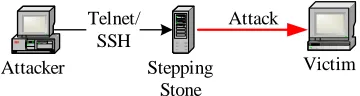
Another popular and effective method for attackers to maintain obscurity is to employ intermediate hosts in their intrusions. Such intermediate hosts could bestepping stones,zombies, orreflectors. The difference between these intermediate hosts are given in [51] and [23]. In this dissertation, I am focusing on tracing attacks through interactive stepping stone computers. When targeting high-profile victims, the intruders may not attack directly from their own computers. In-stead, they could first login (using protocols such as Telnet, rlogin, or SSH) to another host that they have secretly gained access to beforehand, and then attack from that computer. This process is shown in figure 1.1. In this scenario, even if the stepping stone computer is successfully identi-fied, e.g. through IP trace-back, it would be difficult to trace back to the real origin of the attack from the stepping stone. For better protection, the intruders may employ a sequence of stepping stone computers. They can sequentially connect from one stepping stone to another using secure protocols such as SSH [49]. The malicious instructions are passed along the sequence of stepping stones without disclosing the contents or the source of the attack. Only on the last host, the final attack actions will be issued toward the real victim. This process is shown in figure 1.2. The at-tackers may use the sequence of stepping stones that traverses the entire world, which will make the attack attribution even harder. A host does not need to be deeply compromised to become a stepping stone. The only thing needed is ordinary user’s privileges to login to the host and to create outgoing network connections. Such kind of access may be obtained from dictionary attacks [9] on password files, by snooping the unencrypted passwords on the Internet, or through certain kinds of social engineering [47].
The solutions of the IP trace-back problem are not capable of tracing attacks through stepping stones. Unlike the traffics between different routers where IP packets are solely duplicated and propagated, the traffics between different stepping stones belong to different TCP connections. Most of the network characteristic will be modified by the stepping stones. Such characteristics include IP/TCP header, the payload (if transmitted in secure channels), the packet size, etc. All these factors make tracing attacks through stepping stones a difficult problem. Moreover, controlled by attackers, the stepping stones may intentional manipulate the flows they receive to deter attack attribution schemes. For example, they can change the timing characteristics of the traffics by delaying the packets or inserting meaningless padding packets.
The focus of current research is to correlate together the different connections that belong to the same stepping stone attack. Various approaches have been developed, such as [61, 11, 1, 60, 41]. However, existing schemes still have many limitations and are far from prefect. The countermea-sures of attackers have also advanced continuously along with the correlation schemes. In this dissertation, I will thoroughly investigate the advantage and disadvantage of the existing attack attribution techniques, and develop novel methods that can resist different countermeasures that attackers may utilize.
Stepping Stone Telnet/
SSH
Attacker Victim
Attack
Figure 1.1: Attack through a single stepping stone
Chain of Stepping Stones
Stepping Stone
Telnet/ SSH Telnet/
SSH
Attacker Stepping Victim
Stone
Attack
Figure 1.2: Attack through a chain of stepping stones
1.1 Problem Statement: Attack Attribution through Stepping Stones
In this section, I formally define the attack attribution problem through stepping stone computers, and describe the notations used throughout this dissertation.
We useh1 ↔ h2 to represent a bi-directional networkconnectionbetween hostsh1and
attacker employs a series of hostsh1, h2, . . . , hkby creating a sequence of connectionsh1 ↔h2 ↔ · · · ↔hk. Such a sequence is called aconnection chain, and the intermediate hostsh1, h2, . . . , hk
are calledstepping stones. Assumingj > i, we call flowhi → hi+1 an upstreamflow of hj →
hj+1, andhj →hj+1adownstreamflow ofhi →hi+1. Intuitively, information is propagated from an upstream flow to its downstream flows. For a packetpi, we usetito represent its timestamp. A
flowfcan also be represented by the sequence of all its packets ashp1, p2, . . . , pni, whereti< ti+1.
When only packet timing is concerned, we may simply denotef asht1, t2, . . . , tni.
Using the above notations, theattack attributionproblem of a stepping stone connection chainh1 ↔h2 ↔ · · · ↔hk, which is also called thetrace-backproblem, can be defined as:Given the last connection hk−1 ↔ hk, identify other connections that belong to the same connection chain. A perfect solution can enable us to not only trace back to the real origin of the attack, but also discover every stepping stone exploited. However, any practical approach tends to miss certain connections (not 100% true positive rate) or falsely identify some connections that do not belong to the connection chain (not 0 false positive rate).
We do not aim directly at the general trace-back problem. Similar to most of existing schemes, we focus on a more basic stepping stone flow correlation problem: Given a flowf and a suspicious flowf0, determine whetherf0 is a downstream flow off or not. A solution to this
correlation problem would be very helpful to address the trace-back problem, as long as we can access and process all the connections in the chain.
Some frequently used notations are listed in Table 1.1.
Table 1.1: Frequently used notations
f known stepping stone (upstream) flow
f0 a suspicious downstream flow
pi,ti a packet in flowf and its timestamp
p0
i,t0i a packet in flowf0and its timestamp
ci a meaningless chaff packet inserted by attacks
1.2 Motivation
1.2.1 Robust Correlation Scheme against Possible Countermeasures
Tracing attacks through stepping stones is a difficult problem. Since the traffics between stepping stones belong to different TCP connections, information in the IP and TCP headers will be changed after passing a stepping stone and cannot be used for correlation purpose. Moreover, controlled by attackers, the stepping stones can intentionally manipulate the outgoing traffics to alter some important flow characteristics used for correlation. Generally, a working correlation scheme should be able to deal with the following countermeasures that may be used by attackers.
1. Payload encryption. Early methods correlate stepping stone connections based on the payload of the packets in different connections [50, 62]. Since the information is propagated from upstream flows to downstream flows, the packets must contains same or similar contents. However, such methods can only be used when packets are transmitted through unencrypted channels, e.g., using protocols such as Telnet or rlogin. If attackers utilize secure transmission protocols such as SSH or IPsec [18], payload encryption can completely remove the similarity between corresponding packets.
2. Timing perturbation. Knowing the limitation of packet content based schemes, researchers switched to investigate the packet timing in the flows between different stepping stones. In normal stepping stone connections, as soon as one stepping stone receives a packet, it will for-ward the information by sending out another packet. That means the connections in the same connection chain should display similar packet timing characteristics. Several approaches that analyze packet timing information have been proposed [67, 65, 61]. The problem in these methods is that they are only based on normal behavior of stepping stones. If the step-ping stones do not forward the packets immediately, the timing characteristics on which these methods rely may be significantly changed. Since attackers can control the stepping stone hosts, they can intentionally alter the packet timing information through simply delaying the packets to be sent out by certain amounts of time.
By assuming a maximal amount of timing perturbation∆, a stepping stone must forward a packet received at timetino later thanti+ ∆. Using this property, researchers have proposed
schemes [11] and [1]. On the other hand, if we randomly selectm packets, some packets may experience small timing perturbations while others may have large timing perturbations. Combined together the effects of perturbations are likely to cancel each other. Based on this idea two active schemes [59] and [60] were proposed, in which the flows are embedded with digital watermarks that are robust to timing perturbations.
However, all the above schemes are not robust under extra padding packets, also calledchaff
(In [1] the authors investigated chaff packets, but their approach only worked when chaff packets were less than 10% of normal packets). Chaff packets are meaningless packets gen-erated by stepping stones and sent out with normal packets. Their solely purpose is to change both the timing characteristics and the number of packets of the flows. The difficulty is that when transmitted in encrypted channel, chaff packets cannot be distinguished from nor-mal packets. If we useci to represent chaff packet, a flow hp1, . . . , pni may be changed to hc1, . . . , p1, cj, . . . , pn, . . . , cki. If encrypted, we have no way to know which packets are chaff packets.
4. Flow split and merge. Another method attackers can use to reduce the effectiveness of ex-isting trace-back schemes is flow split & merge. At a certainsplit hostin the stepping stone connection chain, the outgoing flow is split into several sub-flows. Each sub-flow contains a part of the packets of the original flow. These sub-flows are transmitted independently until they reach amerge host. In the merge host, all sub-flows come together and the “original” flow is restored. This procedure is illustrated in figure 1.3. Since each sub-flow only has an incomplete copy of packets, it is difficult to correlate sub-flows with either the original flow or the restored flow. Flow split & merge can be used to prevent the re-construction of stepping stone chains.
Besides the above countermeasures attackers can utilize, the normal operation of stepping stone computers and network devices will also affect the timing characteristics of the flows. For example, timing variation could results from propagation delays of the stepping stones or the net-works. Packets could be lost and then re-transmitted between stepping stones. Thepacketization
Split host p1p2…pn
• • •
p'1p'2…p'n
pa1pa2…
pb1pb2…
pk1pk2…
Merge host
Figure 1.3: The illustration of flow split and merge
each other. Large packets may also be split to comply with network configuration. In our experi-ment, we have found out that when large timing perturbation is introduced, repacketization is very common and will affect most of existing correlation schemes. All of the above problems make attack attribution a very complex problem.
1.2.2 Secure Correlation Scheme against Possible Attacks
Another critical problem that motivates my research is the secrecy and security of the existing active timing schemes. Since the watermark schemes actively involve in packet transmis-sion and manipulate the packet timing, it is possible that attackers can be aware of the watermark existence. For example, attackers may hypothesize the presence of a watermark based on whether the packet delays of certain packets between stepping stones vary significantly from other pack-ets or not. If such a watermark detection approach can be developed, the attackers will have a very good chance to abort their attack before being traced back. Moreover, we want to investigate whether the current schemes will leak any important information to the attackers when the existence of watermark can be detected. Such information may be used to effectively and efficiently defeat the watermark scheme, through removing the embedded watermark to decrease the true positive rate, and/or duplicating the watermark to other normal flows to fool the watermark decoders and increase the false positive rate. Such threats of attackers must be fully investigated and the security enhancements must be developed before the watermark schemes can be widely used in practice.
1.3 Summary of Research Results
1. Correlation scheme for traffic flows with chaff packets. This scheme is developed to corre-late stepping stone flows when both timing perturbation and chaff packets are introduced by attackers simultaneously. In this scheme, I improve the active watermark schemes proposed in [59] and [60]. The basic idea is to first actively embed a timing based watermark into an upstream flow. Then we use a packet-matching technique that is similar to the method proposed in [66] to determine the corresponding packets in a suspicious flow. Based on the assumption that the maximum timing perturbation is bounded by∆, for each packet in the upstream flowf, we can decide a set of its possible corresponding packets in the suspicious flowf0whenf0is really the downstream flow. Using these sets of corresponding packets, we decode watermarks from all possible combinations of the corresponding packets. From these watermarks, the one that is closest to the original watermark is used to decide the correlation result. Through theoretical analysis and experimental evaluation, we have shown that our scheme is effective for detecting stepping stone connections under both chaff and timing per-turbation. I also investigate how our correlation scheme can be extended to identify stepping stone connections when attackers employ the technique of flow split & merge. A part of the results has been published in [37] and [38]. The result of this research is included in paper [39].
Using these parameters, they could embed the same watermark to other traffic in order to di-vert the attention of the watermark detector. In this dissertation, I investigate the methods that the attackers could use to detect the watermark existence and infer the watermark parameters. The result is published in [36].
3. The secrecy of the probabilistic watermark scheme.The probabilistic watermark scheme [60] was proposed to provide realtime watermark embedding functionality with better watermark true positive rate and false positive rate than the quantization based watermark scheme. Sim-ilarly, this watermark scheme is under the possible attacks of intelligent attackers. We use similar attacking approaches as those developed for the quantization based scheme to investi-gate the security of this scheme. We will answer three questions: 1) how to determine whether an attacking flow is embedded with watermark or not; 2) how to find out where the watermark is embedded; and 3) how to defeat the watermark scheme by removing the watermark from the attacking flow and/or duplicating the watermark to other normal flows.
4. The secrecy of the interval based watermark scheme and security improvements.The interval based scheme [41] was proposed to provide robust correlation under both random timing perturbation and repacketization. Most of the existing timing based schemes cannot handle repacketization since they assume that packet counts do not change between stepping stones. Unfortunately, the stepping stones may choose to merge multiple packets into a single packet, or even split a large packet into several packets. Such changes on packet counts will cause the existing watermark decoding algorithms out of synchronization and generating false result.
Similarly, we will investigate the attackers’ threats on this watermark scheme, in terms of watermark detection, parameter inference, and watermark removal/duplication. Moreover, we will also develop several security enhancements based on our insights on the weakness of the original scheme. We will demonstrate that the improved scheme can significantly increase the resistance to proposed attacks, while the original scheme is much more vulnerable.
1.4 Dissertation Organization
Chapter 2
Background
In this chapter, we introduce the research literatures related to the problem of tracing attacks through stepping stones. In Section 2.1 we briefly introduce various trace-back schemes for stepping stone attacks. In Section 2.2, we introduce the related work in anonymous communication systems. In Section 2.3, we introduce different schemes about IP trace-back. Section 2.4 briefly introduces the background about digital watermarking. Because my work is closely related to the active watermark schemes, Section 2.5 describes the quantization based watermark scheme, the probabilistic watermark scheme, and the interval based watermark scheme in detail.
2.1 Trace-Back Techniques through Stepping Stones
and more similar among themselves. However, it is also more likely for attackers to detect their existence.
2.1.1 Host Based Approaches
Initial techniques related to attack attribution are host based approaches, in which the stepping stone hosts themselves are used in tracing.
The Distributed Intrusion Detection System (DIDS) [45] is a host based tracing scheme developed in UC Davis. It monitors all TCP connections and login activities within the supervised network, and keeps track of all the actions and the states of users. The monitored information is then transmitted to the central network intrusion detection system for further analysis. A user may have different IDs (UID) in different computers. To identify the same user throughout the supervised network, DIDS assigns a network-user ID (NID) to a user when he/she first logins to the monitored network. Whenever the users change their UIDs, DIDS associates the UIDs with the NIDs to keep tracks of the users.
The Caller Identification System (CIS) [19] is another host based approach that authen-ticate the origin of a user when he/she attempts to login to a host. Every host along the connec-tion chain maintains a list about its view of the chain so far. When a user wants to login to the
nth host, thenth host queries the(n−1)th host for the list of its view of the predecessor hosts:
n−2, n−3, . . . ,1. Thenth host then queries each of the predecessor host in(n−2)’s list for a list of their predecessor hosts. It allows the user to login only if all the lists of predecessor hosts are consistent.
Session Token Protocol (STOP) [3] is a trace-back scheme similar to CIS. It recursively queries the previous hosts in a connection chain for forensic information. A STOP server listens on a pre-defined port of a host, and can be queried about the connections initiated from that host. When queried, STOP returns a secure token consisting of a hash of the user and connection information. If the identified user is remotely connected to the queried host, the STOP server can be directed to query the STOP server on the remote host where the user is coming from. Therefore, each host can record the information of the previous host in the connection chain.
processes started from the remote session inherit the same origin information. The origin informa-tion includes at least five elements: source address, destinainforma-tion address, source port, destinainforma-tion port, and protocol.
The major problem in the host based methods is the trustworthiness of the information provided by the stepping stones. To trace back to the origin of the connection chain, all the informa-tion from the stepping stones must be correct. However, it is very possible that attackers can delete or modify such information since they may gain the control in the stepping stones. If one stepping stone provides misleading records, the whole tracing system is fooled. Because host based schemes require all the stepping stones participated in the attacks can be trusted, they are not suitable for usage on the Internet.
2.1.2 Packet Content Based Approaches
The problem of detecting interactive stepping stones was first formulated by Staniford and Heberlein [50]. They proposed a content based approach by creating thumbprints from the payload of packets, and comparing them to find good matches. A flow is first divided into different time periods. At each time period, the frequencies of different characters occurred in that period are saved. Suppose in a given time period, the frequencies forLcharacters are a vector(F1, . . . ,FL), the thumbprint is defined as a linear combination
T =PLa=1φ(a)Fa.
Using principle component analysis, it can decide which K of the Lcomponents contribute the most to the variance of the vector. Then such thumbprintsT are compared to find correlation.
Another content based scheme is sleepy watermark tracing technique (SWT) [62]. It correlates stepping stone connections by injecting non-displayable watermarks into the contents of packets. The watermark is constructed usingvirtual null strings. Such strings will have no effect when they are echoed back to the attackers, e.g., “abc\b\b\b”. Therefore attackers will not notice that a sleepy watermark is embedded. The correlation is simply to detect the same watermark in any suspicious flows.
2.1.3 Packet Timing Based Approaches
Due to the widely applications of packet encryption, more recent schemes focused on timing characteristic of stepping stone connections. In the following, the first three approaches mainly targeted at the packet encryption, while later schemes also considered timing perturbation.
Zhang and Paxson [67] proposed the first timing based approach that can correlate en-crypted traffic. They observed that in an interactive connection, there existed alternate ON and OFF periods. Each time a packet is transmitted, the flow goes into ON period. If there is no packet more thanTidletime, the flow goes into OFF period. When an attacker creates a chain of stepping stone
connections, the ON/OFF period in each connection should have certain similarities. So the step-ping stone connections could be detected by calculating whether their OFF periods coincide or not. For two OFF periods in two connections, they are said to becorrelatedif the difference between their ending time is less than or equal to a valueδ. For two connections,OF F1 andOF F2 stand
for the number of OFF periods in each of them, andOF F1,2stands for the number of OFF periods
that correlated. These two connections are said to becorrelatedif
OF F1,2
min(OF F1,OF F2) ≥γ,
whereγ is a pre-selected threshold value.
Yoda and Etoh [65] proposed a deviation based scheme to detect stepping stone connec-tions. This scheme calculates deviation between a known attacking flow and all other flows appeared around the same time. The deviation measures how far the two flows differ from each other. Since the starting points of the two flows may not be recorded at the same time, their scheme aligns the two flows to compute the smallest deviation. They observed that unrelated flows would usually have deviations large enough to be distinguished from those in the same stepping stone connections.
Wang et al. [61] proposed a correlation scheme based on inter-packet delays (IPDs). In the scheme, it first computes the inter-packet delays for all the adjacent packets in a given flow, and saves the IPDs as a vectorhd1, . . . , dni. Then thecorrelation window functionis define on the
vector as
Wj,s(hd1, . . . , dni) =hdj, . . . , dj+s−1i,
where j is the starting point of the window, and s is the window size. Given two flows to be correlated, the correlation point function CPF with respect to pointjandkis
Pair (j, j +k) is called a correlation point if max(CP F(X, Y, j, k, s)) ≥ δcp, where δcp is a
threshold. Then for the two flows, it may computencorrelation points(j1, j1+k1), . . . ,(jn, jn+
kn). These points are represent using two n-dimensional vector Cx = hj1, . . . , jni and Cy = hj1+k1, . . . , jn+kni. Then the correlation between two flows is computed usingcorrelation value function
CV F(Cx, Cy) =
0 n= 0
ρ(Cx, Cy) n >1
1 n= 1
,
whereρ(Cx, Cy) =
Pn
i=1(ji−E(Cx))×(ji+ki−E(Cy))
q£P n
i=1(ji−E(Cx))2
¤
×£Pn
i=1(ji+ki−E(Cy))2
¤. The authors tested four different
correlation point function: mini/max sum ratio, statistical correlation, normalized dot product 1 and normalized dot product 2, and found out mini/max is the most effective method.
Donoho et al. [11] investigated the theoretical limits of the attackers’ ability to disguise their traffic through timing perturbations. Their correlation scheme was based on wavelet and multi-scale analysis. LetNi(t)be the cumulative character counting function on streamiin time interval
[0, t). For an upstream flow (stream 1) and its downstream flow (stream 2), two assumptions hold:
N2(t)≤N1(t),
which represents the causality, and
N2(t+ ∆)≥N1(t),
which represents a maximum tolerable delay exists. The authors chose two kinds of wavelets to do the multi-scale analysis. For a waveletψ(t), the multi-scale function is defined as
ψj,k(t) =ψ((t−k2j)/2j)/2j
ifψ(t)is the boxcar function, and
ψj,k(t) =ψ((t−k2j)/2j)/2j/2
ifψ(t)is the Haar wavelet. jis the scale of the multi-scale analysis. Then the wavelet coefficients of each streamNiis defined as the inner product ofψj,k(t)andNi
αj,ki =X
t
The correlation coefficient at scalejis
Corr(j) =X
k
α1j,kα2j,k/µ X
k
(αj,k1 )2X
k
(α2j,k)2
¶1/2
.
Using simulation, the flows under small timing perturbations still have correlation score that is very close to 1. The authors also discussed when chaff packets were added, the correlation result would approach to the “normal packets/(normal+chaff packets)” ratio. However, their paper lacked the important discussion about the false positive rate of their method.
Wang and Reeves [59] proposed the first active watermark scheme that was robust to random timing perturbations. They first identified the quantitative trade-offs between the correlation effectiveness (in term of true positive & false positive), maximum timing perturbations added by the adversary, the defining characteristics of the inter-packet timing of flows and the number of packets needed. Their work is also the first one that identifies provable bound on the number of packets needed to achieve desired correlation effectiveness. Wang et al. also proposed another watermark scheme [60] that guaranteed even timing adjustments and had better true positive rate. The details of these two schemes will be discussed in Section 2.5.
Blum et al. [1] proposed to correlate stepping stone connections by counting the packet number differences in certain time intervals. Based on the assumptions that flows are Poisson dis-tributed, the maximum timing perturbation is ∆, and the p∆ is the maximum number of packets that may be sent in∆time, they provided an algorithm with at most δ false positive rate. They proved that to achieveδ false positive rate, no more than 8p2∆
π log1δ packets to be observed in the
union of the two flows. Then they relaxed the assumption about the Poisson model, and shown that if the flows behaved as sequences of Poisson processes, their algorithm still worked. They also extended their algorithm to deal with small number of chaff packets. However, the number of chaff packets could only consist a very small portions of the entire flow (<10%). They did not show any experimental evaluation of their algorithms either.
Peng et al. [37] proposed to use active watermark scheme and packet matching to detect stepping stone connections when there existed both timing perturbation and extra chaff packets. Several algorithms were proposed with different trade-offs between detection rate, false positive rate and computation overhead.
In [58], the authors provided a watermark approach that could effectively identify the en-crypted peer-to-peer VoIP calls even when they were transmitted through low-latency anonymizing networks. This approach uses the similar ideas as those in the probabilistic watermark scheme [60]. Peng et al. [36] investigated the secrecy issue of the active watermark approaches. They developed multiple attacking techniques and showed that it was possible to detect watermark exis-tence, recover important watermark parameters, and effectively defeat the quantization based wa-termark scheme in [59].
To deal with TCP repacketization, Pyun et al. [41] proposed an interval based watermark scheme. They proposed to divide the attacking flows into time intervals, and embed watermark by manipulating the numbers of packets falling into different intervals. The details of this scheme will be discussed in Section 2.5.
2.1.4 A Related Correlation Approach in Wireless Network
2.2 Related Work in Anonymous Systems
Anonymous communication systems protect the identity information of the participants in network applications. Such applications may include online voting, online auction, etc. Vari-ous anonymVari-ous systems have been developed, which can provide anonymity for message senders, anonymity for message receivers, or unlinkability between senders and receivers. Similar to tracing attack through stepping stones, researchers interested in anonymous communication systems have also investigated the effects of encryption, timing perturbation, chaff packets, and split & merge. All these methods can be utilized to provide anonymity
Chaum proposed the first anonymous email application in [4]. The idea is to use relay servers, also known asmixes, to reroute and encrypt the messages with the public keys of the mixes. When a message is sent to the first mix, the mix decrypts the message with its private key to get the address of the second mix and the new message is encrypted using the public key of the second mix. Each mix will decrypt the message and forward to the next mix. Only the last mix will get the real destination of the message. Chaum also proposed return-address and digital pseudonym for users to communicate with each other anonymously. After Chaum, several anonymous email systems were developed. Hughes and Finney [32] built the cypherpunk remailer, which was a distributed mix network with reply function that used PGP to encrypt and decrypt messages. This system is vulnerable to a global passive attack and replay attack. Babel [17] is a relatively full-fledged anonymous email system. The reply in Babel does not need the sender to remember the secret seed to decrypt the reply message, but it is vulnerable to reply attack. Denezis and et al. developed Mixminion [6] which used secure single-use reply blocks. In Mixminion, mix nodes cannot distinguish forward messages from reply messages, so forward and reply messages share the same anonymity set. Despite its problems, the design of Mixminion considers a relatively complete set of attacks.
The idea to use mixes to provide communication anonymity has also been applied to ap-plications other than email. The onion routing project [43] seeks to provide a general anonymous routing protocol for different Internet applications. Onion Routing is a flexible communication in-frastructure that is resistant to both eavesdropping and traffic analysis. It accomplishes this goal through separating identification from routing. Connection is always kept anonymous, although communication needs not to be. Communication may be made anonymous by removing identifi-cation information from data stream. The onion routing related publiidentifi-cations include [54, 15, 55].
communication system. It improves the first generation by adding perfect forward secrecy, conges-tion control, directory server, integrity checking, configurable exit policies, and the practical design for location-hidden service via rendezvous points. It works on the real-world Internet, requires no special privileges or kernel modifications, needs little synchronization or coordination between nodes, and provides a reasonable trade-off between anonymity, usability, and efficiency. Besides onion routing,Hordes[24] is another anonymous system that uses forwarding mechanisms similar to onion routing. It is the first to use multicast routing. It has the advantages of shorter transmission latency and less protocol participants, and can provide the similar degree of anonymity.
There are multiple papers that address the timing analysis/attacks to anonymous systems. In [16], the authors quantitatively analyzed anonymous systems with regard to anonymity properties. They used a probabilistic method to investigate the anonymous behavior. In [63], the authors studied the threat of passive logging attacks against anonymous communication. They described a possible defense from breaking the assumption of uniformly random path selection. They showed that their defense improved anonymity when nodes stayed in the system, but failed when nodes left and re-joined. In [68], the authors addressed issues related to flow correlation attacks and the corresponding countermeasures in mix networks. In such attacks, an adversary attempts to analyze the network traffic and correlate the traffic of a flow over an input link at a mix with that over an output link of the same mix. They found a mix with any known batching strategy might fail against such attacks. In [29], the authors showed that the low latency of Tor system made it unsecure against traffic analysis attacks by a global passive adversary. They presented new traffic analysis techniques that allowed attackers with only a partial view of the network to infer which nodes were used to relay the message and greatly reduce the anonymity. Fu et al. [13] studied the degradation of anonymity in a flow based wireless mix network under flow marking attacks. The attack was performed by electromagnetic interference. They found out that the traditional mixes were not effective against such attacks. They then proposed a new countermeasure based on digital filtering technology, and showed it could effectively defend a wireless mix network.
2.3 Related Work in IP Trace-Back
vic-tim. In [44], the packets were probabilistically marked by the routers with partial path information, based on the observation that attackers usually comprise a large number of packets. Although each marked packet only represented a sample of its path, the whole path could be completely re-built after receiving a modest number of packets. In [48], the authors proposed two marking schemes: the Advanced Marking scheme and the Authenticated Marking scheme. Compared with [44], their schemes had the same low network and router overhead, but were more efficient and accurate for attack path reconstruction. Moreover, the authenticated marking supported efficient authentication on the marking of routers, which prevented comprised routers from forging markings from other normal routers. PI[64] (Path Identifier) was a packet marking scheme in which a path fingerprint was embedded in each packet. Each packet traversing the same path was marked with the same identifier, so that the destination host could identify packets traversing the same path on the Internet on a per packet basis, despite IP spoofing. Their scheme also had good efficiency and effectiveness.
SPIE(Source Path Isolation Engine) [46] was a hash based technique for IP trace-back that gen-erated audit trails traffic within the network. Their scheme could trace to the origin of a single IP packet delivered by the network in the recent past. Their scheme could also provide explicit trace-back support for packet transforms, generation of attack graphs, no false negatives and minimal false positives. It was also efficient and scalable.
2.4 Related Work in Digital Watermarking
Digital watermarking is a technique to embed hidden information such as copyright no-tices or other verification messages into carrier signals such as digital audio, video or images [5, 40, 56]. While the additional hidden message does not restrict use of a carrier signal, it pro-vides an approach to track the signal to the original owner. A watermark can be classified into two sub-types: visible and invisible. A watermark scheme should be robust to the attacks aiming at removing or destroying the embedded watermark. For invisible watermark, how to prevent the watermark from being detected is also a problem.
least attack energy distortion. In [25], the authors analyzed another type of attack against binary watermarks: the sensitivity attack. They found out there was a way to remove the watermark when the watermark is decoded by comparing the correlation value with a threshold. They proposed to mitigate this problem by using a decision interval instead of decision threshold.
2.5 Active Timing Based Watermark Schemes
2.5.1 Quantization Based Watermark Scheme
Quantization based watermark scheme was published in [59]. This scheme is based on ac-tively embedding a digital watermark into an upstream flow by slightly delaying certain pre-selected packets. The changes on packet timing will then propagate to all of the downstream flows. If the watermark embedded is unique, it should be detected only in all the downstream flows, but nowhere else, with a high probability. Depending on the secrecy of watermark parameters, especially the secret selection of packets to embed the watermark (calledembedding packets), the authors had shown that this scheme was robust to random timing perturbations. It is because the timing changes incurred by random perturbations are very likely to cancel the effects of each other, since attackers have no knowledge about where the watermark might be.
The watermark is embedded through manipulating inter-packet delay (IPD). The IPD between a pair of packethpi, pji(i < j) is define as: ipd(i,j) = tj −ti, whereti andtj are the
timestamps ofpiandpj, respectively. For simplicity, when the packets in the IPD are not concerned,
we also useipdoripdito represent a single IPD. This scheme uses quantization of IPDs to tolerate
certain amount of timing perturbation. Given the parameter quantization step, denoted asS, the quantization function is defined as
q(ipd, S) =round(ipd/S), (2.1)
where function round(x) rounds off real number x to its nearest integer (i.e., round(x) = iif
x∈(i−12, i+12]). It is easy to see that using quantization, a small perturbation may not affect the quantized value.
To embed one binary watermark bit w (0 or 1), the ipd is slightly adjusted so that the watermarked IPD (denote asipdW) fulfills the equationq(ipdW, S)mod2 =w. That means when
ipd
(2n-1)S 2nS (2n+1)S (2n+2)S
ipdW (2n+3)S
2nS (2n+1)S (2n+2)S
1
0
Figure 2.1: Quantization based watermarking: embed 1 watermark bit
1 is embedded, the watermarked IPD will be the odd number of multiples ofS. The watermark encoding function that can achieve this is:
e(ipd, w, S) = [q(ipd+S/2, S) +x]×S, (2.2)
wherex = (w−(q(ipd+S/2, S) mod2) + 2) mod 2. Here the quantization is on(ipd+S/2) instead ofipd. It is to make sure that the watermarked IPDipdW obtained is always bigger than the originalipd. Then the watermarked IPD is achieved through delaying its second packet by the amount of(ipdW−ipd). The process to embed one watermark bit is shown in figure 2.1. Hereafter,
we call the delay caused by watermark embedding aswatermark delay. The function to decode the watermark bit embedded in an IPD is
d(ipd, S) =q(ipd, S)mod2. (2.3) The decoding function returns exactly the embedded watermark bit whenipdW is the input.
More-over, as long as the change of the IPD caused by timing perturbation is limited by(−S/2, S/2], it can still return the correct watermark bit.
Therefore a watermark bit embedded in a single IPD can resist up toS/2random timing perturbations. To be stealthy, the selection ofSis limited. Generally speaking, largerSwill induce bigger delay, which makes the watermark more noticeable to attackers. In order to resist timing perturbations larger than S/2 for one watermark bit, the solution is to using multiple IPDs. To embed the watermark bit onMIPDs, we first compute IPD average as
ipdavg = M1 M X
i=1
ipdi. (2.4)
Then the watermarked IPD average is calculated asipdWavg =e(ipdavg, w, S), using equation (2.2).
... ... . . . ... ...
Bit 1 Bit L
M M M M
Figure 2.2: Quantization based watermarking: embed anL-bit watermark
ipdavg). In watermark decoding, the average of theMwatermarked IPDs is computed then equation
(2.3) is used: w = d(ipdWavg, S). Using the sameS, multiple IPDs can provide higher resistance than a single IPD.
Even using multiple IPDs, a single watermark bit still has limited resistance to timing perturbation. Moreover, from any unwatermarked IPD, we has 50% chance to decode a desired watermark bit. To increase the true positive rate and reduce the false positive rate, multiple-bit watermark is used. AnL-bit watermark W = w1. . . wL is embedded by repeating the procedure
of embedding single bitLtimes. Each time a different set of embedding packets should be used. In watermark detection, anotherL-bit watermarkW0is decoded from a suspicious flow and compared
withW. If the hamming distance betweenW andW0is less than or equal to a pre-defined threshold,
we report a stepping-stone flow is detected. The reason that hamming distance is used is to increase the robustness of watermark scheme under timing perturbation. Because the packets used to embed the watermark are kept secret from attackers, this watermark scheme is robust against random timing perturbations. The procedure of choosing embedding packets to embed anL-bit watermark is shown in figure 2.2. From this figure, we can see that the embedding packets are formed with a regular pattern. As we will show later, such a pattern could leak critical information to attackers, and make the inference of watermark parameter much easier.
The parameters for the quantization based watermark scheme is listed in Table 2.1.
2.5.2 Probabilistic Watermark Scheme
Table 2.1: Parameters for quantization based watermarking
S Quantization step
L The number of binary watermark bits
M Degree of robustness (i.e., the number of IPDs to embed 1 bit)
W =w1. . . wL The watermark. Each bitwiis either 0 or 1
that after the IPD average is computed and the watermarked IPDs are determined, we have already passed the right time to send out the packets. Therefore the encoder may not always be able to embed the watermark in realtime. Knowing this problem, the authors of [59] proposed a realtime watermark scheme [60]. The new scheme also has better true positive rate under timing perturbation and the same false positive rate.
To embed a single watermark bit, we randomly choose2Mdistinct packetshpe1, . . . , pe2Mi,
and construct2M packet pairs: hpei, pei+di, where1 ≤ e1 < ... < e2M ≤ n−d. Hered ≥ 1 is a user-selected parameter. The IPDs of these packet pairs are ipd(ei,ei+d) = tei+d −tei(i = 1, . . . ,2M).
We randomly divide these2MIPDs into 2 groups,ipd1andipd2, with each group having
M IPDs. We useipd1
i andipd2i (i= 1, . . . , M)to denote the IPDs inipd1andipd2, respectively.
Apparently,ipd1i andipd2i are identically distributed. ThereforeE(ipd1i) =E(ipd2i). The average difference between the IPDs from groupipd1andipd2 is defined as
D= 1 2M
M X
i=1
(ipd1i −ipd2i). (2.5)
We should have E(D) = 0. HereM is called redundancy number. The bigger M is, the more likely Dis equal to 0. Figure 2.3 shows the IPD differences from synthetically generated flows. From this figure, the majority of the IPD differences fall into a small interval around 0.
Now if we increase or decreaseDby a valuea >0, we can skew the distribution ofD, and the probability thatDwill be positive or negative is increased. This observation gives us a way to embed a single bit of watermark probabilistically. To embed a watermark bit 0, we decreaseD
bya. Then for the new average IPD differenceD0 = D−a, it is more likelyD0 <0. To embed
bit 1, we increaseD bya. Then forD0 = D+a, it is more likelyD0 > 0. The decrease of D
is achieved by decreasing everyipd1
i and increasing everyipd2i bya; the increase ofDis achieved
by increasing everyipd1
i and decreasing everyipd2i bya. The increase or decrease of a single IPD
Figure 2.3: Probabilistic watermarking: IPD differences
After the watermark bit is embedded, it can be detected by checking if the adjustedD0is less than 0 or not. Bit 0 (or 1, resp.) is decoded whenD0 ≤0(or>0, resp.). There exists a slight probability
that a watermark bit cannot be correctly embedded. For example, ifD > a, then bit 0 cannot be embedded sinceD0 =D−a >0. This probability can be reduced by increasingM.
Similar to the quantization based watermarking, we embed an L-bit watermark by re-peating the procedure for one-bit watermarkLtimes. The correlation result is also determined by computing the hamming distance between the decoded watermark and the original watermark. This scheme is also robust to random timing perturbation.
The parameters for the probabilistic watermark scheme is listed in Table 2.2.
Table 2.2: Parameters for probabilistic watermarking
a Extra watermark delay
L The number of binary watermark bits
M Degree of robustness (i.e., the number of IPDs to embed 1 bit)
2.5.3 Interval Based Watermark Scheme
The interval based watermark scheme [41] is proposed to provide robust correlation un-der both random timing perturbation and repacketization that can change the numbers of packets between stepping stone flows. Most of the existing timing based schemes assume that packet counts do not change. Unfortunately, the stepping stones may choose to merge multiple packets into a single packet, or even split a large packet into several packets. Such changes on packet counts will cause the watermark schemes described previously to be out of synchronization and generate false result.
The idea of the interval based watermark scheme is to use time instead of packet count to achieve synchronization between watermark encoders and decoders. To embed a watermark, a flow is divided into multiple equal length intervals. A watermark bit is embedded by making the number of packets falling into one interval larger than the number of packets in another interval. The number of packets can be increased by “pulling” one or more packets into this interval from its previous interval, and can be decreased by “pushing” one or more packets out of this interval to its next interval. More specifically, the watermark scheme first decides an offset valueO and an interval lengthI. The scheme will omit the beginning part of the flow as specified by O. The rest part of the flow will be divided into multiple intervals with lengthI. The watermark encoder uses three consecutive intervals for each watermark bit. The first interval is used only in watermark encoding so that the packets in this interval can be pushed to the next interval. The second and third intervals are used in both encoding and decoding. To embed bit 0, the encoder delays all packets in the first interval by a pre-selected delay valueδ. So some packets in the first interval may be pushed into the second interval and the number of packets in the second interval increases. The encoder also delays all the packets in the third interval byδto reduce the number of packets. To embed bit 1, the encoder only delays all the packets in the second interval byδto simultaneously decrease the number of packets in the second interval and increase the number of packets in the third interval. The encoding process is illustrated in Figures 2.4 and 2.5, where the packets in the grey intervals will be delayed.
To decode the watermark, a decoder simply compares the numbers of packets in the sec-ond and third intervals. If the secsec-ond interval has more packets, it decodes 0. Otherwise, it decodes 1.
wa-original flow
watermarked flow
Figure 2.4: Interval based watermark scheme: embedding bit 0
original flow
watermarked flow
Figure 2.5: Interval based watermark scheme: embedding bit 1
termark, the encoder first embeds the entire watermark using the first3Lintervals. Then it embeds the entire watermark on the next3Lintervals, and so on. This process is repeated until it reaches the end of the flow. In watermark decoding, the decoder will compare the number of packets in all the second and third intervals for one watermark bit to decide whether 0 or 1 is embedded.
Table 2.3 summarizes the parameters used in this watermark scheme.
Table 2.3: Parameters for interval based watermarking
I Interval length
O Offset value
δ Extra watermark delay
L The number of binary watermark bits
w1. . . wL The watermark, in which each bit
Chapter 3
Active Timing Correlation Scheme of
Traffic Flows with Chaff Packets
In order to detect encrypted stepping stone connections, current approaches are based on flow timing analysis. There are two major countermeasures that may defeat the packet timing based approaches. First, attackers can perturb packet timing through intentionally delaying some or all packets. Such timing perturbation may severely alter the timing characteristics used for cor-relation analysis. Second, attackers can insert meaningless padding packets, also calledchaff, into their flows. Chaff packets are exceedingly difficult to be differentiated from normal packets when transmitted through encrypted channels, and can substantially alter both packet number and packet timing. Some previous work [59, 1, 60, 66] considered how to deal with these two countermeasures separately; however, none of them have investigated robust trace-back techniques that can handle both timing perturbation and chaff at the same time.
propagate to all the following flows in the stepping stone connection chains. Therefore stepping stone flows can be identified by searching suspicious flows for the embedded watermark.
In our scheme, we first use a watermark approach to embed a timing based watermark into the flow to be correlated, then try to detect the watermark in the suspicious flows. However, when extra chaff packets are inserted, the original watermark detection algorithm will fail because the exact location of the embedded watermark cannot be determined. In order to still detect the watermark, we first use packet timestamps to identify multiple possible watermark locations. From each possible location, we decode a watermark and compare it with the original watermark embed-ded. If the similarity between the decoded and original watermarks is high, a stepping stone flow is identified.
We develop a series of algorithms aimed at efficient watermark detection when there are both timing perturbation and chaff. We demonstrate that our approach can successfully correlate stepping stone flows through theoretical analysis and experimental evaluation. We also discuss how our approach can be utilized to identify stepping st