CONTRIBUTING MANAGEMENT FACTORS TO PERFORMANCE MANAGEMENT EFFECTIVENESS IN INFORMATION TECHNOLOGY INDUSTRY OF SMALL AND MEDIUM ENTERPRISES IN WUHAN, CHINA
LIANG QIAN
A thesis submitted in fulfillment of the requirements for the award of the degree of Master of Science ( Human Resource Development)
Faculty of Management and Human Resource Development Universiti Teknologi Malaysia
ACKNOWLEDGEMENTS
To my beloved family, thank you for giving me all the support throughout my study in Master Degree. Your love has shown on who I am today. I am blessed to have you in my life.
ABSTRACT
ABSTRAK
TABLE OF CONTENTS
CHAPTER TITLE PAGE
DECLARATION ii
DEDICATION iii
ACKNOWLEDGEMENTS iv
ABSTRACT v
ABSTRAK vi
TABLE OF CONTENTS vii
LIST OF TABLES xiii
LIST OF FIGURES xvii
LIST OF ABBREVIATIONS xviii
LIST OF APPENDICES xix
1 INTRODUCTION 1
1.1 Background of the Study 1
1.2 Statement of the Problem 4 1.3 Research Questions 7
1.4 Objectives of the Study 8
1.5 Hypothesis 8
1.6 Significance of the Study 9
1.7 Scope of the Study 11
1.8 Limitation of the Study 12
1.9 Conceptual and Operational Definitions 13
1.9.2 Performance 14
1.9.3 Performance Management 15
1.9.4 Effectiveness of Performance Management 16
1.9.5 Performance Planning 18
1.9.6 Performance Communication 19
1.9.7 Information Collection 19
1.9.8 Performance Appraisal 20
1.9.9 Performance Feedback 21
1.9.10 Performance Reward 22
2 LITERATURE REVIEW 24
2.1 Introduction 24
2.2 IT Small and Medium Enterprises 25
2.2.1 The Features of Human Resources in IT SMEs 25
2.2.2 The Status of Performance Management in IT SMEs 26
2.3 Performance Management 27
2.3.1 Definition and Effect of Performance 27
2.3.2 Views of Performance Management 29
2.3.3 Views of Effectiveness of Performance Management 30
2.3.4 The Functions of Effectiveness of Performance Management 32
2.4 The Theories of Performance Management 34
2.4.1 Management by Objectives Theory 34
2.4.2 Hierarchy of Needs Theory 36
2.4.3 Expectancy Theory 37
2.4.4 Equity Theory 38
2.5 Models of Performance Management 40
2.5.1 Models of PM in Organization Level 40
2.5.2 Models of PM in Employee Level 41
2.6 Measurement of Effectiveness of Performance
Management 50
2.7 System of Performance Management 52
2.7.1 Performance Planning 54
2.7.2 Performance Communication 55
2.7.3 Information Collection 56
2.7.4 Performance Appraisal 57
2.7.5 Performance Feedback 58
2.7.6 Performance Reward 60
2.8 Previous Studies in SMEs 62
2.9 Summary and Research Framework 66
3 RESEARCH METHDLOGY 68
3.1 Introduction 68
3.2 Research Design 68
3.3 Research Population 70
3.4 Data Collection 70
3.5 Research Instrument 72
3.6 Pilot Test 74
3.7 Data Analysis 76
3.7.1 Descriptive Analysis 77
3.7.2 Inferential Statistic 77
4 DATA ANALYSIS 79
4.1 Introduction 79
4.2 Respondent’s Demographic 80
4.2.1 Gender 80
4.2.2 Age 81
4.2.3 Length of Service 82
4.2.5 Salary 83
4.3 Reliability Analysis 84
4.4 Descriptive Statistics 85
4.4.1 Independent Variables 86
4.4.1.1Performance Planning 86
4.4.1.2Performance Communication 88
4.4.1.3Information Collection 80
4.4.1.4Performance Appraisal 90
4.4.1.5Performance Feedback 92
4.4.1.6Performance Reward 93
4.4.2 Effectiveness of Performance Management 95
4.4.2.1Financial Indicators 95
4.4.2.2Non- financial Indicators 96
4.5 Peason Corrlation Analysis 98
4.5.1 Performance Planning 99
4.5.2 Performance Communication 100
4.5.3 Information Collection 101
4.5.4 Performance Appraisal 102
4.5.5 Performance Feedback 104
4.5.6 Performance Reward 105
4.6 Multiple Regression Analysis 106
4.6.1 The Impact of Management Factors on Financial Indicators 107
4.6.2 The Impact of Management Factors on Non- financial Indicators 109
4.6.3 The Impact of Management Factors on Effectiveness of Performance Management 111
4.7 Summary of Data Analysis 113
5 CONCLUSION AND RECMMEDATIONS 115
5.1 Introduction 115
5.2 Discussion of the Findings 116
5.2.2 The Level of Management Factors
Practice in Wuhan IT SMEs 117 5.2.2.1 The Level of Performance Planning in Wuhan IT
SMEs 117 5.2.2.2 The Level of Performance
Communication in Wuhan IT SMEs 118
5.2.2.3 The Level of Information Collection in Wuhan IT
SMEs 119 5.2.2.4 The Level of Performance
Appraisal in Wuhan IT
SMEs 120 5.2.2.5 The Level of Performance
Feedback in Wuhan IT
SMEs 120 5.2.2.6 The Level of Performance
Reward in Wuhan IT
SMEs 121 5.2.3 The Relationship between Performance Planning and Effectiveness of
Performance Management 122 5.2.4 The Relationship between Performance Communication and Effectiveness
of Performance Management 123 5.2.5 The Relationship between Information Collection and Effectiveness of
5.2.6 The Relationship between Performance Appraisal and Effectiveness of
Performance Management 124 5.2.7 The Relationship between Performance Feedback and Effectiveness of
Performance Management 125 5.2.8 The Relationship between Performance Reward and Effectiveness of
Performance Management 126 5.2.9 The Impact of Management Factors
On Performance Management
Effectiveness 126 5.3 Recommendation 128 5.3.1 Recommendation to the Organization 128 5.3.2 Recommendations for the Future
Research 132 5.4 Conclusion 133
REFERENCES 135
LIST OF TABLES
TABLE NO. TITLE PAGE
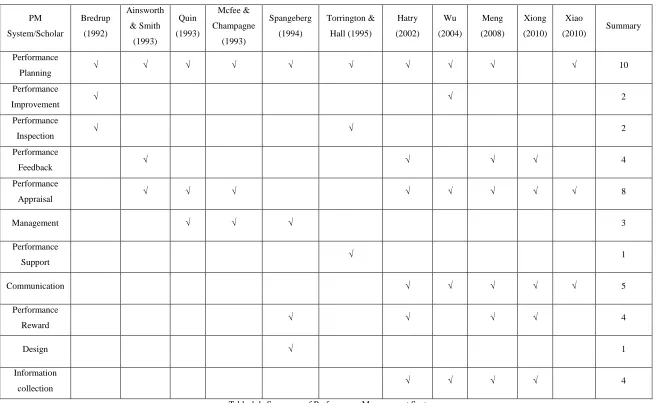
1.1 Summary of Performance Management System 23
2.1 Equity Theory 39 2.2 Quin’s Model 43
2.3 Spangenberg’s Model 48
2.4 The Summary of Performance Management
Effectiveness Index 51
2.5 Types of Performance Conversation 59
3.1 Sample Size based on Krejcie and Morgan 72
3.2 Questionnaire Items of Independent Variables 73
3.3 Questionnaire Items of Dependent Vatiables 73
3.4 The Five Dimensions of Performance Management
Effectiveness 74
3.6 Summary of Reliability Test 76
3.7 Data Analysis Methods Used on Objective of this
Study 76
3.8 The Mean Score 77
3.9 Pearson Correlation (r) Relationship Interpretation 78
4.1 The Distribution of Frequency and Percentage by
Gender 80
4.2 The Distribution of Frequency and Percentage by
Age 81
4.3 The Distribution of Respondent’s Period of Service 82
4.4 The Distribution of Frequency and Percentage by
Education Level 83
4.5 The Distribution of Frequency and Percentage by
Salary 84
4.6 Summary of Reliability Test 85
4.7 Frequency and Percentage on Performance Planning 87
4.8 Frequency and Percentage on Performance
Communication 88
4.9 Frequency and Percentage on Information Collection 90
4.11 Frequency and Percentage on Performance Feedback 92
4.12 Frequency and Percentage on Performance Reward 94
4.13 Frequency and Percentage on Financial Indicators 96
4.14 Frequency and Percentage on Performance Planning 97
4.15 Relationship between Performance Planning and the Dimensions of Performance Management Effectiveness 99
4.16 Relationship between Performance Communication and the Dimensions of Performance Management Effectiveness 101
4.17 Relationship between Information Collection and the Dimensions of Performance Management Effectiveness 102
4.18 Relationship between Performance Appraisal and the Dimensions of Performance Management Effectiveness 103
4.19 Relationship between Performance Feedback and the Dimensions of Performance Management Effectiveness 104
4.20 Relationship between Performance Reward and the Dimensions of Performance Management Effectiveness 106
4.21 Summary of Multiple Regressions on Financial Indicators 107
4.23 Summary of Multiple Regressions on Non-financial
Indicators 109
4.24 The Impact of Management Factors on Non-financial
Indicators 110
4.25 Summary of Multiple Regressions on Effectiveness of
Performance Management 111
4.26 The Impact of Management Factors on Effectiveness of
Performance Management 112
LIST OF FIGURES
FIGURE NO. TITLE PAGE
2.1 Factors Affect Performance Model 28
2.2 Bredrup’s Model 41
2.3 Ainsworth and Smith’s Three-step Cycle Model 42
2.4 Torrington and Hall’s Model 44
2.5 Storey and Sisson’s PM Cycle Model 45
2.6 MCFee and Champagne’s Model 47
LIST OF ABBREVIATIONS
IT - Information Technology Industry SME - Small and Medium Enterprises PM - Performance Management PP - Performance Planning
PC - Performance Communication IC - Information Collection PA - Performance Appraisal PF - Performance Feedback PR - Performance Reward FI - Financial Indicators NFI - Non- financial Indicators
LIST OF APPENDICES
APPENDIX TITLE PAGE
CHAPTER 1
INTRODUCTION
1.1 Background of the Study
Why do organizations manage their performance? Why more and more enterprises establish performance management system? In the 21st century, the pace of economic globalization is moving rapidly with highly intense market competition. In this situation, for an enterprise to be competitive enough, it must continuously improve its entire effectiveness and performance (Ngema, 2003). Lawler (2003) has proved that performance management is an effective way to improve performance. This is because performance management is about thought and strategic management in which its integrated method can improve performance of organization and staff in order to develop potentials teams and individuals. Performance management can help organizations to achieve sustainable development on their performance; to promote performance-oriented corporate culture; motivate employees to work harder; to motivate employees to develop their potentials and improve their satisfaction towards their job; to enhance team cohesion and improve team performance; to establish a constructive and open relationship between employees and managers through continuous communication and interaction during work; to offer opportunities for employees to express their aspirations and expectations (Garengo and Strfano ,2005).
Performance management originated in the United States in the 70‘s, and entered into China in 90‘s. However, after being practiced by Chinese enterprises for years, enterprises without performance management rushed to implement it, while those with performance management gradually lost their confidence towards it (Fang, 2008). Zhu (2009) pointed out that performance management do have significant efforts on the achievement of developmental goals and improvement of management capacity, but there is no doubt that for the special foundation and culture of Chinese enterprises, organizations must search for a simple and practical ‗Chinese style‘ performance management which is more suitable.
opportunities, and contributed 60% of exports (Ma, 2006). At the same time, with the deep development of knowledge economy, there were a large number of IT SMEs emerged out, and became the backbone of economic growth and sustainable development (Zuo, 2007). Due to their unique characteristics of development and the increasingly important roles in the national economy, the Chinese government has introduced a series of policies and regulations in order to improve the environment of development of IT SMEs, and to promote their development (Di, 2009). The plentiful policies and regulations has shown how serious that the Chinese government towards IT SMEs (Yang, 2009).
Although IT SMEs achieved great development and accomplishment, there are still widespread problems in management. Currently, most of Chinese IT SMEs are still in management disorder state, and IT SMEs set department discretionarily, boundary of duty is poor-defined, business process is impeded, relation between responsibility, and right is overlap, and lack of coordination between departments. Most of IT SMEs do not have clear development goals, the concept of organization and management is weak, no target-oriented management system, and performance management system is not in line with its business development goals (Wang, 2004). Therefore, enterprises are unable to establish a stable business core and effective management pattern according to enterprise‘s goals and future development; this seriously restricts the development and improvement of overall quality of IT SMEs in China.
transition, from planned economy to economy market, they need some time to adapt to the transition, and their awareness of competition, innovation and management are incomparable to foreign enterprises (Wang, 2007). It is crucial for Chinese IT SMEs, especially local SMEs, to grow up and adapt to market conditions in order to deal with the fierce market competition, to enhance the sense of competition, and to improve their performance management. After studying the background of this research topic, performance management is a strong necessity and urgent to IT SMEs in China.
1.2 Statement of the Problem
performance management, these three components will all affect the effectiveness of performance management.
On the basis Xiao‘s (2010) study, Xiong(2010) considered that an effective performance management system should also include feedback, reward, information collection and analysis. The information that managers collected at daily work can provides the basis for employees‘ year-end appraisal Timely feedback allows managers to realize the problems occur in employees‘ work, and to help them improve their performance in time. Combining reward with appraisal results will greatly improve employees‘ working motivation. Xiong (2010) has improved Xiao‘s (2010) performance management system, but he ignored an important part of performance management, that is performance planning.
In fact, performance appraisal is only a part of the system of performance management. Lack of aspects such as communication before the appraisal, feedback and applications of appraisal result, will lead to ineffective performance appraisal. These would not achieve the incentive, but discourage initiative of employees to participate in performance, and hinder the development of performance management (Martocchio, 2006). Taking performance appraisal as performance management and ignoring other aspects will greatly reduce the effectiveness of performance management. Performance management is a systematic project (Xie, 2006). Although scholars have different views of performance management system, a famous Chinese scholar, Fu Yahe considered performance planning, performance appraisal, performance feedback are the most basic components of performance management system (Fu and Xu, 2008). Performance appraisal is only a part of this project. It will greatly reduce employees‘ enthusiasm, if performance appraisal had been done without reasonable performance planning.
Employees do not know what they are good at and what needs to be improved without timely communication and feedback (Xiao, 2010). Bernice and Peter (2007) believes that communication is the intermediate link that connects performance planning and appraisal, which can make each individual in performance cycle to obtain information about improvements at any time, in order to better respond to the changes in work. Xie (2006) pointed out that information collection and analysis is essential, the lack of sufficient information will make managers can‘t control employees' progress and problems, managers can‘t make accurate appraisal and provide feedback to employees‘ work results. At the same time, Daniels (2007) pointed out that performance reward also an important part of performance management system. Performance reward is directly related to employee‘s personal interests. If performance reward is not reasonably used, the incentive to employees will be greatly reduced, and it cannot effectively improve employees‘ performances and abilities.
improve their overall efficiency and performance, and an effective way to improve performance is performance management (Aguinis, 2009). Corporate strategic objectives, culture and quality of manager will affect the effectiveness of performance management. As a complete system, every aspect of the system is a direct impact on the effectiveness of performance management (Cao, 2009). Managers of IT SMEs in China do not have necessary theoretical basis of performance management, and they have not realized that performance management is a system, but just take the performance appraisal is performance management. It is difficult to improve employees‘ performance and organizational performance goals if a performance management system lacks of certain aspects (Chen, 2011).
Performance management is a system, and every part of this system will affect the effectiveness of performance management (Zhang, 2010). So far scholars have different views of performance management system, based on the discussion above that this research will examine more management factors contributing to the effectiveness of performance management. Management includes: performance planning, performance communication, information collection and analysis, performance appraisal, feedback and performance reward. Therefore, this study aims to help IT SMEs in China to know the factors contributing to performance management effectiveness thus help them to improve on performance management, to stimulate the potential of employees, and finally to achieve a win-win formula for both companies and employees.
1.3 Research Questions
1. What are the management factors influencing the performance management effectiveness among IT SMEs in Wuhan, China?
2. What are the relationships between management factors and the performance management effectiveness?
3. What are the critical management factors influencing the performance management effectiveness?
1.4 Objectives of the Study
The objectives of the research are as below:
1. To investigate the main management factors influencing the performance management effectiveness among IT SMEs in Wuhan, China.
2. To examine the relationships between performance management factors and the effectiveness of performance management.
3. To determine the critical factors influencing the performance management effectiveness.
1.5 Hypothesis
H: There is a significant and positive relationship between management factors and performance management effectiveness among IT SMEs in Wuhan, China.
communication and performance management effectiveness.
Hc: There is a significant and positive relationship between information collection and performance management effectiveness.
Hd: There is a significant and positive relationship between performance appraisal and performance management effectiveness.
He: There is a significant and positive relationship between performance feedback and performance management effectiveness.
Hf: There is a significant and positive relationship between performance reward and performance management effectiveness.
1.6 Significance of the Study
The development and growth of IT SMEs has great significance to China. Although they achieved great success in implementing performance management, the management is still lacking. Chaotic in management is currently the greatest characteristic of IT SMEs, and it is a stumbling block to the development of IT SMEs (Li,2008). In order to achieve large-scaled and long-term development, they have to implement effectiveness of performance management intensely. The study on performance management for employees in IT SMEs has great practical significance, both in micro level and macro level.
performance management-related theory shows that using the idea of performance management to manage SMEs can greatly improve their management level and optimize their performances, and thus enhance its core competitiveness, and finally achieve a better and faster development. In addition to that, it can be seen that enterprises that implement effectiveness of performance management had shown improvement in their business performances. Furthermore, if the performance management in IT SMEs had been effectively implemented, the management can be improved significantly, and it could become a competitive enterprise, and in addition enhance the core competitiveness too. This helps IT SMEs to remain competitive.
At the macro level, through the study of effectiveness of performance management in IT SMEs, organizations can review its own problems in implementation of performance management, and to seek solutions for the problems. In order to improve management level of enterprises, most SMEs focus on improving management efficiency. The level of management of the entire SMEs in China will increase, and enterprises will gradually become stronger. Enterprises will drive strong economic growth, and hence enhance economic strength of China.
This research will be conducted in Wuhan, China. Wuhan is located in central China, and it is an important economic center, education center and transportation hub of China. Wuhan, an industry-based city, is one of China's largest industrial cities. Since China had focused on developing coastal areas in 1980, the development of Wuhan is relatively slow because it is in the inland, but this began to change since the last 10 years. Since 2003, Wuhan government realized that the development can‘t simply rely on industry, so that it established several economic development zones, and accelerated the development of SMEs, and IT SMEs was also included. Wuhan is one of the most important cities in central China, in order to develop the middle of China,Wuhan must be developed first. Wuhan is a representative city in China.
Optic valley is a well-known IT industrial cluster in Wuhan, is gradually becoming the center of China‘s IT industry. Optic valley plays a vital role in IT industry in China. The respondents include human resource managers from Wuhan IT SMEs. There are 400 organizations in the category of IT SMEs in optic valley of Wuhan. All of the organizations will be the population.
In this research, the researcher will design a set of questionnaire based on the performance management factors and gather information from respondents through questionnaire. The aim is to identify the relationships between performance management system and effectiveness of performance management in IT SMEs in Wuhan.
appraisal, feedback, and reward that in order to reflect the real situation of performance management of IT SMEs in Wuhan.
1.8 Limitation of the Study
In this research, the researcher selected some representatives of IT SMEs in Wuhan as sample to analyze the application of performance management system. However, due to the large amount, different situation of operations and management of IT SMEs in China, the results of this research cannot represent the problems faced by all IT SMEs in China. Therefore, this research will provide constructive comments for the effective factors of performance management system for IT SMEs, and to promote the application of performance management in Chinese enterprises, especially in IT SMEs .Meanwhile, new employees of a company, who do not have deeper understanding of the performance management system, influence the accuracy of results.
1.9.1 Small and Medium Enterprises in IT Industry
IT is the short form of information technology. Companies that mainly responsible for the development and use of information technology can be called as IT business (Lu, 2006). Computer industry, telecommunications industry and Internet industry are all belong to IT industry (Jiang, 2006).
There are several definitions of IT SMEs have been found. They refer to IT industry SME‘s in foreign countries and China. The definition of IT SMEs in the United States is more extensive. Number of employees under 500 in an enterprise can be fall into the category of SMES (Zhang,2006). The definition of IT SMEs given by UK is the enterprise which has less than 200 staffs and low market share, and business was run rely on business owners‘ personal judgments (Jouirou, 2004). However, in Malaysia, the Department of Statistics (2006) note small enterprise refers to ―those fixed assets less than 50 million ringgit or full-time workers less than 50 in enterprise", and medium-sized enterprises means ―with 50-250 million ringgit in enterprises‖.
The operational definition of IT SMEs is the company that mainly responsible for the development and use of information technology, and its staffs are less than 300 or its business income is less than of 10,000,000 Yuan.
1.9.2 Performance
Performance can be defined in three different concepts: (i) Performance is a result. According to Smith and Reading (2001), performance can be seen as the result of work outcome because these results are most closely related to the organization‘s strategic goals, customer‘s satisfaction and return of investment.
Furthermore, (ii) Performance is a behavior as explained by Risher (2002), which means performance should be separated from result, because result will be affected by factors system. According to Lam (2003), performance is a set of behaviors related to the overall goals of organization and specific goals in the department which the employees must achieve. Clark and Berkeley(2001) considered performance cannot be simply defined as results of work, because many results of work are not only because of individual behavior, they may affected by factors unrelated to work.
tasks, and it can be judge separately with result.
Performance in operational definition can be defined as the result shown by employees at a satisfactory level within a specified time frame. In addition, changes in employees‘ behavior are important to look at how employees can adapt to changes in the organization, so that employees are able to compete in the very challenging SMEs sector.
1.9.3 Performance Management
According to Aguinis (2009), Performance Management will link together with the purpose of whole working unit through the work of individual employees or managers, to support the goal of organization's overall business.
Locke and Latham (2000) considered that performance management is a process where manager make sure that employees‘ work and output must be consistent with the goal of organization.
Performance management is a management process that makes organizations and individuals to achieve better results of the work on the basis of mutual understanding. Mutual agreement between employees and managers on goals, standards and capabilities are required in order to achieve the better performance (Kanfer & Ackerman, 2004).
Performance management is a complete system, and it can be divided into four parts: guidance and planning, management and support, review and appraisal, development and reward (Lawler, 2003).
The operational definition of performance management is a coherent and integrated system. Integrated performance management system consists of six parts, which are performance planning, performance communication, information collection and analysis, performance appraisal, performance feedback, and performance reward. In this system, managers and employees are all involved to co-improve the performance through continuous communication.
1.9.4 Effectiveness of performance management
corporate culture, and composed by coaching, appraisal, reward, planning. Effectiveness of performance management is a cycle where managers and employees work together to achieve organizational goals. They participate in performance planning, performance coaching communication, performance appraisal, performance results application, and performance goals improvement. The purpose is to enhance individual and organizational performance (Hong, 2004).
Effectiveness of performance management is to analyze performance management problems occur in an enterprise, to come up with strategies and scientific performance management system and later use the right method to maximize the function of performance management. Effectiveness of performance management needs to grasp performance planning, implementation, appraisal and employee incentive (Qu, 2010).
Effectiveness of performance management is established through scientific and effective performance management system. This is important so that performance management not only used as a management tool, but also as a cognitive approach, a kind of behavior, and a combination between personal behavior and business strategy to provide communication opportunities, self-improvement opportunities and to strengthen the enterprise competitiveness (Zhi, 2007).
1.9.5 Performance Planning
Performance planning is a process through communication between manager and subordinate to achieve the performance‘s goals. During this process, both manager and subordinate will be responsible to discuss the planning (Whitmore, 2001).
Performance planning is a process of management and subordinate discussing tasks assessment period and appraisal standards to reach the mutual performance agreement (Locke & Latham, 2000).
In performance planning, appraiser and appraise have to establish a well discussion about employees‘ job performance that should be achieve in the given period of time. Furthermore, the final decision will be transform into a formal agreement. It is the organization‘s internal agreement that based on employee responsibility and benefits (Satterfield, 2003).
Performance Communication refers to the interviews between appraiser and staff about problems that performance appraisal reflected and problems of appraisal mechanism itself for seeking reply policy, in order to serve management practices of improvement of organization and employees in later stage (John, 2004).
Performance communication between appraiser and appraise are crucial to examine the weaknesses in the performance appraisal and its methods. The interview aims to find appropriate solutions to enhance employee performance management (Latham et al, 2005).
Performance communication is the process that manager makes staffs be clearly aware of their organizational expectations through interviews, and enhance mutual understanding and trust between managers and employees (Du, 2011).
The operation definition of performance communication is the process that manager and employees work together to share information. This information includes case process, potential problems, solutions and what can managers do to help employees, etc.
1.9.7 Information Collection
Information collection and analysis is a method that manager collects performance-related information, records employee work behavior and creates written documents (Fu and Xu, 2008).
The operational definition of information collection and analysis is the method manager pay attention to collect performance-related information and record employees‘ behaviors intend to provide the basis for year-end appraisal.
1.9.8 Performance Appraisal
Performance appraisal is a process to identify, observe, measure and develop employees‘ performance in an organization. It is an important management tool, and relates to some management functions, such as planning and organizing. It is the basic guideline for organization to decide to reward or punish promotion, training and dismissal according to employee‘s current job performance (Grote, 2006).
Performance appraisal is a process of collection, analysis and transfer information that related to individual‘s working behavior, skill proficiency, working efficiency, and etc. (Aguinis, 2009).
measurement of work behavior and work result of employee through systematic approaches. The appraisal results of performance appraisal can directly affects the salary, job promotion and other vital interests of employees.
1.9.9 Performance Feedback
Performance feedback will be conducted after the performance appraisal through communication and discussion between appraiser and appraise regarding current job performance. The purpose of the performance feedback of employee is to find out deficiencies in the work and to suggest improvements to enable better work performance among employees( Ruppel & Harrington, 2000).
Performance feedback refers to give rewards to positive aspects of staffs and propose programs and measures of improvements for inadequacies through the communication between appraiser and stuffs according to the result of performance appraisal (Yang, 2007).
Performance feedback refers to a method of achieving communication between the organization and staffs for personal performance and organizational expectation, thus individuals and organization can understand the expectation and contribution of both sides, in order to enhance employees‘ performances, and improve management efficiency (Fang, 2008).
measures. In addition, employees are given the opportunity to provide comments and suggestions on how to improve organizational performance and the effectiveness of performance appraisal.
1.9.10 Performance Reward
Performance rewards are usually divided into individuals, teams and organizations subject to the policies of the organization. In addition, the employee performance is an indicator of changes in wages and benefits. Therefore, changes in the performance index represent the different salary range (Aguinis & Pierce, 2008).
Performance rewards can be divided into two parts, the intrinsic rewards and extrinsic rewards. Extrinsic rewards are bonuses, promotions, awards and so on. Such rewards motivated by external factors such as an organizational rewards system and manager who wants to motivate employees to work harder. While intrinsic rewards are seen as an internal motivation that move an employee to perform a job. Rewards and benefits are typically derived from personal satisfaction, achievement of personal aspirations and self-control (Whitmore, 2001).
PM
System/Scholar
Bredrup
(1992) & Smith
(1993)
Quin
(1993) Champagne
(1993) Spangeberg (1994) Torrington & Hall (1995) Hatry (2002) Wu (2004) Meng (2008) Xiong (2010) Xiao
(2010) Summary
Performance
Planning √ √ √ √ √ √ √ √ √ √ 10
Performance
Improvement √ √ 2
Performance
Inspection √ √ 2
Performance
Feedback √ √ √ √ 4
Performance
Appraisal √ √ √ √ √ √ √ √ 8
Management √ √ √ 3
Performance
Support √ 1
Communication √ √ √ √ √ 5
Performance
Reward √ √ √ √ 4
Design √ 1
Information
collection √ √ √ √ 4
REFERENCE
Aguinis, H. (2009). Performance management. Upper Saddle River, NJ: Pearson Prentice Hall.
Aguinis, H., & Pierce, C. A. (2008). Enhancing the relevance of organizational behavior by embracing performance management research. Journal of organizational Behavior, 29, 139-145.
Armstrong, M. (2000). Strategic human resource management: A guide to action. London: Kogan Page Ltd.
Askim, J. (2004). Performance management and organizational intelligence: adapting the balanced scorecard in Larvik municipality. International Public Management Journal, 7(3), 415-438.
Attahir, Y. and Kojo,S. (2005). Planning and performance of SMEs operators in a country in transition. Journal of Small Business Management 2005.4.480-497
Bamberger, P. (2000). Human resource strategy: formulation, implementation and impact. Thousand, Oaks, Ca: Sage Publications.
Bao, G. H. (2004). Talking about how to achieve effective performance management. Intelligence, 2004, 36.
Performance measurement and management: TheAchilles' heel in administrative modernization. 25 (4), 359-362.
Cappelli, P., and Crocker, H. A. (2008). Distinctive human resources are firms’ core competencies. Organizational Dynamics.
Cavalluzzo, K.S., and Ittner, C. D. (2004). Implementing performance measurement innovations: Evidence from government. Accounting, Organizations and Society,29,
243-267.
Chen, B. (2011). The relationship between training and job performance. Wu Han University Press.
Chen,G. B. and Wang,Y. J. (2006). Problems and solutions of performance management for SMEs in the Corps. Technology Development of Enterprise, 2006.12 72-74
Chen,D. M. and Zhou, S.D. (2003). SMEs competitiveness research. Nanjing University Press.
Clark, D. & Berkeley, N. (2001). Attitudes to growth among owners of SMEs and the implications for business advice: some evidence from the clothing industry in coventry. International Small Business Journal 19(3), 72-77.
Cui, K. (2011). The relationship between entrepreneurship and financial performance management in China. Tong Ji University Press.
Daniels, A. (2004). Performance management: changing behavior that drives organizational effectiveness, Organizations and Society.
Derek, N. (2006). The role of SMEs in the futures of emerging economies. Retrieved, 2008-05-19.
Di, N. (2006). The status and characteristics of SMEs in China. Wuhan University Publications,2006.
Du, Y. M. (2011). Performance Management. Peking University Publications.
Fandray, D. (2001). The new thinking in performance appraisal. Canadian Manager, 25(1); 13.
Fang, Z. B. (2003). Performance Management. Wuhan University Publications.
Feng, X. L. (2006). Improve the effectiveness of performance management. Development Research, 2006, 3, 84-85.
Gabriel, P. (2005) Beyond reform: structural dynamics and macroeconomic vulnerability. ―Four Sources of De-industrialization and a New Concept of the ‗Dutch Disease‘‖ in Jose Antonio Ocampo (editor) Stanford, Calif.: Stanford University Press.
Garengo, P. & Stefano , B. (2005). Performance measurement systems in SMEs: a review for a research agenda.International Journal of Management Reviews, Volume 7, 2005 1.25-47.
Gay, L. R. & Airasian, P. (2000). Educational research: Competencies for analysis and application, 6th ed. New Jersey, USA: Prentice-Hall, Inc.
Ghosh, B., Liang, T. & Meng, T. (2001). The key success factors, distinctive capabilities, and strategic thrusts of top SMEs in Singapore. Business Research 51(3), 209-221.
Performance & Management Review, 25 (4), 352-35
Henrik, A. & Lan, C. (2001). Balanced scorecard implementation in SMEs: reflection in literature and practice. SME conference ,Copenhangen, Denmark.
Hoffman, K. (2005). Social impact model enterprise solutions to poverty. Shell Foundation Retrieved.
Hong, L. (2004). Effectiveness of performance management. Managers, 2004, 51-52.
Hou, K. (2004). Performance management plan design. China Industrial Publications.
Hu, X. D. (2006). Research on import conditions of performance management System of SMEs. Business Modernization, 20006,08.
Jarkko, T. (2002). Design a performance measurement system: a case study in the telecom business, Frontiers of E-Business Research. 2002. 487-498.
Ji, G. L. (2011). The position and the internal management of SMEs. Shangxin Social Science Newspaper, 15(4) 51-53.
Jouirou, N. (2004). Strategic alignment: a performance tool for SMEs,European & Mediterannean Conference on Information Systems, 25-27 July 2004 .
Juhani, U. (2001). Dimensions and metrics of performance Mmeasurement in SMEs. 2Nd International IFIP Workshop on Performance Measurement.
Kluger, A. N., and Denisi, A. (2004). The effects of feedback interventions on performance: a historical review, a meta- analysis, and a preliminary feedback intervention theory. Psychological Bulletion, 119(2), 254-284.
Lam, T. M. (2003). Enhanced productivity program in Hong Kong: a critical appraisal. Public Performance Management Review, 27(1), 53-70.
Lam, S. S., Schaubroeck, J. & Yik, M. S. (2002). Responses to formal performance appraisal feedback: the role of negative affectivity. Applied Psychology, 87(1), 192-201.
Latham, G. P. (2007). Work motivation: history, theory, research, and practice. Thousand Uaks, CA: Sage Pulications.
Latham, G. P., Almost, J., Mann, S., & Moore, C. (2005). New developments in performance management. Organizational Dynamics, 34(1), 77-87.
Lawler, E. E. (2003). Review practices and performance management system effectiveness. Organizational Dynamics , 32(4), 396-404.
Lawless, M. W. (2009). The structure of strategy:A taxonon study of competitive strategy and technology in strategy. Unpublished Technical Report,University of Colorado.
Li, S. H. (2005). Target and communication: effective mode of performance management in SMEs.[J] Journal of Business, Volume182.
Locke, E. A. & Latham, G. P. (2000). A theory of goal setting and task performance. Englewood Cliffs, NJ: Prentice Hall.
Tongling College Newspaper. 2006, Volume 2.
Madu, C. N., and Jaccob, R. A. (2010). An empirical assessment of the influence of quality dimension on organization performance management. Internal Journal of Production Research, 34(7), 1943-1962.
Mary, J. (2001). Abolishing Performance Appraisals. Winter2001, Vol.54 Issue 4. 1030-1034.
Meng, X. (2008). Empirical study on the performance management of Chinese civil servants. Chong Qing University.
Merriam, S. B. (2000). Qualitative research and case study application in education. San Francisco, USA: Jossey-Bass.
Mi, W. B. (2007). Study of setting up an effective performance management system of enterprise. Tian Jing University, 2007.
Nopado, R. (2005). Why the balanced scorecard fails in SMEs: the case Study. SME Press.
Pamenter, F. (2001). Moving from appraisal to employee enhancement. Canadian Manager, 2001.25(1);13.
Patrizia, G., Stefano, B. & Umit, S. (2005). Performance measurement systems in SMEs: a review for a research agenda. International Journal of Management Reviews, Volume 7, 2005 1.25-47.
Qu, B. Z. (2010). How to improve the effectiveness of performance management. Aerospace Industrial Management, 2010, 6, 6-10.
Ruppel, C.P., & Harrington, S.J. (2000). The relationship of communication, ethical work climate, and trust to commitment and innovation. Journal of Business Ethics, 25, 313-328.
Satterfield, T. R. (2003). From performance management to performance leadership: a model for change. World at Work Journal, 12(1).
Seashore, S. E. and Ephraim, Y. (2010). Factorial analysis of organization performance management. Administrative Science Quarterly, 377-395.
Sekaran, U. (2003). Research methods for business: A skill building approach.. NewYork, USA: John Wiley & Sons.
Serenko, A. (2006). The use of interface agents for email notification in critical incident. International Journal of Human- Computer Studies 64(11): 1084-1098.
Shuttleworth, M. (2008). Descriptive research design. Retrieved [Date of Retrieval].
Smith, K. & Reading, J. (2001), Reviewing performance management- impact and implications, MiE, Vol.16 No.3, 6-11.
Strach, A. & Serenko, A. (2010). The impacts of expectation disconfirmation on custom loyalty and recommendation behavior: investigating online travel and tourism service. Journal of Information Technology Management (3): 26-41.
Thomas, C., William, K. & Carl, M. (2010). Handbook of Organizational Performance, Information Technology Management.
Wang, C. R. (2004). Study on the process of performance management. Journal of The modern scientific management. 2004.8: 81-82.
and their non-finance performance management. Xin Jiang Finance and Economic University Press.
Whitmore, J. (2001). Coaching for performance. London, UK: Nicholas Brealey Publishing.
Wu, M. B. (2004). Study on the ten problems from SMEs. Journal of Human Resource , 2004.11:48-49.
Xie, Y. S. (2004). Performance evaluation analysis of SMEs in China. Journal of Management Science Abstract, Volume 4: 21.
Xiong, P. (2010). The status and counter measures of performance management in SMEs. Journal of Business Times, Volume 7: 37-38.
Yang, J. L.(2004). Management for SMEs in China. Fudan University Publications.
Ye, G. H. (2004). Study on the performance evaluation in SMEs. Journal for Anhui Science and Technology, Volume 10.
Zhang, Q. Q. (2006). Legal definition of SMEs. Journal for International Business and Economics University.
Zhang, B. X., Liu, X. & Zhou, Y. (2003). Plan for performance management of SMEs .Journal of China Target, Volume 10, 25.
Zheng, J. & Zeng, G. P. (2007). Communication problems in the process of performance management in Chinese SME. Science and Management, Volume 3, 42-43.
Zhong, L. F. & Shi, K. (2003). Several basic issues of performance management. Nakai Business Review, 2002, 3.
Zhu, M. J. (2007). How to make performance management more effective. Enterprise Technology and Development, 2007,13.
Zhu, M. F. (2003). Optimization strategy for performance evaluation system in SMEs. Science and Technology Management Research, Volume 21.
Zhuo,L. & Chen,J. Y. (2004). The problems and counter measures of SMEs in China. Journal for Economist, Volume 3, 148-149.