77:23 (2015) 113–120| www.jurnalteknologi.utm.my | eISSN 2180–3722 |
Jurnal
Teknologi
Full Paper
T
ECHNOLOGY
I
NCUBATORS
AND
I
NSTITUTIONAL
D
EVELOPMENT
Farhan Jamil
a*, Kamariah Ismail
a, Nasir Mahmood
b, Noor Ullah
Khan
a, Muhammad Siddique
aa
Faculty of Management, Universiti Teknologi Malaysia, 81310 UTM
Johor Bahru, Johor, Malaysia
b
School of Management, Northwestern Polytechnic University,
Xian, P.R. China
Article history Received
27 April 2015
Received in revised form
15 June 2015
Accepted
25 November 2015
*Corresponding author
[email protected]
Abstract
Globally, technology business incubator (TBI) has become a growing initiative to promote the entrepreneurship. Recently TBIs has gained significant attention from research scholars and play a vital role to facilitate the development of entrepreneurial society. The institutions are established and leadership is groomed via entrepreneurial society. Moreover, entrepreneurial culture encourages the entrepreneurial society for economic development, innovation, technology competitiveness and sustainable job creation. A government backed TBI, Plan9, is presented to highlight the significance towards developing an entrepreneurial society in a developing country context, Pakistan. Plan9 has introduced unique practices with a broad vision for a sustainable entrepreneurial growth. University industry linkages are created, entrepreneurial education and training programs for social awareness are operationalized, innovative ideas are encouraged and financial innovation without equity share and funding support are designated. This paper presents a comprehensive spotlight over the dynamic capabilities and entrepreneurial culture of plan9. Furthermore plan9 is encouraging to promote entrepreneurial society, institutional development and leadership. Lastly this research recommends that the other TBIs should be initiated by the collaboration of government and private sector to nurture the entrepreneurial society.
Keywords: Technology business incubators, entrepreneurial society, institutional development, Plan9, Entrepreneurship © 2015 Penerbit UTM Press. All rights reserved
1.0 INTRODUCTION
Entrepreneurship is the new theoretical phenomena of economic development evolved from physical capital and then knowledge [1]. Nonetheless, a sustainable economic development would be achieved by governments through indulging the entrepreneurial concept [2]. The entrepreneurial culture flourishes the society by reducing unemployment and inducing living standard. The concept of entrepreneurial society is emerged in 1990s, still gaining popularity in several economies. Entrepreneurial society focuses on the entrepreneurial culture as one point agenda for sustainable job creation, economic development, innovation and technology competitiveness [3]. Moreover in an entrepreneurial society; leaders are groomed, institutions are developed and entrepreneurial capital is generated [1].
In the current scenario of the world, business incubators gain much popularity for promoting entrepreneurial activities in the society, creating leaders and developing institutes [4, 5]. Additionally, it is firmly acknowledged that the 21st century will rely on knowledge, innovation, entrepreneurship, and business incubators (Al-mubaraki and Busler, 2013). BIs typically support economic development [7], commercialization of research [8] and creation of new start-ups, which normally have fewer chances to survive, to become self-sustained and grow successfully [9].
through institutional practices, rules, structure, norms and actions.
1.1 Business Incubators: An Overview
In earlier times, incubators remain less advantageous to gain much popularity. However, the scenario changes and incubators become the area of focus globally with a figure of around 7000 (National Business Incubation Association). Although the foundation of first business incubator, a privately owned for profit, in 1959 at Batavia, New York by Joseph Mancuso; incubators are argued as a contemporary component for economic development, job creation, financial sustainability and establishing institutes and leaders. Even though developed countries enjoy the first mover advantage, developing countries are also in the queue. On the other hand, [12] defines the incubators as a mechanism to create new entrepreneurs with provision of resources and services.
The objectives of establishing and promoting incubators can be summarized as 1) Job creation 2) Networking 3) Commercializing new technologies 4) Assisting new start-ups 5) National and regional development 6) Supporting financial framework of businesses 7) Fostering the entrepreneurial culture 8) Strengthening the university industry linkages [4, 12–14]. In addition, researchers identify the main functions of incubators as follows:
Provision of comfortable space
Access to advanced technical equipments
Managerial support
Access to financial capital
Filtering the risk during entrepreneur’s earlier age
Rationalize transaction cost
Screening and selecting incubates
Support in development of business plans
2.0 BUSINESS INCUBATORS AND INSTITUTIONAL
DEVELOPMENT
Institutional development, comprises of institutional rules, social norms and cognitive structures [15], leads to the sustainable economic growth [16]. However, business incubators work as a tool to strengthen institutional development in the economy by promoting the entrepreneurial society. To promote the institutional development, private sector needs to stimulate through favorable government policies [16]. In BIs context, [17] analyze the institutional emergence, environmental effects on institutions and mechanism to
achieve the institutional goals. The theoretical basis stands on the institutional theory to achieve the objectives. Similarly, [18] also apply institutional theory and argues that the incubator’s strategy does not directly influence the performance of BIs.
The institutional perspective guides in evaluating the design, practices, rules and coordination mechanism of various stakeholders including government, industry, academic units and community involved in the incubation system. Institutionalists conceptualize institutional theory as an authoritative framework designed for social structure [15, 19]. Institutional theory validates the theoretical framework to analyze the design, rules and regulations, practices, and the institutional environment BIs. However, [20] argues the existence of this institutional environment as a mechanism of organizational control. Whereas organization control manipulate the allocation of resources and identify the future directions.
Institutional theory mainly focuses on the control systems; their existence, diffusion, its contribution towards sustainability and its social behavior perspective. The institutional theory basically originates from the research of [21]. He argues that the formation of organizations over the period as a technical oriented system saturate with value. According to [22], institutionalization is a social design for a specific element such as estate. However, the key to success of the institutionalization is the institutional structure that embeds pressure on organizations.
2.1 Growth and Development of Business Incubators in Asia
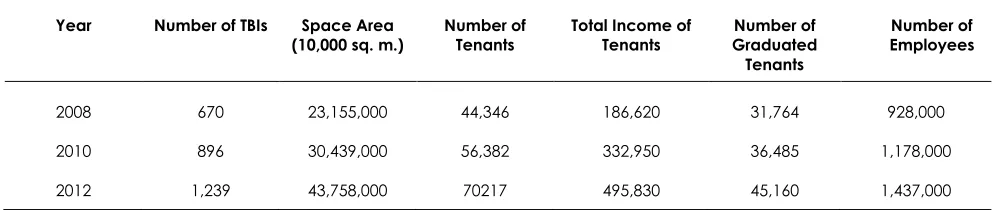
Table 1 Statistics of TBIs in China
Year Number of TBIs Space Area
(10,000 sq. m.) Number of Tenants Total Income of Tenants Graduated Number of Tenants
Number of Employees
2008 670 23,155,000 44,346 186,620 31,764 928,000
2010 896 30,439,000 56,382 332,950 36,485 1,178,000
2012 1,239 43,758,000 70217 495,830 45,160 1,437,000
(Source: Ministry of Science and Technology, China)
The two well know examples of BIs in Asian developing countries reported by InfoDev are Tianjin Women’s Incubator (TWI) established in 1988 in China and Tiruchirappalli Regional Engineering College Science and Technology Entrepreneurs Park (TREC-STEP) in India. The First one, only TWI has generated more than 4000 jobs although more focused toward services industries. However, Second one (TREC-STEP) targeted various industries with 62% (180 enterprises) in mechanical engineering, 20% in ICT and only 13% in chemical industries. The development of innovation based new products contributes with 45%, import substitutes 10% and 3% export (InfoDev).
The key principal of incubation systems in Asia is to develop a dynamic incubation environment by promoting the networking activities among business incubation communities through knowledge sharing, learning and coordination. These actions are in line to strengthen innovation and entrepreneurship in Asia. The objectives of Incubation system in Asian region summarizedby [25] are as follows:
Networking
Create learning environment by providing a platform
Encouraging and promoting entrepreneurial events and activities
Managerial support for advice on rules, practices and structures
Business development plans for financial self-sustainability
Additionally, Asian Incubator Network (AIN) is established in October 2007 to meet the challenges of technology transfer, globalization, training, awareness among stakeholders and linkages amongst industries, academia and government. Unfortunately, Pakistan is still trying to become the member of this network association.
2.2 Scope of Business Incubators in Pakistan
Business Incubators have a broader scope in Pakistan. As per statistics of World Bank Indicators, the population of Pakistan in year 2013 is around 182 million and the sixth populous country in the world (Pakistan Economic Survey, 2013-14). In addition, the population growth rate of 1.95% is also fairly high among other developing countries even higher than the average growth rate of south Asian countries.
However, the situation is not much satisfactory in other economic pillars such as unemployment. The high unemployment rate remains around 5% during the period 2010 to 2013 which is also become a challenging task for Pakistan to rationalize it. To tackle high unemployment rate is more difficult then it seems. As the student enrollment in universities and institutes is almost doubled from 2006 to 2013 (shown in Table 2).
Table 2 Statistics about HEIs and Enrollment in Pakistan
2006 2007 2008 2009 2010 2011 2012 2013
Higher Education
Institutions 118 121 126 127 132 138 146 153
Enrollment 521,473 639,597 738,373 803,507 948,268 1,017,282 1,077,779 1,204,349
(Source: HEC, Pakistan)
Surely, the enrolled students are becoming the part of labour force in coming years. To arrange jobs and employment for such a huge quantum seems near to impossible until or unless feasible measures are taken.
job by all graduating labour force. They definitely have to look for other opportunities such as to become entrepreneur. As business incubators provide a platform to develop entrepreneurs and businesses. Therefore, business incubators are fruitful for a developing country i.e. Pakistan.
Fortunately, Pakistan has realized the significance of business incubators. And similar to other developing countries, Pakistan is also institutive to support the incubation system for the economic uplift, reducing unemployment, promoting industrial culture, grooming leaders and establishing institutes. A delay with limited scope initiative, still appreciable and a positive sign for the country. In Pakistan, currently around 28 incubators of different types including academic incubators, technology incubators and industrial incubators are functioning on the mission.
2.2.1 Technology Business Incubators
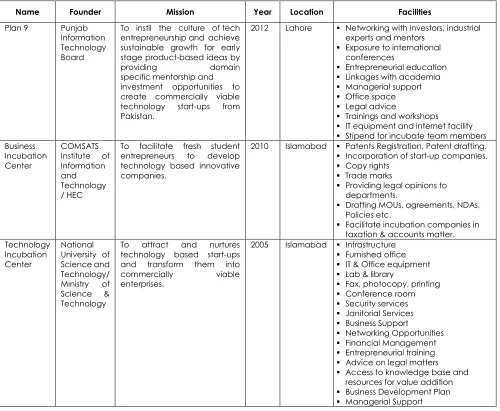
In this study, the case of an incubator i.e. Plan 9 is also a model of technology business incubator. TBIs are a special form of BIs targeting technology and innovation [28]. Simply, TBI is an entity that supports and promotes innovation. The concept is broaden by consider three elements for being TBI [29]. First, TBIs focuses on the creation of technology based new start-ups as its mission. Secondly, TBIs rely on the strong linkages with research universities and institutes. Lastly, TBIs are geographical proximity to university campus. Interestingly, TBIs are more famous in developing countries and majority of incubators are TBIs [30]. Though the term technology being used in broader sense. Some examples of TBIs in Pakistan are depicted in below Table 3:
Table 3 Features of TBIs in Pakistan
Name Founder Mission Year Location Facilities
Plan 9 Punjab
Information Technology Board
To instil the culture of tech entrepreneurship and achieve sustainable growth for early stage product-based ideas by
providing domain
specific mentorship and investment opportunities to create commercially viable
technology start-ups from
Pakistan.
2012 Lahore Networking with investors, industrial
experts and mentors
Exposure to international
conferences
Entrepreneurial education
Linkages with academia
Managerial support
Office space
Legal advice
Trainings and workshops
IT equipment and internet facility
Stipend for incubate team members
Business Incubation Center
COMSATS Institute of Information and Technology / HEC
To facilitate fresh student
entrepreneurs to develop
technology based innovative companies.
2010 Islamabad Patents Registration, Patent drafting.
Incorporation of start-up companies.
Copy rights
Trade marks
Providing legal opinions to
departments.
Drafting MOUs, agreements, NDAs,
Policies etc.
Facilitate incubation companies in
taxation & accounts matter. Technology
Incubation Center
National University of Science and Technology/
Ministry of
Science & Technology
To attract and nurtures
technology based start-ups and transform them into
commercially viable
enterprises.
2005 Islamabad Infrastructure
Furnished office
IT & Office equipment
Lab & library
Fax, photocopy, printing
Conference room
Security services
Janitorial Services
Business Support
Networking Opportunities
Financial Management
Entrepreneurial training
Advice on legal matters
Access to knowledge base and
resources for value addition
Business Development Plan
2.2.2 Academic Incubators (AIs)
AIs are among the state-of-the-art incubators based on academic environment in Pakistan. AIs enjoys the advantages of job opportunities for university own students, pre and post incubation regular monitoring and interaction with private sector to facilitate them. AIs provide a facilitative environment for wealth creation by ensuring technical, legal and financial support for successful coordination between the universities, industries, government and community [5].
The task to establish, strengthen and promote the incubation system at universities and research institutes is laid down with Higher Education Commission (HEC) of Pakistan. The policy framework of HEC to see the universities feasibility and select them for establishing incubators rely mainly on three fundamentals 1) sound R&D activities 2) Entrepreneurial support and 3) industrial area. However, the main objective in establishing the incubation centre’s at universities is to develop successful firms that can survive financially and freestanding.
Table 4 Features of AIs in Pakistan
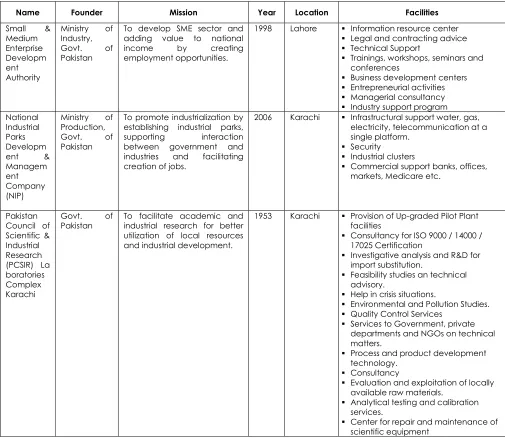
2.2.3 Industrial Business Incubators (IBIs)
IBIs are another type of BIs distinguished by focusing towards industries. These incubators are industrial nurseries for nurturing new business start-ups for the promotion of entrepreneurship and industrial clustering. In Pakistan, currently three IBIs exists and all are led by
Government. Generally, these IBIs provide consultancy to government to strengthen industries, how to address industry issues, the industry requirements, prioritize industrial sector for the economic development of Pakistan.
Name Founder Mission Year Location Facilities
Business Incubation Center (BIC)
University of Agriculture / HEC
Nurturing start-up companies and young firms by helping them to grow and survive when they are most vulnerable.
2009 Faisalabad Lab & libraries
Physical infrastructure
Assist in feasibility projects preparation
Business development plans
Managerial support
Financial support
Legal advice
Shared services to reduce transaction
cost Business
Incubation Center (BIC)
University of Engineering &
Technology/ HEC
To promote the creation of new ventures to strengthen
research and technology
innovation at universities to contribute in the economic development.
Lahore IT infrastructure
Furnished office
Business Plan development
Intellectual property rights
Financial consultancy
Video conferencing, seminars,
meeting rooms etc. Center for
Entreprene urial Leadership and Incubation
IBA
Sukkur/HEC To provide infrastructural and managerial support to strengthen new enterprises for economic growth of Pakistan.
2012 Sukkur Business development support
Networking opportunities
Industrial clustering
Access to finance
Physical infrastructure
Table 5 Features of IBIs in Pakistan
3.0 Case Study: Plan 9
Plan9 is a TBI located at Arfa Software Technology Park in Lahore, Pakistan. Lahore is one of the populous cities in Pakistan with a population of around 7.5 million. Almost 35 Universities are delivering knowledge to society in the city. Plan9 was established in 2012 with a tagline ‘where ideas take flight’. The focus of the incubator is more towards an innovative idea. Plan9 is actually an initiative by the government under the umbrella of Punjab Information Technology Board (PITB). PITB is an autonomous body to promote the idea of innovative economy. Moreover, PITB is also committed to provide IT based solutions in the presence of favorable environment and infrastructure. The government, local enterprises and international businesses are the main clients of PITB.
Additionally, the incubation system at Plan9 is state of the art. The incubator helps to develop a new versatile approach in the business community of Pakistan. Newly graduates from universities are encouraged to start their own business. An incubation period of 6 months works to convert the idea into a growing business entity. A non-equity based concept differentiates Plan9 from traditional ones. Fresh young individuals having entrepreneurial skills, commitment, dedication and industrial know-how are the main focus of Plan9. The incubatees during their early stage of start-ups also guided about business and financial plan, product development, public relations and marketing mechanism, training and communication, legal requisites and other managerial tactics. So far, more than 60 start-ups have already enjoyed the Plan9 benefits.
Name Founder Mission Year Location Facilities
Small &
Medium Enterprise Developm ent Authority
Ministry of
Industry,
Govt. of
Pakistan
To develop SME sector and adding value to national
income by creating
employment opportunities.
1998 Lahore Information resource center
Legal and contracting advice
Technical Support
Trainings, workshops, seminars and
conferences
Business development centers
Entrepreneurial activities
Managerial consultancy
Industry support program
National Industrial Parks Developm
ent &
Managem ent Company (NIP)
Ministry of
Production,
Govt. of
Pakistan
To promote industrialization by establishing industrial parks,
supporting interaction
between government and
industries and facilitating
creation of jobs.
2006 Karachi Infrastructural support water, gas,
electricity, telecommunication at a single platform.
Security
Industrial clusters
Commercial support banks, offices,
markets, Medicare etc.
Pakistan Council of Scientific & Industrial Research (PCSIR) La boratories Complex Karachi
Govt. of
Pakistan To facilitate academic and industrial research for better utilization of local resources and industrial development.
1953 Karachi Provision of Up-graded Pilot Plant
facilities
Consultancy for ISO 9000 / 14000 /
17025 Certification
Investigative analysis and R&D for
import substitution.
Feasibility studies an technical
advisory.
Help in crisis situations.
Environmental and Pollution Studies.
Quality Control Services
Services to Government, private
departments and NGOs on technical matters.
Process and product development
technology.
Consultancy
Evaluation and exploitation of locally
available raw materials.
Analytical testing and calibration
services.
Center for repair and maintenance of
Plan 9 provides various types of facilities and services to their incubatees. The services and facilities contains but not restricted to furnished office space, provision of IT equipments’ such as laptops, internet connectivity, uninterrupted power supply, managerial and legislative support, networking with potential customers, trainings and workshops. Moreover, Plan9 also advices it’s incubatees on hiring requirements and process. The networking opportunities are extended to access industrial experts, mentors, investors and to participate in international conferences.
An environment suitable for the promotion of entrepreneurial activities and business development is also ensured. However, more attention pays to early stage ventures to help them grow and survive in an efficient and self-sustainable way. Indeed, the main aim of establishing Plan 9 is to promote the techno entrepreneurial culture and support early stage ideas by ensuring mentorship and financial opportunities to develop potential technology start-ups in Pakistan.
Actually, Plan9 is working with a broad vision and not restricted to facilitate only incubatees. Several other programs are also executing parallels. One of them is a fellowship program for entrepreneurial education and awareness to society. This fellowship program is based on the concept of internship for students. Students can get exposure in working environment through interaction with Plan9 team and start-ups. This opportunity of 6-12 weeks helps the young students to get hands-on experience before entering the professional life in a more elegant way. Specifically, students get more familiar with business development, content writing, research, marketing techniques, graphic designing, software development and other such tasks. In addition, Plan9 is also working at the children level to bring awareness about entrepreneurial skills at the grass route. A program of Whiz Kids is introduced in this regard for the grade 7 to 12.
The concept of university industry linkages also prevails at Plan9. Many reputable universities such as NUST, GIKI, FAST, BNU, NED and Bahria University are in partnership with Plan9 to bring awareness and promote entrepreneurial skills among the young students. Thus, seminars and workshops are arranged at universities to become an entrepreneurial society.
In addition, a distinctive approach prevails regarding the financial support for start-ups. Surprisingly, no financial support is committed to start-ups. However, funding channels and potential investors are introduced. This also helps start-ups to be more targeted oriented. The focused, goal oriented and viable ideas mostly able to achieve the funding from external sources such as Plan9 Angel Investors Club. The purpose of the club is to promote the idea of ‘angel investment’ and to provide funding in feasible technology based projects.
In order to become incubatees, an individual(s) should hold a Pakistani citizenship and an innovative product development idea. A team of two members is the minimum personnel requirement to become the part of Plan9. Moreover, it is made obligatory for all
team members to ensure their presence in the incubator during all working days and hours.
The selection procedure of Plan9 is much similar to other incubators. The advertisement regarding the opportunities for new start-ups is announced two (2) months before the execution. The formal applications are accepted through an automated online system. After the online applications received, shortlisting is conducted. Once shortlisting is completed, invitations are submitted to shortlisted teams to join Launchpad. A panel of judges in the Launchpad rates the teams and finally the top scorers are selected to join Plan9. The relation of Plan9 and incubatees is not restricted to incubation period. The post incubation support is also the part of Plan9 agenda. Graduated incubatees also have the opportunities to become the part of Plan9 Alumni Network.
4.0 CONCLUSION
TBIs are growing all over the world. Asian developing countries have also operationalized the TBIs in order to promote and develop the entrepreneurial culture and an entrepreneurial society. The entrepreneurial society is driven by leadership and institutional development. TBIs are also excelling in Pakistan as institutional development machine. A bright future is waiting ahead for TBIs in Pakistan. Although, TBI is relatively a new phenomenon in Pakistan, have a great potential to contribute in the economic development. A TBI, Plan9, in Pakistan has performed in a remarkable way and become a productive model. A phenomenal progress in a short span of time is itself an achievement. Plan9 is contributing aggressively in developing new institutes with long survival and growth perspectives. Incubatees get advantageous from the value addition services and facilities of Plan9. Indeed, Plan9 is a unique concept in a developing country, Pakistan.
In addition, the presence of wide potential market and limited supply of incubator’s validate the establishment of more incubators with government support and collaboration of private sector. Plan9 is a role model for further establishments of TBIs to strengthen the economy and moves towards an ecosystem with institutional development and leadership.
References
[1] Audretsch, D. B. 2014. From the entrepreneurial university to the university for the entrepreneurial society. The Journal of
Technology Transfer. 39(3): 313–321.
[2] Méndez-Picazo, M.-T., Galindo-Martín, M.-Á., and Ribeiro-Soriano, D. 2012. Governance, entrepreneurship and economic growth. Entrepreneurship and Regional
Development. 24(9-10): 865–877.
[3] Audretsch, D. B. 2009. Emergence of the entrepreneurial society. Business Horizons. 52(5): 505–511.
Comparative Analysis. Journal of Global Information
Technology Management. 16(2): 33–58.
[5] Jamil, F., Ismail, K., and Mahmood, N. 2015. University Incubators: A Gateway to an Entrepreneurial Society.
Journal of Economics and Sustainable Development. 6(6):
153–160.
[6] Al-mubaraki, H. M., & Busler, M. 2013. Entrepreneurship , Innovation , Incubator and Economic Development: A Case Study. World Academy of Science, Engineering and
Technology.7(6): 1082–1087.
[7] Mahmood, N., Jianfeng, C., Jamil, F., Karmat, J., and Khan, M. 2015. Business Incubators: Boon or Boondoggle for SMEs and Economic Development of Pakistan. International
Journal of u- and e- Service, Science and Technology. 8(4):
147–158.
[8] Jamil, F., Ismail, K., and Mahmood, N. 2015. A Review of Commercialization Tools: University Incubators and Technology Parks. International Journal of Economics and Financial Issues. 5(S): 223–228.
[9] Bruneel, J., Ratinho, T., Clarysse, B., and Groen, A. 2012. The Evolution of Business Incubators: Comparing demand and supply of business incubation services across different incubator generations. Technovation. 32(2): 110–121. [10] Ahmad, A. J. 2014. A mechanisms-driven theory of business
incubation. International Journal of Entrepreneurial Behavior
and Research. 20(4): 375–405.
[11] National Business Incubation Association. 2014. The History of Business Incubation. Resource Library. Athens OH. Retrieved from
http://www.nbia.org/resource_library/history/index.php [12] National Business Incubation Association. 2014. What is
Business Incubation? Retrieved from
http://www.nbia.org/resource_library/what_is/index.php [13] Al-mubaraki, H. M., Busler, M., and Aruna, M. 2013. Towards a
New Vision for Sustainability of Incubator Best Practices Model in the Years to Come. Journal of Economics and
Sustainable Development. 4(1): 114–128.
[14] Chandra, A., and Silva, M. A. M. 2012. Business Incubation in Chile: Development , Financing and Financial Services.
Journal of Technology Management and Innovation. 7(2): 1–
13.
[15] Scott, W. R. 2005. Institutional Theory. In Encyclopedia of
Social Theory (George Rit., pp. 408–414). SAGE Publications.
[16] Hasan, I., Wachtel, P., and Zhou, M. 2009. Institutional development, financial deepening and economic growth: Evidence from China. Journal of Banking and Finance. 33(1): 157–170.
[17] Gstraunthaler, T. 2010. The business of business incubators: An institutional analysis – evidence from Lithuania. Baltic Journal
of Management. 5(3): 397–421.
[18] Johanna, V. 2013. Incubator Strategy , Institutional Context , and Incubator Performance: A moderated mediation analysis of Brazilian Incubators. In Third Meeting Of Business Creation Experts From Business Incubators And Researchers,
Lille (France), April 11, 2013. 1–27.
[19] Selznick, P. 1996. “ Old ” Institutionalism and “ New .”
Administrative Science Quarterly. 41(2): 270–277.
[20] Abernethy, M. a., and Chua, W. F. 1996. A Field Study of Control System “Redesign”: The Impact of Institutional Processes on Strategic Choice. Contemporary Accounting
Research. 13(2): 569–606.
[21] Selznick, P. 1949. TVA and the Grass Roots A Study in the
Sociology of Formal Organization. Berkeley, University of
California Press.
[22] Powell, W. W., and DiMaggio, P. J. 1991. The New
Institutionalism in Organizational Analysis. Chicago: University
of Chicago Press.
[23] Mahmood, N., Jianfeng, C., Jamil, F., Munir, H., and Lu, J. 2015. Snapshot of Technology Business Incubators in China.
International Journal of u- and e- Service, Science and
Technology. 8(7): 235–242.
[24] Chandra, A., He, W., and Fealey, T. 2007. Business Incubators in China: A Financial Services Perspective. Asia Pacific
Business Review. 13(1): 79–94.
[25] Al-Mubaraki, H. M., and Busler, M. 2012. Entrepreneurship Spirit of Asia Business Incubation. In Academic and Business
Research Institute Conference - San Antonio 2012 (p.
SA12036). San Antonio: Academic and Business Research Institute.
[26] Al-Mubaraki, H. M., and Busler, M. 2010. Business Incubators Models of the USA and UK : a SWOT analysis. World Journal of Enterprenuership, Management and Sustainable
Development. 6(4): 335–354.
[27] Ratinho, T., and Henriques, E. 2010. The role of science parks and business incubators in converging countries: Evidence from Portugal. Technovation. 30(4): 278–290. doi:10.1016/j.technovation.2009.09.002
[28] OECD. 2010. Technology incubators.
[29] Ratinho, T., Harms, R., and Groen, A. 2009. Technology Business Incubators as Engines of Growth: Towards a Distinction Between Technology Incubators and Non- Technology Incubators. In 23rd RENT-Research In Entrepreneurship and Small Business Annual Conference
“The Entrepreneurial Growth of the Firm” (pp. 845–859).
Budapest, Hungary: Corvinus University.
[30] Lalkaka, R. 2003. Technology Business Incubation : Role , Performance , Linkages , Trends. In National Workshop on
Technology Parks and Business Incubators (pp. 1–36).