SUBSPACE BASED DIRECT ADAPTIVE CONTROL FOR A CLASS OF NONLINEAR SYSTEMS
OSAMA HOSNI SALEH WHIDA
A project report submitted in partial fulfilment of the requirements for the award of the degree of
Master of Engineering (Electrical- Mechatronics & Automatic Control)
Faculty of Electrical Engineering Universiti Teknologi Malaysia
Dedicated,
To my beloved inspirational father „Hosni‟ To my beloved heartwarming mother „Jamila‟ I love you and I hope that I can serve you better.
To the soul of my beloved grandmother „Muna‟, and uncle „Muftah‟
ACKNOWLEDGEMENT
In The Name Of Allah, Most Gracious, Most Merciful
First and foremost, I must be thankful to Allah s.w.t for everything especially for his guidance in accomplishing this level of study. Indeed, I‘m nothing without your care, Alhamdolellah.
I would like to express my sincere thanks and appreciation to my supervisor Dr Norhaliza Binti Abd Wahab, for her precious guidance, encouragement, constructive criticisms, advice, knowledge and motivation. Without her continued support and interest, this project report would not have been presented as the same as it is presented here.
Besides that, my sincerely appreciation is extended to my family and especially to my father ‗Hosni‘ for his unlimited love, support, encouragement, understanding and care. I would say ―Thank you very much and may Allah s.w.t rewards you well for everything (Jazak Allah A‘nni khiran kathira)‖.
My special thanks is going also to my dearest brothers: Muhee, Shihab and Zakariya, as well as my beloved sisters: Amel, Inasse, Tassnim, Suhaila, Reemo and Ismahan. To Fatima with a great appreciation. To aunt, cousins and their families.
ABSTRACT
ABSTRAK
Tujuan penyelidikan ini dijalankan adalah untuk menghasilkan teknik kawalan yang lebih mudah bagi loji rawatan kumbahan air. Laporan ini mencadangkan kawalan dengan ramalan adaptasi terus atau juga dikenali sebagai kawalan dengan ramalan subspace sebagai alternatif kepada kaedah yang sedia ada. Struktur kawalan adaptasi adalah berdasarkan kepada model berkadar terus sistem tersebut dan digabungkan bersama algoritma angka untuk sistem subspace state space yang berperanan sebagai pengesan untuk anggaran langsung matriks ramalan dan matriks kawalan dalam proses-bio, serta model kawalan ramalan bagi mendapatkan jujukan kawalan yang optimum. Prestasi kedua-dua algoritma anggaran dan kawalan digambarkan menerusi keputusan simulasi. Analisis kestabilan dijalankan bagi menyiasat tindak balas sistem yang dicadangkan apabila wujudnya perubahan parameter. Projek ini membuktikan bahawa kaedah adaptasi subspace memiliki banyak kelebihan yang penting dan berguna, terutama aplikasi keupayaannya dikendalikan bersama sistem pelbagai masukan dan pelbagai keluaran serta keperluan yang rendah mengenai maklumat sistem. Berdasarkan kelebihan tersebut, bidang aplikasi yang sesuai bagi algoritma yang dicadangkan adalah proses dengan pembulehubah berbagai, di mana hanya sedikit info diketahui seperti loji rawatan kumbahan air ini. Dengan itu, pendekatan baru teknik kawalan dengan ramalan adaptasi terus mampu menyediakan kaedah yang mudah, prestasi yang baik serta kestabilan yang teguh
TABLE OF CONTENTS
CHAPTER TITLE PAGE
DECLARATION ii
DEDICATION iii
ACKNOWLEDGEMENT iv
ABSTRACT v
ABSTRAK vi
TABLE OF CONTENTS vii
LIST OF FIGURES xi
LIST OF TABLES xiv
LIST OF ABBREVIATIONS xv
LIST OF SYMBOLS xvii
LIST OF APPENDICES xviii
1 INTRODUCTION
1.1 Background of the project 2
1.1.2 When one might use direct technique 5
1.2 Problem statement 6
1.3 Objectives of project 7
1.4 Scope of the project 7
1.5 Methodology 8
1.6 Project Flow Chart 10
2 WASTEWATER TREATMENT PLANTS
2.1 Introduction 11
2.2 Overview of WWTP 12
2.3 Activated Sludge Process 15
2.3.1 Basic Description 16
2.3.2 Bioprocess Modelling 19
2.3.3 Numerical Values 23
2.4 Summary 24
3 OPEN-LOOP SUPSPACE SYSTEM IDENTIFICATION
3.1 Introduction 26
3.2 Subspace Matrices Description 27
3.2.1 State Space Models 27
3.2.2 Notations and Derivations of Subspace
Equations 28
4 DIRECT ADAPTIVE MODEL PREDICTIVE CONTROL
4.1 Adaptive Control 41
4.2 Model Predictive Control (MPC) 42
4.2.1 Receding Horizon Concept 43
4.2.2 Basic Ingredients of MPC 44
4.2.2.1 Basic formulation of the model 45
4.2.2.2 The cost function 45
4.3 Adaptive Model Predictive Control 47 4.3.1 Indirect Adaptive Model Predictive
Control (IAMPC) 48
4.3.2 Direct Adaptive Model Predictive
Control (DAMPC) 48
4.3.3 Sliding Window Mechanism 50 4.4 Subspace-based Model Predictive Control 51
4.4.1 Updated cost function 52
4.4.2 Predicted output as a function of 53 4.4.3 Cost function in quadratic form 56
4.5 Unconstrained DAMPC 57
5 SIMULATIONS AND RESULTS
5.1 Calculation of the inputs and operating points 59 5.2 Nonlinear Open-Loop System Response for ASP 61
5.3 Linearization Analysis 65
6 CONCLUSION AND FUTURE WORK RECOMMENDATIONS
6.1 Conclusion 82
6.2 Future Work Recommendations 84
REFERENCES 86
LIST OF FIGURES
FIGURE NO TITTLE PAGE
1.1 The Project Flow Chart 10
2.1 A general layout of a wastewater treatment plant 12
2.2 A layout of General Operations in WWTP 15
2.3 Activated Sludge Process 16
2.4 The biological renewal process 17
2.5 Bioprocess Modeling Diagram 20
3.1 Subspace and classical methods of system
Identification 27
4.1 Adaptive Control Structure 41
4.2 MPC Design Methodology block diagram 42
4.3 Model Predictive Control Principle 43
4.4 Illustration of control increment implementation
for three sampling instants 44
(IAMPC) 48 4.6 Direct Adaptive Model Predictive Control
(DAMPC) 49
4.7 Comparison between indirect and direct methods
for obtaining MPC parameters 49
4.8 Sliding Window for 50
5.1 General non-linear model of ASP 62
5.2 Non-linear Subsystem 62
5.3 Open loop response of Biomass concentration 63 5.4 Open loop response of substrate concentration 63 5.5 Open loop response of dissolved oxygen
concentration 63
5.6 Open loop response of recycled biomass
Concentration 64
5.7 Control and Estimation Tool Manager-For Default
Operating Points 65
5.8 Linear model for default operating points 65
5.9 Steady State Operating Points 66
5.10 Linear model around steady state points 67
5.11 Pole-Zero Map for Linear ASP Model 68
5.12 Simulink Diagram of DAMPC 70
5.13 Simulation Structure of the feedback ASP
control System 71
5.14 Substrate Concentration Response 72
5.18 Substrate Concentration Response for
Staircase Tracking 73
5.19 Dissolved Oxygen Response for
Staircase Tracking 74
5.20 Substrate Response with Disturbance Rejection 74 5.21 Dissolved Oxygen Response with
Disturbance Rejection 75
5.22 Dilution Rate Manipulated Input Response in
Presence of disturbance 75
5.23 Airflow Rate Manipulated Input Response
in presence of disturbance 75
5.24 Prediction Estimator Gain Coefficients
Corresponding to the Future Dilution Rate 79 5.25 Prediction Estimator Gain Coefficients
LIST OF TABLES
TABLE NO. TITLE PAGE
1.1 Comparison of control system techniques 3
2.1 Process Parameters 23
2.2 Kinetic Parameters 23
2.3 Initial Conditions 23
LIST OF ABBREVIATIONS
ASP - Activated Sludge Process
DAMPC - Direct Adaptive Model Predictive Controller IAMPC - Indirect Adaptive Model Predictive Controller IVM - Instrumental variable method
LQR - Linear-Quadratic Regulator LTI - Linear Time Invariant M-PRBS - Multi level PRBS
MIMO - Multiple Input Multiple Output
MOESP - Multivariable Output-Error State-space model identification MPC - Model Predictive Control\Controller
MRSE - Mean Relative Squared Error MVAF - Mean Variance-Accounted-For
N4SID - Numerical algorithm for Subspace State Space System Identification
PEM - Prediction Error Method PI - Proportional Integral
LIST OF SYMBOLS
- Block Hankel past input matrix - Block Hankel future input matrix - Block Hankel past output matrix - Block Hankel future output matrix
- Block Hankel matrices consisting of past inputs and past outputs - Block Hankel matrices consisting of future inputs and future outputs - Observability matrix
- Controllability matrix
- Block triangular Toeplitz matrix - State sequence
- Oblique projection
LIST OF APPENDICES
APPENDIX TITLE PAGE
A S-Function idSPC1 92
B Matlab Function SPC1.m 97
CHAPTER 1
INTRODUCTION
This project presents a method of control approach which combines the functions of traditional system identification with that of control design, enabling synthesis of Model Predictive Controllers (MPC) in a single direct process. The method utilizes principles from the recently developed field of subspace identification in order to reduce huge amounts of experimental data to a much smaller "subspace predictor", which is then applied to apply a control law. The approach is referred to as "model free" because at no time in the process is an explicit model of the plant formulated. In addition, an efficient method of recursively updating the subspace predictor is developed, thereby allowing online adaptation of the controller as new experimental data are collected.
1.1 Background of the Project:
For a class of nonlinear systems whose current states can be reconstructed with N past measurements, a new subspace-based predictive controller is designed based directly on input-output data. This technique combines the characteristics of subspace identification method with predictive control, such as the minimum request of prior knowledge, applicability for multi-input multi-output (MIMO) process, and the minimization of multi-step prediction errors, to result in the model-free subspace predictive controller. To add an adaptive mechanism to predictive control, this project uses receding window mechanism to capture nonlinear dynamic characteristics, updates subspace predictor at every time step, and implements the predictive control. Activated Sludge process of Wastewater Treatment Plants is used to prove the efficiency of the proposed algorithm.
There are many types of systems where experimental data are particularly valuable in obtaining knowledge of process behavior. Examples include cases where the process is difficult or expensive to model, where the process is time-varying, or where the plant is well modeled but certain parameters must be determined experimentally. Examples of difficult or expensive plants to model include solid oxide fuel cells (X. Wang et al., 2007) and blast furnace ironmaking process (Zeng et al., 2010). Examples of time-varying processes include evaporator process (Yang, Li, 2005), and the process studied in this project in details the Activated Sludge Process (Nejjari et al., 1999) (Koumboulis et al., 2008). Which is an example of a plant that has features that can be well modeled from first principles, yet requires experimental data in order to obtain appropriate model parameters.
process. The engineer usually performs a number of experiments, and then uses the experimental data in conjunction with various optimization techniques to form a model of the plant. The plant model is then used with one of the well-known model based control design techniques to formulate a control law.
Typical identification techniques include the classical prediction error (PE), auto regressive with exogenous input (ARX), auto regressive moving average with exogenous input (ARMAX), output error (OE), and Box Jenkins (Ljung., 1987) techniques. More recently, subspace techniques such as eigensystem realization analysis (ERA) (Juang., 1994) and numerical algorithms for subspace state space system identification (N4SID) (VODM., 1996) have gained popularity.
The control design literature is vast, and includes simple proportional integral derivative (PID) as well as more advanced modern and postmodern techniques e.g. linear quadratic Gaussian (LQG), and -synthesis. When model based design is used "on-line", it is usually referred to as indirect adaptive control. The process typically begins by assuming a nominal plant model. As new experimental data are collected, the outputs are compared to the outputs predicted by the nominal plant model, producing a nominal error. The gradient of the error with respect to the plant parameters is used to modify the plant parameters to improve the plant model. Periodically, the control law is updated using the most recently developed plant model as the basis for control synthesis. An example of this approach is model reference adaptive control (MRAC) (Astrom & Wittenmark., 1995).
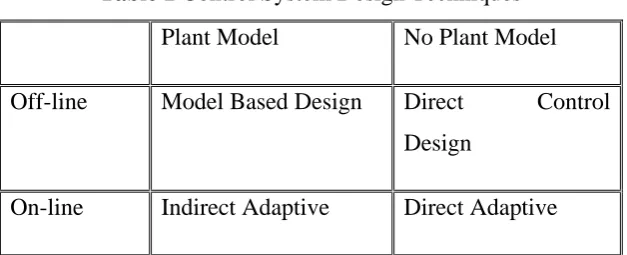
Table 1 Control System Design Techniques Plant Model No Plant Model Off-line Model Based Design Direct Control
Design
The "no plant model" column in Table 1.1 is somewhat of a misnomer: in some sense, a data set can be considered an empirical plant model, thus any simplified representation of the data set is also a plant model. The defining property of model free techniques is that a single integrated procedure derives the control law directly from experimental data and a performance specification. If the technique has a sufficiently low computational burden, it is generally straightforward to implement the "no plant model" design technique on-line. This produces a "direct adaptive" control technique where the controller attempts to improves its performance in response to newly available experimental data. Examples of direct control techniques include model free subspace based LQG control (Favoreel., 1998) (Favoreel., 2000), adaptive inverse control, LMS, and, FxLMS and its alternatives. The next two subsections describe the properties and main features of ‗model free‘ direct control design and outline conditions under which it might be advantageous to apply these techniques.
1.1.1 Properties of Direct Techniques
The most important property of direct control design techniques is the close coupling of the ''plant identification" and the "control design" steps.
In traditional model based control design, the development of a plant model requires great simplifications of the experimental data set in order to obtain a plant model.
identification and control design process should lead to increased automation of the control design process, however, this conjecture can only be confirmed by the experiences of control engineers who are able to try both model based and model free techniques in the field. The increased automation is expected to result from the removal of the intermediate design steps, thereby requiring the engineer to make fewer arbitrary choices of parameters during the design process. An additional advantage is realized in the iterative process between designing "identification" experiments and performing closed loop tests: the direct control design process naturally provides the engineer with an immediate estimate of closed loop performance.
Due to the increased automation, direct techniques are easily implemented as part of an adaptive framework. It is believed that direct techniques will be of great utility when solving adaptive control problems.
1.1.2 When One Might Use Direct Techniques
Control issues with certain attributes are likely to receive the most benefit from direct method. These attributes include:
• Experimental data are plentiful, are representative of the important system dynamics, and are inexpensive to obtain.
• Iteration between design and closed loop experiment is possible.
• Some aspects of the system are difficult to quantify by analytic modeling, e.g. time- varying nonlinearities.
The adaptive methodologies are of course applicable to cases where the plant is time-varying. In many time-varying problems, the control law adapts to compensate for changing system parameters, such as the kinetics parameters of a process. However, if the plant structure is changing, such as addition of new modes, a model free technique may be better suited than a model based adaptive controller in which the model structure is determined a priori.
1.2 Problem Statement:
Generally, nonlinear system‘s control design has many problem statements. Moreover, for this study the main difficulties are:
1. The dynamic model obtained for real plants is most often highly complex and high order non-linear system which makes the prediction of process behavior into the future is quite difficult.
2. Selecting a method of extrapolation of plant behavior into the future is not an easy task due to the lack of cheap and reliable sensors for on-line measurement of the key state variables.
3. Laboratory analysis with delays of several days cannot be used for on-line monitoring which require the proper development of a disturbance uncertainty model.
4. Selection process of the appropriate performance objective function should be applied in order to meet the low effluent quality and high energy consumption of wastewater treatment plants.
a means of tuning the controllers through the disturbance model; these features are important for practical applications.
1.3 Objectives of the project:
The main objectives of this project are:
1. To study the operation of Activated Sludge Process (ASP) in wastewater treatment plants (WWTP).
2. To estimate Prediction Matrices and Control Matrices. 3. To design Subspace Predictive Controller (SPC).
4. To analyse the stability issues occur on the system proposed.
1.4 Scope of the project:
1. To control ASP, in order to provide good performance and stability robustness in controlling: biomass X (t), substrate S (t), dissolve oxygen C (t) and recycled biomass Xr (t) concentrations in the activated sludge process.
3. To design adaptive model predictive controller, this would have the ability to adjust its control order signal for any parameter variations occurring in a plant model.
4. To use the direct method only. This project only focuses on the direct method which gives better performance with respect to input disturbance and also gives better tracking properties as well as disturbance rejection, with less design and computational efforts compared to the indirect method.
5. Stability analysis to investigate the effects of the user defined parameters such as Hankel matrices block sizes on identification results.
1.5 Methodology
With those issues discussed in problem statement section (1.2) in mind, the following design choices were made for this project.
The predictive control applied is completely data based, since it only requires a set of input–output open-loop data.
Through online updating of predictor using receding window, a nonlinear process is approached in the surrounding of working points and adaptive control is implemented.
In addition, unlike other data-driven predictive control designs, the proposed approach can deal with systems without complete on-line measurement of all output variables.
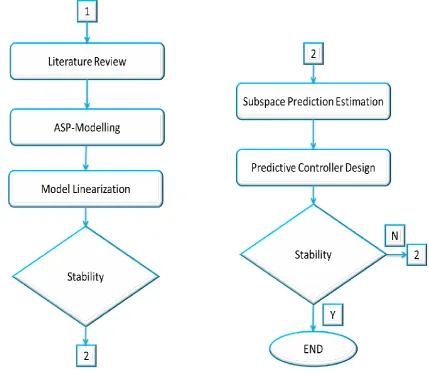
As a member of a class of controllers known as predictive control (Qin & Badgwell., 2003), (Clarke., 1996) Predictive control refers to any technique that employs the following steps:
1. A predictor is used to determine the plant input that will optimize a specified cost function over a future time horizon.
2. The first time step of the control is implemented. The plant output at this time step is recorded.
3. The new input-output data are added to the predictor, and steps 1-3 are repeated.
1.6 Project Flow chart
REFERENCES
Aguero, J. C. and G. C. Goodwin (2004). A recursive algorithm for MIMO stochastic model estimation. Control Conference, 2004. 5th Asian.
Akyurek, E., M. Yuceer, et al., (2009).―Comparison of Control Strategies for Dissolved Oxygen Control in Activated Sludge Wastewater Treatment Process‖. Computer Aided Chemical Engineering. J. Jacek and T. Jan, Elsevier. Volume 26: 1197-1201.
Astrom, K.J, Å. (1983). "Theory and applications of adaptive control—A survey." Automatica 19(5): 471-486.
Astrom & Wittenmark., (1995) Astrom, K.J. and B. Wittenmark, (1995) ―Adaptive Control‖, Addison Wesley, Reading, MA.
Bo Wahlberg, (2007): MIT Optimal Control Course in Principles of optimal control Camacho, E. F., & Bordons, C. (1999). Model predictive control. London: Springer-
Verlag.
Carl-Fredrik Lindberg (1997). ―Control And Estimation Strategies Applied To The Activated Sludge Process‖. Phd. Thesis, Uppsala University.
D.W. Clarke (1996) "Adaptive predictive control." Annual Reviews in Control 20(0): 83-94.
Favoreel,W., De Moor, B., & Gevers, M. (1999). SPC: Subspace predictive control. In Proc. 14th World Cong. IFAC , pp. 235.
Favoreel, D. M. B. a. W., (1998). "SPC: Subspace predictive control." Technical report, Katholieke Universiteit, Leuven.
Favoreel W., B. D. Moor, P. V. Overschee, and M. Gevers (1999). ―Model-free subspace-based LQG-design‖. In Proc. of the American Control Conference, pages 3372-3376, San Diago,California, 1999.
Favoreel, W., B. De Moor and P. Van Overschee (2000). ―Subspace state space system identification for industrial processes, Journal of Process Control, vol.10, no.2-3, pp.149-155, 2000.
Ferkl, L.; irok , J.; Pr vara, S., (2010) "Model predictive control of buildings: The efficient way of heating,"Control Applications (CCA), 2010 IEEE International Conference on, vol., no., pp.1922-1926, 8-10 Sept. 2010 doi: 10.1109/CCA.2010.5611114
Gambler, A., (2004) "Multivariable adaptive state-space control: A survey," Control Conference, 2004. 5th Asian , vol.1, no., pp.185-191 Vol.1, 20-23 July 2004 Garcia C.E., D.M. Prett and M. Morari, (1989) ―Model predictive control: theory and
practice-a survey‖, Automatica, 25 (3), pp. 335–348
Gernaey, K. V., M. C. M. van Loosdrecht, et al. (2004). "Activated sludge wastewater treatment plant modelling and simulation: state of the art." Environmental Modelling & Software 19(9): 763-783.
Golub, G. H. and C. Loan, (1996) Matrix Computations, The Johns Hopkins University Press, Baltimore, MD, 1996.
Hale, E. T. and S. J. Qin, (2002). ―Subspace model predictive control and a case study‖. American Control Conference, 2002. Proceedings of the 2002.
Holenda B., E. Domokos, A. Redey and J. Fazakas, (2008) ―Dissolved Oxygen Control of the Activated Sludge Wastewater Treatment Process Using Model Predictive Control,‖ Computers and Chemical Engineering, Vol. 32, 2008, pp. 1270-1278.
Huang and Kadali, (2008) B. Huang and R. Kadali, Dynamic Modeling, Predictive Control and Performance Monitoring: A Data-Driven Subspace Approach.London: Springer, 2008.
Isaacs S. H. and M. Henz (1995). Controlled carbon source addition to an alternating nitrification-denitrification wastewater treatment process including biological P removal. Wat. Res. 29(1) 77-89
Juang., (1994) J.N. Juang. Applied System Identification. PTR Prentice-Hall, 1994. Kadali, R., Huang, B., & Rossiter, A. (2003). "A data driven subspace approach to
Katayama, T. (1996) Special issue on subspace methods for system identification. Signal Processing 52
Koumboulis et al., (2008) F.N. Koumboulis, N.D. Kouvakas, R.E. King, and A. Stathaki. Two-stage robust control of substrate concentration for an activated sludge process. ISA Transactions 47 (2008) 267–278.
Lalo Magni and Riccardo Scattolini, (2009) An Overview of Nonlinear Model Predictive Control
Larimore, W.E. (1996). Statistical optimality and canonical variate analysis system identification. Signal Proc., 52, 131–144.
L. Ljung. System Identification: (1987) Theory for the User. Prentice-Hall, 1987 Ljung, L., & McKelvey, T. (1996). Subspace identification. Signal Processing, 52,
209–215.
Lennart, L. (2010). "Perspectives on system identification." Annual Reviews in Control 34(1): 1-12.
Maciejowski et. al., (2007) J.M. Maciejowski, P.J. Goulart and E.C. Kerrigan Constrained Control Using Model Predictive Control. Lecture Notes in Control and Information Sciences, 2007, Volume 346/2007, 273-291
Mardi & Wang, (2008) N. A. Mardi and L. Wang, ―Subspace-based model predictive control with data prefiltering,‖ in Proc. of the UKACC International Conference on Control 2008, (University of Manchester, UK), 2008.
Mardi and Wang, (2009) Mardi, N. A. and W. Liuping (2009). ―Subspace-based Model Predictive Control of time-varying systems‖. Proceedings of the IEEE Conference on Decision and Control, art. no. 5400285, pp. 4005-4010.
Mardi, (2010) Noor Azizi Mardi (2010) ―Data-driven Subspace-based Model Predictive Control‖, Phd-Thesis, RMIT University.
Mastronardi, N., D. Kressner, et al., (2001) "A fast algorithm for subspace state-space system identification via exploitation of the displacement structure." Journal of Computational and Applied Mathematics 132(1): 71-81.
Nejjari et al., (1999) F. Nejjari, A. Benhammou, B. Dahhou and G. Roux, Non-linear multivariable adaptive control of an activated sludge wastewater treatment process, Int. J. Adapt. Control Signal Process. Vol. 13, pp. 347-365, 1999. Olsson, G.,(1976) State of the art in sewage treatment plant control', A.I.Ch.E. Symp.
Olsson G, Andrews JF (1987) The dissolved oxygen profile—a valuable tool for control of the activated sludge process. Water Res 12:986–1004
Olsson G. and Newell R.B. (1999) Wastewater Treatment Systems - Modelling, Diagnosis and Control. IWA Publishing, London, United Kingdom. pp. 742. Oscar A.Z. Sotomayor, Song Won Parka, Claudio Garcia, (2003) ―Multivariable
identification of an activated sludge process with subspace-based algorithms‖, Control Engineering Practice 11. pp: 961–969
Overschee, Van. P., De Moor, B. (1994) ―N4SID: Subspace algorithms for the identification of combined deterministic-stochastic systems‖ Automatica, 30 (1), pp. 75-93. Cited 497 times.
Overschee, Van. P., B. De Moor, (1995) ―Choice of state space basis in combined deterministic-stochastic subspace identification‖, Automatica 31 (2) (1995) 1877-1883.
Overschee, Van. P., B. De Moor, (1996) ―Subspace Identification for Linear Systems: Theory-Implementation-Applications‖. Kluwer Academic Publishers.
Pannocchia, G. and M. Calosi (2010). "A predictor form PARSIMonious algorithm for closed-loop subspace identification." Journal of Process Control 20(4): 517-524.
Qin, S. J., Thomas A. Badgwell. (2003) ―A survey of industrial model predictive control technology‖. Control Engineering Practice 11 (2003) 733–764.
Qin, S. J., W. Lin, et al. (2005). "A novel subspace identification approach with enforced causal models." Automatica 41(12): 2043-2053.
Qin, S. J., (2006). "An overview of subspace identification." Computers & Chemical Engineering 30(10–12): 1502-1513.
Rawlings, J. B. (2000). "Tutorial overview of model predictive control." Control Systems, IEEE 20(3): 38-52.
Rossiter. J.A., ―Model-based predictive control, a practical approach‖. Prentice Hall Int., 2003
Ruscio, D. D. (1997). Model based predictive control: an extended state space approach. Decision and Control, Proceedings of the 36th IEEE Conference on.
Sergiu, C., S. Mihaela, et al., (2008). ―Predictive Control of a Wastewater Treatment Process‖. International Journal of Computers, Communications & Control Vol. II (2007), No. 2, pp. 132-142.
Song, In-Hyoup., Kee-Youn Yoo, and Hyun-Ku Rhee (2001) ―Analysis and Design of a Linear Input/Output Data-Based Predictive Control‖ Ind. Eng. Chem. Res. 2001, 40, 4292-4301.
Song, I.-H., S.-B. Lee, et al. (2006). "Identification and predictive control of a simulated moving bed process: Purity control." Chemical Engineering Science 61(6): 1973-1986.
Stare, A., D. Vrecko and N. Hvala, (2007) ―Comparison of Control Strategies for Nitrogen Removal in an Activated Sludge Process in Terms of Operating Costs: A Simulation Study,‖ Journal of Process Control, Vol. 41, 2007, pp. 2004-2014.
Tchobanoglous, G. and E. D. Schroeder (1985). Water Quality. Addison-Wesley Publishing Company.
Torben, K., (2001). "Consistency analysis of subspace identification methods based on a linear regression approach." Automatica 37(1): 81-89.
Verhaegen, M. and E. Deprettere (1991). ―A fast, recursive MIMO state space model identification algorithm‖. Decision and Control, 1991., Proceedings of the 30th IEEE Conference on.
Verhaegen, M., P. Dewilde, (1992) Subspace model identification. Part 1. The output-error model identification class of algorithms, Int. J. Contr. 56 1187– 1210.
Verhaegen, (1994) Verhaegen, Michel, Identification of the deterministic part of MIMO state space models given in innovations form from input-output data, Automatica, Vol. 30. No. 1. pp. 61-74 (1994)
Vlad, G., R. Crisan, et al., (2010). Development and application of a predictive adaptive controller to a wastewater treatment process. Automation Quality and Testing Robotics (AQTR), 2010 IEEE International Conference on. Wahab, N. A., R. Katebi, et al., (2011). "Data-driven adaptive model-based
predictive control with application in wastewater systems." Control Theory & Applications, IET 5(6): 803-812.
Wang. Liuping, (2009) ―Model Predictive Control System Design and Implementation Using MATLAB‖. Springer-Verlag London Limited, 2009. Wang et al., (2007) X. Wang, B. Huang, and T. Chen (2007). "Data-driven predictive
control for solid oxide fuel cells." Journal of Process Control 17(2): 103-114. Woodley, (2001) B. R. Woodley, J. P. How, and R. L. Kosut. (2001) Subspace based
direct adaptive H∞ control. International Journal of Adaptive Control and Signal Processing, 15:535561, 2001.
Yang, H., & Li, S. Y. (2005). Subspace-based adaptive predictive control of nonlinear systems. In Int. J. Innovative Comp., Inf. Control, 4 , pp. 743. Yang, H., & Li, S. Y. (2010) Hua, Y. and L. Shaoyuan (2010). A data-driven bilinear
subspace predictive controller design. Control and Automation (ICCA), 2010 8th IEEE International Conference on Control and Automation (ICCA). Zeng et al.,( 2010) Jiu-sun Zeng, Chuan-hou Gao, Hong-ye Su. Data-driven