
635
AN ALTERNATIVE DESIGN OF COLLABORATIVE
VIRTUAL ENVIRONMENT ARCHITECTURE BASED ON
CLOUD COMPUTING
1ABDULSALAM YA’U GITAL, 2ABDUL SAMAD ISMAIL
1Department of Computer Science, Universiti Teknologi Malaysia.
2Prof., Department of Computer Science, Universiti Teknologi Malaysia, Malaysia.
E-mail: [email protected] , [email protected]
ABSTRACT
Collaborative Virtual Environment (CVE) systems allow the sharing of virtual space, and each participant is represented by an entity in the CVE. Resources are consumed when interaction among several users occurs. The resources are consumed as a result of updating its own state, and the communication resources required to distribute the update of counterpart users in the CVE. The Peer-to-Peer (p2p) and Client Server (CS) architecture in CVE has the limitation of scaling to large number of users while maintaining consistency in the virtual world. This paper identifies the basic requirements of CVE systems, proposed a model based on cloud computing to improve the performance of the traditional CVE systems to evade the limitations of the p2p and CS. The design of the cloud computing-based CVE architecture proposes in our research consist of three layers namely, infrastructure, platform, and application. The potential benefits of the CVE architecture presented in this paper indicated a performance improvement over the traditional CVE. The proposed architecture with little modification can easily be implemented in real life applications to improve the performance of collaborative virtual applications.
Keywords: Collaborative Virtual Environment (CVE), Cloud Computing, CVE Architecture, Platform, Application, Infrastructure
1.
INTRODUCTIONIn collaborative virtual environment
(CVE) systems, all users share the same virtual space, and each of them is represented by an entity within the virtual environment. When a user connects to the environment, moves and/or interacts with other entities and shared objects, the CVE system consumes computing resource to update its own state, and consumes the communication resource to distribute the update of state to other users. With the expansion of the scale of applications, network and computing resources in the systems are far from adequate to meet the requirement of growth of the scale. The key issue
of designing CVE Systems is the
clash
betweenconsistency and scalability [1] and [2]. Consistency i
s the
steady state of entities and users of the CVE systems. Scalability is the successful consistency control even if more users move into the Virtual Environment [3]. In the design of CVE, Peer-to-Peer architecture, Client Server Architecture with a single server and architecture based on ClientMulti-server are used [4], [5] and [6]. However, there limitations are also obvious [3]. In the architecture based on multiple servers, the management of the virtual environment relies on the several interconnected servers. Each server handles a portion of the virtual environment after partitioning is made. After the partitioning, it is required that updates should be transmitted over the network so that users can recognize correct state of the virtual environment at all times which consume many communication resources. In addition, when large number of user signs into the virtual environment, the network bandwidth can be saturated. With the exponential increased in the number of participants, network resources and computing resources can still run out [6] and [7]. This Limited resource significantly affects the performance of CVE systems.
connecting the huge pool of systems [9]. The CC allows users to use infrastructures (e.g. Servers, Network, and storeges), Platforms (e.g. middle service and operating systems), and Software’s (e.g. application programs) provided by the cloud service providers (e.g. Amazone, Google, and Sales force) at a lower cost compared to traditional computing. The CC enables users to elastically utilize network resources in an on-demand fashion. CC technology also described as computing resources that provide highly scalable external services through the Internet [10].
In this paper, we propose the design of efficient cloud-based architecture that can support communication even with the increasing number of concurrent users in order to improve the performance of CVE systems.
The rest of the paper is organized as follows: section 2 describes related work on CVE communication architecture, and the current state and challenges of CVE systems. Section 3 provides an overview of CC and described why CVE on Cloud. Section 4 describes the key feature and characteristics of CC. The realization of the proposed Cloud based CVE Architecture is described in the section 4 before summarization and conclusions in Section 6.
2. BACKGROUND OF THE STUDY
2.1 Cve Architecture: Recent Advances And Challenges
There are different architectures for implementation of CVE systems. The most popular ones are peer-to-peer architecture and client server architecture (with a single server or multiple servers) [5]. The peer-to-peer and client server (with single server) architectures have several drawbacks due to the increasing number of simultaneously collaborating users, and the Client server with multi-server architecture which resolve the system's bottleneck that makes it suitable for designing a scalable CVE system [6] and [11].
In the Peer-to-Peer communication
architecture model, each user sends update directly to other users. The idea is that all components in the distributed systems have the same responsibilities, acting both as the clients and the servers. There is no central server to keep the status of the whole systems. Each peer maintains its own copy of the virtual environment states and exchanges data directly with other peers [12],[13],[14] and [15]. When a program makes changes to its own database, it sends the update data out so that other programs can update their individual databases
[16]. This architecture has the advantages of low
communication latency and fault tolerance
capability. Single client’s fault will not cause the whole systems to crash. Conversely, there is communication complexity with the model as each user has to adopt the filtering algorithm to reduce the consumption of network resources [6].
The client server architecture is classified as either single server or multi server architecture.
In the Client Server with single server model, all
the clients’ sends update to the server; the only common server that collects all data from the different client’s machine, and then sends the results back to each participating client’s machine. Each participant’s application communicates only with a server that is responsible for passing messages to other clients. Although, this model has a simple data structure to store and handle the data, is not scalable. Therefore, it is avoided due to the increasing number of collaborators [3] and [11].
The Client server with multiple servers is a promising model for CVE systems implementation. In this model, each client sends updates to the server, it is connected to, and the server transmits them to other clients and the remaining servers. The management of the virtual environment relies on several interconnected servers and each server handles a portion of the virtual environment [6]. From the above description, it can be noted that servers and the clients, executes a series of functions to keep the consistency in the virtual environment. At the server side, the server perform the function of receiving the update messages from the clients, updating the whole virtual environment and transmitting updates of the virtual environment to other clients and servers. At the client side, clients must execute functions of receiving the user’s input as the update message, transmitting the update message to the server and receiving the update messages from the server to keep the virtual environment up-to-date. However, because the virtual environment is divided into many partitions, a good partitioning algorithm is required to partition the virtual environment and relocate the access to the neighboring servers for consistent operation. Partitioning problem is one of the challenges in the design of large scale CVE systems based on client server architecture with multiple servers. In view of this, there is a need of a model that can effectively manage computing and communication resources to maintain consistent operation even with the increasing number of users among the servers.
637 authors argued that because users log in and out of the systems at any time, the load of the systems becomes uncertain and that may cause the existing servers to get overloaded when a large number of users log in simultaneously. Moreover, load balancing can reduce the load of the overloaded systems in some way, but when all the servers are overloaded, the system's performance may be very low. For a good collaborative performance, the virtual environment should be repartitioned and share the excess to new deployed server. In the architecture based on the tailoring, model, three types of host, maintain the operation of the systems: The main server, the region server and the client. Due to the uncertainty of the number of users and the region servers in the architecture based on tailoring three models, the main server monitor the current load and decide when to configure and deploy new region server based on the system load. When the main server discovers the current load of a server is closed to saturation point, it starts partitioning the virtual environment by the partitioning algorithm and configure region served by the communication program and transfer the excess to the newly configure the region server. The new region server starts the region management on receiving instruction from the main server to join the CVE systems, and initialized the partial virtual environment. Transfer instructor and addresses are sent to the client from the same main server, and after the clients connect to the region server, the region server officially manages the virtual environment of the transferred users. When a region server is approaching the stated threshold, the load balancing scheme transfers some client to another region servers to prevent region server overload, the clients transferred then connect to region server and get information about their virtual environment and start update through the new region server managing their activities. In this architecture, the number of servers is not fixed, and apart from the initial server, all other servers are configured when the interaction processes are in progress. Based on the idea of green computing, managing different servers located at different location is not cost effective. This method may only be suitable for average number of users. The experiment was conducted with a maximum of 480 users. With the increasing number of simultaneous users to the thousand and above, the average system's response time may greatly increase and lead to state of inconsistency. Therefore, this architecture is not really suitable for these types of applications.
Moreover, because of the virtual
environment has to be divided into several parts as users increases in the systems, partitioning problem is among the challenges in the design of CVE applications with the client server architecture with multiple servers[3],[6] and [17]. Many researchers proposed different partitioning method that manages communication and computing resources as follows:
2.2 Network Consideration In Cve
The network layer partially determines the properties and the guarantees of the network
connections in different physical network
conditions. CVEs are also an interesting class of application from a network point of view in that they pose a number of interesting networking challenges[18],[19] and [20] as explained:
2.2.1 Reliability: Some aspects of CVE maneuver may demand a sky-scraping degree of reliability (e.g. transferring state snapshots when entering new virtual worlds) and others require less (e.g. real-time audio). Therefore, the systems should have confrontation to bad condition that may appear, e.g, loss of packet, network overload, machine failure [21]. CVEs for distributed interactive media require that all participants must receive state changes. Due to their specificity there are some states that are time critical and described by small amounts of information, while others are generally non-time critical and require large amounts of information for their description. Thus, there is the need for different levels of reliability when exchanging these types of updates. In a CVE, the last state of a shared object is the most crucial [22]. These messages must be sent with a high reliability level[11].
2.2.2 Consistency: Similarly, the need for consistency may vary according to virtual proximity - two users trying to manipulate the same object in close proximity may require a higher degree of consistency than two distant users who are only peripherally aware of each other’s actions. Thus, consistency becomes a negotiable dimension of Quality of Service (QoS) [18],[19] and [20].
2.2.3 Scalability: According to [20], the existing CVE systems have limited scalability due to the constraints in computer processing power, and
network bandwidth of participating hosts.
2.2.4 TRANSPARENCY: Although, transparency has been a key goal of many distributed systems, it may be impossible to maintain in a distributed CVEs. For example, one cannot guarantee fine-grained consistency for two users who are trying to manipulate the same object when they are at opposite ends of a network connection which are thousands of miles away [19].
2.2.5 MIXED TRAFFIC TYPES: CVEs
typically combine dynamic state updates (e.g. Movements and collisions), large state transfers (e.g. downloading world and object geometry and behaviors), real time audio, video and text. Each of these brings its own requirements for timeliness and reliability, and yet they have to be integrated into some consistent framework and balanced against one another [18].
2.2.6 Dynamic Connection And Membership:
The model of connection and membership in CVEs is highly dynamic and ad-hoc. Users may come and go from worlds as they please and may unintentionally encounter one another leading to new "connections" which were not explicitly requested by either party [18].
2.2.7 Dynamic Negotiation Of Qos: Given a logical connection to another user in a virtual world, the QoS for this connection may be required to vary radically over time. For example, moving towards another person may require that a higher fidelity view can be established, whereas turning away from them (a simple head movement) may result in a lower fidelity view. Thus, QoS becomes subject to continual renegotiation as a result of the most basic actions in the virtual world [18].
2.2.8 Unpredictable Load And Service Provisioning: Systems and network load may vary drastically according to the number of mutually aware users present in a world and the complexity of the world and the actions occurring within it. Service provisioning at the network level will be problematic both due to the complexity of possible actions and also their possible correlation. For example, in our experience, not only does moving between worlds generate a potentially large burst of network traffic, but it is typical that several people may choose to move at the same time. The predicting network load and the resources required to cope with it becomes a challenging problem.
2.2.9 USER CONTROL OVER QOS: Given the
dynamic nature of QoS and the unpredictability of load, it may be necessary to give users some direct control over quality issues. For example, they may wish to influence cost/benefit relationships between fidelity and performance. How can users express high-level preferences, which can be mapped down onto QoS parameters for different media?.
3. OVERVIEW OF CLOUD COMPUTING
3.4 Cloud Computing Architecture
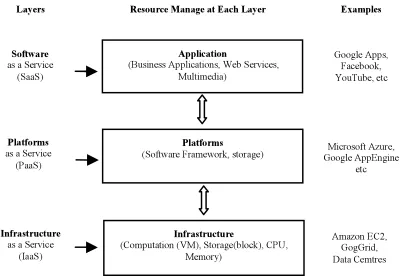
Generally speaking, the architecture of a CC environment can be divided into 4 layers: the hardware/datacenter layer, the infrastructure layer, the platform layer and the application layer, as shown in Fig. 2 [23]:
3.4.1 The Hardware Layer: This layer is responsible for managing the physical resources of the cloud, including physical servers, routers, switches, power and cooling systems. In practice, the hardware layer is typically implemented in data centers. A data center usually contains thousands of
servers that are organized in racks and
interconnected through switches, routers or other fabrics. Typical issues at hardware layer include hardware configuration, fault tolerance, traffic
management, power and cooling resources
management.
3.4.2 The Infrastructure Layer: Also refer to as the virtualization layer, the infrastructure layer creates a pool of storage and computing resources by partitioning the physical resources using virtualization technologies. The infrastructure layer is an essential component of the CC, since many key features, such as dynamic resource assignment, are only made available through Virtualization technologies.
3.4.3 The Platform Layer: Built on top of the infrastructure layer, the platform layer consists of operating systems and application frameworks. The purpose of the platform layer is to minimize the burden of deploying applications directly into VM containers. For example, Google App Engine operates at the platform layer to provide API support for implementing storage, database and business logic of typical web applications.
639
Application
(Business Applications, Web Services, Multimedia)
Platforms
(Software Framework, storage)
Infrastructure
(Computation (VM), Storage(block), CPU, Memory)
Software as a Service
(SaaS)
Infrastructure as a Service
(IaaS)
Platforms as a Service
(PaaS)
Google Apps, Facebook, YouTube, etc
Microsoft Azure, Google AppEngine
etc
Amazon EC2,
GogGrid, Data Cemtres
Layers Resource Manage at Each Layer Examples
Rapid development, deployment and change management Better IT resource management and business fucus
High reliability/availability
traditional applications, cloud applications can leverage the automatic-scaling feature to achieve better performance, availability and lower operating cost. Compared to traditional service hosting environments such as dedicated server farms, the architecture of CC is more modular. Each layer is loosely coupled with the layers above and below, allowing each layer to evolve separately. This is similar to the design of the OSI model for network protocols. The architectural modularity allows CC to support a wide range of application requirements
while reducing management
and maintenance
overhead.
Fig. 2 Cloud Computing Architecture
3.5
The Technologies Used In CloudComputing
3.5.1 Virtualization: Virtualization technology reuses hardware equipment to provide an expandable systems environment with extra flexibility. Such virtualization technologies as VMware [23] and can act as a demand-based virtualization IT equipment. In order to use the
resources in the Cloud, the userscan configure their
personal network and systems environment through such virtualization network as virtual private network.
3.5.2 Service Flow And Workflow: Based on a series of service layers, CC provides a complete set of service environment as per demand. According to Service-Oriented Architecture (SOA), the service layer below will support the service layer above, and the service flow and work flow will be ultimately integrated.
3.5.3 Web Services And Soa: Through standard WSDL, SOAP and UDDI, cloud services can be
delivered by the way of Web service. The service structure in the cloud can be managed by SOA. As a result, the services can be used in different distributed platforms through a network.
3.5.4 Web 2.0: Through Internet and novel Web design & application, Web 2.0 can strengthen information sharing and the interactive cooperation of users.
Accordingly, many brand new designs and applications are produced on the basis of Web architecture. Taking advantage of the Web 2.0 technologies, actually, CC can provide the users with various services by the application of Web.
3.5.5 Large-Scale Distributed
Systems: CC requires large-scale distributed memory systems and computing ability to realize the rental of computing resources and memory spaces by users. The data in the cloud should be transparently transferred, integrated and managed. Google File Systems and Amazon (amazone.com) are the related examples.
3.5.6 Programming Model: Users can write the application program under cloud environment through CC. Efficiently utilizing the highly concurrent cloud architecture, the programming model of the cloud environment can solve new problems. Map Reduce is a new programming model, which is suitable for mass data treatment. The model divides the data set into many small keys/values through Map operation and after it deals with the key/value aggregate with the same key. Hadoop (hadoop. apache.org) is a frame with open source to get the programming model and provides a Hadoop Distributed File Systems (HDFS).
3.6 Characteristics Of Cloud Computing
Different from grid and cluster computing, CC is a system that adopts SOA and is based on service layers. Its main characteristics are as follows:
3.6.1 User-Centered Interface Design: As for the interface of CC, there is no need for the users to change their usual working habits. For example, development language, compiler and operating systems installed at the user end are light weight ones. Besides, most of the CC products can be directly used through a browser.
the users can select the necessary computing resources as per their demands. For example, software installation, network configuration, and hardware configuration. The users enjoy the highest access to these resources.
3.6.3 Quality Guarantee Of Service: The systems environment of CC can assure a high service quality for users, such as CPU bandwidth, and memory capacity.
3.6.4 Self-Management Systems: As a self-management systems, the hardware, software and data from CC can be configured and adjusted automatically, acting as a platform mirror image for users [24].
3.7 Why Cve On Cloud
Clouds offer a new level of flexibility in
application and data delivery. Provisioning
applications and services from a cloud can give you the operational benefits without the capital expenses of maintaining on premises environments
[25]. Cloud technology can provide significant benefits as shown in Figure 3.
Figure 3. Benefits of Cloud Computing.
Source:[26]
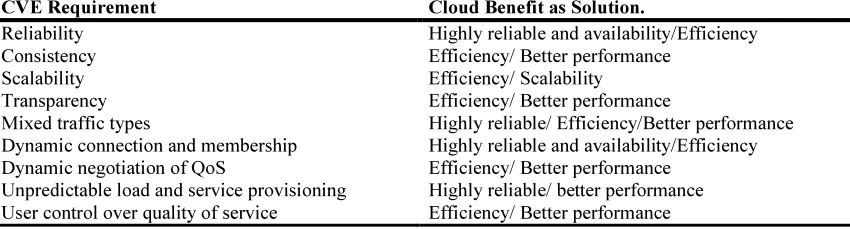
Figure 3 outlines the benefits that can be generated using CC technology. In the previous section, the CVE requirement was listed and described. To clearly show how the cloud features benefit in satisfying the requirement of CVE, it is necessary to match these requirements and the benefit as shown presented in Table 1.
Table 1: CVE Requirement matching Table
CVE Requirement Cloud Benefit as Solution.
Reliability Highly reliable and availability/Efficiency
Consistency Efficiency/ Better performance
Scalability Efficiency/ Scalability
Transparency Efficiency/ Better performance
Mixed traffic types Highly reliable/ Efficiency/Better performance
Dynamic connection and membership Highly reliable and availability/Efficiency
Dynamic negotiation of QoS Efficiency/ Better performance
Unpredictable load and service provisioning Highly reliable/ better performance
User control over quality of service Efficiency/ Better performance
3.8 Worldwide Collaborative Service Forecast
Forrester [27] estimated that collaboration services account for about 2% of total global IT purchases in 2011. The market is expected to show differentiated development patterns as companies’ investments increasingly focus on enhanced collaboration capabilities such as social software capabilities or video conferencing services (see Figure 4). Forrester [27] forecast the following global trends:
3.8.1 Enterprises Will Reduce Their Emphasis On Voice Services Through 2018: Not surprisingly, voice services, including managed IP PBX, still accounted for the largest part of the
collaboration services market in 2011. That said, voice services will be the slowest-growing segment of the collaboration services market through 2018, with a 6.9% CAGR compared with 8.1% for the collaboration services market as a whole.
3.8.3 Videoconferencing Services Will Grow The Fastest, Although From The Smallest Base:
641
Figure 4. The Worldwide Collaboration Services. Source: [27]
4. PROPOSE DESIGN OF THE CVE
ARCHITECTURE ON CLOUD
The proposed CVE architecture on Cloud is a layered architecture. It consists of three main layers, namely, Infrastructure, Platform and Application as shown in Figure 5. The layers comprised of the basic of the cloud services.
4.1 Infrastructure Layer: This layer represents the hardware layer that is used as the Virtual
Collaboration and software visualization
technology, which maintain the reliability and stability of the infrastructures. It enables the provision of networking components, servers,
storage, routers, and switches. The CC
infrastructure heavily influences application
performance and throughput in a distributed computing environment [23]. Because CC enable the hardware layer to serve more like the internet to make the hardware resources shared and accessed the data resources in a secured scalable way, this layer takes care of communication resources management, which allow fast transmission, that resolve the basic CVE requirement such as consistency, reliability, etc. The layer consists of the connection module, aggregation modules, and
server access modules. The connection module provides connectivity to multiple aggregate modules and provides resilience routed fabric with no single point of failure supporting any kind of delay sensitive application. The aggregation module provides load balancing, location services and domain services its functions. The server access module connects servers to the network via switches that are connected to two aggregation
witches for redundancy. The architectural
representation of the infrastructure layer is as shown in Figure 5.
maintain consistency in the user’s level. This module keeps position model of each entity within the virtual world and detect collision among users and entities to avoid penetration. The services provided by this layer are listed as follows:
i. Distribution Service Module (DaaS)
ii. Team Work Services (TWaaS)
iii. Dynamics Services (DNaaS)
iv. Persistence Services (PSaaS)
v. Scene Management services (SCaaS)
vi. Object management services (OBaaS)
vii. Consistency Management Services
(CONaaS)
viii. Event Management Services (EaaS)
ix. Group Control Services
x. Session information Services
xi. User information Services
xii. Multimedia Communication Services
All these modules are utilized to access user and object data from the repository and select the required data from the database. The modules also
make the user data and objects data shareable and interoperable. Because the virtual world becomes more and more large and complex, the whole virtual world is built up by many small virtual scenes. Thus, the Distribution Service Module (also called Distribution as a service (DaaS)) consists of procedures that manages scene information, in such a way user in one scene need not to receive any information of the other scenes. The Team Work service module (TWaaS) consists of procedure that enable user from different scene to communicate with text, audio or video and also to join or leave a
team dynamic. Dynamics Services Module
(DNaaS) procedure handles in and out of the virtual world by a user, and user can move from one virtual scene to another virtual scene. Persistency Service Module (PSaaS) procedure saves users' manipulation within virtual world, even after the user exit and disconnected from the systems.
Figure 5. Cloud Virtual World Representation
Others are: Scene Services (SNaaS): This procedure creates and keeps profiles of the event in the virtual environment, when a new user joins the systems, the module only sent the new profiles and the event after the new profiles. This is because, when session processed for a long time state of the virtual objects changes much and new user need not to load all the long event sequence in order to maintain the correct state of the virtual world. The procedure creates the profile at an interval not too frequent and not too long. It maintains the state of the virtual world when a new object is added by sending the update to all users concern. The scene module provides information for all users when user adds object, the background sound, light and
fog of the surrounding environment is changed by either user or administrator. Object Management Module (OaaS). This module saves object movement information when a user within a region or from a remote site operates the object, this is to keep the exact position of all objects within the virtual world to maintain consistency. It also presents object information whenever a user added or remove an object. Event Management Module (EaaS). This module detects when a user performs a task and sent the update to be perceived by all relevant users within the virtual world.
643 synchronization technique to maintain the same view of the virtual world at different sites at the same time. With the support of cloud visualization and flexibility, most of the synchronization techniques that do not have high consistency or responding performance at the same time in the traditional CVE architecture can perform better. Group Control Services (GCaaS): This module keeps information and manages user information when users communicate within a group and when a user changes group as users can change group dynamically. The module present when, where and who join or leave which group to other group members. This is because the task in CVE is always processed by a Workgroup. Each group member collaborates in a certain work in different area so they need. Therefore, communication is necessary when working.
Session Information Services (SIaaS): Similar to the operation of other applications, this module is concerned about the functions to change and save session information, such as session initiation, session logs, and client join/leave. User Information Services (UIaaS): In CVE each user is represented by an avatar, this module manages the avatar of the user. User Communication Services: The module handles all the three types of communication channel, including video, audio, and text. With the cloud provision of SaaS and IaaS, all this communication is realized. In the traditional architecture, video communication seems to be difficult due to insufficient bandwidth in a WAN.
4.3 Application Layer: This consists of the application platform that supply interface for the users. At this layer, the CC provides convenient access to the virtual world resources. The layer consists of virtual world web application which work with the support of virtual world management modules (as in platform layer). The VW web application presents the virtual world to any user connected to the systems through the assigned URL, it is the user interface that allows users to manipulate objects of the virtual world and or have a group collaboration. The VW application is created for communication with virtual world management modules. When a user performs an operation, the respective modules generate the operation data, store in the cloud data bank and update to be displayed on the virtual world of each connected client.
5. POTENTIAL BENEFITS OF THE
PROPOSE CLOUD BASED ARCHITECTURE OF THE CVE
As CVE demands a high rate of inter server communication due to the increasing number of users, among of the potential benefits that can be derived from the propose architecture are: Its ability to provide Uniform, High Capacity (UHC) by providing full bandwidth to all hosts in the cloud to communicate with each other. The network infrastructure can provide server scalability as well as to allow incremental expansion of servers. The propose cloud based architecture has the potential ability for fault tolerant against all types of server failure and link outage. The cloud computing can have the potentially have the advantage of providing required storage capacity to all its users in the CVE. Considering the CC high performance computing powers, CVE expects guaranteed quality of services in its operations. As a result of the features of the cloud, CVE requirements such as Reliability, Consistency, Scalability, Transparency,
Mixed Traffic type, Dynamic connection
Membership, etc. can benefit from the features of cloud including: Highly reliable, Availability, Efficiency, Better performance and Scalability which in turn can improve the performance of the CVE. Based on the benefits expected to derive from the propose architecture of the CVE and with little modification, the architecture proposed can possibly be applied to enhance the performance of virtual applications.
6. CONCLUSIONS AND FUTURE WORK
be improved. With modest adjustment, our proposed design has the potentials of improving the robustness and effectiveness of virtual collaborative applications in real life environment. The authors of this paper intend to further this research by implementing the design of the propose cloud CVE presented in this work.
REFERENCES
[1] J. Chen, S. Grottke, J. Sablatnig, R. Seiler,
and A. Wolisz, "Scalability of a distributed virtual environment based on a structured
peer-to-peer architecture," in
Communication Systems and Networks (COMSNETS), 2011 Third International Conference on, 2011, pp. 1-8.
[2] N. Gupta, A. Demers, J. Gehrke, P.
Unterbrunner, and W. White, "Scalability for virtual worlds," in Data Engineering, 2009. ICDE'09. IEEE 25th International Conference on, 2009, pp. 1311-1314.
[3] X. M. Hu, H. X. Cai, and T. Yu, "A
Self-Adaptive Filtering Algorithm Based on Consistency QoS in CVE Systems," Advanced Materials Research, vol. 225, pp. 301-306, 2011.
[4] J. Dean and S. Ghemawat, "MapReduce:
simplified data processing on large
clusters," Communications of the ACM,
vol. 51, pp. 107-113, 2008.
[5] M. Macedomia, M. J. Zyda, D. R. Pratt, D.
P. Brutzman, and P. T. Barham, "Exploiting reality with multicast groups: a network architecture for large-scale
virtual environments," in Virtual Reality
Annual International Symposium, 1995. Proceedings., 1995, pp. 2-10.
[6] X. Hu, L. Liu, and T. Yu, "A hierarchical
architecture for improving scalability and
consistency in CVE systems,"
International Journal of Parallel,
Emergent and Distributed Systems, vol. 26, pp. 179-205, 2011.
[7] S. Rueda, P. Morillo, J. M. Ordu, #241,
and J. Duato, "A genetic approach for
adding QoS to distributed virtual
environments," Comput. Commun., vol.
30, pp. 731-739, 2007.
[8] D. Hong, A. Rhie, S.-S. Park, J. Lee, Y. S.
Ju, S. Kim, et al., "FX: an RNA-Seq
analysis tool on the cloud,"
Bioinformatics, vol. 28, pp. 721-723, 2012.
[9] W. Li, "Research on the application of
distributed virtual environment based on
Cloud Computing," in Multimedia
Technology (ICMT), 2011 International Conference on, 2011, pp. 3207-3209.
[10] N. Selviandro and Z. A. Hasibuan,
"Cloud-Based e-learning: a proposed model and benefits by using e-learning based on cloud computing for educational
institution," in Information and
Communicatiaon Technology, ed:
Springer, 2013, pp. 192-201.
[11] A. Y. Gital, A. S. bn Ismail, and S.
Subramaniam, "On consistency and
security issues in collaborative virtual
environment systems," International
Journal of Physical Sciences, vol. 8, pp. 1646-1654, 2013.
[12] S. B. S Bu, M Portela, H Jo "Collaborative
Design Review in Virtual Environment,"
presented at the Korea Computer
Congress, 2007.
[13] K. Berket, A. Essiari, and M. R.
Thompson, "Securing Resources in
Collaborative Environments: A Peer-to-peer Approach," 2005.
[14] M. Khoury, X. Shen, and S.
Shirmohammadi, "A peer-to-peer
collaborative virtual environment for
E-commerce," in Electrical and Computer
Engineering, 2007. CCECE 2007.
Canadian Conference on, 2007, pp. 828-831.
[15] Y. Pan and F. T. Marchese, "A
peer-to-peer collaborative 3D virtual environment
for visualization," in Electronic Imaging
2004, 2004, pp. 180-188.
[16] S. Yong, H.-Y. Moon, Y. Sohn, and M.
Fernandes, "A Survey of Security issues in
Collaborative Virtual Environment,"
IJCSNS, vol. 8, p. 14, 2008.
[17] Y. Deng and R. W. Lau, "On Delay
Adjustment for Dynamic Load Balancing in Distributed Virtual Environments," Visualization and Computer Graphics, IEEE Transactions on, vol. 18, pp. 529-537, 2012.
[18] C. Greenhalgh, M. Flintham, J. Purbrick,
and S. Benford, "Applications of temporal links: Recording and replaying virtual
environments," in Virtual Reality, 2002.
Proceedings. IEEE, 2002, pp. 101-108.
[19] W. Shao-Qing, C. Ling, and C. Gen-Cai,
645 Computer Supported Cooperative Work in Design, 2004. Proceedings. The 8th International Conference on, 2004, pp. 34-39.
[20] Q. Lin, L. Zhang, N. Neo, and I. Kusuma,
"Addressing scalability issues in large-scale collaborative virtual environment," in Advances in Computer Graphics, ed: Springer, 2006, pp. 477-485.
[21] J. Orvalho, P. Ferreira, and F. Boavida,
"State Transmission Mechanisms for a
Collaborative Virtual Environment
Middleware Platform," in Interactive
Distributed Multimedia Systems, ed:
Springer, 2001, pp. 138-153.
[22] S. Shirmohammadi and N. D. Georganas,
"An end-to-end communication
architecture for collaborative virtual
environments," Computer Networks, vol.
35, pp. 351-367, 2001.
[23] Q. Zhang, L. Cheng, and R. Boutaba,
"Cloud computing: state-of-the-art and
research challenges," Journal of Internet
Services and Applications, vol. 1, pp. 7-18, 2010.
[24] Z. Fang and C. Yin, "BPM Architecture
Design Based on Cloud Computing," Intelligent Information Management, vol. 2, pp. 329-333, 2010.
[25] CISCO, 2013.
[26] M. Carroll, A. Van der Merwe, and P.
Kotze, "Secure cloud computing: Benefits,
risks and controls," in Information
Security South Africa (ISSA), 2011, 2011, pp. 1-9.
[27] F. Consulting, "Collaboration Services:
![Figure 4. The Worldwide Collaboration Services. Source: [27]](https://thumb-us.123doks.com/thumbv2/123dok_us/1286575.1161184/7.595.85.491.87.307/figure-worldwide-collaboration-services-source.webp)