New Constructions for Provably-Secure Time-Bound
Hierarchical Key Assignment Schemes
Alfredo De Santis, Anna Lisa Ferrara, and Barbara Masucci
Dipartimento di Informatica ed Applicazioni, Universit`a di Salerno, 84084 Fisciano (SA), Italy {ads, ferrara, masucci}@dia.unisa.it
Abstract
A time-bound hierarchical key assignment scheme is a method to assign time-dependent encryption keys to a set of classes in a partially ordered hierarchy, in such a way that each class in the hierarchy can compute the keys of all classes lower down in the hierarchy, according to temporal constraints.
In this paper we propose new constructions for time-bound hierarchical key assignment schemes which are provably secure with respect to key indistinguishability. Our constructions use as a building block any provably-secure hierarchical key assignment scheme without temporal constraints and exhibit a tradeoff among the amount of private information held by each class, the amount of public data, the complexity of key derivation, and the computational assumption on which their security is based. Moreover, the proposed schemes support updates to the access hierarchy with local changes to the public information and without requiring any private information to be re-distributed.
Keywords: Access control, key assignment, provable security, efficient key derivation.
1
Introduction
Users of a computer system could be organized in a hierarchy formed by a certain number of disjoint classes. These classes, calledsecurity classes, are positioned and ordered within the hierarchy based on the fact that some users have more access rights than others. For example, within a hospital system, doctors can access all data concerning their patients, whereas, researchers can be limited to consult anonymous clinical information for studies. Similar cases abound in other areas, particularly in the government and military.
22, 23, 24, 25]). A recent work by Crampton et al. [13] provides a detailed classification of many schemes in the literature and evaluates their merits according to different parameters, such as the amount of private information distributed and stored by users, the amount of public information, the complexity of key derivation, the complexity of handling dynamic updates to the hierarchy, and the resistance to collusive attacks.
There are several applications requiring a time-based access control. For example, a web-based electronic newspaper company could offer several types of subscription packages, covering different topics. Each user may decide to subscribe to one package for a certain period of time (e.g., a week, a month, or a year). Atime-bound hierarchical key assignment schemeis a method to assign time-dependent encryption keys and private information to each class in the hierarchy, in such a way that key derivation also depends on temporal constraints. Once a time period expires, users in a class should not be able to access any subsequent keys if they are not authorized to do so. Several proposals for time-bound hierarchical key assignment schemes [30, 12, 18, 34] have been shown to be insecure against collusive attacks, whereby two or more users, assigned to some classes in distinct time periods, collude to compute a key to which they are not entitled [36, 14, 35, 27, 6]. Recently, Wang and Laih [37] and Tzeng [31] showed how to construct a time-bound hierarchical key assignment scheme starting from the Akl-Taylor scheme [2]. However, since they did not formalize the definition of security and the adversarial model, it is not clear under which assumption their schemes can be considered to be secure.
Ateniese et al. [6] first addressed the problem of formalizing security requirements for time-bound hierarchical key assignment schemes. They distinguished between two different goals, i.e., security with respect to key indistinguishability and against key recovery, and two different kinds of adversarial behaviors, i.e., the static and adaptive adversarial behaviors. In particular, they proved that security against adaptive adversaries is (polynomially) equivalent to security against static adversaries. They also proposed two different constructions for time-bound key assignment schemes. Both constructions support dynamic updates to the access hierarchy with local changes to the public information and without requiring any private information to be re-distributed.
2
Time-bound Hierarchical Key Assignment Schemes
Consider a set of users divided into a number of disjoint classes, calledsecurity classes. A security class can represent a person, a department, or a user group in an organization. A binary relation¹ that partially orders the set of classesV is defined in accordance with authority, position, or power of each class inV. The poset (V,¹) is called apartially ordered hierarchy. For any two classesuand
v, the notationu¹vis used to indicate that the users invcan accessu’s data. Clearly, sincevcan access its own data, it holds that v¹v, for anyv∈V. We denote by Av the set{u∈V :u¹v},
for any v ∈ V. The partially ordered hierarchy (V,¹) can be represented by the directed graph
G∗ = (V, E∗), where each class corresponds to a vertex in the graph and there is an edge from class
vto class uif and only ifu¹v. We denote byG= (V, E) theminimal representationof the graph
G∗, that is, the directed acyclic graph corresponding to thetransitive and reflexive reductionof the graphG∗ = (V, E∗). Such a graphGhas the same transitive and reflexive closure ofG∗, i.e., there is a path (of length greater than or equal to zero) fromv tou inG if and only if there is the edge (v, u) inE∗. Aho et al. [1] showed that every directed graph has a transitive reduction which can be computed in polynomial time and that such a reduction is unique for directed acyclic graphs. In the following we denote by Γ a family of graphs corresponding to partially ordered hierarchies. For example, Γ could be the family of the rooted trees, the family of the d-dimensional hierarchies [25, 5, 15], etc.
As done in [6], in this paper we consider the case where the membership of a user to a certain class also depends on temporal constraints. Let T = (t1, . . . , tn) be a sequence of distinct time
periods. Each user may belong to a class for a certain non-empty contiguous subsequence λof T. LetP be the set of all nonempty contiguous subsequences ofT. Such a set is called theinterval-set
overT. We recall the definition of a time-bound hierarchical key assignment scheme given in [6].
Definition 2.1 ([6])Atime-bound hierarchical key assignment schemeforΓis a pair of algorithms
(Gen, Der) satisfying the following conditions:
1. Theinformation generation algorithmGenis probabilistic polynomial-time. It takes as inputs the security parameter 1τ, a graph G = (V, E) in Γ, and the interval-set P over a sequence of distinct time periods T, and produces as outputs
(a) a private information su,λ, for any class u∈V and any time sequence λ∈ P; (b) a key ku,t, for any classu∈V and any time period t∈T;
(c) a public informationpub.
We denote by (s, k, pub) the output of the algorithm Gen on inputs 1τ, G, and P, where s and k denote the sequences of private information and of keys, respectively.
2. The key derivation algorithm Der is deterministic polynomial-time. It takes as inputs the security parameter 1τ, a graphG= (V, E) in Γ, the interval-setP over a sequence of distinct time periods T, two classes u and v such that v ∈ Au, a time sequence λ ∈ P, the private information su,λ assigned to class u for the time sequence λ, a time period t ∈ λ, and the public information pub, and produces as output the keykv,t assigned to class v at time period
t.
can be computed by Gen on inputs 1τ, G, and P, it holds that
Der(1τ, G,P, u, v, λ, su,λ, t, pub) =kv,t.
A time-bound hierarchical key assignment scheme is evaluated according to several parameters, such as the amount of secret data that needs to be distributed to and stored by users, the amount of public data, the complexity of key derivation, the complexity of key updates due to dynamic changes to the hierarchy, and the resistance to collusive attacks.
As regards as the complexity of key derivation, we are interested both in the number and of type of operations needed to derive a key. Moreover, notice that in Definition 2.1 we have not specified the structure of the public information puband of the graphG. In order to improve the efficiency of key derivation,pubandGcould be structured in such a way that, whenever classv performs key derivation to compute the key of a classu∈Av, it does not need to input the algorithmDer with
the whole puband G, but only with those parts of them involved in the computation. As regards as the complexity of key updates, due to dynamic changes to the hierarchy, we would like to allow the insertion and deletion of users, classes, or edges in the hierarchy at any time period, without requiring the TA to re-distribute the private information to the other users.
However, the most fundamental feature that a good scheme should have is the resistance to collusive attacks. More precisely, for each class u ∈ V and each time period t ∈ T, the key ku,t
should be protected against a coalition of users belonging to each class v such that u 6∈ Av in all
time periods, and users belonging to each class w such that u ∈ Aw in all time periods but t.
We denote by Fu,t the set {(v, λ) ∈ V × P :u 6∈ Av or t 6∈ λ}, corresponding to all users which
are not allowed to compute the key ku,t. In this paper we consider security with respect to key indistinguishability. Such a requirement, introduced by Ateniese et al. [6], formalizes the fact that the adversarial coalition is not able to distinguisha key, that should not be accessible by any user of the coalition, from a random string of the same length. We consider a static adversarySTATu,t, which wants to attack a classu∈V at a certain time periodt∈T and which is able to corruptall
users not allowed to compute the keyku,t. We define an algorithmCorruptu,t which, on input the
private informationsgenerated by the algorithmGen, extracts the secret valuessv,λassociated to
all pairs (v, λ)∈Fu,t.We denote by corr the sequence output byCorruptu,t(s). Two experiments
are considered. In the first one, the adversary is given the key ku,t, whereas, in the second one, it
is given a random string ρ having the same length as ku,t. It is the adversary’s job to determine
whether the received challenge corresponds to ku,t or to a random string. We require that the
adversary will succeed with probability only negligibly different from 1/2.
If A(·,·, . . .) is any probabilistic algorithm then a ← A(x, y, . . .) denotes the experiment of running A on inputs x, y, . . .and letting abe the outcome, the probability being over the coins of
A. Similarly, if X is a set then x← X denotes the experiment of selecting an element uniformly from X and assigningx this value. If w is neither an algorithm nor a set thenx ←w is a simple assignment statement. A function ²:N → R is negligible if for every constant c > 0 there exists an integer nc such that ²(n)< n−c for all n≥nc.
Definition 2.2 ([6]) Let Γ be a family of graphs corresponding to partially ordered hierarchies, let
ExperimentExpIND−1 STATu,t(1
τ, G,
P) ExperimentExpIND−0 STATu,t(1
τ, G, P) (s, k, pub)←Gen(1τ, G,P) (s, k, pub)←Gen(1τ, G,P)
corr←Corruptu,t(s) corr←Corruptu,t(s)
d←STATu,t(1τ, G,P, pub, corr, ku,t) ρ← {0,1}length(ku,t)
returnd d←STATu,t(1τ, G,P, pub, corr, ρ)
returnd
The advantage of STATu,t is defined as
AdvIND
STATu,t(1τ, G,P) =|P r[Exp IND−1
STATu,t(1τ, G,P) = 1]−P r[Exp IND−0
STATu,t(1τ, G,P) = 1]|.
The scheme is said to be secure in the sense of IND-ST if, for each graph G = (V, E) in Γ, each sequence of distinct time periods T, each class u ∈ V and each time period t ∈ T, the function
AdvIND
STATu,t(1τ, G,P) is negligible, for each static adversary STATu,t whose time complexity is
poly-nomial in τ.
In Definition 2.2 we have considered a static adversary attacking a class. A different kind of adversary, theadaptiveone, could also be considered. Such an adversary is first allowed to access all public information as well as all private information of a number of classes of its choice; afterwards, it chooses the classuit wants to attack and the time periodtfor which the attack will be mounted. In [6] it has been proven that security against adaptive adversaries is (polynomially) equivalent to security against static adversaries. Hence, in this paper we will only consider static adversaries.
An Extension of the Model. In Definition 2.1 we have considered the case where the graph
G has the same structure for any time period, since it represents the same access control policy. However, as noticed in [6], the model could be generalized to the cases where there are different access control policies, one for each time period. For example, consider a web-based electronic newspaper company which offers several types of subscription packages, organized as a partially ordered hierarchy, where leaf nodes represent different topics. Assume that the newspaper company is going to offer some subscription packages in some fixed time periods. In such a case a user may subscribe to a package only for the time periods in which the newspaper company offers it. Such a situation can be modeled by using a different graph to describe the access control policy for each time period. More precisely, for anyi= 1, . . . ,|T|, we could represent the access control policy for time period ti by a graph Gi = (Vi, Ei), where Vi denotes the set of classes affected by the policy
at time periodti, whereas, Ei represent the access relation between the classes.
In order to describe a time-bound hierarchical key assignment scheme for the above general setting, we need to slightly extend Definition 2.1 to allow the algorithms Gen and Der to take as inputs more than one graph, instead that a single one. In particular, the algorithm Gen should take as inputs all graphsG1, . . . , G|T|, whereas, the algorithm Dershould take as inputs the graph Gi, for any isuch that ti ∈ λ. Throughout the paper, we will consider the case where the access
control policy is the same for any time period. However, all the constructions presented in this paper, as well as those proposed in [6] and described in the following, could also be used for the more general setting.
2.1 Previous Solutions
Let Γ be a family of graphs corresponding to partially ordered hierarchies, let G= (V, E) be a graph in Γ, and let T = (t1, . . . , tn) be a sequence of distinct time periods. The constructions
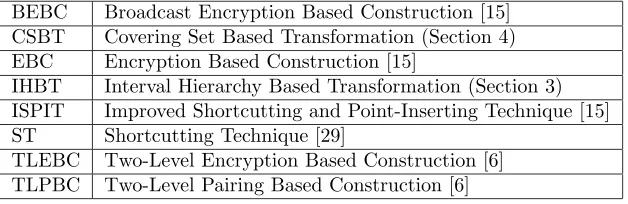
proposed by Ateniese et al. [6] both involve a transformation of the graphGresulting in a two-level partially ordered hierarchy. The first construction, which we refer to as the Two-Level Encryption Based Construction (TLEBC) makes use of a symmetric encryption scheme secure against a non-adaptive chosen plaintext attack, denoted byIND-P1-C0in [20]. The TLEBC requiresO(|E∗|·|T|3) values to be made public, whereas, each user belonging to a certain class for a time sequence has to store a single secret value. Moreover, users are required to perform a single decryption operation in order to derive a key (no other operations are involved in key derivation). The parameters of the TLEBC are summarized in row 1 of Figure 9. The second solution, which we refer to as the Two-Level Pairing Based Construction (TLPBC), makes use of pairings and assumes the intractability of theBilinear Decisional Diffie-Hellman(BDDH) problem [6]. The TLPBC offers a smaller amount of public information compared to the TLEBC, sinceO(|E∗|) values are made public, but requires
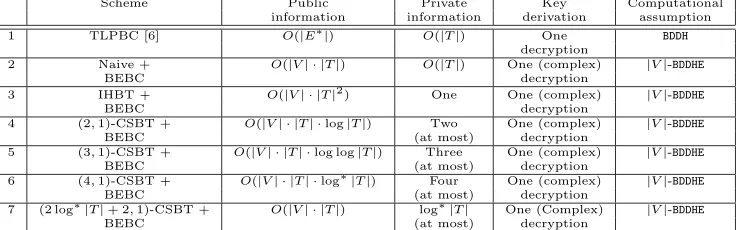
each user to hold at most|T|private values. However, key derivation requires one group operation. Both the TLEBC and the TLPBC are provably secure with respect to key indistinguishability and support dynamic changes to the hierarchy, without requiring the re-distribution of any private information. The parameters of the TLPBC are summarized in row 1 of Figure 10.
The schemes proposed by Wang and Laih [37] and Tzeng [31] both require|V|·|T|public values, whereas, each user has to store a single secret value and key derivation involves one modular exponentiation and O(|V| · |T|) operations. However, since the authors did not formalize the definition of security and the adversarial model, it is not clear under which assumption their schemes can be considered to be provably secure.
3
A General Construction
In this section we consider the problem of constructing a provably secure time-bound hierarchical key assignment scheme for a family of graphs Γ, using as a building block any provably secure hierarchical key assignment scheme Σ, without temporal constraints, for Γ.
The naive solution to construct a time-bound hierarchical key assignment scheme for Γ involves replicating Σ once for each time period. LetG= (V, E) be a graph in Γ, letpubti and su,ti denote the public information and the private information held by users in class u ∈ V, respectively, in the i-th replicate of Σ. The public information of the time-bound scheme obtained by the naive solution is pub = (pub1, . . . , pubn), whereas, the private information held by users belonging to a
class u ∈ V for a time sequence λ = (ti, . . . , tj) ∈ P is su,λ = (su,ti, . . . , su,tj). The drawback of such a solution is that it requires a large amount of public and private information.
In order to obtain schemes offering better performances, we should avoid a simple replication of Σ. For example, we could use Σ just once, to assign keys and private information to the classes of a new hierarchy, obtained by merging the hierarchical and temporal constraints in such a way that the users belonging to the same class share the same access rights (this does not happen in time-bound hierarchical key assignment schemes, since users in the same class may have different access rights, according to the time periods in which they are able to access the data). The new hierarchy could be obtained by performing a graph transformation, starting from the graphGand the interval-set
the interval-hierarchy overT, with respect to the binary relation of inclusion between contiguous subsequences. We denote byHT = (P, EP) theminimal representationof the directed acyclic graph representing such a hierarchy. It is easy to see that|EP|= 2(|P| − |T|) = Θ(|T|2), since any node in
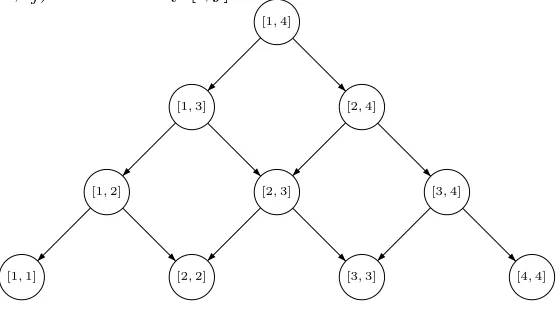
P, with the exception of sink nodes, has exactly two outgoing edges. Figure 1 shows the minimal representation of the interval-hierarchy over T = (t1, t2, t3, t4), where the node corresponding to
each sequence (ti, . . . , tj) is denoted by [i, j].
[1,4]
[1,3] [2,4]
[1,2] [2,3] [3,4]
[1,1] [2,2] [3,3] [4,4]
Figure 1: The minimal representation of the interval-hierarchy overT = (t1, t2, t3, t4).
Starting from the two graphs G = (V, E) and HT = (P, EP), we construct a new graph G0 = (V0, E0), by using theInterval-Hierarchy Based Transformation (IHBT), defined as follows:
• For each classu∈V and each time sequence λ∈ P, we place a class uλ∈V0.
• For each class u∈V and each pair of time sequences λ, γ ∈ P connected by an edge in EP, we place an edge between uλ and uγ in G0, i.e., (uλ, uγ) ∈ E0. Such edges are called time edges.
• For each pair of classes u and v connected by an edge in E and each time periodt∈T, we place an edge between ut and vt inG0, i.e., (ut, vt)∈E0. Such edges are calledpolicy edges.
It is easy to see that |V0| = |V| · |P| = O(|V| · |T|2). Moreover, |E0| = |V| · |EP|+|E| · |T| =
O(|V| · |T|2+|E| · |T|). Indeed, E0 contains |V| · |E
P|time edges and |E| · |T| policy edges. The
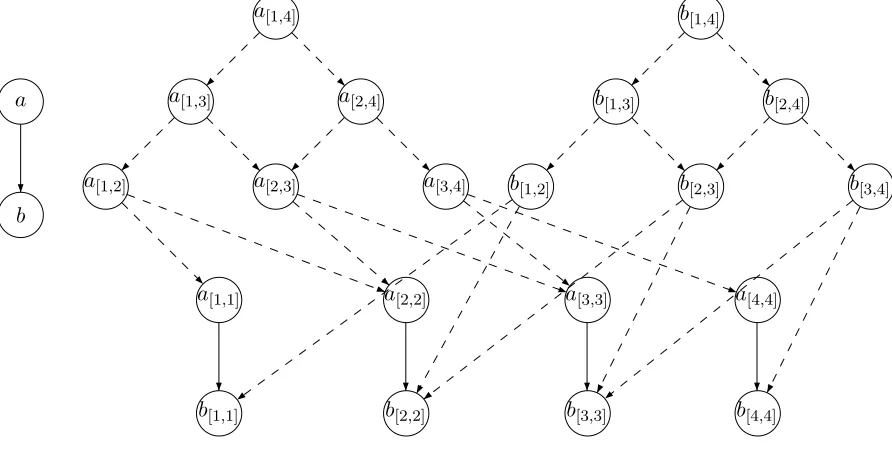
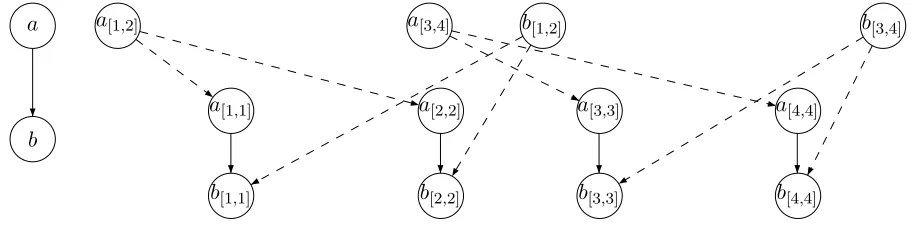
right hand side of Figure 2 shows the graph G0 obtained by the IHBT starting from the graph G
shown on the left hand side of Figure 2 and from the graph HT representing the interval-hierarchy overT shown in Figure 1. Time edges and policy edges are represented by dashed and solid lines, respectively.
Once the graph G0 = (V0, E0) has been obtained, we can use any hierarchical key assignment scheme without temporal constraints. In the following we recall two constructions recently proposed in [15] which will be used as building blocks of our constructions.
The Broadcast Encryption Based Construction (BEBC). A provably-secure hierarchical key assignment scheme can be obtained by using as a building block a secure public-key broadcast encryption scheme. In particular, if the underlying public-key broadcast encryption scheme is semantically secure, then the resulting hierarchical key assignment scheme is secure in the sense of
a
b
a[1,4]
a[1,3] a[2,4]
b[1,4]
b[1,3] b[2,4]
a[1,2] a[2,3] a[3,4] b[1,2] b[2,3] b[3,4]
a[1,1]
b[1,1]
a[2,2]
b[2,2]
a[3,3]
b[3,3]
a[4,4]
b[4,4]
Figure 2: An example of the graphG0 (on the right) corresponding to the graph G(on the left) and the graph HT depicted in Figure 1. Time edges and policy edges are represented by dashed and solid lines, respectively.
for a set ofnusers, assuming the intractability of then-Bilinear Decisional Diffie-Hellman Exponent
(n-BDDHE) problem. The use of such a broadcast encryption scheme, based on pairings, allows to obtain a hierarchical key assignment scheme where the public information consists of 4|V|+1 group elements, whereas, the private information has constant size. Moreover, key derivation requires a single (complex) decryption operation, which involves at most|V|−2 group operations. The BEBC supports dynamic changes to the hierarchy without requiring re-distribution of private information to the classes affected by such changes.
By using the BEBC based on pairings we obtain a time-bound hierarchical key assignment scheme where the number of data to be made public is 4|V0|+ 1 = O(|V| · |T|2), whereas, key
derivation requires a single (complex) decryption operation, involving at most |V0| −2 group
op-erations. Moreover, each user belonging to a certain class for a time sequence has to store a single secret value. The parameters of the scheme described above are summarized in row 3 of Figure 10.
The Encryption Based Construction (EBC). A different construction to obtain a provably-secure hierarchical key assignment scheme uses as a building block a provably-secure symmetric encryption scheme Π = (K,E,D). In particular, if the underlying encryption scheme is secure in the sense of IND-P1-C0, i.e., with respect to a non-adaptive chosen plaintext attack, then the resulting hierarchical key assignment scheme is secure in the sense ofIND-ST. The idea is the following: each class u ∈ V is assigned a private information su, an encryption key ku, and a public information
other hand, each class has to store a single secret value, corresponding to its private information. As for key derivation, in the EBC a class u ∈V which wants to compute the key held by a class
v∈Au is required to perform distG(u, v) + 1 decryptions, where distG(u, v) denotes the length of
the shortest path between u and v in G. The EBC as described above supports insertions, but not deletions, of classes and edges in the hierarchy without re-distributing private information to the classes affected by such changes. However, in [15] a simple modification of the scheme, which avoids the re-distribution of private information when deletions of classes or edges occur, has been proposed. The modified scheme requires |E|+ 2|V|public values, whereas, each class has to store a single secret value. Moreover, the number of decryptions needed by class u to compute the key of class v∈Au is distG(u, v) + 2.
A scheme also based on encryption schemes and offering similar features has been proposed by Atallah et al. [4]. Their scheme requires 2|E|+|V| public values, whereas, each class has to store a single secret value. In order to compute the key held by a class v ∈ Au, users in class u
have to perform distG(u, v) decryptions and distG(u, v) + 1 pseudorandom function evaluations.
However, the security of their scheme is based on two different computational assumptions (the existence of pseudorandom function families and of symmetric encryption schemes secure against chosen ciphertext attacks). Thus, compared to the scheme in [4], the EBC is simpler and more efficient.
In the following we evaluate the time-bound hierarchical key assignment scheme obtained by using as a building block the first version of the EBC, i.e., the one which does not support deletions of classes or edges in the hierarchy. By using such a scheme, we obtain a time-bound hierarchical key assignment scheme where the number of data to be made public is|V0|+|E0|=O(|E|·|T|+|V|·|T|2). However, the number of steps required to perform key derivation can be quite large. Indeed, consider a user assigned to a classv ∈V for a time sequenceλ. In order to compute the key held by class
u∈Av at time period t∈λ, the user is required to performdistG0(uλ, vt) + 1 decryptions, where distG0(uλ, vt) =distG(u, v) +distHT(λ, t). Therefore, the number of decryption operations required
to perform key derivation is upper bounded by the sum of the diameters of the two graphsHT and
G, where the diameter of a directed graph is defined as the maximum distance between a pair of vertices in the graph connected by a path. In Section 3.1 we consider the problem of improving the efficiency of key derivation by using some techniques, described in [15], which allow to reduce the diameter of a directed graph. In particular, we restrict our attention to the graph HT, because the diameter of the graph G, denoted in the following by diam(G), could have already been reduced by employing similar techniques.
3.1 A Tradeoff between Public Storage and Key Derivation Time
In this section we show how to use two techniques described in [15], which we refer to as the
Shortcutting Techniqueand theImproved Shortcutting and Point-Inserting Technique, respectively, in order to reduce key derivation time in the schemes obtained by the EBC. Such techniques, applied to a directed graph, allow to obtain a new graph, having a smaller diameter than the previous graph, such that there exists a path between two vertices in the previous graph if and only if there exists a path between them in the new one.
The Shortcutting Technique (ST). The Shortcutting Technique applied to a directed graph
and denoted by H+ = (V
H, EH+), having a smaller diameter than H. Thorup [29] showed that, given a rooted acyclic planar directed graphH = (VH, EH), by adding at most|EH|shortcut edges we obtain a shortcut graph having diameter O((log|VH|)·α(|VH|,|VH|)), by adding at most |EH|
shortcut edges, where α denotes the inverse of the Ackermann’s function defined by Tarjan [28]. The function α(p, p) is very slowly-growing; in particular, it grows even slower than the iterated logarithmic functionlog∗p, which, for all values ofpless than 265,536, corresponding to much more than the number of atoms in the universe, does not exceed 5. The iterated logarithm function log∗p
is defined to be the number of times the logarithm function must be applied in succession, starting with argumentp, before the result is less than or equal to 1, i.e., log∗p= min{i≥0 : log(i)p≤1}, where
log(i)p=
p ifi= 0,
log(log(i−1)p) ifi >0 and log(i−1)p >0,
undefined ifi >0 and log(i−1)p≤0 or log(i−1)p is undefined.
Since the graph HT = (P, EP), representing the interval-hierarchy over T, is a rooted acyclic planar graph, we can apply Thorup’s technique in order to obtain a shortcut graphH+
T = (P, E
+
P ),
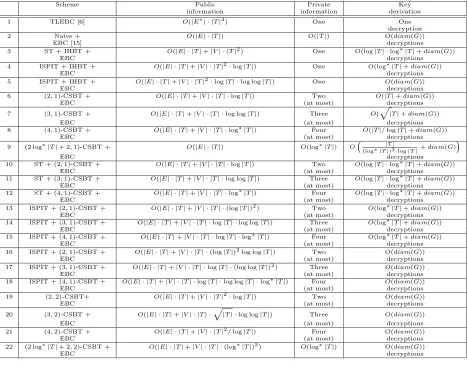
having diameter O(log|T| ·α(|T|2,|T|2)), by adding at most|EP|=O(|T|2) shortcut edges. Thus, by using the IHBT starting on the graphsG= (V, E) andHT+= (P, EP+) and by applying the EBC on the output of the IHBT, we obtain a time-bound hierarchical key assignment scheme where the amount of public information isO(|E|·|T|+|V|·|T|2), whereas, the number of decryption operations needed for key derivation isO(log|T|·log∗|T|+diam(G)). The parameters of the scheme described above are summarized in row 3 of Figure 9.
The Improved Shortcutting and Point Inserting Technique (ISPIT). The Improved Shortcutting and Point Inserting Technique applied to the directed graph H = (VH, EH), repre-senting a partially ordered hierarchy, consists into inserting additional edges inEH, as well as new vertices inVH, in order to obtain a graphH++having a smaller diameter thanH. Such a technique, described in [15], makes use of the concept of dimension of a poset. Let ¹ and ¦ be two binary relations that partially order the elements of a finite setX. The poset (X,¦) is called anextension
of (X,¹) if x ¹y implies x¦y, for any x, y∈ X. If (X,¦) is atotally ordered set, i.e., if for any
x, y ∈ X either x¦y or y¦x, then (X,¦) is also said to be a linear extension of (X,¹). The problem of counting the number of linear extensions of a poset has been shown to be #P-complete [10]. Thedimension of a poset (X,¹), originally defined by Dushnik and Miller [16], is the mini-mum number of linear extensions of (X,¹) whose intersection is (X,¹). It can also be seen as the smallest nonnegative integer dfor which each x∈X can be represented by a d-vector (x1, . . . , xd)
of integers such that x ¹y if and only if xi ≤yi, for any i= 1, . . . , d, and any x, y ∈ X. There
are efficient algorithms to test if a poset has dimension 1 or 2, but the problem of determining if a poset has dimension 3 is NP-complete [32]. A poset has dimension one if and only if it is a total order.
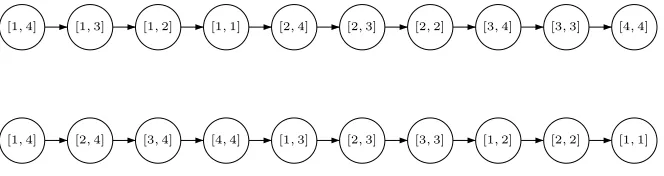
It is easy to see that, given the interval set P over a sequenceT of time periods, the interval-hierarchy represented by the graph HT = (P, EP) has dimension two. Indeed, the two linear extensions can be constructed as follows: given two sequencesλ, γ ∈ P, where λ= (ta, . . . , tb) and
γ = (tc, . . . , td), in the first linear extension λfollowsγ if eithera > cora=c andb≤d; whereas,
[1,4] [1,3] [1,2] [1,1] [2,4] [2,3] [2,2] [3,4] [3,3] [4,4]
[1,4] [2,4] [3,4] [4,4] [1,3] [2,3] [3,3] [1,2] [2,2] [1,1]
Figure 3: The two linear extensions of the hierarchy of time sequences in Figure 1.
Given a partially ordered hierarchy with dimensiondon a set ofpvertices, the ISPIT proposed in [15] allows to reduce the diameter of the graph representing it to log∗p, by addingO(p·d·(3 logp)d−1) new edges and vertices. Therefore, by using such a technique on the graphHT, which as said above has dimension two, we obtain a graphHT++ having diameterO(log∗|T|), by addingO(|T|2·log|T|) new edges and vertices. Thus, by using the IHBT starting on the graphs G and HT++ and by applying the EBC on the resulting graph, we obtain a time-bound hierarchical key assignment scheme where the amount of public information is O(|E| · |T|+|V| · |T|2 ·log|T|), whereas, the number of decryption operations needed for key derivation isO(log∗|T|+diam(G)). The parameters of the scheme described above are summarized in row 4 of Figure 9.
On the other hand, the ISPIT in [15] can be also used to reduce the diameter of the graph representing the partially ordered hierarchy to three, by adding O(p·d·(3 logp)d−1·log logp) new edges and vertices. Therefore, by using such a technique on the graphHT we obtain a graphH++
T having diameter three, by addingO(|T|2·log|T|·log log|T|) new edges and vertices. Thus, by using the IHBT starting on the graphs GandHT++ and by applying the EBC on the resulting graph, we obtain a time-bound hierarchical key assignment scheme where the amount of public information isO(|E| · |T|+|V| · |T|2·log|T| ·log log|T|), whereas, the number of decryption operations needed for key derivation isO(diam(G)). The parameters of the scheme described above are summarized in row 5 of Figure 9.
4
A Tradeoff among Key Derivation Time, Public, and Private
Storage
The techniques described in Section 3.1 allow us to obtain a tradeoff between the amount of public information and the complexity of key derivation. In this section we show how to obtain a further tradeoff, also involving the amount of secret information held by each user. Let `≥1 and assume we have a method to decompose the sequenceT of time periods into a set of subsequencesP`⊆ P,
called an`-covering set forT, in such a way that any contiguous subsequence ofT is the union of at most`elements ofP`. This would allows us to construct a time-bound hierarchical key assignment
scheme Σ0, on input a graphG and the interval-set P, using as a building block any time-bound hierarchical key assignment scheme Σ, on input G and P`. For each class u ∈ V, the private
information assigned by Σ0 tou for any time sequence λ∈ P` is the same as the one assigned by
Σ; whereas, the private information assigned to u for any time sequence γ ∈ P \ P` consists of a
h≤`sequences whose union gives the sequenceγ. Then, the private information assigned by Σ0 to
ufor time sequenceγ consists of the private information assigned by Σ toufor the time sequences
γ1, . . . , γh. As regards as the amount of public information required by the scheme Σ0, it depends
on the number of elements of the `-covering set P`. In the following we show that the larger the
cardinality of P`, the smaller the value of `, thus establishing a tradeoff between the size of the
private information held by each user, the amount of public information required by the scheme, and the complexity of key derivation.
Given a sequence T of n elements and an integer `≥ 1, Alon and Schieber [3] in 1987 estab-lished upper and lower bounds on the minimum possible cardinality of an `-covering set forT. In particular, they considered the problem in a quite different context, where the n elements of T
belong to a given semigroup (S,◦) and one is interested in answering queries of the form“what is the value of ti ◦ti+1 ◦ · · · ◦tj−1 ◦tj?” for any 1 ≤ i ≤ j ≤ n. Their construction is essentially
the same proposed by Yao [33] in 1982 and further analyzed by Bodlaender et al. [7] in 1994. Translating the results in [3] to our scenario, we can construct an`-covering setP`, for a sequence
T of n elements, as described in the following. We first show a construction which is optimal for constant `, i.e., resulting in an `-covering set with cardinalityCmin(`, n). Afterwards, we consider
the cases`=O(logn) and`=O(log∗n).
4.1 A Construction Optimal for Constant `
The following construction results in an`-covering set whose cardinality is denoted by C(`, n). We will see later that such a construction is the best possible when `is a constant.
• Case `= 1: Set P1 =P. Clearly, C(1, n) =O(n2).
• Case `= 2: The algorithm to constructP2 works as follows:
1. Fori= 1, . . . , n, insert the subsequence (ti) into P2;
2. Ifn≥3, then
(a) PartitionT in two consecutive sequencesT1 = (t1, . . . , tdn/2e) andT2= (tdn/2e+1, . . . , tn);
(b) Forj= 1, . . . ,dn/2e −1, insert the subsequence (tj, . . . , tdn/2e) intoP2;
(c) For h=dn/2e+ 2, . . . n, insert the subsequence (tdn/2e+1, . . . , th) into P2;
(d) Apply the construction recursively to the subsequencesT1 and T2.
The construction results in a setP2 whose cardinality is given by the recurrence
C(2, n) = (
n ifn≤2;
C(2,dn/2e) +C(2,bn/2c) +O(n) otherwise,
whose solution isC(2, n) =O(n·logn).
(t1), (t2), (t3), (t4),
(t5), (t6), (t7), (t8),
(t9), (t10), (t11), (t12),
(t13), (t14), (t15), (t16),
(t1, . . . , t8), (t2, . . . , t8), (t3, . . . , t8), (t4, . . . , t8),
(t5, . . . , t8), (t6, t7, t8), (t7, t8), (t9, t10),
(t9, t10, t11), (t9, . . . , t12), (t9, . . . , t13), (t9, . . . , t14),
(t9, . . . , t15), (t9, . . . , t16), (t1, . . . , t4), (t2, t3, t4),
(t3, t4) (t5, t6), (t5, t6, t7), (t1, t2),
(t10, t11, t12), (t11, t12), (t13, t14), (t13, t14, t15),
(t13, . . . , t16) (t15, t16).
• Case `≥3: Before describing the construction, we need to define two very rapidly growing functionsA(i, j) andB(i, j), related to the Ackermann’s function (see [28]):
A(0, j) = 2j, forj≥1, A(i,0) = 1, fori≥1,
A(i, j) = A(i−1, A(i, j−1)) fori, j≥1,
and
B(0, j) = j2, forj≥1, B(i,0) = 2, fori≥1,
B(i, j) = B(i−1, B(i, j−1)) for i, j≥1.
For i≥0, let w(2i, n) = min{j :A(i, j)≥n} and w(2i+ 1, n) = min{j :B(i, j) ≥n}. The first five values ofw(·, n) are the following:
w(0, n) =dn/2e, w(1, n) =d√ne, w(2, n) =dlogne, w(3, n) =dlogdlognee, w(4, n) = log∗n,
whereas, w(i, n) = min{j : w(j)(i−2, n) ≤ 1}, for i ≥ 2, where w(1)(i, n) = w(i, n) and
w(j)(i, n) =w(i, w(j−1)(i, n)),forj ≥2. The function w(·, n) satisfies the following property
(see [21]):
w(2i, n)≤w(2j, m), for any i≥j and anym≥n. (1)
The construction for`≥3 works as follows:
1. Fori= 1, . . . , n, insert the subsequence (ti) into P`;
2. Ifn≥`+ 1, then
(a) Let k = w(` −2, n) and partition T into f = dn/ke ≥ 2 consecutive subse-quences T1, . . . , Tf of k elements each, where the last subsequence can contain
less than k elements. For i = 1, . . . , f −1, let Ti = (t(i−1)k+1, . . . , tik) and let
(b) For anyi= 1, . . . , f−1,and anyt∈Ti, insert inP`the subsequences (t(i−1)k+1, . . . , t)
and (t, . . . , tik). For anyt∈Tf, insert inP` the subsequences (t(f−1)k+1, . . . , t) and
(t, . . . , tn);
(c) Apply the construction recursively to each subsequence T1, . . . , Tf.
(d) Apply the construction for`−2 to the sequence T0 whose elements are T1, . . . , Tf.
LetP`0−2 be the (`−2)-covering set constructed by the recursive call onT0. For each element (Ti, . . . , Tj)∈ P`0−2, insert (t(i−1)k+1, . . . , tjk), i.e., the sequence constituted
by the elements ofTi, . . . , Tj, inP`.
The above construction results in a set P` whose cardinality is given by the recurrence
C(`, n) = (
n ifn≤`;
dn/ke ·C(`, k) +C(`−2,dn/ke) +O(n) otherwise,
whose solution is C(`, n) = O(n·`·w(`, n)). For example, C(3, n) = O(n·log logn) and
C(4, n) =O(n·log∗n).
Example 4.2 Forn= 16and`= 4, by using the above construction, we obtain the covering setP4 for T = (t1, . . . , t16), whose elements are the following:
(t1), (t2), (t3), (t4),
(t5), (t6), (t7), (t8),
(t9), (t10), (t11), (t12),
(t13), (t14), (t15), (t16),
(t1, t2), (t1, t2, t3), (t1, . . . , t4), (t2, t3, t4),
(t3, t4), (t5, t6), (t5, t6, t7), (t5, . . . , t8),
(t6, t7, t8), (t7, t8), (t9, t10), (t9, t10, t11),
(t9, . . . , t12), (t10, t11, t12), (t11, t12), (t13, t14),
(t13, t14, t15), (t13, . . . , t16), (t14, t15, t16), (t15, t16),
(t1, . . . , t8), (t9, . . . , t16).
Notice that the first sixteen elements are inserted in step 1., whereas, the last two are inserted in step 2.(d). All other elements are inserted in step 2.(b) (including recursive calls in step 2.(c)).
For constant`≥2, the above construction is optimal. Indeed, Alon and Schieber [3] showed that the minimum possible cardinality of an`-covering set forT, denoted byCmin(`, n), is Ω(n·w(`, n)).
Moreover, they showed that, in order to obtain an `-covering set for T containing O(n) elements, the value of`is Ω(log∗n).
4.2 An Optimal Construction for ` =O(log∗n)
A Tree Construction for ` = 2dlogne. Construct a balanced binary tree whose leaves corre-spond to the nelements ofT and such that each internal node corresponds to the sequence whose elements are associated to the leaves in the subtree rooted at that node. An `-covering set P` for
T can be obtained by considering the sequences corresponding to the nodes of the tree. Indeed, any contiguous subsequence ofT can be obtained as the union of at most 2dlogne elements of P`.
Since the number of nodes in the tree is 2n−1, it follows that the cardinality of P` isO(n).
A Construction for `= 2 log∗n+ 2. The tree construction, as well as the one of Section 4.1, can be used to construct an`-covering set forT, where`= 2 log∗n+ 2, containingO(n) elements. The new construction works as follows:
1. Let h= 2(log∗n)2 and partition T into f =dn/he consecutive subsequences T
1, . . . , Tf of h
elements each, where the last sequence can contain less elements;
2. For any i= 1, . . . , f and any sequenceTi, apply the tree construction for`0 = 2dlogheto the
sequence Ti. For anyi= 1, . . . , f, insert into P` all the elements of the resulting `0-covering
set forTi;
3. Apply the construction of Section 4.1 for `−2 = 2 log∗nto the sequence T0 whose elements
are T1, . . . , Tf. Let P`0−2 be the (`−2)-covering set constructed by the recursive call on T0.
For each element (Ti, . . . , Tj)∈ P`0−2, insert (t(i−1)h+1, . . . , tjh), i.e., the sequence constituted
by the elements ofTi, . . . , Tj, in P`.
The above construction results in a setP` containingO(n) elements. Indeed, step 2. inserts 2h−1
elements inP` for each sequenceTi, for a total of dn/he ·(2h−1) elements, whereas, step 3. inserts
C(2 log∗n,dn/he) =O(dn/he ·2 log∗n·w(2 log∗n,dn/he)) elements. Therefore
|P`|=dn/he ·(2h−1) +O(dn/he ·2 log∗n·w(2 log∗n,dn/he)).
Since from inequality (1) it holds that w(2 log∗n,dn/he) ≤ w(2 log∗n, n) and w(2 log∗n, n) ≤
w(4, n) = log∗nfor any n≥4, and sinceh= 2(log∗n)2, it follows that|P`|=O(n).
The above construction is optimal. Indeed, any `-covering set for T has to contain at least the
nelements of T.
4.3 A Graph Transformation using an `-Covering Set
In this section we show how to use an`-covering set in order to construct a time-bound hierarchical key assignment scheme. We first need to represent the `-covering set as a directed acyclic graph. We consider the following two representations:
• The minimal edge representationHT,`(1)= (P`, EP(1)
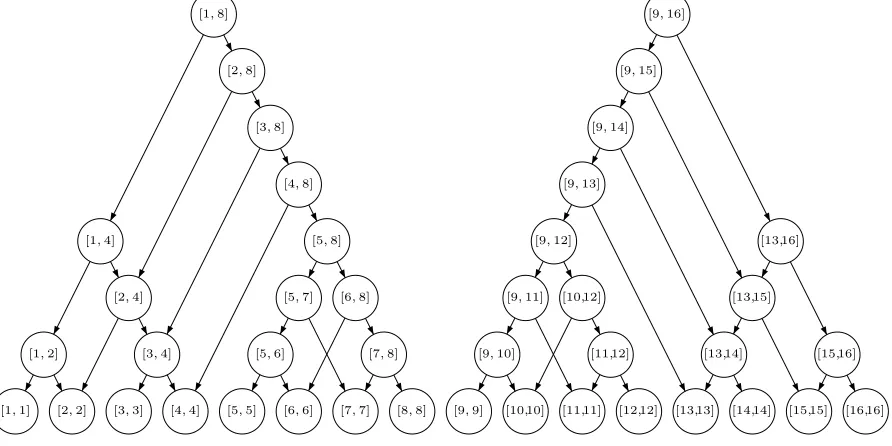
` ) is the minimal representation of the sub-graph of HT∗ = (P, EP∗) induced by P`. Figures 4 and 5 show the graphs HT,(1)2 and HT,(1)4
representing the 2-covering set P2 and the 4-covering set P4, respectively, where the node
corresponding to each sequence (ti, . . . , tj) is denoted by [i, j].
• The minimal diameter representation H(2)
T,` = (P`, E
(2)
P` ) is defined as follows: for any λ∈ P`
containing at least two elements and any t ∈ λ, there is an edge between λ and (t) in
HT,`(2). Figure 6 shows the graph HT,(2)4 representing the 4-covering set P4, where the node
[1,1] [2,2] [3,3] [4,4] [5,5] [6,6] [7,7] [8,8] [9,9] [10,10] [11,11] [12,12] [13,13] [14,14] [15,15] [16,16] [4,8]
[3,8] [2,8]
[1,4]
[3,4] [1,2]
[2,4]
[5,6] [5,7]
[5,8]
[7,8] [6,8]
[9,10] [9,11]
[9,12]
[11,12] [10,12] [9,13]
[9,14] [9,15]
[13,14] [15,16] [13,15]
[13,16]
[1,8] [9,16]
Figure 4: The graphH(1)
T ,2 representing the 2-covering setP2 forT = (t1, . . . , t16).
In order to obtain a time-bound hierarchical key assignment scheme, we define a graph transfor-mation, called the (`, j)-Covering Set Based Transformation (CSBT), making use of an`-covering set for T. Such a transformation, on input the graphs G = (V, E) and HT,`(j) = (P`, EP(j)
` ), where
j∈ {1,2}, constructs a new graphG00= (V00, E00), as follows:
• For each classu∈V and each time sequence λ∈ P`, we place a class uλ ∈V00.
• For each class u ∈ V and each pair of time sequences λ, γ ∈ P` connected by an edge in
EP(j)
` , we place and edge between uλ and uγ inG
00, i.e., (u
λ, uγ)∈E00. Such edges are called decomposition time edges.
• For each pair of classes u and v connected by an edge in E and each time periodt∈T, we
[1,1] [2,2] [3,3] [4,4] [5,5] [6,6] [7,7] [8,8] [9,9] [10,10] [11,11] [12,12] [13,13] [14,14] [15,15] [16,16] [1,2]
[1,3] [1,4]
[3,4] [2,4]
[5,6] [5,7]
[5,8]
[7,8] [6,8]
[9,10] [9,11]
[9,12]
[11,12] [10,12]
[13,14] [13,15]
[13,16]
[15,16] [14,16]
[1,8] [9,16]
Figure 5: The graphH(1)
[1,8]
[1,1] [2,2] [3,3] [4,4] [5,5] [6,6] [7,7] [8,8] [9,9] [10,10] [11,11] [12,12] [13,13] [14,14] [15,15] [16,16] [1,4]
[1,3]
[1,2] [2,4] [3,4] [5,6] [5,7] [5,8] [6,8] [7,8] [9,10] [9,11] [9,12] [10,12] [11,12] [9,16] [13,14] [13,15] [13,16] [15,16] [14,16]
Figure 6: The graphH(2)
T ,4 representing the 4-covering setP4 forT = (t1, . . . , t16).
place an edge between ut and vtin G00, i.e., (ut, vt)∈E00. Such edges are calledpolicy edges.
The right hand side of Figure 7 shows the graph G00 obtained by the (2,1)-CSBT starting from the graph G shown on the left hand side of Figure 7 and from the graph H(1)
T,2 representing the
2-covering set P2 = {(t1),(t2),(t3),(t4),(t1, t2),(t3, t4)} for T = (t1, . . . , t4). Decomposition time
edges and policy edges are represented by dashed and solid lines, respectively.
a
b
a[1,2] a[3,4] b[1,2] b[3,4]
a[1,1]
b[1,1]
a[2,2]
b[2,2]
a[3,3]
b[3,3]
a[4,4]
b[4,4]
Figure 7: The graphG00(on the right) corresponding to the graph G(on the left) and the graph H(1) T ,2. It is easy to see that |V00|= |V| · |P`| and |E00| =|V| · |EP(j`)|+|E| · |T|. Indeed, E
00 contains
|V| · |E(j)
P` |decomposition time edges and |E| · |T|policy edges.
Once the graph G00= (V00, E00) has been obtained, we can use any hierarchical key assignment
scheme. For example, the BEBC based on pairings requires 4|V00|+ 1 =O(|V| · |P`|) public values,
whereas, each user is required to hold at most `secret values. In particular, the amount of public information is
• O(|V| · |T| ·log|T|) if `= 2;
• O(|V| · |T| ·log log|T|) if`= 3;
• O(|V| · |T| ·log∗|T|) if `= 4;
The parameters of the above schemes are summarized in rows 4, 5, 6, and 7 of Figure 10. Notice that since for all values of |T|less than 265,536, corresponding to much more than the number of atoms in the universe, log∗|T| does not exceed 5, the number of private information held by each user when`= 2 log∗|T|+ 2 may be considered to be a constant.
On the other hand, the EBC requires |V00|+|E00| = O(|E| · |T|+|V| · |EP(j)
` |) public values, whereas, each user holds at most ` secret values. Moreover, the number of decryption operations needed to perform key derivation isO(diam(HT,`(j)) +diam(G)). Therefore, in order to evaluate the resulting scheme, we need to compute the number of edges and the diameter of both graphsH(1)
T,` and HT,`(2).
The Minimal Edge Representation. In the following we evaluate the schemes obtained by the EBC when the minimal edge representation of the `-covering set is considered. We first show that the minimal edge representation of an `-covering set for T satisfies an interesting property, called theGraph Composition Property, then we compute both the number of edges and the diameter of such a graph.
Graph Composition Property: For any`≥3, the minimal edge representation of the`-covering set for T, obtained by the constructions in Section 4.1 and 4.2, can be seen as the composition of two graphs, called the bottom and the top graph, respectively.
Indeed, consider the construction of Section 4.1 and let T1, . . . Tdn/ke be the subsequences of
T obtained in step 2.(a) of the algorithm. The nodes of the bottom graph are the successors of the nodes corresponding to the sequences T1, . . . Tdn/ke, whereas, those in the top graph are the
predecessor of such nodes. In particular, the nodes of the bottom graph correspond to sequences inserted in P` in step 2.(b), including recursive calls in step 2.(c), whereas, the nodes of the top
graph are those corresponding to the sequences inserted in step 2.(d).
As regards as the construction of Section 4.2 for ` = 2 log∗n+ 2, let T1, . . . Tdn/he be the
subsequences of T obtained in step 1. of the algorithm. The nodes of the bottom graph are the successors of the nodes corresponding to the sequences T1, . . . Tdn/he, whereas, those in the top
graph are the predecessors of such nodes. In particular, the nodes of the bottom graph correspond to sequences inserted inP` in step 2., whereas, the nodes of the top graph are those corresponding
to the sequences inserted in step 3.
Now we are ready to compute the number of edges of the minimal edge representation of the
`-covering set obtained by the construction of Section 4.1.
Lemma 4.3 Let `≥1and let P` be the `-covering set for a sequenceT of nelements obtained by the construction in Section 4.1. The number of edges in the minimal edge representation of P` is
2(|P`| − |T|).
Proof. We prove that each node inP`, with the exception of sink nodes, has exactly two outgoing
edges in HT,`(1). The proof is by induction on `. Clearly, the lemma holds for ` = 1, since P1 =P
and |E(1)
P1 |=|EP|= 2(|P| − |T|).
Let ` = 2 and let (ti, . . . , tj) be a sequence inserted in P2 in step 2.(b) of the algorithm.
Notice that also (ti+1, . . . , tj) has been inserted in P2 in step 2.(b). Let hmax = max{i ≤ h <
j : (ti, . . . , th) ∈ P2}. Hence, in the minimal edge representation of P2, the node (ti, . . . , tj) is
of (ti, . . . , tj) inserted inP2 are subsequences of either (ti, . . . , thmax) or (ti+1, . . . , tj), thus the node (ti, . . . , tj) has only two outgoing edges in the minimal edge representation ofP2. Similarly, we can
show that each node corresponding to a sequence inserted inP2 in step 2.(c) of the algorithm has
exactly two outgoing edges.
Assume by inductive hypothesis that for any 1 ≤`0 < `, each node in P`0, with the exception
of sink nodes, has exactly two outgoing edges in the minimal edge representation ofP`0.
By the Graph Composition Property, the minimal edge representation of the`-covering set P`
can be seen as the composition of the bottom graph and the top graph. Since the top graph corresponds to the minimal edge representation of the (`−2)-covering set constructed in step 2.(d) of the algorithm, by the inductive hypothesis it follows that the nodes in the top graph have exactly two outgoing edges. Thus, we only have to consider the nodes in the bottom graph, corresponding to sequences inserted inP` in step 2.(b). Let (ti, . . . , tj) be a sequence inserted in P` in step 2.(b)
of the algorithm. It is easy to see that at least one sequence between (ti, . . . , tj−1) and (ti+1, . . . , tj)
has been inserted in P`. W.l.o.g., assume that (ti+1, . . . , tj) has been inserted in P`. Let hmax =
max{i ≤ h < j : (ti, . . . , th) ∈ P2}. Hence, in the minimal edge representation of P`, the node
(ti, . . . , tj) is connected both to (ti, . . . , thmax) and to (ti+1, . . . , tj). It is easy to see that all other subsequences of (ti, . . . , tj) inserted inP` are subsequences of either (ti, . . . , thmax) or (ti+1, . . . , tj), thus the node (ti, . . . , tj) has only two outgoing edges in the minimal edge representation ofP`.
In the following we compute the diameter of the minimal edge representation of the`-covering set P` obtained by the construction in Section 4.1.
Lemma 4.4 Let `≥1and let P` be the `-covering set for a sequenceT of nelements obtained by the construction in Section 4.1. Ifn≥`+1, the diameterD(`, n)of the minimal edge representation of P` satisfies
D(`, n) =
n−1 if `= 1;
dn/2e −1 if `= 2;
k−1 +D(`−2,dn/ke) if `≥3,
where k=w(`−2, n), whereas, D(`, n) = 0 ifn≤`.
Proof. The case ` = 1 is trivial. For the case ` = 2, notice that the largest sequence in P2
is (t1, . . . , tdn/2e), which has been inserted in step 2.(b) of the algorithm. Since, for any j =
2, . . . ,dn/2e −1, the sequence (tj, . . . , tdn/2e) has also been inserted in P2 in step 2.(b), there is an
edge connecting the nodes (tj−1, . . . , tdn/2e) and (tj, . . . , tdn/2e) in the minimal edge representation
of P2. Similarly, since the sequence (tdn/2e) has been inserted in P2 in step 1., there is an edge
connecting (tdn/2e−1, tdn/2e) and (tdn/2e). By the above discussion it follows that there is a path of length dn/2e −1 between (t1, . . . , tdn/2e) and (tdn/2e), thus the diameter of the minimal edge
representation ofP2 isdn/2e −1.
For the case `≥3, recall that by theGraph Composition Property, the minimal edge represen-tation ofP` can be seen as the composition of the bottom graph and the top graph. Therefore, the
diameterD(`, n) of the minimal edge representation of P` is the sum of the diameters of such two
graphs. Since the top graph corresponds to the minimal edge representation of the (`−2)-covering set for a sequence of dn/ke elements, constructed in step 2.(d) of the algorithm, its diameter is
correspond to the sequences inserted in P` in step 2.(b) of the algorithm. To this aim, notice that
the largest sequence inserted in P` in step 2.(b) contains k =w(`−2, n) elements. Without loss
of generality, let (t1, . . . , tk) be one of the largest sequences. Since, for any j = 2, . . . , k−1, the
sequence (tj, . . . , tk) has also been inserted in P` in step 2.(b), there is an edge connecting the
nodes (tj−1, . . . , tk) and (tj, . . . , tk) in the minimal edge representation of P`. Similarly, since the
sequence (tk) has been inserted in P` in step 1., there is an edge connecting (tk−1, tk) and (tk). By
the above discussion it follows that there is a path of length k−1 between (t1, . . . , tk) and (tk),
therefore, the diameter of the bottom graph is k−1. Thus, the lemma follows.
By the above lemma it follows that
D(3, n) = 2d√ne −2,
D(4, n) =dlogne+dn/d2 lognee −2,
and
D(6, n) = log∗n+dlogdn/log∗nee+ &
n
2 log∗n· dlogdlogn∗nee
'
−3.
By Lemmas 4.3 and 4.4 it follows that the schemes obtained by the EBC on the graphG00= (V00, E00)
resulting from the (`,1)-CSBT have the following parameters:
• If`= 2, then the amount of public information isO(|E| · |T|+|V| · |T|log|T|), whereas, key derivation requiresO(|T|+diam(G)) decryptions;
• If`= 3, then the amount of public information isO(|E| · |T|+|V| · |T| ·log log|T|), whereas, key derivation requires O(p
|T|+diam(G)) decryptions;
• If `= 4, then the amount of public information is O(|E| · |T|+|V| · |T| ·log∗|T|), whereas, key derivation requires O(|T|/log|T|+diam(G)) decryptions.
The parameters of the above schemes are summarized in rows 6, 7, and 8 of Figure 9.
In order to evaluate the schemes obtained by the EBC on the graph G00 resulting from the (`,1)-CSBT when `= 2 log∗|T|+ 2, we need to consider the construction of Section 4.2.
Lemma 4.5 Let T be a sequence of n elements, let `= 2 log∗n+ 2 and let P` be the `-covering set for T obtained by the construction in Section 4.2. The number of edges in the minimal edge representation of P` is 2(|P`| − |T|).
Proof. We prove that each node inP`, with the exception of sink nodes, has exactly two outgoing
edges in HT,`(1).
Let (ti, . . . , tj) be a sequence inserted inP` in step 2. of the algorithm. Thus, it corresponds to
either an internal node or a leaf of a balanced binary tree. In the first case, the node has exactly two outgoing edges in HT,`(1), whereas, in the second case, it corresponds to a sink node.
Let (ti, . . . , tj) be a sequence inserted inP`in step 3. of the algorithm. By Lemma 4.3 it follows
Lemma 4.6 Let T be a sequence ofnelements, let`= 2 log∗n+ 2 and let P` be the `-covering set forT obtained by the construction in Section 4.2. The diameter of the minimal edge representation of P` is
diam(HT,`(1)) =O
µ n
(log∗n)3·logn
¶
.
Proof. Recall that by theGraph Composition Property, the minimal edge representation ofP`can
be seen as the composition of the bottom graph and the top graph. Therefore, the diameter of the minimal edge representation ofP`is the sum of the diameters of such two graphs. Since the bottom
graph is the binary tree obtained by the tree construction for `0 = 2dloghe, where h = 2(log∗n)2, its diameter is dloghe =O(log∗n). On the other hand, the diameter of the bottom graph, which corresponds to the minimal representation of the (2 log∗n)-covering set for the sequence of dn/he
elements constructed in step 3. of the algorithm, is D¡
2 log∗n,§n
h
¨¢
. By iterative applications of Lemma 4.4 and from inequality (1), it follows that
D
µ
2 log∗n,
»n
h
¼¶
≤
log∗n−1
X
i=3
w(2i,dn/he) +D(6,dn/he).
The last term can be bounded as follows
D(6,dn/he) ≤ log∗dn/he+dlogdn/(h·log∗dn/he)ee+ &
n
2h·log∗dn/he · dlogdh·log∗ndn/heee
'
≤ log∗n+dlogne+
» n
2(log∗n)3· dlogne
¼
.
Since w(2i,dn/he)≤w(2i, n) andw(2i, n)≤log∗n, for any i≥2, it follows that
D
µ
2 log∗n,
»n
h
¼¶
≤(log∗n)2+ log∗n+dlogne+
» n
2(log∗n)3· dlogne
¼
.
Therefore, the diameter of the minimal edge representation ofP` is O
³
n
(log∗n)3·logn
´ .
By Lemmas 4.5 and 4.6 it follows that the amount of public information in the scheme obtained by the EBC on the graph G00 = (V00, E00), resulting from the (`,1)-CSBT when `= 2 log∗|T|+ 2, is O(|E| · |T|), whereas, key derivation requires O³(log∗|T|T|)3|·log|T|+diam(G)
´
decryptions. The parameters of the above scheme are summarized in row 9 of Figure 9.
Shortcutting the Minimal Edge Representation. The number of decryption operations required for key derivation in the above schemes could be reduced by using the techniques of Section 3.2.1. on the minimal edge representation of the `-covering set for T. First, notice that such a graph is a rooted acyclic planar graph. Thus, by applying Thorup’s shortcutting technique we obtain a shortcut graph having diameterO(log|T|·log∗|T|), by adding at mostO(|T|·w(`,|T|)) shortcut edges. The parameters of the resulting schemes are summarized in rows 10, 11, and 12 of Figure 9. On the other hand, by using the ISPIT on the minimal edge representation of
P`, which has dimension two, we obtain either a graph having diameter O(log∗|T|), by adding
The Minimal Diameter Representation. In the following we compute the number of edges
F(`, n) in the minimal diameter representation of the`-covering set for a sequenceT ofnelements obtained by the construction in Section 3.3.1. for ` ≥1. Notice that for each node in P`
corre-sponding to a sequence λ, with the exception of sink nodes, there are |λ| edges in the minimal diameter representation of P`, thusF(`, n) =Pλ∈P`|λ|.
First, consider the case ` = 1. It is easy to see thatF(1, n) = Pn
i=1i=O(n2). As regards as
the case`= 2 andn≥3, since there are 2(dn/2e −1) sequences inserted in P2 in steps 2.(b) and
2.(c), each having length at mostdn/2e, it follows that the sum of the lengths of such sequences is
n·(dn/2e −1) =O(n2). Therefore,
F(2, n)≤2·F(2,dn/2e) +O(n2),
whereas,F(2, n) = 0 if n≤2. It is easy to see that F(2, n) =O(n2·logn).
Now, consider the case`≥3 andn≥`+ 1. Since there are 2(k−1)·dn/kesequences inserted in
P` in step 2.(b), each having length at mostk=w(`−2, n), it follows that the sum of the lengths
of such sequences is 2(k−1)· dn/ke ·k=O(n·k). Therefore,
F(`, n)≤ dn/ke ·F(`, k) +F(`−2,dn/ke) +O(n·k),
whereas,F(`, n) = 0 if n≤`. It is easy to computeF(`, n) for `= 3,4,5. Indeed we have that
• F(3, n)≤ d√ne ·F(3,d√ne) +F(1,d√ne) +O(n·√n), whose solution isF(3, n) =O(n·√n·
log logn);
• F(4, n) ≤ dn/dlognee · F(4,dlogne) + F(2,dn/dlognee) + O(n·logn), whose solution is
F(4, n) =O(n2/logn);
• F(5, n)≤n/dlogdlognee ·F(5,dlogdlognee) +F(3, n/dlogdlognee) +O(ndlogdlognee), whose solution isF(5, n) =O(n·√n/√log logn).
For the general case, where`≥6, we can easily prove that
F(`, n) =O(n·`·w(`, n)·log∗n).
As regards as the diameter of HT,`(2), clearly,diam(HT,`(2)) = 1.
Therefore, it follows that in the schemes obtained by the EBC on the graph G00 = (V00, E00) resulting from the (`,2)-CSBT the amount of public information is
• O(|E| · |T|+|V| · |T|2log|T|) if`= 2;
• O(|E| · |T|+|V| · |T| ·p
|T| ·log log|T|) if `= 3;
• O(|E| · |T|+|V| · |T|2/log|T|) if `= 4.
On the other hand, all the above schemes requireO(diam(G)) decryptions for key derivation. The parameters of the above schemes are summarized in rows 19, 20, and 21 of Figure 9.
In order to evaluate the schemes obtained by the EBC on the graphG00resulting from the (`,