Tree-based Group Key Agreement
?Yongdae Kim1, Adrian Perrig2, and Gene Tsudik1
1
Department of Information and Computer Science, University of California at Irvine, CA, USA
{kyongdae, gts}@ics.uci.edu
2
Computer Science Department University of California, Berkeley
Abstract. Secure and reliable group communication is an active area of research. Its popularity is caused by the growing importance of group-oriented and collaborative applications. The central research challenge is secure and efficient group key management. While centralized methods are often appropriate for key distribution in large multicast-style groups, many collaborative group settings require distributed key agreement techniques. This work investigates a novel group key agreement approach which blends so-called key trees with Diffie-Hellman key ex-change. It yields a secure protocol suite (TGDH) that is both simple and fault-tolerant. Moreover, the efficiency of TGDH appreciably surpasses that of prior art.
1
Introduction
Fault-tolerant, scalable, and reliable communication services have become critical in modern computing. An important and popular trend is to convert traditional centralized services (e.g., file sharing, authentication, web, and mail) into distributed services spread across multiple systems and networks. Many of these newly distributed and other inherently collaborative applications (e.g., conferencing, white-boards, shared instruments, and command-and-control systems) need secure communication. However, experience shows that security mechanisms for collaborative and dynamic peer groups tend to be both expensive and unexpectedly complex. In that regard, dynamic peer groups are very different from non-collaborative, centrally managed, one-to-many (or few-to-many) broadcast groups such as those encountered in Internet multicast.
Dynamic Peer Groups (DPGs) are common in many layers of the network protocol stack and many application areas of modern computing. Examples of DPGs include replicated servers (such as database, web, time), audio and video conferencing and, more generally, applications supporting collaborative work. In contrast to large multicast groups, DPGs tend to be relatively small in size, on the order of hundred members. Larger groups are harder to control on a peer basis and are often organized in a hierarchy. DPGs typically assume a many-to-many (or, equivalently, any-to-any) communication pattern rather than one-to-many pattern common of larger hierarchical groups.
Despite their relatively small number, group members in a DPG may be spread throughout the Internet and must be able to deal with arbitrary partitions due to network failures, congestion, and hostile attacks. In essence, a group can be split into a number of disconnected partitions each of which must persist and function as an independent peer group.
Security requirements in collaborative DPGs present several interesting research challenges. In this paper, we focus on secure and efficient group key management. The goal of group key management is to set up and maintain a shared secret key among the group members. It serves as a cornerstone for other DPG security services.
1.1 Group Key Management
There are several fundamentally different approaches to group key management in peer groups.
One approach relies on a single entity (called a key server) to generate keys and distribute them to the group. We refer to it as centralized group key distribution. Essentially, a key server maintains long-term shared keys with each group member in order to enable secure two-party communication for the actual key distribution. One form of this solution uses a fixed trusted third party (TTP) as the key server. This approach has two problems: 1) TTP must be
?
constantly available, and 2) TTP must exist in every possible subset of a group in order to support continued operation in the event of network partitions. The first problem can be addressed with fault-tolerance and replication techniques. The second is impossible to solve in a scalable and efficient manner. We note, however, that the centralized approach works well in one-to-many multicast scenarios since a TTP (or a set thereof) placed at, or very near, the source of communication can support continued operation within an arbitrary partition as long as it includes the source. Typically, one-to-many settings only aim to offer continued operation within a single partition that includes the source. Whereas, many-to-many environments must offer continued operation in an arbitrary number of partitions.
Another approach – called decentralized group key distribution – involves dynamically selecting a group mem-ber to generate and distribute keys to other group memmem-bers. This approach is more robust and, thus, more applicable to many-to-many groups since any partition can continue operation by electing a key server. The drawback is that, as in the TTP case, a key server must establish long-term pairwise secure channels with all current group members in order to distribute group keys. Consequently, each time a new key server comes into play, significant costs must be incurred to set up these channels. Another disadvantage, again as in the TTP case, is the reliance on a single entity to generate good (i.e., cryptographically strong, random) keys.
In contrast to the above approaches, contributory group key management requires each group member to contribute an equal share to the common group key (which is then computed as a function of all members’ contributions). This avoids the problems with the centralized trust and the single point of failure. Moreover, some contributory methods do not require the establishment of pairwise secret channels among group members. One significant problem with, current contributory group key agreement 1 protocols is that they are not designed to tolerate failures and group membership changes during execution. In particular, nested (cascaded) failures, partitions and other group events are not accommodated. This is not surprising since most multi-round cryptographic protocols do not offer built-in robustness with the notable exception of protocols for fair exchange [6].
1.2 Overview
In this paper, we focus on contributory group key agreement. In doing so, we unify two important trends in group key management: 1) key trees to efficiently compute and update group keys and 2) Diffie-Hellman key exchange to achieve provably secure and fully distributed protocols. Our main result is a simple, secure, robust and efficient key management solution, called TGDH (Tree-based Group Diffie-Hellman).
Organization: The rest of this paper is organized as follows. Section 2 presents our assumptions and requirements for the reliable group communication system. Section 3 introduces cryptographic requirements of our group key agree-ment protocol and Section 4 introduces notation and terminology. The actual protocols are described in Section 5 followed by practical aspects of the protocol in Section 6. Section 7 analyzes both conceptual and experimental pro-tocol complexity. The summary of related work appears in Section 8. Finally, security argument of the proposed protocols are provided in Appendix A.
2
Group Communication and Group Key Agreement
As noted in the introduction, many modern collaborative and distributed applications require a reliable group com-munication platform. The latter, in turn, needs specialized security mechanisms to perform – among other things – group key management. This dependency is mutual since practical group key agreement protocols themselves rely on the underlying group communication semantics for protocol message transport and strong membership semantics. Implementing multi-party and multi-round cryptographic protocols without such support is foolhardy as, in the end, one winds up reinventing reliable group communication tools.
In this section we begin with a brief discussion of reliable group communication. Next, we summarize the rela-tionship between group membership events and group key management protocols and conclude with the summary of desired cryptographic properties.
1
2.1 Group Communication Semantics and Support
There are two commonly used strong group communication semantics: Extended Virtual Synchrony (EVS) [23, 2] and View Synchrony (VS) [17]. Both guarantee that: 1) group members see the same set of messages between two sequen-tial group membership events, and, 2) sender’s requested message order (e.g., FIFO, Causal, or Total) is preserved. VS provides a stricter service whereas EVS implementations are generally more efficient.
The main difference between EVS and VS is that EVS guarantees that messages are delivered to all receivers in the same membership as existed when the message was originally sent on the network. VS, in contrast, offers a stricter guarantee that messages are delivered to all recipients in the same membership as viewed by the sender application when it originally sent the message.
Providing the latter property requires an extra round of acknowledgment messages from all members before in-stalling a new membership view. This need for acknowledgments dictates that the groups be closed, only allowing members of the group to send messages to it. However, the knowledge that a message is received in the membership the sender believed it was sent makes implementing secure group communication easier because every message is encrypted with the same key as the receiver believes is current when the message is delivered to them.
An implementation of any distributed fault-tolerant group key agreement protocol requires VS. This is because implementing group key agreement on top of EVS would require the key agreement protocol to incorporate and implement semantics identical to those of VS in order to correctly keep state of which messages were sent in which key epoch. (Intuitively, this is because membership events are unpredictable and each triggers an instance of a key agreement protocol. Thus, multiple key agreement protocols can overlap in time and cause instability unless significant amount of state is kept within the key agreement protocol implementation.) For this reason, there is no particular benefit to building key agreement on top of EVS semantics.
The issues surrounding implementation of key agreement in dynamic peer groups are addressed in detail in [3]. Suffice it to say that, in the context of this paper, we require the underlying group communication to provide View Synchrony (VS). However, we stress that VS is needed for the sake of fault-tolerance and robustness; the security of our protocols is in no way affected by the lack of VS.
2.2 Group Membership Events
A comprehensive group key agreement solution must handle adjustments to group secrets subsequent to all member-ship change operations in the underlying group communication system.
We distinguish among single and multiple member operations. Single member changes include member join or leave. Leave occurs when a member wants (or is forced) to leave a group. While there might be different reasons for member leave – such as voluntary leave, involuntary disconnect or forced expulsion – we believe that group key agreement must only provide the tools to adjust the group secrets and leave the rest up to the higher-layer (application-dependent) security mechanisms.
Multiple member changes can also be additive and subtractive. We refer to the former operation as group merge, in which case two or more groups merge into a single group. We refer to the latter as group partition, whereby a group is split into smaller groups. A group partition can take place for several reasons two of which are fairly common:
1. Network failure – a network event causes disconnection within the group. Consequently, a group is split into fragments some of which are singletons while others (those that maintain mutual connectivity) are sub-groups. 2. Explicit (application-driven) partition – the application decides to split the group into multiple components or
exclude multiple members at once.
Similarly, a group merge be either voluntary or involuntary:
1. Network fault heal – a network event causes previously disconnected network partitions to reconnect. Conse-quently, groups on all sides (and there might be more than two sides) of an erstwhile partition are merged into a single group.
2. Explicit (application-driven) merge – the application decides to merge multiple pre-existing groups into a single group. (The case of simultaneous multiple-member addition is not covered.)
both common and expected. In [23], Moser et al. offer some compelling arguments in support of these claims. We consider coping with group partitions and merges to be a crucial component of group key agreement.
In addition to the aforementioned membership operations, periodic refreshes of group secrets are advisable so as to limit the amount of ciphertext generated with the same key and to recover from potential compromises of members’ contributions or prior session keys.
3
Cryptographic Properties
One of the most important security requirements of group key agreement is called key freshness. A key is fresh if it can be guaranteed to be new, as opposed to possibly an old key being reused an adversary.
Furthermore, a session key should be known only to the involved parties. We can now define four important security properties of group key agreement:
Definition 1. Assume that a group key is changed m times and the sequence of successive group keys is K =
{K0, . . . , Km}.
1. Group Key Secrecy guarantees that it is computationally infeasible for a passive adversary to discover any group keyKi∈ Kfor alli.
2. Forward Secrecy guarantees that a passive adversary who knows a contiguous subset of old group keys (say
{K0, K1, . . . , Ki}) cannot discover any subsequent group keyKjfor alliandjwherej > i.
3. Backward Secrecy guarantees that a passive adversary who knows a contiguous subset group keys (say
{Ki, Ki+1, . . . , Kj}) cannot discover preceding group keyKlfor alll, j, kwherel < i < j.
4. Key Independence guarantees that a passive adversary who knows a proper subset of group keysKˆ ⊂ Kcannot discover any other group keyK¯ ∈ (K −Kˆ).
The relationship among the properties is intuitive. Either of Backward or Forward Secrecy subsumes Group Key Secrecy and Key Independence subsumes the rest. Also, the combination of Backward and Forward Secrecy forms Key Independence.
Our definition of group key secrecy allows partial leakage of information. Therefore, it would be more desirable to guarantee that any bit of the group key is unpredictable. For this reason, we prove a decisional version of group key secrecy in Appendix A. In other words, decisional version of group key secrecy guarantees that it is computationally infeasible for a passive adversary to distinguish any group keyKifrom random number.
Our definitions of Backward and Forward Secrecy are stronger than those typically found in the literature. The two are often defined (respectively) as [32, 25]:
– Previously used group keys must not be discovered by new group members. – New keys must remain out of reach of former group members.
The difference is that the adversary here is assumed to be a current or a former group member. Our definition addition-ally includes the cases of inadvertently leaked or otherwise compromised group keys. We refer to the above as Weak Forward Secrecy and Weak Backward Secrecy, respectively.
In this paper we do not consider (implicit or explicit) key authentication as part of the group key management protocols. All communication channels are public but authentic. This means, as discussed later in the paper, that all messages are digitally signed by the sender using a sufficiently strong public key signature method, such as DSA or RSA. Furthermore, each message includes: the protocol identifier (TGDH), the event type identifier (i.e., JOIN, LEAVE, etc.), the protocol sequence number and the sender’s timestamp. All receivers are required to verify signatures on all received messages and check the aforementioned fields. Since no long-term secrets or other keys are used for encryption, we are not concerned with Perfect Forward Secrecy (PFS) since it is achieved trivially.
4
Notation and Definitions
N number of protocol parties (group members)
C set of current group members
L set of leaving members
J set of newly joining members
Mi i-th group member;i∈ {1, . . . , N} h height of a tree
hl, vi v-th node at levellin a tree
Ti Mi’s view of the key tree b
Ti Mi’s modified tree after membership operation Thi,jiA subtree rooted at nodehi, ji
BK∗
i set ofMi’s blinded keys p, q prime integers
α exponentiation base
Key trees have been suggested in the past for centralized group key distribution systems. The seminal work of
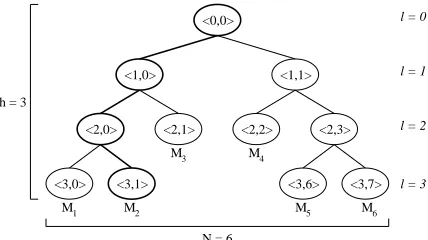
Wallner et al. [34] is the earliest such proposal. One of the main features of our work is the use of key trees in fully distributed contributory key agreement. Figure 1 shows an example of a key tree. The root is located at level 0 and the lowest leaves are at level h. Since we use binary trees,2 every node is either a leaf or a parent of two
nodes. The nodes are denotedhl, vi, where0 ≤ v ≤ 2l−1 since each levellhosts at most 2l nodes.3 Each node
hl, vi is associated with the keyKhl,vi and the blinded key (bkey)BKhl,vi = f(Khl,vi)where the function f() is modular exponentiation in prime order groups, i.e.,f(k) =αkmodp(analogous to the Diffie-Hellman protocol). Assuming a leaf nodehl, vihosts the memberMi, the nodehl, vihasMi’s session random keyKhl,vi. Furthermore, the memberMiat nodehl, viknows every key along the path fromhl, vitoh0,0i, referred to as the key-path and denoted
KEY∗
i . In Figure 1, if a memberM2owns the treeT2, thenM2knows every key{Kh3,1i, Kh2,0i, Kh1,0i, Kh0,0i}in
KEY∗
2 ={h3,1i,h2,0i,h1,0i,h0,0i}and every bkeyBK2∗ ={BKh0,0i, BKh1,0i, . . . , BKh3,7i}onT2. Every key
Khl,viis computed recursively as follows:
Khl,vi= (BKhl+1,2v+1i)Khl+1,2vi modp = (BKhl+1,2vi)Khl+1,2v+1i modp
=αKhl+1,2viKhl+1,2v+1i modp
=f(Khl+1,2viKhl+1,2v+1i)
Computing a key athl, virequires the knowledge of the key of one of the two child nodes and the bkey of the other child node.Kh0,0iat the root node is the group secret shared by all members. We stress, once again, that this value is never used as a cryptographic key for the purpose of encryption, authentication or integrity. Instead, such special-purpose sub-keys are derived from the group secret, e.g., by setting Kgroup = hp(Kh0,0i)where hp is a cryptographically strong hash function uniquely indexed with the purpose idenitiferp, e.g., encryption.
For example, in Figure 1,M2can computeKh2,0i, Kh1,0iandKh0,0iusingBKh3,0i, BKh2,1i,BKh1,1i, andKh3,1i. The final group keyKh0,0iis:
Kh0,0i=α(α
r3(αr1r2 )
)(αr4(αr5r6 )
).
To simplify subsequent protocol description, we introduce the term co-path, denoted asCO∗
i, which is the set of siblings of each node in the key-path of memberMi. For example, the co-pathCO2∗of memberM2in Figure 1 is the set of nodes{h3,0i,h2,1i,h1,1i}. Consequently, every memberMiat leaf nodehl, vican derive the group secret Kh0,0ifrom all bkeys on the co-pathCOi∗and its session randomKhl,vi.
5
TGDH Protocols
In this section we introduce the four basic protocols that form the TGDH protocol suite: join, leave, merge, and partition. All protocols share a common framework with the following notable features:
2
Note that the tree needs to be binary, since our protocol uses the two-party Diffie-Hellman key exchange to derive a node key from the contribution of the two children.
3Even though the key tree is not balanced, we assume a perfectly balanced tree for node numbering. Thus, a node’shl, vileft and
<2,0> <2,1> <2,2> <2,3> <1,0> <1,1>
<0,0>
h = 3
l = 0
l = 1
l = 2
M M
M M
1 2
3 4
N = 6
<3,0> <3,1> <3,6> <3,7>
M5 M6
l = 3
Fig. 1. Notation for tree
– Each group member contributes an equal share to the group key. The key is computed as a function of all current group members’ shares.
– Each share is secret (private to each group member) and is never revealed.
– As the group grows, new members’ shares are factored into the group key and, upon each new member’s joining, one of the old members changes its share.
– As the group shrinks, departing members’ shares are removed from the new group key, and at least one remaining member changes its key share4.
– All protocol messages are signed, timestamped, sequence-numbered and type-identified by the sender; as dis-cussed at the end of Section 3. (We use RSA for message signing since the number of receivers is greater than the number of senders. )
After every membership change, all remaining members independently update the key tree structure. Since we assume that the underlying communication system provides view synchrony (see Section 2), all members who cor-rectly execute the protocol, recompute identical key trees after any membership event. The following is the minimal requirement for computing the group key:
Proposition 2. A group key can be computed from any member’s secret share (i.e., any leaf value) and all bkeys on
the co-path to the root.
It is easy to see that knowledge of its own secret share and all sibling bkeys on the path to the root enables a member to compute all intermediate keys on its key-path, including the root group key. This is similar to other tree-based schemes [36, 34] where each member is required to know all keys on the path from itself (leaf) to the root. Although not strictly necessary for computing group key, our protocol also requires each member to know all bkeys in the entire key tree. As will be seen below, this makes the handling of future membership changes more efficient and robust.
As part of the protocol, a group member can take on a special sponsor role which involves computing intermediate keys and broadcasting to the group. Each broadcasted message contains the sender’s view of the key tree which contains each bkey known to the sender. (We stress that intermediate keys are never broadcasted!) Any member in the group can unilaterally take on this responsibility, depending on the type of membership event. In some cases, such as a partition event, multiple sponsors might be involved.
In case of an additive change (join or merge), all group members identify a unique sponsor. This sponsor is responsible for updating its secret key share, computing affected[key, bkey]pairs and broadcasting all bkeys of the new tree to the rest of the group. The common criteria for sponsor selection is determined by the tree maintenance strategy described in Section 5.6. We emphasize, from the outset, that sponsor is not a privileged entity: its only task is the updating and broadcasting of tree information to the group.
4This prevents the group from reusing old keys. For example, if a member joins and immediately leaves, the group key would be
In response to a subtractive membership change (leave or partition), all members update the tree in the same manner. Since the case of partition subsumes the case of a single leave, we discuss it in more detail. Group partition results in a smaller tree since some leaf nodes disappear. As a result, some subtrees acquire new siblings; therefore, new intermediate keys and bkeys must be computed through a Diffie-Hellman exchange between the new siblings sub-trees. The computation proceeds in a bottom-up fashion with each member computing keys and bkeys until either: 1) it blocks due to a dependency on a new sibling bkey that it does not yet know, or 2) it computes the new root (group) key. If a member blocks without computing any new keys, it does nothing. Otherwise, it broadcasts its view of the key tree which includes the newly computed bkeys. This process is repeated at mosthtimes wherehis the height of the tree, i.e., until all remaining members compute the new group key.
5.1 TGDH Membership Events
As discussed in Section 2, a group key agreement method needs to provide key adjustment protocols to cope with membership changes. TGDH includes protocols in support of the following operations:
– Join: a new member is added to the group – Leave: a member is removed from the group – Merge: a group is merged with the current group – Partition: a subset of members are split from the group – Key refresh: the group key is updated
Before turning our attention to the actual protocols we stress that, while a comprehensive protocol suite must address all types of key adjustment operations, the general policy (or case-by-case decisions) regarding if and when to change a group key is the responsibility of the application and/or the group communication system.
The following sections (5.2 – 5.5), present the four protocols. In each section, we assume that every member can unambiguously determine both the sponsors and the insertion location in the key tree (in case of an additive event). Later in Section 5.6, we will explain how this works. Note that the key refresh operation can be considered a special case of leave without any members actually leaving the group.
5.2 Join Protocol
We assume the group hasnmembers:{M1, . . . , Mn}. The new memberMn+1initiates the protocol by broadcasting a join request message that contains its own bkeyBKh0,0i. This message is distinct from any JOIN messages generated by the underlying group communication system, although, in practice, the two might be combined for efficiency’s sake.
Step 1: The new member broadcasts request for join Mn+1 BKh0,0i=α
rn+1
−−−−−−−−−−−−−−→
C={M1, . . . , Mn}Step 2: Every member
•update key tree by adding new member node and new intermediate node,
•removes all keys and bkeys from the leaf node related to the sponsor to the root node, The sponsorMsadditionally
•generates new share and computes all [key, bkey] pairs on the key path, •broadcasts updated treeTbsincluding only bkeys.
C ∪ {Mn+1}={M1, . . . , Mn+1} Tbs(BK
∗ s)
←−−−−−−−−−−−−−−
MsStep 3: Every member computes the group key usingTbs
Each current member receives this message and determines the insertion point in the tree. The insertion point is the shallowest rightmost node, where the join does not increase the height of the key tree. Otherwise, if the key tree is fully balanced, the new member joins to the root node. The sponsor is the rightmost leaf in the subtree rooted at the insertion node. Next, each member creates a new intermediate node and a new member node, and promotes the new intermediate node to be the parent of both the insertion node and the new member node. After updating the tree, all members, except the sponsor, block. The sponsor proceeds to update its share and compute the new group key; it can do this since it knows all necessary bkeys. Next, the sponsor broadcasts the new tree which contains all bkeys. All other members update their trees accordingly and compute the new group key (see Proposition 2).
It might appear wasteful to broadcast the entire tree to all members, since they already know most of the bkeys. However, since the sponsor needs to send a broadcast message to the group anyhow, it might as well include more information which is useful to the new member, thus saving one unicast message to the new member (which would have to contain the entire tree).
<2,0> <2,1> <1,0> <1,1>
<0,0>
M M
M
1 2
3
Sponsor
<2,0> <2,1>
<1,0> <1,1> <0,0>
M1 M2 M3
<2,2> <2,3>
M4
New Intermediate Node
New Member
Tree T3 Tree T3
Fig. 3. Tree update: join
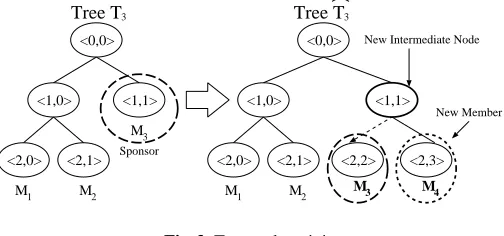
Figure 3 shows an example of memberM4joining a group where the sponsor (M3) performs the following actions: 1. renames nodeh1,1itoh2,2i
2. generates a new intermediate nodeh1,1iand a new member nodeh2,3i
3. promotesh1,1ias the parent node ofh2,2iandh2,3i
Since all members knowBKh2,3iandBKh1,0i,M3can compute the new group keyKh0,0i. Every other member also performs step 1 and 2, but cannot compute the group key in the first round. Upon receiving the broadcasted bkeys, every member can compute the new group key.
5.3 Leave Protocol
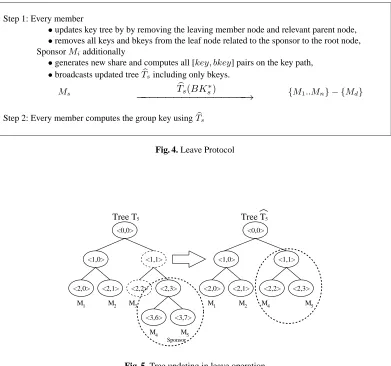
Once again, we start withnmembers and assume that memberMdleaves the group. The sponsor in this case is the rightmost leaf node of the subtree rooted at the leaving member’s sibling node. First off, as shown in Figure 4, each member updates its key tree by deleting the leaf node corresponding toMd. The former sibling ofMdis promoted to replaceMd’s parent node. The sponsor generates a new key share, computes all[key, bkey]pairs on the key path up to the root, and broadcasts the new set of bkeys. This allows all members to compute the new group key.
Looking at the setting in Figure 5, if memberM3leaves the group, every remaining member deletesh1,1iand
Step 1: Every member
•updates key tree by by removing the leaving member node and relevant parent node, •removes all keys and bkeys from the leaf node related to the sponsor to the root node, SponsorMiadditionally
•generates new share and computes all [key, bkey] pairs on the key path, •broadcasts updated treeTbsincluding only bkeys.
Ms Tbs(BK
∗ s)
−−−−−−−−−−−−−−→
{M1..Mn} − {Md}Step 2: Every member computes the group key usingTbs
Fig. 4. Leave Protocol
<2,0> <2,1>
<1,0> <1,1> <0,0>
M1 M2
<2,0> <2,1>
<1,0> <1,1> <0,0>
M1 M2 M4
<2,2> <2,3>
M5
Tree T5 Tree T5
<2,2> <2,3>
M3
<3,6> <3,7>
M4 M5 Sponsor
Fig. 5. Tree updating in leave operation
5.4 Partition Protocol
Assume that a network fault causes a partition of then-member group. From the viewpoint of each remaining member, this event appears as a concurrent leave of multiple members. The partition protocol is involves multiple rounds; it runs until all members compute the new group key.
In the first round, each remaining member updates its tree by deleting all partitioned members as well as their respective parent nodes and “compacting” the tree. The procedure is as follows:
All leaving nodes are sorted by depth order. Starting at the deepest level, each pair of leaving siblings is collapsed into its parent which is then marked as leaving. This node is re-inserted into the leaving nodes list. The above is repeated until all leaving nodes are processed, i.e., there are no more leaving nodes that can be collapsed.
The resulting tree has a number of leaving (leaf) nodes but every such node has a remaining sibling node. Now, for each leaving node we identify a sponsor using the same criteria as described in Section 5.3.
Step 1: Every member
•updates key tree by by removing all the leaving member nodes and their parent node, •removes all keys and bkeys from the leaf node related to the sponsor to the root node, – Each sponsorMst
•IfMst is the shallowest rightmost sponsor, generates new share,
•computes all [key, bkey] pairs on the key path until it can proceed, •broadcasts updated treeTbst including only bkeys.
Mst Tbst(BK
∗ st)
−−−−−−−→
C − LStep 2 toh(Until a sponsorMsjcomputes the group key)
– Each sponsorMst
•computes all [key, bkey] pairs on the key path until it can proceed, •broadcasts updated treeTbst including only bkeys.
Mst Tbst(BK
∗ st)
−−−−−−−→
C − LSteph+ 1: Every member computes the group key usingTbst
Fig. 6. Partition Protocol
To provide key independence, one of the remaining members needs to change its key share. For this reason, in the first round of the partition protocol, we require the shallowest rightmost sponsor to generate a new key share.
This protocol takes multiple rounds to complete. We analyze the number of rounds afterpmembers are partitioned from a group ofnmembers. In the first round, each remaining member updates its tree by deleting all partitioned members as well as their respective parent nodes. Now, each key tree has at mostppaths with empty bkeys. The expected number of paths with empty keys isp/2. Filling up these bkeys requires at most min(log2p, h) rounds, since 1) every sponsor in each subsequent rounds computes bkeys as far up the tree as possible, and 2) the number of rounds never exceeds the tree height.
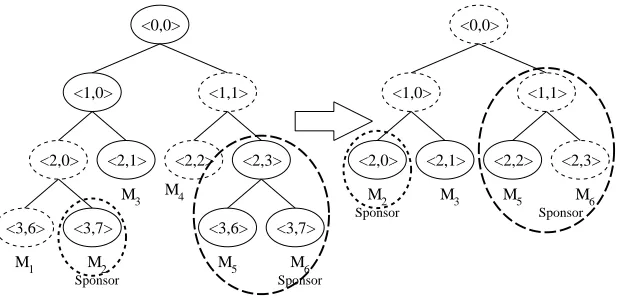
Figure 7 shows an example where all remaining members delete all nodes of leaving members and compute keys and bkeys in the first round. In the figure on the right, any ofM2orM3(M5orM6) cannot compute the new group key, since they lack the bkeyBKh1,1i(BKh1,0i), respectively. However,M3broadcastsBKh1,0i in the first round, andM6can thus compute the group key. Finally, every member knows all bkeys and can compute the group key. As discussed above, before computingKh1,1i,M6changes its shareKh2,3i.
<2,0> <2,1>
<1,0> <1,1> <0,0>
M3
<2,2> <2,3> M4
<3,6> <3,7> M5 M6
Sponsor
<3,6> <3,7> M1 M2
Sponsor
<2,0> <2,1>
<1,0> <1,1> <0,0>
M3
<2,2> <2,3> M5 M6
Sponsor
M2
Sponsor
Note that, if some memberMicomputes the new group key in roundh0, then all other members can compute the group key, at the latest, in roundh0+ 1, sinceM
i’s broadcast message contains all bkeys in the key tree. Hence, each member can detect the completion of the partition protocol independently.
5.5 Merge Protocol
As discussed in Section 2, network faults can partition a group into several subgroups. After the network faults heal, subgroups may need to be merged back into a single group. We now describe the merge protocol forkmerging groups. In the first round of the merge protocol, each sponsor (the rightmost member of each group) broadcasts its tree with all bkeys to all other groups after updating the secret share of the sponsor and relevant[key, bkey]pairs up to the root node. Upon receiving these messages, all members can uniquely and independently determine how to merge thosektrees by tree management policy described in 5.6.
Step 1: EachMsiin each treeTsi:
•generate new share and compute all [key, bkey] pairs on the key path ofTsi,
•broadcast updated treeTbsiincluding only bkeys.
Msi Tbsi(BK
∗ si)
−−−−−−−−−−−−−−→
∪k i=1Ci
Step 2: Every member:
•update key tree by adding new trees and new intermediate nodes,
•remove all keys and bkeys from the leaf node related to the sponsor to the root node, Each sponsorMstadditionally:
•compute all possible [key, bkey] pairs on the key path, •broadcast updated treeTbs.
Mst Tbst(BK
∗ st)
−−−−−−−→
∪k i=1Ci
Step 3 toh(Until a sponsorMsj computes the group key): Each sponsorMst:
•compute all possible [key, bkey] pairs on the key path, •broadcast updated treeTbst.
Mst Tbst(BK
∗ st)
−−−−−−−→
∪k i=1Ci
Steph+ 1: Every member computes the group key usingTbst
Fig. 8. Merge Protocol
Next, each sponsor computes all[key, bkey]pairs on the key-path until it either reaches the root or encounters a dependency.5 It then broadcasts its view of the tree to the group. All members update their tree views with the new
information. If the broadcasting sponsor computed the root key, then, upon receiving the broadcast, all other members can compute the root key as well. In a more general case, a broadcast unblocks exactly one locked sponsor who can now compute further[key, bkey]pairs. This process is incremental, similar to the partition protocol. Finally, some sponsor will compute the new root key and will broadcast the key tree. Now, all members can compute the group key. The communication overhead of the merge protocol may appear high. However, this is not the case. Let us assume
kmerging groups. In the first round, a sponsor in each group broadcasts its key tree after updating its session random. Upon receiving these broadcast messages, every member rebuilds a key tree which has some missing bkeys. At most
kpaths will have missing bkeys. Propagating these bkeys requires at mostlog2krounds, since each sponsor (in each subsequent round) computes bkeys as far as it can. Therefore, a merge ofkgroups takes at mostlog2k+ 1rounds.
5
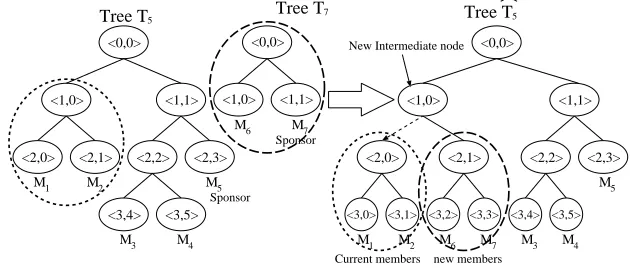
Figure 9 shows an example of two merging groups, where the sponsorsM2andM7broadcast their trees (T2and
T7). Upon receiving these broadcast messages, every member checks whether it is the sponsor in the second round. Every member in both groups merges two trees, and then, M2 (the sponsor in this example) updates the key tree, computes and broadcasts bkeys.
<2,0> <2,1>
<1,0> <1,1> <0,0>
<3,4> <3,5>
<0,0>
<1,0> <1,1>
<2,2> <2,3> <2,2> <2,3> <1,1> <1,0>
<0,0>
<3,4> <3,5>
<2,0> <2,1>
<3,0> <3,1> <3,2> <3,3>
Current members new members New Intermediate node
Sponsor Sponsor
M1 M2 M3 M4
M5
M6 M7
Tree T5 Tree T7 Tree T5
M1 M2
M6 M7 M3 M4 M5
Fig. 9. Tree update in merge
5.6 Tree Management
Modular exponentiation is the most computationally expensive operation in TGDH. The number of exponentiations for a membership event depends on the current tree structure. For example, if a single member or a whole tree merges to the root node of the current tree, at most 5 modular exponentiations are required to complete this operation. If a key tree is balanced, and a member joins to a leaf node, then the number of exponentiations is4dlog2newherenis the current number of users. Hence, it is easy to see that joining to the root always requires the minimum number of exponentiations for additive membership operations. Ifnmembers join to the root, however, the resulting tree becomes unbalanced (similar to a linked list). If a key tree is fully balanced and a member leaves, the number of exponentiations is4dlog2ne.
Therefore, our goal for the tree management policy is to: – keep the key tree as balanced as possible, and
– minimize the number of modular exponentiations, and – minimize the number of protocol rounds
5.6.1 Policy for Additive and Subtractive Events Our heuristic for keeping the key tree balanced is to choose the insertion node for a join or merge operation as the rightmost shallowest node. This usually does not increase the height. If we have to increase the height of the key tree, we simply join to the root. (See also Sections 5.2 and 5.5.) We do not employ any tree balancing scheme for the subtractive events or attempt to re-balance when the key tree becomes unbalanced.
In the rest of this section, we discuss our tree management policy for Merge (Join is a special case thereof). In particular, we focus on how each member independently, simultaneously, and unambiguously merges k trees and selects an insertion point for each merge. Clearly, these properties (independency, concurrency, and consistency) are crucial to obtain a correct and efficient protocol.
Recall that we havekmerging trees. Each member invokes themerge treesfunctionk−1times:
1. First, the trees are ordered from the highestT1to the lowestTk. If multiple trees are of the same height, we list them in lexicographic order of the first member in each tree.
2. LetTb=T1.
Since every member can order the merging trees independently and unambiguously, all members can agree on a key tree if themerge treesalgorithm guarantees uniqueness of the result. We now show how to merge two trees.
If two trees are of the same height, we join one tree to the root node (insertion point) of the other. To provide unambiguous ordering we lexicographically compare the identifiers of the respective sponsors. Otherwise, we join the shallower tree to the deeper tree. To locate the insertion point we first try find the rightmost shallowest node (not necessarily a leaf) where the join would not increase the overall tree height. If no such node exists (i.e., the tree height would increase anyway) the insertion point is the root node.
As an illustration, consider two trees Th and Tl, where the height of Th is greater than that of Tl. The merge treesalgorithm is as follows:
merge_trees (T_h, T_l) { T = T_h
i = 1, j = 2ˆi-1;
While (1) {
If (height (T_l) >= Max {height (T_<i, j>) | 0 <= j < 2ˆi} { // If the height of the smaller tree is
// greater than that of all subtrees
result = T_h // Nowhere to join, join to root Break
} EndIf
If (T_l is joinable to node <i, j> of tree T_h){ result = T_<i, j> // Join to node T_<i, j> } EndIf
Else{
j--If(j < 0){ i++, j = 2ˆi-1 } EndIf
} EndElse } EndWhile
// Merge two trees T_<i+1, 2j> = T_<i, j>
// Old T_<i, j> becomes the left child of new T_<i,j> T_<i+1, 2j+1> = T_l
// T_l becomes the right child of new T_<i, j>
Return T }
The firstifstatement in the while loop breaks when there is no join-able node inTh; the trees will then be joined at the root node. Join-able means that we can merge two trees without increasing the height ofThby placing a subtree rooted at the join-able node as the left child of itself, and puttingTlas the right child. We can see thatmerge trees algorithm fulfills the goal for the tree management policy described above.
5.6.2 Sponsor Selection Summary Sponsor selection in TGDH takes place in each protocol round. (Recall that TGDH is a multi-round protocol.) As mentioned earlier, uniqueness, consistency and independence of this process is crucial for protocol correctness. Sponsor selection is performed as follows.
We already mentioned the behavior of the sponsor in two situations:
2. Subtractive event: member associated with the rightmost leaf node rooted at the sibling node of each leaving member. In case of partition, there may be multiple sponsors.
The above only covers the initial protocol round. In subsequent rounds, a sponsor is always the rightmost leaf rooted at the node which lacks a current bkey.
To summarize, the role of a sponsor is three-fold: 1) refresh its key share6, 2) compute all[key, bkey]pairs as far on the key path as possible, and 3) broadcast the updated key tree to all current group members.
6
Practical Considerations
In this section, we describe the TGDH implementation issues and then discuss self-stabilization and self-clustering properties.
6.1 Implementation Architecture
TREE API is a group key agreement API that implements the cryptographic primitives of TGDH. It contains the following three function calls:
– tree new user: called by any new member to generate its context.
– tree merge req: called by every group member when a join/merge occurs. It identifies the sponsor unambigu-ously (as described in Section 5.6). It then removes all[key, bkey]pairs on its key path. If the caller is a sponsor, generates new secret share and computes all keys and bkeys on its key path. This function returns an output token, which is then broadcast to the whole group.
– tree cascade: invoked by every member when a subtractive event happens or when all members try to compute the group key collaboratively. In the former case, this function removes all leaving members and their parents as described in Section 5.3. If the caller is a sponsor, it also tries to compute [key, bkey]pairs on the sponsor’s key-path. In the latter case, this function is called repeatedly until the group key is computed.
The underlying communication system is assumed to deal with group communication and network events such as merges, partitions, failures and other abnormalities.7We use OpenSSL 0.9.6 [24] as the underlying cryptographic
library.
In the following Sections (6.2 and 6.3), we show that tree cascade provides robustness against cascaded network events. Since TREE API does not provide its own communication facility, the robustness of the API was tested by simulating random events on a single machine running all group members.
6.2 Protocol Unification
Although described separately in the preceding sections, the four TGDH operations (join, leave, merge and partition) actually represent different strands of a single protocol. We justify this claim with an informal argument below.
Obviously, join and leave are special cases of merge and partition, respectively. We observe that merge and partition can be collapsed into a single protocol, since, in either case, the key tree changes and remaining group members lack some number of bkeys. This prevents them from computing the new root key. In a partition, the remaining members (in any surviving group fragment) reconstruct the tree where some bkeys are missing. In case of a merge of two groups, let us suppose that a taller (deeper) treeAis merged with a shorter (shallower) treeB. Similar to a partition, all members formerly inAconstruct the new tree where some bkeys – those inB– are missing. (This view is symmetric since the members inBsee the same tree but with missing bkeys in the subtreeA.)
We now established that both partition and merge initially result in a new key tree with a number of missing bkeys. In the first round of merge protocol, sponsor in each group broadcasts the key tree after updating its session random. Upon receiving this broadcast message, every member rebuilds a key tree which has some missing bkeys. Filling up this bkeys takes at mostlog2krounds. A partition is very similar except the first broadcast message of merge. Recall that every member reconstructs the key tree after a partition in at mostmin(log2p, h)rounds, wherehis the tree height andpis the number of leaving members.
6
In a join, the new member simply generates its first share.
7
1 receive msg (msg type = membership event)
2 construct new tree
3 while there are missing bkeys
4 if ((I can compute any missing keys and I am the sponsor) ||
5 (sponsor computed a key))
6 while(1)
7 compute missing (key, bkey) pairs
8 if (I cannot compute)
9 break
10 endif
11 if (others need my information)
12 broadcast new bkeys
13 endif
14 endif
15 receive msg
16 if (msg type = broadcast)
17 update current tree
18 endif
19 endwhile
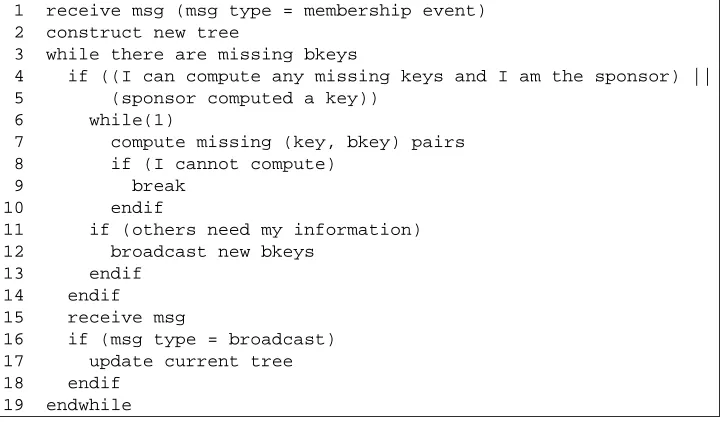
Fig. 10. Unified protocol pseudocode
The apparent similarity between partition and merge allows us to collapse the protocols stemming from all mem-bership events into a single unified protocol. Figure 10 shows the pseudocode. The incentive for doing this is threefold. First, unification allows us to simplify the implementation and minimize its size. Second, the overall security and cor-rectness are easier to demonstrate with a single protocol. Third, we can now claim that (with a slight modification) TGDH is self-stabilizing and fault-tolerant as discussed below.
6.3 Cascaded Events
Since network disruptions are random and unpredictable, it is natural to consider the possibility of so-called cascaded
membership events. (In fact, cascaded events and their impact on group and multi-round protocols are often considered
in group communication literature, but, alas, not often enough in the security literature.) A cascaded event occurs, in a simplest form, when one membership change occurs while another is being handled. Here event means any of: join, leave, partition, merge or any combination thereof. For example, a partition can occur while a prior partition is being dealt with, resulting in a cascade of size two. In principle, cascaded events of arbitrary size can occur if the underlying network is highly volatile.
We claim that the TGDH partition protocol is self-stabilizing, i.e., robust against cascaded network events. This property is notable and rare as most multi-round cryptographic protocols are not geared towards handling of such events. In general, self-stabilization is a very desirable feature since lack thereof requires extensive and complicated protocol “coating” to either: 1) shield the protocol from cascaded events, or 2) harden it sufficiently to make the protocol robust with respect to cascaded events (essentially, by making it re-entrant).
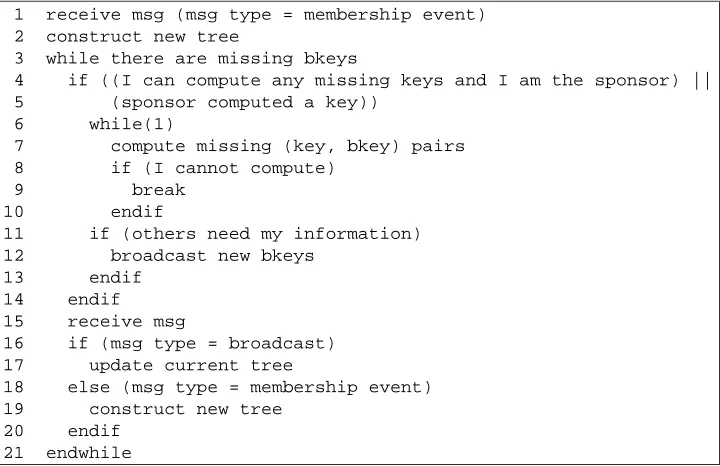
The high-level pseudocode for the self-stabilizing protocol is shown in Figure 11. The changes from Figure 10 are minimal (lines 18 – 19 are added).
Instead of providing a formal proof of self-stabilization we demonstrate it with an example. Figure 12 shows an example of a cascaded partition event. The first part of the figure depicts a partition ofM1,M4, andM7from the prior group of ten members{M1, . . ., M10}. This partition normally requires two rounds to complete the key agreement. As described in Section 5.4, every member constructs the same tree after completing the initial round. The middle part shows the resulting tree. In it, all non-leaf nodes exceptKh2,3imust be recomputed as follows:
1. First,M2andM3both computeKh2,0i,M5andM6computeKh2,1iwhileM8, M9andM10computeKh1,1i. All bkeys are broadcasted by each sponsorM2, M5andM8.
1 receive msg (msg type = membership event)
2 construct new tree
3 while there are missing bkeys
4 if ((I can compute any missing keys and I am the sponsor) ||
5 (sponsor computed a key))
6 while(1)
7 compute missing (key, bkey) pairs
8 if (I cannot compute)
9 break
10 endif
11 if (others need my information)
12 broadcast new bkeys
13 endif
14 endif
15 receive msg
16 if (msg type = broadcast)
17 update current tree
18 else (msg type = membership event)
19 construct new tree
20 endif
21 endwhile
Fig. 11. Self-stabilizing protocol pseudocode
3. Finally, all broadcasts are received andM8, M9andM10computeKh0,0i.
<2,0> <2,1>
<1,0> <1,1> <0,0>
<2,2> <2,3>
M7 M8
<3,0> <3,1>
M1 M2
<3,2> <3,3>
M
M
<3,4> <3,5>
M M
<3,6> <3,7>
3
4 5
6 <4,0> <4,1> <4,2> <4,3>
<2,0> <2,1>
<1,0> <1,1> <0,0>
<2,2> <2,3>
<3,0> <3,1> <3,2> <3,3> <3,6> <3,7>
M9 M10 M2 M3 M5 M6 M8
M9 M10
<2,0> <2,1>
<1,0> <1,1> <0,0>
<2,2> <2,3>
<3,2> <3,3>
M2
M5 M6
M9 M
10
Fig. 12. An Example of Cascaded Partition
Suppose that, in the midst of handling the first partition, another partition (ofM3andM8) takes place. Note that, regardless of which round (1,2,3) of the first partition is in progress, the departure ofM3andM8does not affect the keys (and bkeys) in the subtrees formed byM9andM10as well asM5andM6. All remaining members update the tree as shown in the rightmost part of Figure 12. The bkey ofKh1,0iis the only one missing in all members’ view of the tree. It is computed byM2, M5andM6and broadcasted byM6. When the broadcast is received, all members compute the root key.
membership events are delivered in sequence after all outstanding messages are delivered. In other words, if a message is sent in one membership view and membership changes while the message is not yet delivered, the mem-bership change must be postponed until the message is delivered to the (surviving) subset of the original memmem-bership. This is essentially a restatement of View Synchrony (as discussed in Section 2).
6.4 Self-Clustering
The Internet as a whole provides sporadic and unstable connectivity, e.g., web users frequently experience disconnects and server failures. The instability can occur because of congestion, equipment failures or lossy links. It can also take place as a result of denial-of-service attacks, worms and viruses. It is often the case that an unstable network component (router or link) tends to have multiple failures. In other words, an isolated, “once-in-a-blue-moon” type of failure is uncommon. Repeated failures typically complicate protocol implementation. However, oddly enough, TGDH not only survives but also benefits from repeated failures.
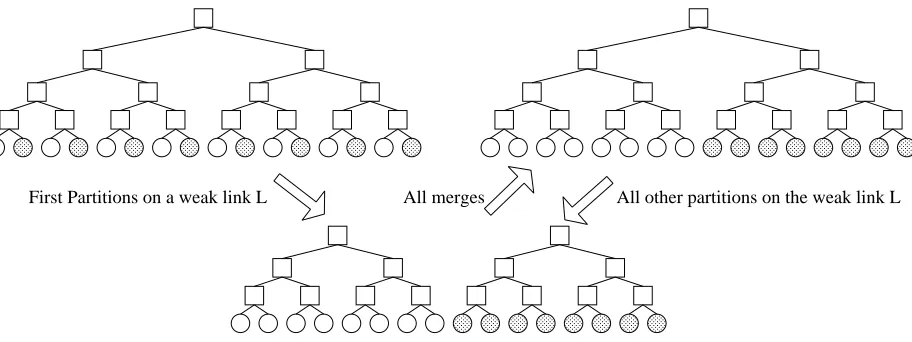
Similar to other tree-based key management schemes (e.g., [34, 36, 22]) the key tree in TGDH is logical: group members are leaves in a tree and internal nodes are logical. The initial placement of members (as tree leaves) is not dependent on their relative physical location. Therefore, members physically close to each other might not be neighbors in a key tree. When a partition occurs, all members in the same physical group fragment form a new key tree and a new group. The partition protocol may cost as many aslognrounds. Then, when the partition heals, the previously separate groups are merged into a single key tree, however, they are still clustered along the lines of the partition. If another partition happens on the same link, the partitioned members are not scattered across the key tree any longer. Therefore, any subsequent partition on the same link will take only one round to complete. This property is especially important in high-delay wide area networks since clustering lowers the number of communication rounds as well as the number of modular exponentiations, in many cases.
First Partitions on a weak link L All merges All other partitions on the weak link L
Fig. 13. An Extreme Example of Self-Clustering
7
Performance Analysis
7.1 Complexity Analysis and Comparison
We analyze the communication and computation costs for join, leave, merge and partition protocols. We focus on the number of rounds, the total number of messages, the serial number of exponentiations, the serial number of signature generations, and the serial number of signature verifications. Note that we use RSA signature for message authenti-cation since RSA is particularly efficient in verifiauthenti-cation. The serial cost assumes parallelization within each protocol round and represents the greatest cost incurred by any participant in a given round. The total cost is the sum of all participants’ costs in a given round.
We also compare our protocol to other contributory group key agreement schemes including GDH.3 [32], BD (Burmester-Desmedt) [12], and STR [20]. Although BD was originally designed to support only group formation, we modify the BD protocol to support dynamic membership operation. This modification is minimal.
Table 1 summarizes the communication and computation costs of four protocols. The numbers of current group members, merging members, merging groups, and leaving members are denoted as:n, m, kandp, respectively.
The height of the key tree constructed by the TGDH protocol ish. The overhead of the TGDH protocol depends on the tree height, the balancedness of the key tree, the location of the joining tree, and the leaving nodes. In our analysis, we assume the worst case configuration and list the worst-case cost for TGDH.
Table 1. Communication and Computation Costs
Communication Computation
Rounds Messages Exponentiations Signatures Verifications
GDH
Join 4 n+ 3 n+ 3 4 n+ 3
Leave 1 1 n−1 1 1
Merge m+ 3 n+ 2m+ 1 n+ 2m+ 1 m+ 3 n+ 2m+ 1
Partition 1 1 n−p 1 1
TGDH
Join 2 3 32h 2 3
Leave 1 1 3h
2 1 1
merge log2k+ 1 2k 3
h
2 log2k+ 1 log2k
Partition min(log2p, h) 2h 3h min(log2p, h)min(log2p, h)
STR
Join 2 3 4 2 3
Leave 1 1 3n
2 + 2 1 1
Merge 2 k+ 1 3m+ 1 2 3
Partition 1 1 32n+ 2 1 1
BD
Join 2 2n+ 2 3 2 n+ 3
Leave 2 2n−2 3 2 n+ 1
Merge 2 2n+ 2m 3 2 n+m+ 2
Partition 2 2n−2p 3 2 n−p+ 2
The BD protocol has a hidden cost that is not listed in Table 1: BD hasn−1modular exponentiations with a small exponent. Unfortunately,n−1such exponentiations can be expensive whennis large. For example, BD requiresO(n2) 1024-bit modular multiplications, if modular exponentiation is implemented with the square-and-multiply algorithm. (OpenSSL uses Montgomery reduction and the sliding window algorithm to implement the modular exponentiation, which is faster than simple square-and-multiply algorithm. However, the former requires almost the same time as the latter for small exponents.) Because of this hidden cost, it is hard to compare the computational overhead of BD to the other protocols. Below, we compare the four protocols for each membership event.
Leave: BD is the most expensive protocol in terms of communication. The cost order among others is determined strictly by the computation cost, since they all have the same communication cost (one round consisting of one mes-sage). Therefore, TGDH is best for handling leave events. STR, and GDH scale linearly with the group size. BD has a hidden cost, which makes it hard to compare.
Merge: We first look at the communication cost. GDH scales linearly with the number of added members, while BD and STR are more efficient with a constant number of rounds. Although a merge in TGDH takes multiple rounds, it depends on the number of merging groups, which is usually small. Since BD and TGDH have2nand2kmessages (at most) respectively, STR is the most communication-efficient for handling merge events. Examining computation requirements, BD has the lowest cost with only three exponentiations. TGDH scales logarithmically with the group size. It is more efficient than STR and GDH which scale linearly with both the group size and the number of new members.
Partition: Both GDH and STR protocols are bandwidth efficient: only one round consisting of one message. BD is less efficient with two rounds ofnmessages each. Partition is the most expensive operation in TGDH requiring a number of rounds bounded by tree height. Computation-wise it is difficult to compare BD with other protocols because of its hidden cost. TGDH requires a logarithmic number of exponentiations. GDH and STR scale linearly with the group size.
7.2 Experimental Results
To compare the actual performance, we implemented the four protocols and compared their costs in this section. We simulated the total computation delay from the time when the membership event happens to the time when group key agreement finishes. Average delay has been measured, since all members do not finish group key agreement simultaneously.
7.2.1 Test Methodology To perform fair comparisons, we consider the followings:
– We usep= 1024andq= 160for all measurements. These values are known to be secure in the current technology [21].
– We use 1024-bit RSA signature with the fixed public exponent 3 for message authentication. All protocols have multiple signature verifications that need to be processed serially. No security risk is known for RSA signatures with small public exponents [11].
– For TGDH, we first generate a random tree by forcing a number of random partition/merge events. Since the cost of TGDH depends on the tree structure, it is fair to generate a random tree instead of a well-balanced or an imbalanced tree.
We use the following scenario to measure delay. For join and leave, the number of current group members isn. For partition and merge,nvaries among: 16, 32, 64, and 128.
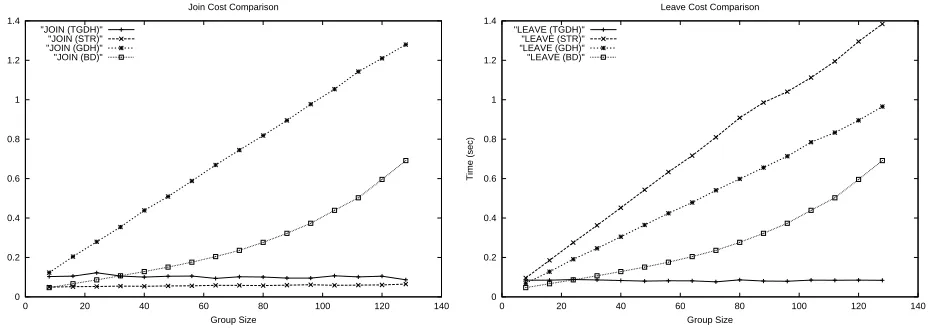
Join We measure the computational delay for a member to join a group ofnmembers. (Left graph of Figure 14) In case of TGDH, we use a random tree as described above. Thex-axis denotes the number of current group members, while they-axis shows the computational delay in seconds.
Leave We measure the computational delay for a random member to leave a group ofnmembers. (Right graph of Figure 14) Note that the delay for GDH and BD does not depend on the location of the leaving member. However, the number of modular exponentiations for STR upon a leave event depends on the location of the leaving node. For TGDH, we pick a random member from the tree, and measure the average delay for the leave. The x-axis denotes the number of remaining group members and they-axis is the computational delay in seconds.
Merge Merge is the trickiest algorithm to measure fairly. First, in BD and GDH, only the number of resulting mem-bers decides the total delay, independent of the number of merging groups. Second, the performance of STR merge depends on the size of the largest group (which decides the number of modular exponentiation), and the number of groups merging (which determines the number of signature verifications). Finally, the performance of TGDH merge depends upon the number of merging groups (which affects the number of signature generations and verifications), and the key tree structure. The number of current group members is not important for TGDH. Since each protocol has different characteristics, we measured the merge costs as follows:
– The number of resulting group members is16,32,64and128.
– We assume the maximum number of merging groups is five. In practice, merge of two groups is the most frequent event. However, we allow up to five groups since some group communication systems may allow (require) more than two groups to merge at one time.
– For TGDH and STR, values in thex-axis mean the number of current group members. The resulting group size is 16, 32, 64, 128, respectively. The values in they-axis are the average computational delays for a member in the current group after a merge of 2 – 5 groups.
0 0.2 0.4 0.6 0.8 1 1.2 1.4
0 20 40 60 80 100 120 140
Time (sec)
Group Size Join Cost Comparison
"JOIN (TGDH)" "JOIN (STR)" "JOIN (GDH)" "JOIN (BD)"
0 0.2 0.4 0.6 0.8 1 1.2 1.4
0 20 40 60 80 100 120 140
Time (sec)
Group Size Leave Cost Comparison
"LEAVE (TGDH)" "LEAVE (STR)" "LEAVE (GDH)" "LEAVE (BD)"
Fig. 14. Join and Leave Cost Comparison:(x, y) =(number of remaining group members after JOIN/LEAVE, computational over-head in seconds)
7.2.2 Join Results. The left graph of Figure 14 depicts measurement for join. As expected, STR has the smallest delay. A surprising result comes from the TGDH for a random tree: the difference between TGDH and STR is small. In case of a random tree, the joining node is located close to the root node. GDH is the worst performer due to many modular exponentiations. BD also shows interesting results. Though it has constant number of exponentiations, the hidden cost evidently plays an important role.
7.2.3 Leave Results. As expected, STR is the worst performer. Note that the worst case (when a lowest member leaves the group) cost for STR is almost twice as much as the current average value. Performance of TGDH looks best overall, while BD performs very well when the number of group members is less than 25. Leave cost in BD is almost the same as join cost, since the protocol needs to restart whenever a new membership event happens.
and decreases afterwards. This is because 1) as the number of leaving members increases, the number of modular exponentiations decreases, 2) when many members leave the group, the resulting group has many empty bkeys spread over the tree, and, hence, requires more messages. The cost of BD and GDH decreases almost linearly, because it depends on the number of resulting group members.
As described in Section 6.4, the cost of partition for TGDH can be improved when the group experiences repeated network partition on the same link.
0 0.02 0.04 0.06 0.08 0.1 0.12 0.14 0.16
0 2 4 6 8 10 12 14 16
Time (sec)
Resulting Group Size Partition Cost Comparison (16 users)
"PARTITION 16 (TGDH)" "PARTITION 16 (STR)" "PARTITION 16 (GDH)" "PARTITION 16 (BD)"
0 0.05 0.1 0.15 0.2 0.25 0.3 0.35
0 5 10 15 20 25 30 35
Time (sec)
Resulting Group Size Partition Cost Comparison (32 users)
"PARTITION 32 (TGDH)" "PARTITION 32 (STR)" "PARTITION 32 (GDH)" "PARTITION 32 (BD)"
0 0.1 0.2 0.3 0.4 0.5 0.6
0 10 20 30 40 50 60 70
Time (sec)
Resulting Group Size Partition Cost Comparison (64 users)
"PARTITION 64 (TGDH)" "PARTITION 64 (STR)" "PARTITION 64 (GDH)" "PARTITION 64 (BD)"
0 0.2 0.4 0.6 0.8 1 1.2 1.4
0 20 40 60 80 100 120 140
Time (sec)
Resulting Group Size Partition Cost Comparison (128 users)
"PARTITION 128 (TGDH)" "PARTITION 128 (STR)" "PARTITION 128 (GDH)" "PARTITION 128 (BD)"
Fig. 15. Partition Cost Comparison:(x, y) =(number of remaining group members after the partition, computational overhead for an existing member if the original group shrinks to a group ofxmembers), the original numbers of group members are 16, 32, 64, 128 respectively.
0 0.1 0.2 0.3 0.4 0.5 0.6 0.7 0.8 0.9
0 2 4 6 8 10 12 14 16
Time (sec)
Group Size Merge Cost Comparison (16 users)
"MERGE 16 (TGDH)" "MERGE 16 (STR)" "MERGE 16 (GDH)" "MERGE 16 (BD)"
0 0.2 0.4 0.6 0.8 1 1.2 1.4 1.6
0 5 10 15 20 25 30 35
Time (sec)
Group Size Merge Cost Comparison (32 users)
"MERGE 32 (TGDH)" "MERGE 32 (STR)" "MERGE 32 (GDH)" "MERGE 32 (BD)"
0 0.5 1 1.5 2 2.5 3 3.5
0 10 20 30 40 50 60 70
Time (sec)
Group Size Merge Cost Comparison (64 users)
"MERGE 64 (TGDH)" "MERGE 64 (STR)" "MERGE 64 (GDH)" "MERGE 64 (BD)"
0 0.5 1 1.5 2 2.5 3 3.5
0 20 40 60 80 100 120 140
Time (sec)
Group Size Merge Cost Comparison (128 users)
"MERGE 128 (TGDH)" "MERGE 128 (STR)" "MERGE 128 (GDH)" "MERGE 128 (BD)"
Fig. 16. Merge Cost Comparison:(x, y) =(number of current group members, computational overhead for a member located in the group ofxmembers), after the membership event the number of group members becomes 16, 32, 64, and 128 respectively.
7.3 Discussion
Based on the experimental results that measured the computational cost, TGDH exhibits the best performance despite the relatively high cost of partitions. Recall that, in practice, the self-clustering property of TGDH lessens the actual delay.
Looking at communication costs, it appears that TGDH also outperforms other protocols, except for partition events. In a high-delay WAN, the overall partition cost in TGDH may be high, although this effect can be lessened by self-clustering.
8
Related Work
Group key management protocols come in three different flavors: contributory key agreement protocols, centralized, decentralized group key distribution scheme, and server-based key distribution protocols. Since the focus of this work is to provide common key to the dynamic peer group, we only consider the first two below.
8.1 Group Key Agreement Protocols
Research on group key agreement protocols started in 1982. We first summarize the early (theoretical) group key agreement protocols which did not consider dynamic membership operations; Most of them only supported group genesis.
The earliest contributory group key agreement built upon the 2-party Diffie-Hellman (DH) is due to Ingemarsson et al. (ING) [18]. In the fist round of ING, every memberMi generates its session randomNiand computesαNi. In the subsequent roundskton−1,Mi computesKi,k = (Ki−1 modn,k−1)Ni where Ki−1 is the message received fromMi−1in the previous roundk−1. The resulting group key is of the form:
Kn =αN1N2N3...Nn.
The ING protocol is inefficient because: 1) every member has to start synchronously, 2)n−1rounds are required to compute a group key, 3) it is hard to support dynamic membership operations due to its symmetry and 4)nsequential modular exponentiations are required.
Another group key agreement developed for teleconferencing was proposed by Steer et al. [31]. This protocol is of particular interest since its group key structure is similar to that in TGDH.
Kn=αNn(α
Nn−1...(αN3(αN2N1 ))···
).
This protocol is well-suited for adding new group members as it takes only two rounds and four modular exponentia-tions. Member exclusion, however, is relatively difficult (for example, consider excludingN1from the group key).
Burmester and Desmedt construct an efficient protocol (called BD) which takes only two rounds and three modular exponentiations per member to generate a group key [12]. This efficiency allows all members to re-compute the group key for any membership change by rerunning the protocol. However, according to [32], most (at least half) of the members need to change their session random on every membership event. The group key in this protocol is different from STR and TGDH:
Kn =αN1N2+N2N3+...+NnN1.
One shortcoming of BD is the high communication overhead. It requires2nbroadcast messages and each member needs to generate 2 signatures and verify2nsignatures. BD also has a hidden cost mentioned in Section 7.2.
Becker and Wille analyze the minimal communication complexity of contributory group key agreement in general [8] and propose two protocols: octopus and hypercube. Their group key has the same structure as the key in TGDH. For example, for eight users their group key is:
Kn=α(α
αr1r2αr3r4
)(ααr5r6αr7r8
).
The Becker/Wille protocols handle join and merge operations efficiently, but the member leave operation is inefficient. Also, the hypercube protocol requires the group to be of size2n(for some integern); otherwise, the efficiency slips.
Asokan et al. look at the problem of small-group key agreement, where the members do not have previously set up security associations [5]. Their motivating example is a meeting where the participants want to bootstrap a secure communication group. They adapt password authenticated DH key exchange to the group setting. Their setting, however, is different from ours, since they assume that all members share a secret password, whereas we assume a PKI where each member can verify any other members authenticity and authorization to join the group.