New Attacks on the Stream Cipher TPy6
and
Design of New Ciphers the TPy6-A and the TPy6-B
⋆Gautham Sekar, Souradyuti Paul, and Bart Preneel
Katholieke Universiteit Leuven, Dept. ESAT/COSIC, Kasteelpark Arenberg 10,
B–3001, Leuven-Heverlee, Belgium
{gautham.sekar, souradyuti.paul, bart.preneel}@esat.kuleuven.be
Abstract. The stream ciphers Py, Pypy and Py6 were designed by Biham and Seberry for the ECRYPT-eSTREAM project in 2005. The ciphers were promoted to the ‘Focus’ ciphers of the Phase II of the eSTREAM project. However, due to some cryptanalytic results on the ciphers, strengthened versions of the ciphers, namely TPy, TPypy and TPy6 were built. So far there exists no attacks on TPy6. In this paper, we find hitherto unknown weaknesses in the keystream generation algorithms of the Py6 and of its stronger variant TPy6. Exploiting these weaknesses, a large number of distinguishing attacks are mounted on the ciphers, the best of which works with 2224.6data and comparable time. In the second part, we present two new ciphers derived from the TPy6, namely TPy6-A and TPy6-B, whose performances are 2.65 cycles/byte and 4.4 cycles/byte on Pentium III. As a result, to the best of our knowledge, on Pentium platforms TPy6-A becomes the fastest stream cipher in the literature. Based on our security analysis, we conjecture that no attacks better than brute force are possible on the ciphers TPy6-A and TPy6-B.
1
Introduction
At first, we recall a brief history of the Py-family of ciphers.
Timeline: the Py-family of Ciphers
– April 2005. The ciphers Py and Py6, designed by Biham and Seberry, were submitted to the ECRYPT project for analysis and evaluation in the category of software based stream ciphers [3]. The impressive speed of the cipher Py in software (about 2.5 times faster than the RC4) made it one of the fastest and most attractive contestants.
– March 2006 (at FSE 2006).Paul, Preneel and Sekar reported distinguishing attacks with 289.2
data and comparable time against the cipher Py [9]. Crowley [5] later reduced the complexity to 272 by employing a Hidden Markov Model.
– March 2006 (at the Rump session of FSE 2006).A new cipher, namely Pypy, was proposed by the designers to rule out the aforementioned distinguishing attacks on Py [4].
– May 2006 (presented at Asiacrypt 2006). Distinguishing attacks were reported against Py6 with 268.6 data and comparable time by Paul and Preneel [10].
– October 2006 (presented at Eurocrypt 2007).Wu and Preneel showed key recovery attacks against the ciphers Py, Pypy, Py6 with chosen IVs [15]. This attack was subsequently improved by Isobeet al.[8].
– January 2007. Three new ciphers TPypy, TPy, TPy6 were proposed by the designers [2]; the ciphers can very well be viewed as the strengthened versions of the previous ciphers Py, Pypy and Py6 where the above attacks do not apply.
⋆The first author is supported by an IWT SoBeNeT project. The second author is funded by the IBBT
– February 2007.Sekaret al.published attacks on TPy and TPypy, each of which requires 2281
data and comparable time [11].
– August 2007 (presented at SAC 2007). Tsunoo et al. showed a distinguishing attack on TPypy with a data complexity of 2199 [14].
– October 2007 (to be presented at ISC 2007). Sekar et al. showed attacks on TPy, the best of which requires 2268.6data and comparable time [12]. So far there exist no attacks on the
cipher TPy6.
– December 2007 (to be presented at Indocrypt 2007). Sekar et al. showed related-key attacks on Py, Pypy, TPy and TPypy, each requiring 2193.7 data and comparable time [13].
Algorithm 1The keystream generation algorithm of TPy6 (and Py6) Require: Y[−3, ...,64], P[0, ...,63], a 32-bit variables
Ensure: 64-bit random output /*Update and rotateP*/ 1: swap (P[0],P[Y[43]&63]); 2: rotate (P);
/* Update s*/
3: s+ =Y[P[18]]−Y[P[57]];
4: s=ROT L32(s,((P[26] + 18)&31));
/* Output 4 or 8 bytes (least significant byte first)*/ 5: output ((ROT L32(s,25)⊕Y[64]) +Y[P[8]]); 6: output (( s ⊕Y[−1]) +Y[P[21]]);
/* Update and rotateY*/
7: Y[−3] = (ROT L32(s,14)⊕Y[−3]) +Y[P[48]]; 8: rotate(Y);
2
Notation and Convention
– Themth bit (m= 0 denotes the least significant bit or lsb) of the first output-word generated at roundnis denoted byOn(m). The second output-word is not used anywhere in our analysis. – Pn,Yn+1andsnare the inputs to the algorithm at roundn. When this convention is followed, we see thatOn = (ROT L32(sn,25)⊕Yn[64]) +Yn[Pn[26]]- the index ‘n’ is maintained throughout the expression.
– TheROT L32(x, k) denotes that the variablexis cyclically rotated to the left bykbits.
– Yn[m], Pn[m] denote themth elements of arrayYn andPn respectively.
– Yn[m]i,Pn[m]i denote theith bit (i= 0 denotes the lsb) of Yn[m],Pn[m] respectively.
– The symbol ‘&’ denotes theand operator.
– The operators ‘+’ and ‘−’ denote addition modulo232and subtraction modulo232 respectively,
except when used with expressions which relate two elements of arrayP. In this case they denote
addition and subtraction over Z.
– The symbol ‘⊕’ denotes bitwise exclusive-or andT denotes set intersection.
– InOn(i),sn(i)andYn[Pm[X]]i, the index representing bit position, i.e.,idenotesimod 32.
– Yc
n[Pm[X]]i denotes the complement ofYn[Pm[X]]i.
– The pseudorandom bit generation algorithm of a stream cipher is denoted by PRBG.
3
Distinguishing attacks on the Py6 and the TPy6
Theorem 1. O1(i)⊕O3(i+7)⊕O7(i+7)⊕O8(i+7)= 0if the following17conditions are simultaneously satisfied.
1. P1[26] ≡ −18 mod 32 (event E1), 2. P2[26] ≡ 7 mod 32 (event E2), 3. P3[26] ≡ −4 mod 32 (eventE3), 4. P7[26]≡3 mod 32(event E4),
5. P8[26]≡3 mod 32 (eventE5), 6. P1[18] =P2[57] + 1(event E6), 7.P1[57] =P2[18] + 1(event
E7), 8.P7[18] =P8[18] + 1(event E8),
9. P7[57] =P8[57] + 1 (eventE9), 10.P3[18] = 62(eventE10), 11. P1[8] =P3[57] + 2 (event E11), 12.P1[18] = 3(event E12),
13. P3[8] = 0 (event E13), 14. P1[57] = P7[8] + 6 (event E14), 15. P7[48] = 60 (event E15), 16.
P6[48] =P8[8] + 2(eventE16),
17.d7(i−7)⊕d8(i−7)⊕c1(i)⊕d3(i)⊕d1(i+7)⊕c3(i+7)⊕c7(i+7)⊕e7(i+7)⊕c8(i+7)⊕e8(i+7)= 0. 1
Proof.First, we state and prove two lemmata which will be used to establish the theorem.
Lemma 1. If
1. P1[26]≡ −18 mod 32, 2.P3[26]≡ −4 mod 32, 3. P7[26]≡3 mod 32, 4. P8[26]≡3 mod 32 then the following equations are satisfied:
1. O1(i)=s0(i+7)⊕Y1[P1[18]]i+7⊕Y1c[P1[57]]i+7⊕Y1[256]i⊕Y1[P1[8]]i
⊕c1(i)⊕d1(i+7),
2. O3(i+7)=s2(i)⊕Y3[P3[18]]i⊕Y3c[P3[57]]i⊕Y3[256]i+7⊕Y3[P3[8]]i+7
⊕c3(i+7)⊕d3(i), 3. O7(i+7)=Y7[P7[18]]i−7⊕Y
c
7[P7[57]]i−7⊕Y6[−3]i+7⊕Y7[P7[8]]i+7
⊕Y6[P6[48]]i+7⊕c7(i+7)⊕d7(i−7)⊕e7(i+7),
4. O8(i+7)=Y8[P8[18]]i−7⊕Y8c[P8[57]]i−7⊕Y7[−3]i+7⊕Y8[P8[8]]i+7
⊕Y7[P7[48]]i+7⊕c8(i+7)⊕d8(i−7)⊕e8(i+7). Proof.From Figure 1, we get
Yn[i] =Yn+1[i−1] (1)
when−2≤i≤64. Wheni=−3,
Yn+1[64] = (ROT L32(si,14)⊕Yn[−3]) +Yn[Pn[48]].
Generalizing (1), we have
Yn[i] =Yn+k[i−k] (2)
when−3≤i−k≤63. Line 5 of Algorithm 1 gives
O7= (ROT L32(s7,25)⊕Y7[64]) +Y7[P7[8]]. (3)
Let thec7 denote the carry in the above equation. SinceROT L32(s7,25)i=s7(i−25 mod 32),
O7(i)=s7(i−25 mod 32)⊕Y7[64]i⊕Y7[P7[8]]i⊕c7(i). (4)
Lines 3 and 4 of Algorithm 1 give us
s7=ROT L32(s6+Y7[P7[18]]−Y7[P7[57]], P7[26] + 18 mod 32) (5)
⇒s7(j)=s6(j−kmod 32)⊕Y7[P7[18]]j−kmod 32⊕Y
c
7[P7[57]]j−kmod 32
⊕d7(j−kmod 32) (6)
where k = P7[26] + 18 mod 32, d7(i) = f7(i)⊕g7(i) and d7(0) = 1 (f7 and g7 are the carry terms
in (5) which are explained in Sect. 4.2). For simplicity, henceforth we denote X(imod 32) by X(i).
Thus (6) becomes,
s7(j)=s6(j−k)⊕Y7[P7[18]]j−k⊕Y
c
7[P7[57]]j−k⊕d7(j−k). (7) 1 The termsc,d,eare the carries generated in certain expressions, the descriptions of which can be found
A
B
C
X
Y
B
C
Y D
A1
C
D
A1 E
B1 − 3
− 2
− 1
63
64
Yn Y Yn+ 2
n+ 1
Fig. 1.The figure shows the update of the S-boxY.Yn[i] =Yn+1[i−1] when−2≤i≤64.Yn+1[64] =A1
when i=−3 andA1 = (ROT L32(sn,14)⊕A) +Yn[Pn[48]]. Generalizing the above, we can writeYn[i] =
Yn+k[i−k] when−3≤i−k≤63.
Ifj=i−25 mod 32, then (7) becomes
s7(i−25)=s6(i−k−25)⊕Y7[P7[18]]i−k−25⊕Y
c
7[P7[57]]i−k−25⊕d7(i−k−25). (8) Substituting (8) in (4), we get,
O7(i)=s6(i−k−25)⊕Y7[P7[18]]i−k−25⊕Y
c
7[P7[57]]i−k−25⊕Y7[64]i
⊕Y7[P7[8]]i⊕c7(i)⊕d7(i−k−25). (9)
Next, we have
Y7[64] = (ROT L32(s6,14)⊕Y6[−3]) +Y6[P6[48]], (10)
Y7[64]i =s6(i−14)⊕Y6[−3]i⊕Y6[P6[48]]i⊕e7(i) (11)
wheree7 is the carry term in (10). Substituting (11) in (9), we get,
O7(i)=s6(i−k−25)⊕s6(i−14)⊕Y7[P7[18]]i−k−25⊕Y
c
7[P7[57]]i−k−25⊕Y6[−3]i
⊕Y7[P7[8]]i⊕Y6[P6[48]]i⊕c7(i)⊕d7(i−k−25)⊕e7(i). (12)
Now, if k=−11 (i.e., k≡ −11 mod 32 ⇒P7[26] + 18≡ −11 mod 32⇒P7[26]≡3 mod 32) then
s6(i−k−25)⊕s6(i−14)= 0. Hence, whenP7[26]≡3 mod 32, (12) becomes
O7(i)=Y7[P7[18]]i−14⊕Y
c
7[P7[57]]i−14⊕Y6[−3]i⊕Y7[P7[8]]i
⊕Y6[P6[48]]i⊕c7(i)⊕d7(i−14)⊕e7(i). (13)
By similar arguments, whenP8[26]≡3 mod 32,
O8(i)=Y8[P8[18]]i−14⊕Y
c
8[P8[57]]i−14⊕Y7[−3]i⊕Y8[P8[8]]i
⊕Y7[P7[48]]i⊕c8(i)⊕d8(i−14)⊕e8(i). (14)
From (9), we get
O1(i)=s0(i−k−25)⊕Y1[P1[18]]i−k−25⊕Y
c
1[P1[57]]i−k−25⊕Y1[64]i
⊕Y1[P1[8]]i⊕c1(i)⊕d1(i−k−25). (15)
Whenk= 0 (i.e.,P1[26]≡ −18 mod 32), the above equation reduces to
O1(i)=s0(i+7)⊕Y1[P1[18]]i+7⊕Y1c[P1[57]]i+7⊕Y1[64]i⊕Y1[P1[8]]i
Similarly, whenP3[26]≡ −4 mod 32, we have
O3(i+7)=s2(i)⊕Y3[P3[18]]i⊕Y3c[P3[57]]i⊕Y3[64]i+7⊕Y3[P3[8]]i+7
⊕c3(i+7)⊕d3(i). (17)
From (13) and (14), we derive the following results:
O7(i+7)=Y7[P7[18]]i−7⊕Y7c[P7[57]]i−7⊕Y6[−3]i+7⊕Y7[P7[8]]i+7
⊕Y6[P6[48]]i+7⊕c7(i+7)⊕d7(i−7)⊕e7(i+7), (18)
O8(i+7)=Y8[P8[18]]i−7⊕Y8c[P8[57]]i−7⊕Y7[−3]i+7⊕Y8[P8[8]]i+7
⊕Y7[P7[48]]i+7⊕c8(i+7)⊕d8(i−7)⊕e8(i+7). (19)
This completes the proof.
Now we state the second lemma.
Lemma 2. s0(i+7)=s2(i) if the following conditions are simultaneously satisfied,
1. P1[26]≡ −18 mod 32, 2. P2[26]≡7 mod 32, 3. P1[18] =P2[57] + 1, 4. P1[57] =P2[18] + 1.
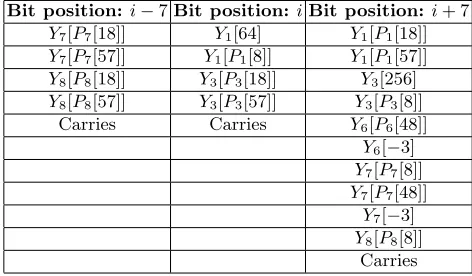
Table 1.Terms generated inO1(i)⊕O3(i+7)⊕O7(i+7)⊕O8(i+7), given the eventsE1 toE7 simultaneously occur (the terms are grouped by their bit positions)
Bit position: i−7Bit position: iBit position:i+ 7
Y7[P7[18]] Y1[64] Y1[P1[18]]
Y7[P7[57]] Y1[P1[8]] Y1[P1[57]]
Y8[P8[18]] Y3[P3[18]] Y3[256]
Y8[P8[57]] Y3[P3[57]] Y3[P3[8]] Carries Carries Y6[P6[48]]
Y6[−3]
Y7[P7[8]]
Y7[P7[48]]
Y7[−3]
Y8[P8[8]] Carries
Proof.Equation (5) gives us:
s1=ROT L32(s0+Y1[P1[18]]−Y1[P1[57]], P1[26] + 18 mod 32).
The first condition (P1[26]≡ −18 mod 32) reduces this to
s1=s0+Y1[P1[18]]−Y1[P1[57]].
Therefore,
s2=ROT L32(s0+Y2[P2[18]]−Y2[P2[57]] +Y1[P1[18]]−Y1[P1[57]],
P2[26] + 18 mod 32).
Conditions 3 and 4, when used with (1), reduce the above equation to
Finally, with condition 2 (i.e.,P2[26]≡7 mod 32), the previous equation becomes
s2=ROT L32(s0,25)
⇒s2(i)=ROT L32(s0,25)i =s0(i−25)
=s0(i+7). (20)
This completes the proof.
Now we observe that, when the conditions listed under (i) Lemma 1 (i.e., eventsE1,E3,E4andE5)
and (ii) Lemma 2 (i.e., eventsE1,E2,E6 andE7) are simultaneously satisfied, then the expression
O1(i)⊕O3(i+7)⊕O7(i+7)⊕O8(i+7) is the XOR of the terms which are listed in Table 1 (grouped
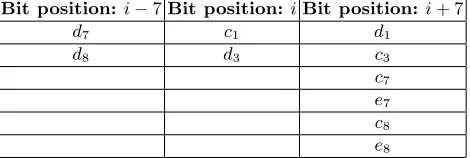
according to the bit positions).2 Similarly, the ‘carries’ in Table 1 are elaborated in Table 2.
Table 2.Carry terms generated inO1(i)⊕O3(i+7)⊕O7(i+7)⊕O8(i+7) grouped by their bit positions
Bit position: i−7Bit position: iBit position:i+ 7
d7 c1 d1
d8 d3 c3
c7
e7
c8
e8
If theY-terms in Table 1 are pairwise equated (this is achieved when the events E8 through to
E16 occur) then we get
O1(i)⊕O3(i+7)⊕O7(i+7)⊕O8(i+7)=d7(i−7)⊕d8(i−7)⊕c1(i)⊕d3(i)⊕d1(i+7)
⊕c3(i+7)⊕c7(i+7)⊕e7(i+7)⊕c8(i+7)
⊕e8(i+7). (21)
Now, when the RHS of (21) equals zero (i.e.,E17 occurs) we get
O1(i)⊕O3(i+7)⊕O7(i+7)⊕O8(i+7)= 0.
This completes the proof.
4
Computation of the Bias
In this section, we quantify the bias in the outputs of TPy6 (and hence Py6) induced by the fortuitous events similar to the one described in Sect. 3. Now it is important to note that there may bemore than one set of 17 conditionspossible, where each of them results inO1(i)⊕O3(i+7)⊕O7(i+7)⊕O8(i+7)= 0
(let us assume that there are nsuch sets). In Theorem 1, we listed one such set. Our experiments suggest that thesensets are mutually independent, however, a formal proof of that is nontrivial.
Each of the eventsE1toE5occurs with approximate probability 321 and each of the eventsE6to
E16 occurs with probability which is approximately 641. Letpdenote the probability that condition
17 is satisfied. LetF denote the eventT16j=1Ej. Therefore,
P[F] = ( 1 32)
5·(1
64)
11.
2 Note that none of the terms listed in Table 1 is of the formAcbecause we used the fact thatAc⊕Bc=A⊕B
We see that there are n F-like events (i.e., the intersection of 16 conditions). Let Fn denote the union of thesenevents. Since, each event occurs with approximately the same probability,
P[Fn]≈n·P[F]
≈n·(1 32)
5·(1
64)
11
=n· 1
291.
From Table 1, we get the maximum number of ways that terms of a particular column can be pairwise equated and hence the upper bound onncan be calculated to be 2·2·945 = 3780, that is, n <3780.
4.1 Formulating the Bias
Now, we establish a formula to compute P[O1(i)⊕O3(i+7)⊕O7(i+7)⊕O8(i+7)= 0], under the
as-sumption of a perfectly random key/IV setup and the uniformity of bits whenFn does not occur.Our experiments suggest that it is infeasible to find a set of conditions such that the overall bias (com-puted on the basis of the aforementioned assumption of randomness in the event thatFn does not occur) is canceled or reduced in magnitude. Therefore, this assumption is reasonable. LetT denote O1(i)⊕O3(i+7)⊕O7(i+7)⊕O8(i+7). Then using Bayes’ rule we get
P[T = 0] =P[T = 0|Fn∩E17]·P[Fn∩E17] +P[T = 0|Fnc∪E c
17]·P[Fnc∪E c
17]
=P[T = 0|Fn∩E17]·P[Fn∩E17] +P[T = 0|Fnc∩E17]·P[Fnc∩E17]
+P[T = 0|Fn∩E17c ]·P[Fn∩E17c ] +P[T = 0|Fnc∩E17c ]·P[Fnc∩Ec17]
= 1·(n·p· 1
291) +
1
2 ·(1−n· 1
291)·p+ 0·P[Fn∩E
c
17]
+ 1
2·(1−n· 1
291)·(1−p)
= 1
2+n·(2p−1)· 1
292. (22)
Hence, we see that the distribution of the outputs (O1(i), O3(i+7), O7(i+7), O8(i+7)) is biased. The
bias is equal ton·(2p−1)· 1
292. In the following section, we provide formulas to computep, i.e., the probability thatE17occurs; or more generally, the probability that the 17th condition of each of the
n F-like events occurs, i.e.,P[d7(i−7)⊕d8(i−7)⊕c1(i)⊕d3(i)⊕d1(i+7)⊕c3(i+7)⊕c7(i+7)⊕e7(i+7)⊕ c8(i+7)⊕e8(i+7)] = 0.
4.2 Biases in the Carry Terms
In this section, we provide formulas to calculate the bias in the carry terms. The carry termscand e are generated in expressions of the form (S⊕X) +Z. We now proceed to calculate P[cl(i) = 0]
assuming that S, X and Z are uniformly distributed and independent. Under this assumption, P[Si = 0] =P[Xi = 0] = P[Zi = 0] = 12, that is, the probability that the carry bit at position i equals zero depends only oni. Stated otherwise,P[c(i)= 0] =P[e(i)= 0]. LetP[c(i)= 0] be denoted
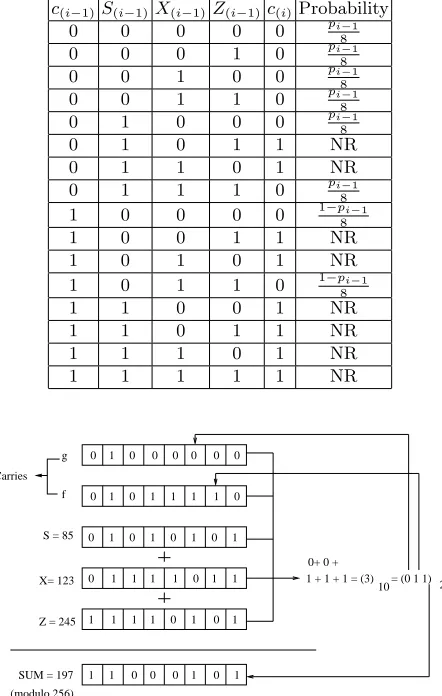
bypi. Since there is no carry on the lsb,p0= 1. We now have Table 3.
From Table 3, using Bayes’ rule we get
pi= pi−1
2 +
1 4.
Solving this recursion, givenp0= 1, we get
pi= 1 2+
1
Table 3.Truth table for computingpi(NR=Not Required)
c(i−1)S(i−1)X(i−1)Z(i−1)c(i)Probability
0 0 0 0 0 pi−1
8 0 0 0 1 0 pi−1
8 0 0 1 0 0 pi−1
8 0 0 1 1 0 pi−1
8 0 1 0 0 0 pi−1
8
0 1 0 1 1 NR
0 1 1 0 1 NR
0 1 1 1 0 pi−1
8 1 0 0 0 0 1−pi−1
8
1 0 0 1 1 NR
1 0 1 0 1 NR
1 0 1 1 0 1−pi−1
8
1 1 0 0 1 NR
1 1 0 1 1 NR
1 1 1 0 1 NR
1 1 1 1 1 NR
1 0 1 0 1 0 1 0
0 0
0 0 1 1 1 1 1 1
1 1 1 1 1 1 0 0 0 0
0 0 0 0 0
0 1 1 1 1 1 1 1 1 1
1 0 0 0 0
0+ 0 +
10 1 + 1 + 1 = (3) = (0 1 1)
2 S = 85
X= 123
Z = 245 g
f Carries
SUM = 197 (modulo 256)
Fig. 2.An example showing how the carries are generated when three 8-bit variablesS= 85,X= 123 and
Z= 245 are added
Now, the carry terms f and g are generated in expressions of the form S+X−Z. This can be rewritten as S +X +Zc + 1 since the additions in these two expressions are modulo 232. The
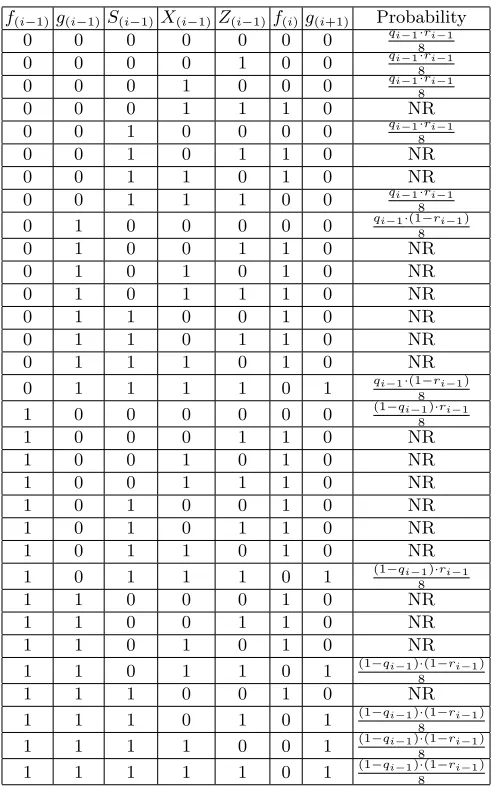
presence of two carries in S+X+Z is demonstrated using the Figure 2. The carries generated in S+X+Zc+ 1 can be thought of as carries generated inS+X+AwhereA=Zc and the carries on the lsb f(0) = 1,g(0) = 0. Let qi denote P[f(i) = 0] and ri denote P[g(i) = 0]. Hence,q0 = 0,
r0= 1 andr1= 1. Now we have Table 4.
From Table 4, using Bayes’ rule we get
qi = 1 2 +
5·qi−1·ri−1
8 −
qi−1
4 −
ri−1
4 , (24)
ri+1=1
2 −
qi−1·ri−1
4 +
3·qi−1
8 +
3·ri−1
8 . (25)
Using the initial conditions, q0 = 0,r0 = 1 and r1 = 1, qi and ri are computed recursively. Since dm(i) denotesfm(i)⊕gm(i)for anym >0,
Table 4.Truth table for computingqi andri+1usingqi−1 andri−1 (NR=Not Required)
f(i−1)g(i−1)S(i−1)X(i−1)Z(i−1)f(i)g(i+1) Probability
0 0 0 0 0 0 0 qi−1·ri−1
8 0 0 0 0 1 0 0 qi−1·ri−1
8 0 0 0 1 0 0 0 qi−1·ri−1
8
0 0 0 1 1 1 0 NR
0 0 1 0 0 0 0 qi−1·ri−1
8
0 0 1 0 1 1 0 NR
0 0 1 1 0 1 0 NR
0 0 1 1 1 0 0 qi−1·ri−1
8 0 1 0 0 0 0 0 qi−1·(1−ri−1)
8
0 1 0 0 1 1 0 NR
0 1 0 1 0 1 0 NR
0 1 0 1 1 1 0 NR
0 1 1 0 0 1 0 NR
0 1 1 0 1 1 0 NR
0 1 1 1 0 1 0 NR
0 1 1 1 1 0 1 qi−1·(1−ri−1)
8 1 0 0 0 0 0 0 (1−qi−1)·ri−1
8
1 0 0 0 1 1 0 NR
1 0 0 1 0 1 0 NR
1 0 0 1 1 1 0 NR
1 0 1 0 0 1 0 NR
1 0 1 0 1 1 0 NR
1 0 1 1 0 1 0 NR
1 0 1 1 1 0 1 (1−qi−1)·ri−1
8
1 1 0 0 0 1 0 NR
1 1 0 0 1 1 0 NR
1 1 0 1 0 1 0 NR
1 1 0 1 1 0 1 (1−qi−1)·(1−ri−1)
8
1 1 1 0 0 1 0 NR
1 1 1 0 1 0 1 (1−qi−1)·(1−ri−1)
8 1 1 1 1 0 0 1 (1−qi−1)·(1−ri−1)
8 1 1 1 1 1 0 1 (1−qi−1)·(1−ri−1)
2. P[c1(i)= 0] = 12+ 1 2i+1,
3. P[d3(i)= 0] =qi·ri+ (1−qi)·(1−ri), 4. P[d1(i+7)= 0] =qi+7 mod 32·ri+7 mod 32
+ (1−qi+7 mod 32)·(1−ri+7 mod 32),
5. P[c3(i+7)= 0] =P[c7(i+7)= 0] =P[e7(i+7)= 0] =P[c8(i+7)= 0]
=P[e8(i+7)= 0] = 12+2(i+7 mod 32)+11 .
Using the above formulas, the value of p can be computed for any given i. Running simulation, we find that the maximum bias in the chosen outputs occurs when i = 25 which corresponds to p= 0.5−2−34.2. Hence, (22) gives us
P[T = 0] = 1 2 −
n 2125.2
⇒P[T = 1] = 1 2+
n 2125.2,
wheni= 25. Substituting n= 3780 in the above equation, we get:
P[T = 1] = 1 2 +
1
2113.3. (26)
This is an upper bound on the probability that the outputs (O1(i),O3(i+7),O7(i+7),O8(i+7)) of TPy6
(and hence Py6) are biased. From Sect. 3, we found thatn≥1. From the previous discussion, we see thatn <3780. Hence, 1≤n <3780. Ifn= 1, then P[T = 1] = 12+21251.2. Thus,
1 2(1 +
1
2124.2)≤P[T = 1]<
1 2(1 +
1
2112.3). (27)
5
The Distinguisher
A distinguisher is an algorithm which distinguishes a given stream of bits from a stream of bits gen-erated by a perfect PRBG. The distinguisher is constructed by collecting sufficiently many outputs (O1(25), O3(0), O7(0), O8(0)) generated by as many key/IVs. To compute the minimum number of
samples required to establish the distinguisher, we use the following corollary of a theorem from [7].
Corollary 1. If an event eoccurs in a distributionX with probability pand in Y with probability
p(1 +q) then, if p = 1 2, O(
1
q2) samples are required to distinguish X from Y with non-negligible
probability of success.
In the present case, eis the event O1(25)⊕O3(0)⊕O7(0)⊕O8(0) = 0, X is the distribution of the
outputs O1, O3, O7 and O8 produced by a perfectly random keystream generator and Y is the
distribution of the outputs produced by TPy6. From (27),p= 12 and the highest value ofq= 21121.3. HenceO((2−1121.3)2) =O(2
224.6) output samples are needed to construct the best distinguisher with
a non-negligible probability of success.
6
A Family of Distinguishers
In Sect. 3 we found that the outputs at rounds 1, 3, 7 and 8 are biased allowing us to build a distinguisher. It is found that there exist plenty of 4-tuples of biased outputs. The generalization is presented in the following theorem.
Theorem 2. The distribution of the outputs (Or(i), Or+2(i+7), Ot(i+7),Ou(i+7)) of the TPy6 are
biased for many suitably chosen (r,t,u)’s wherer >0;t, u≥5;t6∈ {r, r+ 2, u};u6∈ {r, r+ 2, t}.
7
Two New Ciphers: TPy6-A and TPy6-B
The Py-family of stream ciphers has been subject to extensive analysis ever since Py and Py6 were proposed in April 2005. The impressive speeds of the ciphers in software, particularly the Py6 and the TPy6, have motivated us to modify the TPy6 to rule out all the attacks described in the previous sections of the paper. Firstly, many attacks on the Py, in particular, [5], [8], [9] and [15] can be easily translated to attacks on the Py6. However, due to smaller internal state of the TPy6, the attack described in [11] does not apply to TPy6. Secondly, the speed of execution of Py6 on Pentium-III is about 2.82 cycles/byte which is very fast. These observations make TPy6 and Py6 more favorable to be used as fast stream ciphers than Py. The TPy6 is resistant to the attacks described in [8], [15]. In order to generate a fast and secure stream cipher, we redesign the TPy6 where the variable rotation of a 32-bit termsin the round function is replaced by a constant, non-zero rotation term. The resultant cipher is named TPy6-A. It is shown that this tweak clearly reduces one addition operation in each round (thereby, the performance is improved) and makes the cipher secure against all the existing attacks on Py6 and TPy6. A relatively slower version, where one outputword is removed from each round of TPy6, is also proposed. The speeds of execution of the TPy6-A and TPy6-B on Pentium-III are 2.65 cycles/byte and 4.4 cycles/byte. Our security analysis conjectures that the TPy6-A and TPy6-B are immune to all attacks better than brute force. Algorithm 2 describes the PRBGs of the TPy6-A and TPy6-B. Note that the key/IV setup algorithms of the ciphers are identical to the key/IV setup of TPy6.
Algorithm 2Round functions of TPy6-A and TPy6-B Require: Y[−3, ...,64], P[0, ...,63], a 32-bit variables
Ensure: 64-bit random (TPy6-A) or 32-bit random (TPy6-B) output /*Update and rotateP*/
1: swap (P[0],P[Y[43]&63]); 2: rotate (P);
/* Update s*/
3: s+ =Y[P[18]]−Y[P[57]];
4: s=ROT L32(s,19); /*Tweak:variable rotation in TPy6 replaced by aconstant non-zerorotation*/
/* Output 8 bytes (least significant byte first)*/
5: output ((ROT L32(s,25)⊕Y[64]) +Y[P[8]]);/*this step is removed for TPy6-B*/ 6: output (( s ⊕Y[−1]) +Y[P[21]]);
/* Update and rotateY*/
7: Y[−3] = (ROT L32(s,14)⊕Y[−3]) +Y[P[48]]; 8: rotate(Y);
7.1 Security Analysis
In this section we justify how the new ciphers TPy6-A and TPy6-B should be able to resist several common attacks against array-based stream ciphers.
(i) Resistance to Distinguishing Attacks: The TPy6-A and the TPy6-B are modified versions of the TPy6. The following distinguishing attacks are applicable to the TPy6. We now show why those attacks do not apply to the new designs.
1. Paul-Preneel attack[10]: This attack applies to the TPy6. Condition 1 under Theorem 1 in [9], that is, P2[26] ≡ −18 mod 32, is impossible when c = 19 (in which case we have P2[26] ≡
1 mod 32). Note that when c = 0, P2[26] ≡ −18 mod 32 is satisfied. Therefore,c = 0 is not a
safe choice.
2. The attack described in this paper: Again, condition 1 under Theorem 1, that is, P1[26] ≡
condition 1 is common to all the nsets (1≤n <3780) of conditions (see Sect. 4) and hence its violation nullifies the attack.
In Appendix A, we elaborate more on the usefulness of selection of constant rotation to eliminate any distinguishing attacks on the new ciphers.
(ii) Resistance to Differential attacks: Wu and Preneel found weaknesses in the IV setups of the Py6 [15]. Exploiting these weaknesses, it is possible to recover some key-dependent information. The cipher TPy6 was specifically designed to rule out these weaknesses. Since the IV setup algorithms of the TPy6-A and the TPy6-B are identical with that of TPy6, these attacks are no longer applicable to the new ciphers.
(iii) Resistance to Algebraic attacks and Guess-and-Determine Attacks: TPy6-A and TPy6-B are array-based stream ciphers. The sizes of the internal states of TPy6-A and TPy6-B are 2,720 bits each, which is quite large. Hence, it appears infeasible to mount algebraic attacks that are otherwise common against LFSR-based stream ciphers which have low footprints. From our experiments, we expect that the TPy6-A and TPy6-B are also secure against guess-and-determine attacks.
8
Conclusions and Open Problems
The first contribution of the paper is the development of a family of distinguishers from the outputs at rounds r,r+ 2, t and uof the cipher TPy6 (and Py6), wherer >0; t, u≥5;t 6∈ {r, r+ 2, u}; u6∈ {r, r+ 2, t}. The best distinguisher works with data complexity 2224.6. It is reasonable to assume
that these weak states can be combined to mount a more efficient attack on TPy; however, methods to combine many distinguishers into a single yet more efficient one is still an open problem. The second contribution is a proposal of two new, extremely fast stream ciphers TPy6-A and TPy6-B, which rule out all the existing attacks on the TPy6 and are conjectured to be immune to all attacks better than brute force.
References
1. T. Baign`eres, P. Junod and S. Vaudenay, “How Far Can We Go Beyond Linear Cryptanalysis?,”Asiacrypt 2004 (P. Lee, ed.), vol. 3329 ofLNCS, pp. 432–450, Springer-Verlag, 2004.
2. E. Biham, J. Seberry, “Tweaking the IV Setup of the Py Family of Ciphers – The Ciphers Tpy, TPypy, and TPy6,” Published on the author’s webpage at http://www.cs.technion.ac.il/ biham/, January 25, 2007.
3. E. Biham, J. Seberry, “Py (Roo): A Fast and Secure Stream Cipher using Rolling Arrays,” ecrypt submission, 2005.
4. E. Biham, J. Seberry, “Pypy (Roopy): Another Version of Py,”ecrypt submission, 2006.
5. P. Crowley, “Improved Cryptanalysis of Py,”Workshop Record of SASC 2006 - Stream Ciphers Revisited, ECRYPT Network of Excellence in Cryptology, February 2006, Leuven (Belgium), pp. 52-60.
6. S. Fluhrer, I. Mantin, A. Shamir, “Weaknesses in the Key Scheduling Algorithm of RC4,” Selected Areas in Cryptography 2001 (S. Vaudenay, A. Youssef, eds.), vol 2259 of LNCS, pp. 1-24, Springer-Verlag, 2001. 7. I. Mantin, A. Shamir, “A Practical Attack on Broadcast RC4,”Fast Software Encryption 2001(M.
Mat-sui, ed.), vol. 2355 ofLNCS, pp. 152-164, Springer-Verlag, 2001.
8. T. Isobe, T. Ohigashi, H. Kuwakado M. Morii, “How to Break Py and Pypy by a Chosen-IV Attack,” eSTREAM, ECRYPT Stream Cipher Project, Report 2006/060.
9. S. Paul, B. Preneel, G. Sekar, “Distinguishing Attacks on the Stream Cipher Py,” Fast Software En-cryption 2006 (M. Robshaw, ed.), vol. 4047 ofLNCS, pp. 405-421, Springer-Verlag, 2006.
10. S. Paul, B. Preneel “On the (In)security of Stream Ciphers Based on Arrays and Modular Addition,” Asiacrypt 2006 (X. Lai and K. Chen, eds.), vol. 4284 ofLNCS, pp. 69-83, Springer-Verlag, 2006. 11. G. Sekar, S. Paul, B. Preneel, “Weaknesses in the Pseudorandom Bit Generation Algorithms of the
Stream Ciphers TPypy and TPy,” available athttp://eprint.iacr.org/2007/075.pdf.
13. G. Sekar, S. Paul, B. Preneel, “Related-key Attacks on the Py-family of Ciphers and an Approach to Repair the Weaknesses,” available at http://www.cosic.esat.kuleuven.be/publications/article-932.pdf.
14. Y. Tsunoo, T. Saito, T. Kawabata, H. Nakashima, “Distinguishing Attack against TPypy,” Selected Areas in Cryptography 2007 (to appear).
15. H. Wu, B. Preneel, “Differential Cryptanalysis of the Stream Ciphers Py, Py6 and Pypy,” Eurocrypt 2007 (Moni Naor, ed.), vol. 4515 ofLNCS, pp. 276-290, Springer-Verlag, 2007.
A
Effect of Any Non-zero Constant Rotation in TPy6-A and TPy6-B
The distinguishing attacks on Py6 (and hence TPy6) presented in [10] are based on the fact that, when certain conditions on the elements of arrayP are satisfied thensr(i)=sr+2(j), whererdenotes
the round andi,j (0≤i,j≤31) denote the bit positions.
We now examine the effect of constant rotation (say c) in step 4 of the PRBG of TPy6 (see Algorithm 1).
sr(i)=ROT L32(sr−1+Yr[Pr[18]]−Yr[Pr[57]], c)i (28) = (sr−1+Yr[Pr[18]]−Yr[Pr[57]])i−cmod 32. (29)
Letkdenote i−cmod 32. Therefore,
sr(i)=sr−1(k)⊕Yr[Pr[18]]k⊕Yrc[Pr[57]]k⊕er(k),
whereedenotes the carry term generated in (29) and er(0) = 1.
Similarly, if ldenotesj−cmod 32, we have,
sr+2(j)=sr+1(l)⊕Yr+2[Pr+2[18]]l⊕Yrc+2[Pr+2[57]]l⊕er+2(l). (30)
Again, we have
sr+1(l)=sr(m)⊕Yr+1[Pr+1[18]]m⊕Yrc+1[Pr+1[57]]m⊕er+1(m), (31)
wheremdenotesl−cmod 32, and
sr(m)=sr−1(n)⊕Yr[Pr[18]]n⊕Y
c
r[Pr[57]]n⊕er(n), (32)
where ndenotes m−cmod 32. Substituting (31) and (32) in (30), we get that the expression for sr(i)⊕sr+2(j)contains the termsr−1(k)⊕sr−1(n). Now, it follows that ifk6=n, it is very likely that
the terms sr(i) and sr+2(j) are not correlated. Besides, there are a number of Y-terms at different
bit-positions and the terms do not cancel out ifi6=j.
![Fig. 1. The figure shows the update of the S-boxYwhen Y . Yn[i] = Yn+1[i − 1] when −2 ≤ i ≤ 64](https://thumb-us.123doks.com/thumbv2/123dok_us/1854129.1240710/4.612.191.422.24.143/fig-gure-shows-update-s-boxywhen-yn-yn.webp)