Loin d’être l’idéal
La perception du poids, le contrôle du poids et les comportements à risque
qui y sont associés chez des adolescentes de la Nouvelle-Écosse
Sarah Jane Cook,
MDKathleen MacPherson,
MD MPHDonald B. Langille,
MD MHScRÉSUMÉ
OBJECTIF
Examiner la prévalence des préoccupations entourant le poids, les mesures pour contrôler le poids et d’autres comportements associés nuisibles pour la santé chez des adolescentes, et vérifier si ces jeunes femmes avaient discuté de leur poids santé avec leur médecin.CONCEPTION
Étude transversale par sondage anonyme.CONTEXTE
Quatre écoles secondaires dans des milieux ruraux, en Nouvelle-Écosse.PARTICIPANTES
Adolescentes de la 10e à la12e années du secondaire.PRINCIPALES MESURES DES RÉSULTATS
Perception de son poids, prévalence des mesures de contrôle du poids, associations entre la perception du poids et les comportements à risque, associations entre l’alimentation déséquilibrée et d’autres comportements à risque.RÉSULTATS
Dans l’ensemble, le taux de réponse se situait à 76%. La moitié des 1 133 participantes estimaient ne pas peser le «bon» poids; 60% essayaient de maigrir. Au cours des 30 derniers jours, 16% des jeunes filles avaient essayé de contrôler ou de diminuer leur poids et avaient adopté des habitudes alimentaires mal équilibrées. Dans une analyse unidimensionnelle, la perception d’avoir un excès de poids ou d’être maigres était étroitement reliée à des pensées suicidaires, à des projets de suicide et à un risque de dépression. Dans une analyse multidimensionnelle, des associations positives ont été constatées entre l’alimentation déséquilibrée et les pensées suicidaires (rapport de cotes [RC] 4,2, intervalle de confiance [IC] à 95% 2,6 à 6,7), les projets de suicide (RC 2,9, IC à 95% 1,7 à 4.7), les tentatives de suicide (RC 3,4, IC à 95% 1,8 à 6,6), et le fait d’avoir déjà eu des relations sexuelles vaginales (RC 1,6, IC à 95% 1,1 à 2,5). Seulement 22% des répondantes avaient parlé de poids santé avec unmédecin.
CONCLUSION
Les préoccupations entourant le poids sont fréquentes chez les adolescentes en Nouvelle-Écosse. Bon nombre d’entre elles, surtout celles qui se trouvent trop grosses ou trop maigres, adoptent des méthodes de contrôle du poids nuisibles pour leur santé. La perception de grosseur ou de maigreur et l’alimentation déséquilibrée sont fortement associées à la dépression et à des comportements autodestructeurs. Peu nombreuses étaient les participantes qui avaient discuté de poids santé avec un médecin. Les professionnels de la santé devraient être au fait des associations entre la perception du poids, l’alimentation mal équilibrée et d’autres comportements à risque.POINTS DE REPÈRE DU RÉDACTEUR
•
Dans cette étude, plus de 80% des étudiantes du
secondaire essayaient de faire quelque chose à
propos de leur poids. Parmi celles qui considéraient
avoir un «juste» poids, plus de 50% essayaient quand
même de maigrir.
•
De nombreuses étudiantes adoptaient des
comporte-ments à risque, comme le tabagisme, la
consomma-tion de marijuana et une activité sexuelle précoce.
•Un comportement alimentaire déséquilibré et la
per-ception de maigreur ou de grosseur étaient reliés à
la dépression et à un comportement autodestructeur.
Cet article a fait l’objet d’une révision par des pairs.
Le texte intégral est aussi accessible en anglais à
www.cfpc.ca/cfp
.
Can Fam Physician 2007;53:678-684
Far from ideal
Weight perception, weight control, and associated
risky behaviour of adolescent girls in Nova Scotia
Sarah Jane Cook
MDKathleen MacPherson
MD MPHDonald B. Langille
MD MHScABSTRACT
OBJECTIVE
To examine the prevalence of weight-related concerns, unhealthy weight-control behaviour, and associated risky behaviour among adolescent girls, and to ascertain whether these girls had discussed a healthy weight with their physicians.DESIGN
Anonymous, self-report, cross-sectional survey.SETTING
Four high schools in rural Nova Scotia.PARTICIPANTS
Adolescent girls in grades 10 to 12.MAIN OUTCOME MEASURES
Weight perception, prevalence of weight-control behaviour, associations between weight perception and risky behaviour, associations between disordered eating behaviour and other risky behaviour.RESULTS
Overall response rate was 76%. Half the 1133 participants saw themselves as not being the “right” weight; 60% were trying to lose weight. During the past 30 days, 16% of the girls were attemptingto control or lose weight and had engaged in disordered eating behaviour. In univariate analysis,
perception of being either overweight or underweight was significantly associated with suicidal thoughts, suicide planning, and risk of depression. In multivariate analysis, positive associations were found between disordered eating behaviour and suicidal thoughts (odds ratio [OR] 4.2, 95% confidence interval [CI] 2.6 to 6.7), suicide planning (OR 2.9, 95% CI 1.7 to 4.7), suicide attempts (OR 3.4, 95% CI 1.8 to 6.6), and ever having had vaginal intercourse (OR 1.6, 95% CI 1.1 to 2.5). Only 22% of respondents had spoken with a doctor about a healthy weight.
CONCLUSION
Weight concerns are prevalent among adolescent girls in Nova Scotia. Many of them, especially those who see themselves as overweight or underweight, engage in unhealthy weight-control methods. Perceived underweight and overweight and disordered eating behaviour have strong associations with depression and self-harming behaviour. Few participants had discussed a healthy weight with a physician. Health professionals should be aware of the associations between weight perception and disordered eating behaviour and other risky behaviour.EDITOR’S KEY POINTS
•
In this study, more than 80% of high school girls
were trying to do something about their weight.
Among those who saw themselves as the “right”
weight, more than 50% were trying to lose weight
anyway.
•
Many of the students were indulging in risky
behav-iour, such as smoking, regular marijuana use, and
early sexual activity.
•
Disordered eating behaviour and perceptions of
being underweight or overweight were linked to
depression and self-harming behaviour.
This article has been peer reviewed.
Full text is also available in English at
www.cfpc.ca/cfp
.
Can Fam Physician 2007;53:678-684
Research
Far from ideal
M
ost adolescent girls are concerned about con-trolling their weight,1 and there is pressure from the media and their parents to be thin.2,3 Weight-related concerns and behaviour are common among adolescents, particularly girls.4-11Whatever adolescent girls actually weigh, poor body image is often associated with eating disorders.5,12 These eating disorders can have serious consequences, includ-ing malnutrition, menstrual irregularity, gastrointesti-nal problems, and delayed sexual maturation.13,14 Eating disorders have also been associated with depression,1,15 suicidal thoughts,1,5,10 substance use,16,17 early sexual activity,5 and not using contraception.10
The American Medical Association’s (AMA) Guidelines for Adolescent Preventive Services recommend that “all adolescents should be screened annually for eating dis-orders and obesity by determining weight and stature, and asking about body image and dieting patterns.”18 When adolescents see health professionals, however, they most often do so for physical complaints rather than for risky behaviour.19 They are also often not given preventive counseling,20 including counseling about weight.21,22
The Canadian Paediatric Society maintains that eating disorders should be considered in adolescent patients who have unhealthy weight-control practices or demon-strate obsessive thinking about food, weight, or exercise. Eating disorders should be considered in all patients, not just those who meet Diagnostic and Statistical Manual of Mental Disorders’ criteria.23 This would be facilitated if the prevalence of weight-related concerns and disor-dered eating were known. Such information would also help guide population-based prevention efforts.24
Although some data exist on adolescents’ weight per-ception and eating behaviour in Canada,6,9,11,25 there are no Nova Scotia data, and no previous Canadian study has examined associations with other risky behaviour. The goal of this study was to provide information on teenage girls’ weight perceptions and weight-control behaviour, including disordered eating behaviour. For this study, disordered eating behaviour is defined as any 1 or a combination of fasting for ≥24 hours, using diet medications, vomiting, or using laxatives to lose weight. We also examined whether risky behaviour was associated with disordered eating behaviour and whether the girls had discussed a healthy weight with their physicians.
METHODS
Students in grades 10, 11, and 12 at 4 high schools in Nova Scotia participated in a self-report survey in May and June 2000. The survey included questions on weight perception, eating behaviour, depression, substance use, sexual behaviour, self-harming behaviour, contact with health professionals, and socioeconomic status.
The investigators formulated the questions on sex-ual health, contact with the health care system, and socioeconomic status. Although information on family income is difficult to obtain from adolescents,26 parental education usually correlates with household income.27 Socioeconomic status measures included family structure (2-parent family or other) and mother’s education (post-secondary education or not). Having a mother with higher education has been shown to be protective against risky behaviour in adolescent girls; not living with both parents has been associated with risky behaviour.28
Depression was measured with the Center for Epidemiologic Studies of Depression (CES-D) scale29 using a cut point of ≥24 for risk of depression.30 Questions on weight-control behaviour, self-harm (sui-cidal thoughts, suicide planning, and suicide attempt) and substance use were adapted from the Centers for Disease Control and Prevention’s Youth Risk Factor Surveillance Instrument.31 Information on body image included perception of weight and weight goals (lose, gain, stay the same, do nothing). Participants trying actively to lose or stay the same weight were also asked to answer questions about how they were controlling their weight. They were asked whether in the previous year they had spoken with a family doctor or other doc-tor about a healthy weight.
Questionnaires were pilot-tested on 31 grade 10 to 12 students at a non-participating school. The same ques-tionnaires were administered again 1 week later. Test-retest reliability was substantial to excellent (Cohen’s 0.76 to 1.0).32 The coefficient for the CES-D scale was .8. After the retest, discussions were held with students to
refine question wording and assess appropriateness. To further enhance validity, surveys were designed to mini-mize skip patterns, and teachers were trained to speak to students about the importance of accurate reporting.
Teachers administered the surveys during regular class time with members of the research team present. Ethics approval was obtained from the Dalhousie University Health Sciences Human Research Ethics Board. Written consent was obtained from participants. Parents were not required to give written consent, but were informed of the study through a letter sent home with their chil-dren and were given the option of informing the school if they did not wish their children to participate.
Since weight is more of a concern for adolescent girls than it is for boys,6,22 we included only girls’ responses in
Dr Cook is a second-year resident in family medicine at the University of Ottawa in Ontario. She began this analy-sis during an elective under the supervision of Dr Langille
the analysis, which was carried out using SPSS version 11. Univariate analysis using the χ2 statistic examined first
the relationship between weight perception and weight-control behaviour and then between weight perception and disordered eating behaviour and other risky iour. Relationships between disordered eating behav-iour and risky behavbehav-iour were then examined in logistic regression analysis, controlling for school, grade, grade-school interaction, socioeconomic status, risk of depres-sion, and weight perception.
RESULTS
At the time of data collection, 2832 students were reg-istered in grades 10 to 12. The parents of 7 of them refused permission, and 31 could not provide consent. Of the remaining 2794 students, 2159(77%) participated in the study; 52% of them were girls. Responses of these 1133 girls were included in our analysis. Their mean age
was 16.75 years (standard deviation 1.02 years, range 15 to 19 years).
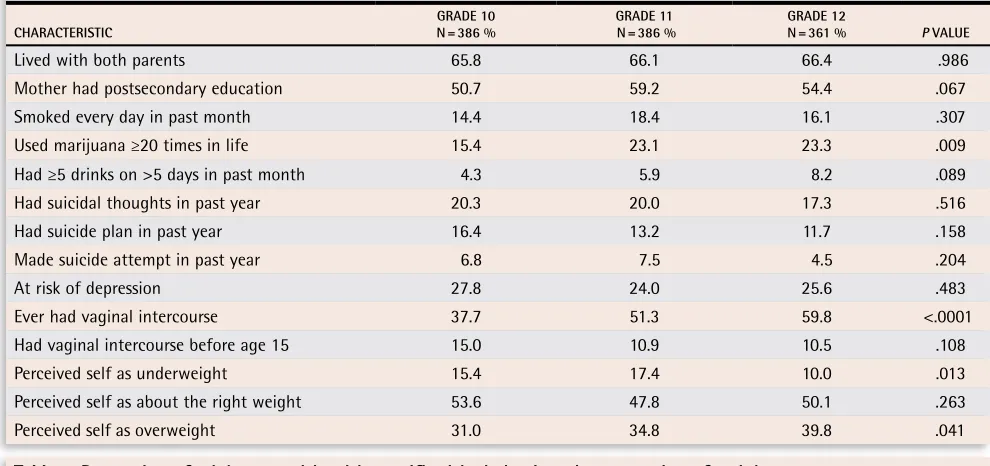
Respondents were distributed equally among grades (Table 1). A substantial number of girls exhibited risky behaviour, including smoking, regularly using marijuana, and engaging in early sexual activity. Nearly a fifth (19%) had had suicidal thoughts during the past year, 14% had made a plan for suicide, and 6% had attempted sui-cide. About 50% of respondents did not see themselves as being the “right” weight; 35% thought they were overweight, and 14% thought they were underweight. Perception of being overweight increased with grade level, while perception of being underweight decreased.
About 82% were trying to do something about their weight: 60% of them were trying to lose weight, 18% were trying to stay the same, and 4% were trying to gain weight. Nearly 90% of those who saw themselves as overweight were trying to lose weight. Among those who saw themselves as the right weight, 51% were try-ing to lose weight. Among those who saw themselves
Table 1. Sociodemographic characteristics and risky behaviour of adolescent girls by grade
CHARACTERISTIC N = 386 %GRADE 10 N = 386 %GRADE 11 N = 361 %GRADE 12 P VALUE
Lived with both parents 65.8 66.1 66.4 .986
Mother had postsecondary education 50.7 59.2 54.4 .067
Smoked every day in past month 14.4 18.4 16.1 .307
Used marijuana ≥20 times in life 15.4 23.1 23.3 .009
Had ≥5 drinks on >5 days in past month 4.3 5.9 8.2 .089
Had suicidal thoughts in past year 20.3 20.0 17.3 .516
Had suicide plan in past year 16.4 13.2 11.7 .158
Made suicide attempt in past year 6.8 7.5 4.5 .204
At risk of depression 27.8 24.0 25.6 .483
Ever had vaginal intercourse 37.7 51.3 59.8 <.0001
Had vaginal intercourse before age 15 15.0 10.9 10.5 .108
Perceived self as underweight 15.4 17.4 10.0 .013
Perceived self as about the right weight 53.6 47.8 50.1 .263
Perceived self as overweight 31.0 34.8 39.8 .041
Table 2. Proportion of adolescent girls with specific risky behaviour, by perception of weight
BEHAVIOUR
PERCEIVED SELF AS UNDERWEIGHT
N = 163 %
PERCEIVED SELF AS RIGHT WEIGHT N = 572 %
PERCEIVED SELF AS OVERWEIGHT
N = 398 % P VALUE
Smoked every day in past month 12.4 16.8 16.6 .389
Used marijuana ≥20 times in life 17.3 19.3 23.5 .16
Drank ≥5 drinks on >5 days in past month 6.3 5.3 7.2 .461 Had suicidal thoughts in past year 24.7 14.3 24.4 <.0001
Had suicide plan in past year 19.1 10.4 16.8 .002
Made suicide attempt in past year 8.1 4.6 8.1 .053
At risk of depression 32.1 20.5 31.0 <.0001
Ever had vaginal intercourse 47.8 49.5 49.7 .915
Research
Far from ideal
as underweight, 19% were trying to lose weight (data not shown).
Table 2 shows risky behaviour by weight perception. Suicidal thoughts, suicide planning, and being at risk of depression were significantly more common among those who saw themselves as not the right weight (ie, either underweight or overweight).
Table 3 shows specific weight-control behaviour according to weight perception among girls trying to lose weight or control their weight. Exercise was the most common behaviour, followed by eating less, fasting, tak-ing diet medications, vomittak-ing, or ustak-ing laxatives.
During the past 30 days, 16% of the girls trying to lose or control weight had engaged in disordered eating behaviour. Girls who saw themselves as underweight (20%) or overweight (22%) were more likely than those
who saw themselves as the right weight (11%) to engage in disordered eating behaviour (P < .001, data not shown).
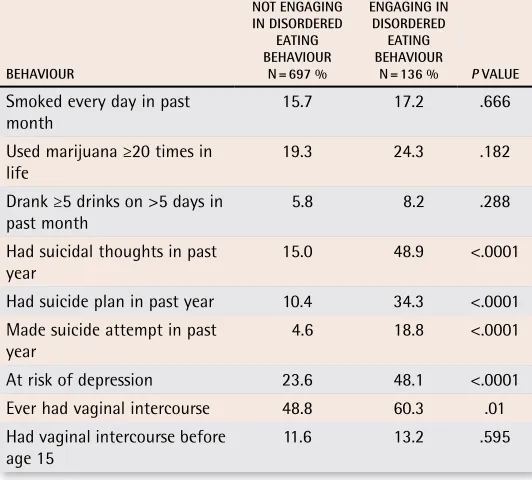
Table 4 shows the percentage of girls trying to lose or control weight who engaged in and did not engage in disordered eating behaviour who also exhibited other risky behaviour. Significant associations were found between disordered eating behaviour and suicidal thoughts, suicide planning, suicide attempts, high risk of depression, and ever having had vaginal intercourse.
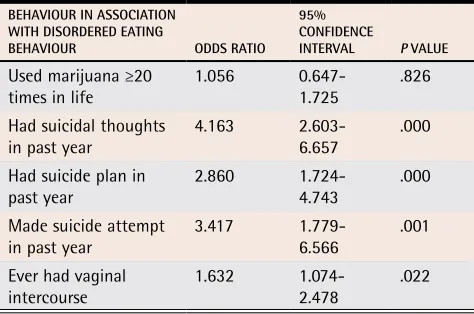
Results of logistic regression analysis are shown in Table 5. Positive associations were found between disordered eating behaviour and suicidal thoughts (odds ratio [OR] 4.2, 95% confidence interval [CI] 2.6 to 6.7), suicide planning (OR 2.9, 95% CI 1.7 to 4.7), sui-cide attempt (OR 3.4, 95% CI 1.8 to 6.6), and ever hav-ing had vaginal intercourse (OR 1.6, 95% CI 1.1 to 2.5).
Only 22% of girls had spoken with a doctor about a healthy weight in the year before the study. Girls engaging in disordered eating behaviour were more likely to have done so than those not engaging in disordered eating behaviour (31% vs 21%, P < .01, data not shown). Discussions about weight can take place only when there is an opportunity for them, and no direct question was asked about seeing a primary care physician during the past year. We did ask about interactions with physicians as rec-ommended in the AMA’s Guidelines for Adolescent Preventive Services.18 When responding yes to any item is taken as a proxy for a yes answer to having had a physician visit, we found that 80% of partici-pants had visited a physician.
DISCUSSION
This study shows that weight-related concerns and associated unhealthy behaviour are preva-lent among adolescent girls in rural Nova Scotia. Nearly half the participants saw themselves as being an appropriate weight, and most thought they were overweight. Most were trying to lose weight, regardless of weight perception. These results are similar to those of studies in Ontario,6,9 British Columbia,11 and elsewhere,1,8,10,33 and might reflect our culture’s perception of the ideal female body as ultrathin. The media promote images of this unrealistic body shape and serve to perpet-uate people’s dissatisfaction with the way they look and in the drive for thinness.3,34-37 Peer and parental pressure compounds these media influ-ences.3 Another Canadian study reported that older women more often perceived themselves as over-weight than underover-weight,6 though the reasons for this were unclear and deserve further study.
Table 3. Proportion of adolescent girls trying to lose or control
their weight with specific weight-control behaviour by
perception of weight
BEHAVIOUR
PERCEIVED SELF AS UNDERWEIGHT
N = 61 %
PERCEIVED SELF AS RIGHT
WEIGHT N = 410 %
PERCEIVED SELF AS OVERWEIGHT
N = 359 % P VALUE
Exercised 88.5 80.5 81.6 .319
Ate less 63.9 66.6 81.3 <.0001
Fasted 14.8 6.8 15.0 .0001
Took diet pills, powder, or liquid
6.6 4.6 5.6 .742
Vomited or
took laxatives 8.2 2.0 7.5 .0001
Table 4. Proportion of adolescent girls trying to lose or control
weight who were engaging in or not engaging in disordered
eating behaviour who also exhibited other risky behaviour
BEHAVIOUR
NOT ENGAGING IN DISORDERED
EATING BEHAVIOUR
N = 697 %
ENGAGING IN DISORDERED
EATING BEHAVIOUR
N = 136 % P VALUE
Smoked every day in past
month 15.7 17.2 .666
Used marijuana ≥20 times in
life 19.3 24.3 .182
Drank ≥5 drinks on >5 days in
past month 5.8 8.2 .288
Had suicidal thoughts in past
year 15.0 48.9 <.0001
Had suicide plan in past year 10.4 34.3 <.0001 Made suicide attempt in past
year 4.6 18.8 <.0001
At risk of depression 23.6 48.1 <.0001 Ever had vaginal intercourse 48.8 60.3 .01 Had vaginal intercourse before
The number of young women who engage in disor-dered eating behaviour is of concern. Among girls try-ing to lose or control weight, 11% fasted, and 5% used medications and self-induced vomiting. These results are similar to those of research in Canada6,9,11 and other coun-tries.1,5,8,10,38,39 Obesity is increasingly prevalent among Canadian adolescents.40 A recent Canadian study found an association between increased body mass index and eating disorders.6 The authors postulated that such a link might be mediated by a growing disparity between popular notions of ideal body weight and the reality of increased obesity.6 Our results indicate, however, that those who saw themselves as underweight were as likely as those who saw themselves as overweight to engage in disor-dered eating behaviour, though the cross-sectional nature of our data limits the interpretation of these relationships.
Those who saw themselves as not being the “right” weight, whether underweight or overweight, and those with disordered eating beviour had higher rates of harm-ing themselves and of ever havharm-ing had vaginal inter-course. The association between disordered eating behaviour and risk of suicide and early sexual activity has been seen elsewhere.1,5,10,15 This study demonstrated that this risky behaviour is associated with disordered eating behaviour regardless of depression and weight perception. Clinicians should consider risk of self-harm in those with disordered eating behaviour even if there is no evidence of depression. Other studies have found associations between disordered eating behaviour and substance use,16,17 though our study did not.
Only 22% of these adolescent girls had spoken with a doctor about weight, though discussion of eating behaviour occurred more often among those with dis-ordered eating behaviour than among those without (31% vs 21%). The Canadian Paediatric Society recog-nizes that, because of puberty-related developmental changes, formal diagnostic criteria for eating disorders
do not always apply to adolescents. Abnormal eating behaviour and attitudes and using vomiting or laxatives might well indicate the early stages of eating disorders, even when adolescents do not meet all the criteria.23 The AMA recommends that adolescents be assessed for eating disorders if they diet recurrently when they are not overweight or use vomiting, laxatives, starvation, or diuretics to lose weight.18
If physicians are to discuss a healthy weight with ado-lescents, they must have an opportunity to do so. Though little is published about how primary care physicians’ look after Canadian adolescents, a 1998 school study in Nova Scotia found that, of the 93% of female students who reported having a regular family doctor, 85% had visited that doctor at least once during the previous year.41 In Manitoba in 1998-1999, the average number of physician visits for those aged 15 to 19 years was 2.6, though the overall proportion of these adolescents receiving services was not reported.42 In this study, though no direct ques-tion was asked about seeing a primary care physician during the past year, we were able to estimate through questions about possible interactions with physicians that 80% of participants had visited physicians.
Though the Canadian Paediatric Society makes no specific suggestions for phrasing questions about eating behaviour, the AMA provides on its website question-naires for adolescents of various ages that include ques-tions about their eating habits.43 Progress has been made in developing screening tools, such as the 5-question SCOFF questionnaire (Table 6) developed in the United Kingdom.44 This questionnaire effectively detects eating disorders, including anorexia, bulimia, and nonspecified disorders, in primary care populations of women aged 18 to 50. Though little work has been carried out with adolescents, 1 study in Colombia found that the ques-tionnaire also worked well for adolescents attending school.45 Further study of such approaches is needed.
Limitations
This study has several limitations. In particular, body mass index was not assessed, directly or indirectly. Comparisons of body image and disordered eating behaviour and measures of weight and height would
Table 5. Results of logistic regression:
Odds ratios for
risky behaviour in association with disordered eating
behaviour.*
BEHAVIOUR IN ASSOCIATION WITH DISORDERED EATING
BEHAVIOUR ODDS RATIO 95% CONFIDENCE
INTERVAL P VALUE
Used marijuana ≥20
times in life 1.056 0.647-1.725 .826 Had suicidal thoughts
in past year 4.163 2.603-6.657 .000 Had suicide plan in
past year 2.860 1.724-4.743 .000 Made suicide attempt
in past year 3.417 1.779-6.566 .001 Ever had vaginal
intercourse 1.632 1.074-2.478 .022
*Controlling for risk of depression, weight perception, school, grade, and socioeconomic status.
Table 6. The SCOFF questions
Do you make yourself Sick when you feel uncomfortably full? Do you worry you have lost Control over how much you eat? Have you recently lost more than One stone† in a 3 month period?
Do you believe yourself to be Fat when others say you are too thin? Would you say that Food dominates your life?
*One point for every “yes”; a score of ≥2 indicates a likely case of anorexia nervosa or bulimia.
†One British stone = 6.4 kg or 14 lb.
Research
Far from ideal
have added a great deal to the study. The data are lim-ited to a rural region of northern Nova Scotia and to girls in school, and the study’s cross-sectional design allows establishment of associations, but not cause and effect. The study’s strengths include its large sample size, which represents approximately 25% of the girls aged 15 to 19 residing in the 3 counties examined,46 and its high participation rate.
Conclusion
This study demonstrates that dissatisfaction with body image and unhealthy weight-control measures are com-mon acom-mong adolescent girls in rural Nova Scotia and that many are not asked about such concerns by pri-mary care physicians. Adolescent girls should be asked about body image, desire for weight change, and weight-related behaviour. Identification of weight concerns or disordered eating behaviour should trigger further ques-tions about other risks, including depression, self-harm, and sexual activity. Brief screening instruments, such as the SCOFF questionnaire, appear to offer promise and should be tested on Canadian adolescents.
Contributors
Drs Cook and Langille contributed to study concept and design. Drs Cook, MacPherson, and Langille contrib-uted to data gathering, analysis, and interpretation and preparing the article for submission.
Competing interests
None declared
Correspondence to:Dr Sarah Jane Cook, 330-5
Cooper St, Ottawa, ON K2P 0G7; telephone 613 565-5140;
e-mail [email protected]
references
1. Neumark-Sztainer D, Hannan PJ. Weight-related behaviours among adolescent girls and boys: results from a national survey. Arch Pediatr Adolesc Med 2000;154:569-77. 2. McVey G, Tweed S, Blackmore E. Correlates of weight loss and muscle-gaining
behaviour in 10- to 14-year-old males and females. Prev Med 2005;40:1-9. 3. Field A, Camargo C, Taylor C, Berkey C, Roberts S, Colditz G. Peer, parent, and
media influences on the development of weight concerns and frequent dieting among preadolescent and adolescent girls and boys. Pediatrics 2001;107:54-60. 4. Grunbaum JA, Kann L, Kinchen S, Ross J, Hawkins J, Lowry R, et al. Youth risk
behavior surveillance—United States, 2003. MMWR Surveill Summ 2004;53(2):1-96. 5. French S, Story M, Downes B, Resnick M, Blum R. Frequent dieting among adolescents:
psychosocial and health behaviour correlates. Am J Public Health 1995;85:695-701. 6. Jones J, Bennett S, Olmsted M, Lawson M, Rodin G. Disordered eating attitudes and
behaviours in teenaged girls: a school-based study. CMAJ 2001;165:547-52. 7. Field A, Austin S, Taylor C, Malspeis S, Rosner B, Rockett H, et al. Relation between
dieting and weight change among preadolescents and adolescents. Pediatrics 2003;112:900-6.
8. Grigg M, Bowman J, Redman S. Disordered eating and unhealthy weight reduction practices among adolescent females. Prev Med 1996;25:748-56.
9. McVey G, Tweed S, Blackmore E. Dieting among preadolescent and young adoles-cent females. CMAJ 2004;170:1559-61.
10. Neumark-Sztainer D, Story M, Dixon L, Murray D. Adolescents engaging in unhealthy weight control behaviors: are they at risk for other health-compromising behaviors? Am J Public Health 1998;88:952-5.
11. McCreary Centre Society. 2003 Adolescent Health Survey. Vancouver, BC: McCreary Centre Society; 2004. Available from: http://www.mcs.bc.ca/. Accessed 2006 January 24.
12. Neumark-Sztainer D, Wall M, Story M, Perry CL. Correlates of unhealthy weight-control behaviours among adolescents: implications for prevention programs. Health Psychol 2003;22:88-98.
13. Bear M. Eating disorders: an overview. Toronto, Ont: National Eating Disorder Information Centre; 2003. p. 43-57.
14. Neumark-Sztainer D, Hannan P, Story M, Perry C. Weight-control behaviours among adolescent girls and boys: implications for dietary intake. J Am Diet Assoc 2004;104:913-20.
15. Fulkerson J, Sherwood N, Perry C, Neumark-Sztainer D, Story M. Depressive symp-toms and adolescent eating and health behaviors: a multifaceted view in a popula-tion-based sample. Prev Med 2004;38:865-75.
16. Potter B, Pederson L, Chan S, Aubut J, Koval J. Does a relationship exist between body weight, concerns about weight, and smoking among adolescents? An integration of the literature with an emphasis on gender. Nicotine Tobacco Res 2004;6:397-425.
17. Strauss RS, Mir HM. Smoking and weight loss attempts in overweight and normal-weight adolescents. Int J Obes Relat Metab Disord 2001;25:1381-5.
18. American Medical Association, Guidelines for Adolescent Preventive Services Executive Committee. Guidelines for adolescent preventive services: recommenda-tions monograph. Chicago, Ill: American Medical Association; 1997. Available from:
http://www.ama-assn.org/ama/upload/mm/39/gapsmono.pdf. Accessed 2006
February 11.
19. Patton G, Sanci L, Sawyer SM. Adolescent medicine. Med J Aust 2002;176(1):3. 20. Merenstein D, Green L, Fryer G, Dovey S. Shortchanging adolescents: room for
improvement in preventive care by physicians. Fam Med 2001;33:120-3. 21. Maradiegue A, Cecelic EK, Bozzelli MJ, Frances G. Do primary care providers
screen for eating disorders? Gastroenterol Nurs 1996;19(2):65-9.
22. Blum R, Beuhring T, Wunderlich M, Resnick M. Don’t ask, they won’t tell: the quality of adolescent health screening in five practice settings. Am J Public Health 1996;86:1767-72.
23. Adolescent Medicine Committee, Canadian Paediatric Society. Eating disor-ders in adolescents: principles of diagnosis and treatment. J Paediatr Child Health 1998;3(3):189-92.
24. McVey G, Davis R, Tweed S, Shaw B. Evaluation of a school-based program designed to improve body image satisfaction, global self-esteem, and eating atti-tudes and behaviors: a replication study. Int J Eat Disord 2004;36:1-11.
25. Thompson A, Chad K. The relationship of social physique anxiety to risk for devel-oping an eating disorder in young females. J Adolesc Health 2002;31:183-9. 26. Mullan E, Currie C. Socio-economic inequalities in adolescent health. In: Currie C,
Hurrelman K, Setterobulte W, Smith R, Todd J, editors. Health and health behaviour in young people. Copenhagen, Den: World Health Organization; 2000. p. 65-72. 27. Liberatos P, Link B, Kelsey J. The measurement of social class in epidemiology.
Epidemiol Rev 1988;10:87-121.
28. Langille D, Curtis L, Hughes J, Murphy G. Association of socio-economic factors with health risk behaviours among high school students in rural Nova Scotia. Can J Public Health 2003;94:442-7.
29. Radloff LS. The CES-D scale: a self-report depression scale for research in the gen-eral population. Appl Psychol Meas 1977;1:385-401.
30. Roberts R, Lewinsohn P, Seeley J. Screening for adolescent depression: a compari-son of depression scales. J Am Acad Child Adolesc Psychiatry 1991;30:58-66. 31. Brener ND, Collins JL, Kann I, Warren CW, Williams BL. Reliability of the youth risk
behavior questionnaire. Am J Epidemiol 1995;141:575-80.
32. Streiner DL, Norman GR. Health measurement scales: a practical guide to their devel-opment and use. New York, NY: Oxford University Press; 1995. p. 116-8.
33. Strauss R. Self-reported weight status and dieting in a cross-sectional sample of young adolescents: National Health and Nutrition Examination Survey III. Arch Pediatr Adolesc Med 1999;153:741-7.
34. Field AE, Cheung L, Wolf AM, Herzog D, Gortmaker S, Colditz GA. Exposure to the mass media and weight concerns among girls. Pediatrics 1999;103(3):E36. 35. Tiggemann M, Slater A. Thin ideals in music television: a source of social
compari-son and body dissatisfaction. Int J Eat Disord 2004;35:48-58.
36. Tiggemann M, Pickering A. Role of television in adolescent women’s body dissatis-faction and drive for thinness. Int J Eat Disord 1996;20:199-203.
37. Field A, Camargo C, Taylor C, Berkey C, Colditz G. Relation of peer and media influ-ences to the development of purging behaviours among preadolescent and adoles-cent girls. Arch Pediatr Adolesc Med 1999;53:1184-9.
38. Croll J, Neumark-Sztainer D, Story M, Ireland M. Prevalence and risk and protective factors related to disordered eating behaviours among adolescents: relationship to gender and ethnicity. J Adolesc Health 2002;31:166-75.
39. Patton G, Carlin J, Shao Q, Hibbert M, Rosier M, Selzer R, et al. Adolescent diet-ing: healthy weight control or borderline eating disorder? J Child Psychol Psychiatry 1997;38:299-306.
40. Plotnikoff RC, Bercovitz K, Loucaides CA. Physical activity, smoking, and obesity among Canadian youth. Can J Public Health 2004;95:413-8.
41. Langille DB, Murphy GT, Hughes J, Rigby JA. Nova Scotia high school students’ interactions with physicians for sexual health information and services. Can J Public Health 2001;92:219-22.
42. Brownell M, Kozyrskyj A, Roos NP, Friesen D, Mayer T, Sullivan K. Health service utilization by Manitoba children. Can J Public Health 2002;93(Suppl 2):S57-62. 43. American Medical Association. Clinical preventive services. Chicago, Ill: American
Medical Association; 1980. Available from: http://www.ama-assn.org/ama/pub/ category/1980.html. Accessed 2006 July 5.
44. Morgan JF, Reid F, Lacey JH. The SCOFF questionnaire: assessment of a new screening tool for eating disorders. BMJ 1999;319:1467-8.
45. Rueda Jaimes GE, Diaz Martinez LA, Ortiz Barjas DP, Pinzon Plata C, Rodriguez Martinez J, Cadena Afanador LP. [Validation of the SCOFF questionnaire for screening eating behaviour disorders of adolescents in school.] Aten Primaria 2005;35(2):89-94.