in the Three-Party Setting
Michel Abdalla, Pierre-Alain Fouque, and David Pointcheval
Departement d’Informatique ´
Ecole Normale Sup´erieure
45 Rue d’Ulm, 75230 Paris Cedex 05, France
{Michel.Abdalla,Pierre-Alain.Fouque,David.Pointcheval}@ens.fr http://www.di.ens.fr/users/{mabdalla,fouque,pointche}.
Abstract. Password-based authenticated key exchange are protocols which are designed to be secure even when the secret key or password shared between two users is drawn from a small set of values. Due to the low entropy of passwords, such protocols are always subject to on-line guessing attacks. In these attacks, the adversary may succeed with non-negligible probability by guessing the password shared between two users during its on-line attempt to impersonate one of these users. The main goal of password-based authenticated key exchange protocols is to restrict the adversary to this case only. In this paper, we consider password-based authenticated key exchange in the three-party scenario, in which the users trying to establish a secret do not share a password between themselves but only with a trusted server. Towards our goal, we recall some of the existing security notions for password-based authenticated key exchange protocols and introduce new ones that are more suitable to the case of generic constructions. We then present a natural generic construction of a three-party protocol, based on any two-party authenticated key exchange protocol, and prove its security without making use of the Random Oracle model. To the best of our knowledge, the new protocol is the first provably-secure password-based protocol in the three-party setting.
Keywords. Password, authenticated key exchange, key distribution, multi-party protocols.
1 Introduction
Motivation. A fundamental problem in cryptography is how to communicate securely over
an insecure channel, which might be controlled by an adversary. It is common in this scenario for two parties to encrypt and authenticate their messages in order to protect the privacy and authenticity of these messages. One way of doing so is by using public-key encryption and signatures, but the cost associated with these primitives may be too high for certain applica-tions. Another way of addressing this problem is by means of a key exchange protocol, in which users establish a common key which they can then use in their applications.
In practice, one finds several flavors of key exchange protocols, each with its own benefits and drawbacks. Among the most popular ones is the 3-party Kerberos authentication sys-tem [31]. Another one is the2-party SIGMA protocol [21] used as the basis for the signature-based modes of the Internet Key Exchange (IKE) protocol. Yet another flavor of key exchange protocols which has received significant attention recently are those based on passwords.
PASSWORD-BASED KEY EXCHANGE. Password-based authenticaded key exchange protocols
they can be very damaging when the secret key is a password since the attacker has a non-negligible chance of winning. Such attacks are usually divided in two categories: off-line and online dictionary attacks.
To address this problem, several protocols have been designed to be secure even when the secret key is a password. The goal of these protocols is to restrict the adversary’s success to on-line guessing attacks only. In these attacks, the adversary must be present and interact with the system in order to be able to verify whether its guess is correct. The security in these systems usually relies on a policy of invalidating or blocking the use of a password if a certain number of failed attempts has occurred.
3-PARTY PASSWORD-BASED KEY EXCHANGE. Passwords are mostly used because they are
easier to remember by humans than secret keys with high entropy. Consequently, users prefer to remember very few passwords but not many. However, in scenarios where a user wants to communicate with many other users, then the number of passwords that he or she would need to remember would be linear in the number of possible partners. In order to limit the number of passwords that each user needs to remember, we consider in this paper password-based authenticated key exchange in the 3-party model, where each user only shares a password with a trusted server. The main advantage of this solution is that it provides each user with the capability of communicating securely with other users in the system while only requiring it to remember a single password. This seems to be a more realistic scenario in practice than the one in which users are expected to share multiple passwords, one for each party with which it may communicate privately. Its main drawback is that the server is needed during the establishment of all communication as in the Needham and Schroeder protocol.
KEY PRIVACY. One potential disadvantage of a3-party model is that the privacy of the
com-munication with respect to the server is not always guaranteed. Since we want to trust as little as possible the third party, we develop a new notion called key privacy which roughly means that, even though the server’s help is required to establish a session key between two users in the system, the server should not be able to gain any information on the value of that session key. Here we assume that the server is honest but curious. Please note that key distribution schemes usually do not achieve this property.
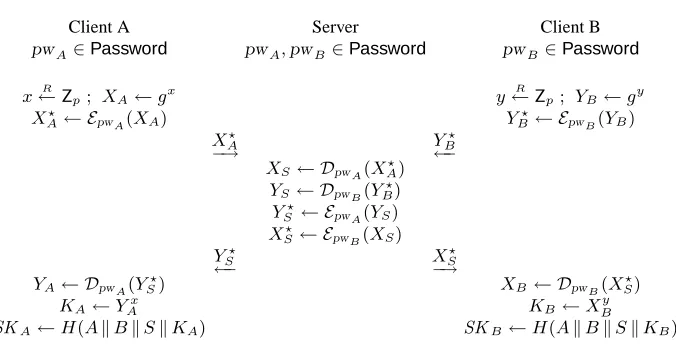
INSIDER ATTACKS. One of the main differences between the2-party and the3-party scenarios is the existence of insider attacks. To better understand the power of these attacks, consider the protocol in Figure 1, based on the encrypted key exchange of Bellovin and Merritt[8], in which the server simply decrypts the message it receives and re-encrypts it under the other user’s password. In this protocol, it is easy to see that one can mount an off-line dictionary by simply playing the role of one of the involved parties. Notice that both Aand B can obtain the necessary information to mount an off-line dictionary attack against each other simply by eavesdropping on the messages that are sent out by the server. More specifically,AandBcan respectively learn the valuesX?
S =EP WB(XS)andYS?=EP WA(YS)and mount a dictionary
attack against each other using the fact thatXS = XAand YS =YB. Insider attacks do not
need be considered explicitly in the case of 2-party protocols due to the independence among the passwords shared between pairs of honest users and those shared with malicious users.
Public information:G, g, p,E,D, H
Client A Server Client B
pwA∈Password pwA,pwB ∈Password pwB∈Password
x←R Zp; XA←gx y
R
←Zp; YB←gy
X?
A← EpwA(XA) Y
?
B← EpwB(YB)
XA?
−→ Y
? B ←−
XS← DpwA(X
? A)
YS← DpwB(Y
? B)
YS?← EpwA(YS)
X?
S← EpwB(XS)
Y? S
←− X
? S −→
YA← DpwA(Y
?
S) XB← DpwB(X
? S)
KA←YAx KB←XBy
SKA←H(AkBkSkKA) SKB←H(AkBkSkKB) Fig. 1. An insecure3-party password-based encrypted key exchange protocol.
A GENERIC CONSTRUCTION. In this paper, we consider a generic construction of3-party
password-based protocol. Our construction is a natural one, building upon existing 2-party password-based key exchange and 3-party symmetric key distribution schemes, to achieve provable security in the strongest sense. Moreover, our construction is also modular in the sense that it can be broken into two parts, a3-party password-based key distribution protocol and 2-party authenticated key exchange. The second part is only needed if key privacy with respect to the server is required.
THE NEED FOR NEW SECURITY NOTIONS. Surprisingly, the proof of security for the new scheme does not follow from the usual security notions for the underlying schemes as one would expect and requires a new and stronger notion of security for the underlying 2-party password-based scheme (see Section 2). In fact, this new security notion is not specific to password-based schemes and is one of the main contributions of this paper. Fortunately, we observe that most existing2-party password-based schemes do in fact satisfy this new prop-erty [10, 13, 19, 25]. More specifically, only a few small changes are required in their proof in order to achieve security in the new model. The bounds obtained in their proof remain essentially unchanged.
Contributions. In this paper, we consider password-based (implicitly) authenticated key
ex-change in the3-party model, where each user only shares a password with a trusted server.
NEW SECURITY MODELS. Towards our goal, we put forth a new formal security model that
is appropriate for the3-party password-based authenticated key exchange scenario and give precise definitions of what it means for it to be secure. Our model builds upon those of Bel-lare and Rogaway [6, 7] for key distribution schemes and that of BelBel-lare, Pointcheval, and Rogaway [4] for password-based authenticated key exchange.
AGENERIC CONSTRUCTION IN THE STANDARD MODEL. We present a generic and natural framework for constructing a 3-party password-based authenticated key exchange protocol from any secure 2-party password-based one. We do so by combining a 3-party key dis-tribution scheme, an authenticated Diffie-Hellman key exchange protocol, and the 2-party password-based authenticated key exchange protocol. The proof of security relies solely on the security properties of underlying primitives it uses and does not assume the Random Or-acle model [5]. Hence, when appropriately instantiated, this construction yields a secure pro-tocol in the standard model.
ASEPARATION BETWEEN KEY DISTRIBUTION AND KEY EXCHANGE. In addition to seman-tic security of the session key, we present a new property, called key privacy, which is specific to key exchange protocols. This new notion captures in a quantitative way the idea that the session key shared between two instances should be only known to these two instances and no one else, including the trusted server.
Related Work. Password-based authenticated key exchange has been extensively studied
in the last few years [4, 9–13, 15–18, 20, 22–24, 26, 28, 32–35], with a portion of the work dealing with the subject of group key exchange and the vast majority dealing with different aspects of2-party key exchange. Only a few of them (e.g., [11, 22, 32]) consider password-based protocols in the3-party setting, but none of their schemes enjoys provable security. In fact, our generic construction seems to be the first provably-secure 3-party password-based authenticated key exchange protocol.
Another related line of research is authenticated key exchange in the3-party setting. The first work in this area is the protocol of Needham and Schroeder [27], which inspired the Kerberos distributed system. Later, Bellare and Rogaway introduced a formal security model in this scenario along with a construction of the first provably-secure symmetric-key-based key distribution scheme [7]. In this paper, we consider the special but important case in which the secret keys are drawn from a small set of values.
Organization. In Section 2, we recall the existing security model for2-party password-based authenticated key exchange and introduce a new one. Next, in Section 3, we introduce new models for3-party password-based authenticated key exchange. Section 4 then presents our generic construction of a3-party password-based authenticated key exchange protocol, called
GPAKE, along with the security claims and suggestions on how to instantiate it. Some future extensions of this work are presented in Section 5. The proofs of security forGPAKEare given in Appendix A. Also in the appendix are the more detailed descriptions of the cryptographic primitives and assumptions on which GPAKE is based. We conclude by presenting some results in Appendix C regarding the relation between the existing security notions and the new ones being introduced in this paper.
2 Security models for2-party password-based key exchange
A secure 2-party password-based key exchange is a2PAKE protocol where the parties use their password in order to derive a common session key sk that will be used to build secure
channels. Loosely speaking, such protocols are said to be secure against dictionary attacks if the advantage of an attacker in distinguishing a real session key from a random key is less than O(n/|D|) +ε(k) where|D|is the size of the dictionary D,nis the number of active sessions andε(k)is a negligible function depending on the security parameterk.
a new one. For reasons that will soon become apparent, we refer to the new model as the Real-Or-Random (ROR) model and to the BPR model as the Find-Then-Guess (FTG) model, following the terminology of Bellare et al.for symmetric encryption schemes [3].
2.1 Communication model
PROTOCOL PARTICIPANTS. Each participant in the2-party password-based key exchange is either a client C ∈ C or a server S ∈ S. The set of all users or participants U is the union
C ∪ S.
LONG-LIVED KEYS. Each clientC ∈ C holds a passwordpwC. Each serverS ∈ S holds a vectorpwS=hpwS[C]iC∈C with an entry for each client, wherepwS[C]is the transformed-password, as defined in [4]. In a symmetric model,pwS[C] =pwC, but they may be different in some schemes.pwC andpwSare also called the long-lived keys of clientCand serverS.
PROTOCOL EXECUTION. The interaction between an adversary Aand the protocol partici-pants occurs only via oracle queries, which model the adversary capabilities in a real attack. During the execution, the adversary may create several concurrent instances of a participant. These queries are as follows, whereUidenotes the instanceiof a participantU:
– Execute(Ci, Sj): This query models passive attacks in which the attacker eavesdrops on honest executions between a client instanceCi and a server instance Sj. The output of
this query consists of the messages that were exchanged during the honest execution of the protocol.
– Send(Ui, m): This query models an active attack, in which the adversary may intercept a
message and then either modify it, create a new one, or simply forward it to the intended participant. The output of this query is the message that the participant instanceUiwould
generate upon receipt of messagem.
2.2 Security definitions
PARTNERING. We use the notion of partnering based on session identifications (sid), which says that two instances are partnered if they hold the same non-null sid. In practice, the sid is taken to be the partial transcript of the conversation between the client and the server instances before the acceptance.
FRESHNESS. In order to properly formalize security notions for the session key, one has to be
careful to avoid cases in which adversary can trivially break the security of the scheme. For example, an adversary who is trying to distinguish the session key of an instance Ui from a
random key can trivially do so if it obtains the key for that instance through aReveal query (see definition below) to instance Ui or its partner. Instead of explicitly defining a notion of
freshness and mandating the adversary to only perform tests on fresh instances as in previous work, we opted to embed that notion inside the definition of the oracles.
Semantic security in the Find-Then-Guess model. This is the definition currently being
– Reveal(Ui): If a session key is not defined for instanceUi or if aTest query was asked
to eitherUi or to its partner, then return⊥. Otherwise, return the session key held by the
instanceUi.
– Test(Ui): If no session key for instanceUi is defined or if a Reveal query was asked to either Ui or to its partner, then return the undefined symbol⊥. Otherwise, return the
session key for instanceUiifb= 1or a random of key of the same size ifb= 0.
The adversary in this case is allowed to ask multiple queries to the Execute, Reveal , and Send oracles, but it is restricted to ask only a single query to the Test oracle. The goal of the adversary is to guess the value of the hidden bit bused by theTest oracle. The adversary is considered successful if it guessesbcorrectly.
Let SUCCdenote the event in which the adversary is successful. The ftg-ake-advantage of an adversary A in violating the semantic security of the protocol P in the Find-Then-Guess sense and the advantage function of the protocolP, when passwords are drawn from a dictionaryD, are respectively
AdvftgP,D−ake(A) = 2·Pr[SUCC]−1; and
AdvftgP,D−ake(t, R) = max
A {Adv
ftg−ake P,D (A)},
where the maximum is over all A with time-complexity at most t and using resources at mostR(such as the number of queries to its oracles). The definition of time-complexity that we use henceforth is the usual one, which includes the maximum of all execution times in the experiments defining the security plus the code size [1]. Note that the advantage of an adversary that simply guesses the bitbis 0 in the above definition due to the rescaling of the probabilities.
Semantic security in the Or-Random model. This is a new definition. In the
Real-Or-Random model, we only allow the adversary to askExecute , Send , and Test queries. In other words, theReveal oracle that exists in the Find-Then-Guess model is no longer available to the adversary. Instead, we allow the adversary to ask as manyTest queries as it wants to different instances. AllTest queries in this case will be answered using the same value for the hidden bitbthat was chosen at the beginning . That is, the keys returned by theTest oracle are either all real or all random. However, in the random case, the same random key value should be returned forTest queries that are asked to two instances which are partnered. Please note that theTest oracle is the oracle modeling the misuse of keys by a user in this case. The goal of the adversary is still the same: to guess the value of the hidden bitbused to answer Test queries. The adversary is considered successful if it guessesbcorrectly.
Let SUCCdenote the event in which the adversary is successful. The ror-ake-advantage
AdvrorP,D−ake(A)of an adversaryAin violating the semantic security of the protocolP in the Real-Or-Random sense and the advantage functionAdvrorP,D−ake(t, R)of the protocolP are then defined as in the previous definition.
Relation between notions. As we prove in Appendix C, the Real-Or-Random (ROR)
To better understand the gap between the two notions, imagine a password-based scheme that was proven secure in the FTG model. By definition, the advantage of any adversary is at mostO(n/|D|) +ε(k), wherenis the number of active sessions andε(k)is a negligible term. By applying the reduction, we can show that no adversary can do better thanO(n2/|D|) +n·
ε(k), which is not enough to guarantee the security of the same scheme in the ROR model. Note that such a gap is not as important in the case where high-entropy keys are used since both terms in the expression would be negligible.
As a consequence, we cannot take for granted the security of the existing schemes and new proofs of security need be provided. Fortunately, we would like to point out here that the security proof for several of the existing schemes can be easily modified to meet the new security goals with essentially the same bounds. The reason for that is that the security proofs of most existing password-based schemes in fact prove something stronger than what is required by the security model. More specifically, most proofs generally show that not only the session key being tested looks random, but all the keys that may be involved in a reveal query also look random to an adversary that does not know the secret password, thus satisfying the security requirements of our new model. In particular, this is the case for the KOY protocol [19] and its generalization [13], and some other schemes based on the encrypted key exchange scheme of Bellovin and Merritt [8] (e.g., [10, 25]).
Since most existing password-based schemes do seem to achieve security in the new and stronger security model and since the latter appears to be more applicable to situations in which one wishes to use a password-based key exchange protocol as a black box, we suggest the use of our new model when proving the security of new password-based schemes.
3 Security models for3-party password-based key exchange
In this section, we put forward new formal security models for3-party password-authenticated key exchange and key distribution protocols. Our models are generalizations of the model of Bellare and Rogaway [7] for 3-party key distribution schemes to the password case and that of Bellare, Pointcheval, and Rogaway [4] for2-party password-based authenticated key exchange.
3.1 Protocol Syntax
PROTOCOL PARTICIPANTS. Each participant in a 3-party password-based key exchange is either a clientU ∈ Uor a trusted serverS∈ S. The set of clientsU is made up of two disjoint sets:C, the set of honest clients, andE, the set of malicious clients. For simplicity, and without loss of generality1, we assume the setSto contain only a single trusted server.
The inclusion of the malicious setE among the participants is one the main differences between the2-party and the3-party models. Such inclusion is needed in the3-party model in order to cope with the possibility of insider attacks. The set of malicious users did not need to be considered in the2-party due to the independence among the passwords shared between pairs of honest participants and those shared with malicious users.
LONG-LIVED KEYS. Each participantU ∈ U holds a password pwU. Each server S ∈ S holds a vector pwS = hpwS[U]iU∈U with an entry for each client, where pwS[U] is the transformed-password, following the definition in [4]. In a symmetric model, pwS[U] = pwU, but they may be different in some schemes. The set of passwordspwE, whereE ∈ E, is assumed to be known by the adversary.
1
3.2 Communication model
The interaction between an adversary Aand the protocol participants occurs only via oracle queries, which model the adversary capabilities in a real attack. These queries are as follows:
– Execute(Ui1
1 , Sj, Ui
2
2 ): This query models passive attacks in which the attacker
eaves-drops on honest executions among the client instances Ui1
1 and U i2
2 and trusted server
instanceSj. The output of this query consists of the messages that were exchanged
dur-ing the honest execution of the protocol.
– SendClient(Ui, m): This query models an active attack, in which the adversary may
intercept a message and then modify it, create a new one, or simply forward it to the intended client. The output of this query is the message that client instance Ui would
generate upon receipt of messagem.
– SendServer(Sj, m): This query models an active attack against a server. It outputs the
message that server instanceSj would generate upon receipt of messagem.
3.3 Semantic security
The security definitions presented here build upon those of Bellare and Rogaway [6, 7] and that of Bellare, Pointcheval, and Rogaway [4].
NOTATION. Following [6, 7], an instance Ui is said to be opened if a queryReveal(Ui) has been made by the adversary. We say an instanceUiis unopened if it is not opened. Similarly,
we say a participant U is corrupted if a query Corrupt(U) has been made by the adversary. A participant U is said to be uncorrupted if it is not corrupted. We say an instanceUi has accepted if it goes into an accept mode after receiving the last expected protocol message.
PARTNERING. Our definition of partnering follows that of [4], which uses session identifica-tions (sid). More specifically, two instancesUi
1andU j
2 are said to be partners if the following
conditions are met: (1) BothUi 1 andU
j
2 accept; (2) BothU1i and U j
2 share the same session
identifications; (3) The partner identification forUi 1isU
j
2 and vice-versa; and (4) No instance
other than Ui 1 andU
j
2 accepts with a partner identification equal toU1i orU j
2. In practice, as
in the2-party case, the sid could be taken to be the partial transcript before the acceptance of the conversation among all the parties involved in the protocol, a solution which may require the forwarding of messages.
FRESHNESS. As in the2-party case, we opted to embed the notion of freshness inside the definition of the oracles.
Semantic security in Find-Then-Guess model. This definition we give here is the
straight-forward generalization of that of Bellare, Pointcheval, and Rogaway [4] for the2-party case, combined with ideas of the model of Bellare and Rogaway [7] for3-party key distribution. As in the2-party case, we also define aReveal oracle to model the misuse of session keys and a Test oracle to capture the adversary’s ability to distinguish a real session key from a random one. Letbbe a bit chosen uniformly at random at the beginning of the experiment defining the semantic security in the Find-Then-Guess model. These oracles are defined as follows:
– Reveal(Ui): If a session key is not defined for instanceUi or if aTest query was asked
to eitherUi or to its partner, then return⊥. Otherwise, return the session key held by the instanceUi.
– Test(Ui): If no session key is defined for instanceUi or if the intended partner ofUi is
part of the malicious set or if aReveal query was asked to eitherUior to its partner, then
return the invalid symbol ⊥. Otherwise, return either the session key for instanceUi if
Consider an execution of the key exchange protocolP by an adversaryA, in which the latter is given access to theReveal , Execute , SendClient , SendServer , and Test oracles and asks a singleTest query, and outputs a guess bitb0. Such an adversary is said to win the experiment defining the semantic security ifb0
=b, wherebis the hidden bit used by theTest oracle. Let SUCCdenote the event in which the adversary wins this game. The ftg-ake-advantage
AdvftgP,D−ake(A)of an adversaryAin violating the semantic security of the protocolP in the
Find-Then-Guess sense and the advantage functionAdvftgP,D−ake(t, R)of the protocolP are then defined as in previous definitions.
We say a3-party password-based key exchange protocol P is semantically secure in the Find-Then-Guess sense if the advantage AdvftgP,D−ake is only negligibly larger than kn/|D|, wherenis number of active sessions andkis a constant. Note thatk= 1in the best scenario since an adversary that simply guesses the password in each of the active sessions has an advantage ofn/|D|.
Semantic security in Random model. This is a new definition. In the
Real-Or-Random model, Reveal queries are no longer allowed and are replaced by Test queries. In this case, however, the adversary is allowed to ask as manyTest queries as it wants.
The modifications to theTest oracle are as follows. If a Test query is asked to a client instance that has not accepted, then return the undefined ⊥. If a Test query is asked to an instance of an honest client whose intended partner is dishonest or to an instance of a dishonest client, then return the real session key. Otherwise, theTest query returns either the real session key ifb = 1and a random one ifb = 0, wherebis the hidden bit selected at random prior to the first call. However, when b = 0, the same random key value should be returned for Test queries that are asked to two instances which are partnered. The goal of the adversary is still the same: to guess the value of the hidden bit used by the Test oracle. The adversary is considered successful if it guessesbcorrectly.
Consider an execution of the key exchange protocol P by an adversaryA, in which the latter is given access to theExecute, SendClient , SendServer, and Test oracles, and outputs a guess bitb0
. Such an adversary is said to win the experiment defining the semantic security in the ROR sense ifb0 =b, wherebis the hidden bit used by theTest oracle. Let SUCCdenote the event in which the adversary wins this game. The ror-ake-advantageAdvrorP,D−ake(A)of an adversary Ain violating the semantic security of the protocolP in the Real-Or-Random sense and the advantage functionAdvrorP,D−ake(t, R)of the protocolP are then defined as in previous definitions.
3.4 Key privacy with respect to the server
Differently from previous work, we define the notion of key privacy to capture, in a quantita-tive way, the idea that the session key shared between two instances should only be known to these two instances and no one else, including the trusted server. The goal of this new notion is to limit the amount of trust put into the server. That is, even though we rely on the server to help clients establish session keys between themselves, we still want to guarantee the privacy of these session keys with respect to the server. In fact, this is the main difference between a key distribution protocol (in which the session key is known to the server) and a key exchange protocol (for which the session key remains unknown to the server).
simulated using the passwords. To capture the adversary’s ability to tell apart the real session key shared between any two instances from a random one, we also introduce a new type of oracle, calledTestPair, defined as follows, wherebis a bit chosen uniformly at random at the beginning of the experiment defining the notion of key privacy.
– TestPair(Ui 1, U
j
2): If client instances U1i and U j
2 do not share the same key, then return
the undefined symbol ⊥. Otherwise, return the real session key shared between client instancesU1i andU2jifb= 1or a random key of the same size ifb= 0.
Consider an execution of the key exchange protocolP by an adversaryAwith access to theExecute , SendClient , and TestPair oracles and the passwords of all users, and letb0 be its output. Such an adversary is said to win the experiment defining the key privacy if b0
= b, where bis the hidden bit used by theTestPair oracle. Let SUCCdenote the event in which the adversary guesses bcorrectly. We can then define the kp-advantageAdvkpP,D−ake(A) of
Ain violating the key privacy of the key exchange protocol P and the advantage function
AdvkpP,D−ake(t, R)ofP as in previous definitions.
Finally, we say an adversaryA succeeds in breaking the key privacy of a protocolP if
AdvkpP,D−ake(A)is non-negligible.
4 A generic three-party password-based protocol
In this section, we introduce a generic construction of a3-party password-based key exchange protocol in the scenario in which we have an honest-but-curious server. It combines a2-party password-based key exchange, a secure key distribution protocol and a 2-party MAC-based key exchange and has several attractive features. First, it does not assume the Random Oracle (RO) model [5]. That is, if the underlying primitives do not make use of the RO model, neither does our scheme. Hence, by using schemes such as the KOY protocol [19] for the
2-party password-based key exchange and the3-party key distribution scheme in [7], one gets a3-part password-based protocol whose security is in the standard model. Second, if2-party password-based key exchange protocols already exist between the server and its users in a distributed system, they can be re-used in the construction of our3-party password-based key exchange.
Description of the generic solution. Our generic construction can be seen as a form of
com-piler transforming any secure 2-party password-based key exchange protocolP into a secure password-based 3-party key exchange protocolP0
in the honest-but-curious security model using a secure key distribution KD, a secureMACscheme, and generic number-theoretic op-erations in a groupGfor which the DDH assumption holds (see Appendix B).
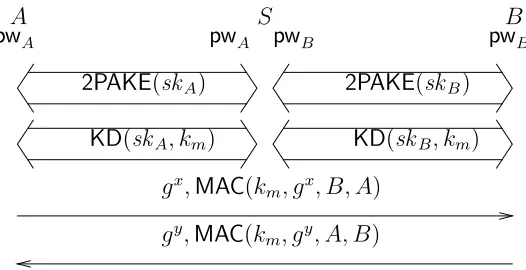
The compiler, depicted in Figure 2, works as follows. First, we use the protocolP between a userAand the serverSto establish a secure high-entropy session keyskA. Second, we use
the protocolP between the serverS and the userB in order to establish a session keyskB.
Third, using a key distributionKD, we have the serverSfirst select aMACkeykm, using the
key generation of the latter, and then distribute this key toAandBusing the session keysskA
andskB, respectively, generated in the first two steps. Finally,AandBuse aMAC-based key
exchange to establish a session keyCDHin an authenticated way.
Semantic security in the Real-Or-Random model. As the following theorem states, the
generic schemeGPAKEdepicted in Figure 2 is a secure3-party password-based key exchange protocol as long as the Decisional Diffie-Hellman assumption holds inGand the underlying
pwB
2PAKE(skA) 2PAKE(skB)
KD(skB, km)
KD(skA, km)
gx,MAC(km, gx, B, A)
gy,MAC(k
m, gy, A, B)
B
A S
pwA pwA pwB
Fig. 2.GPAKE: a generic three-party password-based key exchange
Theorem 1. Let2PAKEbe a secure2-party password-based Key Exchange,KDbe a secure key distribution, andMACbe a secure MAC algorithm. Letqexeandqtestrepresent the number
of queries toExecute and Test oracles, and letqA
send,qBsend,qkd, andqakerepresent the number
of queries to theSendClient and SendServer oracles with respect to each of the two2PAKE
protocols, theKDprotocol, and the finalAKEprotocol. Then,
AdvrorGPAKE−ake,D(t, qexe, qtest, q
A
send, qsendB , qkd, qake) ≤
4·(qexe+qkd)·Advftg
−kd
KD (t,1,0) + 2·qake·Adv euf−cma MAC (t,2,0)
+ 2·AdvddhG (t + 8(qexe+qake)τe) + 4·Advror2PAKE−ake,D(t, qexe, qexe+q
A
send, qAsend)
+ 4·Advror2PAKE−ake,D(t, qexe, qexe+q
B
send, qBsend),
whereτedenotes the exponentiation computational time inG.
Key privacy with respect to the server. As the following theorem states, the generic scheme
GPAKEdepicted in Figure 2 has key privacy with respect to the server as long as the Deci-sional Diffie-Hellman assumption holds inG.
Theorem 2. LetGPAKEbe the3-party password-based authenticated key exchange scheme depicted in Figure 2. Then,
AdvkpGPAKE−ake,D(t, qexe, qtest, q
A
send, qsendB , qkd, qake) ≤ 2·AdvddhG (t 0
),
wheret0
=t + 8·(qexe+qake)·τeand the other parameters are defined as in Theorem 1.
Instantiations. Several practical schemes can be used in the instantiation of the 2-party password-based key exchange of our generic construction. Among them are the KOY pro-tocol [19] and its generalization [13], the PAK suite [25], and several other schemes based on the encrypted key exchange scheme of Bellovin and Merritt [8] (e.g., [10]).
In the instantiation of the key distribution scheme, one could use the original proposal in [7] or any other secure key distribution scheme. In particular, the server could use a chosen-ciphertext secure symmetric encryption scheme to distribute the keys to the users. Indepen-dently of the choice, one should keep in mind that the security requirements for the key dis-tribution scheme are very weak. It only needs to provide security with respect to one session. For the instantiation of the MAC, any particular choice that makes the MAC term in Theorem 1 negligible will do. Possible choices are the HMAC [2] or the CBC MAC.
5 Concluding remarks
AUTHENTICATION. In order to take (explicit) authentication into account, one can easily
ex-tend our model using definitions similar to those of Bellare et al. [4] for unilateral or mutual authentication. In their definition, an adversary is said to break authentication if it succeeds in making any oracle instance terminate the protocol without a partner oracle. Likewise, one could also use their generic transformation to enhance our generic construction so that it pro-vides unilateral or mutual authentication. The drawback of using their generic transformation is that it requires the random oracle model.
MORE EFFICIENT CONSTRUCTIONS. Even though the generic construction presented in this paper is quite practical, more efficient solutions are possible. One example of such an im-provement is a generic construction in which the key distribution and the final key exchange phases are combined into a single phase. One can easily think of different solutions for this scenario that are more efficient that the one we give. However, the overall gain in efficiency would not be very significant since the most expensive part of these two phases, the Diffie-Hellman protocol, seems to be necessary if key privacy with respect to the server is to be achieved. Perhaps the best way to improve the efficiency of3-party password-based schemes is to adapt specific solutions in the 2-party model to the 3-party model, instead of treating these schemes as black boxes.
RELATION TO SIMULATION MODELS. In [29], the Find-Then-Guess model of [7] is shown to be equivalent to simulation models in the sense that a scheme that is proven secure in one model is also secure in the other model. By closely examining their proof, one can easily see that the equivalence does not apply to the case of password-based protocols due to the non-security-preserving reduction. It seems, however, that their proof of equivalence can be adapted to show the equivalence between the simulation model and the Real-Or-Random model that we introduce in this paper in the case of password-based protocols. This is also the subject of ongoing work.
Acknowledgements
The work described in this document has been supported in part by the European Commission through the IST Programme under Contract IST-2002-507932 ECRYPT. The information in this document reflects only the author’s views, is provided as is and no guarantee or war-ranty is given that the information is fit for any particular purpose. The user thereof uses the information at its sole risk and liability
References
1. M. Abdalla, M. Bellare, and P. Rogaway. The oracle Diffie-Hellman assumptions and an analysis of DHIES. In D. Naccache, editor, CT-RSA 2001, volume 2020 of LNCS, pages 143–158. Springer-Verlag, Apr. 2001. 2. M. Bellare, R. Canetti, and H. Krawczyk. Keying hash functions for message authentication. In N. Koblitz,
editor, CRYPTO’96, volume 1109 of LNCS, pages 1–15. Springer-Verlag, Aug. 1996.
3. M. Bellare, A. Desai, E. Jokipii, and P. Rogaway. A concrete security treatment of symmetric encryption. In 38th FOCS, pages 394–403. IEEE Computer Society Press, Oct. 1997.
4. M. Bellare, D. Pointcheval, and P. Rogaway. Authenticated key exchange secure against dictionary attacks. In B. Preneel, editor, EUROCRYPT 2000, volume 1807 of LNCS, pages 139–155. Springer-Verlag, May 2000. 5. M. Bellare and P. Rogaway. Random oracles are practical: A paradigm for designing efficient protocols. In
ACM CCS 93, pages 62–73. ACM Press, Nov. 1993.
7. M. Bellare and P. Rogaway. Provably secure session key distribution — the three party case. In 28th ACM STOC, pages 57–66. ACM Press, May 1996.
8. S. M. Bellovin and M. Merritt. Encrypted key exchange: Password-based protocols secure against dictionary attacks. In 1992 IEEE Symposium on Security and Privacy, pages 72–84. IEEE Computer Society Press, May 1992.
9. V. Boyko, P. MacKenzie, and S. Patel. Provably secure password-authenticated key exchange using Diffie-Hellman. In B. Preneel, editor, EUROCRYPT 2000, volume 1807 of LNCS, pages 156–171. Springer-Verlag, May 2000.
10. E. Bresson, O. Chevassut, and D. Pointcheval. New security results on encrypted key exchange. In F. Bao, R. Deng, and J. Zhou, editors, PKC 2004, volume 2947 of LNCS, pages 145–158. Springer-Verlag, Mar. 2004.
11. J. W. Byun, I. R. Jeong, D. H. Lee, and C.-S. Park. Password-authenticated key exchange between clients with different passwords. In R. H. Deng, S. Qing, F. Bao, and J. Zhou, editors, ICICS 02, volume 2513 of LNCS, pages 134–146. Springer-Verlag, Dec. 2002.
12. Y. Ding and P. Horster. Undetectable on-line password guessing attacks. ACM SIGOPS Operating Systems Review, 29(4):77–86, Oct. 1995.
13. R. Gennaro and Y. Lindell. A framework for password-based authenticated key exchange. In E. Biham, editor, EUROCRYPT 2003, volume 2656 of LNCS, pages 524–543. Springer-Verlag, May 2003. http: //eprint.iacr.org/2003/032.ps.gz.
14. O. Goldreich. Foundations of Cryptography: Basic Tools, volume 1. Cambridge University Press, Cambridge, UK, 2001.
15. O. Goldreich and Y. Lindell. Session-key generation using human passwords only. In J. Kilian, editor, CRYPTO 2001, volume 2139 of LNCS, pages 408–432. Springer-Verlag, Aug. 2001. http://eprint. iacr.org/2000/057.ps.gz.
16. L. Gong. Optimal authentication protocols resistant to password guessing attacks. In CSFW’95: The 8th IEEE Computer Security Foundation Workshop, pages 24–29, Kenmare, County Kerry, Ireland, Mar. 13–15, 1995. IEEE Computer Society.
17. L. Gong, T. M. A. Lomas, R. M. Needham, and J. H. Saltzer. Protecting poorly chosen secrets from guessing attacks. IEEE JSAC, 11(5):648–656, June 1993.
18. S. Halevi and H. Krawczyk. Public-key cryptography and password protocols. In ACM Transactions on Information and System Security, pages 524–543. ACM, 1999.
19. J. Katz, R. Ostrovsky, and M. Yung. Efficient password-authenticated key exchange using human-memorable passwords. In B. Pfitzmann, editor, EUROCRYPT 2001, volume 2045 of LNCS, pages 475–494. Springer-Verlag, May 2001.
20. J. Kim, S. Kim, J. Kwak, and D. Won. Cryptanalysis and improvement of password authenticated key ex-change scheme between clients with different passwords. In A. Lagan, M. L. Gavrilova, V. Kumar, Y. Mun, C. J. K. Tan, and O. Gervasi, editors, ICCSA 04, volume 3043 of LNCS, pages 895–902. Springer-Verlag, May 2004.
21. H. Krawczyk. SIGMA: The “SIGn-and-MAc” approach to authenticated Diffie-Hellman and its use in the ike protocols. In D. Boneh, editor, CRYPTO 2003, volume 2729 of LNCS, pages 400–425. Springer-Verlag, Aug. 2003.
22. C.-L. Lin, H.-M. Sun, and T. Hwang. Three-party encrypted key exchange: Attacks and a solution. ACM SIGOPS Operating Systems Review, 34(4):12–20, Oct. 2000.
23. C.-L. Lin, H.-M. Sun, M. Steiner, and T. Hwang. Three-party encrypted key exchange without server public-keys. IEEE Communications Letters, 5(12):497–499, Dec. 2001.
24. P. MacKenzie, S. Patel, and R. Swaminathan. Password-authenticated key exchange based on RSA. In T. Okamoto, editor, ASIACRYPT 2000, volume 1976 of LNCS, pages 599–613. Springer-Verlag, Dec. 2000. 25. P. D. MacKenzie. The PAK suite: Protocols for password-authenticated key exchange. Contributions to IEEE
P1363.2, 2002.
26. P. D. MacKenzie, T. Shrimpton, and M. Jakobsson. Threshold password-authenticated key exchange. In M. Yung, editor, CRYPTO 2002, volume 2442 of LNCS, pages 385–400. Springer-Verlag, Aug. 2002. 27. R. Needham and M. Schroeder. Using encryption for authentication in large networks of computers.
Com-munications of the ACM, 21(21):993–999, Dec. 1978.
28. M. D. Raimondo and R. Gennaro. Provably secure threshold password-authenticated key exchange. In E. Biham, editor, EUROCRYPT 2003, volume 2656 of LNCS, pages 507–523. Springer-Verlag, May 2003. 29. V. Shoup. On formal models for secure key exchange. Technical Report RZ 3120, IBM, 1999.
30. V. Shoup. OAEP reconsidered. In J. Kilian, editor, CRYPTO 2001, volume 2139 of LNCS, pages 239–259. Springer-Verlag, Aug. 2001.
31. J. G. Steiner, B. C. Neuman, and J. L. Schiller. Kerberos: An authentication service for open networks. In Proceedings of the USENIX Winter Conference, pages 191–202, Dallas, TX, USA, 1988.
33. G. Tsudik and E. Van Herreweghen. Some remarks on protecting weak keys and poorly-chosen secrets from guessing attacks. In SRDS’93: The 12th Symposium on Reliable Distributed Systems, pages 136–142, Princeton, New Jersey, USA, Oct. 6–8, 1993. IEEE Computer Society.
34. S. Wang, J. Wang, and M. Xu. Weaknesses of a password-authenticated key exchange protocol between clients with different passwords. In M. Jakobsson, M. Yung, and J. Zhou, editors, ACNS 04, volume 3089 of LNCS, pages 414–425. Springer-Verlag, June 2004.
35. H.-T. Yeh, H.-M. Sun, and T. Hwang. Efficient three-party authentication and key agreement protocols resistant to password guessing attacks. Journal of Information Science and Engineering, 19(6):1059–1070, Nov. 2003.
A Proof of security forGPAKE
Semantic security ofGPAKEin the ROR model. Without loss of generality, we assume
the set of honest users contains only users AandB. The solution can be easily extended to the more general case with essentially the same bounds.
LetAbe an adversary against the semantic security ofGPAKEin the Real-Or-Random sense with time-complexity at mostt, and asking at mostqexe queries to itsExecute oracle,
qtest queries to itsTest oracle, qAsendqueries toSendClient and SendServer oracles with
re-spect to the2PAKEprotocol betweenAand the trusted serverS,qB
sendqueries with respect to
the2PAKEprotocol betweenBandS,qkdqueries with respect to theKDprotocol, andqake
queries with respect to the final authenticated key exchange protocol.
Our proof consists of a sequence of hybrid experiments, starting with the real attack against GPAKEscheme and ending in an experiment in which the adversary’s advantage is 0, and for which we can bound the difference in the adversary’s advantage between any two consecutive experiments. For each experimentExpn, we define an event SUCCn
correspond-ing to the case in which the adversary correctly guesses the hidden bitbinvolved in theTest queries (see Section 3).
ExperimentExp0. This experiment corresponds to the real attack. By definition, we have
AdvrorGPAKE−ake,D(A) = 2·Pr[SUCC0]−1 (1)
ExperimentExp1. We now modify the simulation of the oracles as follows. We replace the session keyskAused as input to theKDprotocol by a random session keysk0Ain all of the
sessions. As the following lemma shows, the difference between the success probability of the adversaryAbetween the current and previous experiments is at most that of breaking the security of the underlying2PAKEprotocol betweenAandS.
Lemma 3. Pr[SUCC1]−Pr[SUCC0]
≤2·Advror −ake
2PAKE,D(t, qexe, qexe+q
A
send, qsendA ).
Proof. LetA1be a distinguisher for experimentsExp1andExp0. We can build an adversary Apake against the semantic security of the 2PAKE protocol between A and S using A1 as
follows.Apakestarts by choosing a bitbuniformly at random and selecting the passwords for all users in the system exceptAaccording to the distribution ofD. Next, it starts runningA1,
giving it the passwords for all the malicious clients in the system, and answering to its oracle queries as follows.
– SendClient and SendServer queries. If A1 asks aSendClient or SendServer query
ask aTest query to that instance (unless Test query had already been asked to its partner). The output of thisTest query will be used to simulate the key distribution and final key exchange phases of the protocol. All the otherSendClient and SendServer queries byA1
can be easily answered either using the output of theTest queries made to instances of AorS or the session keys computed in the execution of the2PAKEprotocol betweenA andB.
– Execute queries.Apakecan easily answer these queries using its ownExecute oracle and the output of theTest queries.
– Test queries.Apake can easily answer these queries using the bitbthat it has previously selected and the session keys that it has computed.
Letb0
be the output ofA1. Ifb0 =b, thenApakeoutputs1. Otherwise, it outputs0.
One can easily see that the probability thatApake outputs1when itsTest oracle returns real keys is exactly the probability thatA1returns 1 in experimentExp0. Similarly, the
prob-ability thatApakeoutputs1when itsTest oracle returns random keys is exactly the probability thatA1returns 1 in experimentExp1. The lemma follows by noticing thatApakehas at most time-complexitytand asks at mostqexe+qAsendqueries to itsTest oracle, at mostqexequeries
to itsExecute oracle, and at mostqA
sendqueries to itsSend oracle.
Experiment Exp2. We modify the previous experiment by replacing the session key skB
used as input to theKDprotocol by a random session keysk0B in all of the sessions. Using
similar arguments, one can prove the following lemma.
Lemma 4. Pr[SUCC2]−Pr[SUCC1]
≤2·Advror −ake
2PAKE,D(t, qexe, qexe+qsendB , qsendB ).
Experiment Exp3. In this experiment, we replace the MAC key km obtained via the key
distribution protocol with a random key in all of the sessions. According to the following lemma, the difference between the success probability of the adversary A between the cur-rent and previous experiments is at most that of breaking the security of the key distribution schemeKDprotocol betweenA,B, andS.
Lemma 5. Pr[SUCC3]−Pr[SUCC2]
≤2 (qexe+qkd)Advftg −kd KD (t,1).
Proof. The proof of this lemma uses standard hybrid arguments [14] in order to replace each of the key generated by the key distribution schemeKD. We can do so here because the input of the key distribution scheme are all independents since experimentExp2.
The hybrids in this case consist of a sequence of random variablesVi, where0 ≤i≤qs
andqs = (qexe+qkd), such that (1) the random variable Viis constructed as follows : in the
first (i−1) sessions, the session keys are generated according to experimentExp3, (i.e. at random), and in the(qs−i+ 1)sessions, they are generated according to theExp2, (i.e.
ac-cording to the real protocol); (2) extreme hybrids(i= 0)and(i=qs)collide withExp2and
Exp3respectively; (3) random values of each hybrid can be produced by a probabilistic poly-nomial time algorithm and the session that we modify is independent of the other sessions; and (4) there are only polynomially many hybrids.
The hybrids allow us to defineqsdifferent experiments where we only ask queries to the
Send oracles of theKDscheme with respect to a single session in each of the hybrids. Indeed, we start with a distinguisherA3,ifor experimentsVi−1andViand we build an adversaryAikd
against theKDprotocol. The adversaryAi
kdwill choose at random the MAC keyskmfor the firsti−1sessions as well as the secret keysskAandskBshared between the server and clients
A andB, respectively. Hence, it can perfectly answer to the queries made by the adversary
i-th session of hybrid experimentExp3,i,Ai
kdwill use theKDoracles to answer its queries. It also makes aTest query with respect to this session to obtain a keyk˜mand uses it in order
to simulate the remainder of theGPAKEprotocol for that session. If the output of theTest query is the real key, thenAi
kd is runningA3,ias in the hybrid experiment Vi−1. If the session key returned by the Test query is a random key, then Aikd is running A3,i as in the hybrid experiment Vi Note the number of queries asked byAikd to its Send oracles is at most the maximum number of messages in a single execution of the protocol, c, hence the bound given in the lemma. Finally, when answering to the Test queries made by A3,i, Aikd uses the same random bit b chosen at random at the beginning of its execution. Let b0 be the output of adversary A3,i. If b0 = b, then Aikd returns1 or 0, otherwise. Using classical probability analysis and the fact that Ai
kd has time-complexity t and asks queries to itsSend oracle with respect to a single session and no Reveal queries, we can show that the difference between the probabilities thatAi
kdin experimentsViandVi−1 is at most2·AdvftgKD−kd(t,1,0). The lemma follows immediately by noticing that there are at mostqshybrids.
Experiment Exp4. In this experiment, we modify the oracle instances as follows. If the adversary asks aSendClient query containing a new pair message-MAC not previously gen-erated by an oracle, then we consider the MAC invalid and force the instance in question (which received a forged message) to terminate without accepting. As the following lemma shows, the difference between the current and previous experiments should be negligible if we use a secure MAC scheme.
Lemma 6. Pr[SUCC4]−Pr[SUCC3]
≤qake·Adveuf −cma
MAC (t,2,0).
Proof. The proof of this lemma also uses hybrid arguments in the same as in the proof of Lemma 5. The total number of hybrids in this case is qake, since Execute queries do not
need to be taken into account in this case. In hybrid Vi, where0 ≤i ≤ qake, queries in the
firstisessions are answered as in experimentExp4 and all other queries are answered as in experiment Exp3. LetA4,i be a distinguisher for hybridsVi and Vi−1. Using A4,i, we can build an adversary for the MAC scheme as follows.
For the firsti−1sessions, the adversaryAi
mac will choose random values for the MAC key and is therefore able to perfect simulate the oracles given to A4,i. In the i-th session, Aimacmakes use of itsMACgeneration and verification oracles to answer queries fromA4,i.
If A4,i generates a pair message-MAC not previously generated byAimac, thenAimac halts and outputs that pair as its forgery. If no such pair is generated, we output a failure indication. For all remaining sessions, Ai
macuses the actual MAC keys obtained via the key distribution scheme as in experimentExp3 to answer queries fromA4,i.
LetF be the event in which a MAC is considered invalid in hybridVibut valid in hybrid
Vi−1. Notice thatPr[F]is at most the probability that an adversary Aimac can forge a MAC under a chosen-message attack. Since Ai
mac has time-complexity tand makes at most two queries to its MAC generation oracle (to answer theSendClient queries) and no queries to its verification oracle, we have that Pr[F] ≤ SucceufMAC−cma(t,2,0). Moreover, since the two hybrids proceed identically untilF occurs, we havePr[SUCCVi−1∧¬F] = Pr[SUCCVi∧¬F].
By Lemma 1 of [30], we have|Pr[SUCCVi−1]−Pr[SUCCVi]| ≤Pr[F]. The lemma follows
from the fact that there are at mostqakehybrids.
of the Diffie-Hellman problem, one can introduce the above triples in all the sessions which can be tested by the adversary. We do not need to modify the other sessions.
The behavior of our simulation in this experiment is as follows. Experiment Exp5 is identical to experimentExp4, except that we apply the following special rules when dealing withTest(Ui)andSendClient(Ui, m)queries for the last two flows ofGPAKE:
R1: When processing aSendClient(Ai,Start)query, the simulator picks two random values
a0andx0inZq, computesX0 =Xa0gx0, and stores in someX-table(a0, x0, X0). R2: When processing aSendClient(Bj,(X
0, m0))query in the last message of the protocol, – if the elementX0 has been computed by our simulator and thus have been stored
in the X-table, then it generates the same way its answer by choosing two random values b0, y0
R
← Zq, it computes Y0 = Yb0gy0 and stores in someY-table (b
0, y0,
Y0). It can now computeZ0 =Za0b0×Yx0b0×Xa0y0×gx0y0 for theTest queries. – if the elementsX0 has not been previously computed by our A-simulation, then it
proceeds as in the experimentExp4.
R3: When processing aTest(Ui)query, we know that such a query only reveal information
about the hidden bit when asked on an accepting instance, and an accepting instance can only happen when the simulator knows the correct valueZ0and can answer such query
as in the experimentExp4.
It is easy to see that in the second case of rule R2, as in experimentExp4, the adversary will not been able to forge aMACtag, and then he will not be able to generate a correct message for either one of the two last flows. Consequently, the session will not be accepted by any party and so the adversary will not be able to send a Test query to any instance. Hence, the simulation will be consistent.
It is then clear that experimentsExp4 and Exp5 are equivalent, since we have consis-tently replaced one set of random variables by another set of identically distributed random variables. In particular,Pr[SUCC4] = Pr[SUCC5].
ExperimentExp6. ExperimentExp6is exactly the same as experimentExp5, except that in all the rules, we use a random triple(X, Y, Z)coming from a random distribution(gx, gy, gz),
instead of a DDH triple. As the following lemma shows, the difference between the current and previous experiments should be negligible if DDH is hard inG.
Lemma 7. Pr[SUCC6]−Pr[SUCC5]
≤AdvddhG (t + 8(qexe+qake)τe).
Proof. Let Abe an attacker that breaks the semantic security experiment ofGPAKEwith a different advantage in Experiment Exp6 than in ExperimentExp5. We can build an adver-sary Addh for the DDH problem in Gas follows. Let(X, Y, Z) be the input given toAddh.
Addhfirst selects a bitbat random and then starts runningA. IfAasks aSendClient , Execute , orTest query, thenAddhcomputes its output exactly as in the previous experiment but using the triple(X, Y, Z)that it had received as input. Letb0
be the output ofA. Ifb0
=b, thenAddh returns 1 or 0, otherwise.
Let us now analyze the success probability of Addh. Clearly, when the triple (X, Y, Z) is a true Diffie-Hellman triple, Addh runs A exactly as in experiment Exp5 and thus the
probability thatAddh outputs 1 is exactlyPr[SUCC5]. On the other hand, when (X, Y, Z)is
a random triple, Addh runs Aexactly as in experiment Exp6 and thus the probability that Addh outputs 1 is exactly Pr[SUCC6]. The lemma follows from the fact thatAddh has time-complexity at mostt + 8(qexe+qake)τe, due to the additional time for the computations of
Due to the random self-reducibility property of the Diffie-Hellman problem, all the ses-sions keys Z0 used to answer Test queries in experiment Exp6 are randomly and
indepen-dently distributed inG. As a result, no information on the hidden bitbused by theTest oracle
is leaked to the adversary and thus Pr[SUCC6] = 12. This result combined with the previous lemmas yields the result in Theorem 1.
Key privacy. The proof of key privacy uses arguments similar to those used in experiments
Exp5andExp6in the proof of semantic security ofGPAKE. LetAkp be an adversary against
the key privacy ofGPAKEwith time-complexity at mostt, and asking at mostqexequeries to
its Execute oracle,qtest queries to itsTestPair oracle, and qake queries toSendClient oracle
with respect to the final MAC-based authenticated key exchange protocol. UsingAkp, we can
build an adversaryAddhfor the DDH problem inGas follows.
Let(X, Y, Z)be the input given toAddh.Addh first chooses the passwords for all users in the system according to the distribution ofD. It also chooses a bitbat random that is used to answer queries to theTestPair oracle. It then starts runningAkp giving all the password of
all users to it. SinceAddhknows the password of all users, it can easily answer queries made byAkp. However, in order to useAkp to help it solve the DDH problem,Addh will use the classical random self-reducibility of the Diffie-Hellman problem to introduce its input triple in the answers toSendClient , Execute, and TestPair queries with respect to the last two flows ofGPAKE.
To simulate theExecute oracle, we simply use the passwords that we have chosen and SendClient queries. The simulation of the SendClient and TestPair are as follows:
R1: When processing aSendClient(Ai,Start)query,A
ddh picks two random valuesa0 and
x0inZq, computesX0 =Xa0gx0, and stores in someX-table(a0, x0, X0). R2: When processing aSendClient(Bj,(X
0, m0))query in the last message of the protocol, – if the elementX0 has been computed byAddh and thus have been stored in theX -table, thenAddhgenerates the same way its answer by choosing two random values b0, y0
R
←Zq. It computesY0 =Yb0gy0 and stores in someY-table(b
0, y0, Y0).Addh can now computeZ0 =Za0b0 ×Yx0b0 ×Xa0y0 ×gx0y0 for theTestPair queries. – if the elementsX0has not been previously computed byAddh, thenAddh proceeds
with the simulation as it would in a real attack.
R3: When processing a TestPair(Ui
1, U2j)query,Addh first checks whetherU1i and U2j have
both accepted and have the same key. If the check fails, thenAddhreturns⊥. If the check passes, thenAddh knows the corresponding valueZ0for the secret key and can answer it
based on the hidden bitbit had previously chosen.
Letb0
be the output ofAkp. Ifb0
=b, thenAddhreturns 1 and 0, otherwise.
We would like to observe here that the second case of rule R2 has no influence over TestPair queries, since the latter can only be asked to pair of oracle instances which share the same key. This is because even though the instance involved in theSendClient may itself accept, its partner would not be an oracle instance. Hence, a TestPair query involving this instance would always return the invalid symbol⊥.
In order to analyze the success probability ofAddh, first consider the case in which the triple (X, Y, Z) is a true Diffie-Hellman triple. Then, in this case, one can see that simu-lation of the Akp oracles is perfect. Hence, the probability that Addh outputs 1 is exactly
1
2 + 12Adv kp−ake
GPAKE,D(Akp). On the other hand, when (X, Y, Z) is a random triple, the keys Z0 used to answer TestPair queries are all random and independent as a result of the
this case. The proof of Theorem 2 follows from the fact that Addh has time-complexity at mostt + 8(qexe+qake)τe, due to the additional time for the computations of the random
self-reducibility.
B Building blocks
In this section, we recall the definitions for the cryptographic primitives that we use in the construction of our generic3-party password-based authenticated key exchange,GPAKE.
Decisional Diffie-Hellman assumption: DDH. The DDH assumption states, roughly, that
the distributions (gu, gv, guv) and (gu, gv, gw) are computationally indistinguishable when
u, v, w are drawn at random from{1, . . . ,|G|}. This can be made more precise by defining
two experiments, ExpddhG -real(A) and ExpddhG -rand(A). In both experiments, we compute two valuesU = gu andV =gv to be given toA. But in addition to that, we also provide a
third input, which isguv inExpddhG -real(A)andgz for a randomzinExpddhG -rand(A). The goal of the adversary is to guess a bit indicating the experiment it thinks it is in. We define ad-vantage ofAin violating the DDH assumption,AdvddhG (A), asPr[ExpddhG -real(A) = 1 ]−
Pr[ExpddhG -rand(A) = 1 ]. The advantage function of the group,AdvddhG (t)is then defined as the maximum value ofAdvddhG (A)over allAwith time-complexity at mostt.
Message authentication codes (MAC). A Message Authentication Code MAC = (Key,
Tag,Ver)is defined by the following three algorithms: (1) A MAC key generation algorithm
Key, which on input1k produces a `-bit secret-key sk uniformly distributed in {0,1}`; (2)
A MAC generation algorithm Tag, possibly probabilistic, which given a message m and a secret keysk ∈ {0,1}`, produces an authenticator µ; and (3) A MAC verification algorithm
Ver, which given an authenticator µ, a message m, and a secret key sk, outputs 1if µis a
valid authenticator formundersk and0otherwise.
Like in signature schemes, the classical security level for a MAC is to prevent existential forgeries, even for an adversary which has access to the generation and verification oracles. We define advantage ofAin violating the security of the MAC,AdveufMAC−cma(A), as
Pr
sk ← {0,1}`,(m, µ)← ATag(sk;·),Ver(sk;·,·)() :Ver(sk;m, µ) = 1,
and the advantage function of the MAC,AdveufMAC−cma(t, qg, qs), as the maximum value of
AdveufMAC−cma(A) over allAthat asks up toqgand qv queries to the generation and
verifica-tion oracles, respectively, and with time-complexity at most t. Note that A wins the above experiment only if it outputs a new valid authenticator.
3-party key distribution. A secure key distribution protocol KD is a3-party protocol be-tween 2parties and a trusted serverS whereS picks a session key at random and securely sends it to the users. The security model, formally introduced in [7], is a generalization of that for2-party authenticated key exchange protocols, to which a new oracle was added to repre-sent the trusted server. Their security is in the Find-Then-Guess model, using the terminology that we introduced for key exchange protocols.
advantage of adversary Ain violating the semantic security of a key distribution KDin the FTG sense, andAdvftgKD−kd(t, s, r)as the advantage function ofKD, which is the maximum value ofAdvftgKD−kd(A)over allAwith time-complexity at mostt, askingSend queries with respect to at mostssessions and asking at mostrReveal queries.
C Relations between notions
In this section, we prove the relation between the Find-Then-Guess (FTG) and Real-Or-Random (ROR) notions of security for authenticated key exchange protocols. The relation is not specific to password-based schemes, but its implications are more important in that scenario. We do not present proofs for the forward-secure case as these proofs can be easily derived from the proofs in the non-forward-secure case.
Lemma 8. For anyAKE,AdvftgAKE−ake(t, qsend, qreveal, qexe)≤2·Advror
−ake
AKE (t, qsend, qreveal
+ 1, qexe).
Proof. In order to prove this lemma, we show how to build an adversary Aror against the
semantic security of an authenticated key exchangeAKEprotocol in the ROR model given an adversaryAftgagainst the semantic security of the same protocolAKEin the FTG model. We
know thatAftg has time-complexity at mosttand that it asks at mostqsend,qreveal, andqexe
queries to itsSend , Reveal , and Execute oracles, respectively.
The description ofAroris as follows.Arorstarts by choosing a bitbuniformly at random
and starts runningAftg. IfAftgasks aSend query, thenArorasks the corresponding query to
its Send oracle. IfAftg asks a Execute query, thenAror asks the corresponding query to its
Execute oracle. IfAftgasks aReveal query, thenArorasks aTest query to its Test oracle and
uses the answer it receives as the answer to theReveal query. IfAftgasks aTest query, then Arorasks the corresponding query to its Test oracle. Ifb = 1, then Aror uses the answer it
received as the answer to theTest query. Otherwise, it returns a random key toAftg. Letb0be
the final output ofAftg. Ifb0=b, thenAroroutputs1. Otherwise, it outputs0.
Note thatArorhas time-complexity at mosttand asks at mostqsend,qreveal+ 1, andqexe
queries to itsSend , Test , and Execute oracles, respectively.
In order to analyze the advantage ofAror, first consider the case in which itsTest oracle
returns random keys. It is easy to see that, in this case, Aftg cannot gain any information
about the hidden bit bused to answer its singleTest. Therefore, the probability thatAror is
exactly 12. Now consider the case in which itsTest oracle returns the actual sessions keys. In this case, the simulation ofReveal is perfect andArorrunsAftg exactly as in the experiment
defining the semantic security ofAftgin the FTG model. Therefore, the probability thatAroris
exactly 21+12AdvAKEftg−ake(Aftg)and, as a result,Advftg
−ake
AKE (Aftg)≤2·Adv
ror−ake
AKE (Aror)≤
AdvrorAKE−ake(t, qsend, qreveal+ 1, qexe). The lemma follows easily.
Lemma 9. For anyAKE,AdvrorAKE−ake(t, qsend, qtest, qexe)≤qtest·Advftg
−ake
AKE (t, qsend, qtest
−1, qexe).
Proof. In order to prove this lemma, we show how to build a sequence of adversaries Ai ftg
against the semantic security of an authenticated key exchange AKE protocol in the FTG model given an adversaryAroragainst the semantic security of the same protocolAKEin the
ROR model. We know that Arorhas time-complexity at mosttand that it asks at mostqsend,
qtest, andqexequeries to itsSend , Test , and Execute oracles, respectively.
The proof uses a standard hybrid argument, in which we define a sequence ofqtest + 1