R E S E A R C H
Open Access
On performance analysis for optimum
combining of DF relaying with fast-fading
multiple correlated CCIs, correlated
source-relay, and thermal noise
Kyuhyuk Chung
Abstract
This paper analyzes the outage probability (OP) and the average symbol error rate (SER) of decode-and-forward (DF) relaying. The paper derives closed-form expressions for the OP and the average SER with optimum combining (OC) considering fast-fading multiple correlated CCIs, the correlated source-relay, and thermal noise. It is shown that the performance of the large distance between the source and the relay is better than that of the small distance, regardless of interference fading speed at the destination. We also show that given the source-relay distance, the performance of slow-fading interference is basically better than that of fast fading, except in the low signal-to-noise-ratio (SNR) regime for the distance being small. In result, the source-relay distance is generally a more dominating factor for the performance than fading CCIs.
Keywords:Decode-and-forward relaying, Fast-fading correlated multiple CCIs, Correlated source-relay, Optimum combining, Rayleigh fading, Thermal noise, Outage probability, Symbol error rate
1 Introduction
Cooperative communications have been prominent because
of diversity gain [1]. In cooperative networks, there are
mainly two methods, such as the amplify-and-forward (AF) relay network and the decode-and-forward (DF) relay network [2]. Then with multiple copies, the destination can achieve cooperative diversity. In order to do so, we can use
maximal-ratio combining (MRC) [3] (p., 316) or optimum
combining (OC) [4]. MRC maximizes the
signal-to-noise-ratio (SNR), while OC maximizes the signal-to-ference-plus-noise ratio (SINR). When co-channel inter-ferers (CCIs) are present at the destination, OC reduces CCIs’power and increases diversity [5]. Since the analytical expressions for the outage probability (OP) and the average symbol error rate (SER) are complex for derivation, some simplified models have been used [6, 7]. Usually, thermal noise is ignored for the tractability of analytical expressions, assuming CCIs being dense, and the system models are sim-plified. In this case, when the effect of thermal noise is
greater than that of CCIs, the analysis of the simplified
model might be incorrect [8]. Therefore thermal noise is
considered, but fading is still assumed to be slow so that fad-ing in phase 1 and 2 is unchanged and constant. In this case, the analysis is limited for slow fading with MRC [8] or with OC [9]. In addition, it has been assumed that the source and the relay are always far enough to be uncorrelated, which is not always true. Sometimes they become so close that the correlation between them occurs, with which the perform-ance degrades to some extent.
Recently, there have been many research advances in the DF relay network: the opportunistic relaying (OR) in the presence of CCIs is investigated in [10]; a new transmission scheme for selective DF relaying networks is presented, con-sidering the employment of different modulation levels at
the transmitting nodes [11]; and a joint scheme (JS) has
been proposed for a multiple-relay multiple-input
multiple-output (MIMO) network with a DF relaying strat-egy [12]. In [13], a novel distributed space-time coding (DSTC) transmission scheme for a two-path successive DF relay network is proposed. The average SER is analyzed for
© The Author(s). 2019Open AccessThis article is distributed under the terms of the Creative Commons Attribution 4.0 International License (http://creativecommons.org/licenses/by/4.0/), which permits unrestricted use, distribution, and reproduction in any medium, provided you give appropriate credit to the original author(s) and the source, provide a link to the Creative Commons license, and indicate if changes were made.
Correspondence:[email protected]
a wireless-powered three-node DF relaying system in Naka-gami-mfading environment [14].
In this paper, a DF protocol is considered. It is assumed that at the relay symbol-by-symbol decoding is executed, and at the destination, full decoding is carried out [2]. We also assume that multiple correlated CCIs are fast faded, the source and relay are correlated, and thermal noise is present. To the best of our knowledge, the performance analysis for this system has not been reported. First, we derive closed-form expressions for the OP and the average SER with OC considering fast-fading multiple correlated CCIs, the correlated source-relay, and thermal noise. Second, we investigate the effects of the source-relay distance and fast/ slow-fading CCIs on the performance.
The paper is organized as follows: Section 2 defines the
system and channel model. In Section3, the exact analytical expressions are derived for the OP and the average SER.
Section 4 presents the analytical and simulation results,
which we discuss in detail. The paper is concluded in Sec-tion5.
2 System and channel model
We define the full cooperative case as relaying with no symbol errors and the non-cooperative case as relaying with the symbol error probability being one. Let the probability of symbol errors at the relay bePðRÞ
e . For the full cooperative
case, PðRÞ
e ¼0, and for the non-cooperative case, PðeRÞ¼1.
For 0<PðeRÞ<1, we say simply the cooperative case. We assume that the destination knows whether or not the relay sends the symbol with the probability one. We suppose a time division duplex (TDD) mode [1,8]. The DF protocol is
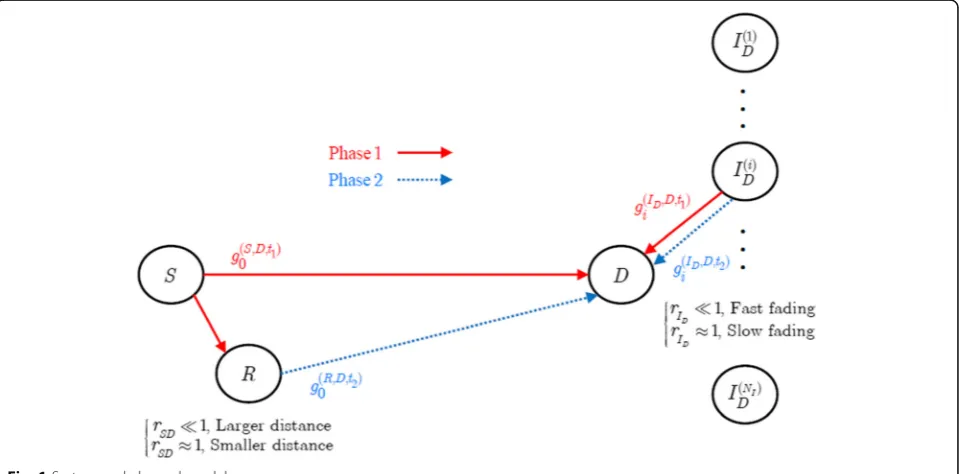
composed of two time slots,t1andt2. One time intervalt1 is for phase 1 and the othert2is for phase 2. Therefore, a single transmission duration (STD) tSTD becomes t1+t2. Note that under fast fading assumption, channel states
change and are not constant over tSTD. The relay system
consists of a source (S), a relay (R), a destination (D), inter-ferers (IðRjÞ, j¼1;2;⋯;NIR) at the relay, and interferers (I
ðiÞ
D,
i¼1;2;⋯;NID) at the destination. We model thermal noise
as circularly symmetric additive white Gaussian noise (AWGN). Each channel is affected by AWGN. The system
and channel model is depicted in Fig. 1. (The source-relay
channel correlation coefficientrSRand the destination inter-ferer channel correlation coefficientrIDare defined in the
fol-lowing sections.)
Under the above assumptions, for the first time slott1, i.e., in phase 1, the source transmits its data symbols. The received signal at the destination is expressed by:
yðS;D;t1Þ¼
ffiffiffiffiffiffi
Et1
S q
gðS;D;t1Þ
0 b0þ
XNID
i¼1
ffiffiffiffiffiffiffi
Et1
ID q
gðID;D;t1Þ
i biþnðS;D;t1Þ ð1Þ
where Et1
S, E t1
ID,b0, andbiare the power transmitted by the
source over the time slott1, the power transmitted by each interferer over the time slott1, the source data symbol with unit average power, and each interferer data symbol with unit average power fori¼1;⋯;NID, respectively, andNID is the
number of interferers. Furthermore, the channel propagation parametersgðS;D;t1Þ
0 andg
ðID;D;t1Þ
i ,i¼1;2;⋯;NID,∼CNð0;
12Þare Rayleigh faded, and thermal noisenðS;DÞ∼CNð0;N 0Þ
is complex AWGN, where the notation CNðμ;ΣÞ denotes
the complex circularly symmetric normal distribution with
mean μand variance Σ. The received signal at the relay is
IR is each interferer power over the time slot t1
and ri, and j¼1;⋯;NIR are the interferer data symbols
each with unit average power. The channel parameters
gðIR;R;t1Þ
i , i¼1;2;⋯;NIR,∼CNð0;1
2Þare Rayleigh faded,
andnðS;R;t1Þ∼CNð0;N
0Þis complex AWGN.
For the second time slott2, i.e., in phase 2, if the relay correctly decodes the symbol, then it forwards the symbol to the destination. In this case, the signal at the destination is expressed by:
yðR;D;t2Þ¼
R is the transmitter power and E
t2
received signal at the destination is expressed by:
ynon‐co¼ y
3 OP and SER derivation We first derive the OP, Pðoutfull‐coÞðγð
with the interference-plus-noise correlation matrix R=
N0I2+EIGG†and G¼ ½g1g2⋯gNID[4]. The notationI2is
the (2 × 2) identity matrix, and the notation (•)†is the con-jugation and transposition. The instantaneous maximum output SINR at the destination is expressed as
γfull‐co¼ESg0†R−1g0 ð6Þ
The moment-generating function (MGF) of γfull‐co is
given by:
where on the fifth line in the above equation, we use
the general central quadratic form [15] of the MGF,
the notation jAj is the determinant of a matrix A,
the source-relay channel parameter (2 × 2) correlation matrix E½g0g†0 is denoted as ΣSR, the power ratio Γ0
≜ES/N0 is the SNR over each time slot, i.e., t1 or t2,
and the power ratio Γ1≜EID=N0 is the
interference-to-noise ratio (INR) over each time slot,
i.e., t1 or t2. We express the (2 × 2) Hermitian matrix
GG† as the eigenvalue decomposition [16].
where on the fourth line in the above equation, we use
the fact that the random variable (RV) θ is uniformly
distributed in the interval [−π,π) [17]. The MGFMγcoðsÞ
is simplified by the integration over the RVθas:
Mγ
where the notation |a| is the absolute value of a scalara.
The expectation overΒis obtained using the probability
density function (PDF)fΒ(Β) [18] as:
The functionΓ(·) is the gamma function. The valuesα1
andα2withα1≥α2are the eigenvalues of the destination interferer channel parameter (2 × 2) correlation matrixΣID ≜E½gigi†, i¼1;2;⋯;N
ID. Using the (2 × 2) determinant
formula, the MGFMγfull‐coðsÞis given by:
With some algebraic manipulations, the MGFMγfull‐coðsÞ
is expressed as:
has unit diagonal elements because the channel parame-tersgðID;D;t1Þ
multiple correlated CCIs withNID≥2. For the single
inter-ferer case with NID ¼1 , we obtain the simpler MGF
Mγfull‐coðsÞ. Let the conditional MGF Mγfull‐cojλ1ðsÞ be the
MGF Mγfull‐coðsÞ conditioned onλ1[19] and the RVλ1be
the random eigenvalue ofR(the other eigenvalue ofRis
In the derivation of Eq. (17), we use λ1∼χ21, where the
notation χ2
1 denotes a complex chi-squared distribution
with one complex degree of freedom; fλ1ðλ1Þ ¼ ðλ1−N0Þ
Fourier transform, which is easily calculated using the
fast Fourier transform (FFT). Then, SERfull‐co with the
coherent binary phase shift keying (BPSK) is calculated as [19]:
can be alternatively calculated by Eq. (10.20) in [19]. For a given thresholdγðThfull‐coÞ, the OPPðoutfull‐coÞðγ
ðfull‐coÞ
Th Þis
de-fined and is calculated as:
Pðoutfull‐coÞ γ
destination can be expressed as:
γnon‐co¼ESgð0S;D;t1Þ
is exponentially distributed with the PDF fX(x)≜e−x, x≥0. The chi-squared-distributed Now based on the total probability theorem, finally, we obtain a closed-form expression for the OPPout(γTh) at the destination as:
Pout γTh
and the average SER at the destination is derived as:
SER¼
With these exact analytical expressions, we can inves-tigate the effects of the distance between the source and
the relay, i.e., ΣSR and fast/slow-fading interference at
the destination, i.e.,ΣID. 4 Results and discussion
We assume that the signals have the exponential
correl-ation [20]. Thus, with the source-relay channel
correl-ation coefficientrSR∈[0, 1):
ΣSR¼
1 rSR
rSR 1
ð25Þ
and with the destination interferer channel correlation coefficientrID∈½0;1Þ:
two time slots. The correlation coefficients are explained as follows: the smaller therSRis, the larger the distance between the source node and the relay node is. On the
other hand, the smaller therID is, the more independent,
gðID;D;t1Þ
i and g
ðID;D;t2Þ
i are, for a giveniamongi¼1;2;⋯;
NID. This means that the maximum Doppler spread is
larger so that the coherence time is smaller, i.e., fast
fad-ing [21]. Thinking in the opposite direction, i.e., slow
fading, is also true.
First, we investigate the effect of the probability of symbol errorsPðeRÞ at the relay on the OPPout(γTh) at the
destination. We assume that withNID ¼2,Γ
total
1 ¼ ð2NIDÞ
Γ1¼3 dBþ3 dBþ4 dB¼10 dB is fixed. We also
as-sume that there are almost uncorrelated users (rSR= 0.01) and slow-fading multiple correlated CCIs (rID ¼0:99 ),
which are the assumptions of the previous researches, i.e.,
independent users and flat-fading interference over tSTD.
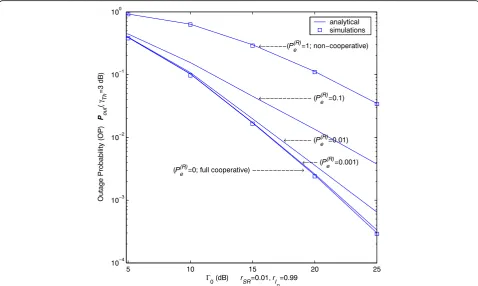
In Fig.2, the OP performance is shown for various PðRÞ
e
values. We observe in Fig.2that the OP performance with
PðRÞ
e ≤0:001 reaches that with the full cooperative casePðeRÞ
¼0. Since this paper focuses on the performance analysis
for the source-relay distance and fast/slow fading CCIs, from now on, we setPðRÞ
e ¼0:001. In Fig.2, we also show
the analytical and simulation results, which are in good agreement, so that the following analyses are based on the analytical expressions.
Next, we analyze the OP Pout(γTh) at the destination
for variousrSRand rID values. In Fig. 3, for the fixed rID
¼0:99, i.e., slow fading CCIs (which is the previous
re-search assumption), the OP Pout(γTh) at the destination
is shown for variousrSR. We observe in Fig.3that as the correlation between the source and the relay becomes larger, the OP performance degrades severely and
co-operative diversity decreases. It is shown in Fig. 4 that
for the fixed rID¼0:01 , i.e., fast fading CCIs (which is
considered in this paper), the OPPout(γTh) at the
destin-ation is shown for various rSR. The results in Fig. 4 are
similar with those in Fig. 3, but the patterns of the OP
performance degradation are different. In order to
inves-tigate the difference, we plot the combination of Fig. 3
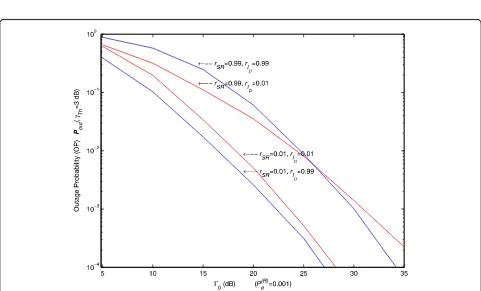
and Fig. 4 in Fig. 5. It is investigated in Fig. 5 that the performance of the large distance between the source and the relay is better than that of the small distance, re-gardless of interference fading speed at the destination. We define the impact of fast-fading CCIs on the
per-formance as the SNR Γ0 loss in decibel compared with
slow-fading CCIs. We observe in Fig. 5 that given the
distance between the source and the relay (rSR= 0.01 or
0.99), the performance of fast-fading interference at the destination is basically worse than that of slow fading, except in the low SNR regime for the distance being small (rSR= 0.99). The exception is explained as follows: since the small distance results in lost diversity, in the
Fig. 2The outage probability,Pout(γTh), for variousPðeRÞvalues in the presence of almost uncorrelated users (rSR= 0.01), and slow-fading multiple correlated CCIs (rID¼0:99), and thermal noise, withNID¼2,Γ
total
low SNR regime, the weak power correlated signals transmitted by the source and the relay are more vulner-able to highly correlated CCIs (rID ¼0:99 ) than almost
uncorrelated CCIs (rID ¼0:01). (Note that if we ignored
thermal noise, we could not observe the exception in the low SNR regimes.) In other words, besides the exception,
DF-relaying OC more easily cancels out almost
flat-fading CCIs (rID ¼0:99 ) than fast-fading CCIs (rID
¼0:01 ). Slow-fading CCIs represent highly correlated
CCIs, and fast-fading CCIs represent weakly correlated CCIs. In result, the source-relay distance (rSR) is gener-ally a more dominating factor than the fading CCIs (rID)
at the destination, when the performance of OC for
these systems is analyzed. It is also shown in Fig. 5
that the previous research assumption (rID ¼0:01, rID
¼0:99) is the most optimistic. In order to further
in-vestigate the effects of various rSR and rID on the
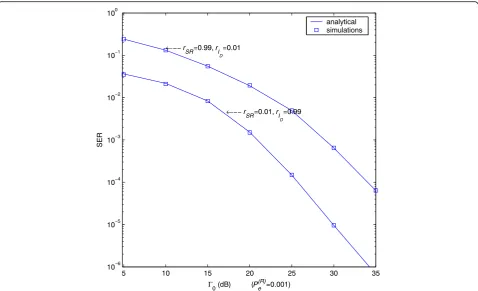
average SER for the DF-relaying OC system, Fig. 6
shows the SER of the BPSK modulation versus the
SNR Γ0. It is clearly shown in Fig. 6 that there is the
gap between the most optimistic case (rID ¼0:01, rID
¼0:99) and the most conservative case (rSR= 0.99, rID
¼0:01). The gap is about 8 dB in the SNR Γ0 at the
SER of 10−4. We also observe that the results in Fig. 6
are consistent with those in Fig. 5.
Now, we discuss the difference between OC and non-OC. In order to achieve cooperative diversity, OC
maximizes the SINR, reduces CCIs’power, and increases
diversity. On the other hand, non-OC, such as MRC, maximizes only the SNR so that a smaller output SINR is produced and the performance is degraded severely in the presence of CCIs.
5 Conclusion
In this paper, we investigated the effects of the source-relay distance and fast/slow-fading CCIs on the performance of the DF-relaying OC system. Con-ditioned on the probability of symbol errors at the relay, we first developed the MGF of the instantan-eous maximum output SINR. Using the total
prob-ability theorem, we then derived closed-form
expressions for the OP and the average SER at the destination. With these analytical expressions, it was shown that the performance of the large distance be-tween the source and the relay is better than that of the small distance, regardless of interference fading speed at the destination. Furthermore, we also showed
that given the distance, the performance of
slow-fading interference is basically better than that of fast fading, except in the low SNR regime for the Fig. 3The outage probability,Pout(γTh), for variousrSRvalues in the presence of slow-fading multiple correlated CCIs (rID¼0:99), and thermal noise, withNID¼2,Γ
total
Fig. 5The outage probability,Pout(γTh), for variousrSRandrIDvalues in the presence of fading multiple correlated CCIs, and thermal noise, with NID¼2,Γ
total
1 ¼10 dB,γTh= 3 dB, andPðeRÞ¼0:001
Fig. 4The outage probability,Pout(γTh), for variousrSRvalues in the presence of fast-fading multiple correlated CCIs (rID¼0:01), and thermal noise, withNID¼2,
Γtotal
distance being small. In result, the source-relay dis-tance is generally a more dominating factor than the fading CCIs. Finally, we presented the average SER performance, which showed the gap between the most optimistic case and the most conservative case.
Abbreviations
AF:Amplify-and-forward; AWGN: Additive white Gaussian noise; BPSK: Binary phase shift keying; CCIs: Co-channel interferers; DF: Decode-and-forward; DSTC: Distributed space-time coding; FFT: Fast Fourier transform; MGF: Moment-generating function; MIMO: Multiple-input multiple-output; MRC: Maximal-ratio combining; OC: Optimum combining; OP: Outage probability; OR: Opportunistic relaying; PDF: Probability density function; SER: Symbol error rate; SINR: Signal-to-interference-plus-noise ratio; SNR: Signal-to-noise-ratio; STD: Single transmission duration; TDD: Time division duplex
Acknowledgements
Not applicable.
Funding
Not applicable.
Availability of data and materials
Not applicable.
Authors’contributions
KC analyzed the outage probability (OP) and the average symbol error rate (SER) of decode-and-forward (DF) relaying. KC derived closed-form expres-sions for the OP and the average SER with optimum combining (OC) consid-ering fast fading multiple correlated CCIs, the correlated source-relay, and thermal noise. KC read and approved the final manuscript.
Competing interests
The authors declare that they have no competing interests.
Publisher’s Note
Springer Nature remains neutral with regard to jurisdictional claims in published maps and institutional affiliations.
Received: 23 February 2018 Accepted: 19 March 2019
References
1. A. Nosratinia, T.E. Hunter, A. Hedayat, Cooperative communication in wireless networks. IEEE Commun. Mag.42(10), 74–80 (2004)
2. J.N. Laneman, D.N.C. Tse, G.W. Wornell, Cooperative diversity in wireless networks: efficient protocols and outage behavior. IEEE Trans. Inf. Theory
50(12), 3062–3080 (2004)
3. W.C. Jakes Jr. et al.,Microwave Mobile Communications(Wiley, New York, 1974)
4. J. Winters, Optimum combining in digital mobile radio with cochannel interference. IEEE Trans. Veh. Technol.33, 144–155 (1984)
5. N. Suraweera, N.C. Beaulieu, The impact of imperfect channel estimations on the performance of optimum combining in decode-and-forward relaying in the presence of co-channel interference. IEEE Wireless Commun. Lett.3(1), 18–21 (2014)
6. Q.T. Zhang, X.W. Cui, Outage probability for optimum combining of arbitrarily faded signals in the presence of correlated Rayleigh interferers. IEEE Trans. Veh. Technol.53(4), 1043–1051 (2004)
7. P.D. Rahimzadeh, N.C. Beaulieu, Limits to performance of optimum combining with dense multiple correlated antennas. IEEE Trans. Commun.
58(7), 2014–2022 (2010)
8. H. Yu, I.-H. Lee, G.L. Stüber, Outage probability of decode-and-forward cooperative relaying systems with co-channel interference. IEEE Trans. Wirel. Commun.11(1), 266–274 (2012)
Fig. 6SER for variousrSRandrIDvalues in the presence of fading multiple correlated CCIs, and thermal noise, withNID¼2,Γ total
9. N. Suraweera, N.C. Beaulieu, Outage probability of decode-and-forward relaying with optimum combining in the presence of co-channel interference and Nakagami fading. IEEE Wireless Commun. Lett.2(5), 495– 498 (2013)
10. N. Wu, H. Li, Performance analysis of SNR-based decode-and-forward opportunistic relaying in the presence of co-channel interference. IEEE Trans. Veh. Technol.65(9), 7244–7257 (2016)
11. H.U. Sokun, H. Yanikomeroglu, On the spectral efficiency of selective decode-and-forward relaying. IEEE Trans. Veh. Technol.66(5), 4500–4506 (2017)
12. Y. Zhang, J. Ge, Joint antenna-and-relay selection in MIMO decode-and-forward relaying networks over Nakagami-m fading channels. IEEE Signal Process. Lett.24(4), 456–460 (2017)
13. M.S. Gilan, A. Olfat, New beamforming and space-time coding for two-path successive decode and forward relaying. IET Commun.12(13), 1573–1588 (2018)
14. P. Kumar, K. Dhaka, Performance analysis of wireless powered DF relay system under Nakagami-m fading. IEEE Trans. Veh. Technol.67(8), 7073– 7085 (2018)
15. M. Schwartz, W.R. Bennett, S. Stein,Communication Systems and Techniques (McGraw-Hill, New York, 1996)
16. R.A. Horn, C.R. Johnson,Matrix Analysis, 1st ed(Cambridge Univ. Press, Cambridge, 1990)
17. K. Chung, An analytical expression for performance of optimum combining with multiple correlated CCIs and two antennas. IEEE Commun. Lett.16(4), 458–461 (2012)
18. M. Chiani, M.Z. Win, A. Zanella, On the capacity of spatially correlated MIMO Rayleigh-fading channels. IEEE Trans. Inf. Theory49(10), 2363–2371 (2003) 19. M.K. Simon, M.S. Alouini,Digital Communication over Fading Channels, 1st Ed
(Wiley, Hoboken, 2000)
20. V. Aalo, Performance of maximal-ratio diversity systems in a correlated Nakagami fading environment. IEEE Trans. Commun.43, 2360–2369 (1995) 21. A. Goldsmith,Wireless Communications(Cambridge University Press, New