UDPipe: Trainable Pipeline for Processing CoNLL-U Files Performing
Tokenization, Morphological Analysis, POS Tagging and Parsing
Milan Straka, Jan Hajiˇc, Jana Strakov´a
Charles University in PragueFaculty of Mathematics and Physics Institute of Formal and Applied Linguistics
{straka,hajic,strakova}@ufal.mff.cuni.cz
Abstract
Automatic natural language processing of large texts often presents recurring challenges in multiple languages: even for most advanced tasks, the texts are first processed by basic processing steps – from tokenization to parsing. We present an extremely simple-to-use tool consisting of one binary and one model (per language), which performs these tasks for multiple languages without the need for any other external data. UDPipe, a pipeline processing CoNLL-U-formatted files, performs tokenization, morphological analysis, part-of-speech tagging, lemmatization and dependency parsing for nearly all treebanks of Universal Dependencies 1.2 (namely, the whole pipeline is currently available for 32 out of 37 treebanks). In addition, the pipeline is easily trainable with training data in CoNLL-U format (and in some cases also with additional raw corpora) and requires minimal linguistic knowledge on the users’ part. The training code is also released.
Keywords:Universal Dependencies; dependency parsing; part-of-speech tagging
1.
Introduction
The Universal Dependencies project (Nivre et al., 2016) seeks to develop cross-linguistically consistent treebank an-notation for many languages. The anan-notation scheme is based on the universal Stanford dependencies (de Marn-effe et al., 2014), the Google universal part-of-speech tags (Petrov et al., 2012), and the Interset interlingua for mor-phosyntactic features (Zeman, 2008). The latest version of UD (Univeral Dependencies Treebanks version 1.2, 2015)1
consists of 37 dependency treebanks.
Our aim is to create a simple-to-use, one-binary and a single-model tool (per language), to easily process raw text to CoNLL-U-formatted tagged and/or parsed dependency trees (with morphological features if available in UD). In particular, our goals are
• state-of-the-art tools for tokenization, morphological analysis, part-of-speech tagging and dependency pars-ing,
• free C++ tools available under the Mozilla Public Li-cense (MPL) 2.0 liLi-cense (code) and CC BY-NC-SA 4.0 license (models),
• simple tool with a single model (per language), easily trainable with custom data (CoNLL-U format),
• trained models provided for as many UD treebanks as possible,
• no feature engineering, no external morphological dic-tionary, no language specific knowledge,
• efficient programming design in terms of RAM and disc usage.
Following these requirements, we developed a morpholog-ical dictionary tool and tagger software, which is described in Section 4. and in detail in (Strakov´a et al., 2014), and a dependency parser described in Section 5. and in detail in (Straka et al., 2015). We wrapped these tools along with a trainable tokenizer based on artificial neural networks
(Sec-1http://hdl.handle.net/11234/1-1548
tion 3., which we describe in a little more detail since it has not been published previously) in a single tool called UD-Pipe, described in Section 6. We also compare our set of tools contained in theUDPipewith other results, expecially other dependency parsers.
2.
Related Work
A considerable number of natural language processing pipelines are available, e.g. OpenNLP2 or Natural Lan-guage Processing Toolkit (NLTK), (Bird et al., 2009)3; however, our aim was to develop an extremely simple tool to be easily used by users with no language specific knowl-edge and little interest in programming, a tool with clear licensing, no feature engineering, no morphosyntactic dic-tionary or other additional resources necessary, with a train-able tokenizer (which is, surprisingly, an underestimated problem) and above- or near state-of-the-art results.
3.
Tokenization
Tokenization is usually considered a trivial task for many languages, notably for those that use separators between words. Nevertheless, treebanks in many languages use language-specific or even treebank-specific rules to parti-tion unseparated words or replace contracparti-tions, for exam-ple, in English,isn’tis usually tokenized asis n’t. Obviously, it is crucial to perform exactly the same tok-enization on a text to be processed by a tool trained on such a (idiosyncratically tokenized) treebank. The requirement for identical tokenization applies also for additional lan-guage resources used for additional or different methods (e.g., when using word embeddings).
Although the tokenization of every treebank can usually be described using only a limited set of rules, developing a rule-based tokenizer for several dozens of treebanks ap-pears to be a very demanding task.
2
https://opennlp.apache.org
We describe a tokenizer which is trained solely by com-paring original (raw) and tokenized text, without any addi-tional knowledge about the language. The tokenizer learns both where to split words even without space separators, and also where to split sentences.
If the original raw text is not available, which is quite com-mon, we suggest a method of reconstructing plain text of given tokenized corpus by utilizing an additional raw text corpus.
3.1.
Tokenization for Universal Dependencies
The CoNLL-U format, used by UD treebanks, allows re-construction of the original pre-tokenized text using the SpaceAfter=No feature: it signals that a given token was not followed by a space separator in the original text. In UD 1.2, there are five treebanks using theSpaceAfter feature.4
Additionally, the so-called multi-word tokens in the CoNLL-U format allow to capture various contractions – for example, one can describe that the input token imin German representsin dem. Note that recognizing word tokens is quite different from tokenization – the multi-word token is usually not just a simple string concatenation. Therefore, the described tokenizer does not handle multi-word tokens.5
3.2.
The Tokenizer (and Segmentation) Model
Given a plain text, the tokenizer locates both token and sentence boundaries at the same time. We assume that a (white)space character always acts as a token separator, and we train the tokenizer to locate only the token boundaries which arise between two non-space characters.
The tokenizer is based on a bidirectional LSTM artificial neural network (Graves and Schmidhuber, 2005). Long short-term memory (LSTM) unit computes the state se-quenceh1, . . . , hngiven the input vectorx1, . . . , xn. It was
designed to be able to capture non-linear and non-local dy-namics in sequences (Hochreiter and Schmidhuber, 1997) and has been used to obtain several state-of-the-art results in sequence classification, for example part-of-speech tag-ging (Ling et al., 2015). Recently, a gated linear unit (GRU) was proposed by Cho et al. (2014) as an alternative to LSTM, and was shown to have similar performance, while being less computationally demanding.
The inputs of the proposed tokenizer are fixed-length seg-mentsc1, . . . , cS ∈A, whereAis the alphabet of Unicode
characters andS is the length of the input segments. The goal of the tokenizer is to divide input characters in tokens and sentences. The classification task is therefore for each character to be classified into three classes: token boundary follows, sentence boundary follows and no boundary. We represent each character ci ∈ A as an embedding
eci ∈R
d, a vector of lengthd, an equivalent of vector word
embedding (Collobert et al., 2011) for characters.
4
Czech, English, Finnish, Slovenian and Tamil; although Finnish-FTB treebank also containsSpaceAfter=Nofeature, it is used incorrectly.
5
Currently, UDPipe solves the problem by inserting a mod-ule consisting of a trivial lookup in the dictionary of multi-word tokens which is generated from training data.
When processing the fixed-length segment of characters c1, . . . , cS, we use GRU on the sequenceec1, . . . ,ecS to obtain hf1, . . . ,hfS, and another GRU on the reversed se-quence to obtainhr
1, . . . ,hrS, and classify every character
ci (into either no boundary, token boundary or sentence
boundary) using a softmax on catenation of vectorshfi and hrS+1−i. We employ dropout (Srivastava et al., 2014) on the softmax input.
When tokenizing a text, we start by processing the firstS characters. If any sentence boundaries were found, we re-move as many complete sentences as possible and proceed by processing the rest of the characters. If there are no sen-tence boundaries in the segment, we continue with the pro-cessing from the first word boundary in the second half of the segment, or last word boundary in the second half of the segment if the former was not found. In the cast case when no token boundaries were found in the segment, we continue the processing from the middle of the segment. We train the tokenizer using the Adam stochastic optimiza-tion method (Kingma and Ba, 2014). We randomly shuffle input sentences in each training epoch and we concatenate them (using a space character) into one long string. Us-ing the described method, we locate the positions of the S-character segments covering this string, and perform the stochastic optimization using minibatches of size 100.
3.3.
Generating Detokenized Text of a Tokenized
Corpus
In case theSpaceAfter=Nofeature is not present in the treebank and the language uses spaces between words,6we
can use additional raw corpus to detokenizethe treebank, i.e., to fill the missingSpaceAfter=Nofeatures accord-ing to the raw corpus. This allows us to train the tokenizer even when theSpaceAfter=Nofeature is missing in the treebank.
We suggest the following heuristic when deciding if a SpaceAfter=Nofeature should be added between words v andw. We start by counting the number of occurrences of lowercased sequence v w in the raw corpus, and com-pare it to the number of corpus occurrences of lowercased sequence vw . If one of the figures is greater than the other, we add or do not add the SpaceAfter=No fea-ture accordingly. If both counts are the same, then if both words v and w contain a letter, or both contain a digit, we do not add the SpaceAfter=No. Otherwise, we continue counting number of occurrences of additional se-quences, until we either find a differing number, or we pro-cess the whole sequence (in which case we do not add the SpaceAfter=Nofeature). The additional sequences are:
• lowercasedv wandvw,
• lowercased v w andvw where each character is re-placed by its Unicode General category,
• lowercased v w and vw where each character is replaced by its Unicode General category.
Although the method may seem as an unfounded heuristic, it has straightforward motivation and we show in the next Section that it performs well.
6For languages that do not use spaces between words, we can
Language Unit UDPipe + SpaceAfter UDPipe + detokenization Rule-based tokenizer Baseline tokenizer
Prec Recall F1 Prec Recall F1 Prec Recall F1 Prec Recall F1
Czech Tokens 100.0 100.0 100.0 99.9 99.9 99.9 100.0 100.0 100.0 85.1 72.8 78.4
Sentences 89.3 81.7 85.3 88.2 80.7 84.3 88.6 72.7 79.9 73.9 68.1 70.9
English Tokens 98.6 98.7 98.7 98.6 98.1 98.4 91.3 96.1 93.7 85.6 73.4 79.0
Sentences 76.9 66.2 71.2 76.5 64.2 69.9 74.4 42.7 54.3 72.3 51.8 60.4
Finnish Tokens 99.8 99.8 99.8 99.7 99.5 99.6 53.7 55.2 54.4 84.3 72.2 77.8
Sentences 91.7 89.2 90.4 92.8 88.3 90.5 48.1 40.0 43.6 89.5 82.9 86.1
Slovenian Tokens 99.9 99.9 99.9 100.0 99.9 99.9 99.5 99.6 99.6 85.3 74.1 79.3
Sentences 98.4 98.4 98.4 97.2 97.5 97.3 95.1 90.6 92.8 95.0 96.3 95.7
Tamil Tokens 99.6 99.7 99.6 99.3 99.4 99.4 95.6 98.5 97.0 90.1 81.7 85.7
Sentences 98.3 99.1 98.7 98.0 99.1 98.7 16.7 0.8 1.6 73.6 85.8 79.2
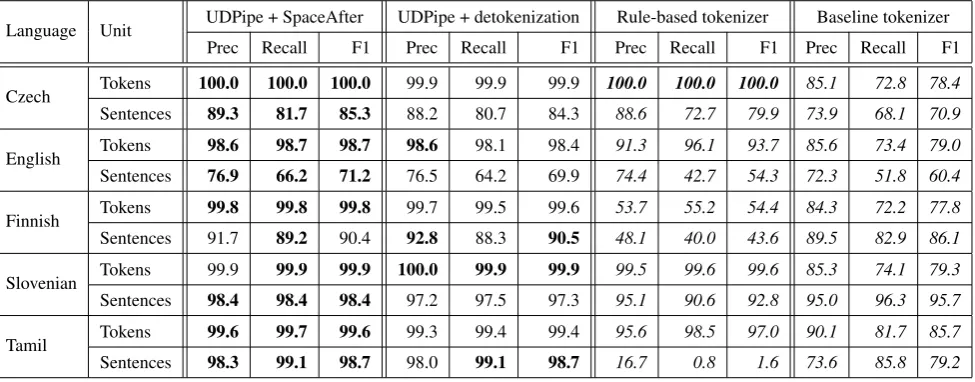
Table 1: Tokenizer precision, recall and F1-score on treebanks of Universal Dependencies 1.2 which include the original raw text. The UDPipe tokenizer results are presented both when using the original plain text (through theSpaceAfter=No feature) and when reconstructing the original plain text using additional raw text corpus. For comparison, we also provide results for a baseline tokenizer (which splits tokens on spaces and sentences on spaces following dot, question mark or exclamation mark) and a rule-based tokenizer from MorphoDiTa (Strakov´a et al., 2014), developed initially for Czech. Best results in each category (Precision/Recall/F1-score) are shown in bold font.
3.4.
Tokenization Results
Our goal was not only to achieve high tokenizing accu-racy (score), but also reasonable runtime performance. We therefore utilized GRUs instead of LSTMs and preferred short character embeddings during hyperparameter selec-tion. We decided to select single hyperparameters for all treebanks, so that we avoid the need for development set for treebanks which do not contain theSpaceAfter=No fea-ture. We utilize character embeddings of size 24, dropout value of 0.3 and segment size 50.
We present the tokenization results on those UD 1.2 tree-banks containing the original texts in Table 1, as F1-score compared to gold tokenization of the treebanks. For com-parison, we also provide a baseline tokenizer (which splits tokens on spaces and sentences on spaces following dot, question mark or exclamation mark) and a rule-based tok-enizer from MorphoDiTa (Strakov´a et al., 2014) developed initially for Czech. The performance of the rule-based to-kenizer shows some interesting (even if not unexpected) properties – while the tokenizer reaches very high perfor-mance for Czech and Slovak (which are two closely related languages and mother tongues of the authors), it fails for sentence boundary detection in Tamil. This happens be-cause the rule-based tokenizer heavily depends on casing, while Tamil does not have cased characters.
The trainable tokenizer performs remarkably well, notably in token boundary detection. The lower performance in sentence boundary detection for some treebanks is caused among others by the fact that the original texts are seg-mented using some additional structural information (e.g., headings, titles), the information about which is not re-tained in the corpus.
We also evaluate the effect of detokenization described in Section 3.3. in Table 1. We used the W2C corpora
col-lection7 as the source of additional raw corpora.8 Perfor-mance of the tokenizer trained using automatically gener-atedSpaceAfter=Nofeature is highly competitive when compared to the performance of the tokenizer trained us-ing gold annotations. Due to these positive results, we expect the tokenizer trained on automatically detokenized treebanks using raw texts to perform well even on those treebanks which do not use theSpaceAfter=Nofeature (32 out of 37 treebanks of UD 1.2).
4.
Morphological Analysis and POS Tagging
There are several morphological fields used in the CoNLL-U format:• universal part-of-speech tag (Petrov et al., 2012),
• list of morphological features (Zeman, 2008),
• language-specific part-of-speech tag,
• lemma or stem.
UDPipe is able to fill all these fields, depending on which of them are available in the training data.
To perform the POS tagging and lemmatization, UDPipe uses MorphoDiTa (Strakov´a et al., 2014). The MorphoDiTa POS tagger is based on part of (Spoustov´a et al., 2009) and is implemented as a supervised, rich feature averaged per-ceptron (Collins, 2002), employing dynamic programming at runtime (Viterbi decoder).
4.1.
Morphological Analysis
In order to use the averaged perceptron tagger, morpholog-ical analyses for every input form must be provided. Per-forming such analysis for a language with small tag set may
7
http://hdl.handle.net/11858/ 00-097C-0000-0022-6133-9
8Surprisingly, we obtained best tokenization results by using
be trivial (by considering all possible tags), but if the tag set is richer (which is the case of many languages using morphological features in CoNLL-U) or if lemmatization is performed, either a morphological dictionary or a spe-cialized analyzer is usually required.
In order to avoid the need for additional language resource or language-specific code, we have developed the following morphological “guesser.”
For every suffix of fixed length,9 we establishGmost
fre-quent analyses according to the training data. If there are not enough forms with the given suffix, we consider shorter and shorter suffixes, until we obtain the required number of analyses.Each analysis consists of a universal part-of-speech tag, language-specific part-of-part-of-speech tag if avail-able, list of (possible empty) morphological features and a lemma rule. The lemma rule is the shortest formula for gen-erating a lemma from a given form, using any combination of “remove a specific prefix“, “remove a specific suffix“, “append a prefix“ and “append a suffix“ operations. We then generate a morphological dictionary of full forms from the UD data. Such a dictionary, even if it covers most frequent analyses, is almost surely not complete. We there-foreenrichthe dictionary by addingEadditional analyses to every form of the dictionary (using the analyses associ-ated with the form suffix, which we described above). To analyze a given form, we try locating it in the enriched dictionary. If it is contained in the dictionary, we return the dictionary analyses (including theEadded ones); oth-erwise, we return allGanalyses associated with the form suffix. UsuallyEcan be considerably smaller thanG, be-cause the most common form analyses are likely present in the dictionary itself. Consequently, most forms having E instead ofG E analyses speeds up the decoding sub-stantially, by a factor of(G/E)3, because Viterbi decoder
of order 3 is used (each state consist of a pair of tags). Morphological information is, in some languages, also in-dicated by a prefix. For example, negations in Czech are frequently formed by prefixing a word with ne-, and su-perlatives are formed by prefixing comparatives with nej-prefix. If we detect such situation during analyzer construc-tion, we create the above described suffix guesser individu-ally for every such prefix.10
4.2.
Classification Features
Internally, UDPipe uses in fact two models, one disam-biguating all available morphological fields (a POS tag-ger), and the other one performing lemmatization (a lem-matizer), because a combination of two taggers improves overall accuracy. Both POS tagger and lemmatizer employ their own morphological guesser and utilize different clas-sification feature sets.
The POS tagger disambiguates all available morphological fields (and can jointly disambiguate a lemma too, if it helps tagging accuracy). It uses a feature set adopted from Spous-tov´a et al. (2009), who described classification features de-veloped for Czech, a morphologically rich language. The
9
We use suffixes of length 4, thereby constructing morpholog-ical guesser with reasonable high accuracy and small size.
10
We currently use four such most widely used prefixes, if they are used by at least 10 lemmas.
lemmatizer disambiguates the lemma (and jointly also uni-versal part-of-speech tag in order to improve lemmatization accuracy). Both feature sets are in the UDPipe repository.
4.3.
Tagging Results
One of the most important hyperparameters of tagger train-ing is the number of analysesGreturned by the guesser, and the number of analysesEadded to the dictionary for every word form. These hyperparameters were tuned11separately
for every treebank, so that the tagging performance on the development portion of the treebank would be as high as possible.
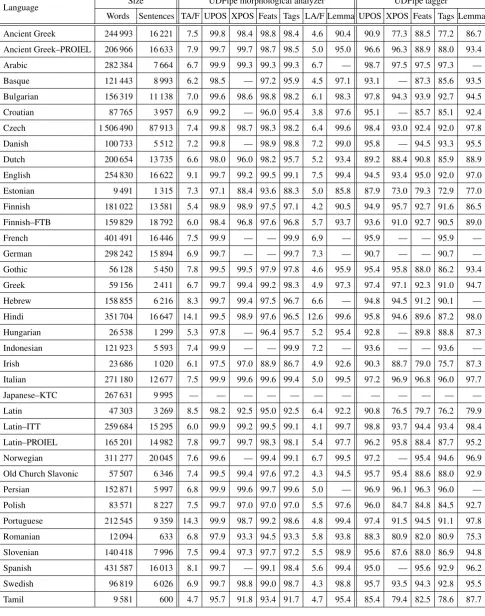
The success rate (whether the correct analysis is one of those returned by the analyzer) of the morphological guesser is presented in Table 2, together with the average number of analyses returned by the guesser. The same char-acteristics is returned for the lemmatization guesser. The part-of-speech tagging and lemmatization accuracy is presented also in Table 2. We do not compare our tagger to any related work, because we could not find any part-of-speech tagging and lemmatization results on Universal De-pendencies 1.2. However, the used POS tagger algorithm and the used feature set achieve state-of-the-art results on Czech and very good results on English (Spoustov´a et al., 2009).
5.
Dependency Parsing
Parsito is a transition-based, non-projective dependency parser described in (Straka et al., 2015), capable of parsing both projective and non-projective sentences. The parser, inspired by (Chen and Manning, 2014), uses a neural net-work classifier for prediction and requires no feature engi-neering. In (Straka et al., 2015) a newsearch-based oracle is proposed, which improves parsing accuracy similarly to a dynamic oracle, but is applicable to any transition system, such as the fully non-projectiveswapsystem. The parser has excellent parsing speed, compact models, and achieves high accuracy.
UDPipe employs the Parsito parser nearly unmodified. Compared to (Straka et al., 2015), only an optional beam-search decoding along the lines of (Zhang and Nivre, 2011) was added. The beam-search decoding improves accu-racy, but decreases runtime performance. By default, beam search of size 5 is used.
5.1.
Parsing Results
We trained the parser as described in (Straka et al., 2015), choosing the hyperparameters, transition system and an or-acle which maximize the parser performance on the devel-opment portion of the data.
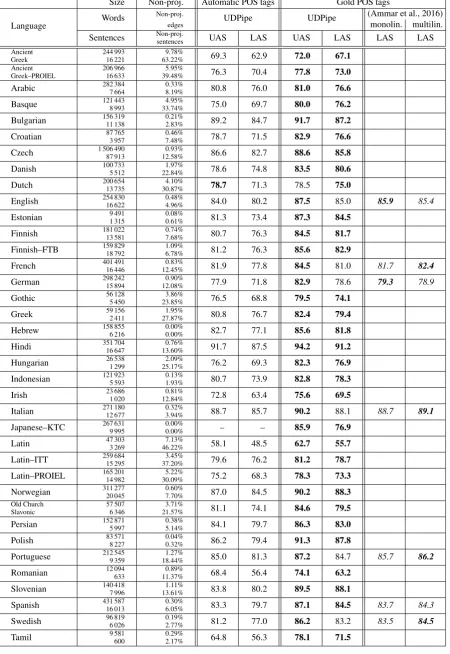
We report both unlabelled (UAS) and labelled attachment score (LAS) of the parser in Table 3.
We consider both the situations when the part-of-speech tags are automatically generated and when the gold tags are used, because while most users will parse data with au-tomatically generated POS tags, system comparison is usu-ally performed using gold tags.
11
Language Size UDPipe morphological analyzer UDPipe tagger
Words Sentences TA/F UPOS XPOS Feats Tags LA/F Lemma UPOS XPOS Feats Tags Lemma
Ancient Greek 244 993 16 221 7.5 99.8 98.4 98.8 98.4 4.6 90.4 90.9 77.3 88.5 77.2 86.7
Ancient Greek–PROIEL 206 966 16 633 7.9 99.7 99.7 98.7 98.5 5.0 95.0 96.6 96.3 88.9 88.0 93.4
Arabic 282 384 7 664 6.7 99.9 99.3 99.3 99.3 6.7 — 98.7 97.5 97.5 97.3 —
Basque 121 443 8 993 6.2 98.5 — 97.2 95.9 4.5 97.1 93.1 — 87.3 85.6 93.5
Bulgarian 156 319 11 138 7.0 99.6 98.6 98.8 98.2 6.1 98.3 97.8 94.3 93.9 92.7 94.5
Croatian 87 765 3 957 6.9 99.2 — 96.0 95.4 3.8 97.6 95.1 — 85.7 85.1 92.4
Czech 1 506 490 87 913 7.4 99.8 98.7 98.3 98.2 6.4 99.6 98.4 93.0 92.4 92.0 97.8
Danish 100 733 5 512 7.2 99.8 — 98.9 98.8 7.2 99.0 95.8 — 94.5 93.3 95.5
Dutch 200 654 13 735 6.6 98.0 96.0 98.2 95.7 5.2 93.4 89.2 88.4 90.8 85.9 88.9
English 254 830 16 622 9.1 99.7 99.2 99.5 99.1 7.5 99.4 94.5 93.4 95.0 92.0 97.0
Estonian 9 491 1 315 7.3 97.1 88.4 93.6 88.3 5.0 85.8 87.9 73.0 79.3 72.9 77.0
Finnish 181 022 13 581 5.4 98.9 98.9 97.5 97.1 4.2 90.5 94.9 95.7 92.7 91.6 86.5
Finnish–FTB 159 829 18 792 6.0 98.4 96.8 97.6 96.8 5.7 93.7 93.6 91.0 92.7 90.5 89.0
French 401 491 16 446 7.5 99.9 — — 99.9 6.9 — 95.9 — — 95.9 —
German 298 242 15 894 6.9 99.7 — — 99.7 7.3 — 90.7 — — 90.7 —
Gothic 56 128 5 450 7.8 99.5 99.5 97.9 97.8 4.6 95.9 95.4 95.8 88.0 86.2 93.4
Greek 59 156 2 411 6.7 99.7 99.4 99.2 98.3 4.9 97.3 97.4 97.1 92.3 91.0 94.7
Hebrew 158 855 6 216 8.3 99.7 99.4 97.5 96.7 6.6 — 94.8 94.5 91.2 90.1 —
Hindi 351 704 16 647 14.1 99.5 98.9 97.6 96.5 12.6 99.6 95.8 94.6 89.6 87.2 98.0
Hungarian 26 538 1 299 5.3 97.8 — 96.4 95.7 5.2 95.4 92.8 — 89.8 88.8 87.3
Indonesian 121 923 5 593 7.4 99.9 — — 99.9 7.2 — 93.6 — — 93.6 —
Irish 23 686 1 020 6.1 97.5 97.0 88.9 86.7 4.9 92.6 90.3 88.7 79.0 75.7 87.3
Italian 271 180 12 677 7.5 99.9 99.6 99.6 99.4 5.0 99.5 97.2 96.9 96.8 96.0 97.7
Japanese–KTC 267 631 9 995 — — — — — — — — — — — —
Latin 47 303 3 269 8.5 98.2 92.5 95.0 92.5 6.4 92.2 90.8 76.5 79.7 76.2 79.9
Latin–ITT 259 684 15 295 6.0 99.9 99.2 99.5 99.1 4.1 99.7 98.8 93.7 94.4 93.4 98.4
Latin–PROIEL 165 201 14 982 7.8 99.7 99.7 98.3 98.1 5.4 97.7 96.2 95.8 88.4 87.7 95.2
Norwegian 311 277 20 045 7.6 99.6 — 99.4 99.1 6.7 99.5 97.2 — 95.4 94.6 96.9
Old Church Slavonic 57 507 6 346 7.4 99.5 99.4 97.6 97.2 4.3 94.5 95.7 95.4 88.6 88.0 92.9
Persian 152 871 5 997 6.8 99.9 99.6 99.7 99.6 5.0 — 96.9 96.1 96.3 96.0 —
Polish 83 571 8 227 7.5 99.7 97.0 97.0 97.0 5.5 97.6 96.0 84.7 84.8 84.5 92.7
Portuguese 212 545 9 359 14.3 99.9 98.7 99.2 98.6 4.8 99.4 97.4 91.5 94.5 91.1 97.8
Romanian 12 094 633 6.8 97.9 93.3 94.5 93.3 5.8 93.8 88.3 80.9 82.0 80.9 75.3
Slovenian 140 418 7 996 7.5 99.4 97.3 97.7 97.2 5.5 98.9 95.6 87.6 88.0 86.9 94.8
Spanish 431 587 16 013 8.1 99.7 — 99.1 98.4 5.6 99.4 95.0 — 95.6 92.9 96.2
Swedish 96 819 6 026 6.9 99.7 98.8 99.0 98.7 4.3 98.8 95.7 93.5 94.3 92.8 95.5
Tamil 9 581 600 4.7 95.7 91.8 93.4 91.7 4.7 95.4 85.4 79.4 82.5 78.6 87.7
Size Non-proj. Automatic POS tags Gold POS tags
Language Words
Non-proj.
UDPipe UDPipe (Ammar et al., 2016)
edges monolin. multilin.
Sentences Non-proj.sentences UAS LAS UAS LAS LAS LAS
Ancient 244 993 9.78%
69.3 62.9 72.0 67.1
Greek 16 221 63.22%
Ancient 206 966 5.95%
76.3 70.4 77.8 73.0
Greek–PROIEL 16 633 39.48%
Arabic 282 3847 664 0.33%8.19% 80.8 76.0 81.0 76.6
Basque 121 4438 993 33.74%4.95% 75.0 69.7 80.0 76.2
Bulgarian 156 31911 138 0.21%2.83% 89.2 84.7 91.7 87.2
Croatian 87 7653 957 0.46%7.48% 78.7 71.5 82.9 76.6
Czech 1 506 49087 913 12.58%0.93% 86.6 82.7 88.6 85.8
Danish 100 7335 512 22.84%1.97% 78.6 74.8 83.5 80.6
Dutch 200 65413 735 30.87%4.10% 78.7 71.3 78.5 75.0
English 254 83016 622 0.48%4.96% 84.0 80.2 87.5 85.0 85.9 85.4
Estonian 9 4911 315 0.08%0.61% 81.3 73.4 87.3 84.5
Finnish 181 02213 581 0.74%7.68% 80.7 76.3 84.5 81.7
Finnish–FTB 159 82918 792 1.09%6.78% 81.2 76.3 85.6 82.9
French 401 49116 446 12.45%0.83% 81.9 77.8 84.5 81.0 81.7 82.4
German 298 24215 894 12.08%0.90% 77.9 71.8 82.9 78.6 79.3 78.9
Gothic 56 1285 450 23.85%3.86% 76.5 68.8 79.5 74.1
Greek 59 1562 411 27.87%1.95% 80.8 76.7 82.4 79.4
Hebrew 158 8556 216 0.00%0.00% 82.7 77.1 85.6 81.8
Hindi 351 70416 647 13.60%0.76% 91.7 87.5 94.2 91.2
Hungarian 26 5381 299 25.17%2.09% 76.2 69.3 82.3 76.9
Indonesian 121 9235 593 0.13%1.93% 80.7 73.9 82.8 78.3
Irish 23 6861 020 12.84%0.81% 72.8 63.4 75.6 69.5
Italian 271 18012 677 0.32%3.94% 88.7 85.7 90.2 88.1 88.7 89.1
Japanese–KTC 267 6319 995 0.00%0.00% – – 85.9 76.9
Latin 47 3033 269 46.22%7.13% 58.1 48.5 62.7 55.7
Latin–ITT 259 68415 295 37.20%3.45% 79.6 76.2 81.2 78.7
Latin–PROIEL 165 20114 982 30.09%5.22% 75.2 68.3 78.3 73.3
Norwegian 311 27720 045 0.60%7.70% 87.0 84.5 90.2 88.3
Old Church 57 507 3.71%
81.1 74.1 84.6 79.5
Slavonic 6 346 21.57%
Persian 152 8715 997 0.38%5.14% 84.1 79.7 86.3 83.0
Polish 83 5718 227 0.04%0.32% 86.2 79.4 91.3 87.8
Portuguese 212 5459 359 18.44%1.27% 85.0 81.3 87.2 84.7 85.7 86.2
Romanian 12 094633 11.37%0.89% 68.4 56.4 74.1 63.2
Slovenian 140 4187 996 13.61%1.11% 83.8 80.2 89.5 88.1
Spanish 431 58716 013 0.30%6.05% 83.3 79.7 87.1 84.5 83.7 84.3
Swedish 96 8196 026 0.19%2.77% 81.2 77.0 86.2 83.2 83.5 84.5
Tamil 9 581600 0.29%2.17% 64.8 56.3 78.1 71.5
We compare our parser results to (Ammar et al., 2016), which present two parsers trained on 7 treebanks from Uni-versal Dependencies 1.2. The first parser is monolingual (it is trained on the training data of the target language only), the second one is trained on all 7 treebanks. Although both these parsers utilize additional raw corpora during train-ing (by employtrain-ing pretrained word embeddtrain-ings and Brown clusters embeddings) and use more advanced Stack-LSTM model (Dyer et al., 2015), UDPipe parsing results are quite competitive, as presented in Table 3.
Note that for some languages there is a noticeable drop in parsing performance when automatically generated POS tags are used instead of gold POS tags. Since we train the tagger and the parser using the same input data, we were concerned whether it is proper to train the parser using gen-erated POS tags that were trained on the same data (be-cause these POS tags are nearly identical to the gold tags, unlike POS tags generated on development and testing por-tion of the data). However, when the parser is trained us-ing POS tags generated by 10-fold cross-trainus-ing (i.e., POS tags of each fold of the training data are generated by a tag-ging model trained on the remaining folds), the resulting attachment scores (both unlabelled and labelled) averaged across all treebanks dropped, demonstrating that this is not the case.
6.
UDPipe
UDPipe is a single C++ tool containing a tokenizer, mor-phological analyzer, POS tagger, lemmatizer and a de-pendency parser as described in the previous sections. It is released under the very permissive Mozilla Pub-lic License (MPL) and can be obtained from the UD-Pipe homepagehttp://ufal.mff.cuni.cz/udpipeor directly using the permanent ID http://hdl.handle. net/11234/1-1659. The training code is part of the re-lease.
The whole pipeline is easily trainable using training data in CoNLL-U format (and optionally additional raw text if the tokenizer is to be trained and the pre-tokenized version of the text is not available).12 All the trained models of the whole pipeline are stored in a single file. Naturally, it is possible to train only a selected part of the complete pipeline.
We believe UDPipe to be a light-weight, efficient soft-ware with low resource usage and high throughput – the complete pipeline usually has throughput of several thou-sand words per second, with model sizes on the order of megabytes.
In addition to the UDPipe binary we also provide a library with many language bindings – we currently offer Java, Python, Perl and C#. Furthermore, UDPipe is available as a web service with REST API.
Finally, we released models for most of UD 1.2 treebanks – the only missing treebanks are Japanese (because of licens-ing issues) and four historical treebanks (due to unavailable raw corpus for tokenizer training, which we nevertheless hope to obtain soon).
12Note that even if we have set the hyperparameters to
reason-able defaults, some hyperparameter tuning still must take place in order to obtain best possible performance results.
7.
Conclusions and Future Work
We presentedUDPipe, a simple, unified tool for tokeniza-tion, morphological analysis, POS tagging, lemmatization and dependency parsing. It is distributed as one binary (and as a library) and with models for most of the Universal De-pendencies treebanks. UDPipe can also be easily trained for new languages and requires neither additional resources such as morphosyntactic dictionaries, nor feature engineer-ing and no language-specific knowledge.There are several areas we want to explore in the future. We want to evaluate the effect of employing real morphologi-cal dictionary instead of morphologimorphologi-cal analysis using UD data only described in Section 4.1. Furthermore, we would like to utilize additional raw corpora during training, for ex-ample by using word embeddings, character-level embed-dings, or improving the morphological guesser.
Acknowledgments
This work has been partially supported and has been us-ing language resources and tools developed, stored and dis-tributed by the LINDAT/CLARIN project of the Ministry of Education, Youth and Sports of the Czech Republic (project LM2015071). This research was also partially supported by SVV project number 260 224.
Ammar, W., Mulcaire, G., Ballesteros, M., Dyer, C., and Smith, N. A. (2016). One parser, many languages. CoRR, abs/1602.01595.
Bird, S., Klein, E., and Loper, E. (2009). Natural Lan-guage Processing with Python. O’Reilly Media, Inc., 1st edition.
Chen, D. and Manning, C. (2014). A fast and accurate de-pendency parser using neural networks. InProceedings of the 2014 Conference on Empirical Methods in Natural Language Processing (EMNLP), pages 740–750, Doha, Qatar, October. Association for Computational Linguis-tics.
Cho, K., van Merrienboer, B., Bahdanau, D., and Ben-gio, Y. (2014). On the properties of neural ma-chine translation: Encoder-decoder approaches. CoRR, abs/1409.1259.
Collins, M. (2002). Discriminative Training Methods for Hidden Markov Models: Theory and Experiments with Perceptron Algorithms. InProceedings of the 2002 Con-ference on Empirical Methods in Natural Language Pro-cessing, pages 1–8. Association for Computational Lin-guistics, July.
Collobert, R., Weston, J., Bottou, L., Karlen, M., Kavukcuoglu, K., and Kuksa, P. (2011). Natural lan-guage processing (almost) from scratch. The Journal of Machine Learning Research, 12:2493–2537.
de Marneffe, M.-C., Dozat, T., Silveira, N., Haverinen, K., Ginter, F., Nivre, J., and Manning, C. D. (2014). Univer-sal stanford dependencies: A cross-linguistic typology. InProceedings of the Ninth International Conference on Language Resources and Evaluation (LREC-2014). Dyer, C., Ballesteros, M., Ling, W., Matthews, A., and
of the 53rd Annual Meeting of the Association for Com-putational Linguistics and the 7th International Joint Conference on Natural Language Processing (Volume 1: Long Papers), pages 334–343, Beijing, China, July. As-sociation for Computational Linguistics.
Graves, A. and Schmidhuber, J. (2005). Framewise phoneme classification with bidirectional lstm and other neural network architectures. Neural Networks, pages 5– 6.
Hochreiter, S. and Schmidhuber, J. (1997). Long short-term memory. Neural Comput., 9(8):1735–1780, November.
Kingma, D. P. and Ba, J. (2014). Adam: A method for stochastic optimization.CoRR, abs/1412.6980.
Ling, W., Lu´ıs, T., Marujo, L., Astudillo, R. F., Amir, S., Dyer, C., Black, A. W., and Trancoso, I. (2015). Finding function in form: Compositional character mod-els for open vocabulary word representation. CoRR, abs/1508.02096.
Nivre, J., de Marneffe, M.-C., Ginter, F., Goldberg, Y., Hajiˇc, J., Manning, C. D., McDonald, R., Petrov, S., Pyyaslo, S., Silveira, N., Tsarfaty, R., and Zeman, D. (2016). Universal dependencies v1: A multilingual tree-bank collection. Submitted to this LREC.
Petrov, S., Das, D., and McDonald, R. (2012). A universal part-of-speech tagset. InProceedings of the Eight Inter-national Conference on Language Resources and Evalu-ation (LREC’12), Istanbul, Turkey, may. European Lan-guage Resources Association (ELRA).
Spoustov´a, D. j., Hajiˇc, J., Raab, J., and Spousta, M. (2009). Semi-Supervised Training for the Averaged Per-ceptron POS Tagger. InProceedings of the 12th Confer-ence of the European Chapter of the ACL (EACL 2009), pages 763–771, Athens, Greece, March. Association for Computational Linguistics.
Srivastava, N., Hinton, G., Krizhevsky, A., Sutskever, I., and Salakhutdinov, R. (2014). Dropout: A simple way to prevent neural networks from overfitting. Journal of Machine Learning Research, 15:1929–1958.
Straka, M., Hajiˇc, J., Strakov´a, J., and Hajiˇc jr., J. (2015). Parsing universal dependency treebanks using neural net-works and search-based oracle. InProceedings of Four-teenth International Workshop on Treebanks and Lin-guistic Theories (TLT 14), December.
Strakov´a, J., Straka, M., and Hajiˇc, J. (2014). Open-source tools for morphology, lemmatization, pos tagging and named entity recognition. In Proceedings of 52nd An-nual Meeting of the Association for Computational Lin-guistics: System Demonstrations, pages 13–18, Balti-more, Maryland, June. Association for Computational Linguistics.
Univeral Dependencies Treebanks version 1.2. (2015). Released Nov 15, 2015. Perma-nent identifier for download http://hdl. handle.net/11234/1-1548, documentation at http://universaldependencies.org/. Zeman, D. (2008). Reusable tagset conversion using
tagset drivers. In Proceedings of the Sixth Interna-tional Conference on Language Resources and
Evalu-ation (LREC’08), Marrakech, Morocco, may. European Language Resources Association (ELRA).