Open Access
Short report
A case for a CUG-initiated coding sequence overlapping torovirus
ORF1a and encoding a novel 30 kDa product
Andrew E Firth*
1and John F Atkins*
1,2Address: 1BioSciences Institute, University College Cork, Cork, Ireland and 2Department of Human Genetics, University of Utah, Salt Lake City,
UT 84112-5330, USA
Email: Andrew E Firth* - [email protected]; John F Atkins* - [email protected] * Corresponding authors
Abstract
The genus Torovirus (order Nidovirales) includes a number of species that infect livestock. These viruses have a linear positive-sense ssRNA genome of ~25-30 kb, encoding a large polyprotein that is expressed from the genomic RNA, and several additional proteins expressed from a nested set of 3'-coterminal subgenomic RNAs. In this brief report, we describe the bioinformatic discovery of a new, apparently coding, ORF that overlaps the 5' end of the polyprotein coding sequence, ORF1a, in the +2 reading frame. The new ORF has a strong coding signature and, in fact, is more conserved at the amino acid level than the overlapping region of ORF1a. We propose that the new ORF utilizes a non-AUG initiation codon - namely a conserved CUG codon in a strong Kozak context - upstream of the ORF1a AUG initiation codon, resulting in a novel 258 amino acid protein, dubbed '30K'.
Findings
The genus Torovirus belongs to the family Coronaviridae in the order Nidovirales. Species include Bovine torovirus, Equine torovirus and Porcine torovirus. As with other members of the order Nidovirales, these viruses have a lin-ear positive-sense ssRNA genome encoding a large repli-case polyprotein that is expressed from the genomic RNA (ORF1a and, via ribosomal frameshifting, an ORF1aORF1b fusion product), and a number of other proteins -including the structural proteins - which are translated from a nested set of 3'-coterminal sub-genomic RNAs (Figure 1A) [1-6].
Overlapping genes are common in RNA viruses where they serve as a mechanism to optimize the coding poten-tial of compact genomes. However, annotation of over-lapping genes can be difficult using conventional
gene-number of complementary approaches to systematically identify new overlapping genes in virus genomes [7-11]. When we applied these methods to the toroviruses, we found strong evidence for a new coding sequence - over-lapping the 5'-terminal region of ORF1a (Figure 1). Here we describe the bioinformatic analyses.
Relatively little sequence data is available for the relevant 5'-terminal region of the torovirus genome. In fact there are only two non-identical sequences in GenBank (tblastn [12] of translated NC_007447 ORF1a; 2 Aug 2009) for the region of interest: [GenBank:NC_007447] - Breda virus or Bovine torovirus (derived from [GenBank:AY427798]) [5], and [GenBank:DQ310701] - Berne virus or Equine torovirus [4]. However these two viruses are reasonably divergent (mean nucleotide identity within ORF1a ~68%), thus providing robust statistics for comparative
Published: 8 September 2009
Virology Journal 2009, 6:136 doi:10.1186/1743-422X-6-136
Received: 9 August 2009 Accepted: 8 September 2009
This article is available from: http://www.virologyj.com/content/6/1/136
© 2009 Firth and Atkins; licensee BioMed Central Ltd.
Coding potential statistics for torovirus ORF1a and the overlapping ORFX Figure 1
Coding potential statistics for torovirus ORF1a and the overlapping ORFX. (A) Torovirus genome map (Breda
virus or Bovine torovirus [GenBank:NC_007447]; from [5]) showing the location of the proposed new coding sequence, ORFX. (B1) Map of the ORF1a region showing the proposed new coding sequence, ORFX, overlapping ORF1a in the +2 read-ing frame. (B2-B4) The positions of stop codons in each of the three forward reading frames. The +0 frame corresponds to ORF1a and is therefore devoid of stop codons. Note the conserved absence of stop codons in the +2 frame within the ORFX region. (B5-B6) Conservation at synonymous sites within ORF1a (see [11] for details). (B5) depicts the probability that the degree of conservation within a given window could be obtained under a null model of neutral evolution at synonymous sites, while (B6) depicts the absolute amount of conservation as represented by the ratio of the observed number of substitutions within a given window to the number expected under the null model. Note that the relatively large sliding window size (75 codons) - used here for improved statistical power - is responsible for the broad smoothing of the conservation scores at the 3' end of ORFX. (B7-B9) MLOGD sliding-window plots (window size 75 codons; step size 25 codons; see [8] for details). The null model, in each window, is that the sequence is non-coding, while the alternative model is that the sequence is coding in the given reading frame. Positive scores favour the alternative model and, as expected, in the +0 frame (B7) there is a strong cod-ing signature throughout ORF1a except where ORF1a is overlapped by ORFX (see text). In the +1 and +2 frames (B8-B9), scores are generally negative, albeit with significant scatter into positive scores (a reflection of the limited amount of available input sequence data). Nonetheless the ORFX region is characterized by consecutive positively scoring windows in the +2 frame (B9). Note that, regardless of the sign (either positive or negative), the magnitude of MLOGD scores tends to be lower within the overlap region itself (B7-B9) due to there being fewer substitutions with which to discrimate the null model from the alternative model in this region of above-average nucleotide conservation.
(A)
0 2000 4000 6000 8000 10000 12000
−30
DQ310701 ORF1a amino acid sequences were aligned with CLUSTALW [13] and back-translated to produce a nucleotide sequence alignment, which was analyzed with a number of techniques.
The first piece of evidence for an overlapping coding sequence is the presence of an unusually long open read-ing frame (229 codons; hereafter ORFX) at the 5' end of ORF1a but in the +2 reading frame relative to ORF1a (Fig-ure 1B, panels 2-4). In fact ORF1a in Breda virus has 589 stop codons in the +2 frame (out of a total of 4444 codons), while Berne virus has 569 stop codons (out of 4568). In other words, approximately one in every eight codons in the +2 reading frame is a stop codon (see, for example, the last three alignment blocks in Figure 2). Thus the probability of obtaining an uninterupted 229-codon +2 frame ORF simply by chance is vanishingly small (if +2 frame stop codons within ORF1a are assumed to be ran-domly distributed, then the probability is of order p < 10 -10). Moreover, there are 141 point nucleotide differences between Breda virus and Berne virus within ORFX, and yet the open reading frame is preserved in both viruses. The absence of stop codons may be linked to local nucleotide biases - indeed the mean nucleotide frequencies within ORFX (Breda virus) are A 28%, C 24%, G 20% and U 27% compared with A 27%, C 14%, G 23% and U 36% in the rest of ORF1a, so that the ORFX region is relatively C-rich and U-poor. However the simplest explanation for these nucleotide biases is simply the presence of an overlapping gene (i.e. ORFX) and the constraints imposed by having to code in multiple reading frames.
Next, the ORF1a alignment was analysed for conservation at synonymous sites, as described in [11] (but inspired by ref. [14]). The procedure takes into account whether syn-onymous site codons are 1-, 2-, 3-, 4- or 6-fold degenerate and the differing probabilities of transitions and transver-sions. There was a striking, and highly statistically signifi-cant (p < 10-17 for the total conservation within ORFX), peak in ORF1a-frame synonymous site conservation at the 5' end of the alignment, corresponding precisely to the conserved open reading frame, ORFX (Figure 1B, panels 5-6). Peaks in synonymous sites conservation are gener-ally indicative of functiongener-ally important overlapping ele-ments, though such elements may be either coding or non-coding. In fact, high synonymous site conservation at the 5' end of long polyprotein-encoding sequences is a feature common to a number of RNA viruses and can not, in itself, be taken as evidence of an overlapping coding sequence. However the extent (229 codons) and degree (Figure 1B, panel 6) of the conservation here is unusual and, furthermore, the high conservation is not matched in the related coronaviruses. Thus an overlapping gene, viz. ORFX, provides the most obvious explanation for the high conservation seen here. (An alternative explanation
is recombination, as in ref. [15]. However recombination does not provide an explanation for the other evidence presented in this report.)
Finally, we analysed the alignment with MLOGD - a gene-finding program which was designed specifically for iden-tifying overlapping coding sequences, and which includes explicit models for sequence evolution in multiply-coding regions [7,8] (Figure 1B, panels 7-9). In contrast to the synonymous site conservation index above, MLOGD, when applied in the sliding window mode, does not depend on the degree of conservation per se (the sequence divergence parameter is fitted independently for each win-dow). With just two input sequences, the MLOGD signal proved to be somewhat noisy (e.g. there are a number of positively scoring windows that clearly do not correspond to potential overlapping genes in, for example, the +2 frame; Figure 1B, panel 9). However the signal for ORFX was clear - with consecutive positively scoring windows throughout the ORFX region in the +2 frame - indicating, again, that ORFX is indeed a coding sequence. Moreover, the MLOGD score in the +2/ORFX frame within the ORFX region was significantly greater than the score in the +0/ ORF1a frame, indicating that the ORFX product is subject to stronger functional constraints than the product of the overlapping region of ORF1a (which indeed has a nega-tive MLOGD score towards the 5'-terminal half of the ORFX region). Consistently, further inspection showed that, in the region where ORFX and ORF1a overlap, ORFX has higher amino acid conservation than ORF1a (182/ 229 identities for ORFX, 153/229 identities for ORF1a).
Alignment extract showing ORFX and flanking regions Figure 2
Alignment extract showing ORFX and flanking regions.
!∀# !∃
%&∋( )∗+!
,∋(
,
,−
% −./0−121−
&
3 −4 &∋(
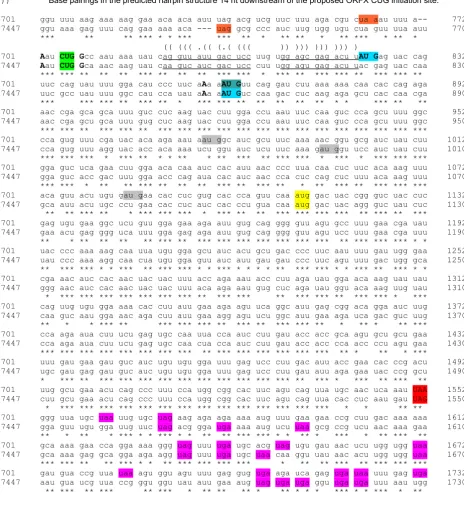
ORFX-frame coding sequence (Figure 2). This pattern of base variation continues right up to the proposed CUG initiation codon. Initiation at a site further upstream is precluded by ORFX-frame termination codons and, con-sistently, the sequence further upstream does not main-tain the reading frame and base variations no longer favour the 3rd position (Figure 2).
Initiation at the upstream CUG codon would give ORFX the nucleotide coordinates 774..1547 in NC_007447 and 776..1549 in DQ310701, resulting in a 258 amino acid product with a molecular mass of 30 kDa which, for want of a better designation, we tentatively name '30K'. The full predicted amino acid sequences are shown in Figure 3. Note that the product has only one methionine residue, making detection with [35S]Met difficult. Application of blastp [12] to the amino acid sequences revealed no sim-ilar sequences in GenBank (3 Aug 2009) - as expected for a gene created de novo via out-of-frame 'overprinting' of a preexisting gene [19,20]. Similarly, application of Inter-ProScan [21] also returned no hits (protein motifs, domains etc).
It is expected that a large proportion of ribosomes should scan past the CUG codon and initiate at the ORF1a AUG codon - thus allowing synthesis of the replicase polypro-tein - though the additional possibility that the CUG-ini-tiation efficiency may be temporally regulated as part of
Overlapping genes are difficult to identify and are often overlooked. However, it is important to be aware of such genes as early as possible in order to avoid confusion (oth-erwise functions of the overlapping gene may be wrongly ascribed to the gene they overlap), and also so that the functions of the overlapping gene may be investigated in their own right. We hope that presentation of this bioin-formatic analysis will help fullfil these goals. Initial verifi-cation of ORFX product could be by means of immunoblotting with ORFX-specific antibodies, bearing in mind, however, that it may be expressed at relatively low levels.
Competing interests
The authors declare that they have no competing interests.
Authors' contributions
AEF carried out the bioinformatic analysis and wrote the manuscript. Both authors edited and approved the final manuscript.
Acknowledgements
This work was supported by National Institutes of Health Grant R01 GM079523 and an award from Science Foundation Ireland, both to JFA.
References
1. Snijder EJ, Horzinek MC: Toroviruses: replication, evolution and comparison with other members of the coronavirus-like superfamily. J Gen Virol 1993, 74:2305-2316.
Amino acid alignment for '30K', the translated ORFX Figure 3
Amino acid alignment for '30K', the translated ORFX. Note, here the proposed CUG initiation codon is assumed to be
translated by initiator Met-tRNA - resulting in an N-terminal methionine rather than leucine.
Publish with BioMed Central and every scientist can read your work free of charge "BioMed Central will be the most significant development for disseminating the results of biomedical researc h in our lifetime."
Sir Paul Nurse, Cancer Research UK
Your research papers will be:
available free of charge to the entire biomedical community
peer reviewed and published immediately upon acceptance
cited in PubMed and archived on PubMed Central
yours — you keep the copyright
Submit your manuscript here:
http://www.biomedcentral.com/info/publishing_adv.asp
BioMedcentral 2. Hoet AE, Saif LJ: Bovine torovirus (Breda virus) revisited. Anim
Health Res Rev 2004, 5:157-171.
3. van Vliet AL, Smits SL, Rottier PJ, de Groot RJ: Discontinuous and non-discontinuous subgenomic RNA transcription in a nido-virus. EMBO J 2002, 21:6571-6580.
4. Smits SL, Snijder EJ, de Groot RJ: Characterization of a torovirus main proteinase. J Virol 2006, 80:4157-4167.
5. Draker R, Roper RL, Petric M, Tellier R: The complete sequence of the bovine torovirus genome. Virus Res 2006, 115:56-68. 6. Pasternak AO, Spaan WJ, Snijder EJ: Nidovirus transcription: how
to make sense...? J Gen Virol 2006, 87:1403-1421.
7. Firth AE, Brown CM: Detecting overlapping coding sequences with pairwise alignments. Bioinformatics 2005, 21:282-292. 8. Firth AE, Brown CM: Detecting overlapping coding sequences
in virus genomes. BMC Bioinformatics 2006, 7:75.
9. Chung BYW, Miller WA, Atkins JF, Firth AE: An overlapping essential gene in the Potyviridae. Proc Natl Acad Sci USA 2008, 105:5897-5902.
10. Firth AE, Chung BY, Fleeton MN, Atkins JF: Discovery of frameshifting in Alphavirus 6K resolves a 20-year enigma. Virol J 2008, 5:108.
11. Firth AE, Atkins JF: A conserved predicted pseudoknot in the NS2A-encoding sequence of West Nile and Japanese encephalitis flaviviruses suggests NS1' may derive from ribosomal frameshifting. Virol J 2009, 6:14.
12. Altschul SF, Gish W, Miller W, Myers EW, Lipman DJ: Basic local alignment search tool. J Mol Biol 1990, 215:403-410.
13. Thompson JD, Higgins DG, Gibson TJ: CLUSTAL W: improving the sensitivity of progressive multiple sequence alignment through sequence weighting, position-specific gap penalties and weight matrix choice. Nucleic Acids Res 1994, 22:4673-4680. 14. Simmonds P, Karakasiliotis I, Bailey D, Chaudhry Y, Evans DJ, Good-fellow IG: Bioinformatic and functional analysis of RNA sec-ondary structure elements among different genera of human and animal caliciviruses. Nucleic Acids Res 2008, 36:2530-2546.
15. Smits SL, Lavazza A, Matiz K, Horzinek MC, Koopmans MP, de Groot RJ: Phylogenetic and evolutionary relationships among toro-virus field variants: evidence for multiple intertypic recombi-nation events. J Virol 2003, 77:9567-9577.
16. Touriol C, Bornes S, Bonnal S, Audigier S, Prats H, Prats AC, Vagner S: Generation of protein isoform diversity by alternative ini-tiation of translation at non-AUG codons. Biol Cell 2003, 95:169-178.
17. Kozak M: An analysis of 5'-noncoding sequences from 699 ver-tebrate messenger RNAs. Nucleic Acids Res 1987, 15:8125-8148. 18. Kozak M: Downstream secondary structure facilitates recog-nition of initiator codons by eukaryotic ribosomes. Proc Natl Acad Sci USA 1990, 87:8301-8305.
19. Belshaw R, Pybus OG, Rambaut A: The evolution of genome compression and genomic novelty in RNA viruses. Genome Res 2007, 17:1496-1504.
20. Rancurel C, Khosravi M, Dunker KA, Romero PR, Karlin D: Over-lapping genes produce proteins with unusual sequence prop-erties and offer insight into de novo protein creation. J Virol in press.
21. Zdobnov EM, Apweiler R: InterProScan - an integration plat-form for the signature-recognition methods in InterPro. Bio-informatics 2001, 17:847-848.