Volume 2006, Article ID 71249, Pages1–8 DOI 10.1155/WCN/2006/71249
A Sigma-Delta ADC with Decimation and Gain Control
Function for a Bluetooth Receiver in 130 nm Digital CMOS
Jinseok Koh, Gabriel Gomez, Khurram Muhammad, R. Bogdan Staszewski, and Baher Haroun
Wireless Analog Technology Center, Texas Instruments Inc., Dallas, TX 75243, USA
Received 25 October 2005; Revised 15 April 2006; Accepted 18 April 2006
We present a discrete-time second-order multibit sigma-delta ADC that filters and decimates by two the input data samples. At the same time it provides gain control function in its input sampling stage. A 4-tap FIR switched capacitor (SC) architecture was chosen for antialiasing filtering. The decimation-by-two function is realized using divided-by-two clock signals in the antialiasing filter. Antialiasing, gain control, and sampling functions are merged in the sampling network using SC techniques. This compact architecture allows operating the preceding blocks at twice the ADC’s clock frequency, thus improving the noise performance of the wireless receiver channel and relaxing settling requirements of the analog building blocks. The presented approach has been validated and incorporated in a commercial single-chip Bluetooth radio realized in a 1.5 V 130 nm digital CMOS process. The measured antialiasing filtering shows better than 75 dB suppression at the folding frequency band edge. A 67 dB dynamic range was measured with a sampling frequency of 37.5 MHz.
Copyright © 2006 Jinseok Koh et al. This is an open access article distributed under the Creative Commons Attribution License, which permits unrestricted use, distribution, and reproduction in any medium, provided the original work is properly cited.
1. INTRODUCTION
Discrete-time analog signal processing approaches for Blue-tooth wireless receivers have been proposed and successfully
implemented [1,2]. These receivers employ a discrete-time
architecture in which the RF signal is directly sampled and filtered using analog and digital signal processing techniques. Although sampling close to the front-end may render the receiver architecture more susceptible to noise folding and
clock jitter effects, it also provides significant advantages that
make this technique very attractive.
From the RF wireless system point of view, integrating analog building blocks and digital baseband circuits on the same chip helps to reduce area and power consumption, thus driving down the total system cost. Advanced digital CMOS technology provides very high-speed switching devices, thus allowing discrete-time circuits to be clocked at very high rates. Additionally, it is well known that these digital CMOS processes show component matching as good as or even bet-ter than traditional analog processes, even though absolute component value may present big spread over process cor-ners.
The approach shown inFigure 1[1,2] takes advantage
of this system and CMOS process characteristics by directly sampling the RF signal after the LNA and subsequent pro-cessing that exploits the precise capacitance ratios that set
the filtering coefficients. Total noise due to folding can be
minimized by sampling at a very high rate compared to the input signal bandwidth. This is achieved in the direct sam-pling mixer (DSM) which samples the RF signal at RF carrier rate, while down-converting and integrating it in a sampling capacitor. In order to realize the direct sampling, the DSM clocking frequency must be kept high at RF, while, at the same time, the ADC data rate should be kept low in order to
reduce power dissipation and to allow for sufficient settling
time to the input signal. Thus, an ADC that provides data rate conversion and signal amplification in the input
sam-pling stage becomes very advantageous.Figure 2represents a
basic idea for this approach.
In this paper, we present such an approach, which has been implemented and verified in a 130 nm digital CMOS
process. The organization of this paper is as follows.Section
2presents the receiver architecture. The sigma-delta ADC
de-sign and the proposed built-in antialiasing filter merged into
sampling network are described inSection 3. Measurements
and implementation are presented inSection 4. Performance
summary and conclusions are covered inSection 5.
2. RECEIVER ARCHITECTURE
AGC MTDSM AGC Sigma-delta ADC
2400 MS/s 300 MS/s 75 MS/s 37.5 MS/s
LNA TA Sampler Sinc filter 8
Filter
IIR/sinc 4 IFA Sinc
3
filter 2 ADC
ADPLL DCU PCU CLK
Digital receive
chain Bits
TA Sampler filterSinc 8 IIR/sincFilter 4 IFA Sincfilter3 2 ADC
LNTA MTDSM AGC Sigma-delta ADC
Figure1: A discrete-time RF wireless receiver [1,2].
Input
FIR filter Decimationby 2 Buffer
2 x1 Sigma-delta ADC
3bit out
Figure2: Typical building blocks for what would be required for decimation and gain control.
Vin
2 + Σ z1
1 z 1 a2 + Σ z 1 1 z1
b1 b2
ILA Decoder 3bit
out
Figure3: Proposed sigma-delta ADC architecture.
to a minimum of 60 dB. In [3, 4], it was shown that a
5-level second-order sigma-delta ADC can achieve this DR at
aFs =37.5 MHz sampling frequency while maintaining a
low power dissipation. The block diagram inFigure 3shows
the 3-bit sigma-delta architecture with the built-in antialias-ing filter. This multibit architecture relaxes the first integra-tor’s amplifier requirements, thanks to the reduced signal changes at the amplifier’s output when compared to a single-bit sigma-delta ADC. Also, the required full signal swing at this node is reduced, resulting in a relaxed settling time and slew rate specifications. This also results in area and power savings, since a single-stage low-voltage and low-power am-plifier can be used for the implementation.
Two issues need to be carefully considered for the ADC system design. First, since decimation causes noise folding, an antialiasing filter is required. This filter is implemented using an FIR switched capacitor structure. Second, from the Bluetooth system requirements, there is a need for an au-tomatic gain control (AGC) function. Providing some gain control at the input of the ADC helps distributing the AGC function between the ADC and the intermediate frequency
amplifier (IFA), thus relaxing the IFA specification and opti-mizing power consumption.
A hypothetical conventional solution, as shown inFigure
2would require an isolation buffer between the FIR filter and
the ADC input sampling stage in order to avoid charge
shar-ing between the two switched capacitor blocks. This buffer
would also provide the required AGC functionality. How-ever, this amplifying stage would have very demanding set-tling time requirements to reduce the error at the sampling instant in the ADC input stage. In addition, it would increase area and power consumption.
The FIR filtering, decimation-by-two, and gain control functions are all implemented in the sampling network at
the input of the ADC. As shown in Figure 3, combining
these functions in a single sampling structure optimizes area, power, and complexity.
3. SIGMA-DELTA ADC DESIGN
3.1. FIR antialiasing filter and decimation
The diagram inFigure 4shows a switched capacitor
imple-mentation of the sampling network, but, for the sake of clar-ity at this point, it does not include the gain control func-tion. Since the supply voltage is 1.58 V, that is, above 1.4 V of the nominal supply to ensure good transconductance, all switches are realized as regular NMOS devices with
nomi-nalVT=600 mV. The key role of the FIR filter is to provide
enough noise suppression aroundFs/2. The signal at the
in-put of the ADC is naturally band-limited to 75 MHz by the preceding circuits. The ADC works at half that frequency. A 4-tap charge-domain FIR filter is implemented to attenuate the input signal noise around 37.5 MHz. The FIR order was
determined by system level simulations. The FIR filter diff
er-ence equation is given by
CM·y[n]=C0·x[n] +C1·x[n−1]
+C2·x[n−2] +C3·x[n−3],
(1)
where coefficientsC0,C1,C2, andC3are 1, 3, 3, and 1,
Input P1
Figure4: Four-tap FIR filter implementation.
100
FIR filter frequency response
Figure5: Output power spectrum density for FIR filter with white noise input.
The plot inFigure 5 shows the FIR output power spectral
density with white noise applied as input. Matlab simulations indicate that more than 80 dB attenuations can be achieved at the folding frequency band edge (36.5 MHz, since 1 MHz is the signal bandwidth).
Capacitor mismatches in the FIR filter can possibly cause distortion and unwanted modulation. In order to reduce this
effect, dynamic element matching techniques can be
em-ployed with additional switched capacitor circuits. However, these extra circuits increase area. Another way to minimize
this effect is to use bigger unit capacitance which has
gener-ally better matching. Thanks to the good matching property of the CMOS process, 10 bit matching can be easily achieved
P1
Figure6: Control signals for the FIR filter.
without dramatically increasing unit capacitance. Based on behavioral-level simulations, the minimum allowable capac-itance value was chosen. Six-phase clock signals are utilized to realize both the FIR filter and the decimation functions.
On P1 phase, the input signal is sampled inCp2 and 3Cp1,
on P2 phase, it is sampled inCp2, and 3Cp2, and on Pi phase,
the input is sampled intoCpiand 3Cpi, withi=1,. . ., 6.
Af-ter P6, the process is repeated back from P1 phase. On I1
integrating phase, charge in capacitorsCp2, 3Cp3, 3Cp4, and
Cp5is dumped into the integrating capacitorCM. As shown
in the timing diagram inFigure 6, integration occurs in P1,
High gain mode
Figure7: Gain control in the FIR filter.
0
noise tot quant.561 amp.75
18.8 3. 5 level flash
Figure8: Noise analysis.
3.2. Gain control
Figure 7shows how the two-step (0 dB and 14 dB, derived from the Bluetooth RX system specifications) gain control function is implemented using switched capacitor circuits. When the switch HG turns on, the 14 dB gain mode is ac-tivated. When the 0 dB mode is activated, switch LG turns on instead of switch HG. The total gain is simply defined by the ratio between the sampling and the integrating ca-pacitors. This function is implemented in the FIR sampling block by adding the high-gain-mode switched capacitor in
parallel with each of the capacitors inFigure 4. An
alterna-tive of adding the capacitance in the amplifier feedback is not the best choice since it would change the amplifier gain-bandwidth (GBW) product. The load capacitance at the IFA
output is an important design parameter, since it affects the
GBW product as well as the slew rate of the amplifier. There-fore, both gain modes should provide the same load
condi-tion to the IFA output. As shown inFigure 7, the capacitance
seen at the input port is kept constant for both gain modes. In order to minimize the sampling error due to charge in-jection and clock feed-through from the switches, transistor
sizes are optimized for speed and area. Figure 8shows the
VDDA
Figure9: Folded cascode amplifier.
noise analysis for the proposed ADC. Quantization noise is a dominant noise contributor for this application due to the low oversampling ratio (OSR), making kT/C noise less of an issue. Therefore, the unit capacitance element in the FIR
fil-ter is selected based mainly on the effect of mismatch on the
ADC performance.
3.3. Amplifier, comparator, and DAC
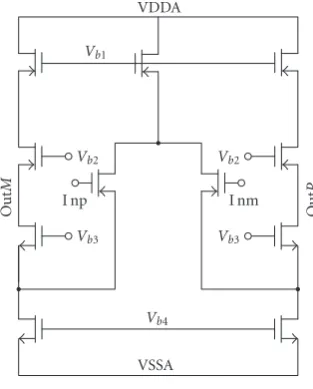
A folded cascode fully differential amplifier with a switched
capacitor common mode feedback is used [5]. Amplifier
noise is optimized on the basis of power consumption and area. However, as in the case of kT/C noise, noise from the amplifier is not very critical due to the high in-band quanti-zation noise. Therefore slew rate, GBW, and output dynamic range became the most critical design parameters. Since the sigma-delta ADC has to work in the same substrate as the digital core, digital circuit noise coupling through the sub-strate and supply rails was carefully considered as an impor-tant design and layout parameter. Layout considerations are also very critical, since any component mismatch could result in degradation of common-mode noise rejection and cancel-lation. Also, great care was taken to provide enough guard ringing and supply decoupling. The final amplifier
configu-ration is shown inFigure 9, which does not include the
com-mon mode feedback or the bias circuits.
A five-level quantizer is implemented using four compa-rators to build a flash ADC. The flash ADC utilizes switched
capacitor subtraction in order to generate four different
threshold voltages. The simplified comparator circuits for one of the flash’s four stages, including subtraction circuits,
are depicted inFigure 10.
The 5-level (+2, +1, 0,−1,−2) DAC is implemented
VINP
REFP
VINM
REFM
N1 N2
Ci
Cr
Ci
Cr
N2
N2 +
+ COMP
OutM
OutP
Latch
Figure10: Switched capacitor comparator.
0.8 0.6 0.4 0.2 0 0.2 0.4 0.6 0.8
Output
1 1.5 2 2.5 3 3.5 4 4.5 5 Input
DAC response
Ideal Set1 Set2
(a)
0.8 0.6 0.4 0.2 0 0.2 0.4 0.6 0.8
Output
1 1.5 2 2.5 3 3.5 4 4.5 5 Input
DAC response
Ideal Set1 Set2
(b)
Figure11: Transfer functions.
of the quantizer output. Two DAC elements could have been used for a 5-level DAC realization, but the load capacitance
would be different for the case when quantizer output is +1
or−1 versus the case when it is +2, 0, and−2. In order to
suppress nonlinearities generated in the 5-level switched ca-pacitor DAC, the individual level averaging (ILA) algorithm
is used [3,6]. Any possible distortion from the capacitor
mis-match in the 5-level DAC is translated into gain error by the
ILA algorithm. This phenomenon is depicted in Figure 11.
Two worst-case mismatch conditions were chosen and
veri-fied in behavioral and SPICE simulations.Figure 11(a) shows
the 5-level DAC transfer function by using two worst-case
mismatch conditions. Figure 11(b) shows a DAC transfer
function when ILA is used to liberalize the DAC transfer
function. In order to visualize the effect from capacitor
mis-match clearly, unrealistic mis-matching numbers were used to
generate the plot inFigure 11.
4. EXPERIMENTAL RESULTS
The 3-bit sigma-delta ADC output was captured using a high-frequency DSP-based data acquisition system. The dy-namic performance was obtained by post-processing the cap-tured data through an FFT and computing various
perfor-mance numbers. Figure 12 is the measured FIR filter
re-sponse with a−6 dBFS input sinusoidal signal applied to the
ADC at frequency steps of 1 MHz from 1 MHz to 30 MHz. The measurement results are well matched to the theoreti-cal curve of the FIR antialiasing filter, as can be seen in the plot. The gain of the filter response is slightly less than the theoretical number due to the gain error induced from
non-idealities in the integrator, reference buffer, and SC DAC.
The power spectral density plot inFigure 13shows the
sys-tem performance when two signals (0 dB at 37 MHz and
80 Antialiasing FIR filter response
Theoretical response Measurements
Figure12: Measured transfer function.
140
Figure13: Spectrum of the captured output.
this should cause a folding signal at 500 kHz (37.5 MHz (Fs)
−37 MHz), but as the figure shows, it is filtered and
attenu-ated below the quantization noise floor.
The interferers in communication systems need to be carefully taken into account especially in cases where sys-tem nonlinearities may create intermodulation. Due to ADC nonlinearities, an interferer can be folded into the Bluetooth
signal bandwidth by means of intermodulation. Figure 14
shows the measured FFT plot for an intermodulation test.
Two−8 dBFS sinusoidal signals at 1 MHz (F1) and 2.2 MHz
(F2) are applied. A−80 dBc IM3 signal appears at 200 kHz.
The measured IM3 satisfies and exceeds the system
require-ments. Figure 15 shows the measured SNDR versus input
amplitude for 0 dB and 14 dB gain modes. The measured
140
Figure14: Two-tone test measurement.
0 14 dB gain mode
Figure15: Measured SNDR versus input power.
peak SNDR is 60 dB for an input 4 dB from full scale with a 1 MHz bandwidth, where the full scale is defined as twice the
reference voltage.Table 1shows the performance summary
of the implemented ADC. Die photo for the dual channel
implementation is shown inFigure 16.
5. CONCLUSION
Table1: Performance summary.
Technology 130 nm digital CMOS
Sampling frequency 37.5 MHz Signal bandwidth 1 MHz Peak SNDR (0 dB gain option) 60 dB Peak SNDR (14 dB gain option) 57 dB
Dynamic range 67 dB
Overall dynamic range 77 dB Input range 1.4 Vpp(diff)
Supply voltage 1.58 V Power consumption 1.6 mW
Core area 0.2 mm2
ADC
DAC
MTDSM
Figure16: Micrograph of the dual channel ADC.
implementation. Since the quantization noise is the domi-nant factor due to the low oversampling ratio and the kT/C noise and amplifier noise are not critical, the power con-sumption in the ADC system was optimized, which resulted in saving area and current consumption. The total area
in-cluding the switched capacitor sampling network is 0.2 mm2
per ADC channel. The consumed power is 1.6 mW per chan-nel at a 1.58 V supply. The achieved dynamic performance fully satisfies the system requirements for a Bluetooth re-ceiver. The presented architecture can be easily extended to higher decimation ratios and better gain control resolution,
while the FIR filter can be easily adjusted for different modes
or system requirements.
ACKNOWLEDGMENTS
The authors would like to thank B. Bakkaloglu for discussion and comments and to W. E. Kim and H. S. Kim for support in device testing and characterization.
REFERENCES
[1] K. Muhammad, D. Leipold, B. Staszewski, et al., “A discrete-time Bluetooth receiver in a 0.13μm digital CMOS process,” in Proceedings of IEEE International Solid-State Circuits Conference
(ISSCC ’04), vol. 1, pp. 267–269, 527, San Francisco, Calif, USA, February 2004.
[2] R. B. Staszewski, K. Muhammad, D. Leipold, et al., “All-digital TX frequency synthesizer and discrete-time receiver for Blue-tooth radio in 130-nm CMOS,”IEEE Journal of Solid-State Cir-cuits, vol. 39, no. 12, pp. 2278–2291, 2004.
[3] G. Gomez and B. Haroun, “A 1.5 V 2.4/2.9 mW 79/50 dB DR ΣΔmodulator for GSM/WCDMA in a 0.13μm digital process,” inProceedings of IEEE International Solid-State Circuits Confer-ence (ISSCC ’02), pp. 242–243, 490, San Francisco, Calif, USA, February 2002.
[4] J. Koh, K. Muhammad, B. Staszewski, G. Gomez, and B. Horoun, “A sigma-delta ADC with a built-in anti-aliasing filter for Bluetooth receiver in 130nm digital process,” inProceedings of IEEE Custom Integrated Circuits Conference (CICC ’04), pp. 535–538, Orlando, Fla, USA, October 2004, sec. 25-6.
[5] H. C. Yang, M. A. Abu-Dayeh, and D. J. Allstot, “Analysis and design of a fast-settling folded-cascode CMOS operational am-plifier for switched-capacitor applications,” inProceedings of the 32nd Midwest Symposium on Circuits and Systems, vol. 1, pp. 442–445, Champaign, Ill, USA, August 1989.
[6] B. H. Leung and S. Sutarja, “MultibitΣ-ΔA/D converter in-corporating a novel class of dynamic element matching tech-niques,”IEEE Transactions on Circuits and Systems II, vol. 39, no. 1, pp. 35–51, 1992.
Jinseok Kohwas born in Seoul, Korea, in 1968. He received his Ph.D. degree in elec-trical engineering from Texas A&M Univer-sity in 2000. From 1993 to 1996, he was with Samsung Electronics as a Design En-gineer working on the high-speed BiCMOS SRAM. When he was at Texas A&M Univer-sity, he was with Analog Mixed Signal Cen-ter working on the sensor-based circuit im-plementations and modeling of
nonideali-ties in data converters. He has developed an LMS-based sigma-delta ADC. He joined Texas Instruments in 2000, where he is working on transceiver designs for wireless applications. His interest is on the sigma-delta ADCs, high-speed DACs, and transceiver architectures.
Gabriel Gomezreceived the Master’s de-gree electronic engineering from the Philips International Institute, Eindhoven, Nether-lands, in 1987 and the M.S.E.E. degree from Wright State University, Dayton, Ohio in 1991. During 1992, he worked as an Assis-tant Professor at the Universidad del Valle, Cali, Colombia. From 1993 to 1995 he was a Ph.D. student while working as a Research Assistant at Texas A&M University, College
Khurram Muhammadreceived the B.S. de-gree from the University of Engineering and Technology, Lahore, Pakistan, in 1990, the M.Eng. degree from the University of Melbourne, Parkville, Victoria, Australia, in 1993, and the Ph.D. degree from Purdue University, West Lafayette, Ind in 1999, all in electrical engineering. Since 1999, he has worked at Texas Instruments Inc., Dallas, Tex, on read-channel, power-line modem,
as well as A/D and D/A converters. Currently he leads system de-velopment of the Digital RF Processor (DRP) Group in addition to leading the receiver design. His research interests include software-defined radio, SoC integration, as well as power and low-complexity design.
R. Bogdan Staszewski received the BSEE (summa cum laude), MSEE, and Ph.D. de-grees from the University of Texas at Dal-las in 1991, 1992, and 2002, respectively. From 1991 to 1995 he was with Alcatel Net-work Systems in Richardson, Tex, Net-working on Sonnet cross-connect systems for fiber optics communications. He joined Texas In-struments in Dallas, Tex, in 1995 where he is currently a Distinguished Member of
Tech-nical Staff. Between 1995 and 1999, he has been engaged in ad-vanced CMOS read channel development for hard disk drives. In 1999 he costarted a Digital Radio Frequency Processor (DRP) Group within Texas Instruments with a mission to invent new digi-tally intensive approaches to traditional RF functions for integrated radios in deep-submicron CMOS processes. Dr. Staszewski cur-rently leads the DRP system and design development for trans-mitters and frequency synthesizers. He has authored and coau-thored 40 journal and conference publications and holds 25 issued US patents. His research interests include deep-submicron CMOS architectures and circuits for frequency synthesizers, transmitters, and receivers.
Baher Haroun received the B.S. degree (1981), the M.S. degree (1984) in electri-cal engineering from Ain Shams University, Egypt, and the Ph.D. degree (1989) from Electrical and Computer Engineering De-partment, University of Waterloo, Waterloo, Ontario, Canada. From 1989 to 1995, he was an Assistant, then Associate Professor in the Department of Electrical and Com-puter Engineering at Concordia University,