Volume 2006, Article ID 39814, Pages1–17 DOI 10.1155/WCN/2006/39814
Energy-Efficient Medium Access Control Protocols for
Wireless Sensor Networks
Qingchun Ren and Qilian Liang
Department of Electrical Engineering, The University of Texas at Arlington, Arlington, TX 76019-0016, USA
Received 3 November 2005; Revised 14 April 2006; Accepted 2 May 2006
Recommended for Publication by Dongmei Zhao
A key challenge for wireless sensor networks is how to extend network lifetime with dynamic power management on energy-constraint sensor nodes. In this paper, we propose two energy-efficient MAC protocols: asynchronous MAC (A-MAC) protocol and asynchronous schedule-based MAC (ASMAC) protocol. A-MAC and ASMAC protocols are attractive due to their suitabilities for multihop networks and capabilities of removing accumulative clock-drifts without any network synchronization. Moreover, we build a traffic-strength- and network-density-based model to adjust essential algorithm parameters adaptively. Simulation results show that our algorithms can successfully acquire the optimum values of power-on/offduration, schedule-broadcast interval, as well as super-time-slot size and order. These algorithm parameters can ensure adequate successful transmission rate, short waiting time, and high energy utilization. Therefore, not only the performance of network is improved but also its lifetime is extended when A-MAC or ASMAC is used.
Copyright © 2006 Q. Ren and Q. Liang. This is an open access article distributed under the Creative Commons Attribution License, which permits unrestricted use, distribution, and reproduction in any medium, provided the original work is properly cited.
1. INTRODUCTION AND MOTIVATIONS
A wireless sensor network (WSN) can be thought as an ad hoc network consisting of sensor nodes that are linked by wireless medium to perform distributed sensing tasks. Recent developments in integrated circuit technology have brought about the construction of small and low-cost sen-sor node with signal processing and wireless communication capabilities. Distributed WSNs have increasing applications, as they hold the potential to renovate many segments of our economies and lives from environment monitoring to
man-ufacture and business asset management [1].
One crucial challenge for WSN designers is to develop a system that will run for years unattendedly, which calls for not only robust hardware and software, but also lasting en-ergy sources. However, currently, sensor nodes are powered by battery, whose available energy is limited. Moreover, re-placing or recharging battery, in many cases, may be imprac-tical or uneconomical. Even though, future sensor nodes may be powered by ambient energy sources (such as sunlight,
vi-brations, etc.) [2], the provided current is very low. From
both perspectives, protocols and applications designed for
WSNs should be highly efficient and optimized in terms of
energy.
In general, a sensor node consists of a microprocessor, a data storage, sensors, analog-to-digital converters (ADCs), a data transceiver, an energy source, and controllers that tie
those pieces together [1]. Communications, not only
trans-mitting, but also receiving, or merely scanning a channel for
communication, can use up to half of the energy [3]. Thus,
recently, some researchers have begun to study the energy ef-ficiency problem through reducing power consumption on wireless interface.
Commonly, a distributed WSN is composed of a set of low-end gathering sensor nodes and high-end data-collection sensor nodes. In kinds of network, data-data-collection sensor nodes collect the data about a physical phenomenon and send them to related data-gathering sensor nodes that act as lead-sensor or fusion center over wireless links. For
exam-ple, in [4,5], such network model was employed for
investi-gating the energy efficiency of distributed coding and signal
processing. A similar model was employed in [6] to develop a
collaborative and distributed tracking algorithm for energy-aware WSNs.
Clock drift + interaction among users
Synchronized clock (network synchronization) +
Working-status switching
schedule
= Matchingoperation
Traditional method Our method
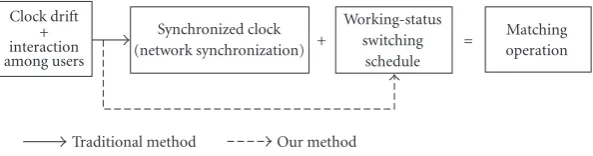
Figure1: Motivation of our energy-efficient MAC protocols.
nodes, as well as communication between data-collection nodes and data-gathering nodes. In this paper, we mainly
focus on how to design energy-efficient MAC protocols to
organize the communication between data-collection nodes,
which suffer from power constraint strictly. This type of
communication is quite common in general WSNs. For stance, data-collection nodes exchange their collected in-formation before sending it to data-gathering nodes to re-duce information redundancy caused by position
correla-tion of nodes. Another example is given in [7], in which
to implement V-BLAST-based virtual multiple-input multi-ple-output (MIMO) communication, data-collection nodes share their collected information with each other before transmission.
1.1. Accumulative clock-drift problem
As a matter of fact, the quality of a node’s clock usually boils
down to its frequency’s stability and accuracy [8]. Generally
speaking, as frequency stability and accuracy increase, so do its required power, size, and cost, which are all troublesome for general nodes. Moreover, the frequency generated by a
quartz oscillator is also affected by a number of
environmen-tal factors: voltage applied to it, ambient temperature, ac-celeration in space, and so forth. Low-cost oscillators
com-monly have nominal frequency accuracy on the order of 104
to 106. That is, two similar but uncalibrated oscillators will
drift apart from 1 to 100 microseconds every second [8]. As
time goes, oscillators will drift apart farther and farther. We call this accumulative clock-drift in this paper.
The basic idea of most energy-efficient MAC protocols
is to power on/offtheir radios alternately to implement
com-munication and to reduce energy consumption. This ac-tive/sleep scheme requires matching operation among nodes (i.e., source-destination pairs switch between active and sleep states coincidently) to ensure that the low-power ra-dio schedule works successfully. Hence, for general WSNs,
it is necessary to develop effective and efficient methods
to resolve the mismatching problem caused by accumula-tive clock-drift. Network synchronization is one of the exist-ing approaches for this issue, in which a common timescale is necessary. However, is it the only or the best choice? If a system dose not provide network synchronization ser-vice, is there any alternative solution? Furthermore, although the strategies exploited by existing network synchronization schemes are various, the working load for carrying out net-work synchronization is mainly located at the user’s sides (or
data-collection node sides), which we call user-exhaustion schemes. Obviously, user-exhaustion scheme is not a wise choice, since data-collection nodes are typically subjected to strict energy constraint while data-gathering nodes are not.
1.2. Heterogeneous problem
The traffic of WSN, in general, has a heterogeneous nature
[9] (i.e., the traffic arrival rate for different sensor nodes and
even for the same sensor node at different time fluctuates
considerably during the network lifetime). Consequently, ac-cording to the time-variant situation of system, how to adjust essential parameters adaptively is another important task for protocol designers. As a matter of fact, we notice that the
power-on/offduration is tightly related to the system
per-formance in terms of energy saving, time delay, and system
throughput. That is, with the increase of power-offduration,
there is more chance for buffer overflowing, longer
waiting-time for data packets, and fewer data packets being transmit-ted during a period of time. However there is more energy reserved for avoiding excessive idle listening. On the other hand, with the increase of power-on duration, there are more
data packets transmitted, then there is less chance for buffer
overflowing and shorter waiting-time for data packets. How-ever, there is more energy wasted by idle listening. Neverthe-less, little work is done on how to determine those essential parameters.
1.3. Our contributions
Leveraging the characteristics of free-running timing method and the advantages of fuzzy logic system on uncertain
prob-lems, we propose two energy-efficient MAC protocols for
WSNs: asynchronous MAC (A-MAC) protocol and asyn-chronous schedule-based MAC (ASMAC) protocol. Our timing-rescheduling scheme and time-slot allocation algo-rithm provide an approach to remove the tight dependency
on network synchronization for energy-efficient MAC
pro-tocols, which is a critical constraint for network upgrading
and expanding (Figure 1). Within A-MAC and ASMAC
pro-tocols, no common timescale is needed any more, which will free the energy for setting up and maintaining.
Furthermore, considering the heterogeneous nature of
WSN, we build a traffic-strength- and
terms of energy reservation and communication capability.
Those algorithm parameters include power-on/offduration,
schedule-broadcast interval, as well as super-time-slot size and order. In addition, static approaches may be far from be-ing optimal because they deny the opportunity to reschedule operations if the system situation is changed, thus we apply adaptive methods for parameter adjustment.
In opposit to existing network synchronization schemes, A-MAC and ASMAC are control-center-exhaustion schemes. It is data-gathering nodes, whose energy is more abundant and easier to be recharged than data-collection nodes, that are in charge of most working load to form matching opera-tion among nodes.
The rest of this paper is organized as follows. InSection 2,
we discuss some related works. Sections3and4describe our
A-MAC and ASMAC protocols, respectively. Simulation
re-sults are given inSection 5.Section 6concludes this paper.
2. RELATED WORKS AND PRELIMINARIES
2.1. Energy-efficient MAC protocols
In contrast to typical MAC protocols of WLAN, MAC
proto-cols designed for WSNs usually trade offperformance (such
as latency, throughput, fairness) and cost (such as energy ef-ficiency, reduced algorithmic complexity). However, it is not
clear what is the best tradeoffand various designs differ
sig-nificantly.
An energy-efficient MAC protocol, power-aware
multi-access protocol with signaling (PAMAS) [10] for ad hoc
net-works, is proposed in 1999. PAMAS reserves battery power
by intelligently powering offusers that are not actively
trans-mitting or receiving packets. In this algorithm, two
sepa-rated channels—control channel and traffic channel—are
needed. Following PAMAS, some other solutions for WSNs
are put forward. Energy-efficient MAC protocols for WSNs
can be classified into three main categories according to strategies applied to channel access: contention-based pro-tocols, TDMA-based propro-tocols, and slotted protocols.
As a contention-based energy-efficient MAC protocol,
802.11 [11] standard is based on carrier sensing (CSMA) and
collision detection (through acknowledgements). A node in-tended to transmit must test the channel whether it is free
for a specified time (i.e., DIFS). In [12], Hill and Culler
de-veloped a low-level carrier sensing technique that effectively
turns radios offrepeatedly without losing any incoming data.
This technique operates at the physical layer and concerns the layout of PHY prepended header of packet. However, energy consumption by collision, overhearing, and idle lis-tening is still an unresolved problem. Nevertheless, TDMA-based MAC protocols (i.e., TDMA) have the advantage of avoiding all those energy wastes, since TDMA scheme is in-herently collision-free and schedules notify each sensor node when it should be active and, more importantly, when not.
As a TDMA-based energy-efficient MAC protocol,
traf-fic-adaptive medium access (TRAMA) [13] employs a traffi
c-adaptive and distributed election scheme to allocate system
time among nodes. EMACS [14] reduces idle time by
forc-ing nodes to go into dormant mode and to wake up for an-nouncing their presence at the schedule time only. Other
TDMA-based energy-efficient MAC protocols such as
bit-map-assisted (BMA) protocol and GANGS MAC protocol
are described in [15,16]. However, the price to be paid is the
fixed costs (i.e., broadcasting traffic schedules) and the
re-duced flexibility to handle traffic fluctuations and topology
change. The third type of energy-efficient MAC protocol—
slotted MAC protocols—is proposed and organizes sensor nodes into a slotted system (much like slotted ALOHA), which strikes a middle ground between the first two ones.
As a slotted energy-efficient MAC protocol, S-MAC [17]
is a low-power RTS-CTS protocol for WSNs inspired by
PA-MAS and 802.11. S-MAC includes four major components:
periodic listening and sleeping, collision avoidance, over-hearing avoidance, and message passing. In S-MAC, period-ically listening and sleeping are designed to reduce energy
consumption during the long idle time. T-MAC [18]
im-proves S-MAC on energy usage by using a quite short lis-tening window at the beginning of active period. To achieve
ultra-low-power operation, effective collision avoidance, and
high channel utilization, B-MAC [19] provides a flexible
in-terface and employs an adaptive preamble sampling scheme to reduce duty cycle and to minimize idle listening. However, synchronization among sensor nodes is a strict premise for this kind of protocol.
Besides above works, battery-aware MAC (BAMAC(k))
protocol is proposed in [20]. BAMAC(k) is a distributed
battery-aware MAC scheduling scheme, where nodes are considered as a set of batteries and scheduled by a round-robin scheduler. BAMAC(k) tries to increase the node’s life-time by exploiting the recovery capacity of batteries. Their work showed how battery awareness influences throughput, fairness, and other factors which indicate the system’s
per-formance. In [21], a power control MAC protocol, proposed
power control MAC (PCM), is put forward. PCM allows nodes to vary transmission power on the packet basis, which does not degrade throughput and yields energy saving with
comparison to some simple modifications of IEEE 802.11.
2.2. Network synchronization
For many digital communication engineers, the term syn-chronization is familiar in a somewhat restricted sense, meaning only the acquisition and the tracking of a clock in a receiver with reference to the periodic timing information contained in the received signal. More properly speaking, this should be referred to as carrier or symbol synchronization. Summarily, there are eight types of synchronization mainly applied to telecommunication networks, that is, carrier syn-chronization, symbol synsyn-chronization, frame synchroniza-tion, bit synchronizasynchroniza-tion, packet synchronizasynchroniza-tion, network synchronization, multimedia synchronization, and
synchro-nization of real-time clocks [22]. Network synchronization is
one of the targets in this paper.
Crisp input
xεX Fuzzifier Fuzzy input
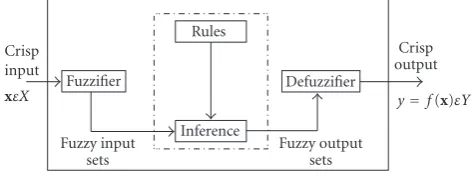
Figure2: Structure of a fuzzy logic system.
scales of all clocks by using the communication capacity of links interconnecting them. Some well-known applica-tions for network synchronization are synchronization of
clocks located at different multiplexing and switching points
in a digital telecommunication network, synchronization of clocks in a telecommunication network that requires some form of time-division multiplexing multiple access and range measurement between two nodes in a network.
Over the years, many protocols have been designed for maintaining synchronization of physical clocks over
telecom-munication networks [23–25]. Some wireless standards such
as 802.11 have similar time-synchronization beacons built
into MAC layer. Network time protocol (NTP) stands out by virtue of its scalability, self-configuration for creating a global timescale in multihop networks, robustness to various types of failure, security in the face of deliberate sabotages, and ubiquitous deployments. Other algorithms, such as
time-diffusion synchronization protocol (TDP) and
reference-broadcast synchronization (RBS), are proposed in [8,26].
2.3. Preliminaries: overview of fuzzy logic systems
Figure 2shows the structure of a fuzzy logic system (FLS)
[27]. When an input is applied to an FLS, the inference
en-gine computes the output set corresponding to each rule. The defuzzifier then computes a crisp output from these rule’s
output sets. Consider ap-input 1-output FLS, using
single-ton fuzzification,center-of-setsdefuzzification [28], and
“IF-THEN” rules of the form [29]
Rl: IFx1isFl
1andx2isF2l and· · ·
andxpisFlp, THENyisGl.
(1)
Assuming singleton fuzzification, when an inputx =
{x1,. . .,xp}is applied, the degree of firing corresponding to
thelth rule is computed as
μFl
whereandT both indicate the chosent-norm. There are
many kinds of defuzzifiers. In this paper, we focus, for
illus-trative purposes, on the height defuzzifier [29]. It computes
a crisp output for the FLS by first computing the height ¯ylof
every consequent setGl, and then computing a weighted
av-erage of these heights. The weight corresponding to thel
th-rule consequent height is the degree of firing associated with thelth ruleTi=p1μFl
whereMis the number of rules in the FLS.
In [30], there is a survey on the computation complexity
of the fuzzy logic system. Because a key element of fuzzy logic is its characteristic trait that transforms the binary world of digital computing into a computation based on continuous intervals, true fuzzy logic must be emulated by a software program on a standard microcontroller/processor. Inform Software Corp. has pioneered the fuzzy logic development tool market with its “fuzzyTECH microkerne” software ar-chitecture that provides implementation of fuzzy logic much
more efficiently than previous emulation technologies. Now,
the same example of a small fuzzy logic system running on a standard 8051 requires about one millisecond only for com-putation.
3. ASYNCHRONOUS MAC (A-MAC) PROTOCOL
Asynchronous MAC (A-MAC) protocol divides the system
time into four phases: TRFR-Phase, Schedule-Phase,
On-Phase, and Off-Phase(Figure 3).
(i) TRFR-Phaseis preserved for data-collection nodes to
send traffic-rate and failure-rate (TRFR) messages to
data-gathering nodes.
(ii) Schedule-Phaseis preserved for data-gathering nodes to locally broadcast phase-switching schedules.
(iii) Off-Phase is preserved for data-collection nodes to
power offtheir radios. In this phase, there is no
com-munication, but data storing and sensing may happen. (iv) On-Phase is preserved for data-collection nodes to
power on their radios to carry on communication.
In our system, at the end of On-Phase—nodes go to
“vacation”—Off-Phase—for a period of time. Thus, new
ar-rivals during anOn-Phasecan be served in first-in-first-out
(FIFO) order. However, new arrivals during an Off-Phase,
rather than going into service immediately, wait until the end
of thisOff-Phase, then they are served in On-Phaseand in
FIFO order. Interarrival time and service time for data
pack-ets are independent and follow general distributionsF(t) and
G(s) individually. For average interarrival time 1/λ, we have
0<1/λ=0∞tdF(t). Similarly, for average service timeμ, we
have 0< μ=0∞sdG(s).
3.1. Essential parameter design
3.1.1. Off-phase duration (Tf)
We treat each node as a single-server queuing system dur-ing our analysis on the waitdur-ing time of data packets. Note
that most data packets arrive during eitherOff-Phaseor
TRFR-Phase Schedule-Phase
On-Phase Off-Phase On-Phase Off-Phase On-Phase On-Phase Off-Phase
TRFR-Phase Schedule-Phase
On/OffRotation 1 On/OffRotation 2 Schedule broadcast interval
Figure3: Time scheme structure for A-MAC.
as
(i) ti jdenotes the interarrival time for theith arrived data
packet for node j, andt1j,t2j,. . .,tN jare independent and identically distributed (i.i.d.) random variables;
(ii)si j denotes the service time for the ith arrived data
packet for node j, ands1j,s2j,. . .,sN jare i.i.d. random variables also;
(iii)Nis the total number of data packets that arrived
dur-ing one on/offrotation, andnis the number of data
packets that arrived only during an Off-Phase, that
is, nl=1ti j ≤ Tf <
stant for each on/offrotation during a schedule-broadcast
in-terval. However,ti jandsi jare random variables with
proba-bility distribution function (PDF) fj(ti)= fj(t)=Fj(t) and
gj(si)=gj(s)=Gj(s), respectively. In this case, the average
waiting time ¯wi jcan be formulated as
¯
Note that when fixing data arrival rateλjand service timeμj,
the longerOff-PhasedurationTf,jis, the longer data packets
waiting time ¯wi jis. Moreover, based on (6), the difference of
average waiting time between theith arrived packet and the
kth arrived packet for nodejis shown as follows:
Δw¯j(ik)=(k−i)
Obviously, the earlier arrived data packet waits longer time than the later ones if the queuing system is not overloaded
(i.e.,μλ < 1) and is served in FIFO. In order to keep data
packets up to date, ¯wi j should be no longer than the
max-imum acceptable waiting time Wmax, which is specified by
applications. SoTf,jshould satisfy
Tf,j− 1
λj ≤Wmax.
(8)
Tf is the power-offduration for all nodes within a cluster.
In order to ensure that data packets from all nodes are up to
date, it is reasonable to choose the shortest duration ofTf,j
as a cluster’s sleep duration. Then we have
Tf ≤min
The expected duration, denoted byt, within which node
j’s buffer will be fully loaded, is given byt=kj/λj, wherekj
is the buffer size for node j. So Tf,j should also satisfy the
following constraint to avoid buffer overflowing:
Tf,j≤t=
kj
λj.
(10)
Since there are multiple nodes that have various buffer
sizes and traffic arrival rates within a cluster, the power-off
duration of a cluster should ensure no buffer overflow for all
nodes. Hence, setting Tf equal to the shortest duration of
Tf,jdetermined by (10) can satisfy this criterion:
3.1.2. On-Phase duration (Tn)
DuringOn-Phase, data-collection nodes start to send data
packets through competition. The contention process is
sim-ilar to 802.11 DCF scheme. In A-MAC algorithm, a
transmis-sion is treated as an unsuccessful one when retransmistransmis-sion
time exceeds a thresholdNret. We utilize the same model to
calculate the value ofNret as in [31], and only data packets
will do retransmission.
If we let the duration ofOn-Phasefor node j beTn,j,
according to Little’s theorem [32], the total number of data
packets (Nj) that arrived during an on/offrotation is given
by
In ourOn-Phase duration and Off-Phaseduration
de-signs, we not only try to extend the power-offduration to
reserve energy (by avoiding excessive idle listening), but also to ensure data packets up to date. So the optimum value for
Tn,jis
Tnis the power-on duration for a cluster. In order to
en-sure that all nodes have enough time to send buffered data
packets out, we choose the longest duration ofTn jas a
clus-ter’s active duration:
Tn=max
For 802.11 DCF scheme, the service time for data packets
consists of back-offtime and transmission time as follows:
μj=T¯B,j+Ld
Rj
, (16)
whereRj is the data transmission rate for node j andLd is
the size of the data packet.
Researches in [33,34] showed the theoretic result on
av-erage backofftime ( ¯TB) of data transmission in 802.11 DCF
scheme. Under the assumption that stations always have a packet available for transmission, in other words, the system
operates in saturation condition, ¯TBis determined by
¯
(i) qis the conditional successful probability;
(ii)α=σ pi+tcpc+tsps;
(iii) psis the probability of successful transmission,piis the
probability of the channel being idle, pcis the
proba-bility of collision, and moreover,ps+pi+pc=1;
(iv)σis the time during which the channel is sensed idle,tc
is the average time during which the channel is sensed
busy due to a collision in the channel,tsis the average
time that the common channel is sensed busy due to a successful transmission; Data arrival rate
SRd FR OR
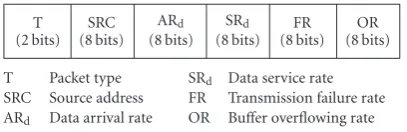
Data service rate Transmission failure rate Buffer overflowing rate Figure4: TRFR message format.
(v) wl is the contention window size at the lth backoff
stage.
In A-MAC, for nodej, the probabilityqjthat a packet is
successfully transmitted at the end of a backoffstage is linear
with its traffic strength, that is,qj =qλj/
N
l=1λl. We assume
there areNnodes within this cluster, and each node accesses
the common channel following 820.11 DCF scheme.
More-over the duration of On-Phase is designed to be just long
enough to let all arrived data packets be sent out. In this case,
the assumption for (17) is still held, but the average backoff
time for our A-MAC is modified as follows:
¯
3.1.3. TRFR-Phase duration
At the beginning ofTRFR-Phase, nodes estimate their data
arrival rate, service time, transmission failure rate, and
buffer overflowing rate over on/offrotations independently.
That information will be forwarded to data-gathering nodes
through TRFR messages (Figure 4).
In this situation, data-gathering nodes become bottle-necks in increasing the chance for TRFR messages being suc-cessfully transmitted. Our strategy is to make the transmis-sion time for each TRFR message comply with a uniform dis-tribution, and carrier sensing is done before sending. Since hidden problem is accessible for our system, the performance will be worse compared with using CSMA/CA scheme. Fol-lowing experiments shows the chance for a TRFR message being successfully transmitted.
Fixing the duration of TRFR-Phase from 5 to 30
sec-onds and increasing the number of nodes within a cluster from 5 to 30, we obtain a branch of curves on successful
transmission rate for TRFR messages (Figure 5). Note that
TRFR’s successful transmission rate is impacted by node den-sity (which is defined as how many nodes are there over an
area) and the length ofTRFR-Phase. From experimental
re-sults, we can choose a suitable duration forTRFR-Phaseto
ensure that data-gathering nodes can acquire necessary in-formation from data-collection nodes to determine the sys-tem schedule successfully.
3.2. Matching schedule establishment and maintenance
According to received schedule messages (Figure 6), nodes
100
Number of nodes in one cluster TRFR-Phaseduration=5 seconds TRFR-Phaseduration=10 seconds TRFR-Phaseduration=15 seconds TRFR-Phaseduration=20 seconds TRFR-Phaseduration=25 seconds TRFR-Phaseduration=30 seconds
Figure5: Successful transmission rate for TRFR message.
T TRFR phase duration
Don Doff
Ir
On-Phase duration Off-Phase duration Reschedule interval Figure6: Schedule message packet format for A-MAC.
them to switch to the same phase simultaneously. To sim-plify the schedule setting up process, we consider, firstly, the
scenario in which there is no clock-drift and traffic is
time-invariant.
We utilize two techniques to make our scheme robust and
feasible to use free-running timing method [8], which allows
nodes to run on their own clocks and makes contribution to save the energy used by setting up and maintaining the global or common timescale. Firstly, schedule messages are broad-casted. Leveraging the property of broadcast, schedule mes-sages can reach all data-collection nodes at the same time,
once we ignore the difference of propagation time of them
(it is reasonable since the propagation time within a clus-ter is between 0.1 and 1 microsecond). Moreover, nodes go toOn-Phaseimmediately after receiving schedule messages. Secondly, in a schedule message, all time references, such as
on-duration and off-duration, are relative values rather than
absolute values. This property can eliminate errors intro-duced by sending time and access time. Hence, each node within a cluster is synchronized to a reference packet (sched-ule message) that is injected into the physical channel at the
same instant. Furthermore, after a same period of time
spec-ified byTn, all nodes switch toOff-Phaseand stay there for
aTf period. Finally, all nodes switch back toOn-Phase. A
phase is circulatedly switched like this way (seeFigure 7).
Note that based on schedule messages and nodes’ local clocks, phase-switching schedules are supposed to be estab-lished at each node to ensure matching operations if there is no clock-drift. Obviously, there is no global or common timescale in our system.
As we mentioned earlier, however, mismatching opera-tions among nodes are unavoidable, since there are always clock-drifts caused by unstable and inaccurate frequency standards. So it is possible that transmitters have powered on their radios to send a message, but receivers’ radios are still
powered off. Those mismatching operations cause
commu-nication to fail. Moreover, with the accumulative clock-drift becoming bigger and bigger, the impact on communications turns to be more and more serious.
Our solution is to rebroadcast schedule message, which forces data-collection nodes to remove accumulative clock-drifts and to reestablish matching schedules. However, how can data-collection nodes know the time of the next sched-ule broadcast so as to power on their radios? The solution is that we include reschedule interval information into sched-ule messages. How to preestimate the value of a schedsched-ule in-terval is another main contribution in this paper. The details
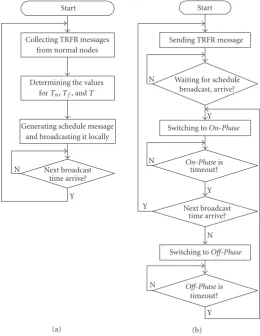
are described in Section 3.3. Flowcharts for data-gathering
nodes and data-collection nodes are modified as inFigure 8,
in which clock-drift is added and time-variant traffic is
con-sidered.
Nevertheless, this scheme may lose efficiency in a special
situation. That is, data-collection nodes startSchedule-Phase
later than their data-gathering nodes for accumulative clock-drifts. Consequently, the schedule broadcast will be missed and those nodes cannot be synchronized or know the lat-est schedule. This kind of node is named synchronization-losing node. For this issue, we design an on-demand
strat-egy. That is, when the lastOn-Phaseis over,
synchronization-losing nodes proactively send requests to their data-gathering nodes. Related data-gathering nodes will reply those requests
with the latest schedule and the information on the next
On-Phase’s starting time. Then, synchronization-losing nodes can be synchronized and reestablish their phase-switching schedules.
3.3. Schedule interval design
The above discussions show that the matching operation among nodes can avoid unsuccessful transmission caused by accumulative clock-drifts. However, we also argue that it
is unnecessary to offer matching operation at all times and
for all nodes. For instance, two nodes, which have little in-formation to exchange, need not to switch phases coinci-dently, since their mismatching operation has little influence on communications. Hence, some nodes could be allowed to go out of coincidence and to be rescheduled only if necessary.
Furthermore, from (12) and (15), we note that the
Start
Collecting TRFR messages from normal nodes
Determining the values forTn, Tf, andT
Generating schedule message and broadcasting it locally
End
(a)
Start
Sending TRFR message
Waiting for schedule broadcast, arrive? N
Y Switching toOn-Phase
On-Phaseis timeout? N
Y Switching toOff-Phase
N Off-Phaseis timeout?
Y (b)
Figure7: Without clock-drift and time-variant traffic, flowchart for (a) data-gathering nodes and (b) data-collection nodes to establish and maintain matching schedules in A-MAC.
nodes’ traffic strength and service capability, which are
het-erogeneous for WSNs as we discussed above. Thus, besides on-demandly removing accumulative clock-drifts and in-forming phase-switching schedules, an additional function for schedule broadcasts is to acquire more suitable values for essential parameters according to the system situation. This property enables our algorithm to be an adaptive scheme in
terms of node density and traffic strength.
How to combine all factors to adjust the length of sched-ule interval correctly is a complicated and vague task, which impacts the performance in terms of energy reservation and successful communication significantly. Since FLS is out-standing in dealing with uncertain problems, we design a rescheduling FLS to monitor the influence of accumulative
clock-drifts, the variance of traffic strength, and service
ca-pability on communications. Then we can adjust schedule
interval and power-on/offduration adaptively. We use
Ti=ξi×Ti−1 (19)
as our interval adjustment function, whereTiis the interval
for theith schedule broadcast,ξiis theith adjustment factor
determined by our rescheduling FLS.
In our rescheduling FLS, there are three antecedents:
(i) ratio of node with overflowing buffer (Rof): the
per-centage of node having buffer overflowing within a
cluster;
(ii) ratio of node with high unsuccessful transmission
rate (Rhf): the percentage of node whose unsuccessful
transmission rate is higher than a threshold within a cluster;
(iii) ratio of node experiencing unsuccessful transmission
(Rsr): the percentage of node having transmission
fail-ure within a cluster.
Rof reflects traffic strength.Rhf andRsrreflect the influence
of accumulative clock-drifts on communications from depth and width aspects individually.
The consequent is the adjustment factor (ξi) for the
schedule-broadcast interval. The linguistic variables
repre-senting Rof,Rhf, andRsrare divided into three levels: low,
moderate, and high. ξi is divided into 5 levels: highly
de-crease, dede-crease, unchange, increase, and highly increase. We use trapezoidal membership functions (MFs) to represent
low, high, highly decrease, and highly increase, and triangle
MFs to representmoderate, decrease, unchange, andincrease.
We show those MFs in Figures9(a)and9(b).
The schedule interval should be shortened when there are many data packets missing due to accumulative
clock-drifts and/or unsuitable Off-Phase duration, otherwise the
schedule interval should be extended to reduce the energy consumption on scheduling. Based on this fact, we design
our rescheduling FLS using rules summarized inTable 1.
For every input (Rof,Rhf,Rsr), the output is defuzzified
Start
Collecting TRFR messages from normal nodes
Determining the values forTn,Tf, andT
Generating schedule message and broadcasting it locally
Next broadcast time arrive? N
Y
(a)
Start
Sending TRFR message
Waiting for schedule broadcast, arrive? N
Y Switching toOn-Phase
On-Phaseis timeout? N
Y
N Next broadcast
time arrive? Y
Switching toOff-Phase
N Off-Phaseis timeout?
Y (b)
Figure8: With clock-drift and time-variant traffic, flowchart for (a) data-gathering nodes and (b) data-collection nodes to establish and maintain matching schedules in A-MAC.
1.5
1
0.5
0
0 1 2 3 4 5 6 7 8 9 10
Low Moderate High
(a)
1.5
1
0.5
0
0 0.5 1 1.5 2 2.5 3 3.5 4 4.5 5 Highly decrease
Decrease Unchange Increase Highly increase
(b)
Figure9: (a) Antecedent MFs for rescheduling-FLS and (b) consequent MFs for rescheduling-FLS.
Figure 9(b)are ¯ξ1=0.2, ¯ξ2=0.5, ¯ξ3=1.0, ¯ξ4=3.0, ¯ξ5=4.0,
yRof,Rhf,Rsr=
15
l=1ξ¯lμFl 1
RofμFl 2
RhfμFl 3
Rsr 15
l=1μFl 1
RofμFl 2
RhfμFl 3
Rsr . (20)
The inputs of rescheduling FLS are acquired from TRFR messages. Prior to each schedule broadcast, rescheduling FLSs located in data-gathering nodes individually estimate the influence degree of the accumulative clock-drift and
TRFR-Phase Schedule-Phase
On-Phase Off-Phase On-Phase Off-Phase On-Phase On-Phase Off-Phase
TRFR-Phase Schedule-Phase
On/OffRotation 1 On/OffRotation 2 Schedule broadcast interval
Super-time-slot 1 Super-time-slot 1
Super-time-sloti
Super-time-sloti
Figure10: System time scheme structure for ASMAC.
Table1: Rules for rescheduling-FLS; Ante1 isRof, Ante2 is Rhf, Ante3 isRsr, consequent isξ.
Rule Ante1 Ante2 Ante3 Consequent
1 Low Low Low Highly increase
2 Low Low Moderate Increase
3 Low Moderate Moderate Decrease
4 Low Moderate High Decrease
5 Moderate Low Moderate Increase
6 Moderate Low High Unchange
7 Moderate Moderate Moderate Decrease
8 Moderate Moderate High Highly decrease
9 Low High High Decrease
10 Moderate High High Highly decrease
11 High Low Moderate Increase
12 High Low High Unchange
13 High Moderate Moderate Decrease
14 High Moderate High Decrease
15 High High High Highly decrease
obtainingξi, data-gathering nodes determine the value for
the next schedule-broadcast interval according to (19). This
operation cannot only save energy through avoiding unnec-essary schedule broadcasts and idle listening, but also ensures an adequate data successful transmission rate.
4. ASYNCHRONOUS SCHEDULE-BASED
MAC (ASMAC) PROTOCOL
Asynchronous schedule-based MAC (ASMAC) is similar to A-MAC. ASMAC’s system time is also divided into four
phases: TRFR-Phase, Schedule-Phase, On-Phase, and Off
-Phase(Figure 10). The same TRFR message andTRFR-Phase
duration design method are used by ASMAC. However,
On-Phase is further divided into super-time-slots, which are composed of several normal time slots, and one source-destination pair continuously occupies one super-time-slot.
T Off-Phase duration On-Phase duration
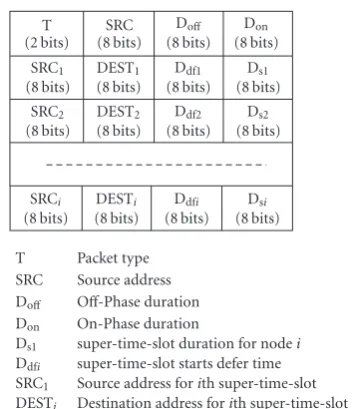
super-time-slot duration for nodei super-time-slot starts defer time Source address forith super-time-slot Destination address forith super-time-slot Figure11: Schedule message packet format for ASMAC.
We add ACK message as the acknowledgment for receiving data packets successfully. A transmission is defined as an un-successful one once the transmitter does not receive ACK af-ter a certain period of time. The format of the schedule
mes-sage is shown inFigure 11.
Matching schedule establishment, maintenance, and schedule interval design mechanisms of ASMAC are the same
as in A-MAC, but power-on/offduration design is somewhat
different. A new task, time-slot allocation, is added into
AS-MAC.
4.1. On-Phase/Off-Phase duration (Tn/Tf) design
In ASMAC, nodes perform communication in their own
super-time-slots and turn offtheir radios to save energy in
Off-Phaseand other nodes’ super-time-slots. Hence, nodes carry out communications orderly and contention freely.
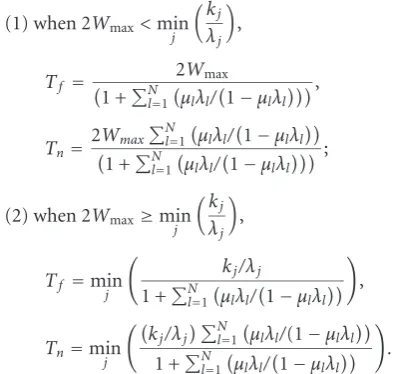
The same criteria are utilized by ASMAC forOn-Phaseand
Off-Phaseduration designs: trying to save more energy, keep-ing information up to date, and avoidkeep-ing loskeep-ing information
1.5
1
0.5
0
0 1 2 3 4 5 6 7 8 9 10
Low Moderate High
(a) Very low Low Moderate High Very high
(b)
Figure12: (a) Antecedent MFs for allocation-FLS and (b) consequent MFs for allocation-FLS.
Tncan be calculated:
(1) when 2Wmax<min
4.2. Time-slot assignment
For classic TDMA systems, the system time is divided into slots, and each user occupies cyclically repeating time slots—
a buffer-and-burst method. Thus, high-quality network
syn-chronization method is needed. Unfortunately, this premise is troublesome for our ASMAC scheme. However, we note that as the length of time slots increases, more transmissions are done successfully under the same mismatching situation.
Hence, with contrast to buffer-and-burst method, we design
a buffer-and-continue method to enhance the tolerance on
accumulative clock-drifts, in which the same communication pairs occupy sets of continuous time-slots.
In ASMAC, we design an allocation FLS to correspond-ingly quantify transmission priorities for each node. There are two antecedents to our allocation FLS:
(i) traffic arrival rate (Ra),
(ii) transmission failure rate (Rus).
Table2: Rules for allocation-FLS; Ante1 is the traffic arrival rate, Ante2 is the unsuccessful transmission rate, consequent is the pri-ority of a node performing transmission.
Rule Ante1 Ante2 Consequent
1 Low Low Moderate
2 Low Moderate High
3 Low High Very high
4 Moderate Low Low
5 Moderate Moderate Moderate
6 Moderate High High
7 High Low Very low
8 High Moderate Low
9 High High Moderate
The consequent is the priority of a node performing trans-mission (Pt).
The linguistic variables used to representRaandRusare
divided into three levels: low, moderate, and high.Pt is
di-vided into 5 levels:very hign, high, moderate, low, andvery
low. We use trapezoidal membership functions (MFs) to
rep-resentlow, high, very low, and very high, and triangle MFs
to representmoderate, low, andhigh. We show those MFs in
Figures12(a)and12(b).
The transmission priority of a node should be higher when there are more data packets waiting for transmitting and/or its transmission failure rate is high. Based on this fact, we design our allocation FLS using rules summarized in
Table 2. With the allocation FLS, data-gathering nodes lever-age the information acquired from TRFR messlever-ages to quan-tify priorities for nodes. The node owning the highest pri-ority is the earliest one to perform communications during
160 140 120 100 80 60 40
Energ
y
utilization
(pk/J)
0 0.005 0.01 0.015 0.02 0.025 0.03 0.035 Average clock-drift rate (ms/s)
A-MAC S-MAC
(a)
200 180 160 140 120 100 80 60 40
Energ
y
u
tilization
(pk/J)
0 0.05 0.1 0.15 0.2 0.25 0.3 0.35 0.4 0.45 0.5 Average clock-drift rate (ms/s)
ASMAC S-MAC TRAMA
(b) Figure13: Energy utilization for (a) A-MAC and (b) ASMAC.
Table3: Physical layer parameters.
Wwmin 32 Wwmax 1024
MAC header 34 bytes ACK 38 bytes
CTS 38 bytes RTS 44 bytes
SIFS 10μs DIFS 50μs
ACK timeout 212μs CTS timeout 348μs
5. SIMULATION AND PERFORMANCE EVALUATION
We used the simulator OPNET to run simulations. A net-work with 30 nodes is set up and the radio range (radius) of each node is 30 m. Those nodes are randomly deployed in an
area of 100×100 m2and have no mobility. This network can
be treated as one cluster in a large-scale system. In order to simplify the analysis about the impact of accumulative clock-drifts on communications and the performance of our MAC algorithms, we exclude the factors coming from physical layer and network layer in our experiments. The clock-drift rate of frequency oscillators varies from 1 to 100 microseconds every
second.Table 3summarizes the parameters used by our
sim-ulations. The packet size is 1000 bytes. The destination for
each node’s traffic is randomly chosen from its neighbors.
As in [35,36], data packets arrive according to a Poisson
process with certain rate in our simulations. Moreover, every
10 seconds, the traffic will be held for 5 seconds to simulate
bursting traffic. In our simulations, we substitute statistic
av-erage values with time-avav-erage values for data packet arrival rate and service time.
All nodes are set with initial energy of 15 J. We use the
same energy consumption model as in [37] for radio
hard-ware. To transmit anl-symbol message for a distanced, the
radio expends:
ETx(l,d)=ETx−elec(l)+TTx−amp(l,d)
=l×Eelec+l×efs×d2; (22)
and to receive this message, the radio expends:
ERx=l×Eelec. (23)
The electronics energy Eelec, as described in [37], depends
on factors such as coding, modulation, pulse shaping, and
matched filtering. The amplifier energy efs ×d2 depends
on the distance to the receiver and the acceptable bit
er-ror rate. In this paper, we choose Eelec = 50 nJ/syn and
efs = 10 pJ/sym/m2. When a node receives packets but the
destination is not for it, those packets will be discarded. This kind of useless receiving, that is, idle listening, uses the same
model in (23) to calculate energy consumption.
5.1. A-MAC versus S-MAC
We compared our A-MAC against S-MAC [17] without
net-work synchronization function. In our simulations, energy utilization is assessed by the number of successfully trans-mitted data packets per J, and the unit is pk/J. Energy
uti-lization versus clock-drift rate is plotted inFigure 13(a).
Ob-serve that A-MAC can send 17.85% to 33.33% more packets
per J. Therefore, with the same available energy and traffic
strength, the lifetime of a network will be extended about 0.2
to 0.4 times when using our algorithm A-MAC instead of
100 90 80 70 60 50 40
Su
cc
essful
tr
ansmission
ra
te
(%)
0 0.005 0.01 0.015 0.02 0.025 0.03 0.035 Average clock-drift rate (ms/s)
A-MAC S-MAC
(a)
100
95
90
85
80
75
Su
cc
essful
tr
ansmission
ra
te
(%)
0 0.01 0.02 0.03 0.04 0.05 0.06 0.07 0.08 0.09 0.1 Clock-drift rate (ms/s)
S-MAC TRAMA ASMAC
(b) Figure14: Successful transmission rate for (a) A-MAC and (b) ASMAC.
14 12 10 8 6 4 2
A
ver
age
w
aiting
time
(s)
0 0.005 0.01 0.015 0.02 0.025 0.03 0.035 Average clock-drift rate (ms/s)
A-MAC S-MAC
(a)
24 22 20 18 16 14 12 10
A
ver
age
w
aiting
time
(s)
0 0.01 0.02 0.03 0.04 0.05 0.06 0.07 0.08 0.09 0.1 Average clock-drift rate (ms/s)
ASMAC S-MAC TRAMA
(b) Figure15: Waiting time for (a) A-MAC and (b) ASMAC.
Saving energy is one of the main aims of A-MAC. How-ever, we should not achieve this goal through sacrificing data successful transmission rate, since communication is the
ul-timate role for communication systems. InFigure 14(a), we
plot data successful transmission rate versus clock-drift rate. Observe that A-MAC can transmit data packets successfully
about 30.77% more than S-MAC. The reasons are, firstly,
failure transmissions are reduced because clock-drifts among
nodes are removed effectively; secondly, more energy is
uti-lized by transmitting data packets.
In Figure 15(a), we plot average waiting time versus
clock-drift rate. It is shown that A-MAC has about 33.3%
shorter waiting time than that of S-MAC. Moreover, we
setWmax to 12 seconds for average waiting time, we found
that average waiting-time for A-MAC is always shorter than
100
Total number of nodes in a cluster Clock-drift rate=0 ms/s
Clock-drift rate=0.05625 ms/s Clock-drift rate=0.09 ms/s Clock-drift rate=0.3425 ms/s
(a)
Total number of nodes in a cluster Average clock-drift rate=0.3425 ms/s Average clock-drift rate=0.225 ms/s Average clock-drift rate=0.09 ms/s Average clock-drift rate=0.0625 ms/s Average clock-drift rate=0.05625 ms/s Average clock-drift rate=0.045 ms/s
(b) Figure16: Network density adaptation for (a) ASMAC and (b) A-MAC.
S-MAC, the average waiting-time is longer than 12 seconds
when clock-drift rate is longer than 0.0225 ms/s. That is,
there are many out-of-date packets received when using S-MAC. This result demonstrates our claim that our algorithm A-MAC is a waiting-time-aware method.
5.2. ASMAC versus S-MAC and TRAMA
We compared our ASMAC against S-MAC and TRAMA [13]
without network synchronization function. Energy
utiliza-tion versus clock-drift rate is plotted inFigure 13(b). Observe
that ASMAC can send 41.176% to 56.14% more packets per
J. Therefore, with same available energy and traffic strength,
the lifetime of a network will be extended about 0.4 to 0.6
times when using our algorithm ASMAC instead of S-MAC and TRAMA schemes. This result demonstrates that ASMAC can also implement energy reservation task successfully.
InFigure 14(b), we plot data successful transmission rate versus clock-drift rate. Observe that ASMAC can transmit
data packets successfully about 12.5% more than S-MAC,
and about 4.65% more than TRAMA.
In Figure 15(b), we plot average waiting time versus
clock-drift rate. It is shown that ASMAC has about 56.178%
shorter waiting time than TRAMA, and about 8.648% than
S-MAC. We found that the average waiting time for ASMAC
is also shorter thanWmax = 12 seconds at different
clock-drift rates. However, for TRAMA and S-MAC, the average waiting time is longer than that threshold.
5.3. Adaptation of ASMAC and A-MAC
We investigate the influences of node density and traf-fic strength on system performance of our algorithms. We
change node density and traffic strength individually at a set
of clock-drift situations. InFigure 16(a), we plot number of
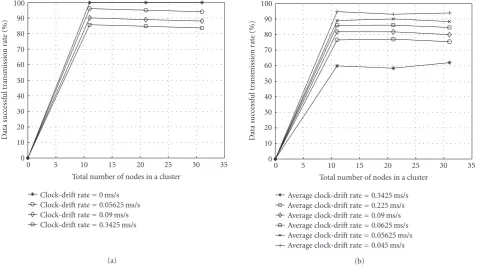
nodes, changed from 10 to 30, in a cluster versus success-ful transmission rate of data packet for ASMAC. Notice that for each clock-drift rate, the vibration of successful transmis-sion rate with the change of the node density is less than
85.714%−83.606% = 2.108%. The same experiment is
done for A-MAC. We can see that the vibration of
success-ful transmission rate is less than 61.96%−59.87%=2.09%
(Figure 16(b)).
InFigure 17(a), we compare successful transmission rate at different traffic arrival rates, varying from 0.1 to 0.5 pk/s. This shows that for each clock-drift, the vibration of suc-cessful transmission rate with the change of node number is
less than 97.099%−96.087% = 1.012% for ASMAC. The
vibration of A-MAC is less than 60%−58.79% = 1.21%
(Figure 17(b)).
These two experiments show that with the variance of
node density and traffic strength, network throughput can
keep almost stable through using our A-MAC and AS-MAC protocols. The reason is that essential parameters—
reschedule interval,On-Phase, andOff-Phasedurations—are
100 Traffic arrival rate (pk/s)
Clock-drift rate=0 ms/s Clock-drift rate=0.05625 ms/s Clock-drift rate=0.09 ms/s Clock-drift rate=0.3425 ms/s
(a)
Traffic arrival rate (pk/s) Average clock-drift rate=0.3425 ms/s Average clock-drift rate=0.225 ms/s Average clock-drift rate=0.09 ms/s Average clock-drift rate=0.0625 ms/s Average clock-drift rate=0.05625 ms/s Average clock-drift rate=0.045 ms/s
(b) Figure17: Traffic intensity adaptation for (a) ASMAC and (b) A-MAC.
6. CONCLUSIONS
In this paper, we proposed two energy-efficient MAC
proto-cols for WSNs: A-MAC and ASMAC. They make following
contributions compared with existing energy-efficient MAC
protocols for WSNs:
(i) saving energy at MAC layer through trading offdata
waiting time and reducing energy consumption on collision and idle listening;
(ii) utilizing free-running time scheme and schedule broadcast to set up system schedules without establish-ing a common timescale within a system;
(iii) exploiting a reschedule method, instead of network synchronization, to handle mismatching operations caused by accumulative clock-drifts;
(iv) taking advantage of fuzzy logical theories to design rescheduling FLS and allocation FLS;
(v) proposing a traffic-strength- and
network-density-based model to optimize essential algorithm param-eters.
Simulation results showed that not only the performance of network is improved, but also its lifetime is extended when A-MAC or ASMAC is used.
ACKNOWLEDGMENT
This work was supported by the US Office of Naval
Re-search (ONR) Young Investigator Program Award under Grant N00014-03-1-0466.
REFERENCES
[1] D. Culler, D. Estrin, and M. Srivastava, “Guest Editors’ In-troduction: overview of sensor networks,”Computer, vol. 37, no. 8, pp. 41–49, 2004.
[2] F. Zhao and L. Guibas,Wireless Sensor Networks: An Informa-tion Processing Approach, Morgan Kaufmann, San Francisco, Calif, USA, 2004.
[3] M. Stemm and R. H. Katz, “Measuring and reducing energy consumption of network modules in hand-held devices,” IE-ICE Transactions on Communications, vol. E80-B, no. 8, pp. 1125–1131, 1997.
[4] J. Chou, D. Petrovic, and K. Ramachandran, “A distributed and adaptive signal processing approach to reducing energy consumption in sensor networks,” inProceedings of 22nd An-nual Joint Conference on the IEEE Computer and Communi-cations Societies (INFOCOM ’03), vol. 2, pp. 1054–1062, San Francisco, Calif, USA, March-April 2003.
[5] M. L. Chebolu, V. K. Veeramachaneni, S. K. Jayaweera, and K. R. Namuduri, “An improved adaptive signal processing ap-proach to reduce energy consumption in sensor networks,” in Proceedings of 38th Annual Conference on Information Science and System (CISS ’04), Princeton, NJ, USA, March 2004. [6] S. Balasubramanian, I. Elangovan, S. K. Jayaweera, and K.
R. Namuduri, “Distributed and collaborative tracking for energy-constrained ad-hoc wireless sensor networks,” in Pro-ceedings of IEEE Wireless Communications and Networking Conference (WCNC ’04), vol. 3, pp. 1732–1737, Atlanta, Ga, USA, March 2004.
Ad Hoc Communications and Networks (SECON ’04), pp. 299– 308, Santa Clara, Calif, USA, October 2004.
[8] J. E. Elson, “Time synchronization in wireless sensor net-works,” Dissertation, Computer Science Department, Univer-sity of California Los Angeles, Los Angeles, Calif, USA, 2003. [9] C. Ma, M. Ma, and Y. Yang, “Data-centric energy efficient
scheduling for densely deployed sensor networks,” in Pro-ceedings of IEEE International Conference on Communications, vol. 6, pp. 3652–3656, Paris, France, June 2004.
[10] S. Singh and C. S. Raghavendra, “Pamas: power aware multi-access protocol with signaling for ad hoc networks,”ACM SIG-COMM Computer Communication Review, vol. 28, no. 3, pp. 5–26, 1998.
[11] P802.11, “Ieee standard for wireless lan medium access con-trol (mac) and physical layer (phy) specifications,” November 1997.
[12] J. L. Hill and D. E. Culler, “Mica: a wireless platform for deeply embedded networks,”IEEE Micro, vol. 22, no. 6, pp. 12–24, 2002.
[13] V. Rajendran, K. Obraczka, and J. J. Garcia-Luna-Aceves, “Energy-efficient, collision-free medium access control for wireless sensor networks,” in Proceedings of the 1st Interna-tional Conference on Embedded Networked Sensor Systems (Sen-Sys ’03), pp. 181–192, Los Angeles, Calif, USA, November 2003.
[14] L. F. W. van Hoesel, T. Nieberg, H. J. Kip, and P. J. M. Havinga, “Advantages of a TDMA based, energy-efficient, self-organizing MAC protocol for WSNs,” inProceedings of IEEE 59th Vehicular Technology Conference (VTC ’04), vol. 3, pp. 1598–1602, Milan, Italy, May 2004.
[15] J. Li and G. Y. Lazarou, “A bit-map-assisted energy-efficient MAC scheme for wireless sensor networks,” inProceedings of 3rd International Symposium on Information Processing in Sen-sor Networks (IPSN ’04), pp. 55–60, Berkeley, Calif, USA, April 2004.
[16] S. Biaz and Y. D. Barowski, “GANGS: an energy efficient MAC protocol for sensor networks,” inProceedings of the 42nd An-nual Southeast Regional Conference (ACMSE ’04), pp. 82–87, Huntsville, Ala, USA, April 2004.
[17] W. Ye, J. Heidemann, and D. Estrin, “An energy-efficient MAC protocol for wireless sensor networks,” inProceedings of 21st Annual Joint Conference of the IEEE Computer and Communi-cations Societies (INFOCOM ’02), vol. 3, pp. 1567–1576, New York, NY, USA, June 2002.
[18] T. Van Dam and K. Langendoen, “An adaptive energy-efficient MAC protocol for wireless sensor networks,” inProceedings of the 1st International Conference on Embedded Networked Sen-sor Systems (SenSys ’03), pp. 171–180, Los Angeles, Calif, USA, November 2003.
[19] J. Polastre, J. Hill, and D. Culler, “Versatile low power media access for wireless sensor networks,” inProceedings of the 2nd International Conference on Embedded Networked Sensor Sys-tems (SenSys ’04), pp. 95–107, Baltimore, Md, USA, November 2004.
[20] S. Jayashree, B. S. Manoj, and C. S. R. Murthy, “On using bat-tery state for medium access control in ad hoc wireless net-works,” inProceedings of the 10th Annual International Confer-ence on Mobile Computing and Networking (MobiCom ’04), pp. 360–373, Philadelphia, Pa, USA, September-October 2004. [21] E.-S. Jung and N. H. Vaidya, “A power control MAC protocol
for ad hoc networks,” inProceedings of the 8th Annual Interna-tional Conference on Mobile Computing and Networking (Mo-biCom ’02), pp. 36–47, Atlanta, Ga, USA, September 2002.
[22] S. Bregni,Synchronization of Digital Telecommunications Net-works, John Wiley & Sons, New York, NY, USA, 2002. [23] F. Cristian, “Probabilistic clock synchronization,”Distributed
Computing, vol. 3, no. 3, pp. 146–158, 1989.
[24] R. Gusella and S. Zatti, “The accuracy of the clock synchro-nization achieved by TEMPO in Berkeley UNIX 4.3 BSD,” IEEE Transactions on Software Engineering, vol. 15, no. 7, pp. 847–853, 1989.
[25] T. K. Srikanth and S. K. Toueg, “Optimal clock synchroniza-tion,”Journal of the ACM, vol. 34, no. 3, pp. 626–645, 1987. [26] W. Su and I. F. Akyildiz, “Time-diffusion synchronization
pro-tocol for wireless sensor networks,”IEEE/ACM Transactions on Networking, vol. 13, no. 2, pp. 384–397, 2005.
[27] J. M. Mendel, “Fuzzy logic systems for engineering: a tutorial,” Proceedings of the IEEE, vol. 83, no. 3, pp. 345–377, 1995. [28] E. H. Mamdani, “Application of fuzzy logic to approximate
reasoning using linguistic synthesis,” IEEE Transactions on Computers, vol. 26, no. 12, pp. 1182–1191, 1977.
[29] J. M. Mendel,Uncertain Rule-Based Fuzzy Logic Systems: Intro-duction and New Directions, Prentice-Hall, Upper Saddle River, NJ, USA, 2001.
[30] C. V. Altrock, “Fuzzy logic design: methodology, standards, and tools,”Electronic Engineering Times, July 1996.
[31] L. H. Bao and J. J. Garcia-Luna-Aceves, “Hybrid channel access scheduling in ad hoc networks,” inProceedings of 10th IEEE International Conference on Network Protocols (ICNP ’02), pp. 46–57, Paris, France, November 2002.
[32] D. Bertsekas and R. Gallager, Data Networks, Prentice-Hall, Upper Saddle River, NJ, USA, 1987.
[33] M. M. Carvalho and J. J. Garcia-Luna-Aceves, “Delay anal-ysis of IEEE 802.11 in single-hop networks,” in Proceedings of 11th IEEE International Conference on Network Protocols (ICNP ’03), pp. 146–155, Atlanta, Ga, USA, November 2003. [34] G. Bianchi, “Performance analysis of the IEEE 802.11
dis-tributed coordination function,”IEEE Journal on Selected Ar-eas in Communications, vol. 18, no. 3, pp. 535–547, 2000. [35] A. Manjeshwar, Q.-A. Zeng, and D. P. Agrawal, “An analytical
model for information retrieval in wireless sensor networks using enhanced APTEEN protocol,”IEEE Transactions on Par-allel and Distributed Systems, vol. 13, no. 12, pp. 1290–1302, 2002.
[36] V. P. Mhatre, C. Rosenberg, D. Kofman, R. Mazumdar, and N. Shroff, “A minimum cost heterogeneous sensor network with a lifetime constraint,”IEEE Transactions on Mobile Computing, vol. 4, no. 1, pp. 4–14, 2005.
[37] W. B. Heinzelman, A. P. Chandrakasan, and H. Balakrishnan, “An application-specific protocol architecture for wireless mi-crosensor networks,”IEEE Transactions on Wireless Communi-cations, vol. 1, no. 4, pp. 660–670, 2002.
Qingchun Renreceived her B.S. and M.S. degrees from University of Electrical Sci-ence and Technology of China, in 1997 and 2003, respectively, both in electrical engi-neering. She is working towards the Ph.D. degree in electrical engineering at The Uni-versity of Texas at Arlington. Prior to that, she was a Member of the technical staff at WATT Electronic Co., Ltd. at Shenzhen, China. Since August 2003, she has been
are in sensor networks (energy efficiency, cross-layer design, opti-mal sensor deployment, etc.), fuzzy logic systems, and query pro-cessing for sensor database systems.
Qilian Liangreceived the B.S. degree from Wuhan University, China, in 1993, the M.S. degree from Beijing University of Posts and Telecommunications in 1996, and the Ph.D. degree from University of Southern Califor-nia (USC) in May 2000, all in electrical en-gineering. He joined the faculty of The Uni-versity of Texas at Arlington in August 2002. Prior to that, he was a Member of the tech-nical staffin Hughes Network Systems Inc.