Blind Identification of Out-of-Cell Users in DS-CDMA
Tao Jiang
Department of Electrical and Computer Engineering, University of Minnesota, 200 Union Street SE, Minneapolis, MN 55455, USA
Email:[email protected]
Nicholas D. Sidiropoulos
Department of Electronic and Computer Engineering, Technical University of Crete, Chania-Crete 73100, Greece Department of Electrical and Computer Engineering, University of Minnesota, 200 Union Street SE,
Minneapolis, MN 55455, USA Email:[email protected]
Received 29 May 2003; Revised 2 December 2003
In the context of multiuser detection for the DS-CDMA uplink, out-of-cell interference is usually treated as Gaussian noise, possibly mitigated by overlaying a long random cell code on top of symbol spreading. Different cells use statistically independent long codes, thereby providing means for statistical of-cell interference suppression. When the total number of (in-cell plus out-of-cell) users is less than the spreading gain, subspace identification techniques are applicable. If the base station is equipped with multiple antennas, then completely blind identification is possible via three-dimensional low-rank decomposition. This works with more users than spreading and antennas, but a purely algebraic solution is missing. In this paper, we develop an algebraic solution under the premise that the codes of the in-cell users are known. The codes of out-of-cell users and all array steering vectors are unknown. In this pragmatic scenario, we show that in addition to algebraic solution, better identifiability is possible. Our approach yields the best known identifiability result for three-dimensional low-rank decomposition when one of the three component matrices is partially known, albeit noninvertible. Simulations show that the proposed identification algorithm remains close to the pertinent asymptotic (symbol-independent) Cram´er-Rao bound, which is also derived herein.
Keywords and phrases:cellular systems, smart antennas, interference mitigation.
1. INTRODUCTION
In the context of uplink reception for cellular DS-CDMA systems, interference can be classified as either (i) interchip (ICI) and intersymbol (ISI) self-interference, (ii) in-cell mul-tiuser access interference (commonly referred to as MUI or MAI), or (iii) out-of-cell multiuser access interference. The latter is typically ignored or treated as noise; however, it has been reported [1] that in IS-95 other cells account for a large percentage of the interference relative to the interfer-ence coming from within the cell. MUI is usually a side-effect of propagation through dispersive multipath channels. The conceptual difference between in-cell and out-of-cell inter-ference boils down to what the base station (BS) can assume about the nature of interfering signals. Typically, the codes of interfering in-cell users are known to the BS, whereas those of out-of-cell users are not. Specifically, in the presence of ICI, the receive-codes of the in-cell users can be estimated via training or subspace techniques (e.g., cf. [2]), using the fact that the transmit-codes are known. This is not the case for out-of-cell users.
Appealing to the central limit theorem, the total inter-ference from out-of-cell users is usually treated as Gaussian noise. In IS-95, a long random cell-specific code is overlaid on top of symbol spreading, and cell despreading is used at the BS to randomize out-of-cell interference. This helps mitigate out-of-cell interference in a statistical fashion. To see how random cell codes work, consider the simplified synchronous flat-fading baseband-equivalent received data model
x=DinCinsin+DoutCoutsout+n, (1)
wherexholds the received data corresponding to one sym-bol period,Cin(resp.Cout) is the spreading code matrix,sin
(resp.sout) is the symbol vector,Din(resp.Dout) is a diagonal
of interest. Then
z1:=
1 Pc
T
1Dinx
=sin(1) + 1
Pc T
1DinDoutCoutsout+n.
(2)
The interference term is zero-mean; under certain condi-tions, its variance is O(1/P). This is easy to see for a sin-gle out-of-cell user. It follows that random cell codes work reasonably well in relatively underloaded systems with large spreading gain (e.g., 128 chips/symbol), but performance can suffer from near-far effects, and cell codes cannot help iden-tify out-of-cell transmissions. Although the latter may seem of little concern in commercial applications, it can be impor-tant for tracking, handoff, and monitoring.
In a way, a structured approach towards the explicit iden-tification1of out-of-cell users is the next logical step beyond
in-cell multiuser detection and is motivated by considera-tions similar to those that stimulated research took from matched filtering to multiuser detection. Note that, unlike the case of in-cell interference, out-of-cell interference can-not be mitigated by power control, simply because the BS does not have the authority to exercise power control over out-of-cell users. For a power-controlled in-cell population, near-far effects may be chiefly due to out-of-cell interference. Unfortunately, out-of-cell detection is compounded by the fact that it has to be blind, since the BS has no control and usually no prior information on out-of-cell users. This places limitations on the number and nature of out-of-cell trans-missions that can be identified.
The literature on out-of-cell blind identification is scarce. Assuming that (i) the codes of the in-cell users are known, (ii) the total number of (in-cell plus out-of-cell) users is less than the spreading gain and the combined spreading code matrix is full column rank, and (iii) given the correlation matrix of the vector of chip samples taken over a symbol interval, it is possible to cancel out the effect of out-of-cell users [3], then adopt linear or nonlinear solutions for in-cell detection. This approach is appealing, but it has two drawbacks. First, it can be unrealistic to assume that thetotalnumber of users is less than the spreading gain. This is especially so in loaded systems and urban areas. Second, in practice one uses sample estimates of the correlation matrix. This yields cancellation errors for finite samples, even in the noiseless case.
Recently, a novel code-blind identification approach has been proposed, exploiting uniqueness of low-rank decom-position of three-way arrays [4]. This requires the use of a BS antenna array, but in return allows the identification of both in-cell and out-of-cell users without requiring knowledge of the code or steering vector ofanyuser. More users than spreading and antenna elements can be supported. There are two drawbacks to this approach. First, a direct algebraic solu-tion is generally not possible, thus iterative estimasolu-tion
tech-1Here, byidentificationwe mean explicitly modeling and estimating all user signals (as opposed to treating certain user signals as unstructured noise).
niques must be employed. Although these iterative methods generally work very well, they are computationally intensive. Second, in-cell code information, which may be available, is not directly exploited (except numerically, by constraining certain parameters during the iterations). In this paper, we develop an algebraic solution that exploits the fact that the codes of the in-cell users are known. In this scenario, we show that in addition to algebraic solution, better identifiability is possible. Our approach yields the best known identifiability result for three-dimensional low-rank decomposition when one of the three component matrices is partially known, al-beit noninvertible.
Note that the group-blind multiuser detection approach of [3] can be easily extended to handle multiple BS antennas, but this requires that the array steering vectors, in addition to the spreading codes2 of all the in-cell users, are known.
Estimating steering vectors is more difficult than estimating codes, partly because they are generally unstructured, but also due to mobility-induced fast fading. Note that the ap-proach developed herein (see also [4]) does not assume any parameterization of the manifold vectors.
For clarity of exposition, we will begin our analysis by assuming that both in-cell and out-of-cell user trans-missions are synchronized at the BS. In practice, this can be approximately true in synchronous CDMA systems, like CDMA2000.3 Quasisynchronism (i.e., timing offsets in the
order of a few chips) can be handled by dropping a short chip prefix at the receiver. We will refer to both cases as synchronous CDMA for brevity. Synchronization is usually achieved via pilot tones emitted from the BS, or a GPS-derived timing reference for synchronous networks involving multiple cells. Out-of-cell transmissions will typically not be synchronized with in-cell transmissions. Notable exceptions include synchronous microcellular networks for “hotspot” coverage, and calls undergoing hand-offat cell boundaries (hence approximately equidistant from the two base sta-tions). As we will see, when delay spread is small relative to the symbol duration, this can be handled by treating each out-of-cell user as two virtual users. Hence our analysis gen-eralizes to the interesting case of a quasisynchronous in-cell population plus asynchronous out-of-cell interference, as in Wideband CDMA (WCDMA). We will refer to this situation asasynchronous CDMA.
The rest of the paper is organized as follows. The main ideas and concepts are exposed in Section 2.1, which treats the idealized case of a synchronous DS-CDMA uplink sub-ject to flat fading. This is then extended to frequency-selective multipath and quasisynchronous transmissions in Section 3, which also discusses a suitableadmission protocol
2In the literature, it is common to use the term “(spreading) codes” for the transmit codes, and “signatures” for the effective receive codes. For brevity and to avoid confusion with spatial signatures, we adopt the term “spreading codes” throughout, with the understanding that in the presence of ICI/ISI, the term “codes” means the receive codes.
that avoids explicit code estimation for the in-cell users. Note that in the presence of strong out-of-cell interference and frequency selectivity, estimating the codes of the in-cell users is a difficult task in itself. Section 4 discusses is-sues related to our choice of a pertinent symbol-independent asymptotic Cram´er-Rao Bound (CRB) to benchmark perfor-mance of steering vector and spreading code estimation. As-sociated derivations are deferred to the appendix.Section 5 provides analytical and simulated performance comparisons, andSection 6summarizes our conclusions.
Notation
(·)Tand (·)Hdenote transpose and Hermitian transpose, re-spectively;δ(·) stands for Kronecker’s delta.rAstands for the rank of matrixA, whilekAstands for thek-rank (Kruskal-rank) of matrix A: the maximumk ∈ Z+ such that every
k columns ofAare linearly independent (kA ≤ rA). · F stands for Frobenius norm; (·)−1and (·)†stand for the ma-trix inverse and pseudoinverse, respectively.Di(A) stands for the diagonal matrix constructed out of theith row ofA.In stands for then×nidentity matrix.E(·) denotes the expec-tation operator.f,gdenotes theL2inner product between
functions f andg.
2. MULTIUSER DETECTION FOR BLIND IDENTIFICATION OF OUT-OF-CELL USERS 2.1. Data model
Consider a DS-CDMA uplink withMusers (in-cell plus out-of-cell), normalized chip waveform ψ of duration Tc, and spreading gain P (chips per symbol). The mth user is as-signed a binary chip sequence (cm(1),. . .,cm(P)). The result-ing signature waveform for themth user is
φm(t)=
P
i=1
cm(i)ψt−iTc, 0≤t≤Ts, (3)
whereTs=PTcis the symbol duration. All spreading codes are assumed short (symbol periodic).
The baseband-equivalent signal received at the BS for a burst ofLtransmitted symbols can be written as
x(t)=
M
m=1
L
l=1
αm
Emsm(l)φmt−lTs−τm+w(t), (4)
whereMis the total number of active users,αm is the com-plex path gain, Em is the incident power for the mth user loaded at the transmitter,sm(l) is thelth transmitted symbol associated with themth user,τmis the delay of themth user’s signal, andw(·) is additive white Gaussian noise (AWGN). Since in-cell users are synchronized with the BS, the delays τm for all in-cell users are taken to be zero. For out-of-cell users, the associated delays can be assumed to lie in [0,Ts], without loss of generality.
IfK receive antennas are employed at the BS, the base-band signal at the output of the chip-matched filter of the
kth antenna for thepth chip in thenth symbol interval can be written as
xk,n,p=
x(t),βkψt−nTs−pTc
=
Min
m=1
αk,mβk
Emsm(n)cm(p)
+ M
m=Min+1
L
l=1
αk,mβk
Emsm(l)νpm(n,l) +w(k,n,p)
=
Min
m=1
αk,mβk
Emsm(n)cm(p)
+ M
m=Min+1
αk,mβk
Emsm(n)νpm(n,n)
+sm(n−1)νpm(n,n−1)
+w(k,n,p),
(5)
where Min (≤ P) denotes the number of in-cell users and
Moutthe number of out-of-cell users (M=Min+Mout);βkis
the antenna gain associated with thekth antenna;νpm(n,l)=
P
i=1cm(i) Tc
0 ψ(t + (n −l)Ts + (p − i)Tc − τm)ψH(t)dt;
w(k,n,p)=Tc
0 w(t+nTs+pTc)ψH(t)dt.
Note that, due to asynchronism, each out-of-cell user is viewed by the BS as two synchronous users, whose symbol sequences are time-shifted versions of one another. The as-sociated spreading codes are given byνpm(·,·).
From (5), in a frequency-flat block-fading scenario, the baseband-equivalent chip-rate sampled data model for a synchronous DS-CDMA system with short symbol-periodic spreading codes andKreceive antennas at the BS can be writ-ten as
xk,n,p= M
m=1
am(k)cm(p)sm(n) +wk,n,p, (6)
for k = 1,. . .,K,n = 1,. . .,N, p = 1,. . .,P, where N is the number of symbol snapshots,xk,n,pdenotes the baseband output of thekth antenna element for symbol (time)nand chipp,am(k) is the compound flat fading/antenna gain asso-ciated with the response of thekth antenna to themth user.
It is useful to recast this model in matrix form. We de-finePreceived data matricesXp∈CK×Nwith (k,n)-element given by xk,n,p, and AWGN matrices Wp ∈ CK×N with (k,n)-element given by wk,n,p. We also define the steering matrix A ∈ CK×M withmth column [am(1)· · ·am(K)]T, the spreading code matrix C ∈ CP×M with mth column [cm(1)· · ·cm(P)]T, and the signal matrixS ∈ CN×M with mth column [sm(1)· · ·sm(N)]T. Without loss of generality, we assume that the submatricesAin ∈CK×Min,Cin∈CP×Min,
Sin ∈ CN×Min, consisting of the firstMin columns ofA,C,
S, respectively, correspond to the in-cell users; and simi-larly forAout,Cout, andSout. Thus, we haveA=[Ain Aout],
Xpadmits the factorization
It is also worth mentioning that we can write the above set of matrix equations into more compact form if we intro-duce the so-called Khatri-Rao product(column-wise Kro-necker product, see [4] and references therein). Stacking the matrices in (7), we obtain
Due to the symmetry of the model (6), we may also recast (8) in the following form
XPN×K=(SC)AT+WPN×K, (9)
whereWPN×Kis a reshuffled AWGN matrix (see [4]). In what follows, we consider detecting the signal matrixS transmitted fromallactive users given only knowledge ofCin
andM. As a byproduct, we will be able to recover the steering matrixAand the unknown spreading code matrixCoutfrom
the received dataXas well.
2.2. Preliminaries
In the sequel, we will need to invoke certain preliminary results in order to prove our main identifiability result in Theorem 1.Identifiabilitymeans that,in the absence of noise, it is possible to recover the sought signals (model parame-ters) without error; that is, it is possible to pin down the sought parameters exactly. For this reason, we drop noise terms in the discussion that follows. The basic ideas behind preliminary results leading toTheorem 1are due to Harsh-man [5]. We begin by recalling the definition ofk-rank.
2.2.1. Definition
Definition1. Thek-rank [6] ofAis equal tokAif everykA columns drawn fromAare linearly independent, and either there exists a collection ofkA+ 1 linearly dependent columns inAorAhas exactlykAcolumns. Note thatkA ≤rank(A),
tinct. Consider the singular value decomposition (SVD) of the stacked data matrix
The linear space spanned by the columns ofUis the same as the space spanned by the columns ofADA sinceSD1(C) has
full column rank; hence there exists a nonsingular matrixP such that
Next, construct the auto- and cross-product matrices
R0=UH1U1=P−HAHAP−1:=QP−1,
R1=UH1U2=P−HAHADP−1:=QDP−1.
(12)
Note that since bothAandSare assumed full column rank,5
the matricesR0,R1,Q,P, andDin (12) areM×Mfull rank
matrices. Solving the first equation in (12) forQ, then sub-stituting the result into the second, it follows that
R−01R1
P=PD, (13)
which is a standard eigenvalue problem with distinct eigen-values.Pcan therefore be determined up to permutation and scaling of columns based on the matricesX1 andX2. After
that, Acan be obtained asA = U1P,CD−11(C) can be
re-trieved with all ones in the first row, and the entire second row taken from the diagonal ofD, and finallySD1(C) can be
4Note that the columns ofCcorrespond to chip-rate samples of the re-ceivedcodes (orsignatures) of the users, that is, the convolution of the trans-mit codes and the respective multipath channels. Without such multipath, BPSK or other finite-alphabet codes would violate the condition that the diagonal elements ofD2(C)D−11 (C) are distinct. However, note that we do not advocate using this result for actual separation—it is merely listed here as background needed in the proof of our main result inTheorem 1. Due to the use of the left pseudoinverse ofCinemployed to bringCin canon-ical form, theCoutinTheorem 1holdscode cross-correlations, rather than actual codes. For some binary codes, for example, Gold and Kasami codes, the conditions inTheorem 1hold with high probability. With random mul-tipath taps, the condition can be shown to hold almost surely. Furthermore, the condition can also be sustained with real- or complex-valued spreading codes.
recovered asSD1(C)=(A†X1)
T
, all under the same permu-tation and scaling of columns, which carries over from the solution of the eigenvalue problem in (13).
Repeated values along the diagonal ofD2(C)D−11(C) give
rise to eigenvalues of multiplicity higher than one. In this case, the span of eigenvectors corresponding to each distinct eigenvalue can still be uniquely determined. This will be im-portant when we discuss the case of asynchronous out-of-cell users later inSection 3.
More generally, we have the following claim.
Claim 1. Given matricesXp=ADp(C)ST forp=1,. . .,P≥ 2,A,C, andScan be found up to permutation and scaling of columns provided that bothAandSare full column rank, and
kC≥2.
SincekC≥2, we know that the spreading code matrixC does not contain any zero columns. Note thatkC ≥ 2 does not necessarily imply that there always exists a submatrix of Cwhich comprises two rows ofCsuch that thek-rank of this submatrix is 2. For instance, consider
C=
1 1 1 1 2 2 1 2 1
. (14)
It can be seen thatrC=kC=3, whereas none of the 2×3 submatrices ofChask-rank greater than 1. From this exam-ple, it is evident that one cannot proveClaim 1by eigende-composition applied to a pair ofXp’s. For this, we will need the following claim.
Claim 2. GivenC∈CP×Mwithk
C ≥2, there always exists a 2×PmatrixGsuch that thek-rank ofGCis two.
For a proof ofClaim 2, note that the objective can be eas-ily shown equivalent to proving that there exists a 2×P ma-trixGsuch that the determinants of all 2×2 submatrices of GCare not zero.Gis determined by its 2Pcomplex entries. The determinant of each 2×2 submatrix ofGCis a polyno-mial in those 2Pvariables, and hence analytic. SincekC≥2, for each specific 2×2 submatrix ofGC, for instance, the sub-matrix comprising the first two columns ofGC, it is not hard to show that there always exists aG0 such that the
determi-nant of the corresponding submatrix ofG0Cis not zero.
In-voking [7, Lemma 2], we conclude that the set ofG’s which yield zero determinant for any specific submatrix ofGC con-stitutes a measure zero set inC2P. The number of all 2×2 sub-matrices ofGCis finite, and any finite union of measure zero sets is of measure zero. The existence of the desired Gthus follows. Not only does such aGexist, but in fact a randomG drawn from, for example, a Gaussian product distribution, will do with probability one. This establishesClaim 2.
The existence of suchGimplies that the elements on the diagonal ofD2(GC)D−11(GC) will be distinct. Therefore, the
eigenanalysis steps can be carried through to solve forAand S from the two mixed slabs AD1(GC)ST andAD2(GC)ST.
With the recovered AandS,Ccan be computed fromXp. ThereforeClaim 1follows.
2.2.3. Lemma
In the proof of our main theorem, we will need the following lemma.
Lemma 1. Given
1 0 ∗ · · · ∗
0 1 ∗ · · · ∗
∈C2×M, (15)
where ∗stands for a nonzero entry, it holds that for almost every(µ1,µ2)∈ R2(i.e., except for a set of Lebesgue measure zero), the matrix
E:=
1 1 µ1 µ2
1 0 ∗ · · · ∗
0 1 ∗ · · · ∗
=
1 1 • · · · •
µ1 µ2 ∗ · · · ∗
(16)
contains no zero entry in the second row; and the first two ele-ments on the diagonal ofD1(E)D−21(E)are distinct and distinct from the remaining elements.
Proof. Having a zero entry in the second row occurs when (µ1,µ2) lies on the union ofM lines. Since a finite union of
lines cannot cover the plane, zeros in the second row are ex-cluded almost surely. The second claim can be proven in the same manner.
2.3. Main theorem on identifiability
Without loss of generality, we assume thatCinis incanonical form. The general case can be reduced to canonical form as explained in the following section.
Theorem 1. GivenXp=ADp(C)ST,p=1,. . .,P,2≤Min≤
P, whereA∈CK×M,C∈CP×M,S∈CN×M, andCin
canoni-cal form
C=IP
1 :Min
Cout
, (17)
where IP(1 : Min) denotes the first Min columns of IP, if
the first Min rows ofCout contain no zero entries, andkC ≥ 2, min{kA,kS} ≥Mout+ 2, then the matricesA,C, andSare unique up to permutation and scaling of columns.
Proof. We will show that we can first recoverAinandSin up
to permutation and scaling of columns from the givenXp, and then obtainAout,Cout, andSoutafterwards.
We begin by recovering the first two columns ofAinand
Sin. Start from
X1=AD1(C)ST
=Adiag
1 0 Min−2
0· · ·0 Mout ∗ · · · ∗
ST
=A¯diag1 0 ∗ · · · ∗S¯T,
X2=AD2(C)ST
=Adiag0 1 0 · · · 0 ∗ · · · ∗ST
=A¯diag0 1 ∗ · · · ∗S¯T.
Recall that∗stands for a nonzero entry; ¯A(¯S) is a column-reduced submatrix ofA(S). InvokingLemma 1, we always can pick a pair (µ1,µ2)∈R2such that
contains no zero entry in the second row; and the first two elements on the diagonal of D1(E)D−21(E) are distinct and
distinct from the remaining elements. We also note that both ¯
Aand ¯ShaveMout+ 2 columns from the originalAandS; by
definition ofk-rank, it follows that
kA¯≥min
are full column rank. Therefore, eigendecomposition as in Section 2.2.2can be applied to the following mixed slabs,
Y1=X1+X2=A¯diag[1 1 • · · · •]¯ST,
Y2=µ1X1+µ2X2=A¯diag[µ1µ2 • · · · •]¯ST,
(21)
to recover the first two columns ofAandST up to permu-tation and scaling. We can repeat this procedure withXiand Xi+1 to recover theith and the (i+ 1)th columns ofAinand
Sinfori=2,. . .,Min−1 until bothAinandSinare recovered.
The matricesXin
p :=AinDp(IP(1 :Min))STincorresponding to
the in-cell users can be constructed, and we thus obtain the matricesXout
The first two inequalities hold due to the condition that min{kA,kS} ≥ Mout+ 2, and imply that bothAout andSout
are full column rank matrices.
IfMout ≥ 2, we know thatkCout ≥2; thereforeClaim 1
can be invoked, and eigenanalysis of two mixed slabs can be carried out to recoverAout,Cout, andSout, up to permutation
and scaling of columns.
WhenMout = 1, it is known that rank-one matrix
de-composition is unique up to scaling.
Remark1. Note thatCinTheorem 1can be a fat matrix. A similar result can be derived forMin=1, with slightly diff
er-ent conditions onCout.
Remark 2. The assumption that the firstMin rows of Cout
contain no zero entries is posed mainly for simplicity of proof
ofTheorem 1.Theorem 1 holds, provided that none of the columns of the submatrix comprising the firstMin rows of
Cout is proportional to a column ofIMin. We chose to prove
the slightly restrictedTheorem 1due to space considerations.
Remark3. The model identifiability conditions ofTheorem 1are usually met in practice deterministically or statistically with proper system parameters. For instance, if we assume thatAandCare drawn from a continuous distribution, and Sdrawn from an i.i.d. BPSK source, it can be shown thatkA≥
Mout+ 2,kC≥2 holds almost surely, providedK≥Mout+ 2,
P ≥ 2, while kS ≥ Mout+ 2 occurs with high probability
provided thatNis moderately higher thanM.
2.4. Algorithms
The proof ofTheorem 1is constructive; it directly yields a se-quential eigenvalue-based solution that recovers everything exactly in the noiseless case, under only the model identifi-ability condition in the theorem. In the noisy scenario, this eigenvalue approach can be coupled with an iterative LS-based refinement algorithm that yields good estimation per-formance for moderate signal-to-noise ratio (SNR) and be-yond.
Assuming thatCin is known, the two major steps of our
algorithm are summarized next.
(1)Algebraic initialization
Arrange the received noisy dataxk,n,p into a set of matrices,
Xk∈CP×N, fork=1,. . .,K. The (p,n) entry ofXkisxk,n,p. It can be shown that
Xk=CDk(A)ST+Wk, (23)
whereWkis the AWGN matrix. Left multiply by the pseudo-inverse ofCinto getZk∈CMin×N:
(2)Joint constrained Least Squares refinement
Use the A, Cout, and S obtained in the first step and the
knownCinas initialization for constrained trilinear
alternat-ing least squares (CTALS) regression applied to the original dataxk,n,p. The basic idea behind TALS is to compute a con-ditional LS update ofAgivenC,S, then repeat forS, and so forth in a circular fashion until convergence [4]. For CTALS, theCinpart ofCis fixed, and onlyCoutis updated in the
iter-ations.
3. EXTENSION TO QUASISYNCHRONOUS SYSTEMS AND MULTIPATH CHANNELS
There are two issues that must be addressed in order to es-tablish the usefulness of our algorithm in a realistic cellu-lar CDMA environment. One is synchronization; the other is frequency selectivity.
In so-called quasisynchronous CDMA (QS-CDMA) the symbol timing of the in-cell users may be offby as much as a few chips. This causes ISI, but, as already mentioned, it can be circumvented by dropping a short chip-prefix for each symbol at the receiver—the associated performance degra-dation is negligible when the prefix is short relative to the spreading gain.
Quasisynchronism is a reasonable assumption for the in-cell user population in the context of 3G systems (e.g., CDMA2000), but much less so for out-of-cell users, who ac-tually attempt to synchronize with a different BS. The key here is (5) asynchronous out-of-cell users appear as two vir-tual synchronous users, with “split” code pieces, and symbol sequences that are offset by one symbol. Note that splitting and offset generally preserve linear independence; however, the steering vectors (spatial responses) will be colinear for each such pair of virtual users. Fortunately, by exchanging the roles of AandCand invoking the remark on repeated eigenvalues inSection 2.2.2, it can be shown that the parame-ters of all in-cell users can still be uniquely determined, along with the span of each pair of virtual out-of-cell users.
Frequency selectivity is realistically modeled by convolu-tion with a relatively short chip-rate FIR filter that models the discrete-time baseband-equivalent channel impulse re-sponse, including transmit chip pulse-shaping and receive chip-matched filtering. The effective spreading codes seen at the receiver are the convolution of the transmit codes with the corresponding multipath channels. This means that the in-cell receive codes must be estimated before our basic ap-proach developed in the above section can be applied. This estimation is compounded by the cochannel out-of-cell in-terference, which is not under the control of the BS. In or-der to deal with the problem of receive-code estimation for the in-cell users, we propose the followingadmission proto-col“as new in-cell users come into the system, they are ini-tially treated as out-of-cell: their receive-codes are thereby es-timated blindly, and they are subsequently added to the list of in-cell users. Initially, the process is started by solving a blind problem,” as in [4]. In this way, the problem of receive-code estimation for the in-cell users is never explicitly solved.
Once the in-cell receive-codes have been estimated at the BS, the proposed algorithm can be carried over to the quasisyn-chronous frequency-selective DS-CDMA systems.
4. ASYMPTOTIC CRAM ´ER-RAO BOUND
In order to benchmark the performance of our estimation al-gorithm, it is useful to derive pertinent bounds. While low bit error rate (BER) is of primary concern, accurate estimates of the of-cell user’s receive-codes and both in-cell and out-of-cell steering vectors are also of interest. CRBs can be de-veloped for the latter, owing to the fact that unlike symbols, steering vectors and receive-codes are continuous parame-ters.
The conditional CRB for low-rank decomposition of multidimensional arrays has been derived in [8], assuming all matrices are fixed unknowns. In our present context, how-ever, we are more interested in bounds that are independent of the symbol matrixS. Towards this end, we can aim for one of two options: computing an averaged (or modified) CRB, or an asymptotic CRB. The former turns out to be far more complicated to derive in closed form; we therefore opt for the latter.
In the appendix, wherein the detailed CRB derivations can be found, we begin by developing a compact form of the conditional CRB in [8]. The new compact form is much simpler to compute than the expression given in [8]. Then, following the approach developed in [9], we work out the asymptotic CRB as the number of symbols, N, goes to in-finity. The key to this computation is that the limit and the CRB operator can be exchanged, since the latter is continu-ous; and whenNtends to infinity, the sample estimate of the correlation matrix ofSapproaches the exact correlation ma-trix ofS. For the sake of brevity, in what follows, we assume that the entries ofSare drawn from an i.i.d. BPSK source. This implies that
Esm1
n1
sm2
n2
=δm1,m2δn1,n2. (27)
Note that the asymptotic CRB derived in the appendix is valid for arbitrary C—it is not necessary to haveCin in
canonical form. The main limitation of the asymptotic CRB is that it is valid for large enough N, but for smallNthere will be some mismatch.
5. SIMULATION RESULTS
In this section, we provide computer simulation results to demonstrate the performance of the proposed algorithm.
COMFAC Algebraic approach Constrained LS refinement
0 2 4 6 8 10 12 14 16 18
SNR (dB) 10−7
10−6 10−5 10−4 10−3 10−2 10−1 100
BER
Figure1: No out-of-cell user interference.
ambiguity among the out-of-cell users cannot be solved at the BS without additional side information, but this indeter-minacy is irrelevant in practice.
LetXp=ADp(C)ST+Wpbe the received noisy data, for p=1,. . .,P, whereWpare the AWGN matrices. We define the sample SNR at the input of the multiuser receiver as
SNR :=10 log10
P
p=1ADp(C)ST2F
P
p=1Wp2F
dB. (28)
We first show that the proposed algebraic initialization significantly accelerates the convergence of least square re-finement and improves the performance. In order to have a benchmark, we consider cases wherein the TALS-based COMFAC algorithm [4] is also applicable, but note that the approach developed herein can work well when COMFAC fails. When both methods are applicable, our simulations show that the new approach yields better performance.
Figure 1plots BER versus average SNR, without out-of-cell interference and forMin =4, DE-BPSK,K=2,N=50,
and P = 4. Results are averaged over 102 i.i.d. Rayleigh
channels (A—no power control is assumed), and 106
real-izations per each Rayleigh channel. Note that total averag-ing is O(108). The spreading codes are randomly drawn from
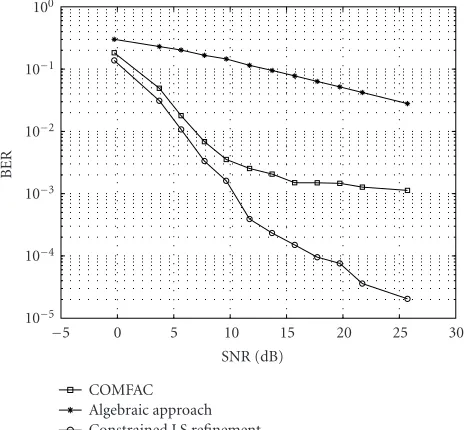
a continuous distribution and fixed throughout the simula-tions. Figure 2depicts average BER for the in-cell users for Min=4,Mout=2,K=4,N=50,P=4, and otherwise the
same simulation setup. Note that in the second experiment, both the number of antennas and spreading gain are less than the number of total active users. It is seen from those fig-ures that, as expected, the proposed algorithm has provided better BER performance than COMFAC; in particular, such
COMFAC Algebraic approach Constrained LS refinement
−5 0 5 10 15 20 25 30
SNR (dB) 10−5
10−4 10−3 10−2 10−1 100
BER
Figure2: More active users than spreading gain.
improvement is significant in the high SNR regime. In addi-tion, the proposed algorithm has been observed to converge at least 70 percent faster (in terms of time) than the gen-eral TALS with random initialization, and comparably with respect to the computation-efficient TALS-based COMFAC, especially in the high SNR regime.
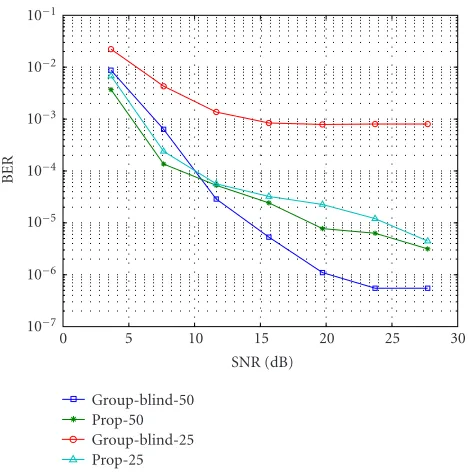
Next, the performance of the proposed algorithm and that of the linear group-blind decorrelating detector [3] with two different sample sizes is shown in Figure 3. The orig-inal group-blind multiuser detector is designed for uplink CDMA with a single receive antenna, but the approach of [3] can be easily extended to handle multiple BS antennas, provided that the array steering vectors, in addition to the spreading codes, of all the in-cell users are known. Estimat-ing steerEstimat-ing vectors is more difficult than estimating codes, because the former vary faster due to mobility-induced fast fading. In our simulation, in contrast to the proposed algo-rithm, the linear group-blind decorrelating detector assumes perfect knowledge of in-cell user’s steering matrix Ain, that
is, we provide the linear group-blind decorrelating detector with perfect knowledge of (CinAin) in (8). Figure 3
Group-blind-50 Prop-50 Group-blind-25 Prop-25
0 5 10 15 20 25 30
SNR (dB) 10−7
10−6 10−5 10−4 10−3 10−2 10−1
BER
Figure3: Small sample performance compared to the group-blind approach with known in-cell steering (K=4,P=8,Min=4,M=
6).
detector clearly outperforms the linear group-blind decor-relating detector, despite the fact that it uses less side infor-mation. In both cases, the proposed detector outperforms the linear group-blind decorrelating detector in the low SNR regime. We emphasize that the proposed algorithm performs well even for very small sample sizes (e.g.,N = 10) in the high SNR regime, whereas the group-blind approach hits the error floor at very low SNR in this case.
Our proposed detector is also robust to strong out-of-cell interference. We have compared the user 1’s BER per-formance of proposed approach against the usual minimum mean squared error (MMSE) receiver, which assumes ex-act knowledge of the in-cell user codes and steering vectors, but treats out-of-cell users as Gaussian interference. The soft MMSE solution forSis
STin=
CinAin
H
CinAin
+ 1 SNRI
−1
CinAin H
XKP×N.
(29)
Figure 4 shows that as the power of out-of-cell users in-creases, the performance of the MMSE receiver deteriorates significantly whereas the degradation of the proposed detec-tor is marginal.
The proposed algorithm is capable of accurately estimat-ing the steerestimat-ing matrix of all active users and the code matrix of out-of-cell users. In order to illustrate this, we compare the (mean squared error MSE) performance of the proposed ap-proach against the associated asymptotic CRB. Throughout,
MMSE: no out-of-cell info Proposed algorithm
6 8 10 12 14 16 18
Power ratio of interference to user 1 (dB) 10−6
10−5 10−4 10−3 10−2 10−1 100
BER
1
Figure 4: Robustness to strong out-of-cell interference (SNR1 =
8 dB,K=4,N=25,P=8,Min=3,M=4).
the asymptotic CRB is first normalized in an elementwise fashion, that is, each unknown parameter’s CRB is weighed with weight proportional to the inverse modulus square of respective parameter. The average weighted CRB of all the unknown parameters is then used as a single performance metric. The average MSE for all free model parameters is cal-culated in the same fashion. The SNR is defined as
SNR :=10 log10CA
2
F
KPσ2 dB, (30)
which can be shown consistent with the definition (28) when we take the expectation of (28) with respect toS.
Figure 5depicts simulation results comparing TALS per-formance to this asymptotic CRB for two different snapshots. In this simulation, K = 4, P = 4,M = 6, and the true parameters were used to initialize TALS. The point here is to measure how tight the asymptotic CRB is for variousN; for this reason, we use the sought parameters as initializa-tion in order to ensure the best possible scenario for TALS. It can be seen that TALS with good initialization remains very close to the CRB from medium to high SNR and rela-tively large sample size,N =64. Note thatN =64 is a rea-sonable number of symbol snapshots in practice. When the sample size is relatively small, the MSE performance of TALS is naturally worse than what is predicted by the asymptotic CRB.
TALS:N=8 CRB:N=8 TALS:N=64 CRB:N=64
5 10 15 20 25 30
SNR 10−3
10−2 10−1 100 101 102
MSE
Figure5: TALS versus asymptotic CRB.
COMFAC Proposed algorithm CRB
0 5 10 15 20 25 30
SNR 10−3
10−2 10−1 100 101
MSE
Figure6: MSE performance of COMFAC and the proposed algo-rithm versus asymptotic CRB (K=4,P=4,Min=4,M=6,N =
64).
whereas the COMFAC is forced to use random initializations in this case, wherein no two modes are full column rank. The average MSE of the proposed algorithm deviates from CRB about two to three dB. This is mainly because the initializa-tions the algebraic approach provides are still not perfect, and the pre-specified tolerance threshold used to terminate the iterative refinement algorithm is set higher than in previ-ous simulations, due to complexity considerations.
6. CONCLUSIONS
Out-of-cell interference in DS-CDMA systems is usually treated as noise, possibly mitigated using random cell codes. If the total number of in-cell plus out-of-cell users is smaller than the spreading gain, subspace-based suppression of out-of-cell users is possible. The assumption of more spreading than the total number of users can be quite unrealistic, even for moderately loaded cells. Completely blind reception is feasible under certain conditions (even with more users than spreading) with BS antenna arrays. We have proposed a new blind identification procedure that is capable of recovering both in-cell and out-of-cell transmissions, with sole knowl-edge of the in-cell user codes. The codes of the out-of-cell users and the steering vectors of all users are also recovered. The new procedure remains operational even when com-pletely blind or subspace-based procedures fail. Interestingly, if the in-cell codes are known, then algebraic solution is pos-sible.
APPENDIX
ASYMPTOTIC CRB ASNTENDS TO INFINITY
To derive a meaningful CRB, following what has been done in [8], we assume that the first row of AandSis fixed (or normalized) to [1· · ·1]1×F(this takes care of scale ambigu-ity), the first row ofCout is known and consists of distinct
elements (which subsequently resolves the permutation am-biguity) andCinis incanonical form. In turn, the number of
unknown complex parameters is (N+K−2)M+(P−1)Mout.
Let
θ:=aT
2;. . .;aTK;coutT2;. . .;coutTP;sT2;. . .;sTN;aH2;. . .;sHN
∈C(N+K−2)M+(P−1)Mout×1,
(A.1)
whereakdenotes thekth row ofA,coutpdenotes theith row ofCout, andsndenotes thenth row ofS.
It has been shown in [8] that the Fisher information ma-trix (FIM) is given by
Ω(θ)=E
∂ f(θ)
∂θ
H∂ f(θ)
∂θ =
Ψ 0
0 Ψ∗
, (A.2)
where f(θ) is the log-likelihood function and
Ψ=
Ψaa Ψac Ψas
ΨH
ac Ψcc Ψcs
ΨH
as ΨHcs Ψss
(A.3)
with obvious notation. In addition,
CRBaa CRBac CRBHac CRBcc
= !
Ψaa Ψac
ΨH ac Ψcc
−
Ψas
Ψcs
Ψ−1
ss
ΨH asΨHcs
"−1
.
The elements ofΨcan be given6as follows
where we have used the identity
CHC DHD=(CD)H(CD), (A.6)
and stands for the Hadamard product. Similarly, we have
E
In addition, we have
E
Since we have assumed that
Es∗n1
6The forms given here can be shown to be mathematically equivalent to those in [8]. The new forms are computationally much simpler.
from which it is not difficult to see that
Preliminary version of part of this paper was presented at ICASSP 2002, Orlando, Fla. This work was supported by the Army Research Laboratory (ARL) through participation in the ARL Collaborative Technology Alliance (ARL-CTA) for Communications and Networks under Cooperative Agree-ment DADD19-01-2-0011, and the National Science Foun-dation (NSF) under Grants NSF/CAREER CCR-0096165 and NSF/Wireless IT & Networks CCR-0096164.
REFERENCES
[1] V. Shtrom, “CDMA vs. OFDM in broadband wireless access— the fundamental characteristics of OFDM make it ideally suited for broadband data,” Broadband Wireless Online, vol. 3, no. 5, 2002.
[2] H. Liu and G. Xu, “A subspace method for signature waveform estimation in synchronous CDMA systems,”IEEE Transactions on Communications, vol. 44, no. 10, pp. 1346–1354, 1996. [3] P. Spasojevic, X. Wang, and A. Høst-Madsen, “Nonlinear
group-blind multiuser detection,” IEEE Trans. Communica-tions, vol. 49, no. 9, pp. 1631–1641, 2001.
[4] N. D. Sidiropoulos, G. B. Giannakis, and R. Bro, “Blind PARAFAC receivers for DS-CDMA systems,”IEEE Transactions on Signal Processing, vol. 48, no. 3, pp. 810–823, 2000. [5] R. Harshman, “Foundations of the PARAFAC procedure:
Mod-els and conditions for an “explanatory” multi-mode factor analysis,”UCLA Working Papers in Phonetics, vol. 16, pp. 1–84, 1970.
[6] J. B. Kruskal, “Three-way arrays: rank and uniqueness of trilin-ear decompositions, with application to arithmetic complexity and statistics,” Linear Algebra and Its Applications, vol. 18, no. 2, pp. 95–138, 1977.
[7] T. Jiang, N. D. Sidiropoulos, and J. M. F. ten Berge, “Almost-sure identifiability of multidimensional harmonic retrieval,”
IEEE Transactions on Signal Processing, vol. 49, no. 9, pp. 1849– 1859, 2001.
[8] X. Liu and N. D. Sidiropoulos, “Cramer-Rao lower bounds for low-rank decomposition of multidimensional arrays,”IEEE Transactions on Signal Processing, vol. 49, no. 9, pp. 2074–2086, 2001.
Tao Jiang received his B.S. degree from Peking University, Beijing, China, in 1997, and his M.S. degree from University of Min-nesota, Minneapolis, in 2000, both in math-ematics. He is currently working towards the Ph.D. degree in the Department of Elec-trical and Computer Engineering at Uni-versity of Minnesota, Minneapolis. His re-search interests are in the area of signal pro-cessing for communications with focus on wireless communications.
Nicholas D. Sidiropoulos received his Diploma in electrical engineering from the Aristotelian University of Thessaloniki, Greece, and M.S. and Ph.D. degrees in elec-trical engineering from the University of Maryland at College Park (UMCP) in 1988, 1990, and 1992, respectively. He has been a Postdoctoral Fellow (1994–1995) and Re-search Scientist (1996–1997) at UMCP, As-sistant Professor in the Department of