R E S E A R C H
Open Access
A social trust and preference
segmentation-based matrix factorization
recommendation algorithm
Wei Peng and Baogui Xin
*Abstract
A recommendation can inspire potential demands of users and make e-commerce platforms more intelligent and is essential for e-commerce enterprises’sustainable development. The traditional social recommendation algorithm ignores the following fact: the preferences of users with trust relationships are not necessarily similar, and the consideration of user preference similarity should be limited to specific areas. To solve these problems mentioned above, we propose a social trust and preference segmentation-based matrix factorization (SPMF) recommendation algorithm. Experimental results based on the Ciao and Epinions datasets show that the accuracy of the SPMF algorithm is significantly superior to that of some state-of-the-art recommendation algorithms. The SPMF algorithm is a better recommendation algorithm based on distinguishing the difference of trust relations and preference domain, which can support commercial activities such as product marketing.
Keywords:Personalized recommendation, Collaborative filtering, Data sparsity, Machine learning, Trust relationship, Preference similarity
1 Introduction
The Internet has brought about industrial change and nurtured e-commerce. E-commerce has generated huge amount of network information, which results in infor-mation overload [1]. Information overload directly in-creases the difficulty of selecting products and inspires people to seek effective solutions. Today, there are mainly four types of solutions we can employ: (1) infor-mation acquisition timelines, (2) categories, (3) search engines, and (4) personalized recommendations.
The first type of solution can save information re-trieval time, but it is easy to miss lots of useful informa-tion. The second type of solution is to classify the project according to the similarity feature chosen by the user; this can overcome the defects of the first type of solution, but it has the disadvantage of low efficiency and poor precision. The third type of solution allows users to retrieve and filter irrelevant information by key-words, which can solve the problem of the second type of solution but cannot consider the user’s individualized
needs. Finally, the fourth type of solution can solve the problem of the third solution, and through historical data, user attributes, product attributes, and other infor-mation to mine user preferences, it can actively make personalized recommendations to users [2,3].
A recommendation system can inspire the potential needs of users and make an e-commerce platform more intelligent and humanized. Such systems have helped Amazon, JD, Alibaba, and other companies to signifi-cantly increase sales. The recommendation algorithm is
the core of the recommendation system [4], but data
sparsity and other problems have always been obstacles
to its further development. Most scholars [5] employ
machine learning algorithms, such as those for clustering and dimensionality reduction, to fill sparse data with a small amount of original data. However, it is difficult to guarantee the quality of the filled data.
In order to solve the above problems and improve the
accuracy of recommendation, many scholars [6–9] put
forward recommendation algorithms based on the social network, that is, using direct or indirect trust relation-ships to make recommendations for target users. How-ever, the trust relationship-based algorithm still has
© The Author(s). 2019Open AccessThis article is distributed under the terms of the Creative Commons Attribution 4.0 International License (http://creativecommons.org/licenses/by/4.0/), which permits unrestricted use, distribution, and reproduction in any medium, provided you give appropriate credit to the original author(s) and the source, provide a link to the Creative Commons license, and indicate if changes were made.
* Correspondence:[email protected]
three problems: (1) The preference similarity of users with the trust relationship may be small or even zero. For example, a user has a trust relationship with his par-ents, but their preference differences may be significant, and therefore the recommendation may not be ideal. (2) The diversity of user preference determines that the measurement of preference similarity should be limited to certain areas. For example, the preference similarity of users is low in the music field, but it may be very high in the film field, and therefore a recommendation in the film field is very satisfactory. (3) Even if the preferences of different users are very similar, the recommendation will significantly influenced because of the difference in trust relationships.
In the light of the shortcomings of traditional social recommendation, our main contributions include that we proposed a social trust and preference segmentation-based matrix factorization recommendation algorithm by setting different recommendation trust weights for different relationships and preference domains. With the social trust and preference segmentation-based matrix factorization (SPMF) algorithm, we solve the problems mentioned above and improve the recommendation accuracy.
The remainder of this paper is organized as follows. In Section 2, we review some related literature. In Section
3, we propose a social trust and preference
segmentation-based matrix factorization
recommenda-tion algorithm. In Section 4, we introduce the
experiments on two public datasets. In Section 5, we present the experimental results and perform some par-ameter analysis. In Section 6, we conclude our work and future work.
2 Related work
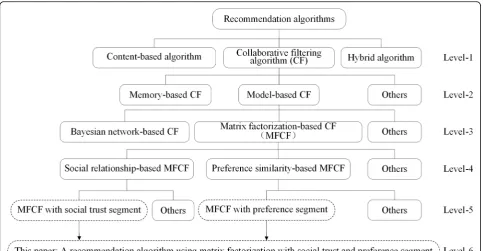
The context of the literature in this paper is shown in Fig1. As the level-1 classification shows, [8, 10] divided the recommendation algorithms into three categories:
content-based recommendation algorithms [11],
collaborative filtering algorithms [12], and hybrid
recom-mendation algorithms [13]. Strictly speaking, the
content-based recommendation algorithm is derived from the collaborative filtering recommendation algo-rithm, and both generate recommendations for target users based on similarity. Content-based recommenda-tion algorithms need to filter massive amounts of infor-mation and update user profiles regularly, resulting in high time complexity and unsatisfactory recommenda-tion results. Conversely, collaborative filtering recom-mendation algorithms only use neighbors with high similarity to target users to evaluate a product, predict the preferences of target users, and make recommenda-tions. Hybrid recommendation algorithms are designed to meet a specific need and incorporate content-based recommendation algorithms and collaborative filtering recommendation algorithms.
The collaborative filtering algorithm is the most suc-cessful and widely used personalized recommendation
algorithm in business, and it is also a hotspot of aca-demic research. As the level-2 classification shows [14]), this algorithm was divided into a memory-based collab-orative filtering algorithm and a model-based collabora-tive filtering algorithm. The memory-based collaboracollabora-tive filtering algorithm does not distinguish the rated item information attributes, and therefore it directly uses the correlation matrix to make predictions, which results in a heavy workload and low efficiency. In order to improve the recommendation efficiency and accuracy, the model-based collaborative filtering algorithm employs machine learning and data mining models such as the Bayesian network [15], SVM [16], or matrix decomposition [17] for recommendation; this is shown in the level-3 classifi-cation. However, the ability to solve the sparsity problem of user-item rating data is an important indicator for evaluating the pros and cons of a recommendation algo-rithm. The matrix factorization-based collaborative fil-tering algorithm has become one of the most popular algorithms in the last decade due to its outstanding per-formance in the 2009 Netflix Prize competition.
As the level-4 classification shows, the matrix
factorization-based collaborative filtering algorithm in-cludes the trust relationship-based matrix factorization algorithm [18, 19] and the preference similarity-based matrix factorization algorithm [20]. Wang et al. [21] solved the problem of low-accuracy caused by sparse data by integrating the user preference similarity and matrix factorization algorithm and combining the user rating data. Lai et al. [22] constructed a social recom-mendation model that integrated trust relationships and product popularity and speculated on their potential in-teractions based on user interaction behavior. The trust relationship could lead to more accurate recommenda-tions. Guo et al. [23] proposed TrustSVD, a trust-based matrix factorization technique for recommendations.
Lee and Ma [24] constructed a recommendation
algo-rithm that combined the KNN and matrix factorization by using a trust relationship and propagation effect, and combining user rating and the trust relationship, they achieved a higher recommendation accuracy. Apart from the classifications mentioned above, there are also some other recommendation algorithms [25–27]. Qi et al. [25]
proposed SerRectwo−LSH, a novel service
recommenda-tion method to provide privacy-preserving and scalable
mobile service recommendations. Moreover, SerRectwo−
LSH achieved significant improvement both in accuracy
and scalability, while privacy preservation is
guaran-teed. Gong et al. [26] extended the traditional
LSH-based service recommendation to propose
theSerRec-multi−qos to protect users’ privacy over multiple
qual-ity dimensions.
In this paper, we will combine the social trust segmen-tation and the preference domain segmensegmen-tation and
construct the level-6 classification, i.e., the SPMF recom-mendation algorithm.
3 Methodology
Traditional social recommendation algorithms ignored the following fact: the preferences of users with trust re-lationships are not necessarily similar, and the consider-ation of user preference similarity should be limited to specific areas. There has no literature proposed to fulfill the literature gap mentioned above. Based on this, we proposed the SPMF recommendation algorithm.
The main ideas of the SPMF recommendation algo-rithm are as follows:
(1) To show the impact of preference domain segmen-tation on target user recommendation.
(2) To reveal the different influences on target users’ recommendation between users with and without trust relationships.
3.1 Preference domain segmentation
User preferences are diverse, but most of the existing recommendation algorithms do not take full account of it. To demonstrate the impact of preference domain seg-mentation on measuring user preference similarity, we provide the following example.
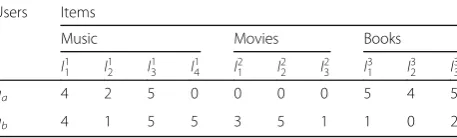
A website provides ten products that can be subdi-vided into three categories: music, movies, and books (Table 1). The numbers in the table represent rating re-cords. The rating scale is 1–5, and 0 indicates no rating. uaandubrepresent users, andIPk denotes thekthitem in
the domainP.
Table1 shows that the preferences ofuaandubin the music field are similar; the preferences are temporarily uncertain in the movie field, and the preferences are quite different in the book field.
We measure preference similarities sim(ua,ub)COS,
sim(ua,ub)
Jaccard [29], respectively. Then, we compare them with the similarity after preference domain segmentation.
This comparison is shown in Table2.
Table2 shows that the preference similarity with pref-erence domain segmentation can describe prefpref-erence similarity among users more precisely than that without
Table 1Rating records of a website
Users Items
Music Movies Books
I11 I12 I13 I14 I21 I22 I23 I31 I32 I33
ua 4 2 5 0 0 0 0 5 4 5
preference domain segmentation. Furthermore, PCC is
the most accurate method. Moreover, from ssim(ua,
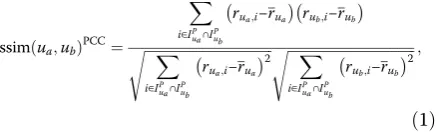
ub)PCC, we can predict thatuamay be interested inI14. In this paper, we will employ sism(ua,ub)PCC to calculate the preference similarity. The formula is as follows:
ssimðua;ubÞPCC¼ denote the average rating ofuaandub, respectively.
Considering the preference domain segmentation of users, we can measure a user’s experience in a particular domain based on the number of items bought by the user. The formula is as follows:
ξuP¼
jIuj
jIu1∪Iu2∪⋯∪Ium j
; ð2Þ
whereIudenotes the item set rated by the target useru;
∣ ⋅ ∣indicates the element amount of the set; andu1,u2,
…,umrepresent all users in the particular domainP.
3.2 Trust relationship segmentation
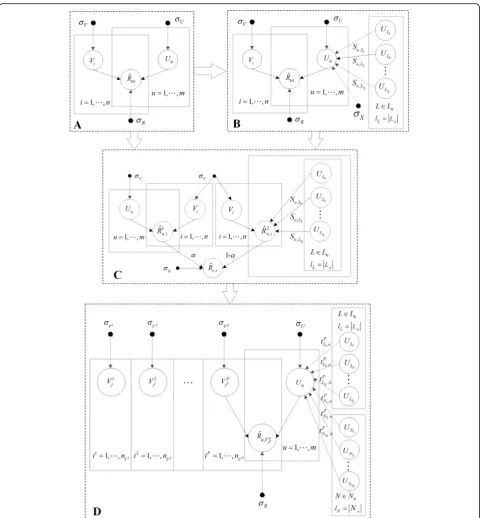
In Fig. 2, the user eigenmatrix Uu obeys the Gaussian
distribution with the mean μ= 0 and the variance σ2
¼σ2
U; the item eigenmatrixViobeys the Gaussian distri-bution with the mean μ= 0 and the variance σ2¼σ2V; and the predicted ratingR^uiobeys the Gaussian distribu-tion with the mean μ=rui, and the variance σ2¼σ2R. Sua;ub denotes the social link value, whereSua;ub ¼0 indi-cates no social relationship between uaand ub. Lu repre-sents the set of users who have a social link with the target user u, and w1, w2, ⋯wn denote elements of Lu. Nurepresents the set of users who do not have a social link with the target user u, and z1;z2;⋯zn0 denote
ele-ments ofNu.tPw;u andtPz;udenote different
recommenda-tion influences in specific domain P, which can be
calculated by Eq. (3).
User relationships are complex, but in classical recom-mendation algorithms, we assume that user relationships are independent of each other in order to simplify the problem. Typically, we only consider the user’s ratings on products, such as with the probability matrix
factorization (PMF) recommendation algorithm [30], as
shown in Fig. 2a. However, it is difficult for us to be completely independent when making sensible decisions, and we are often influenced by our friends and family. In view of this, some researchers introduced the trust re-lationship into the recommendation algorithm and only considered the user evaluation with a trust relationship to make recommendations for target users, i.e., the
SocialMF recommendation algorithm [30]. This
algo-rithm is shown in Fig. 2b. Social recommendation
algo-rithms could improve recommendation accuracy but ignored the user’s evaluation of the product. In order to overcome the shortcomings of the PMF recommenda-tion algorithm and the trust-based recommendarecommenda-tion al-gorithm and utilize their advantages, it is necessary to combine them. Doing so produces the STE recommen-dation algorithm [31], as shown in Fig. 2c. In order to adequately reflect the effect of the trust relationship and the preference similarity to target users, we construct a matrix factorization recommendation algorithm that combines trust relationship segmentation and preference domain segmentation, named SPMF, which is shown in Fig.2d.
In order to distinguish the different influences of Lu
and Nuonu, we define the specific domain
recommen-dation influencetP
u0;uas follows:
whereαis an adjustment factor that is used to weigh the
recommendation impact ofLuandNuon the target user
u; and u′ represents another user who belongs to either LuorNu.
Table 2Comparison of preference similarity
Domains Measures
Without preference domain segmentation With preference domain segmentation
Values
Music 0.53 0.50 0.29 0.78 0.75 0.97
Movies -- --
In the specific domain P, we can define the predicted target user eigenvectorU^uaccording to the eigenvectors
ofLuandNu:
If we incorporate the specific domain recommendation influence into the PMF algorithm, the posterior
prob-ability distribution of the user eigenmatrix U and the
item eigenmatrixVis as follows:
p U;VjR;T;σ2
represents no rating record; and I is a unit matrix of
K dimensions.
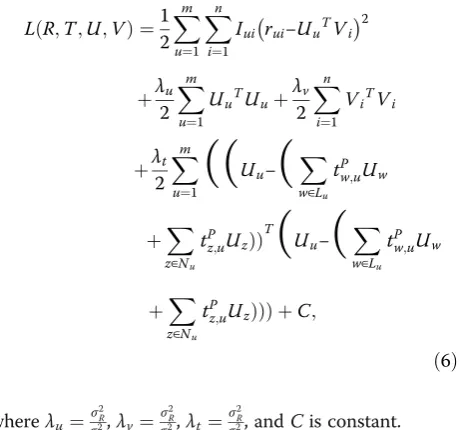
The objective function of this algorithm is
ob-tained by taking a negative logarithm of Eq. (5) as
follows: In order to obtain the optimal value of the objective function (6), we employ the gradient descent algorithm to get the partial derivatives of the eigenvectors Uuand Vi:
In this way, we can get the following eigenvectors by iteratively updating the gradient descent algorithm:
Uðτþ1Þ
where τ is the sequence number of the iterative
updat-ing, andγis the learning rate.
4 Experimental section 4.1 Experimental datasets
In this section, two public datasets1, Ciao and Epinions, are employed. The performance of the proposed SPMF is evaluated by the mean absolute error (MAE) and the root mean square error (RMSE) [30, 31]. The statistics of datasets Ciao and Epinions are shown in Table3. Ob-viously, both datasets are highly sparse.
1https://www.librec.net/datasets.html
Table 3Statistics of the experimental datasets
Ciao Epinions
Number of users (m) 7375 40,163
Number of items (n) 99,746 139,738
Number of rating records 280,391 664,824
Number of trust relationships 111,781 487,183
Sparsity of rating records 99.9619% 99.9882%
4.2 Algorithm implementations and complexity analysis 4.2.1 Generate a recommendation influence matrix of specific domains
For the SPMF recommendation algorithm, the recom-mendation influence matrix element of specific domains can be calculated by Eq. (3), and the algorithm generated
by the recommendation influence matrix Tm×m of
spe-cific domains is shown by Algorithm 1.
Algorithm 1.Generate a recommendation matrixTm×m of specific domains
In Algorithm 1,α is set to 0.4. We explain this in the section titled“Parameter analysis onα.”
From the above process, the complexity of Algorithm 1 isO(n3).
4.2.2 The user-item rating matrix for prediction
For the SPMF recommendation algorithm, the algorithm of the user-item rating matrix for prediction is shown by Algorithm 2.
Algorithm 2. The user-item rating matrix for prediction
In Algorithm 2, K represents matrix factorization
dimensions.
From the above process, the complexity of Algorithm 2 isO(n6).
5 Results and discussion 5.1 Results
In this section, we compare the proposed SPMF with some state-of-the-art algorithms.
PMF [32] is the probabilistic matrix factorization algorithm, which decomposes the original rating matrix into lower-rank latent feature matrices of user and item, then takes the matrices product as the predicted rating matrix.
RSTE [31] is a probabilistic matrix factorization framework with social trust ensemble.
SocialMF [30] is a model-based recommendation al-gorithm, which incorporates the crucial
phenomenon of trust propagation into matrix factorization.
TrustSVD [23] is a trust-based matrix factorization technique for recommendation.
For comparison, we use the same strategy as most of the literature: the matrix factorization dimensions are
Table 4RMSE comparison with baselines
Datasets Dimension Indicator PMF RSTE SocialMF TrustSVD SPMF Accuracy improvement
Epinions K= 5 MAE 0.979 0.950 0.825 0.804 0.794 1.24%
RMSE 1.290 1.196 1.070 1.043 0.989 5.18%
K= 10 MAE 0.909 0.958 0.826 0.805 0.762 5.34%
RMSE 1.197 1.278 1.082 1.044 0.974 6.70%
Ciao K= 5 MAE 0.920 0.767 0.749 0.723 0.571 21.02%
RMSE 1.260 1.020 0.981 0.955 0.759 20.52%
K= 10 MAE 0.822 0.763 0.749 0.723 0.565 21.85%
RMSE 1.078 1.013 0.976 0.956 0.756 20.92%
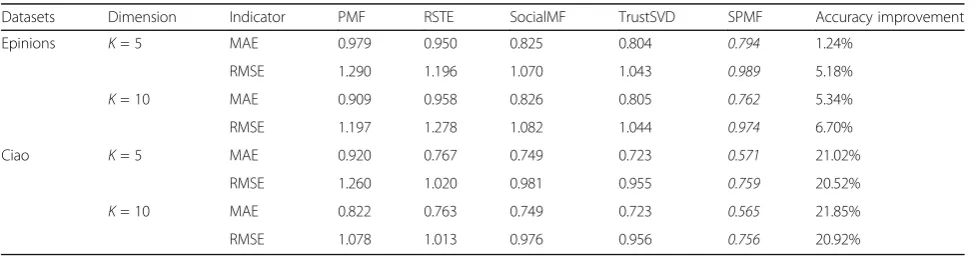
set to K= 5 and 10. The MAE and RMSE of the pro-posed SPMF algorithm and other recommendation algo-rithms on Epinions and Ciao datasets are shown in Table4.
Table 4 shows that the MAE and RMSE of the SPMF
algorithm are less than those of algorithms PMF, RSTE,
SocialMF, and TrustSVD in the cases of K= 5 and 10,
i.e., the accuracy of the SPMF algorithm is the highest
among all compared algorithms. Moreover, from Table4,
we can find that the SPMF has a significant accuracy im-provement compared with some existing algorithms.
6 Discussion
In exploring the influence of various parameters on the performance of the algorithm, this paper adopts the idea of control variables. The more the epoch increases, the longer the training time becomes. Therefore, the epochs in this section are all set at 10.
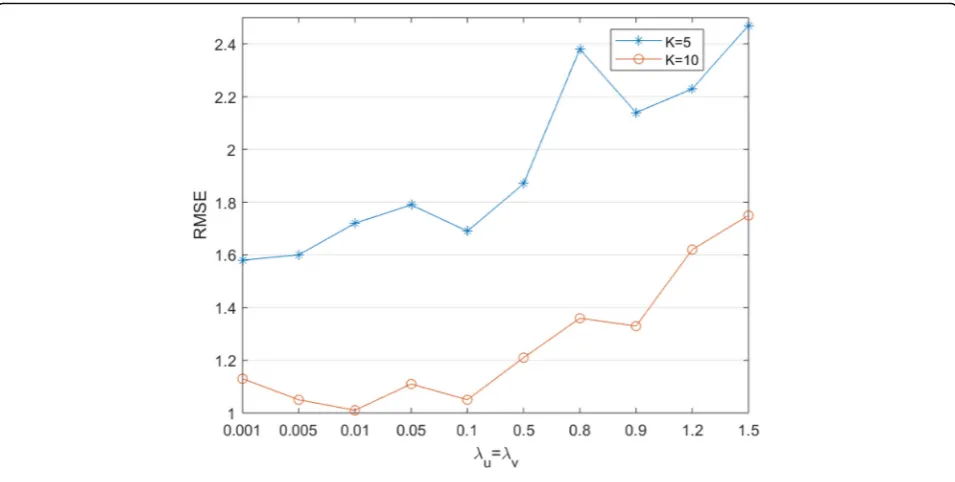
Fig. 3RMSE vs.λuandλvon Ciao.The blue line withK= 5, and the green line with K = 10
6.1 Parameter analysis onλuandλv
In this section, we explore the effect of λuand λvvalues on algorithm performance under different decompos-ition dimensions. The results are shown in Figs3and4.
Figures 3 and 4 show that the optimal parameter
values should be λu=λv= 0.005 on both Ciao and Epi-nions since the average RMSE corresponding to different
decomposition dimensions is the smallest only when
λu=λv= 0.005.
6.2 Parameter analysis onλt
In this section, we explore the effect ofλtvalues on algo-rithm performance under different decomposition di-mensions. The results on datasets Ciao and Epinions are
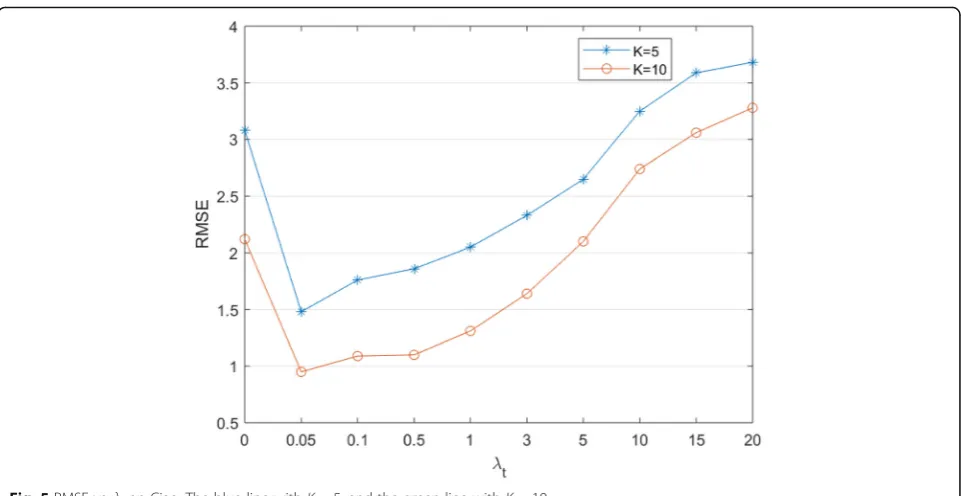
Fig. 5RMSE vs.λton Ciao. The blue line withK= 5, and the green line withK= 10
shown in Figs.5and6. The differentλtvalues are set as in the previous literature.
From Figs 5 and 6, we can conclude that in different
decomposition dimensions of different datasets, the
R.MSE value of the algorithm is the lowest when λt=
0.05 on both datasets.
6.3 Parameter analysis onα
In this section, we explore the optimal α of the
algo-rithm. The result is shown in Fig7.
Figure 7 shows that the optimal parameter value
should beα= 0.4 on datasets Ciao and Epinions. Because the sum of RMSEs on Ciao and Epinions is smallest
Fig. 7RMSE vs.αon Ciao and Epinions. The blue line for Ciao, and the green line for Epinions
when α= 0.4, that is to say, the SPMF algorithm can fit
different datasets better when α= 0.4 compared with
other values ofα.
6.4 Parameter analysis onK
In this section, we will explore the optimal
decom-position dimension K. The result is shown in Fig. 8.
Figure 8 shows that the optimal factorization
di-mension of both datasets is K= 20. On Ciao, the
RMSE of K= 20 is not the smallest in this
experi-ment, but too large of a decomposition dimension may cause overfitting, and the difference of RMSE
between K= 20 and K= 40, K= 50 is within a
reason-able range, and. Similarly, we can conclude that K=
20 is the optimal decomposition dimension of
Epinions.
7 Conclusions
The traditional social recommendation algorithm ignores the following fact: the preferences of users with trust relationships are not necessarily similar, and the consideration of user preference similarity should be limited to specific areas. To solve these problems, this paper proposed a SPMF recommen-dation algorithm by setting different recommenda-tion trust weights for different relarecommenda-tionships and preference domains. The experimental results on Ciao and Epinions datasets show that the accuracy of the SPMF algorithm is much higher than that of some state-of-the-art recommendation algorithms.
Because we take into consideration different recommen-dation trust weights for different relationships and prefer-ence domains, the limitation of SPMF is its high complexity of the algorithm. In the future, researchers can explore simpler algorithms by incorporating our ideas.
Abbreviations
SPMF:Social trust and preference segmentation-based matrix factorization; MAE: Mean absolute error; RMSE: Root mean square error
Acknowledgements
The authors would like to express sincere gratitude to the referees for their valuable suggestions and comments.
Authors’contributions
The authors have made the same contribution. All authors read and approved the final manuscript.
Funding
The work is supported by the National Social Science Foundation of China [No. 16FJY008], the National Natural Science Foundation of China [No. 11801060], and the Natural Science Foundation of Shandong Province [No. ZR2016FM26], and the innovation program of Shandong University of Science and Technology (No. SDKDYC190114).
Availability of data and materials
[1] Ciao dataset
https://www.librec.net/datasets/CiaoDVD.zip [2] Epinions dataset
http://www.trustlet.org/downloaded_epinions.html.
Competing interests
The authors declare that they have no competing interests.
Received: 4 April 2019 Accepted: 11 November 2019
References
1. Z.P. Fan, Y. Xi, Y. Li, Supporting the purchase decisions of consumers: a comprehensive method for selecting desirable online products. Kybernetes 47(4), 689–715 (2018).https://doi.org/10.1108/K-03-2017-0116
2. L. Kuang et al., A Personalized QoS Prediction Approach for CPS Service Recommendation Based on Reputation and Location-Aware Collaborative Filtering. Sensors18(5), 1556 (2018).https://doi.org/10.3390/s18051556 3. C.Wu, et al., Recommendation algorithm based on user score probability
and project type.EURASIP J. Wirel. Commun. Netw., 2019(1),80(2019). (doi: https://doi.org/10.1186/s13638-019-1385-5)
4. P.C. Chang, C.H. Lin, M.H. Chen, A hybrid course recommendation system by integrating collaborative filtering and artificial immune systems. Algorithms9(3), 47 (2016).https://doi.org/10.3390/a9030047 5. E. Khazaei, A. Alimohammadi, An automatic user grouping model for a
group recommender system in location-based social networks. ISPRS Int. J. Geo Inf.7(2), 67 (2018).https://doi.org/10.3390/ijgi7020067
6. K. Haruna et al., Context-aware recommender system: A review of recent developmental process and future research direction. Appl. Sci.7(12), 1211 (2017).https://doi.org/10.3390/app7121211
7. B. AlBanna et al., Interest aware location-based recommender system using geo-tagged social media. ISPRS Int. J. Geo Inf.5(12), 245 (2016).https://doi. org/10.3390/ijgi5120245
8. L. Cui et al., A novel context-aware recommendation algorithm with two-level SVD in social networks. Futur. Gener. Comput. Syst.86, 1459–1470 (2018).https://doi.org/10.1016/j.future.2017.07.017
9. N. Iltaf, A. Ghafoor, M. Hussain, Modeling interaction using trust and recommendation in ubiquitous computing environment.EURASIP J. Wirel. Commun. Netw., 2012(1),119(2012). (doi: https://doi.org/10.1186/1687-1499-2012-119)
10. X. Su, T.M. Khoshgoftaar, A survey of collaborative filtering techniques. Advances in artificial intelligence2009, 421425 (2009).https://doi.org/10. 1155/2009/421425
11. M.J. Pazzani, D. Billsus, Content-based recommendation systems, in The adaptive web. Springer, 325–341 (2007). https://doi.org/10.1007/978-3-540-72079-9_10
12. J.L. Herlocker, J.A. Konstan, J. Riedl, Explaining collaborative filtering recommendations. in Proceedings of the 2000 ACM conference on Computer supported cooperative work. 2000. ACM..https://doi.org/10.1145/ 358916.358995
13. R. Burke, Hybrid recommender systems: Survey and experiments. User Model. User-Adap. Inter.12(4), 331–370 (2002).https://doi.org/10.1023/A: 1021240730564
14. J.S. Breese, D. Heckerman, C. Kadie, Empirical analysis of predictive algorithms for collaborative filtering. in Proceedings of the Fourteenth conference on Uncertainty in artificial intelligence. 1998. Morgan Kaufmann Publishers Inc..https://doi.org/10.1109/ICCV.2009.5459155
15. S. Kang, Outgoing call recommendation using neural network. Soft. Comput.22(5), 1569–1576 (2018).https://doi.org/10.1007/s00500-017-2946-3 16. L. Ren, W. Wang, An SVM-based collaborative filtering approach for Top-N
web services recommendation. Futur. Gener. Comput. Syst.78, 531–543 (2018).https://doi.org/10.1016/j.future.2017.07.027
17. J. Zhao, G. Sun, Detect user’s rating characteristics by separate scores for matrix factorization technique. Symmetry10(11), 616 (2018).https://doi.org/ 10.3390/sym10110616
18. H. Ma et al., Sorec: Social recommendation using probabilistic matrix factorization. in Proceedings of the 17th ACM conference on Information and knowledge management. 2008. ACM..https://doi.org/10.1145/1458082. 1458205
19. C. Mi, P. Peng, R. Mierzwiak, A recommendation algorithm considering user trust and interest. in Lecture Notes in Computer Science, 17th International Conference on Artificial Intelligence and Soft Computing, 2018, 408-422. IEEE. (doi:https://doi.org/10.1007/978-3-319-91262-2_37)
21. J. Wang, A.P. De Vries, M.J. Reinders. Unifying user-based and item-based collaborative filtering approaches by similarity fusion. in Proceedings of the 29th annual international ACM SIGIR conference on Research and development in information retrieval. 2006. ACM. (doi:https://doi.org/10. 1145/1148170.1148257)
22. C.H. Lai, S.J. Lee, H.L. Huang, A social recommendation method based on the integration of social relationship and product popularity. International Journal of Human-Computer Studies121, 42–57 (2019).https://doi.org/10. 1016/j.ijhcs.2018.04.002
23. G. Guo, J. Zhang, N. Yorke-Smith, A novel recommendation model regularized with user trust and item ratings. IEEE Trans. Knowl. Data Eng. 28(7), 1607–1620 (2016).https://doi.org/10.1109/TKDE.2016.2528249 24. W.P. Lee, C.Y. Ma, Enhancing collaborative recommendation performance by
combining user preference and trust-distrust propagation in social networks. Knowl.-Based Syst.106, 125–134 (2016).https://doi.org/10.1016/j. knosys.2016.05.037
25. L. Qi et al.,A two-stage locality-sensitive hashing based approach for privacy-preserving mobile service recommendation in cross-platform edge environment. Futur. Gener. Comput. Syst.88, 636–643 (2018).https://doi.org/10.1016/j. future.2018.02.050
26. Gong, W., L. Qi, and Y. Xu, Privacy-aware multidimensional mobile service quality prediction and recommendation in distributed fog environment. Wireless Communications and Mobile Computing, 2018, 3075849(2018). (doi:https://doi.org/10.1155/2018/3075849)
27. H. Liu, H. Kou, C. Yan, L. Qi, Link prediction in Paper Citation Network to Construct Paper Correlated Graph. EURASIP Journal on Wireless Communications and Networking, 2019. (In press).
28. A. Salah, N. Rogovschi, M. Nadif,A dynamic collaborative filtering system via a weighted clustering approach.Neurocomputing, 175, 206-215(2016).https:// doi.org/10.1016/j.neucom.2015.10.050
29. H. Liu et al., A new user similarity model to improve the accuracy of collaborative filtering. Knowl.-Based Syst.56, 156–166 (2014).https://doi.org/ 10.1016/j.knosys.2013.11.006
30. M. Jamali, M. Ester, A matrix factorization technique with trust propagation for recommendation in social networks. in Proceedings of the fourth ACM conference on Recommender systems. 2010. ACM. (doi:https://doi.org/10. 1145/1864708.1864736)
31. H. Ma, I. King, M.R. Lyu, Learning to recommend with social trust ensemble. in Proceedings of the 32nd international ACM SIGIR conference on Research and development in information retrieval. 2009. ACM. (doi:https:// doi.org/10.1145/1571941.1571978)
32. R. Salakhutdinov, A. Mnih, Probabilistic matrix factorization. in Advances in Neural Information Processing Systems 20(NIPS 2007). 2008: 1257-1264. (http://papers.nips.cc/paper/3208-probabilistic-matrix-factorization.pdf)
Publisher’s Note