R E S E A R C H
Open Access
Feasibility study on security deduplication
of medical cloud privacy data
Huiqi Zhao
1,2, Lexia Wang
1, Yinglong Wang
2*, Minglei Shu
2and Jimin Liu
1Abstract
In view of the problem of resource waste caused by the repeated storage of medical data, our scheme proposes that convergent encryption is applied to the medical cloud, and the hash value of the convergent key is used as a repeat detection label and Bloom filter search to achieve the efficiency of the medical cloud, and the practicality of medical data is improved by introducing fuzzy keywords searching, ensuring the safe storage and correctness of medical data through local validation. At the same time, based on the actual application of different medical data, we use the authorization access method of identity token to realize the multi role access of medical cloud.
Keywords:Medical cloud, Convergence encryption, Fuzzy keyword search, Deduplication, Identity token, Message authentication code(MAC)
1 Introduction
In order to protect the security of these medical privacy
data, the traditional scheme puts forward the
attribute-based access control [1], which is a more flex-ible access control mechanism; has the advantages of strong scalability and fine granularity access; and is suitable for complex and changeable cloud environ-ment. However, there are some problems in the trad-itional attribute-based access control mechanism, such as low encryption efficiency, lack of continuity, and low efficiency of strategy retrieval. At the same time, be-cause of the flexibility of attribute access control model, the strategy conflict detection and resolution in the model is also an urgent problem. Jia-shun [2] intro-duces the concept of using the obligation in the control model based on the traditional access control, adds the state mechanism, realizes the continuity and the state relativity of the decision, and has the characteristic of dynamic multiple authorization. At the same time, the concept of linked list and balanced binary tree is intro-duced, and two kinds of static conflict detection methods based on conflict detection list and conflict detection tree are proposed, which transforms the
conflict detection problem into the data structure prob-lem of query overlapping path. However, the scheme only considers the security privacy protection mechan-ism of access control, ignoring the importance of en-cryption for the security protection of medical data. Then, in the access control scheme which is based on the PBAC access control model and the ABE encryp-tion technology, a data access control method based on attributed-based encryption is adopted in this paper [3], and the attribute encryption technology is applied to the access control process. On the one hand, the secur-ity of medical data is realized in the access control layer; on the other hand, the security protection [4] of medical data is realized on the encryption level. Based on the application of medical cloud, this paper puts for-ward a research on data protection of medical cloud system based on attributed-based encryption [5], using attributed-based encryption to restrict the access of doctors, so as to ensure the security and privacy of medical data. In addition, the decision access structure and multithreading implementation are adopted to im-prove the efficiency problem. Later, the research on data sharing scheme based on privacy protection in medical cloud [6] adopts an improved aggregation key
encryption algorithm (Improved Key-Aggregate
Encryption; IKAE) to control the user’s access rights. The authorization center can complete the access authorization for the user by simply sending a constant * Correspondence:[email protected]
2
Shandong Provincial Key Laboratory of Computer Networks, Shandong Computer Science Center (National Supercomputer Center in Jinan), Qilu University of Technology (Shandong Academy of Sciences), Jinan, Shandong, China
Full list of author information is available at the end of the article
size aggregation key to the authorized user. Compared with attributed-based encryption, the access efficiency is greatly improved [7] and the complexity of key man-agement is greatly reduced. But with the massive in-crease in medical data and the increasing number of duplicate medical data, we have to consider applying ridding unbalance to the medical cloud to take full ad-vantage of the storage space of the medical cloud and reduce the transmission bandwidth of unnecessary medical data. However, it is very difficult for the med-ical data to be repeatedly detected on the medmed-ical cloud after the encryption method is encrypted lo-cally. This is because the uniqueness of the local key causes the same plaintext data to produce different ciphertext. However, if all senders use the same key to ensure the consistency of the ciphertext to facili-tate the medical cloud ridding unbalance, it will cer-tainly bring some security threats [8].
The contradiction between the encryption of med-ical data and ridding unbalance cloud data always ex-ists before the convergence encryption [9]. The so-called convergence encryption is to define the hash value of the medical data file as the key of the file symmetric encryption. This allows the same file to re-main the same encryption key for each user with a different private key, thus ensuring that the encrypted file is kept the same as the encrypted file, thus resolv-ing the contradiction between encryption and riddresolv-ing unbalance. But the simple convergence encryption al-gorithm can easily encounter a violent crack and guess an attack and so on. To optimize the perform-ance, the file label is no longer defined as the hash value of the data encryption ciphertext, but the hash value of the convergence key, which is proposed in
the randomized convergent encryption scheme
(Randomized Convergent Encryption; RCE) [10]. This greatly saves the tag generation overhead. However, this also poses a new threat to the data security of the medical cloud-replica forgery attack, and the in-tegrity of the file is not guaranteed. To protect the integrity and privacy of medical data on unreliable medical clouds, encryption prior to data upload and validation of data returned by the cloud server is par-ticularly important. Moreover, even if the encryption is applied before the data is uploaded, it does not mean that the data we store in the medical cloud will not be maliciously altered. In view of the cloud server’s unreliable and inquisitive service attitude, the cloud server may be, to save computational overhead and network bandwidth, only in partial operation, returning a part of the results, or the cloud server may maliciously delete and modify some files, plus malicious adversary attacks, causing users to receive unreliable data files. Therefore, it is necessary to
verify the integrity of the results returned by the cloud server.
The necessary encryption is required before data is uploaded, making efficient retrieval of ciphertext data a challenging problem. A common solution is to search for encryption [11], which allows the server to retrieve encrypted data from the user and the server will not get any plaintext messages. The first symmet-ric searchable encryption scheme is the SWP scheme pro-posed by Song et al. In this scheme, the server can scan and compare ciphertext words and ciphertext files to con-firm whether the key words are in the file, and even count the number of keyword occurrences. However, with the increasing of data in the database, the search cost is in-creasing linearly, resulting in low efficiency. Later, the method proposed by Goh used the Bloom filter to con-struct an index for each file, which greatly reduced our search cost for ciphertext files.
2 Preliminary knowledge
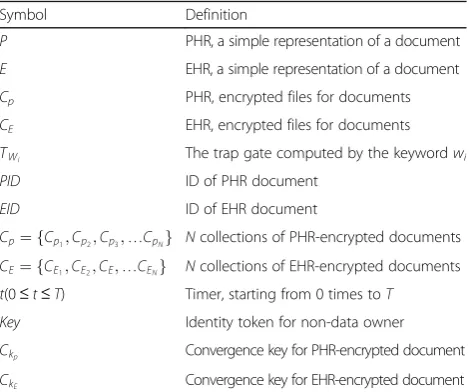
This section introduces the symbolic instruction and key techniques and algorithms introduced in this paper (Tables 1,2, 3, 4, 5, 6, 7, 8, 9, and 10).
2.1 Symbol description
Symbol Definition
P PHR, a simple representation of a document
E EHR, a simple representation of a document
Cp PHR, encrypted files for documents
CE EHR, encrypted files for documents
TWi The trap gate computed by the keywordwi
PID ID of PHR document
EID ID of EHR document
Cp¼ fCp1;Cp2;Cp3;…CpNg Ncollections of PHR-encrypted documents
CE¼ fCE1;CE2;CE;…CENg Ncollections of EHR-encrypted documents
t(0≤t≤T) Timer, starting from 0 times toT
Key Identity token for non-data owner
Ckp Convergence key for PHR-encrypted document
CkE Convergence key for EHR-encrypted document
2.2 Technical introduction
This paper briefly introduces the key technologies and algorithms in the proposed scheme based on medical environment.
2.2.1 Convergence encryption
Convergent encryption is a deterministic encryption algorithm, which is essentially a special symmetric encryption scheme, the special point is that the encryption key is not a user’s private decision, but rather is determined by the text to be encrypted, using the hash value of the text as the encryption key, thus guaranteeing that, although in different user encryption, as long as the same text is to be encrypted, the same cipher can be obtained. Based on this feature, the symmetric encryption method of convergent encryption is widely used in the heavy scheme of all kinds of encrypted data.
A basic convergence encryption scheme consists of the following four algorithms:
2.2.2 Bloom filter
Bloom filter [14, 15] is a kind of a high spatial efficiency random data structure, which uses a bit array to represent a set, consisting of a long bit array and a series of random mapping functions.
The Bloom filter can quickly determine whether an element is in a set or is an array of m bits, as each position is initially initialized to 0, using R-independent hash functionsh1,…, hr, among them, hi: {0, 1}∗→[1,m],
i∈[1,r]. For a collection of n elements,S ={S1,S2,…Sn},
where each of the elements in S is mapped by the r
hash function to h1(s),h2(s), …, hr(s) and replace the
Of course, because of the hash collision, each bit of the array could be caused by several hash functions. Therefore, the Bloom filter in this kind of judgment has an error rate.
2.2.3 Edit distance [16]
Edit distance is a measure of string similarity. The editing distance between two strings refers to the smallest number of edits required to convert from one to another. The editing operations here include character insertion, character substitution, and character deletion, where substitution converts one character to another, deleting removes a character from a word, and inserting inserts a character into a word. Based on the above three basic operations, we can define the following set: For a given keywordW,S(W,S) indicates that all keywordWremains within the edit distancedof the keyword set, that is, each keyword in the collection satisfies ED(W,W′)≤d
( d is an integer).
2.2.4 Hash function [17]
A hash function, also called a hash function or a hash function, is a public function that maps any long
Table 1Algorithm of generation Keys
Algorithm 1: Convergence key generation algorithm
1. Enter the textMto be encrypted
2. Calculation key: CE.KeyGen(M) = >K
3. Output keyK
Table 2Algorithm of encryption
Algorithm 2: Convergent encryption algorithm
1. Enter the convergence keyKand the text to be encryptedM
2. Computational ciphertext based on cryptographic algorithms C:CE.Enc(K, M)= >C
3. Output ciphertextC
Table 3Algorithm of decryption
Algorithm 3: Decryption algorithm
1. Input convergence key and ciphertextC
2. Execution algorithm:CE.Dec(K, C)= >M
message to a shorter, fixed-length value as a qualifier, called a hash value, hash code, or message digest. A hash value is a function of all bits in a message, thus providing an error detection capability that alters the hash value by altering any bit or bits in the message. The definition of the hash function is given below:
Functionh=H(M) satisfies:
(1) The length of the inputMis arbitrary, and the length of the outputH(M) is fixed;
(2) The forward calculation is easy, that is, given anyM, it is easy to calculate theH(M), inverse calculation difficulty, that is, give anH(M) value, find the inputM, so that h=H(M) which is not feasible in the calculation;
(3) Given an inputM, findingM′(M′≠M) makes
H(M) =H(M′) which is infeasible to compute, and finding any two different inputsM1andM2make
H(M1) =H(M2) which is computationally infeasible.
Such a function is called a hash function.
Hash function is mainly used for digital signature, message integrity detection, message origin authentication detection, and so on.
2.2.5 Message Authentication Code [18]
The Message Authentication Code (MAC) is a short message that validates the message and provides integrity and authenticity to the message. In our scheme, we apply the message authentication code to realize the integrity of the cloud medical data. It is easy to construct a hash function; by entering a user’s private key and an arbitrary length of the file, you can get a MAC. A hash is obtained by the downloader based on its own private key and the received file, and if the hash is equal to the MAC of the file, the integrity and authenticity of the file is guaranteed. Otherwise, it indicates that the file has been modified.
2.2.6 Ownership certificate [19–23]
For the first time, Halevi and others introduce the concept of provable ownership (Proof of Ownership; PoW). This technique is used to provide data privacy and confidentiality in the context of a user-side-heavy scenario. In other words, users can prove to the server that they really own a file without having to upload the entire file. The essence of PoW and PDP is to achieve data integrity verification, where the difference is that the PDP is the cloud server to the user to prove the in-tegrity of the file, and PoW is the user to the cloud ser-ver to prove the integrity of the file (the authenticator and the authenticator identity interchange).
3 System models
In program I, a medical cloud system [24] consists of three types of entities: medical cloud servers, patient roles, doctors, or medical institutions.
In program II, a medical cloud system consisting of five entities of medical cloud servers, private cloud servers, medical personnel, patient roles, and other authorized units is studied.
A medical cloud server entity is responsible for receiving the medical data uploaded by the private cloud or other role entities, storing various medical data documents and checking to ensure that the storage is unique.
Patient role: In program I, the patient belongs to the data owner, has the direct operation authority to the data, through the medical cloud’s after the examination, is responsible for uploads the local medical data, and protects the medical cloud data’s uniqueness. At the same time, the patient through the keyword search can get the data on the cloud. In program II, the patient no longer belongs to the data owner and cannot upload the medical data, even though the data originates from the patient; although the patient cannot directly access the data which searches the cloud, the patient may access it through the medical personnel who carries the keyword fuzzy search to carry on the data understanding [25].
A doctor or medical institution is not the owner of the medical data, but in the case of a certain demand, the doctor or the medical institution may apply to the data owner (patient) for authorization to obtain the identity token so that it can be uploaded through the patient and the keyword search.
The private cloud server, save the user’s private key and a public key, is the place for encryption, trap calculation and file tag calculation.
Other authorized units: In program II, it does not belong to the owner of the data, but after obtaining the identity token under the authorization of the medical staff (data owner), the keyword search can be conducted through the medical personnel.
Table 4Algorithm of generation tag
Algorithm 4: Tag generation algorithm
1. Enter the convergence keyK
2. Execution algorithm:CE.TagGen(K)= >Tag
3. Output: LabelTag
Table 5List of identity tokens
Identity tokens T (timer)
Key1 t1
4 Keyword search scheme based on multi role access for secure duplication in medical cloud In our program, we set up the medical cloud system based on two different medical data of PHR and EHR according to different actual situations [26–28].
4.1 PHR [29] medical cloud [30] application system Basic thought: patients have storedninitial medical data
PHR= {P1,P2,P3,⋯,PN} in the medical cloud, wherein each file has a corresponding file label. When a patient uploads his or her own, he or she needs to define a set of keywords for each one, forming a different set of keywords on the medical cloud. The patient uses the local key to encrypt the data and then uploads the medical cloud. Later, users continue to upload a medical data, where he needs to check first, as there are backups that do not have to be repeated for upload, otherwise, defined as the initial upload.
4.1.1 System initialization
Step 1: On the client side, or the patient end, the convergence encryption algorithm is used to converge the localn PHRdocument: (1) To execute the convergence key generation algorithm, the convergence key generation algorithm used in this scheme isKP=H0(P), where the patient enters the
PHR document to be encrypted, according to the algorithm that can obtain each PHR document convergence key, askp. (2) In the implementation
of the encryption algorithmCP=EncCE(kP,P), the
patient input convergence key iskpwhich is the
PHR document to be encrypted, and the output of the encrypted PHR document isCP. (3) For each
copy to be uploaded, the encrypted PHR document performs the two steps above to getCP¼ fCP1;CP2
;CP3;⋯;CPNg.
Step 2: The patient indexed thesenlocal encrypted documents:
(1) The patient input the above to upload the encryption PHR. The document keyword is set as W , the client system carries on the
trap gateTW, calculates Twi ¼ fðsk;wiÞ,
enters the user private key and the key word, and calculates the trap gate under the above algorithm effect.
(2) The patient will calculate theTWinserted to the
Bloom filter as an index and the document identityPIDwith the Index binding:
Define r hash function h1(PID,Tw), h2(PID,Tw), ⋯,
hr(PID,Tw), enter the trap gate, and under the action of
N hash function get the code word (position code) of the trap gate in y1=h1(PID,Tw), ·⋯, yr=hr= (PID,Tw), place therposition above 1.
Step 3:PHRfile label page calculation: According to the algorithm Page =H(kP), with the convergence key as
input, hash operation is used to get the document label Page. Each document to be uploaded has its own label, which corresponds to each one. Step 4: Encryption Convergence key:Ckp=Enc(sk,kp)
Step 5: Upload the encrypted NPHRfiles, the encryption of the Convergence key, index and file tags to the medical cloud server.
4.1.2 Uploading of PHR documents based on patient roles Based on the patient role, they will have ownership of
their private PHR document, that is, the patient is
unique owner of thePHRdocument, who can determine
what information is stored in the PHR document and
decide who can access that data.
First, when a patient is unaware of a medical cloud store and wants to store its PHR in a medical cloud, the medical system will repeat the test to determine whether to perform PHR.
The patient uploads PHR file tag Page, which is intended to interact with the medical cloud to repeat the check:
Step 1:PHRDocument label calculation formula:
Page=H(kP) (where the convergence key is
generated in the same way as above)
Step 2: The patient uploads Page medical cloud: the medical cloud compares the upload tag Page
Table 6Total time overhead for files without duplicates
File size/KB 64 128 256 512 1 K 2 K 4 K 8 K 16 K 32 K
Baseline/s 0.501 0.602 0.603 1.001 1.203 3.102 4.500 9.001 20.551 53.104
BF/s 0.495 0.585 0.602 0.6 0.855 0.995 1.187 3.064 7.552 19.895
Table 7The time cost of ownership proof based on BF
File size/KB 64 128 256 512 1 K 2 K 4 K 8 K 16 K 32 K
whether the cloud server already exists to determine whether the file already exists.
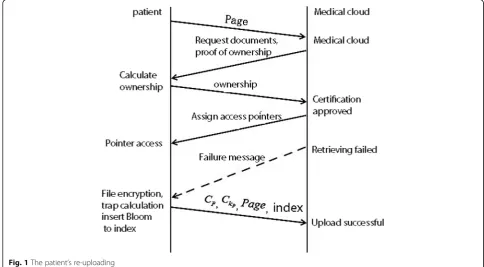
Step 3: If the comparison exists, the same file already exists on the medical cloud server. However, there is a possibility of a hash collision based on the patient’s Page calculation, and in order to prevent illegal users from exploiting this vulnerability to gain access to the document, the patient needs to further document ownership to prove that he or she owns thePHRdocument. If the proof does exist, the patient is allowed to assign pointers directly to access the samePHRdocument on the medical cloud server without having to repeat the upload.
Step 4: Otherwise, the patient realizes the encryption upload and index construction operation of the new PHR document.
(1) Encryption upload stage: The same as the system initialization phase, using the convergence key to encrypt the new uploadPHR, calculate
kP=H0(P)andCP=EncCE(kP,P), while calculating
the file label Page =H(kP) and encryption of the
convergence keyCkP ¼Encðsk;kPÞ.The encrypted
PHRdocument, the encrypted convergence key, and the label are uploaded after the calculation is completed.
(2) Indexing stage: According to the uploadedPHR
keywordWand the patient’s unique private key
skcalculates the trap gateTwi ¼ fðsk;wiÞ, then
inserts the trap door into the Bloom filter to form the updated index and binds it to thePID. As with the initialization phase of the index creation, this is no longer detailed here.
4.1.3 Uploading of PHR documents based on series roles such as medical institutions
Doctors or medical institutions essentially do not have information ownership for a PHR document. However, in reality, sometimes doctors or medical institutions also need access to the patient’s PHR document, so there is a
situation in which a patient’s PHR document can be accessed after the consent authorization is granted.
The authorization of a patient’s role to a physician or a medical institution consists of two parts: the first part is a shared hash function; the second part is the identity token key that the patient assigns to the doctor or the medical institution with the third party identification effect, and the patient himself keeps a list of identity tokens. Each identity token in the list
is equipped with a timer t (0≤t≤T), which is
automatically cleared in the list when the timer t
number reaches a certain size of T.
First, the doctor or the medical establishment calculates the kP=H0(P), Page=H(kP)to get the label Page of the document to be uploaded locally based on the hash function obtained by the shared patient. Upload tag Page to the medical cloud server and compare to find out if such a label exists to determine whether the uploaded file has been duplicated in the medical cloud.
If present, it indicates that the same file already exists on the medical cloud server. As with patients, doctors or medical institutions need to further document ownership to prove that they do own thePHR document. If it proves to be true, the medical cloud returns to a physician or medical institution, and then the doctor or medical institution uploads the identity token Key, and the medical cloud assigns a time-sensitive pointer to the samePHRdocument on the medical cloud server after identifying the identity token Key exists in its own saved list of Identity tokens.
Otherwise, the doctor or medical institution realizes the encryption uploading and indexing of the new PHR documents.
(1) Encrypted upload: The same as the patient role, using the convergence key to encrypt the new upload PHR, calculatekP=H0(P)andCP=EncCE(kP,P);
(2) Index construction: After a physician or medical institution’s identity token is present at the patient’s end, the physician or medical institution will input in the PHR the uploaded keywordWthrough the patient’s unique private key sk forTwi¼ fðsk;wiÞ,
and then return to the doctor or medical institution, and then, like the patient, use theR
hash functionh1(PID,Tw),h2(PID,Tw), ,hr(PID,Tw)
to get the position code in the Prum filter and place each position in 1 to form an index.
The authentication request is shown in Fig.2and the de-reupload process is shown in Fig3.
Table 8Time cost of cryptographic convergence secret key
Repetition rate/% 0 25 50 75
Baseline/KB 80 80 80 80
BF/KB 80 60 40 20
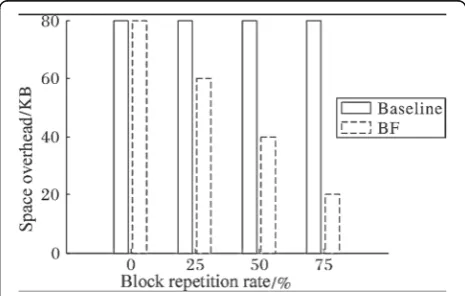
Table 9Space overhead of cryptographic convergence secret key
Repetition rate/% 0 25 50 75
Baseline/KB 80 80 80 80
BF/KB 80 60 40 20
Table 10Construction of index
Keyword quantity 1000 2000 3000 4000 5000 6000
Fuzzy/ms 6.721 8.899 10.006 14.622 16.665 20.007
4.1.4 Keyword search for patients
Step 1: The patient provides the private key with the keyword to compute the trap gateTW—as a search
request to submit the medical cloud server; Step 2: The medical cloud server will receive the trap
gateTWas the input calculation result of the h1(PID,Tw),h2(PID,Tw), ,hr(PID,Tw)Rhash
function as the position code in the Prum filter. The medical cloud calculates the position code to find the corresponding position of the server-side Prum filter. According to the position code, if the search result is all 1, then it proves that the cloudPID
contains the keyword and returns the patient PID; otherwise, the search fails.
4.1.5 A keyword search for the role of a physician or medical institution
After obtaining a patient’s search authorization, the physician or medical institution will be allowed to temporarily pass the patient’s trap calculation to submit the medical cloud server as a search request. The search process is ditto.
Step 1: First, the doctor or medical institution obtains the identity token Key with the third party identity effect after obtaining the patient’s search authorization. Step 2: If a physician or medical institution wishes to
search for a keyword, it should first submit the keyword and all its identity tokens Key to the medical cloud system.
Step 3: The medical cloud system will search the keyword and identity token Key to the patient end, the patient end after verifying identity token will carry out the trap door TW calculation: TWi¼ fðsk;wiÞ, and then the trap door back to
the doctor or medical institutions.
Step 4: Next, as with the patient search, the doctor or medical institution submits the trap door to the medical cloud server first.
Step 5: The medical cloud server after taking over to the trap door, the same as the patient search for the operation ofRhash function to get the location code, detects whether the layout of the corresponding position in the filter is all 1; this is no longer explained in detail.
4.1.6 Download and integrity verification of PHR documents When the patient or the doctor or the medical
institution will upload the medical cloud server
download request and PID, the medical cloud to the
requester authentication confirm that it is eligible to download the PHR document.
After the authentication passed, the medical cloud issued CP=EncCE(kP,P) and Ckp=Enc(sk,kp) to the requester local.
1. If the patient then uses the local key to decrypt, the convergence keykPis obtained and if the convergence
key is used to decrypt, the plaintextPHRis obtained. 2. If the doctor or medical institution will submit the identity tokenkPandCP=EncCE(kP,P) as before, Ckp=Enc(sk,kp) to the patient end; after the
authentication, the patient will use the private key to decryptCkpto obtain the convergence keykP, and
then use the convergence keykPdecryption
eventually to get a clear PHR document and return it to the doctor or medical institutions local.
Finally, the local computation decrypts the plaintext
PHR which is the hash value of H(P) and compares
whether it is equal to decrypt the obtained convergence keykP
(1) Equal, the certificate received the correct and completePHRdocument;
(2) Otherwise, it is proved that the received PHR is an errorPHRthat has been maliciously changed. The keyword search process is shown in Fig.4.
4.2 EHR [31] medical cloud application system 4.2.1 System initialization
The model uses the “medical staff—private cloud
(holding private key)—Medical cloud storage”role chain, where the medical personnel no longer holds the private key, in turn to private cloud security preservation.
The medical cloud stores an index of n-Encrypted
EHR documents with medical personnel and a different set of keywords for theseEHRdocuments:
(1) EncryptingEHRdocuments: On the client side, that is, the medical personnel to upload theEHR
document to the private cloud, the private cloud performs the convergence encryption algorithm to the uploaded nEHRdocument to converge the encryption: Executing the convergence key generation algorithm, this scheme uses the convergence key generation algorithm askE=H(H0(E),K). TheEHR
document and private cloud encryption public key are encrypted as input of the algorithm, and the
convergence keykE=H(H0(E),K) of each EHR
document can be obtained according to the algorithm.
➁Executing the cryptographic algorithm
CE=EncCE(kE,E), the convergence keykEand the EHR
document to be encrypted is entered and outputs the
both of these steps for each of the encrypted EHR documents to be uploaded.
(2) Index construction:➀the medical personnel should first set the editing distanced, and then upload the keywordWandEIDto the private cloud;➁private cloud first calculates the keyword fuzzy set
W = {w1,w2,w3, ,wi} according to the medical
personnel preset editing distance and keyword; Then, the private key is used to compute the trap gateTW ¼ fTW1;TW2;TW3;⋯;TWigfor each
keyword in the fuzzy set, and theEIDfor each keyword isTwi ¼fðsk;wiÞaccording to
Encðsk;EIDwiÞ. Finally, the computed trap is
correlated with the encryptedEIDaccording to the corresponding keywords to get the index table
fTWi;Encðsk;EIDWiÞg.
(3) Private cloud using the user’s private key SK encryption convergence key:CkE ¼EncðkE;skÞ
(4) Private cloud uses the convergence key to compute the label of the EHR Document:Page=H(H(kE),K)
(5) Private cloud upload a series of encrypted file CE¼ fCE1;CE2;CE3;⋯;CENg, each file label
PAGE and its respective computed index table
fTWi;Encðsk;EIDWiÞgand encrypt the convergence
keyCkEto the medical cloud.
Private cloud holds the key pair (sk, K) and the convergence keykEof the medical personnel.
4.2.2 Re-uploading of EHR files
The medical personnel uploads the EHRto the private cloud, through the private cloud computing after the convergence key kE (the computation way ditto), then takes the input and unifies the user to encrypt the public key to carry on the hash operation that obtains the file the label Page=H(H(kE),K), in order to carry on the examination. In turn, the private cloud uploads the tag page to the medical cloud for repeated checks: if there is a duplication of the label comparisons, the certificate of ownership of the EHR is first shown and then assigned to the medical staff by a pointer to an EHR with the same label as the medical cloud;
Medical personnel will complete no repeat upload: As with system initialization, just complete the encryption of the EHR document, index creation, encryption of the convergence key, tag calculation, and the above four upload medical cloud.
4.2.3 Key words for medical personnel on electronic medical records EHR fuzzy search
Step 1: Medical personnel input search keywordWto private cloud and preset edit distanced;
Step 2: The private cloud computes the fuzzy set
W= {W1,W2,W3,,…,Wi,} using the keywordWand
d, and thenTwi ¼ fðsk;wiÞthe fuzzy set to the
TW ¼ fTW1,TW2;TW3;…TWigand the calculated
trap is uploaded to the medical cloud as a search request.
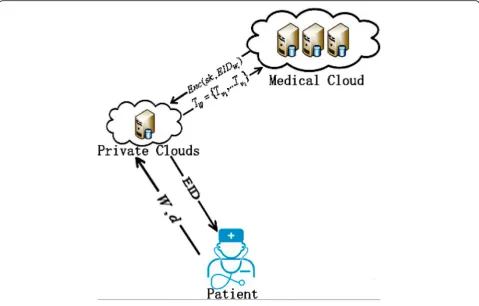
Step 3: The medical cloud carries on the comparison between the trap gate and the index, determining if there is a matchingEHRdocument: If there is a match, return the corresponding encrypted EID in the Index TablefTWi;Encðsk;EIDWiÞgEncðsk;EIDwiÞ,
send it to the private cloud using the private key of the medical personnel sending the request to decrypt, and get the EID identifier, search success, otherwise, return search failed.
4.2.4 Patients fuzzy search for the key words of electronic medical records
Although the electronic medical record is of the patient’s hospital diagnosis and treatment situation and so on records, the patient does not have the ownership to the electronic medical record. However, as long as the patient provides identification to the medical personnel, searching for patients with electronic medical records can be through the medical staff with the medical cloud keyword. The fuzzy searching of medical staff for the key words of the medical cloud is the same as part4.2.3aboved.
4.2.5 The keyword fuzzy search of electronic medical records by other authorized units
In some cases, the transfer of electronic medical records
between different hospitals or between different
departments of the hospital is not optional, and each call should be legally authorized. Therefore, the other authorized units on the electronic medical records of the keyword fuzzy search in the medical cloud should be allowed.
Step 1: First, the other departments to the ownership of medical personnel departments to apply for
authorization, after the successful authorization, medical personnel departments to the application department issued a certain timeliness of identity token key.
At the same time, the medical personnel department will itself save a list of identity tokens, each identity token in the list is equipped with a time t(0≤t≥T), when the timer t number reached a certain size T will automatically clear in the list.
identity token key and search the keyword W
to the ownership of the medical personnel system client.
Step 3: The medical personnel system client first detects whether the identity token key is legally authorized by itself (that is, whether it is in its own list of Identity tokens), and if so, can upload the keywordWto the private cloud.
Step 4: The private cloud uses the submitted keyword
Wand the preset edit distancedto compute the fuzzy set to get theW= {w1,w2,w3,…wi}, then to
the fuzzy set to carry on the trap gate computation Twi¼ fðsk;wiÞ obtains theTw= {w1,w2,w3,…wi},
calculates the trap gate namely as the search request uploads to the medical cloud.
Step 5: The medical cloud carries on the comparison between the trap gate and the index, determine if there is a matching EHR document: If there is a match, return the corresponding encrypted
EID in the Index Table fTWi;;Encðsk;EIDWiÞg
Encðsk;EIDWiÞ, sent to the private cloud using
the private key of the medical personnel sending the request to decrypt, get EID identifier, search success; return search failed.
4.2.6 EHR document download and integrity verification Medical personnel, patients, or other authorized units send a download request to the medical cloud and download an EID of EHR for the enterprise.
The medical cloud first verifies the eligibility of the patient and confirms that it is eligible to download the
EHRdocument;
After the authentication is passed, the medical cloud sends CE=EncCE(kE,E)and CKE=Enc(sk,kE) to medical personnel, patients, or other authorized units locally, and medical personnel, patients, or other authorized units are decrypted by the private key of the medical personnel on the cloud to obtain
a convergence key kE(under the premise that the
patient or other authorized entity has been
authenticated),
Use the convergence key to decrypt the plaintext
EHR.
Finally, for medical personnel, patients, or other authorized units, the hash value of the plaintext EHR
obtained by the local computing decryption gets the
message authentication code (MAC)= H(E)to
determine if the convergence key kE is equal: if equal,
then the medical personnel, patients or other
authorized units receive the correct and complete
EHR document, to certify that an EHR received by a
medical person, patient, or other authorized entity is a malformed EHR that has been maliciously altered.
5 The experimental method 5.1 Experimental target
1. Data confidentiality: We mainly consider the confidentiality of the data from three aspects: first, when a multiple identity role accesses a medical cloud system, the non-data owner is not able to access the data without authorization, and the second is that the attacker cannot acquire the secret data illegally by cracking the acquisition of the convergence key. Third, an attacker with partial file information is still unable to obtain access to a file for legal access.
2. Data integrity: Download to local medical data before use to be clear whether there is integrity and to ensure that the actual use of medical data is correct and complete.
5.2 Experimental steps
We proposed solutions to the above, in order to reflect the efficiency of our scheme and practical, we truly simulate large medical data simulation experiments, namely in the different phases of the scheme, random selection of N(< = 1500) different sizes (< = 32 MB) of
medical documents, full extraction M (< = 6000)
different keywords. We use the C language on the
Linux operating system to complete multiple
experiments at different stages. Here, we compared the Baseline scenario mentioned in literature [20, 21] with a series of comparisons based on the Bloom filter we are going to adopt.
Experiment 1: in the experiment, we selected a large number of files between 64 KB and 32 MB.
From the diagram, the BF scheme efficiency is better than the baseline scheme, and especially when the file is larger, the advantage of BF is more obvious. When the file is first stored, because the server needs to initialize the baseline filter, it occupies a large amount of time overhead, so at this time, the BF scheme is less obvious than the efficiency of the scheme. But when the file is duplicated, the server needs to prove the ownership of the client, and the BF scheme has obvious advantages in efficiency.
Experiment 2: the introduction of BF has a great advantage in the encryption key. Because our solution client ultimately needs to upload the ciphertext of the key that is not a duplicate file, the small key space decreases linearly with the file repetition rate.
Experiment 3: compared with ordinary search, the time consumption of fuzzy search index construction is high, as shown in the figure below:
that of an ordinary keyword search; however, as the file size increases at the same time, the time consumption basically remains the same, and this shows that in the fuzzy search, the greater the number of files, the lesser the search to have disadvantages.
6 Results and discussion
From the analysis of statistical results, it is concluded that the introduction of BF, especially in the case of duplication of files, makes the efficiency of the file retrieval significantly improved, and also has great advantages in the encryption key, but the fuzzy search used in our scheme does require a greater price for the more accurate search in the index construction (Figs. 1, 2, 3, 4, 5, 6, 7, 8, 9, and 10).
6.1 Risk analysis
In our program implementation, there must be a variety of potential risks that affect the outcome we expect. In the previous experiments on the use of wireless technology to obtain various data on physical health information, we expect all data to be true and reliable, but the error is inevitable. In the experiment, we carried out statistical analysis on the test data and selected the confidence interval reasonably according to the 95% confidence level, and then analyzed the absolute risk and relative risk. In different roles, for example, on a visit to medical data, based on an artificial operation, may lead to a wrong operation, and there is the possibility of human error to tamper with medical data and the data
of the system to avoid the absolute risk. However, such
operational risk is trivial compared with our
expectations of the medical system (i.e., relative risk).
6.2 Discussion
Even though we have tried to ensure the performance of the entire medical cloud system in all aspects, there are still some unavoidable problems in our proposed scheme. Below, we briefly discuss some issues from the following three perspectives.
First, in the third party, when the non-data owner wants to access medical data of the medical cloud, the third needs to submit identification and access to the owner’s system, but here, we have no better mechanism to ensure that the submitted proof is legal and cannot be forged. Secondly, we do not provide a better mechanism to ensure the security of the token list held by the owner of medical data. In other words, the illegal visitor is likely to modify the identity list by the intrusion owner system and save the identity information of the illegal visitors directly in the list, so that the illegal visitors can achieve legal access. In addition, for the cost of medical system, public cloud and private cloud will increase investment in cost. The building of a private cloud, the structure, and good plan-ning are all a great problem in the process of practice.
7 Security analysis 7.1 Confidentiality of data
In the case of a medical cloud system with multiple identity roles, no authorized non-data owners will be
able to perform the search for heavy detection or ac-curate or fuzzy keywords. For the access role for non-data owners to interact with and access the med-ical cloud data, the access request must be submitted to the data owner system prior to this, and the data owner will then be given the validity of an identity token by interacting with the legality of its identity. Visitors can access the medical cloud with this iden-tity token.
However, visitors are not allowed to make permanent visits at once, because their identity tokens are valid for a period of time, which reduces the likelihood of identity tokens being stolen and provides secure access. In addition, it is impossible to get the plaintext information
through the decryption of the convergence key,
especially in our second scheme, in which an attacker may obtain a convergence key in two aspects. The first is that it is extremely difficult for an attacker to obtain a
Fig. 2Request authorization process
Fig. 4The keyword fuzzy search of medical personnel
user’s private key and decrypt it directly to obtain a convergence key. Because the private key protection is more rigorous, and in the second scenario, we put the private key more closely on the private cloud, so we think that it is impossible to crack the convergence key by obtaining the private key. The second aspect is that the attacker uses a hash collision to directly brute force the convergence key. First of all, considering the unknowns of the hash function plus the possibility of a function collision, we think this is a very low probability
method. Moreover, medical data based on
extraordinarily complex data types in the absence of clear text, the likelihood of a hash collision is almost non-existent, and in the second scenario, our conver-gence key is generated by two hash functions, which makes it possible, regardless of whether or not some of the plaintext information is available. It is not feasible to directly guess the convergence key. A third type of at-tacker is an illegal visitor who has some plaintext
information and wants to access the entire information of the file by obtaining an access pointer.
In this case, the attacker would have to meet the following conditions:
1. Having the label of the document
2. Through the Proof of Ownership Agreement (PoW) detection
The second condition will fail at a high probability when the attacker has only part of the information in the file (in the first scenario, the Prum filter is set to a reasonable size), and the POW protocol requests a sufficient amount of data information. However, we also consider that if the attacker owns most of the information in the file, it would be highly possible to verify through the POW protocol. However, when a user owns most of the information on a file, he can be identified as a legitimate user.
Fig. 6Total time overhead for files without duplicates. :It indicates the total time overhead of the baseline scheme without duplication of files. :It indicates the total time overhead of the BF scheme without duplication of files
Fig. 7The time cost of ownership proof based on BF. : It represents the time cost of ownership proof based on BF
Fig. 8Time cost of cryptographic convergence secret key. : It represents the time overhead of the baseline scheme to encrypt the key. : It represents the time overhead of the BF scheme to encrypt the key
7.2 Data integrity
After the medical data is downloaded to the local, the message verification code is computed, comparing with the data downloaded Convergence key, considering that the convergence key has also been tampered with, the attacker will have to have the data owner’s private key, because the possibility is very low, so the use of the integrity of the message Verification code verification method is more reliable.
8 Conclusions
In spite of the above problems, there is still a lot of value in our scheme. In the rapid development of the medical industry information age, the growing mass of medical data to urge the birth and application of medical cloud. The protection of the privacy of medical data has also become a major focus of the medical cloud. In the two schemes of this paper, we introduce Bloom filter and private cloud respectively to improve the efficiency and safety of this structure in medical cloud. Then, according to the specific data type of medical cloud and the actual situation of the owner and user of the document, the method of identity token is used to realize the multiple role uploading and keyword accurate or fuzzy search safely, so that the structure application in medical cloud is more operable and closer to the actual situation.
At the same time, the paper proposes the structure combination of document ownership and authentication to avoid the illegal users of confidential data caused by the leak. Finally, using the message verification code to test the integrity of the downloaded documents, the users can avoid using the wrong medical data blindly and have unpredictable and serious consequences.
Acknowledgements
This work was supported by the Natural Science Foundation of Shandong Province under Grant No.ZR2017MF029.
Authors’contributions
HZ and LW contributed to the conception and algorithm design of the study. YW and MS contributed to the acquisition of simulation. HZ and JL contributed to the analysis of simulation data and approved the final manuscript. All authors read and approved the final manuscript.
Authors’information
Huiqi Zhao received his B. Sc and M. Sc degree from Shandong University of science and technology, China, in 2003 and 2009, respectively. He is currently working toward his Ph. D. degree in Shandong University of science and technology. He is an Ph. D. and lecturer in Department of information engineering, Shandong University of science and technology, Taian, Shandong Province and Qilu University of Technology (Shandong Academy of Sciences), Shandong Computer Science Center (National Supercomputer Center in Jinan), Shandong Provincial Key Laboratory of Computer Networks, Shandong Jinan. His research interests are computer networks, wireless body area networks and healthcare applications, and data privacy protection.
Lexia Wang is a college student in Department of information engineering, Shandong University of science and technology, Taian, Shandong Province. Her research interests are network and information security.
Yinglong Wang is a doctor and researcher in Qilu University of Technology (Shandong Academy of Sciences), Shandong Computer Science Center (National Supercomputer Center in Jinan), Shandong Provincial Key Laboratory of Computer Networks, Jinan, Shandong Province. His research interests are information security, computer forensics and wireless sensor network technology. Minglei Shu is a doctor and associate researcher in Qilu University of Technology (Shandong Academy of Sciences), Shandong Computer Science Center (National Supercomputer Center in Jinan), Shandong Provincial Key Laboratory of Computer Networks, Jinan, Shandong Province. His research interests are wireless sensor network, wireless body domain network and cloud health.
Jimin Liu received his Ph.D. degree in Shandong University of science and technology. He is an Ph. D. and lecturer in Department of information engineering, Shandong University of Science and Technology, Taian. His research interests are computer networks and cloud computing
Competing interests
The authors declare that they have no competing interests.
Publisher’s Note
Springer Nature remains neutral with regard to jurisdictional claims in published maps and institutional affiliations.
Author details
1Department of Information Engineering, Shandong University of Science
and Technology, Taian, China.2Shandong Provincial Key Laboratory of
Computer Networks, Shandong Computer Science Center (National Supercomputer Center in Jinan), Qilu University of Technology (Shandong Academy of Sciences), Jinan, Shandong, China.
Received: 2 May 2018 Accepted: 26 June 2018
References
1. Liu Xueyan,Research on data access control method based on attribute encryption(Lanzhou University of Technology, 2016).http://kns.cnki.net/kns/ detail/detail.aspx?FileName=1017802099.nh&DbName=CDFD2017
2. W Jianfeng,Research on fuzzy searchable encryption scheme in cloud computing(Xi'an University of electronic science and technology, 2013),
http://kns.cnki.net/kns/detail/detail.aspx?FileName=1013304858. nh&DbName=CMFD2013
3. Z Jiashun, Z Yongxie, G Yan, Research on ABAC model based on usage control in cloud environment. Comput Appl Res31(12), 3692–3694+3699 (2014) 4. S Jin-shu, II Apao, Wang, Yipin S, H Qiaolin, Attribute base encryption
mechanism. Software J.6, (2011)
5. F Anmin, S Jianye, S Ying, L Yu, The client-side security scheme for ciphertext data in cloud storage. Electronics45(12), 2863–2872 (2017)
6. W Chenfeng,Research on data protection of medical cloud system based on attribute encryption(Xi'an University of electronic science and technology, 2016)http://kns.cnki.net/kns/detail/detail.aspx?FileName=1016214547. nh&DbName=CMFD2017
7. H Nana,Research on data sharing scheme based on privacy protection in medical cloud(Xi'an University of electronic science and technology, 2015)
http://kns.cnki.net/kns/detail/detail.aspx?FileName=1016248002. nh&DbName=CMFD2017
8. W Jianfeng,Research on efficient retrieval and security audit technology of outsourced data in cloud environment(Xi'an University of electronic science and technology, 2016)http://kns.cnki.net/kns/detail/detail.aspx?FileName= 1016245829.nh&DbName=CDFD2017
9. Z Yukun, F Dan, X Wen, F Min, A convergent encryption strategy based on two-time hashing for data-weight. Comput Eng Sci38(09), 1755–1762 (2016) 10. J Li. Research on key issues of data outsourcing security in cloud
computing. Nankai University, 2014
11. HG Wang, KF Chen, BD Qin, et al., Randomized convergent encryption in standard model via UCES//Con Ference on Computer and applications. IEEE, 298–302 (2017)
12. S Zhirong, X Wei, S Jiwu, Research and development of searchable encryption mechanism. Software J25(04), 880–895 (2014)
13. Y Xiaolong,Research on fuzzy keyword searchable encryption scheme in cloud computing(Chongqing University, 2016)http://kns.cnki.net/kns/detail/detail. aspx?FileName=1016908011.nh&DbName=CMFD2017
14. Yin Qinqin. Hybrid cloud storage based on Bloom filter security to go heavy scheme. Computer Engineering and Application: 1–9[2018–02-20].http://kns. cnki.net/kcms/detail/11.2127.Tp.20170810.0852.008.html. Accessed Aug 2017 15. M Yang, Research on the sharing of medical archives information in the
cloud ERA. China Manag Inf19(03), 204 (2016)
16. L Shi, C Xiaofeng, L Yupeng, Cloud platform history electronic medical record case similarity fuzzy inference research. Electron Technol Softw Eng10, 29 (2015) 17. H Xiao, The rights and obligations of hospitals and patients with respect to
medical records. Chinese Med Inf lead19, 15 (2002)
18. Z Jing, Z Yuanyan, T Lunyu, Study on the security mechanism of medical cloud platform. Comput CD-ROM Software Appl18(01), 17+19 (2015) 19. J Li, X Chen, F Xhafa, L Barolli, Secure deduplication storage systems
supporting keyword SEARCH. J Comput Syst Sci.81(8), 1532–1541 (2015) 20. S HALEVI, D HARNIK, B PINKAS, et al.,Proofs of ownership in remote storage
systems//Proceedings of the 18th ACM Conference on Computer and Communications Security(ACM, New York, 2011), pp. 491–500
21. L González-Manzano, A Orfila, An efficient confidentiality-preserving proof of ownership for deduplication. J Netw Comput Appl50, 49–59 (2015).
https://doi.org/10.1016/j.jnca.2014.12.004
22. J Xiong, Y Zhang, F Li, S Li, J Ren, Z Yao, Data security in cloud environment to restudy progress. J Commun.37(11), 169–180 (2016)
23. J Wang, Z Zhao, Z Xu, H Zhang, L Li, Y Guo, I-sieve: An inline high performance deduplication system used in cloud storage. Tsinghua Sci Technol.20(01), 17–27 (2015)
24. R Zhu, L Qin, J Zhou, H Zheng, Using multi-threads to hide deduplication I/ O latency with low synchronization overhead. J Cent South Univ.20(06), 1582–1591 (2013)
25. L Zhenhua, K Yaqian, L Chen, F Yaqing, Hybrid cloud approach for block-level deduplication and searchable encryption in large universe. J China Univ Posts Telecommun24(05), 23–34 (2017)
26. Zhibo Li. Deduplication of files in cloud storage based on differential Bloom filter. The Institute of Electrical and Electronics Engineers、IEEE Beijing Section. Proceedings of 2016 IEEE 7th International Conference on Software Engineering and Service Science (ICSESS 2016). The Institute of Electrical and Electronics Engineers, IEEE Beijing Section: 2016:4.http://kns.cnki.net/ kns/detail/detail.aspx?FileName=IEEE201608003026&DbName=IPFD2017
27. M Jianting,A Deduplication-based Data Archiving System. IACSIT, Proceedings of 2012 international conference on image, Vision and Computing(ICIVC 2012).IACSIT (2012), p. 5
28. L Sandrine, Multiple protective pathways against reperfusion injury: a SAFE path without Aktion? J Mol Cell Cardiol.46(5), 607–609 (2009)
29. MC Talley Kristine, F Wyman Jean, R Gross Cynthia, Psychometric properties of the activities-specific balance confidence scale and the survey of activities and fear of falling in older women. Am Geriatr Soc J56(2), 328–333 (2008) 30. T Debbie, SAFE discharge for infants with high-risk home environments.
Adv Neonatal Care7(4), 167 (2007)