R E S E A R C H
Open Access
Multiple access interference in
MIMO-CDMA systems under Rayleigh fading:
statistical characterization and applications
Khalid Mahmood
1, Syed Muhammad Asad
1, Muhammad Moinuddin
2,
Azzedine Zerguine
3*and Lahouari Cheded
4Abstract
A major limiting factor in the performance of multiple-input-multiple-output (MIMO) code division multiple access (CDMA) systems is multiple access interference (MAI) which can reduce the system’s capacity and increase its bit error rate (BER). Thus, a statistical characterization of the MAI is vital in analyzing the performance of such systems. Since the statistical analysis of MAI in MIMO-CDMA systems is quite involved, especially when these systems are fading, existing works in the literature, such as successive interference cancellation (SIC) or parallel interference cancellation (PIC), employ suboptimal approaches to detect the subscriber without involving the need for MAI statistics. The knowledge of both MAI and noise statistics plays a vital role in various applications such as the design of an optimum receiver based on maximum likelihood (ML) detection, evaluation of the probability of bit error, calculation of the system’s capacity, evaluation of the outage probability, estimation of the channel’s impulse response using methods including the minimum mean-square-error (MMSE), the maximum likelihood(ML), and the maximum a posteriori probability (MAP) criterion. To the best of our knowledge, there is no existing work that explicitly evaluates the statistics of the MAI-plus-noise in MIMO fading channels. This constitutes the prime objective of our proposed study here. In this work, we derive the expressions for the probability density function (PDF) of MAI and MAI-plus-noise in MIMO-CDMA systems in the presence of both Rayleigh fading channels and additive white Gaussian noise. Moreover, we evaluate the probability of the bit error rate in the presence of optimum reception using a ML receiver. Our theoretical findings can provide a reliable basis for both system design and various performance analyses of such systems. Our simulation results show that the theoretical findings are very well substantiated.
1 Introduction
In spite of their numerous advantages, MIMO-CDMA systems suffer from a major drawback in MAI which can reduce their capacity and increase their BER, thus result-ing in a degraded system performance. Hence, a statistical analysis of MAI becomes a very important factor in the performance analysis of these systems.
In CDMA systems, each user is assigned a unique spreading code. These orthogonal codes should ideally provide perfect isolation from other subscribers so as to maintain error-free communication among all users. However, in reality, the orthogonality between these codes
*Correspondence: [email protected]
3Department of Electrical Engineering, King Fahd University of Petroleum and Minerals, Dhahran 31261, Kingdom of Saudi Arabia
Full list of author information is available at the end of the article
is difficult to preserve due to asynchronism and channel delay spread at the receiving end. While both asynchro-nism and channel delay spread exist on the uplink, only channel delay spread can be seen on the downlink of the channel. A correlation receiver, which in a multi-path channel turns into a Rake receiver, cannot perfectly separate the signals in the case of multiple users. This lack of separation leads to MAI causing a system perfor-mance degradation, which may lead to unacceptable error performances for moderate user loads.
Most of the reported research work is done on char-acterization of single-input single-output (SISO) CDMA systems and is based only on approximations, such as the standard Gaussian approximation (SGA) [1], improved Gaussian approximation (IGA) [2] and simplified IGA (SIGA) [3]. The central limit theorem is applied in SGA
to get an approximate sum of additive white Gaussian noise processes (AWGNP). These approximations are widely used because of their ease of application but can exhibit major drawbacks. For example, the SGA overes-timates the system’s performance, thus making the use of approximations an even more severe problem when the number of users is small [2]. The Standard Hermite polynomial error correction method was employed in [4] to improve the accuracy of SGA. In [5], the improved Gaussian approximation (IGA) method was used based on both the derivation of the conditional characteristic func-tion of MAI and on bounds on its error probability for binary direct-sequence spread-spectrum multiple access (DS-SSMA) systems. In the case where the number of users is low, IGA has outperformed the SGA [2] but at the cost of an increased in computational complexity which makes it a major limitation for this method. The IGA was later simplified and renamed as the simplified IGA (SIGA) in [6].
Another approach adopted by researchers to find the BER of the DS/SSMA scheme is to ignore MAI completely. Most of these techniques are basically an extension of pre-viously studied inter-symbol interference (ISI) techniques. Some of these techniques are moment space method, characteristic function method, moments method, and the approximate Fourier series method. It has been reported in the literature that these techniques are supe-rior to the central limit theorem-based techniques in approximating the BER but involve higher computational costs. A study of the signal-to-noise ratio (SNR) of Rician fading channels at the correlator receiver’s output was done by [7]. The BER performance of the DS-CDMA sys-tem in frequency non-selective Rayleigh fading channels for deterministic sequences using the SGA approach was evaluated in [8]. The characteristic function (CF) tech-nique was utilized to assess the performance of the spread spectrum multiple access (SSMA) scheme in an AWGN environment in [9]. The CF method used to evaluate the performance of the DS-SSMA scheme in multipath fad-ing channels with multipath intersymbol interference was applied in [10] without taking into account the MAI effect. An approximate Fourier series technique was utilized in [11, 12] to evaluate the BER performance in selective and non-selective Rayleigh fading environments. System degradation caused by an imperfect chip and phase syn-chronization were also assessed in this technique.
For a given SNR, the BER dependency on the number of users is analyzed in [13], where a closed-form expres-sion for the CF of MAI for asynchronous operation in a Rayleigh fading environment was obtained. An expression for a single integral for overall BER is derived therein.
The conditional CF of MAI together with bounds on the probability error rate for the DS-SSMA scheme are obtained here, whereas [14] derived only the average
probability of error at the correlation receiver’s output for binary as well as quaternary synchronous and asyn-chronous DS-SSMA schemes which use a random signa-ture sequence.
The probability density function (PDF) of MAI for a synchronous downlink CDMA in an AWGN case was derived in [15]. This result is then used to derive the conditional probability density function of the MAI, ISI, and noise in multi-carrier code division multiple access scheme (MC-CDMA) provided that the fading environ-ment is known. The PDF of both the MAI and the inter carrier interference is also derived while assuming that the channel-fading effect in CDMA system is known.
A new unified approach to MAI analysis in fading environments was presented in [16], assuming that the channel phase is either known or has been perfectly esti-mated. Random behavior of the channel fading is also included in [16] to get realistic results for the PDF of MAI and noise. Also, the analysis does not make any simpli-fying assumptions on the MAI and provides a complete statistical characterization of MAI.
many interesting applications in Section 5 such as the design of optimum receiver, derivation of probability of bit error rate and the derivation for the probability of out-age in MIMO-CDMA systems in the presence of Rayleigh flat fading in addition to the design of MMSE estimator. Moreover, we have also highlighted some future research directions/challenges that can be dealt via utilizing the proposed framework of MAI statistics analysis.
1.1 Main contributions
In this work, the main contributions are outlined next.
1. Expressions for the PDF of MAI and MAI and noise in MIMO-CDMA systems in the presence of both Rayleigh fading channel and additive Gaussian noise are derived.
2. Three important applications that utilize the newly-derived statistics of MAI are provided and analyzed.
(a) In the first application, an optimum receiver based on ML detection criterion is developed. For this, a new expression for the probability of BER, which is of prime importance in the study of any communication system, is also derived.
(b) In the second application, a new expression for the minimum mean-square-error (MMSE) channel estimation of Rayleigh fading using our derived MAI statistics, is derived. (c) In the final application, we derive the
expression for the probability of outage for MIMO-CDMA systems
3. Although our analysis deals with only a Rayleigh fading channel, our methodology is nevertheless generalized and can be applied to other fading channels.
4. In the last section, we also highlighted some future applications for MIMO-CDMA systems that can employ the proposed framework of designing MAI statistics.
1.2 Paper organization
The paper is organized as follows. Section 2 describes the system model used for the analysis. Section 3, where the analysis of the PDF of MAI is carried out is followed by Section 4 which describes the analysis of the PDF of MAI-plus-noise. Two important and pertinent applications that utilize the analyses, namely the optimum receiver design using the ML criterion and the MMSE channel estimation, are presented in Section 5. Section 6 presents simula-tion and numerical results to corroborate the theoretical findings of this work. Finally, Section 7 concludes the paper.
2 System model
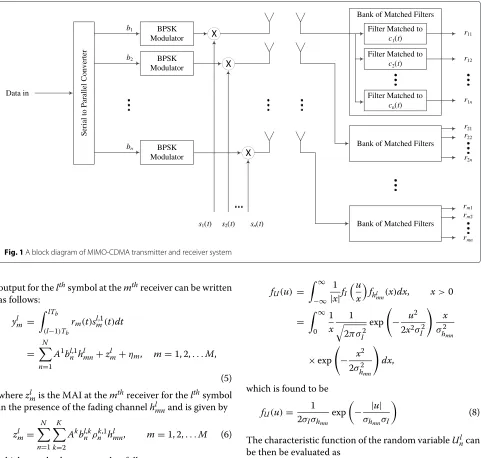
In this paper, a synchronous DS–CDMA transmitter model for the downlink of a mobile radio network withN transmit andMreceive antennas is considered as shown in Fig. 1. Consider a flat-fading channel whose complex impulse response between the nth transmitter and mth receiver for thelthsymbol is given by
Hmnl (t)=hlmnejφlδ(t) (1)
wherehlmnis thelthchannel tap between thenth transmit-ter and themthreceiver whose value becomes unity for the AWGN channel, andφlis the phase of the complex
chan-nel for thelthsymbol. Thus, for a Rayleigh fading channel, the PDF ofhlmnwill be:
fhl mn(x)=
x σ2 hmn
exp
− x2 2σh2 mn
, for x>0, (2)
whereσh2
mnrepresents the variance of the real and imagi-nary Gaussian component in the Rayleigh fading. Assum-ing that the receiver is able to perfectly track the phase of the channel, the detector in themthreceiver then observes the following signal:
rm(t)= N
n=1
∞
l=−∞
K
k=1
Akbln,ksln,k(t)hlmn+ηm(t), m=1, 2,. . .,M
(3)
whereKrepresents the number of users,sl,k
n (t)is the
rect-angular signature waveform with random PN signature sequence of thekthuser defined in the(l−1)T
b ≤ t ≤
lTb, Tb andTcare the bit period and the chip interval,
respectively, related byNc = Tb/Tc,
bln,k is the input bit stream of the kth user, Ak is the transmitted ampli-tude of thekthuser, andνmis the additive white Gaussian
noise with zero mean and varianceσν2at themthreceiver. The cross-correlation between the signature sequences of usersjandkfor thelthsymbol is given by
ρk,j l =
lTb
(l−1)Tb
skn(t)sjn(t)dt= Nc
i=1
ckl,icjl,i, (4)
where
Bank of Matched Filters
Serial to Parallel Converter
Data in
Filter Matched to
c1(t)
Filter Matched to
c2(t)
Filter Matched to
cn(t)
r11
r12
r1n
Bank of Matched Filters
Bank of Matched Filters
r21
Fig. 1A block diagram of MIMO-CDMA transmitter and receiver system
output for thelthsymbol at themthreceiver can be written as follows: in the presence of the fading channelhlmnand is given by
zlm=
which can also be expressed as follows
zlm=
N
n=1
Imnl hlmn, m=1, 2,. . .,M (7)
where the random variableIl mn=
K
k=2Akbln,kρkn,1, which
is nothing but MAI in AWGN environment, is shown to follow Gaussian behavior in [16], that is,Imnl ∼N0,σI2 where σI2 = A2(NK−1)
c . For the sake of tractability of the analysis, we have assumed the same behavior for random variableIlmnin the MIMO system.
3 PDF of MAI in MIMO-CDMA systems
In order to find the PDF of the random variable Unl = Imnl hlmn, we use the assumption of statistical independence ofIl,kandhlmnas follows
which is found to be
fU(u)=
The characteristic function of the random variableUnlcan be then be evaluated as
Un(ω) = E
Iσh2mn. Since the interferers are assumed to be independent of, but not identical to, each other, it can therefore be observed from (7) that the characteris-tic function ofzlmwill be the product ofNcharacteristic functions of the independent random variablesUnl, that is,
Inverse-Fourier transforming the above characteristic function will yield:
fZ(z) = F−1[ Z(ω)]
The above integral is evaluated in Appendix A for two dif-ferent scenarios: (1)σU2nhave distinct values for eachnand (2)σU2
n are equal for alln. As a result, expression for the PDF ofzcan be shown to
is the Bessel function for imaginary arguments [24] and it is defined in (67). The PDF of MAI in (12) for the distinct scenario shows that the MAI experienced at any receiving antenna is a sum of Laplacian distributed random vari-ables. It can be easily seen that by setting N = 1 in the above, the PDF of MAI will reduce to a single Lapla-cian random variable, which is consistent with the result obtained in [16].
3.1 Variance of MAI
The MAI term is already defined in (7). Since it is assumed that the interferers are independent and zero mean (zero mean is due to the fact thatEImnl = 0), the variance of total MAI in MIMO-CDMA system (denoted byσz2) can be evaluated as follows:
σ2
4 PDF of MAI-plus-noise
In order to find the PDF of the MAI-plus-noise, we con-siderκml to be a random variable resulting in MAI-plus-noise, that is,
κl
m=zlm+ηlm m=1, 2,. . .,M (15)
whereηl
mis the AWGN part. Thus, the PDF of the
ran-dom variableκml can be evaluated by the convolution of the PDFs ofzlmandηml as follows:
whereβnis the integral defined as
βn=
and can be evaluated using the technique of “completing the square” and by employing the definition of the error complement function erfc(x) [24]. This yields
βn =
Now, using the fact that
is thegeneralized incomplete gamma function[25]. We can express the PDFfκl
where, for compactness purposes, the symbolsAn= σCUnn
exp(Bn),Bn= σ
2
η
2σUn2 andCn=4σ 2
Unhave been introduced.
5 Important applications involving the utilization
of the exact MAI statistics
utilized the exact statistics of MAI. Therefore, system designs based on approximated MAI statistics have lead to poor system performance. In this work, in order that the knowledge of the exact MAI statistics does indeed remarkably improve system performance, we present here two important applications to emphasize this point. These applications are listed below and discussed in the ensuing subsections:
• design of an optimum MIMO-CDMA receiver using the ML criterion.
• design of MMSE channel estimator for Rayleigh fading in MIMO-CDMA systems.
• derivation of probability of outage for Rayleigh fading in MIMO-CDMA systems.
5.1 Design of an optimum MIMO-CDMA receiver using the ML criterion
Both the design and characteristics of optimum receivers in the presence of AWGN for different modulation methods have been extensively covered in the literature [26]. It is reported in the literature that the optimum detector for a AWGN channel is comprised of a corre-lation demodulator or a matched filter followed by an optimum decision rule, and is based on the maximum a posteriori probability (MAP) criterion when the a priori probabilities of the transmitted signal are unequal, and the ML criterion when these a priori probabilities are equal. Decisions based on any of the criteria used depend on the conditional PDF of the received vector at the output of either the matched filter or the correlator, whichever is used. In our analysis, the ML criterion is utilized, since we are using the case where the a priori probabilities of the transmitted signal are equal.
BER is defined as the number of bits received in error with respect to the total number of bits received at a par-ticular receiver. BER performance is considered to be a very important criterion for CDMA systems as it deter-mines the quality of transmission as well as the amount of data that can be transmitted per unit of bandwidth. Since all users contribute to the interference levels at the receiving side, the BER of each user increases when sev-eral users try to access the same channel simultaneously. Subsequently, the maximum number allowable of users is determined by the amount of interference which can be tolerated [27]. This section deals with the design of an optimum receiver in the presence of MAI-plus-noise for a Rayleigh fading environment. The probability of error is derived here for the maximum likelihood receiver and the simulation results obtained here support our analytical finding.
At the front end of the optimum receiver, a matched filter is placed, and is matched to the desired subscriber, which in our case, is user 1. The output of the matched
filter that is matched to the signature waveform of the desired user for thelth symbol can be written as
ylm=wlm,i+κml i=1, 2 (for BPSK signals) (21)
wherewlm,iis the desired symbol in a MIMO system. IfEb
represents the energy-per-bit, thenwlm,iis given by either +Nαi√Ebor−Nαi√Ebfor BPSK signals. From the
out-put of the matched filter given in (5), the desired signal is given by Nn=1A1bnl,1hlmn, where the channel tapsαi are
no longer individual Rayleigh fading contributions but are rather a sum of all Rayleigh fading contributions. This can be seen as
N
n=1
A1bln,1hlmn=A1bl,1
N
n=1
hlmn (22)
where we are assuming that the same data is being trans-mitted from each antenna for a given user (i.e., bln,1 = bl,1 ∀ n). Thus,αl = N
n=1hlmn represents the sum of
Nindependent Rayleigh random variables whose PDF can be obtained from ([28] Eq. 4a–b) as
fα(α)= α
2N−1e−α2ψ2
2N−1ψN(N−1)!, (23)
where ψ = σN2 [(2N−1)! ! ]1/N,(2N−1)! != (2N−1) (2N−3)· · ·3.1,α =x/√N,xis the normalized Rayleigh random variable andNis the number of transmitters.
For BPSK signaling, the conditional PDF pylm|wlm,1 can be obtained by using (20) as
p
ylm|wlm,1
= 1
2√π
N
n=1 An
1 2,Bn;
ylm−Nαi√Eb
2
Cn
(24)
For the case when wlm,1 and wlm,2 have equal a pri-ori probabilities, then according to the ML crite-rion, the optimum test statistic is the likelihood ratio
=pylm|wlm,1/pylm|wlm,2. Now assuming that the channel attenuation (αl) is deterministic, therefore any
Pe|wi,1
(25) by their respective expressions mentioned right after (20). In the derivation of BER, we require the PDF ofα2 for which we need the PDF ofα. In order to get the PDF ofα2, we need to apply a transformation to the random variableαto get the PDF of the squared one. This carried out as follows: We define a new random variable
γκ = α2N2Eb
From (27) we have
α= 2
So the PDF of γκ can be found by the transformation method as
whereddγα can be found by differentiating (27) to get
dγ
The expression for the BER is evaluated in Appendix A and can be setup as
P(e)= 1
There is no closed-form expression for the above integral and so it was evaluated numerically.
5.2 Design of MMSE channel estimator for Rayleigh fading in MIMO-CDMA systems
In order to ascertain the impact of the above analysis from an application perspective, a pilot-aided MIMO channel estimation scheme is devised which extends the original work done in [29]. The estimation is based on the MMSE criterion. Taking the sum of Rayleigh fading in the MIMO system for thelthsymbol to beαl=Nn=1hlmn, we define the signal of the desired user as
xb1α (34)
where we have dropped the time index for simplicity. Denoting the estimate of xby xˆ, the mean-square-error cost function for the MMSE estimate is
J=Ex− ˆx2 (35)
The solution of the cost function in Eq. (35) is well known and is given by [30]
In order to evaluate xˆ, we require the conditional PDF fx|y(x|y), which can be obtained, using Bayes theorem
dom variablexis the product of two random variablesb1 andα, its PDF can be evaluated using the procedure of the random variable transformation as follows:
fx(x)=
PDF of the sum of Rayleigh fading random variables given in (23). Inserting both PDFs in (39), the integral results in
where G = √1
Plugging both (40) and (41) in (42) yields
f(y) = 1
using (36) through some mathematical simplification, we get
Although the integrals in (44) and (46) cannot be eval-uated analytically, there are various numerical integration techniques to evaluate these numerically [31]. Hence, the estimate in (45) can be used in (37) to get the MMSE esti-mate of the Rayleigh fading channel for MIMO-CDMA system.
6 Outage probability
It is well known that outage probability is used as a per-formance measure for a communication link when signal to interference-plus-noise ratio (SINR) is a random quan-tity. This happens when we deal with random channel as in the case fading.
The outage probability is the probability that the received SINR is below certain threshold (corresponding to a minimum required rate) in a given duration. Thus, the outage probability (denoted byPout) can be expressed as
Pout=Pr[SINR≤ζ] (47)
whereζ is a certain threshold to meet the required min-imum rate. In our case, the instantaneous SINR can be expressed as neous desired signal power which make the SINR a ran-dom quantity. Here,σz2= Ezlm2 andση2=Eηlm2 represent the MAI power and the noise power, respec-tively. In order to evaluate the MAI power, we make use of the probability of MAI expression derived in (12). Thus, we can evaluateσz2as
Since, the PDF of MAI is even symmetric due to the term |z|, we can simplify the above as
Next, by using the definition of gamma function(α) = !∞
Now, we turn our attention to characterize the instanta-neous desired signal power (S). To do so, we first utilize the formulation given in (22) which allows us to writeSas
S=
Since we are focusing on BPSK modulation, we have
A1bl,12 = 1. As a result, the random variableScan be formulated as S = α2 where α is the sum of N inde-pendent Rayleigh random variables whose PDF is given in (23). Eventually, this provides the following PDF of random variableS
fS(s) =
sN−1e−2sψ
Outage probability is given by
Pout =
ζσ2
z+ση2
0
fS(s)ds
=
ζσ2
z+ση2
0
sN−1e−2sψ
2NψN(N−1)!ds (55)
By using the change of variablet= 2sψ, we get
Pout=
1 (N−1)!
ζ(σ2
z+ση2)
2ψ
0
tN−1e−tdt (56)
Finally, by utilizing the definition of incomplete gamma function (i.e.,γ (α,x)!0xtα−1e−tdt), we obtain
Pout=
1 (N−1)!γ
⎛ ⎝N,ζ
σ2 z +ση2
2ψ ⎞
⎠ (57)
7 Simulation results
In this section, we present some simulation results to validate our theoretical findings. The simulation setup consists of two different scenarios of 2×2 and 4×4 MIMO systems. The CDMA system used here relies on the use of random signature sequences of length 31. The wave-form chosen for the PN signatures are rectangular chip waveforms. The channel noise is taken to be an additive
white Gaussian noise with an SNR of 20 dB. The Rayleigh channel is chosen to be flat and slow-fading. The simula-tion results are discussed according to the various tasks in the ensuing subsections.
7.1 Investigation on MAI statistics
In this section, we aim to investigate the effect of differ-ent parameters on the PDF of the MAI and MAI-plus-noise, namely the effect of the number of transmitting and receiving antennas, length of the pseudo-random-noise (PN) sequence used, and the number of users in the system. Moreover, we validate the theoretically derived results for the PDF of MAI and MAI-plus-noise by com-paring them with various simulation experiments.
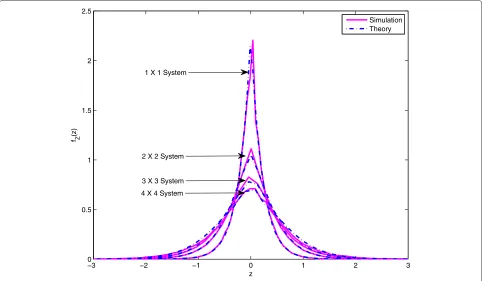
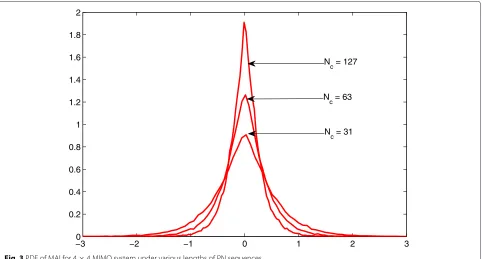
Figure 2 shows the effect of system’s diversity order on the PDF of MAI. As can be seen, the variance of MAI increases with an increase in diversity. This is consistent with our theoretical predictions in that the severity of the interference would increase in the presence of such diversity because the cumulative effect of all the inter-ferences emerging from the various transmitting chan-nels. The effect of the length of the signature sequence on the PDF of MAI can be seen in Fig. 3 where the MIMO system used is a 4×4 one. This is also consis-tent with the results reported in [16]. The variance of MAI decreases with an increase in the length of the PN sequence.
−3 −2 −1 0 1 2 3
0 0.5 1 1.5 2 2.5
z
fZ
(z)
Simulation Theory
1 X 1 System
2 X 2 System
3 X 3 System
4 X 4 System
−30 −2 −1 0 1 2 3 0.2
0.4 0.6 0.8 1 1.2 1.4 1.6 1.8 2
N c = 127
N c = 63
N c = 31
Fig. 3PDF of MAI for 4×4 MIMO system under various lengths of PN sequences
Table 1 shows the comparison between the analytical and experimental variances in each case, which corrobo-rates our theoretical analysis. As shown in our analysis, the MIMO-MAI is a sum of Laplacian-distributed ran-dom variables. Thus, to ascertain this fact, it is necessary to test the kurtosis of the MIMO-MAI. Table 1 lists the kurtosis of the MAI which is gradually increasing as the signature length increases. The decrease in the signature sequence’s length would result in MAI in AWGN becom-ing Gaussian while affectbecom-ing the MAI under the fadbecom-ing environment at the same time. Although from simulation, it cannot be predicted whether the MIMO-MAI would exhibit any Gaussian behavior. However, it can be safely assumed that for a short-enough signature length, the MIMO-MAI would assume a Gaussian behavior. This fact is also observed in Fig. 3.
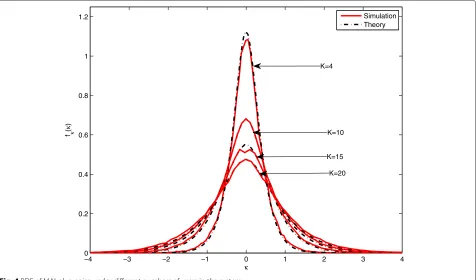
Figure 4 shows the effects of interference on both the PDF of MAI-plus-noise and on the system’s performance. It is intuitive to predict that the system will be severely degraded by an increase in the number of users. As the number of users increases, the power of the MAI
Table 1Kurtosis and variance of MAI in a 4×4 MIMO system
withK=10
Nc=31 Nc=63 Nc=127 Nc=255
Experimental kurtosis of MAI 4.02 4.11 4.16 4.21
Experimental variance 1.1689 0.5736 0.2823 0.1411
Analytical variance 1.1613 0.5714 0.2835 0.1412
experienced by the desired user will also increase as depicted in Fig. 4. Table 2 lists the experimental kurtosis of MAI-plus-noise under different capacity and diversity scenarios to test the Gaussianity assumption. In all the cases studied, the kurtosis increases with an increase in the system’s user capacity. Particularly for the 2×2 MIMO case, the MAI-plus-noise behaves more like a Gaussian signal as its kurtosis gets closer to that of a Gaussian dis-tribution which is 3. Moreover, it can be seen that the kurtosis decreases with an increase in number of users. For example, in case of 2× 2 MIMO with 20 users, it reduces to 3.14 which is very close to Gaussian behavior. This is due to the fact that larger number of users makes the MAI approaching to the Gaussian behavior by virtue of the central limit theorem.
Figure 5 shows the effect of diversity on the PDF of the MAI-plus-noise. Even though a MIMO-CDMA system will provide higher data rates with an increase in reliabil-ity, the system will be severely degraded by such limiting factors as capacity and diversity. The results shown here motivate the fact that any receiver design for such a system will have to take such factors into account.
−4 −3 −2 −1 0 1 2 3 4 0
0.2 0.4 0.6 0.8 1 1.2
κ
fκ
(
κ
)
Simulation Theory
K=4
K=15 K=10
K=20
Fig. 4PDF of MAI-plus-noise under different numbers of users in the system
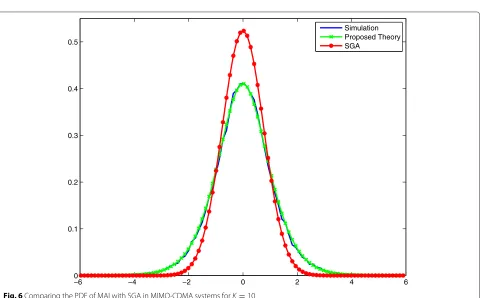
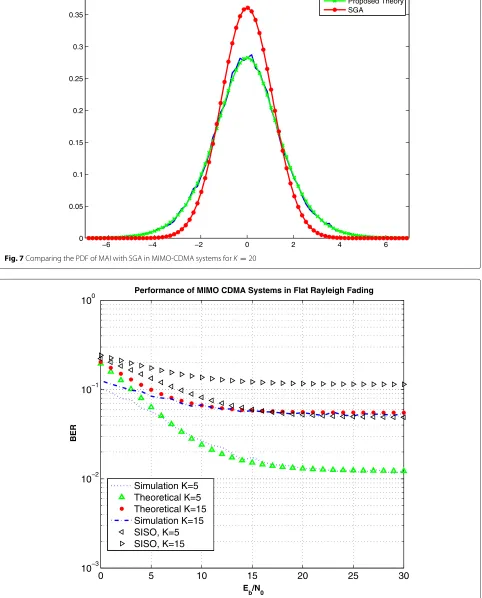
the PDF of MAI derived in (12). It can be easily depicted from these results that the well-known SGA is failed to correctly model the statistics of the MAI in the MIMO-CDMA systems. On the other hand, the proposed analysis provides a good match with the simulation results in both scenarios which shows that the derived theoretical results for the PDF of MAI are valid for both smaller and larger number of users. This also justifies our claim that the MAI cannot be approximated as Gaussian distributed random variable in the MIMO-CDMA systems.
7.3 Probability of bit error rate
To validate the theoretical findings, simulations are car-ried out and results are discussed below. The simulation setup used random signature sequences of length 31 and rectangular chip waveforms. The measurement noise is taken to be additive white Gaussian with an SNR of 20 dB.
Table 2Experimental kurtosis of MAI-plus-noise under different system’s capacity withNc=31
MIMO system 2×2 3×3 4×4
K=4 3.77 4.28 4.63
K=10 3.30 3.90 4.02
K=15 3.18 3.80 3.94
K=20 3.14 3.71 3.83
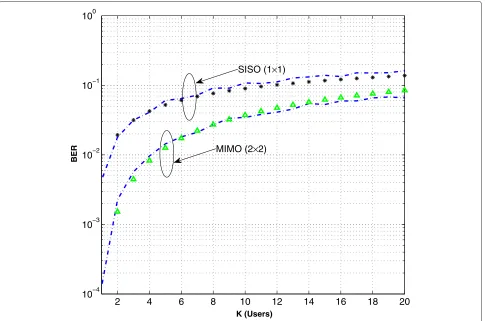
Figure 8 shows the performance of CDMA systems in a flat Rayleigh fading environment for a 2× 2 MIMO system and a 1×1 SISO system [16] where the number of system users is set toK = 5 andK = 15. It is evident from the result that the proposed analytical findings closely match the experimental ones. It is also evident that the MIMO system performs significantly better by achieving a lower BER as compared to the SISO system, especially for the lower number of usersK=5. However, an increase in the number of users severely degrades the BER performance due to the resulting increase in MAI. This intuitive fact is well-corroborated by our analysis. The theory-simulation mismatch in the low SNR is mainly due to the relatively high noise power. Moreover, the sum of Rayleigh fading used in the deriva-tion of BER is only an approximaderiva-tion valid for small arguments only. This also contributes somewhat to this mismatch.
−3 −2 −1 0 1 2 3 0
0.2 0.4 0.6 0.8 1 1.2 1.4 1.6
κ
f κ
(
κ
)
Simulation Theory
2X2
3X3
4X4 1X1
Fig. 5PDF of MAI-plus-noise for different scenarios of transmit and receive antennas
−6 −4 −2 0 2 4 6
0 0.1 0.2 0.3 0.4 0.5
Simulation Proposed Theory SGA
−6 −4 −2 0 2 4 6 0
0.05 0.1 0.15 0.2 0.25 0.3 0.35 0.4
Simulation Proposed Theory SGA
Fig. 7Comparing the PDF of MAI with SGA in MIMO-CDMA systems forK=20
0 5 10 15 20 25 30
10−3 10−2 10−1 100
E
b/N0
BER
Performance of MIMO CDMA Systems in Flat Rayleigh Fading
Simulation K=5 Theoretical K=5 Theoretical K=15 Simulation K=15 SISO, K=5 SISO, K=15
2 4 6 8 10 12 14 16 18 20 10−4
10−3 10−2 10−1 100
K (Users)
BER
SISO (1×1)
MIMO (2×2)
Fig. 9BER Performance of MIMO-CDMA System versus number of users
7.4 Channel estimation
In this simulation, we have used a 2×2 MIMO system to estimate the channel taps for the flat Rayleigh fading channel based on (37) and (45). The estimator was tested forK=4,K=6, andK =10 users. Figure 10 shows the mean-square-error performance of the estimator versus the SNR for a flat MIMO Rayleigh channel. As is evident from Fig. 10, the MMSE estimator based on our analysis is able to estimate the channel by minimizing the error forK = 4 users. As the MAI severely degrades the per-formance of the system, the estimator is unable to track channel variations for a higher number of users in the sys-tem, as is seen for the case ofK = 6 andK = 10 in the Fig. 10. This is mainly due to the fact that any existing use-ful information on the channel is simple swamped by the accumulated effect of the contributions to the MAI by the large number of users.
7.5 Probability of outage
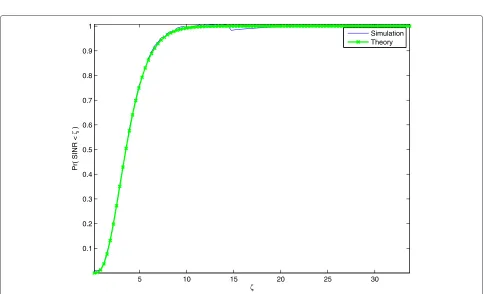
In this section, we compare the results for the probabil-ity of outage obtained via simulation and the proposed theoretical results given in (57). The results are compared for four users (i.e.K = 4). The other system parameters are the same as mentioned in previous experiments. The
results are shown in Fig. 11. It can be observed that there is an excellent agreement between the simulation result and the one obtained via the proposed theoretical analysis.
8 Conclusions
0 2 4 6 8 10 12 14 16 18 20 −10
−8 −6 −4 −2 0 2 4
SNR (dB)
Mean−Square−Error (dB)
K=4 K=6 K=10
Fig. 10Mean-square-error performance of the proposed channel estimator
5 10 15 20 25 30
0.1 0.2 0.3 0.4 0.5 0.6 0.7 0.8 0.9 1
ζ
Pr( SINR <
ζ
)
Simulation Theory
be utilized for designing the optimum coherent receiver, derivation for the expression of probability of bit error rate, derivation of MMSE channel estimator for Rayleigh fading, and derivation for the probability of outage in fading environment. For future work, our analysis can provide a platform for many interesting applications in MIMO-CDMA systems. For example, one can utilize the expression for probability of outage to design a receiver that can optimization the system performance by min-imizing the probability of outage. Another interesting application can be the design of optimum algorithm for MIMO antenna selection by joint minimization of receive probability of outage. In addition, our work can extended to frequency selective channels and asynchronous sys-tems. Thus, we believe that our work will open new research directions to solve various challenging problems in MIMO communication systems.
Endnote 1Note thatσ2
Unis just an intermediate variable and it does not represent the true variance of the random variableUnl. The actual variance of theUnl is equal to
To evaluate the integral in (11), we consider two different scenarios: (1)σU2n have distinct values for eachnand (2) σ2
Unare equal for alln. Scenario 1: For distinctσU2n
For the first scenario, we perform a partial fraction expan-sion of the product in (10) as follows:
N
where constantCnin the numerator is given by
Cn=
Thus, the inverse Fourier transform can be set up as
fZ(z) = F−1[ Z(ω)]
which is a sum ofNinverse Fourier transforms. The inner integral can be easily evaluated using the residue theory [24] as
whereθ(z)is the unit step function. The result in (61) can be simplified as
1
Finally, after substituting the result for the above integral in (60), the PDF of the MAI with distinctσ2
Un is found to be given in (12).
Scenario 2: For identicalσU2 n
which can be solved using the residue theory [24] to obtain
defined as [24]
Wλ,μ(z)=
For the special case when λ = 0, the Whittaker func-tion can be related to the Bessel function for imaginary arguments(denoted asKμ(z)) as follows [24]
where, the Bessel function for imaginary arguments is defined as [24]
Kμ(z)= 1
Thus, by using the above relation, we can simplify the result of integral in (64) to
Finally, the PDF of the MAI with identicalσU2
nis obtained after substituting the above solution and it is given in (12).
Derivation of Eq. (32)
Using (23) and (50) and after some mathematical manipu-lation, the PDF ofγκcan be setup as
which is consistent with [16]. As the channel attenuation is taken to be deterministic thenγκis also deterministic. If αiis taken to be random then the above conditional PDF
in (26) will have to be averaged over the PDF ofγκ. So the average probability of error in BPSK symbols can be obtained as
Rearranging the above we get
P(e)= 1
The inner integral can be evaluated as
Iγκ =
The above result is again consistent with [16] forN = 1 which yields Iγκ = γκ
. Replacing in the above integral in (72) and rearranging terms, we get
P(e)= 1
The authors declare that they have no competing interests.
Acknowledgements
The authors acknowledge the support provided by the Deanship of Scientific Research at KFUPM under Research Grant SB111012.
Author details
1Electrical and Electronics Technology Department, Affiliated Colleges at Hafr
Al Batin, King Fahd University of Petroleum and Minerals, P. O. Box 1803, Hafr Al Batin 31991, Saudi Arabia.2Electrical and Computer Engineering, King
Abdulaziz University, Jeddah, Saudi Arabia.3Department of Electrical
Engineering, King Fahd University of Petroleum and Minerals, Dhahran 31261, Kingdom of Saudi Arabia.4Department of Systems Engineering, King Fahd
University of Petroleum and Minerals, Dhahran 31261, Kingdom of Saudi Arabia.
Received: 9 June 2015 Accepted: 17 March 2016
References
1. M Pursley, D Sarwate, Performance evaluation for phase-coded spread-spectrum multiple-access communication—part ii: code sequence analysis. Commun. IEEE Trans.25, 800–803 (1977)
2. RK Morrow Jr, JS Lehnert, Bit-to-bit error dependence in slotted ds/ssma packet systems with random signature sequences. Commun. IEEE Trans. 37, 1052–1061 (1989)
3. JM Holtzman, inCommunications, 1991. ICC ’91, Conference Record. A simple, accurate method to calculate spread spectrum multiple access error probabilities, vol. 3 (IEEE International Conference on, Denver, CO, 1991), pp. 1633 –1636
4. B Long, J Hu, P Zhang, Method to improve gaussian approximation accuracy for calculation of spread-spectrum multiple-access error probabilities. Electron. Lett.31, 529 –531 (1995)
5. J Lehnert, M Pursley, Error probabilities for binary direct-sequence spread-spectrum communications with random signature sequences. Commun. IEEE Trans.35, 87–98 (1987)
6. JJM Holtzman, A simple, accurate method to calculate spread-spectrum multiple-access error probabilities. Commun. IEEE Trans.COM-40, 461–464 (1992)
7. D Borth, M Pursley, Analysis of direct-sequence spread-spectrum multiple-access communication over rician fading channels. Commun. IEEE Trans.27(10), 1566–1577 (1979)
8. C Gardner, J Orr, Fading effects on the performance of a spread spectrum multiple access communication system. Commun. IEEE Trans.27(1), 143–149 (1979)
9. E Geraniotis, M Pursley, Error probability for direct-sequence spread-spectrum multiple-access communications—part ii: approximations. Commun. IEEE Trans.30(5), 985–995 (1982) 10. E Geraniotis, Direct-sequence spread-spectrum multiple-access
communications over nonselective and frequency-selective rician fading channels. Commun. IEEE Trans.34(8), 756–764 (1986)
11. MO Sunay, PJ McLane, inGlobal Telecommunications Conference, 1996. GLOBECOM’96.’Communications: The Key to Global Prosperity. Calculating error probabilities for DS-CDMA systems: when not to use the Gaussian approximation, vol. 3 (IEEE, London, 1996), pp. 1744–1749
12. MO Sunay, PJ McLane, Probability of error for diversity combining in DS CDMA systems with synchronization errors. Eur. Trans. Telecommun.9(5), 449–463 (1998)
13. J Cheng, NC Beaulieu, Accurate DS-CDMA bit-error probability calculation in Rayleigh fading. Wirel. Commun. IEEE Trans.1(1), 3–15 (2002) 14. J Lehnert, M Pursley, Error probabilities for binary direct-sequence
spread-spectrum communications with random signature sequences. Commun. IEEE Trans.35, 87–98 (1987)
15. W Mee Jang, L Nguyen, P Bidarkar, MAI and ICI of synchronous downlink MC-CDMA with frequency offset. Wirel. Commun. IEEE Trans.5, 693–703 (2006)
17. JO Mark, MNM Saad, BB Samir, inNational Postgraduate Conference (NPC), 2011. Average BER perfomance and spectral efficiency for MIMO orthogonal MC DS-CDMA system over Nakagami-m fading channels, (Kuala Lumpur, 2011), pp. 1–6
18. P Li, RC de Lamare, R Fa, Multiple feedback successive interference cancellation detection for multiuser mimo systems. Wirel. Commun. IEEE Trans.10(8), 2434–2439 (2011)
19. H Huang, H Viswanathan, GJ Foschini, inGlobal Telecommunications Conference, 1999. GLOBECOM ’99. Achieving high data rates in CDMA systems using blast techniques, vol. 5, (1999), pp. 2316–2320
20. G Kaddoum, M Coulon, D Roviras, P Chargé, Theoretical performance for asynchronous multi-user chaos-based communication systems on fading channels. Signal Process.90(11), 2923–2933 (2010)
21. G Kaddoum, F Gagnon, Performance analysis of STBC-CSK communication system over slow fading channel. Signal Process.93(7), 2055–2060 (2013) 22. K Mahmood, SM Asad, M Moinuddin, A Zerguine, S Paul, inStatistical
Signal Processing (SSP), 2014. Statistical analysis of multiple access interference in Rayleigh fading environment for MIMO CDMA systems (IEEE Workshop on, Gold Coast, VIC, 2014), pp. 412–415
23. K Mahmood, SM Asad, OB Saeed, M Moinuddin, A Zerguine, in
Communications, Signal Processing, and their Applications (ICCSPA), 2015. Rayleigh fading channel estimation using MMSE estimator for MIMO-CDMA systems (International Conference on, Sharjah, 2015), pp. 1–4
24. IS Gradshteyn, IM Ryzhik,Table of Integrals, Series, and Products, 7th edn. (Academic Press, London, U.K., 2007)
25. MA Chaudhry, SM Zubair,On A Class Of Incomplete Gamma Functions with Applications. (Chapman & Hall CRC, 2002)
26. JG Proakis,Digital communications, 4th edn. (Mc Graw-Hill, United States, 2001)
27. C D’Amours, AO Dahmane, Bit error rate performance of a MIMO-CDMA system employing parity-bit-selected spreading in frequency nonselective Rayleigh fading. Int. J. Antennas Propagation.2011, 1–8 (2011)
28. J Hu, S Member, NC Beaulieu, accurate simple closed-form approximations to Rayleigh sum distributions and densities.9(2), 109–111 (2005)
29. MN Iqbal, M Moinuddin, inMultitopic Conference (INMIC), 2011 IEEE 14th International. Pilot-aided rayleigh fading channel estimation using MMSE estimator for DS-CDMA system, (Karachi, 2011), pp. 347–350
30. AJ Hayter,Probability and statistics for engineers and scientists, 4th edn. (Cengage Learning, Mason, OH, United States, 2012)
31. TV K’arm’an, M Biot,Mathematical methods in engineering, (McGraw-Hill, United States, 1940)
Submit your manuscript to a
journal and benefi t from:
7Convenient online submission
7Rigorous peer review
7Immediate publication on acceptance
7Open access: articles freely available online
7High visibility within the fi eld
7Retaining the copyright to your article