R E S E A R C H
Open Access
Robust mainlobe interference suppression
for coherent interference environment
Yasen Wang
*, Qinglong Bao and Zengping Chen
Abstract
A mainlobe interference suppression method is proposed in this paper, which can still work when the signal of interest (SOI) is present in the training data. In this method, the iterative adaptive approach (IAA) is applied to spatial spectrum estimation at first. Then, IAA spatial spectrum is used to reconstruct the interference-plus-noise covariance matrix (INCM). Next, the eigenvector associated with mainlobe interference in INCM is determined, and the eigen-projection matrix can be calculated to suppress the mainlobe interference. Meanwhile, the sidelobe-interference-plus-noise covariance matrix (SINCM) can be reconstructed. Finally, the adaptive weight vector is obtained. One main advantage is that the proposed method can deal with coherent mainlobe interference and sidelobe interferences simultaneously. Simulation results demonstrate the effectiveness and robustness of the proposed method.
Keywords: Mainlobe interference suppression, Iterative adaptive approach, Covariance matrix reconstruction, Eigen-projection
1 Introduction
Adaptive beamformers have wide applications in radar, navigation, sonar, radio astronomy, microphone array speech processing, and so on. Conventionally, adaptive beamformers are applied to suppress interferences that exist in sidelobe area [1, 2]. This kind of interference is called sidelobe interference. However, when the interfer-ence from mainlobe area exists, it will induce peak offset and distortion of the mainlobe and heightening of the sidelobe level. This kind of interference is mainlobe interference. Nowadays, as the electromagnetic environ-ment becomes more complex, the mainlobe interference appears more frequently. Alternative solutions such as the blocking matrix preprocessing (BMP) method [3] and the eigen-projection matrix preprocessing (EMP) method [4] for suppressing the mainlobe interference are proposed. However, the former could work well pro-vided that the direction of mainlobe interference and giving rise to the reduction of the effective degrees of freedom, and the latter relies on the absence of the sig-nal of interest (SOI) in the training data. Furthermore, the problem of mainlobe peak offset cannot be overcome
by both methods. Later, a modified EMP method [5] is proposed for solving the mainlobe peak offset problem. Another new method based on EMP method and simi-larity constraints [6] can suppress multiple mainlobe in-terferences. Both of them make the assumption that there is no SOI appearing in the training data, which is not always available in many applications such as passive location, mobile communications, and radio astronomy [7]. For example, in the case of passive radar, the trans-mit signal may already exist when the receiver starts working. Besides, coherent interference is another prob-lem in adaptive beamforming. In applications like pas-sive radar [8] and meter-wave radar [9], it is likely that target echoes are masked by multipath echoes, which would lead to coherent interference. When this coherent interference appears in mainlobe area, the methods mentioned above are no longer effective.
Recently, some new beamforming techniques have been proposed [10–12]. Among them, an interference-plus-noise covariance matrix (INCM) reconstruction processing is put forward in [8] to eliminate the SOI component when calculating the adaptive weight vector. However, the performance of this procedure degrades when coherent interference exists. In [13] and [14], an iterative adaptive approach (IAA) is proposed, which has * Correspondence:[email protected]
College of Electronic Science and Engineering, National University of Defense Technology, Changsha 410073, China
high accuracy of direction of arrival (DOA) and power estimation even when coherent sources and finite-sampling effects exist. In this paper, the IAA spatial spectrum is used to reconstruct the INCM. Then, in-spired by the method proposed in [5], mainlobe and sidelobe interferences can be suppressed using the re-constructed INCM. Compared to the existing methods, the proposal in this paper can handle the coherent main-lobe interference even when the SOI is present in the training data.
2 Signal model
Consider an array composed of M omnidirectional
an-tenna elements, the output of a narrowband adaptive beamformer at the kth snapshot y(k) is given by y(k) =
wHx(k), where w∈CM× 1 is the complex beamforming weight vector, x(k) stands for the signal received by the array antenna, and (⋅)Hdenotes the Hermitian transpose.
Assume there are Q sidelobe interferences and one
mainlobe interference, where Q+ 1 <M; then, x(k) is
the corresponding steering vector (SV), respectively. θq stands for the qth signal DOA, and n(k) denotes the
additive white Gaussian noise. xs0(k) =a(θ0)s0(k) and xint
k
ð Þ ¼XQq¼þ11a θq sqð Þk denote the SOI and interference
vectors, respectively.sQ+ 1(k) denotes the mainlobe
inter-ference waveform. The INCM can be written as
Riþn¼E ðxintð Þ þk nð Þk Þðxintð Þ þk nð Þk ÞH
n o
∈CMM ð2Þ
The solution to the minimum variance distortionless response (MVDR) beamformer is given by
wopt¼ R
−1
iþnað Þθ0 að Þθ0 HR−iþ1nað Þθ0
ð3Þ
Since Ri+n is unavailable when the SOI is present in
the training data, it is usually replaced by the sample
co-variance matrix R^ ¼K1X
K
k¼1
xð Þxk Hð Þk , where K is the
number of snapshots. Then, the adaptive beamformer
wSMI¼
is the sample matrix inversion (SMI)
beamformer. The corresponding Capon spatial spectrum distribution can be calculated as
^
PCaponð Þ ¼θ 1
dHð Þθ R^−1dð Þθ ð
4Þ
whered(θ) is the SV associated with the array structure and a hypothetical direction θ. Whenever the training data contains the SOI, SMI beamformer is in essence a minimum power distortionless response (MPDR) beam-former. However, the MPDR beamformer is more sensi-tive than MVDR beamformer when SV error exists [15].
3 Proposed method
In this paper, a mainlobe coherent interference suppres-sion algorithm is proposed based on IAA spatial spectrum, INCM reconstruction, eigen-projection pro-cessing, and sidelobe-interference-plus-noise covariance matrix (SINCM) reconstruction.
3.1 IAA algorithm
IAA is a nonparametric adaptive algorithm. This algo-rithm assumes the presence of a large number of poten-tial targets uniformly located on a fine grid withP≫M points in it. LetP be aP×Pdiagonal matrix whose diag-onal contains the power at each angular grid point. Besides, define Að Þ≜θ ½a1 a2 ⋯ aP withap denoting the SV of thepth source andsð Þ≜k ½s1ð Þk s2ð Þk ⋯ sPð Þk T is the source waveform vector. Define the interference and noise covariance matrixGpto beGp¼R−sp 2apaHp where to the IAA algorithm. The initialization of IAA is done by the data-independent delay-and-sum (DAS) beamfor-mer. The steps of IAA can be summarized as follows.
Initialization:
terminated when the relative change p^ð Þi−^pði−1Þ
F is less than a specified tolerance, where ‖⋅‖F denotes the Frobenius norm.
An accurate spatial spectrum can be obtained from the results of IAA, and the SOI DOA ^θ0 is also deter-mined by searching for the peak of IAA spatial spectrum in the possible angle sector. Besides, the performance of IAA is not affected much by the presence of coherent sources [14]. For each IAA iteration, the complexity is O(M2P). Thus, a biggerPresults in a higher accuracy as well as a larger calculation.
3.2 INCM reconstruction
According to [7], INCM can be reconstructed as
^
whereΘis the angular sector in which only the desired signal is located and Θ denotes the complement sector of Θ. When mainlobe interference exists, it also locates inΘ.Θis easily determined by the results of IAA spatial spectrum. Then, the INCM can be reconstructed as
^
whereP^pis obtained through IAA.
3.3 Eigen-projection processing
The reconstructed INCM is eigen-decomposed as
^
The estimation of Q is a public problem and is very critical. For an array with known array structure and SOI DOA, the mainlobe width is fixed. For example, for a uniform linear array (ULA), the mainlobe width BW0
can be expressed as
BW0¼2 arcsin λ
Mdþsinθ0
ð9Þ
Therefore, the mainlobe angle sectorΦcan be defined as
Φ¼ θ0−BW0
Φ denotes the complement sector of Φ. By using Φ and the results of IAA spatial spectrum, the number of
sidelobe interferences Q can be determined. Besides, when more than one mainlobe interference exists, the number of mainlobe interference can also be determined through the same method.
The correlation coefficient of two vectors x1and x2is
defined as corðx1;x2Þ ¼ x coefficients can be maximized when the interference is a mainlobe interference. Therefore, the mainlobe interfer-ence eigenvectoremcan be determined as
cor em;a θ^0
Then, the corresponding eigenvalue λm can be
ob-tained. When multiple mainlobe interferences like J mainlobe interferences exist, em can be determined by searching for the biggest J values of the correlation coefficients.
The eigen-projection matrix can be calculated as
^
B¼I−em eHmem −1
eHm ð12Þ
whereIis the identity matrix. B^ is adopted to suppress the mainlobe interference in echo dataXas follows
Y¼BX^ ð13Þ
3.4 SINCM reconstruction
λd represents the average value of the noise eigenvalues.
In order to remove the effect of background noise per-turbation,λdis used to replace the noise eigenvalues.λd
can be obtained by
λd¼σ^2n¼
λQþ2þ⋯þλM
M−Q−1 ð14Þ
λm is the eigenvalue corresponding to em. According
to [4] and [3], a noticeable part of mainlobe interference will be eliminated if its eigenvalueλmis replaced by λd.
Thus, the SINCM can be reconstructed as
^
Rre¼EΛ^E ð15Þ
where Λ^ ¼diag λ1;⋯;λm−1;σ^2n;λmþ1;⋯;λQþ1;σ^2n;⋯;σ^2n
is the reconstructed eigenvalue matrix and the eigen-vector matrixE¼½Es Enremains unchanged.
Based on the reconstructed SINCM R^re, the weight vector of the proposed algorithm is calculated as
wre ¼μreR^ −1 rea ^θ0
ð16Þ
Z¼wHreY¼wHreBX^ ð17Þ
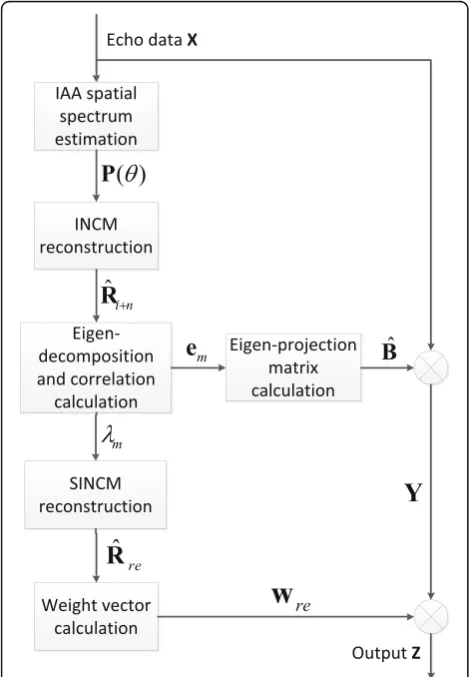
Processing block diagram of the proposed algorithm is described in Fig. 1. The known parameters of this algo-rithm contain array geometry and a presumed SOI dir-ection sector. Based on these parameters, the proposed method can suppress coherent mainlobe and sidelobe interferences when SOI appears in the training data. Moreover, the proposed method improves robustness of the beamformer from the two aspects. First, since the INCM reconstruction procedure converts a MPDR beamformer to a MVDR beamformer, the proposed method is less sensitive to SV error when SOI appears in the training data. Second, due to the high accuracy of IAA spatial spectrum, the presumed SOI direction error can be corrected.
4 Simulation results
In simulations, we consider a uniform linear array with M= 16 omnidirectional antenna elements spaced half a wavelength. The SOI direction is 0°, and the mainlobe interference direction is 5°with interference-to-noise ra-tio (INR) 5 dB. Two sidelobe interferences impinging
from−45°to 35°are considered with INR 25 and 35 dB, respectively. Noise is assumed to be the Gaussian white additive noise. The number of snapshots is fixed to be K= 100. The number of sidelobe interferences Q is assumed to be known in simulations. For each sce-nario, 200 Monte Carlo runs are performed.
The proposed method is compared to SMI, BMP, EMP, and the method proposed in [5] (EMP-CMR). The SOI is not present in the training data when using EMP and EMP-CMR methods. In BMP method, the exact mainlobe interference angle is known. For Capon and IAA, the scanning grid is uniform in the range from−90° to 90° with 1° increment between adjacent grid points. The presumed SOI angular sector is set asΘ= [−2°, 2°] in the proposed method.
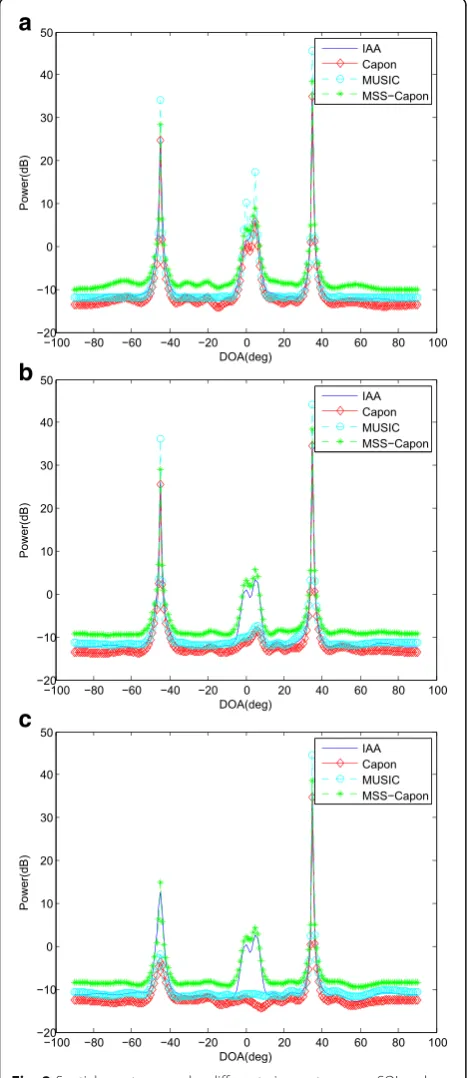
First, the input signal signal-to-noise ratio (SNR) is fixed to be 0 dB. We consider the accuracy of IAA, MUSIC, Capon, and forward-backward spatial smooth-ing (MSS) Capon spatial spectrum [16] when the SOI and the interference are coherent. When using the forward-backward spatial smoothing method, the array is divided into 2 sub-arrays and each sub-array contains 15 sensors. In Fig. 2a, the SOI and all the interferences are uncorrelated. In Fig. 2b, only the SOI and the main-lobe interference are coherent. In Fig. 2c, the SOI, the mainlobe interference, and the sidelobe interference from−45°are coherent. Figure 2 shows that IAA spatial spectrum outperforms the MUSIC and Capon spatial spectrum when coherent interference exists. Besides, the noise floor of the MSS Capon spatial spectrum is signifi-cantly higher than the IAA spatial spectrum.
Next, we compare the output signal-to-interference-plus-noise (SINR) of different methods when input signal SNR varies. The presumed SOI direction is 0°. Figure 3
shows that EMP-CMR method outperforms other
calculation of adaptive weight vector is affected by the co-herent sidelobe interferences. Therefore, the performance of these two methods degrades severely in Fig. 6. For the
proposed method, its performance also degrades.
However, the output SINR of the proposed method is ob-viously higher than other methods in this scenario. There-fore, the proposed method has the best stability in complex coherent interference environment.
Finally, we examine the robustness of the beamformers to array SV error. We consider the SVs of the SOI and interferences to be randomly distributed in an uncer-tainty set [17], so it can be modeled as
aq¼a^qþeq ð18Þ
where âq is the nominal SV of the direction ^θq and eq
represents random SV error.eqis set as follows:
eq¼ εffiffiffiffiffiq
M
p ejϕq
0ejϕ
q
1⋯ejϕ
q M−1
h i
ð19Þ
a
b
c
Fig. 2Spatial spectrum under different circumstances.aSOI and interferences are uncorrelated.bSOI and the mainlobe interference are coherent.cSOI, the mainlobe interference, and one sidelobe interference are coherent
Fig. 3Output SINR against input SNR for the case of uncorrelated sources
where εq denotes the norm of eq and is uniformly
dis-tributed in the interval [0,0.4] in each simulation run and ϕqmðm¼1;2;⋯;MÞ is phases ofmth coordinate of the random error vector eq, which are independently
and uniformly taken from the interval [0, 2π] in each simulation run. θ^q is uniformly distributed in the
inter-val [−2°, 2°] in each simulation run. This kind of SV mis-match model is universal because it can be caused by calibration error, local scattering error, look direction error, and so on. The other simulation conditions are the same to the simulation sets of Fig. 4. The output SINR versus the input SNR is shown in Fig. 7. From Fig.7, we notice that the SV error has more side effects
on EMP-CMR method and the proposed method. How-ever, the performance of EMP-CMR method and the proposed method is still better than other methods.
5 Conclusions
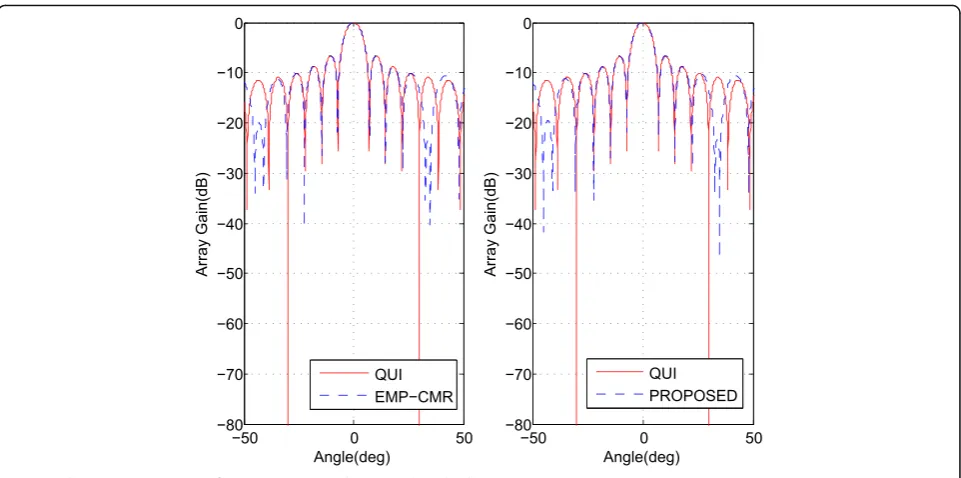
In this paper, we have developed a new mainlobe inter-ference suppression method based on IAA spatial spectrum, INCM reconstruction, eigen-projection pro-cessing, and SINCM reconstruction, which annihilates the prior information restrictions existing in the previ-ous methods for mainlobe interference suppression. Vig-orous steps have been taken to reduce these restrictions, and simulation results demonstrated that the proposed method exhibits superior performance when coherent Fig. 5Adaptive array patterns of QUI, EMP-CMR, and proposed method
Fig. 6Output SINR against input SNR for the case of three
mainlobe interference and sidelobe interferences exist. In addition, robustness of the proposed method against SV error is also verified in this paper.
Acknowledgements
This work was supported in part by the National Natural Science Foundation of China under Grant 61401489.
Competing interests
The authors declare that they have no competing interests.
Received: 5 March 2016 Accepted: 1 December 2016
References
1. W Liu, J Liu, L Wang, K Duan, Z Chen, Y Wang, Adaptive array detection in noise and completely unknown jamming. Digital Signal Processing.46, 41–48 (2015)
2. W Liu, J Liu, X Hu, Z Tang, L Huang, Y Wang, Statistical performance analysis of the adaptive orthogonal rejection detector. IEEE Signal Processing Letters.23(6), 873–877 (2016)
3. RF Li, YL Wang, SH Wan, Robust adaptive beam forming under main lobe interference conditions. System Engineering and Electronics.24(7), 4–7 (2002)
4. RF Li, YL Wang, SH Wan, Research of reshaping adapted pattern under mainlobe interference conditions. Modern Radar.24, 50–55 (2002) 5. XP Yang, Z Zhang, T Zeng, T Long, TK Sarkar, Mainlobe interference
suppression based on eigen-projection processing and covariance matrix reconstruction. IEEE Antennas Wireless Propag. Lett.13, 1369–1372 (2014) 6. J Qian, Z He, Mainlobe interference suppression with eigenprojection
algorithm and similarity constraints. Electronics Lett.52, 228–230 (2016) 7. SA Vorobyov, Principles of minimum variance robust adaptive beamforming
design. Signal Process.93, 3264–3277 (2013)
8. Special issue on passive radar systems—IEE Proceedings on Radar, Sonar and Navigation.152(3), 106-223 (2005)
9. Y Zhao, R Li, Y Wang, W Liu, Angles measurement of meter-wave radars by mainlobe multipath jamming suppression. J. Huazhong Univ. of Science and Technology (Natural Science Edition)41(4), 51–55 (2013) 10. Y Gu, A Leshem, Robust adaptive beamforming based on interference
covariance matrix reconstruction and steering vector estimation. IEEE Signal Process. Mag.60(7), 2974–2987 (2012)
11. J Liu, H Li, B Himed, Joint optimization of transmit and receive beamforming in active arrays. IEEE Signal Process Lett.21(1), 39–42 (2014) 12. J Liu, W Liu, H Liu, B Chen, XG Xia, F Dai, Average SINR calculation of a
persymmetric sample matrix inversion beamformer. IEEE Signal Process. Mag.64(8), 2135–2145 (2016)
13. T. Yardibi, J. Li, P. Stoica, M. Xue, A.B. Baggeroer. Source localization and sensing: a nonparametric iterative adaptive approach based on weighted least squares. IEEE Trans. Aerospace and Electronic Systems.(2008) 14. L Du, T Yardibi, J Li, P Stoica, Review of user parameter-free robust adaptive
beamforming algorithms. Digital Signal Process.19(4), 567–582 (2009) 15. L. Ehrenberg, S. Gannot A. Leshem, E. Zehavai. Sensitivity analysis of MVDR
and MPDR beamformers. IEEE 26th Convention of Electr. Electron. Eng. in Israel, Eliant, Israel, Nov., 2010.
16. W Liu, L Zhang, Robust beamforming for coherent signals based on the spatial-smoothing technique. Signal Process.92(11), 2747–2758 (2012) 17. L Huang, XX Zhang, Z Ye, Robust adaptive beamforming with a novel
interference-plus-noise covariance matrix reconstruction method. IEEE Trans.
Signal Process.63, 1643–1650 (2015)
Submit your manuscript to a
journal and benefi t from:
7 Convenient online submission
7Rigorous peer review
7 Immediate publication on acceptance
7Open access: articles freely available online
7 High visibility within the fi eld
7Retaining the copyright to your article