Computationally Efficient Blind Code Synchronization
for Asynchronous DS-CDMA Systems
with Adaptive Antenna Arrays
Chia-Chang Hu
Department of Electrical Engineering, National Chung Cheng University, Min-Hsiung, Chia-Yi 621, Taiwan Email:[email protected]
Received 28 July 2003; Revised 18 February 2004
A novel space-time adaptive near-far robust code-synchronization array detector for asynchronous DS-CDMA systems is devel-oped in this paper. There are the same basic requirements that are needed by the conventional matched filter of an asynchronous DS-CDMA system. For the real-time applicability, a computationally efficient architecture of the proposed detector is developed that is based on the concept of the multistage Wiener filter (MWF) of Goldstein and Reed. This multistage technique results in a self-synchronizing detection criterion that requires no inversion or eigendecomposition of a covariance matrix. As a consequence, this detector achieves a complexity that is only a linear function of the size of antenna array (J), the rank of the MWF (M), the system processing gain (N), and the number of samples in a chip interval (S), that is,O(JMNS). The complexity of the equiv-alent detector based on the minimum mean-squared error (MMSE) or the subspace-based eigenstructure analysis is a function ofO((JNS)3). Moreover, this multistage scheme provides a rapid adaptive convergence under limited observation-data support.
Simulations are conducted to evaluate the performance and convergence behavior of the proposed detector with the size of the J-element antenna array, the amount of theL-sample support, and the rank of theM-stage MWF. The performance advantage of the proposed detector over other DS-CDMA detectors is investigated as well.
Keywords and phrases:code-timing acquisition, rank reduction, smart antennas, adaptive interference suppression, generalized likelihood ratio test.
1. INTRODUCTION
Spread-spectrum communication systems have been used successfully in military applications for several decades. Re-cently, direct-sequence (DS) code-division multiple access (CDMA), a specific form of spread-spectrum transmission, has become an important component in third-generation (3G) mobile communication systems, such as wideband CDMA (W-CDMA) or multicarrier CDMA (MC-CDMA) for 3G cellular radio systems, because of its many advan-tages compared with the conventional frequency- and/or time-division multiple-access (FDMA/TDMA) systems. In a DS-CDMA communication system, all users are allowed to transmit information simultaneously and independently over a common channel using preassigned spreading wave-forms or signature sequences that uniquely identify the users. In [1], Verd ´u demonstrates that a DS-CDMA receiver is not fundamentally multiple-access interference (MAI) limited and can be near-far resistant. The proposed optimal mul-tiuser detector for DS-CDMA signals comprises a bank of matched filters followed by a maximum-likelihood sequence detector whose decision algorithm is the Viterbi algorithm. Unfortunately, the computational complexity of Verd ´u’s
de-tector grows exponentially with the number of users, which is much too complex for practical DS-CDMA systems. A va-riety of suboptimal DS-CDMA receivers resistant to MAI have been proposed over the last decade or so (e.g., [2] and additional references therein), such as the decorrelating re-ceiver [3], the MMSE receiver [4], and the multistage suc-cessive interference cancellation (SIC) [5] and parallel inter-ference cancellation (PIC) [6]. However, most DS-CDMA multiuser receivers use detection systems that require pre-cise time-delay knowledge of all the users, which is usually not known to the receiver a priori. To use such algorithms, the time delays have to be estimated, and also the receivers that use these delays suffer from high complexity and errors that occur with the estimation of the propagation delays. The effect of imperfect time-delay estimation, that is, delay mis-match, degrades dramatically the capability of such a receiver to adequately establish code acquisition and demodulation [7]. Hence, synchronization has become an essential part of all communication systems.
utilizing stringent power control mechanism and increasing the transmit-power level or the ratio of the spreading factor (SF) to the number of users. Fortunately, the acquisition per-formance can be enhanced considerably if the MAI is miti-gated or suppressed effectively. Existing schemes contributed on MAI-resistant propagation-delay acquisition techniques include the following: a modified correlator-type timing es-timator developed based on the minimum mean-squared error (MMSE) criterion, is proposed in [9]. The MMSE scheme is able to outperform substantially the conventional correlator-based methods, especially in a near-far environ-ment. However, an all-one training sequence is required for it to function properly. In [10], a maximum-likelihood syn-chronization for single users is developed. But the method presented in [10] again requires a training period. Subspace-based code-timing estimators that use a single antenna ele-ment are presented in [11,12,13]. However, these timing es-timators involve intensive computations due to the require-ment of an eigendecomposition. Additionally, the knowledge of the exact number of active users is needed.
The incorporation of adaptive-array antennas in cellular systems to mitigate MAI, time dispersion, and multipath fad-ing that occur in mobile communications has received con-siderable attention in the recent research. This is due to the fact that the base stations are being equipped with a num-ber of antenna elements. The spacing between antenna el-ements at the base station is assumed to be close enough, typically half the signal-carrier wavelength. This type of an-tenna arrays can be used as a beamforming array, where the received signal’s envelope correlation at each antenna ele-ment is equal to one. In other words, the same signal is re-ceived by all elements of the beamforming array. AJ-element beamforming array antenna is known to be able to per-form beamper-forming with J −1 degrees of freedom to con-trol the directions of J−1 nulls of the antenna. Hence, a better acquisition and demodulation performance of asyn-chronous DS-CDMA signals can be expected in compari-son to the single-antenna case. Multiple-element antenna al-gorithms that utilize the large-sample maximum-likelihood (LSML) estimation in [14,15] and the subspace-based multi-ple signal classification (MUSIC) in [16] are used to perform code-timing acquisition over a time-varying fading channel. The resulting computational cost of a covariance matrix in-version or an eigendecomposition is O((JNS)3) [17]. Here the big O(·) notation indicates that complexity in number of operations is proportional to the argument. This require-ment is quite computationally expensive in a nonstationary environment because the receiver filter coefficients need to be recalculated quite often. In [18], a decoupled multiuser acquisition (DEMA) algorithm for the code-timing estima-tion is introduced. It provides an improved timing accuracy and an alleviated computational cost over LSML. But this DEMA algorithm shows restrictive applications due to the need of the code sequences and the transmitted data bits for all users. A filterbank-based blind code-synchronization scheme with the only requirement of the signature vector of the desired user is proposed in [19]. This filterbank scheme can be used to perform code acquisition and code
track-ing in frequency-flat and frequency-selective, time-invariant, and time-varying fading channels. However, this algorithm again involves the forming process of the covariance matrix inversion. As a consequence, the computational complexities of those proposed systems remain high and thus of limited practical use.
In the present paper, an adaptive near-far robust syn-chronization array detector for space-time asynchronous DS-CDMA signals is developed. The primary requirement needed for the proposed timing synchronization system is knowledge of the signature’s spreading code vector of the desired user, making it ideal for a decentralized implemen-tation. There is no need for a pilot signal, a side channel, a long training period, or signal-free observations. Further-more, a computationally efficient implementation of the pro-posed detector that utilizes the recently developed reduced-rank multistage Wiener filter (MWF) of Goldstein et al. [20] is presented. By exploiting the low-rank MWF structure, one can not only avoid the computationally expensive matrix in-version operation, but also maintain the performance close to that of its full-rank counterpart with a much smaller num-ber of data samples. Consequently, the computational com-plexity of the system is reduced substantially fromO((JNS)3) toO(JMNS) for each computing cycle of clock time, where 1 ≤ M ≤ JNS−1. In fact, the multistage structure can achieve near full-rank detection and estimation performance with often only a small number of stages, that is, M
JNS. Therefore, the computational complexity achieved by the proposed array detector is comparable to the complexity
O(JNS) of the MMSE CDMA detector that uses the adap-tive least-mean-square (LMS) coefficients update algorithm [21]. But the proposed detector does not have the drawback of convergence instability and the sluggishness of an LMS-based algorithm. This is because of the dependence free of the proposed detector on the eigenvalue spread. Moreover, the achieved computational efficiency is better than that of the adaptive recursive least-squares (RLS) taps-update algorithm used in the linear MMSE CDMA detector (withO((JNS)2) operations) [21]. Also this multistage adaptive filtering scheme provides a rapid adaptive convergence and track-ing capability under limited observation-data support. These important features contribute significantly to the reduction of the computational cost and amount of data sample sup-port needed to accurately estimate a covariance matrix.
The material included in this paper is organized as fol-lows: inSection 2, an asynchronous DS-CDMA signal model is outlined.Section 3develops the test statistic for the pro-posed code-synchronization detector and derives an equiv-alent structure of the classical generalized sidelobe canceler (GSC) as well. In particular, an effective decision-feedback (DF) adaptive scheme for the steering vector is detailed in Section 3.3. InSection 4, an adaptive batch-mode trun-cated MWF realization is introduced and its performance is evaluated via computer simulations in Section 5. The comparison between the proposed reduced-rank multistage scheme with other timing estimation techniques is also eval-uated inSection 5. Finally, concluding remarks are given in
2. ASYNCHRONOUS DS-CDMA SIGNAL MODEL In DS-CDMA systems, all users transmit simultaneously in the same frequency band. Consider an asynchronous DS-CDMA mobile radio system withK users that employsK spreading waveforms s1(t),s2(t),. . .,sK(t) and their
trans-mitted sequences of the BPSK symbols. The received base-band continuous-time signal, which impinges on the receiv-ing antenna array withJ sensors in an additive white Gaus-sian noise (AWGN) channel, is a superposition of allK sig-nals as follows:
(v) Tb: information (data) symbol interval;
(vi) τl: propagation delay of userl.
We assume that different symbols of the same user, as well as symbols of different users, are uncorrelated. Thesl(t) in (2)
is the spreading waveform of userl, given by
sl(t)=
where Tc is the chip interval and p(t) represents the
rect-angular chip waveform of duration Tc. In one symbol
pe-riod, there areN=Tb/Tcchips, modulated with the
spread-ing code sequence (cl,0,cl,1,. . .,cl,N−1). HereN is called the spreading factor. The spreading sequences are repeated pe-riodically in each symbol duration (i.e., length-N short spreading codes are employed).
3. STRUCTURE OF SYNCHRONIZATION DETECTOR
The proposed receiver is described by means of a baseband-equivalent structure. Such a baseband complex signal process is physically achieved by the combination of quadrature de-modulation and a phase-locked loop (PLL) (see [22, Chapter 6]). This converts the received radio-frequency (RF) modu-lated signal to a baseband complex-valued signal. Then the received signal of each individual antenna sensor is passed through a chip matched filter (CMF). The output of thekth
antenna element is each antenna element is sampled every Ts seconds, where
S(= Tc/Ts) is an integer and S ≥ 1. Assume that the
out-put signals of the CMFs are sampled at the time instantiTs.
The tapped delay lines (TDLs) for theJ-element antenna ar-ray are expressed as aJ×NSdata array, given by
Z[i]=
quencing all matrix rows in the form of a vector as follows:
x[i]=VecZ[i]=z1[i],z2[i],. . .,zJNS[i]
. (6)
The vector x[i] in (6) denotes the joint space-time data of the CJNS×1 complex vector domain, and thez
n[i] forn =
1, 2,. . .,JNSare the data components of the vectorx[i]. The symbol (·)denotes matrix transpose.
Similarly the adaptive filter-weight vector forx[i] is ex-pressed as the column vector
w[i]=w1[i],w2[i],. . .,wJNS[i]
. (7)
The components of the weight vectorw[i] as an optimum Wiener filter are determined later in (30).
The output of the TDL filter is the inner product of the vectors in (6) and (7) as follows: mitian) transpose of a matrix and the conjugate of a com-plex number, respectively. This output is passed through the time-synchronization acquisition system to obtain the infor-mation about synchronization. This time acquisition system can be modeled conceptually as a filter bank constructed of NSfilters in sequence, each of the type as shown above, in order to identify the time phase of the desired user.
3.1. Test statistic of synchronization detector
two hypotheses of the desired user, say user 1. The target-signal vector under hypothesisH1is given by theJNS-vector A1a1d1(b1 ⊗s1), where A1 is the amplitude of user 1, a1 denotes the complex gain introduced by the channel, d1 is the information bit of user 1, b1 = [b11,b21,. . .,bJ1] represents the direction J-vector of user 1, and s1 = [c1,0,c1,1,. . .,c1,NS−1]is the discretized spreading codeNS -vector of user 1. The notation (·)⊗(·) represents the Kro-necker product of vectors, defined by
b1⊗s1=
For a linear array and identical element patterns,b1has the form
Here, λ is the signal-carrier wavelength, d is the spacing between antenna elements, and θ1 is the angular antenna-boresight bearing of user 1 in radians.
The two hypotheses that the adaptive detector must dis-tinguish at each sampling time are given by
H0:x[i]=v[i],
interference-plus-noise environment without the target sig-nalg1d1(b1⊗s1). The interference-plus-noise process is as-sumed to approximate zero-mean, colored, complex Gaus-sian noise [15,21], where the associated covariance matrix is defined as Rv[i]= E{v[i]v†[i]}, where E{·}denotes the expected-value operator.
The random vectorx[i], when conditioned on the in-formation symbold1, is an approximate complex Gaussian process under both hypotheses. The conditional probability density ofx[i] givenH1can be expressed in terms of the con-1/2. Then, the Bayes-optimum likelihood-ratio test (LRT) evidently takes the form [23]
Λ= 1
This evidently reduces to
Λ=cosh2 Reg1
where Re{·} denotes the real part. Evidently this test no longer depends on the values ofd1. Since the hyperbolic co-sine function cosh (·) is a monotonically increasing function in the magnitude of its argument, the test in (15) is clearly equivalent to the test
whereγ1is the detection threshold. Define what is called the steering vectorg1(b1⊗s1) as
Thus, the test statistic in (16) can be reexpressed by
Reu†R−1
To perform the test in (18), it is necessary to find estimates
u[i] andRv[i] to substitute foruandRv[i], respectively. To find the estimate u[i] of the vector u, first corre-late the received data matrix Z[i] in (5) under hypothesis H1with the modified signature vectors1/s†1s1of the desired user. Note that the Kronecker-product vector of the vector (Z[i]·(s1/s†1s1)) and the desired signature vectors1, denoted
expected value in (19) is an unbiased estimate ofd1udefined in (17). That is,
is the desired estimate ofd1u. Even though the difference of a sign may exist between ud[i] in (20) and the vectoru in
(17) when d1 = −1, they can be used interchangeably for the magnitude test, which is used for time-synchronization acquisition [24], in (18).
3.2. An equivalent GSC-form structure
with the structure matrix which annihilates those signal components in the di-rection of the vectoru such thatB1[i]u1[i] = B1[i]u = 0. Hence, the transformation of the vectorx[i] by the operator T1[i] in (21) yields a vector ˘x[i] in the form same process which is obtained from the conventional cross-correlation detector. The “auxiliary” channelx1[i] is used to cancel MAI with a Wiener filter which estimates the non-white residual noise process in theδ1[i] channel. Thus, the subsequent multistage decomposition process for a Wiener filter can provide a natural and optimal way to accomplish such a stage-by-stage interference cancellation task. The cor-relation matrixR˘x[i] =T1[i]Rx[i]T†1[i] associated with the transformed vector process ˘x[i] is expressed in the form of the partitioned matrix
The signal-free correlation matrixRv[i], needed in (18), evi-dently is expressed in terms ofRx[i] under hypothesisH1by the relation vectoruin (17) with itself. If one defines the positive scalar (norm),∆1[i]=
Figure1: An equivalent GSC structure of the test statistic.
The matrix inversion of Rv˘[i] = T1[i]Rv[i]T†1[i] is deter-mined by the aid of the matrix inversion lemma for parti-tioned matrices [25], given by
R−1
Thus, the test statistic is given by
Re
Evidently, this test statistic has the form of the classical GSC [26], as shown inFigure 1, that was used originally to sup-press or cancel interferers or jammers of radars and commu-nication systems.
The integer time phasei∈ {i,i−1,. . .,i−NS+ 1}, that coarse synchronization is most likely to occur within the interval (i−NS+ 1,i), is determined by
i=i−k=arg max
k∈{0,1,...,NS−1}Re
y[i−k]. (33)
3.3. Decision-feedback adaptation scheme
One of the cornerstones for the proposed algorithm is the es-timation accuracy on the steering vectoruin (17). In [27], the vectoruis defined by the cross-correlation between the received space-time data vectorx[i] and the desired informa-tion bitd1, as follows:
u=Ed1
x[i]d1
(34)
under the assumption ofτ1=0, that is, equivalently hypoth-esisH1. In other words, only attention is focused on a syn-chronous DS-CDMA channel. The statistical expectation in (34) is taken with respect to information bitsd1. In practice, vectoruin (34) is realized by (35), in the form of the sample average on a “supervised” mode, given by
u= 1
P
P
p=1
xp[i]d1(p), (35)
where{xp[i]}Pp=1is a sequence of joint space-time data vec-tors.
In this paper, an accurate estimate aboutuin (17) can be achieved by means of an initial training symbol followed by the decision-directed adaptation manner and is then applied to an asynchronous DS-CDMA scenario. Thus, the estimated information symbold1is utilized as the feedback informa-tion to provide an accurate estimainforma-tion of vectoruin (17). An efficient recursive formula for updating the estimate of vector ucan be used within thepth symbol interval, given by
u(p)[i]=
1− 1
p
u(p−1)[i] +1 pd
(p−1)
1 ud[i], (36)
whereu(p−1)[i] is the estimate of vectoruof the (p−1)th symbol interval, and the termd(1p−1)ud[i] is updated by the
(p−1)th observed data. Here d1(0) = 1 denotes an initial training symbol used as preamble. In addition, the vector
u(p)[i] in (36) can be used to serve as the space-time RAKE filter for a slowly fading channel. To examine the adaptive learning capability of this iterative procedure proposed in (36) for the steering vectoru, an asynchronous DS-CDMA system with the parametersJ = 2,K = 6,N = 31, SNR = 10 dB, and NFR = 10Γl/10, whereΓ
l ∼ N(4, 16) is
con-sidered. InFigure 2, the normalized correlation coefficient, ρ(p) = |u†·u(p)[i]|/|u| · |u(p)[i]|, whereiis defined and derived in (33), is shown versus the number of iterations p used in the recursive adaptation. Note that the detector is developed using only the minimum required information with only the desired spreading code vector being known at the receiver and having a limited computational complexity.
1 0.95 0.9 0.85 0.8 0.75 0.7 0.65 0.6
N
o
rmaliz
ed
co
rr
elatio
n
coe
ffi
cient
5 10 15 20 25 30 35 40 45 50 55 60 pnumber of iterations
Estimated
Figure2: Convergence dynamics of the steering vector of the pro-posed receiver implementation with system parametersJ =2,K=
6,N=31, SNR=10 dB, and NFR=10Γl/10, whereΓ
l∼N(4, 16).
Therefore, it is suitable not only for the base stations (on up-links) but also for mobile users (on downup-links). The perfor-mance could be improved further by utilizing a more precise estimate of the steering vector that is derived on the correla-tions between users or the estimates of theKspatial channels. Any method that uses channel estimation [28,29] could be used to obtain a more precise estimate of vectoru, but at the expense of extra computational complexity.
The decision statistic of the information symbold1based on the MMSE technique [4] is shown next to be generated by the use of the GSC-form structure developed inSection 3.2. Let wMMSE[i] be the filter-weight vector based on MMSE criterion and letx[i] denote the observation vector at time phaseiobtained upon coarse synchronization in (33). Then the estimate of the information symbold1has the form
d1=sgn
Rew†MMSE[i]x[i]
=sgnReu†R−1 x [i]x[i]
,
(37)
where sgn denotes thesignoperator. The decision statistic in (37) can be modified by the techniques used inSection 3.2to the test function given as follows:
Reξ1−1[i]∆1[i]
q[i]. (38)
The quantityω1[i]=(κ1−1[i]∆1[i]) in (30) can be proved to be strictly positive, due primarily to the fact that scalar κ−11[i] is one of the diagonal elements of the positive-definite matrix,R−1
˘
be obtained by ignoring the positive scalar (ξ−1 mon with both the coarse synchronization and the demod-ulation operations. This term can be computed and stored during the adaptive acquisition and synchronization process. It does not need to be recomputed for demodulation.
However, to launch this DF adaptive estimation algo-rithm, an initially rough estimate of time delay is required which is determined by the term of |Re{q[i]}| in (31). In other words, the same test in (30) ignoring the termw1[i] is utilized becausew1[i] does not vary significantly over the symbol interval [30].
3.4. Reduced-complexity multistage analysis
To derive the desired reduced-rank multistage decomposi-tion of the test statistic in (30), a sequence of orthogonal pro-jections is applied to the observed data vector. Thus, the same procedure for the multistage decomposition in the first stage is repeated in the second stage of this process. Define a new nonsingular transformationT2[i] as follows:
T2[i]= puted readily to be
σ22[i]=E
thereby directly relating the variance ξ1[i] with the corre-sponding varianceξ2[i] of the second stage of the multistage decomposition.
A continuation of this decomposition process, extending (41), yields theJNS-stage test statistic in terms of a sequence of only scalar quantities in a form given as follows [23]:
y[i]=ω1[i]
Hence, this filter-bank structure is optimal in terms of reduc-ing the MSE for a given rank, and if the multistage orthogo-nal decomposition is carried out for the fullJNSstages, then the multistage filter is exactly equivalent to the full-rank clas-sical Wiener filter. Rank reduction is concerned with find-ing a low-rank subspace, say of rank M < JNS. Here the rank-Mdetector is obtained by stopping the decomposition at stageM, that is, by settingBM[i]=0. As a consequence,
M[i]= δM[i] andξM[i]= σM2 [i]= σδ2M[i].Figure 3
illus-trates (a) the standard multidimensional Wiener filter and examples of the multistage decomposition of the test statistic based on the concept of the multistage Wiener filter for (b) M = 2 and (c)M =4. The complete recursion procedure for the rank-Mversion of the likelihood ratio test in (18) is summarized inAlgorithm 1as a pseudocode.
Let the (JNS × M)-matrix QM[i] construct the
di-mensionality reducing transformation with column vectors forming a basis associated with anM-dimensional subspace of the MWF, whereM < JNS. Evidently, theMbasis vectors for theM-stage truncated MWF are given by
QM[i]=
The analysis filterbankQM[i] operates on the observed-data
d1 +
Σ ε0[i] −
x[i] w
d1
(a)
d1 +
Σ −
ε0[i]
x[i] T1
δ1[i]
u1[i]
+ Σ
− ε1[i]
ω1[i]
y[i]
B1[i]
x1[i]
u2[i]
δ2[i]=x2[i]=ε2[i]
ω2[i]
(b)
x[i] T1
u1[i]
δ1[i] +
Σ − ε1[i]
ω1[i]
y[i]
B1[i]
x1[i]
T2
u2[i] δ2[i]
+ Σ
− ε2[i]
ω2[i]
B2[i]
x2[i]
T3
u3[i] δ3[i]
+ Σ
ε3[i] −
ω3[i]
B3[i]
x3[i]
u4[i] ω4[i]
x4[i]=δ4[i]=ε4[i] (c)
Figure3: The multidimensional (vector) Wiener filter. Structures of the multistage decomposition of the test statistic for (b)M=2 and (c)M=4.
The error-synthesis filterbank of theM-stage MWF is com-posed ofMnested scalar Wiener filters, which is given by
†
M[i]=
ω∗1[i]−ω∗1[i]ω∗2[i]· · ·(−1)M+1
M
j=1 ω∗j[i]
. (49)
The error-synthesis filterbank operates on the output of the analysis filterbank, ˘dM[i], to form anM×1 error vector ˘M[i]
defined by
˘
M[i]=
1[i],2[i],. . .,M[i]
, (50)
where
j[i]=†j[i] ˘dj, j=1, 2,. . .,M. (51)
It is evident that the observation vector is projected onto a lower-dimensional subspace, and the proposed reduced-rank Wiener filter is then constructed to lie in this subspace. This procedure makes possible optimal signal detection and ac-curate signal estimation while allowing for a lower compu-tational complexity and a smaller sample support. Remark-ably, this multistage Wiener filter does not require an es-timate of covariance matrix or its inverse when the statis-tics are unknown since the only requirements are for esti-mates of the cross-correlation vectors and scalar correlations, which can be estimated directly from the observed data vec-tors.
From (46) and (49), the mapping from the MWF with fullJNSstages to the equivalentJNS-dimensional Wiener fil-ter is given by
w†[i]=†
Initialization:u1[i]=∆u
Algorithm1: The MWF recursion equations for the LRT.
TheJNS×1 correlated random vector ˘dJNS[i] is computed
to be
˘
dJNS[i]=Q†JNS[i]x[i]. (53)
Finally, an equivalent Gram-Schmidt matrix of the error-synthesis filterbank, defined in (55), is then applied to ˘dJNS[i]
to produce the uncorrelated errorJNS-vector ˘JNS[i] as
fol-lows [20]:
4. BATCH-MODE TRUNCATED MWF REALIZATION
InAlgorithm 1, thejth-stage signal blocking matrix,Bj[i]=
null(uj[i]), may be computed using the methods detailed in
[31, Appendices A and C], or any other method which results in a valid transformation matrix Tj. Here a training-based
(batch-mode or FIR) algorithm in [32,33,34] for the multi-stage decomposition is used. The dimension of the blocking matrixBj[i] is kept the same for every stage in this algorithm.
To make this possible, a blocking matrix of the form
Bj[i]=I−uj[i]u†j[i] (56)
is employed. In this manner, the lengths of the registers needed to store the blocking matrices and vectors can be kept
the same at every stage, a fact that is very desirable for either a hardware or software realization. To obtain this algorithm, let L approximately independent snapshots of the observation vectors. The estimate of the cross-correlation vectorrxjδj[i]
is computed as
Also let the estimated variance ofδj[i] be computed by
Using the above results, a simplified version ofAlgorithm 1is given inAlgorithm 2. This new structure no longer requires the calculation of a blocking matrix and the computational burden is reduced significantly.
5. NUMERICAL RESULTS
In this section, simulations are conducted to demonstrate the performance of the proposed code-timing detector for chronous space-time joint DS-CDMA signals. Here an asyn-chronous 6-user (K = 6) BPSK DS-CDMA system is con-sidered. The spreading sequence of each user is a Gold se-quence of lengthN =31. The detector to be simulated em-ploys a uniformly spaced linear-array antenna with multiple elements of half-wavelength (λ/2) spacing. Each user signal is assumed to have different directions-of-arrival (DOAs) uni-formly distributed in (−π/2,π/2). Also the performance of the asynchronous DS-CDMA detector equipped with a sin-gle antenna is derived for purpose of comparison. The power ratios between each of the five interfering users and the de-sired user are randomly chosen from the log-normal distri-bution with a mean 6 dB larger than that of the desired signal and a standard deviation of 6 dB. This power ratio is denoted by a quantity called thenear-far ratio(NFR), defined by
NFR= gl
2
g12 =10Γl
/10, Γ
LetX0[i]=[x(1)[i],x(2)[i],. . .,x(L)[i]] beLindependent samples.
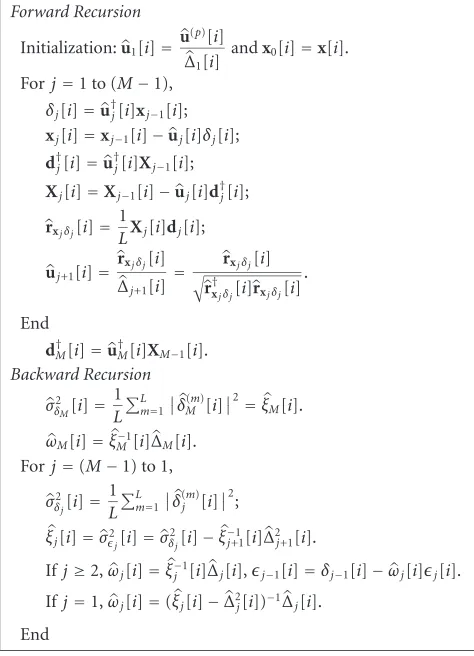
Forward Recursion
Initialization:u1[i]= u(p)[i]
∆1[i]
andx0[i]=x[i].
Forj=1 to (M−1), δj[i]=u†j[i]xj−1[i]; xj[i]=xj−1[i]−uj[i]δj[i]; d†j[i]=u†j[i]Xj−1[i];
Xj[i]=Xj−1[i]−uj[i]d†j[i];
rxjδj[i]=
1
LXj[i]dj[i];
uj+1[i]=
rxjδj[i]
∆j+1[i]
= rxjδj[i]
r†xjδj[i]rxjδj[i] .
End
d†M[i]=uM†[i]XM−1[i].
Backward Recursion
σ2
δM[i]=
1 L
L
m=1δ
(m)
M [i]
2 =ξM[i].
ωM[i]=ξM−1[i]∆M[i].
Forj=(M−1) to 1,
σ2
δj[i]=
1 L
L
m=1δ
(m)
j [i]
2
;
ξj[i]=σ2j[i]=σ 2
δj[i]−ξ
−1
j+1[i]∆2j+1[i].
Ifj≥2,ωj[i]=ξj−1[i]∆j[i],j−1[i]=δj−1[i]−ωj[i]j[i].
Ifj=1,ωj[i]=(ξj[i]−∆2j[i])−1∆j[i].
End
Algorithm2: The training-based MWF for the LRT.
Here N(·,·) represents the Gaussian distribution and the subscript “l” denotes userl(l=1). The relative transmission delays of the different users denoted by ˇτlforl=2, 3,. . .,K
are the delays relative to user 1, that is, ˇτl=τl−τ1. For sim-plicity, ˇτlis assumed to be multiples ofTc. All experimental
curves are obtained by performing 1000 independent trials. First, the acquisition performance of the proposed detec-tor as a function of the signal-to-noise ratio (SNR, Eb/N0) is shown inFigure 4for aJ-element antenna array, data size L = 6JN, and NFR= 0 dB, under the assumption that the channel parameters of all users are known at the detector. Hence, the precise covariance matrix is assumed to be avail-able at the detector. The simulations inFigure 4provide an upper bound on the acquisition performance of the pro-posed DS-CDMA detector.
InFigure 5, the acquisition-error-rate performance of a rank-2 filter usingud[i] in (20) (i.e., without using
decision-feedback adaptation mechanism) for various numbers of an-tenna elements is presented in terms of SNR under data size L=6JNand NFR=3 dB. A better acquisition performance is achieved when a larger antenna is employed. This is made possible because MAI can be mitigated successfully by plac-ing spatial nulls, that are formed by theJ-element adaptive beamforming array, in the directions of the interferers. More-over, a 2-element antenna detector not only accomplishes the
100
10−1
10−2
10−3
A
cq
u
isition
er
ror
ra
te
0 5 10 15
SNR (dB) Single element
2 elements
4 elements 6 elements
Figure4: The acquisition performance of full rank versus SNR pa-rameterized byJforL =6JNand NFR=0 dB, when the precise covariance matrix is available.
100
10−1
10−2
10−3
A
cq
u
isition
er
ror
ra
te
0 5 10 15
SNR (dB) Conventional
Single element 2 elements
4 elements 6 elements
Figure5: The acquisition performance without utilizing the deci-sion feedback adaptation versus SNR parameterized byJ forL =
6JN,M=2, and NFR=3 dB.
competitive performance with the detectors with a larger an-tenna array (J = 4 and 6) but also achieves a substantial improvement in acquisition in comparison with a single an-tenna element (J=1).
100
10−1
10−2
10−3
A
cq
u
isition
er
ror
ra
te
2 4 6 8 10 12 14 16 18 20 22
Mnumber of stages Conventional
Full-rank 1 Multistage 1 Full-rank 2
Multistage 2 Full-rank 4 Multistage 4
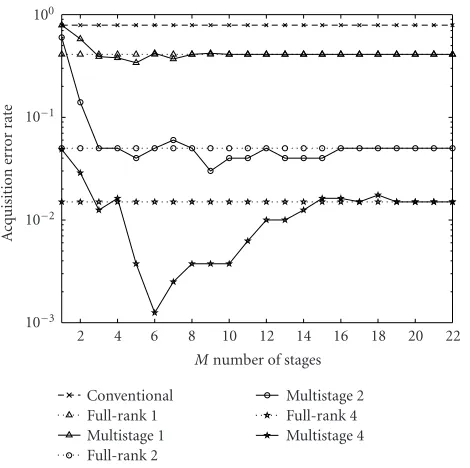
Figure6: The acquisition performance versus the number of stages Mof the MWF forJ=1 to 4,L=6JN, and SNR=8 dB.
InFigure 7, the acquisition performance of a rank-4 fil-ter versus the signal-to-noise ratio for (a) the size of theJ -element antenna array and (b) the amount of theL-sample support is presented. A better acquisition performance is achieved when a larger size of antenna array or a larger num-ber of training data samples is available. Again a 2-element antenna array detector accomplishes a substantial improve-ment in acquisition in comparison with a single-eleimprove-ment an-tenna. Moreover, it is evident that an additional performance gain in acquisition is achieved by observing the results shown in Figures5and7a. This is due primarily to the incorpora-tion of the decision-feedback adaptaincorpora-tion mechanism.
InFigure 8a, the probability of correct acquisition of a 2-element antenna detector is presented as a function of the number of training data samples L for SNR= 14 dB and NFR = 3 dB. It is demonstrated in the figure that the fil-ters of lower rank provide a quite fast adaptive convergence rate while a much larger number of training data samples is required for the case of a full-rank filter. Thus, the adap-tive reduced-dimension multistage filters converge substan-tially faster than an adaptive full-rank filter. InFigure 8b, the probability of correct acquisition of a 2-element array re-ceiver is presented as a function of the number of training data samplesLfor a number of cases for fixed NFR values, NFR=0 dB, 3 dB, 6 dB, and 9 dB. No significant degradation is observed in this figure when the case of rank 4 is compared for a wide range of NFR values, 0 dB to 9 dB. This shows that the proposed receiver still performs well under conditions of poor power control. Hence, a stringent power control mech-anism is not required for the proposed detector.
Figure 9a depicts the comparison between the conver-gence and acquisition capabilities of the training-based LMS and RLS algorithms and the proposed multistage algorithm.
100
10−1
10−2
10−3
A
cq
u
isition
er
ror
ra
te
0 5 10 15
SNR (dB) Conventional
Single element
2 elements 4 elements (a)
100
10−1
10−2
10−3
A
cq
u
isition
er
ror
ra
te
0 5 10 15
SNR (dB) Conventional
Full-rank 6JN JN
3JN 6JN (b)
Figure7: (a) The acquisition performance versus SNR parameter-ized byJforK=6,L=6JN,M=4, andN =31. (b) The acquisi-tion performance versus SNR parameterized byLforJ=2,K=6, M=4, andN=31.
1 0.9 0.8 0.7 0.6 0.5 0.4 0.3 0.2 0.1 0
P
rob
.o
f
cor
re
ct
ac
q
u
isition
0 50 100 150 200 250 300
Lnumber of training samples Full rank
Rank 2
Rank 3 Rank 4 (a)
1 0.95 0.9 0.85 0.8 0.75 0.7
P
rob
.o
f
cor
re
ct
ac
q
u
isition
0 50 100 150 200 250 300
Lnumber of training samples NFR 0 dB
NFR 3 dB
NFR 6 dB NFR 9 dB
(b)
Figure8: (a) Probability of correct acquisition versusL parame-terized by M forJ = 2,K = 6,N = 31, SNR = 14 dB, and NFR=3 dB. (b) Probability of correct acquisition versusL param-eterized by NFR forJ = 2,K = 6,M = 4,N = 31, and SNR
=14 dB.
proposed reduced-rank multistage detector on the accuracy of the steering vector.
In Figure 10a, the probability of correct acquisition of a 2-element antenna detector is presented as a function of the signal-to-noise ratio for L = 6JN and NFR = 10 dB. In this simulation, each interfering user is assumed to have a received power 10 dB larger than that of the desired user.
1 0.95 0.9 0.85 0.8 0.75 0.7 0.65 0.6 0.55 0.5
P
rob
.o
f
cor
re
ct
ac
q
u
isition
0 50 100 150 200 250 300
Lnumber of training samples LMS
RLS Rank 2
(a) 1
0.9 0.8 0.7 0.6 0.5 0.4 0.3 0.2 0.1 0
P
rob
.o
f
cor
re
ct
ac
q
u
isition
−5 0 5 10 15 20 25 30
SNR (dB) Conventional
Rank 2 Rank 3
Rank 4 MUSIC (b)
Figure9: (a) Probability of correct acquisition versusLfor the LMS, RLS, and the proposed training-based algorithm with the parame-tersJ=2,K=6,M=2,N =31, SNR=14 dB, and NFR=3 dB. (b) Probability of correct acquisition versus SNR for the MUSIC algorithm and the proposed training-based algorithm with the pa-rametersJ=1,K=6,L=6JN,M=2 to 4, andN=31.
1 0.9 0.8 0.7 0.6 0.5 0.4 0.3 0.2 0.1 0
P
rob
.o
f
cor
re
ct
ac
q
u
isition
−5 0 5 10 15 20 25 30
SNR (dB) Conventional
Full rank Rank 2 Rank 3
Rank 4 Rank 5 Rank 6 (a)
1 0.9 0.8 0.7 0.6 0.5 0.4 0.3 0.2 0.1 0
P
rob
.o
f
cor
re
ct
ac
q
u
isition
−5 0 5 10 15 20 25 30
SNR (dB) NFR 10 dB, conventional NFR 0 dB, 2 elements NFR 3 dB, 2 elements
NFR 10 dB, 2 elements NFR 10 dB, 1 element (b)
Figure10: (a) Probability of correct acquisition versus SNR param-eterized byMforJ=2,K=6,L=6JN,N=31, and NFR=10 dB. (b) Probability of correct acquisition versus SNR parameterized by NFR forJ=1 to 2,K=6,L=6JN,M=3, andN=31.
becomes more severe, the proposed detector performs signif-icantly better than the conventional detector. InFigure 10b, the probability of correct acquisition of the proposed detec-tor is presented as a function of the signal-to-noise ratio for M =3 and NFR=0 dB, 3 dB, and 10 dB with either single or two antenna elements. These results show that the pro-posed detector performs well at a remarkably low rank under
100
10−1
10−2
10−3
A
cq
u
isition
er
ror
ra
te
0 10 20 30 40 50 60 70 80 90 100
Knumber of users Conventional
Single element 2 elements
4 elements 6 elements
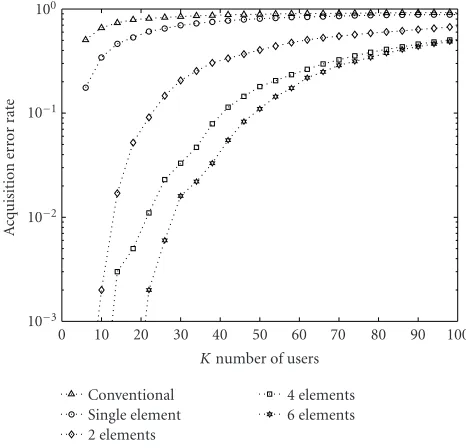
Figure11: The acquisition performance versus the number of users Kparameterized byJforL=6JN,M=2,N =31, SNR=14 dB, and NFR=0 dB.
conditions of poor power control, that is, severe MAI, when a 2-element antenna array is employed. Moreover, the pro-posed multistage detector equipped with 2 antenna elements outperforms significantly the conventional detector and the multistage detector only with a single antenna element.
InFigure 11, the acquisition-error-rate performance of a rank-2 filter for various number of antenna elements is presented in terms of the number of users K for data size L = 6JN and SNR= 14 dB. In this simulation, each inter-fering user is assumed to have a received power equal to the desired user, that is, NFR=0 dB. Clearly a better acquisition performance is accomplished when a larger antenna is em-ployed. Also results demonstrate that the potential to achieve a significant increase in system capacity is without a doubt when a larger antenna array is employed at a fixed perfor-mance allowance (requirement).
Figure 12 shows the simulation results of the acquisi-tion performance versus the signal-to-noise ratio for diff er-ent timing estimation techniques. In [35], the timing acquisi-tion problem by the use of an antenna array is formulated as a binary-hypothesis test on the assumption that the noise pro-cess is spatially correlated and temporally uncorrelated. Un-der the binary hypotheses, an adaptive generalized likelihood ratio test (GLRT) is developed to acquire the code timings of the user of interest in a fading environment. The GLRT of the desired spreading code vector denoted byΩ(Z[i]), originally due to Neyman and Pearson (NP) [36], takes the form
ΩZ[i]= det
Z[i]Z†[i] detZ[i]Z†[i]−Z[i]˜s
1
Z[i]˜s1
†
= 1
1−Z[i]˜s1
†
Z[i]Z†[i]−1Z[i]˜s1
100
10−1
10−2
10−3
A
cq
u
isition
er
ror
ra
te
0 5 10 15
SNR (dB) Conventional
NP, 4 elements Multistage, 4 elements
Figure12: The acquisition performance versus SNR parameterized by algorithms forK=6,L=6JN,M=4, andN=31.
The test in (62) is equivalent to the new test statistic given by
˘
ΩZ[i]=Z[i]˜s1)†
Z[i]Z†[i]−1Z[i]˜s1
=
Z[i]s1
†
Z[i]Z†[i]−1Z[i]s1
s†1s1
, (63)
where “det(R)” denotes the determinant of matrix R, ˘
Ω(Z[i]) is apparently related toΩ(Z[i]) byΩ(Z[i])=1/(1− ˘
Ω(Z[i])), and the spreading code sequence is normalized by letting
˜ s1=
s†1s1
−1/2
s1. (64)
The test statistic ˘Ωis used to test at each time phase within time periodNTc for the existence of the desired signal. The
decision on which timing phase the code synchronization is most likely to occur is attained by finding the maximum over the filter bank of tests in a symbol interval. That is,
i=i−k=arg max
k∈{0,1,...,NS−1}
˘
ΩZ[i−k]. (65)
It is demonstrated in the figure that the proposed multistage array detector withM=4 outperforms significantly the con-ventional detector and the spatial-only NP-type array detec-tor proposed in [35]. This is because the space-time process-ing offers the capability of canceling more interferers com-pared to the time-only or space-only processing. However, the disadvantage of the space-time processing is that the as-sociated computation and processing speed requirements are substantially greater than that needed for the time-only or space-only processing. To decrease the required computation and processing speed, a reduced complexity implementation of the space-time filter based on the MWF is presented in
this paper. The essential and important property of the MWF is its orthogonal decomposition structure which extracts the most correlated information necessary to estimate the filter-weight vector at the initial stages of the filter. This technique eliminates the need of a full decomposition of the space-time correlation matrix. Apparently, all above features make the proposed space-time adaptive truncated MWF perfectly suit-able for the need of the high voice and data rate of wireless communications.
6. CONCLUSIONS
A low-complexity version of the proposed asynchronous DS-CDMA time-delay detector is developed that utilizes the con-cept of the multistage reduced-rank Wiener filter. This struc-ture results in a substantial reduction of the computational burden and a rapid adaptive convergence for the filter coef-ficients without any need for a matrix inversion. Also due to its near-far resistant property of the proposed detector, this new DS-CDMA detector does not require the stringent power control mechanism that is needed in the conventional detector. Only knowledge of the desired signature vector is needed. A separated training period of signal-free observa-tions is not necessary. Evidently those are the same require-ments needed by the conventional DS-CDMA detector that uses a standard matched filter. Moreover, the proposed ac-quisition detector can be anticipated to combine with most previous multiuser DS-CDMA algorithms that require pre-cise knowledge of the propagation delays of all users. The proposed DS-CDMA timing detector achieves superior per-formance under the environment of a lower filter rank and a smaller number of data samples. This makes it possible to design a lower-complexity detector without a huge loss in performance in comparison with the full-rank system. Fur-thermore, experimental results show that the proposed ar-ray detector substantially outperforms the conventional tector and the spatial-only NP-type cotiming array de-tector in all simulations at a considerably reduced rank and accomplishes a substantial improvement in propagation de-lay acquisition when a larger antenna array is employed. The proposed multistage algorithm also shows a better conver-gence and tracking capability over DS-CDMA systems with the training-based adaptive LMS or RLS algorithm. These facts make the novel space-time adaptive truncated MWF meet the requirements of a lower-complexity, small-size, and light-weight detector that mobile users demand today.
REFERENCES
[1] S. Verd ´u, “Minimum probability of error for asynchronous Gaussian multiple-access channels,”IEEE Trans. Inform. The-ory, vol. 32, no. 1, pp. 85–96, 1986.
[2] S. Verd ´u, Multiuser Detection, Cambridge University Press, Cambridge, UK, 1998.
[3] R. Lupas and S. Verd ´u, “Linear multiuser detectors for synchronous code-division multiple-access channels,” IEEE Trans. Inform. Theory, vol. 35, no. 1, pp. 123–136, 1989. [4] Z. Xie, R. T. Short, and C. K. Rushforth, “A family of
[5] P. Patel and J. M. Holtzman, “Analysis of a simple succes-sive interference cancellation scheme in a DS/CDMA system,” IEEE J. Select. Areas Commun., vol. 12, no. 5, pp. 796–807, 1994.
[6] M. K. Varanasi and B. Aazhang, “Multistage detection in asynchronous code-division multiple-access communica-tions,” IEEE Trans. Commun., vol. 38, no. 4, pp. 509–519, 1990.
[7] S. Parkvall, E. G. Str¨om, and B. E. Ottersten, “The impact of timing errors on the performance of linear DS-CDMA re-ceivers,” IEEE J. Select. Areas Commun., vol. 14, no. 8, pp. 1660–1668, 1996.
[8] R. L. Pickholtz, D. L. Schilling, and L. B. Milstein, “Theory of spread-spectrum communications—a tutorial,” IEEE Trans. Commun., vol. 30, no. 5, pp. 855–884, 1982.
[9] R. F. Smith and S. L. Miller, “Code timing estimation in a near-far environment for direct-sequence code-division multiple-access,” inProc. IEEE Military Communications Con-ference (MILCOM ’94), vol. 1, pp. 47–51, Fort Monmouth, NJ, USA, October 1994.
[10] S. E. Bensley and B. Aazhang, “Maximum-likelihood syn-chronization of a single user for code-division multiple-access communication systems,” IEEE Trans. Commun., vol. 46, no. 3, pp. 392–399, 1998.
[11] S. E. Bensley and B. Aazhang, “Subspace-based channel esti-mation for code division multiple access communication sys-tems,” IEEE Trans. Commun., vol. 44, no. 8, pp. 1009–1020, 1996.
[12] E. G. Str¨om, S. Parkvall, S. L. Miller, and B. E. Ottersten, “DS-CDMA synchronization in time-varying fading chan-nels,”IEEE J. Select. Areas Commun., vol. 14, no. 8, pp. 1636– 1642, 1996.
[13] E. G. Str¨om, S. Parkvall, S. L. Miller, and B. E. Otter-sten, “Propagation delay estimation in asynchronous direct-sequence code-division multiple access systems,”IEEE Trans. Commun., vol. 44, no. 1, pp. 84–93, 1996.
[14] S. Kim and S. L. Miller, “Code timing estimation using a spa-tial diversity for DS-CDMA communication systems,” inProc. IEEE 49th Vehicular Technology Conference (VTC ’99), vol. 3, pp. 2383–2387, Houston, Tex, USA, July 1999.
[15] Z.-S. Liu, J. Li, and S. L. Miller, “An efficient code-timing esti-mator for receiver diversity DS-CDMA systems,”IEEE Trans. Commun., vol. 46, no. 6, pp. 826–835, 1998.
[16] S. Kim and S. L. Miller, “Subspace-based synchronization us-ing antenna array for DS-CDMA signals in multipath time-varying fading channels,” inProc. IEEE 51th Vehicular Tech-nology Conference (VTC ’00), vol. 1, pp. 547–551, Tokyo, Japan, May 2000.
[17] G. H. Golub and C. F. Van Loan,Matrix Computations, Johns Hopkins University Press, Baltimore, Md, USA, 3rd edition, 1996.
[18] H. Li, J. Li, and S. L. Miller, “Decoupled multiuser code-timing estimation for code-division multiple-access commu-nication systems,” IEEE Trans. Commun., vol. 49, no. 8, pp. 1425–1436, 2001.
[19] H. Li and R. Wang, “Filterbank-based blind code synchro-nization for DS-CDMA systems in multipath fading chan-nels,” IEEE Trans. Signal Processing, vol. 51, no. 1, pp. 160– 171, 2003.
[20] J. S. Goldstein, I. S. Reed, and L. L. Scharf, “A multistage rep-resentation of the Wiener filter based on orthogonal projec-tions,” IEEE Trans. Inform. Theory, vol. 44, no. 7, pp. 2943– 2959, 1998.
[21] D. Zheng, J. Li, S. L. Miller, and E. G. Str¨om, “An efficient code-timing estimator for DS-CDMA signals,” IEEE Trans. Signal Processing, vol. 45, no. 1, pp. 82–89, 1997.
[22] J. G. Proakis, Digital Communications, McGraw-Hill, New York, NY, USA, 3rd edition, 1995.
[23] P. Thanyasrisung,Theory and application of reduced-rank sta-tistical processing, Ph.D. thesis, University of Southern Cali-fornia, Los Angeles, Calif, USA, 2001.
[24] C.-C. Hu, I. S. Reed, and X. Yu, “Blind low-complexity code-timing acquisition for space-time asynchronous DS-CDMA signals,” in Proc. IEEE Global Telecommunications Confer-ence (GLOBECOM ’02), vol. 1, pp. 259–263, Taipei, Taiwan, November 2002.
[25] L. L. Scharf,Statistical Signal Processing: Detection, Estimation and Time Series Analysis, Addison-Wesley, 1991.
[26] S. P. Applebaum and D. J. Chapman, “Adaptive arrays with main beam constraints,”IEEE Trans. Antennas Propagat., vol. 24, no. 5, pp. 650–662, 1976.
[27] D. A. Pados and S. N. Batalama, “Joint space-time auxiliary-vector filtering for DS/CDMA systems with antenna arrays,” IEEE Trans. Commun., vol. 47, no. 9, pp. 1406–1415, 1999. [28] P. Comon and G. H. Golub, “Tracking a few extreme singular
values and vectors in signal processing,” Proc. IEEE, vol. 78, no. 8, pp. 1327–1343, 1990.
[29] M. Torlak and G. Xu, “Blind multiuser channel estimation in asynchronous CDMA systems,”IEEE Trans. Signal Processing, vol. 45, no. 1, pp. 137–147, 1997.
[30] C.-C. Hu, Space-time adaptive acquisition and demodulation in mobile cellular, Ph.D. thesis, University of Southern Cali-fornia, Los Angeles, Calif, USA, 2002.
[31] J. S. Goldstein,Optimal reduced-rank statistical signal process-ing, detection and estimation theory, Ph.D. thesis, University of Southern California, Los Angeles, Calif, USA, 1997. [32] D. J. Lee, Adaptive detection of DS/CDMA signals using
reduced-rank multistage Wiener filter, Ph.D. thesis, University of Southern California, Los Angeles, Calif, USA, 2000. [33] M. L. Honig and J. S. Goldstein, “Adaptive reduced-rank
in-terference suppression based on the multistage Wiener filter,” IEEE Trans. Commun., vol. 50, no. 6, pp. 986–994, 2002. [34] S. Chowdhury, M. D. Zoltowski, and J. C. Goldstein,
“Reduced-rank adaptive MMSE equalization for high-speed CDMA forward link with sparse multipath channels,” inProc. 34th Asilomar Conference on Signals, Systems and Comput-ers, vol. 2, pp. 965–969, Pacific Grove, Calif, USA, November 2000.
[35] C.-C. Hu, I. S. Reed, X. Yu, and P. Thanyasrisung, “Code timing acquisition using an antenna array for asynchronous DS-CDMA systems in a near-far environment,” inProc. IEEE Int. Conf. Acoustics, Speech, Signal Processing (ICASSP ’01), vol. 4, pp. 2213–2216, Salt Lake City, Utah, USA, May 2001. [36] H. L. Van Trees,Detection, Estimation and Modulation Theory:
Part I, John Wiley & Sons, New York, NY, USA, 1968–1971.
Chia-Chang Hureceived the B.S. and M.S. degrees from the National Cheng Kung Uni-versity, Tainan, Taiwan, in 1990 and 1992, respectively, and the Ph.D. degree from the University of Southern California, Los An-geles, Calif, in 2002, all in electrical engi-neering. Since February 2003, he has been with the Department of Electrical Engi-neering, National Chung Cheng University, Chia-Yi, Taiwan, where he is an Assistant