MP-01.01
Accuracy of 2D Trans-rectal Ultrasound (TRUS) Guided Biopsy (Bx) of MRI Targets: Quantitative Simulator-based Analysis
Zhang, Xuli (Jerry)1; Cool, Derek W.2; Izawa, Jonathan3; Romano, Walter2; Fenster, Aaron4; Romagnoli, Cesare2
1Schulich School of Medicine and Dentistry, Western University, London, ON, Canada; 2Department of Medical Imaging, Western University, London, ON, Canada; 3Department of Surgery, Division of Urology, Western University, London, ON, Canada; 4Robarts Imaging, Robarts Research Institute, London, ON, Canada
Introduction and Objectives: Prostate MRI is sensitive to early stage
pros-tate adenocarcinoma (PCa) and can be used for detection lesions missed on systematic Bx. Biopsy targeting of MRI lesions using TRUS for needle guidance is most economical; however, corresponding MRI findings with TRUS is non-trivial. The accuracy of 2D TRUS targeting of MRI lesions is quantified.
Methods: 11 patients (Pros. Vol=37+/-12g, PSA=9.3+/-5.3) with
Bx-confirmed PCa lesions (0.8+/-0.8 g) on MRI were selected from a larger MRI-3D TRUS fusion study. Simulated 2D TRUS biopsies were performed on each patient by 3 experts using a validated TRUS Bx simulator. Two simulated core-biopsies were targeted at each suspicious lesion identified on MRI using 2D TRUS guidance, and single core bxs were directed toward common regional targets identified across all patients. Regions included: left-anterior transition zone (Ant_TZ), left-mid gland (Mid), right apex (Apex) and right base (Base). The locations of the simulated Bx cores were com-pared to the original MRI to evaluate the sampling accuracy.
Results: Only 59.5% (8.3 of 14) of the MRI PCa lesions were successfully
bx’d using 2D TRUS guidance, without significant interoperator differences. The mean Bx error for the MRI regional targets was 7.94+/- 4.46mm, equal-ing a detection rate of 29% if each target were a tumour of 5mm radius (smallest clinically significant size) and 69% for a 1cm radius. Stratified by location, the Apex had the fewest bxs within 5mm (15% vs. Ant_TZ: 36%, Mid: 30%, Base: 33%). Bx cores targeted at the Base (2.5 mm) and Ant_TZ (3.4 mm) were over-rotated toward the base, while Apex (2.6 mm), & Mid-gland cores (8.2 mm) erred toward the apex. Marked orientation differences between the axial MRI acquisition and the standard axial TRUS images acquired for Bx, which ranged from 50°-90° is likely a reason for targeting errors.
Conclusion: Bx of MRI-identified lesions under 2D TRUS may be
sub-optimal due to difficulties in translating lesion location from MRI to US.
MP-01.02
GLUT-1, GLUT-12 and Hexokinase 2 Protein Expression in Prostatic Adenocarcinoma: Clinical Correlation with Intraprostatic 18F-FDG-Positron Emission Tomography (FDG-PET) Uptake
Bouchard, Frédérick1; Rimac, Goran1; Blouin, Annie-Claude1; Lefebvre, Véronique2; Têtu, Bernard2; Hovington, Hélène3; Lemay, Claude2; Pouliot, Frédéric2
1Université Laval, Quebec, QC, Canada; 2CHUQ, Quebec, QC, Canada; 3Centre de recherche du CHU de Québec, Quebec, QC, Canada
Introduction and Objectives: Intracellular FDG uptake is dependent on its
transport through cell membrane and its cellular trapping after phosphoryla-tion by hexokinases. Indeed, FDG-PET positivity has been inconsistently correlated to glucose transporters expression in some non-urological can-cers. Moreover, no well-powered studies on their expression in primary
prostate cancers have been published. In this study, we aimed to determine the expression pattern of GLUT-1, GLUT-12 and Hexokinase 2 (HK2) in normal prostatic tissue (NP) and PCa, and to correlate their expression with intraprostatic FDG-uptake on FDG-TEP-CT.
Methods: Antibodies against GLUT1 (Millipore), HK2 and GLUT12 (Atlas
Antibodies) epitopes were used to perform immunohistochemistry (IHC). Study group 1 included 48 patients with either NP, benign prostatic hyper-plasia (BPH), Gleason 6 (3+3) or Gleason 7 (4+3/3+4) (n=12 per group). Study group 2 included 29 patients with high-risk PCa (Gleason ≥8) who underwent FDG-PET-CT as a staging procedure before a radical prosta-tectomy with lymph node dissection. 9 of these patients had increased intraprostatic FDG-uptake.
Results: GLUT1 was strongly expressed in benign and PCa glands while
GLUT12 and HK2 were detected only in PCa samples. Based on aver-age total scores (TS) for global staining and intensity, HK2 and GLUT12 were consistently overexpressed in PCa (TS=1.18±0.75 for HK2 and TS=1.34±0.70 for GLUT12) when compared to BPH (TS=0.52±0.58) or NP (TS=0.85±0.87) (p<0.0001). Each of the PCa GS subgroup (6, 7 or 8+) had a statistically significant higher TS for GLUT12 expression when compared to BPH or NP (p<0.05). Neither marker expression pattern did correlate with intraprostatic FDG uptake on PET-CT.
Conclusions: We show in the largest primary PCa series published to date
that GLUT1, GLUT12 and HEX2 proteins are expressed in PCa. While GLUT12 and HEX2 expression is increased in PCa, it did not correlate with Gleason sum nor it was predictive of FDG uptake on PET-CT.
MP-01.03
Population-based 10 Year Event-free Survival after Radical Prostatectomy for Patients with Prostate Cancer in British Columbia
So, Alan1; Quirt, Jill2; Morris, William2; Peacock, Michael2; Kim-Sing, Charmaine2; Pickles, Tom2; Tyldesley, Scott2
1Vancouver Prostate Centre, Vancouver, BC, Canada; 2BC Cancer Agency, Vancouver, BC, Canada
Introduction and Objectives: Our purpose was to determine the
popula-tion-based proportion of men treated with radical prostatectomy (RP) who remain event free (event defined as a composite of any of prostate specific mortality, salvage androgen ablation (AA), and/or salvage radiotherapy) 10 years after treatment (EF 10 years).
Methods: All incident cases of prostate cancer diagnosed in 1999 and 2000
in British Columbia (BC) were identified. All radiotherapy and AA is pro-vided by the BC Cancer Agency (BCCA), and the treatment dates recorded in BCCA databases. Incident cases were linked to provincial radiotherapy and pharmacy records, BCCA staging data. The pathology reports on all cases not known to have been metastatic at diagnosis or known to have received high dose EBRT or BT were reviewed to determine whether they had a RP, and, if they did, the Gleason grade and date of prostatectomy was recorded.
Results: A total of 6028 incident prostate cancer cases were diagnosed.
Curative intent treatment within the first year of diagnosis was RP in 22.6%, EBRT in 22.7%, and BT in 5.9%. Median survival of living patients was 11 years. 10 year prostate specific survival was for 98% for RP, 95.2% for EBRT and 98.6% for BT (log rank p<0.001). Of RP cases, Gleason score (GS) was 581, 429, and 89 for GS 2-6, 7, and 8-10 respectively. The EF 10y rate after RP (as defined above) was 87.5%. The EF 10y after RP varied with Gleason groups: 93.3%, 84.3%, and 62.4% for Gleason 2-6, 7 and 8-10
Moderated Posters 1: Prostate Cancer
respectively (p<0.0001). For patients with Gleason 8-10 EF 10-year rates were 69% for those with pT2 and 36% for those with pT3 respectively.
Conclusions: Population-based clinically relevant outcomes provide
benchmarks against which to compare therapies which help guide phy-sicians, patients and health system managers. Event free rates for patients treated with RP vary with Gleason grade, and outcomes for high grade advanced stage disease have room for improvement.
MP-01.04
Abiraterone Acetate in Metastatic Castration-resistant Prostate Cancer Patients Without Prior Chemotherapy: Interim Analysis of the COU-AA-302 Phase 3 Trial
Saad, Fred1; Shore, Neal2; Van Poppel, Hendrik3; Rathkopf, Dana4; Smith, Matthew5; de Bono, Johann S.6; Logothetis, Christopher7; de Souza, Paul8; Fizazi, Karim9; Mulders, Peter10; Mainwaring, Paul11; Hainsworth, John D.12; Beer, Tomasz M.9; North, Scott13; Fradet, Yves14; Griffin, Tom15; Kheoh, Thian15; Small, Eric J.16; Scher, Howard I.4; Molina, Arturo15; Ryan, Charles J.16
1University of Montreal Hospital Centre, CRCHUM, Montreal, QC, Canada; 2Carolina Urologic Research Center, Myrtle Beach, SC, United States; 3University Hospitals of KU Leuven, Leuven, Belgium; 4Memorial Sloan-Kettering Cancer Center, New York, NY, United States; 5Massachusetts General Hospital Cancer Center, Boston, MA, United States; 6Institute of Cancer Research and Royal Marsden Hospital, Sutton, United Kingdom; 7MD Anderson Cancer Center, Houston, TX, United States; 8University of Western Sydney School of Medicine, Ingham Institute, Sydney, Australia; 9Institut Gustave Roussy, Villejuif, France; 10Radboud University Medical Centre, Nijmegen, Netherlands; 11Haematology and Oncology Clinics of Australia, Brisbane, Australia; 12Sarah Cannon Research Institute, Nashville, TN, United States; 13Cross Cancer Institute, Edmonton, AB, Canada; 14Laval University, Quebec City, QC, Canada; 15Janssen Research & Development, Los Angeles, CA, United States; 16Helen Diller Family Comprehensive Cancer Center, University of California, San Francisco, CA, United States
Introduction and Objectives: The COU-AA-302 phase 3 trial evaluates
abiraterone acetate (AA) in asymptomatic or mildly symptomatic patients with progressive metastatic castration-resistant prostate cancer (mCRPC) and no prior chemotherapy. We present results of primary/secondary endpoints from a prespecified interim analysis (IA), along with preliminary data on the effect of prior use of bisphosphonates/other bone-targeted therapies (BTT) on outcomes in this trial.
Methods: 1088 patients were stratified by Eastern Cooperative Oncology
Group performance status (ECOG-PS, 0 vs. 1) and randomized 1:1 to AA
1 g or placebo po QD, plus prednisone (P) 5 mg po BID. Radiographic progression-free survival (rPFS) and overall survival (OS) were co-primary endpoints. Primary and secondary endpoints were compared between treatment arms by stratified log rank test and proportional hazards model. The effect of prior BTT use on primary endpoints was investigated. All analyses were conducted on data from the IA at 56% OS events.
Results: Median follow-up for OS at the time of this IA was 27.1 months.
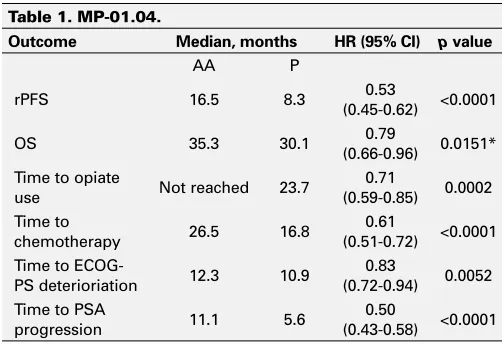
Prior use of BTT (AA: 38%, P: 34%) was similar between treatment arms. Prespecified analyses of OS, rPFS and secondary endpoints all favoured the AA arm (Table 1); risk of death decreased by 21% but did not reach the prespecified efficacy boundary. In the overall study population, prior BTT use had no impact on rPFS (HR 0.95; 95% CI 0.81-1.12, p=0.565) and OS (HR 0.92; 95% CI 0.75-1.12, p=0.409). The main grade 3/4 adverse events in the AA and P arms were hypertension 4.2% vs. 3.1%, hypokalemia 2.6% vs. 1.9%, ALT elevated 5.5% vs. 0.7%, AST elevated 3.1% vs. 0.9%.
Conclusions: In mCRPC patients without prior chemotherapy, AA delays
time to disease progression, with a clinically and statistically significant advantage over P in rPFS and all secondary endpoints. Prior use of BTT was not associated with a difference in rPFS and OS.
MP-01.05
Are There Prostates That Are Too Big and Urinary Symptoms Too Severe for Permanent Seed Prostate Brachytherapy?
Taussky, Daniel; Donath, David; Delouya, Guila University of Montreal, Montreal, QC, Canada
Introduction and Objectives: To analyze whether patients with large
pros-tates (≥60 cc) and/or severe urinary symptoms (≥ 17) have a higher rate of urinary problems and/or have worse implant quality after permanent seed prostate brachytherapy (PB).
Methods: From our database of 730 treated patients, we identified 7
patients with an IPSS baseline of 17-24 (with a postvoid residual of <100 ml) as well as 21 patients with a prostate volume of 60-78 cc (median 63.3 cc). These 28 patients were compared to all patients (n=93) whose prostate volume was within ≥2 cc of the mean prostate volume of our cohort of 730 patients (37 cc) and with an IPSS <8. To compare implant quality, dosimetry of the post-implant CT-scan at 1 month following PB was analyzed. Urinary problems were compared using the time of acute (catheterization ≥21 days) and chronic (self-catheterization) urinary reten-tion. Non-parametric tests were used for comparison between those two groups.
Results: For patients with large prostates, dosimetry was not significantly
different between both groups: D90 (p=0.71), V100 (p=0.21) and V150 (p=0.18). The number of unsatisfactory quality implants (D90 <130 Gy) was not different between the two groups, 7.4% in the study group and 8.8% in the control group (p=0.67). The rate of self-catheterization was not different (p=0.67), 1 patient in the study group and 4 in the control group.
Patients in the study group had a significantly higher rate of acute urinary retention (p=0.044). In the study group, 41% (con-trol group 62%) never had a urinary catheter and 41% (con(con-trol group 36%) had a catheter inserted for 1 day. The remaining 18% (control group 2%) had an in-dwelling catheter for 2-21 days.
Conclusions: Patients with large prostates or baseline severe urinary
prob-lems have a higher rate of acute urinary retention but do not have a higher rate of self-catheterization. With careful selection of patients with large prostates, good quality implants are possible.
Table 1. MP-01.04.
Outcome Median, months HR (95% CI) p value
AA P
rPFS 16.5 8.3 (0.45-0.62)0.53 <0.0001 OS 35.3 30.1 (0.66-0.96)0.79 0.0151* Time to opiate
use Not reached 23.7
0.71
(0.59-0.85) 0.0002 Time to
chemotherapy 26.5 16.8
0.61
(0.51-0.72) <0.0001 Time to
ECOG-PS deterioriation 12.3 10.9
0.83
(0.72-0.94) 0.0052 Time to PSA
progression 11.1 5.6
0.50
(0.43-0.58) <0.0001
MP-01.06
Radical Prostatectomy for High-risk Prostate Cancer: A Canadian Experience
Ischia, Joseph; Black, Peter; So, Alan; Goldenberg, Larry; Gleave, Martin Department of Urologic Sciences, University of British Columbia, Vancouver, BC, Canada
Introduction: Radiation Oncologists have taken the initiative by
per-forming several well-conducted randomized trials for men with clini-cally localized high-risk prostate cancer which has lead to a decrease in the proportion of men who receive surgery as their primary treatment. However, the advantages of surgery are multiple, and importantly, around half of men can avoid ADT. The objective of this study is to report on the biochemical progression-free outcomes of radical prostatectomy in men with high-risk localized prostate cancer.
Methods: Men with high-risk clinically localized prostate cancer were
operated on at Vancouver Coastal Health. 565 patients were identified on a prospectively collected database with high risk prostate cancer by virtue of a prostate-specific antigen (PSA) >20, biopsy Gleason score 8 to 10, or clinical stage ≥T3. PSA recurrence was defined as a PSA >0.2 ng/mL or initiation of any salvage therapy. Cox regression analysis was used to test for independent predictors of biochemical progression-free survival (bPFS).
Results: Median age was 63.8 years (45.7-79.6). Median follow-up was
2.4 years (range 0.1-20.2 years). 80% of patients had a single baseline risk factor, 16.8% had 2 risk factors and 3.2% had all 3 risk factors. Neoadjuvant therapy was administered to 279 patients (49%) and adju-vant therapy to 97 (17%); while 230 men (41%) received RP monotherapy. The overall 5 and 10-year bPFS were 60% and 50%, respectively. The 5-year bPFS for PSA>20 ng/mL, Gleason 8-10, and ≥cT3 were 57%, 56%, and 52% respectively. On multivariate analysis, only biopsy Gleason score and the number of risk factors were independent predictors of bPFS.
Conclusion: Radical prostatectomy should be considered a primary
treat-ment option in men with high-risk localized prostate cancer. Around half of men with very high-risk disease will be cured with radical prostatec-tomy as the primary (and often only) component of their initial treatment.
MP-01.07
Prostate Biopsy Practices in Ontario: Results of a Provincial Survey Assessing Self-reported Practices in Ontario
Chin, Joseph1; Singal, Rajiv2; Srigley, John3; Evans, Andrew2; Toi, Ants2; Victor, Charles4; Hunter, Amber4; McKnight, Leigh4; McLeod, Robin4 1University of Western Ontario, London, ON, Canada; 2University of Toronto, Toronto, ON, Canada; 3Credit Valley Hospital, Mississauga, ON, Canada; 4Cancer Care Ontario, Toronto, ON, Canada
Introduction and Objectives: Prostate biopsy (Bx) is a ubiquitous
proce-dure. Cancer Care Ontario (CCO) Surgical Oncology Program is a provin-cial initiative to improve cancer care via practice guideline development and community of practice engagement. Aiming to standardize improve quality, a population-based survey was done to assess current provincial Bx practices. A specific goal was to identify inappropriate practices.
Methods: A CCO-appointed multidisciplinary group developed a survey,
covering the spectrum of Bx practices (referral patterns, Bx techniques, specimen submission & processing, path. reporting). Survey was sent to UROs and RADs who perform Bx. from a provincial directory.
Results: Response rate was 62%. Bx training was through residency,
men-torship, fellowship and courses. Frequently cited reasons for Bx included positive DRE, PSA qualifiers, family history, suspicious TRUS and risk tables. Bx Techniques: 76% Bx were performed in hospital. 92% URO used mainly TRUS-guidance. Digital guidance was used by 4 URO in >80% of their patients. 58% of URO routinely take 12-core Bx while RAD only 26% did.
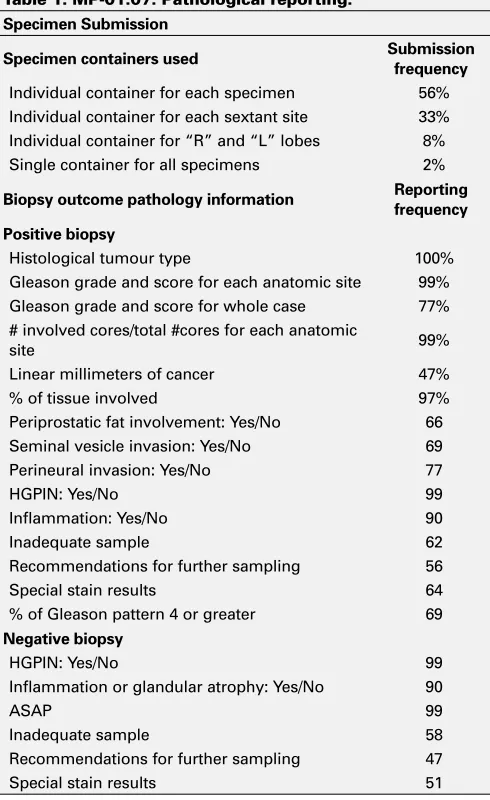
Specimen Submission: See Table 1. Quality and quantity of clinical infor-mation given to PATH varied widely (Pathology Reporting [Table 1]). Some key relevant PATH features were not reported 100% of the time.
Conclusions: While most URO and RAD in Ontario meet practice
stan-dards, some egregious practices were noted routine digital guidance, all specimens submitted in ONE jar), possibly due to deficiency in training and/or resources, providing opportunities for remediation. These results
are being used to develop a provincial Bx Practice Guideline on param-eters including Bx indications, techniques, relevant information provi-sion to pathologists, and specimen submisprovi-sion. This mode of knowledge transfer/exchange via communities of practice engagement and practice guideline development should result in overall improvement of CaP care in the province.
MP-01.08
The Performance of Magnetic Resonance Imaging to Detect Extraprostatic Cancer Extension: A Systematic Review and Meta-analysis
Nguyen, Laura; Punjani, Nahid; Witiuk, Kelsey; Mallick, Ranjeeta; MacDonald, Blair; Cagiannos, Ilias; Morash, Christopher; Fergusson, Dean; Breau, Rodney
University of Ottawa, The Ottawa Hospital, Ottawa, ON, Canada
Introduction and Objectives: Pelvic magnetic resonance imaging (MRI)
may be used for stage assessment prior to radical prostatectomy. To bet-ter understand which patients may benefit from this test, a systematic review was performed.
Methods: A comprehensive search of major databases (Ovid EMBASE,
Ovid MEDLINE, Ovid Medline In-Process & Other Non-Indexed Citations) was performed for studies published up to April 2012 with no language
Table 1. MP-01.07. Pathological reporting. Specimen Submission
Specimen containers used Submission
frequency
Individual container for each specimen 56% Individual container for each sextant site 33% Individual container for “R” and “L” lobes 8% Single container for all specimens 2%
Biopsy outcome pathology information Reporting frequency
Positive biopsy
Histological tumour type 100% Gleason grade and score for each anatomic site 99% Gleason grade and score for whole case 77% # involved cores/total #cores for each anatomic
site 99%
Linear millimeters of cancer 47% % of tissue involved 97% Periprostatic fat involvement: Yes/No 66 Seminal vesicle invasion: Yes/No 69 Perineural invasion: Yes/No 77 HGPIN: Yes/No 99 Inflammation: Yes/No 90 Inadequate sample 62 Recommendations for further sampling 56 Special stain results 64 % of Gleason pattern 4 or greater 69
Negative biopsy
HGPIN: Yes/No 99 Inflammation or glandular atrophy: Yes/No 90
ASAP 99
restrictions. Articles were included if they assessed accuracy of EPE on preoperative MRI compared to radical prostatectomy specimens. Studies that used <1.5 Tesla magnets or did not evaluate T2 weighted images were not included. All studies were reviewed and data extracted independently by two reviewers.
Results: In total 2775 abstracts were identified and screened. 316 full text
articles were reviewed; 85 met inclusion criteria. Final analysis included 6018 patients from 19 countries. Endorectal coil was used exclusively in 20 studies, and in conjunction with whole-body coil and phased-array coil in 7 and 39 studies, respectively. Four studies used only whole-body coil, eight used only phased-array coil, and one used both. One study used all three coil types. Forty-two (49.4%) of the studies were published since 2002. Fifty-five studies reported isolated EPE, with pooled sensi-tivity and specificity of 54.1% (95% CI 48.2-60.0) and 90.7% (95% CI 86.5-92.6). Twenty-nine studies examined detection of isolated seminal vesicle invasion, with pooled sensitivity and specificity of 54.0% (95% CI 45.2-62.5) and 96.4% (95% CI 94.5-97.7). Only six studies examined lymph node involvement, with pooled sensitivity and specificity of 34.5% (95% CI 1.1-96.2) and 95.2% (95% CI 86.4-98.4). Comparisons between MRI techniques will be presented.
Conclusions: Assessment of EPE with MRI is highly specific but only
moderately sensitive. Pre-test probability of EPE should be considered prior to performing MRI or stage assessment.
MP-01.09
Comparison of Efficacy of Primary Treatment with Bicalutamide Versus LHRH Analogue in Patients with Biochemical Recurrence After Radical Prostatectomy
Alesawi, Anwar; Caron, André; Bergeron, Alain; Hovington, Hélène; Fradet, Vincent; Lacombe, Louis; Fradet, Yves
Laval University, Quebec City, QC, Canada
Objective: To evaluate the relative efficacy of initial treatment of
bio-chemical recurrence after radical prostatectomy (RP) with bicalutamide - to preserve their quality of life - compared to LHRH analogue therapy.
Methods: This single centre, retrospective study included 266 prostate
cancer (PCa) patients treated with RP who were started on hormono-therapy after biochemical recurrence. 155 patients received LHRH ana-logue while 111patients received bicalutamide as primary treatment. Of the 111 patients on bicalutamide, 26 patients were further treated with LHRH analogue after PSA failure while they were on bicalutamide treat-ment. The mean follow-up after surgery for the whole cohort was 77.5 months (median: 71.1 months).
Results: Compared to LHRH analogue group the bicalutamide-treated
group was at higher risk with significantly more high stage (pT3+: 55% vs. 67%, p=0.042) and high grade (7+: 70% vs. 89%, p=0.0002) respectively. There was no significant difference for mean time to PSA failure between the bicalutamide and LHRH-treated groups (52.1 vs. 53.6 months.
p=0.948). In survival analysis, adjusted for age, stage and Gleason grade, there was no significant difference in risk of PSA failure under LHRH treat-ment in patients initially treated with bicalutamide and switched to LHRH upon biochemical recurrence (HR: 0.438 (0.139-1.382) p=0.1592) com-pared to patients initially treated with LHRH analogue. Furthermore, initial bicalutamide treatment showed no significant increase risk of metastasis (HR 1.440 (0.637-3.528) p=0.381) nor death (HR: 0.513 (0.138-1.910)
p=0.319) compared to LHRH analogue only treatment.
Conclusions: Initial treatment of biochemical recurrence after RP with
bicalutamide for men wishing to preserve their quality of life was not associated with a worse oncological outcome compared to medical cas-tration with LHRH.
MP-01.10
Denosumab in Men with Non-metastatic Castration-resistant Prostate Cancer and Prostate-specific Antigen Doubling Time
≤ 6 Months
Egerdie, R. Blair1; Miller, Kurt2; Smith, Matthew3; Dearnaley, David4; Dogliotti, Luigi5; Fizazi, Karim6; Kueppers, Frank7; Montes De Oca, Luis8; Morote, Juan9; Pavlik, Ivan10; Sieber, Paul11; Tammela, Tuevo12; Van Poppel, Hendrik13; Wirth, Manfred14; Wong, Shirley15; Ye, Zhishen16; Braun, Ada16 1Urology Associates, Urologic Medical Research, Kitchener, ON, Canada; 2Charité Berlin, Berlin, Germany; 3Massachusetts General Hospital Cancer Center, Boston, MA, United States; 4Institute of Cancer Research, Royal Marsden Hospital, Sutton, United Kingdom; 5Ospedale San Luigi Gonzaga, Orbassano, Italy; 6Institut Gustave Roussy, University of Paris Sud, Villejuif, France; 7Canterbury Urology Research Trust, Christchurch, New Zealand; 8Centro de Diagnostico Urologico, Buenos Aires, Argentina; 9Hospital Vall d’Hebron, Barcelona, Spain; 10Clinic of Urology, General Teaching Hospital and the 1st Faculty of Medicine, Prague, Czech Republic; 11Urological Associates of Lancaster, Lancaster, PA, United States; 12Tampere University Hospital, Tampere, Finland; 13Universitair Ziekenhuis Gasthuisberg, Leuven, Belgium; 14Universitätsklinikum Carl Gustav Carus, Dresen, Germany; 15Western Hospital, Footscray, Australia; 16Amgen Inc, Thousand Oaks, CA, United States
Introduction and Objectives: Men with non-metastatic
castration-resis-tant prostate cancer (CRPC) and prostate-specific antigen doubling time (PSADT) of approximately ≤6 months are in the top tier of risk for PC progression to bone, reflecting an important high-risk group to target for prevention of bone metastasis. Results from a randomized, placebo-con-trolled phase 3 trial showed that denosumab prolonged bone metastasis-free survival (BMFS) by 4.2 months (HR 0.85;p=0.028) compared with placebo. The objective of this post-hoc analysis was to evaluate the effects of denosumab in the high-risk subgroup of men with PSADT ≤6 months.
Methods: Men with non-metastatic CRPC at high risk for bone metastasis
(PSA ≥8.0 ng/mL and/or PSADT ≤10 months) were randomized 1:1 to receive monthly subcutaneous denosumab 120 mg or placebo (n=1432). BMFS, the primary endpoint, was defined as time to first bone metastasis (symptomatic or asymptomatic) or death from any cause. Among men with PSADT ≤6 months (n=846), we evaluated multiple, symptomatic, and multiple or symptomatic BMFS and time to multiple, symptomatic, and multiple or symptomatic bone metastases.
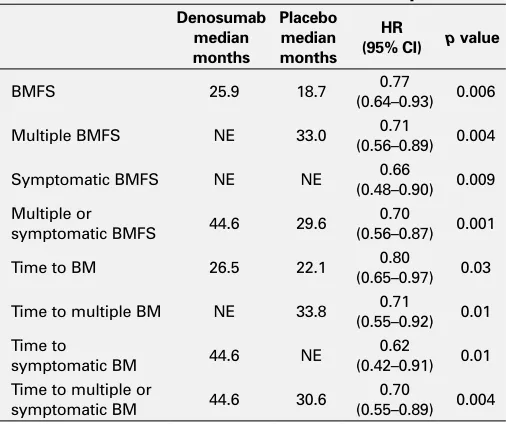
Table 1. MP-01.10. PSADT ≤6 months subset endpoints Denosumab
median months
Placebo median months
HR
(95% CI) p value
BMFS 25.9 18.7 (0.64–0.93)0.77 0.006 Multiple BMFS NE 33.0 (0.56–0.89)0.71 0.004 Symptomatic BMFS NE NE (0.48–0.90)0.66 0.009 Multiple or
symptomatic BMFS 44.6 29.6
0.70
(0.56–0.87) 0.001 Time to BM 26.5 22.1 (0.65–0.97)0.80 0.03 Time to multiple BM NE 33.8 (0.55–0.92)0.71 0.01 Time to
symptomatic BM 44.6 NE
0.62
(0.42–0.91) 0.01 Time to multiple or
symptomatic BM 44.6 30.6
0.70
(0.55–0.89) 0.004
Results: Improvements in BMFS and delay in time to bone metastases,
including multiple or symptomatic bone metastases, were observed with denosumab (Table 1). The overall safety profile of denosumab in this subgroup was similar to the overall population.
Conclusions: Denosumab showed a pronounced treatment effect in men
with CRPC at high risk of bone metastases based on PSADT ≤6 months compared with the overall population. This observation was consistent in those with multiple or symptomatic bone metastases.
MP-01.11
Active Surveillance for Low-risk Prostate Cancer Compared with Immediate Treatment: A Canadian Economic Evaluation
Dragomir, Alice1; Cury, Fabio2; Aprikian, Armen3
1McGill University, Montreal, QC, Canada; 2McGill University Health Centre, Montreal, QC, Canada; 3McGill University, McGill University Health Centre, Montreal, QC, Canada
Introduction and Objectives: Active surveillance is an accepted
manage-ment strategy for patients with low-risk prostate cancer (PCa). The costs associated with active surveillance (AS) strategy compared with immediate treatment (IT) were recently evaluated in US. The corresponding estimates in the Canadian context are unknown. The main objective of this study was to evaluate the costs associated with AS and treatment in Canadian context over a 6- and 11-year period following the diagnosis of PCa. The secondary objective was to compare the US and Canadian cost estimates.
Methods: A Markov model with Monte-Carlo microsimulations was
devel-oped to estimate the Canadian cost of PCa under the IT and AS strategies. The patients on AS were assumed to receive delayed treatment at a rate of 7% per year for the first 5-year period of follow-up, and of 4.5% for the following 5-year period. All costs were assigned in Canadian dollars ($) and reflect Quebec’s health system (RAMQ). The costs of drugs, costs of medical procedures related to treatments and medical visit costs were based on RAMQ’s lists. Other Canadian published sources were used to complete cost calculation.
Results: With AS, the average cost of PCa management over the 6-year
period was estimated at $6,394 (95% Confidence Interval: $6,323 to $6,474) per patient. The average cost corresponding to the IT strategy was estimated at $11,765 per patient. In addition, 30% of patients on AS have received a delayed treatment and have incurred higher costs estimated at $12,210 per patient.
Conclusions: Our study demonstrates that AS could offer important
economic benefits to the Canadian health system. We estimated that each annual cohort of incident prostate cancer managed with AS strat-egy allows cost savings of $69 million over a 6-year period. Eighty-four percent of these benefits could be maintained after 11 years. The relative reduction of PCa cost under AS was approximately 36% in US, compared to 46% in Canada.
MP-01.12
Health-related Quality of Life Following Radical Prostatectomy: Long-term Outcomes
Matthew, Andrew1; Alibhai, Shabbir1; Davidson, Tal1; Currie, Kristen1; Jiang, Haiyan1; Krahn, Murray2; Kalnin, Robin3; Louis, Alyssa1; Davison, Joyce4; Trachtenberg, John1
1Princess Margaret Cancer Centre, University Health Network, Toronto, ON, Canada; 2University of Toronto, Toronto, ON, Canada; 3Meridian Software, Toronto, ON, Canada; 4University of Saskatchewan, Saskatoon, SK, Canada
Introduction and Objective: Radical prostatectomy (RP) results in
side-effects that negatively impact health-related quality of life (HRQoL). Understanding the affected HRQoL domains can inform survivorship pro-grams. The current study explores the long-term impact of RP on HRQoL.
Methods: 1200 RP patients completed the Patient-Oriented Prostate Utility
Scale - Psychometric (PORPUS-P; range 0-100, higher is better), a prostate cancer-specific HRQoL measure, prior to RP and at 0-3 (T1), 3-9 (T2), 9-18 (T3) and 18-30 (T4) months post-RP. Changes in HRQoL were examined using paired t-tests and a mixed effect growth curve model. Multivariable
analyses were performed to investigate demographic factors predicting the change of HRQoL.
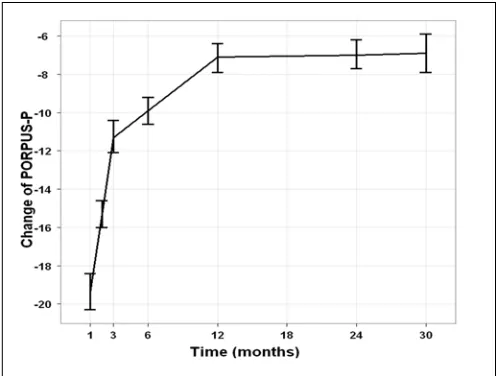
Results: Mean baseline PORPUS-P score was 83.1, and fell to 66.5
(p<0.001) at T1. Over time HRQoL improved but did not return to base-line (T4 mean 76.4, p<0.001). The estimated mean PORPUS-P change using growth curve analysis is shown in Figure 1. Domain analysis revealed that sexual drive (p<0.001), energy (p=0.001), and bladder con-trol (p<0.001) failed to return to baseline at T4. Sexual function failed to return to baseline and demonstrated the greatest impairment overall. The multivariable model revealed Black men experienced greater losses in global HRQoL compared to White men (coefficient: -2.77, 95% CI: -5.00--0.54, p=0.015). High baseline HRQoL, non-smoking, and bilateral nerve-sparing were significantly associated with smaller reductions in HRQoL post-RP. Use of pro-erectile aids was associated with less decline of HRQoL (coefficient: 1.01, 95% CI: 0.09-1.94, p=0.032) (Fig. 1).
Conclusion: Overall HRQoL, sexual drive, sexual function, energy, and
bladder control do not return to preoperative levels within 30 months post-RP. Black patients experience the greatest reductions in HRQoL. Losses in HRQoL may be ameliorated by use of pro-erectile aids. These findings may help to identify at-risk patient populations and inform sur-vivorship programs.
MP-01.13
Underutilization of Local Salvage Therapy After Primary Radiotherapy for Prostate Cancer in British Columbia
Tran, Henry1; Kwok, Jaime1; Pickles, Tom2; Tyldesley, Scott2; Black, Peter1 1Department of Urology, University of British Columbia, Vancouver, BC, Canada; 2Department of Radiation Oncology, University of British Columbia, Vancouver, BC, Canada
Introduction and Objectives: Early biochemical detection and subsequent
slow progression of recurrent prostate cancer after primary radiotherapy permit the delivery of potentially curative local salvage therapy (LST). Options for LST include cryotherapy, salvage brachytherapy (SBT), and salvage radical prostatectomy (SRP). Based on our clinical impression that few patients were receiving LST, we studied rates at which patients are offered, and receive LST after failure of primary radiotherapy.
Methods: Patients with localized prostate cancer who received primary
Results: Out of 1782 patients treated in the study period, 1067 met
inclu-sion criteria. Of these, 257 failed radiation. This was managed with obser-vation (>12 months) in 128 patients and androgen depriobser-vation therapy (ADT) in 118. Of the observed patients, 66 subsequently received ADT. Five patients (1.8%) received LST (3 SRP, 2 SBT). A documented discus-sion of LST was present in 44 (17%), unknown in 56 (22%) and absent in 157 (60%) cases. Based on clinicopathologic parameters, 24% of patients appeared eligible for SRP but were not offered it.
Conclusions: Few patients were considered for LST after radiation failure,
and only 1.8% received it. While the benefits of LST are unproven, these findings reveal a possible underutilization of LST after radiotherapy, and indicate a need for more collaboration between all treating physicians, as well as with tertiary care centres.
MP-01.14
Prostate Inflammation is Associated with Reduced Risk of Prostate Cancer
Nickel, J. Curtis1; Moreira, Daniel2; Gerber, Leah3; Andriole, Gerald4; Castro-Santamaria, Ramiro5; Freedland, Stephen6
1Department of Urology, Queens University, Kingston, ON, Canada; 2The Arthur Smith Institute for Urology, North Shore Long Island Jewish Health System, New Hyde Park, NY, United States; 3Division of Urologic Surgery, Department of Surgery, Duke University School of Medicine, Durham, NC, United States; 4Division of Urologic Surgery, Department of Surgery, Washington University School of Medicine, St. Louis, MO, United States; 5Metabolic Pathways and Cardiovascular R&D Unit, GlaxoSmithKline Inc., King of Prussia, PA, United States; 6Department of Pathology, Duke University School of Medicine, Durham, NC, United States
Introduction and Objectives: An association between prostate
inflamma-tion and prostate cancer (PCa) has been suggested but never established. We sought to evaluate the association between prostate inflammation determined in baseline prostate biopsy and the subsequent risk of PCa in a 2-year repeat prostate biopsy.
Methods: This was a retrospective analysis of 6269 men enrolled in the
REDUCE study who completed a 2-year biopsy. PCa status, acute and chronic prostate inflammation was assessed by systematic central review as present or absent. The association of inflammation in baseline prostate biopsies with positive 2-year repeat biopsy was evaluated with chi-square and logistic regression controlling for age, race, body-mass index, digital rectal exam, prostate volume, pre-repeat biopsy prostate-specific antigen and treatment arm (dutasteride or placebo).
Results: Acute, chronic inflammation and both were detected in 51 (1%),
3936 (63%), and 887 (14%) baseline biopsies, respectively. Presence of acute and chronic inflammation were significantly associated with each other (p<0.001). Patients with acute inflammation at baseline biopsy were significantly younger, had lower PSA and smaller prostates (all p<0.01). In opposition, patients with chronic inflammation were significantly older and had larger prostates (all p<0.01). Both types of inflammation were unrelated to race, BMI, DRE and treatment arm. The prevalence of PCa at the 2-year repeat biopsy was 15% (n=910). In univariable analysis, both acute and chronic inflammation demonstrated a significant inverse association with PCa risk (all p<0.001). In multivariable analysis, both acute (OR=0.75; p=0.012) and chronic (OR=0.65; p<0.001) inflammation were independently associated with a lower PCa risk.
Conclusion: In a cohort of men undergoing repeat prostate biopsy 2 years
after negative baseline biopsy, baseline acute and chronic inflammations were both independently associated with a lower risk of PCa.
MP-01.15
High Intensity Focused Ultrasound Treatment for Radio-recurrent Localized Prostate Cancer: Predictors for Outcome
Al-Zahrani, Ali1; Yutkin, Vladimir2; Williams, Andrew2; Martinez, Carlos2; Chin, Joseph2
1Dammam University, Dammam, Saudi Arabia; 2London Health Science, Western University, London, ON, Canada
Introduction and Objective: High-intensity focused ultrasound (HIFU)
is a minimally invasive ablative technique that can be used as a salvage treatment option in radio-recurrent prostate cancer (PCa). The primary objective of this study is to report the clinical factors that can predict the outcome after salvage HIFU for radio-recurrent PCa.
Methods: This is a retrospective analysis of patients who underwent
sal-vage HIFU treatment of the prostate after radiation therapy. All patients had prostate specific antigen (PSA) level of <10 ng/ml, histological diag-nosis of recurrent PCa and negative metastatic work-up (CT scan and Bone scan). HIFU treatment was done with Sonablate®500 machine. Patients were followed with serial PSA levels (initially every 3 months then every 6 months) and TRUS guided biopsy (6 months post-HIFU). Pre-salvage PSA velocity was calculated from PSA values (3 months apart) within the last 2 years before the HIFU treatment. Biochemical failure after HIFU was defined according to the Phoenix criteria (nadir + 2ng/mL). Patients were considered as HIFU failure if they had any further treatment, biochemical failure or positive post-HIFU biopsy.
Results: In all, 66 patients underwent salvage HIFU for radio-recurrent
PCa. Before commencing the HIFU treatment, median PSA was 4.71 ± 2.91 and median prostate volume was 25.25 ml±10.5. There were no statistical differences between patients who underwent EBRT or BT regarding the clinico-pathological features. After HIFU therapy the median follow-up was 31.2 months (SD±18.7). Thirty patients (45.5%) had no evidence of PCa persistence or relapse. PSA velocity was lower in the non-failure group (0.12 vs. 0.22 ng/ml/month) (p=0.04). Patients in the failure group had higher percentage of positive biopsy at the base of pros-tate in comparison to the non-failure group (91.7% vs. 52.6%) (p=0.01).
Conclusions: Salvage HIFU is viable treatment option in patients with
recurrent PCa after radiotheapy.
MP-01.16
Impact of Metabolic Syndrome on the Risk of Prostate Cancer and High Grade Disease Among Men Presenting for Prostate Biopsy
Bhindi, Bimal; Margel, David; Hamilton, Robert; Kulkarni, Girish; Al Edwan, Ghazi; Finelli, Antonio; Trachtenberg, John; Zlotta, Alexandre; Hersey, Karen; Fleshner, Neil
University Health Network, Toronto, ON, Canada
Introduction and Objectives: Although prostate cancer (PCa) has long
been recognized as a disease of Westernization, the search for modifiable risk factors has been somewhat elusive. Links have emerged between PCa and metabolic syndrome (MetS), a constellation of metabolic risk factors (MRFs) thought to arise from caloric excess and sedentary lifestyle. Our objective was to study the association between metabolic syndrome and prostate cancer diagnosis and grade.
Methods: Clinical and demographic parameters were ascertained using
Results: Of 3013 patients, 660 (21.8%) were obese, 1058 (34.9%) had
HTN, 1050 (34.6%) had dyslipidemia, 328 (10.8%) had DM, and 293 (9.7%) had MetS. PCa was detected in 1626 patients (53.6%), while 755 (24.9%) had HG-PCa. On univariate analyses each additional MRF gradu-ally increased odds of PCa diagnosis ([MRF=1: OR 1.22], [MRF=2: OR 1.38], [MRF≥3 (i.e., MetS): OR 1.56], Chi-square p=0.0032) and HG-PCa detection ([MRF=1: OR 1.11], [MRF=2: OR 1.18], [MRF≥3 (i.e., MetS): OR 1.64], Chi-square p=0.0078). Upon multivariate adjustment, MetS remained significantly associated with PCa (OR 1.44, 95% CI 1.06-1.98,
p=0.021) and HG-PCa (OR 1.58, 95%CI 1.12-2.22, p=0.0087), with evi-dence of a dose-response relationship with increasing number of MRFs.
Conclusions: MetS is associated with PCa overall and HG-PCa in our
cohort of patients undergoing prostate biopsy. Evidence exists for a dose-response relationship for each additional MRF component studied, beyond the isolated effect of each MRF. This is consistent with mecha-nisms and mediators (such as adipokines) that are emerging in support of this association.
MP-01.17
Determination of the Accuracy of 18F-FDG-PET/CT in the Primary Staging of Biological High Risk Prostate Cancers Before Local Therapies: Increased Uptake Associated with Highly Aggressive Tumours
Blouin, Annie-Claude; Rimac, Goran; Bouchard, Frédérick; Fradet, Vincent; Caron, André; Fradet, Yves; Lacombe, Louis; Dujardin, Thierry; Tiguert, Rabi; Beauregard, Jean-Mathieu; Pouliot, Frédéric
Université Laval, Quebec, QC, Canada
Introduction and Objectives: Cancer staging with FDG-PET is accurate
for many cancers but not for prostate cancer (PCa) based on early studies
on heterogeneous cohorts of patients. However, in more recent studies, FDG-PET was shown to be as accurate as 18F-Choline-PET in recurrent and metastatic PCa. Moreover, it was shown that glucose metabolism enzymes were overexpressed in high Gleason sum (GS) PCa. We hypoth-esized that FDG-PET might be useful in the initial staging of biological high risk PCa before local therapies.
Methods: 54 patients with GS ≥8 at biopsy underwent a FDG-PET and a bone scan as initial staging procedures. 41 patients then underwent radi-cal prostatectomy (RP) and bilateral pelvic lymph node (LN) dissection, while 13 patients received androgen deprivation therapy (ADT) alone or ADT and radiation therapy. Increased FDG uptake for each organ was defined as our detection rate.
Results: 73 and 27% of patients had GS 8 and 9, mean preoperative PSA
was 16 ng/mL and 34, 34, 26 and 6% of patients had clinical stages T1, T2, T3 or T4. Increased FDG uptake was found in the prostate, LN and bones of 44, 15 and 6% of patients. Using RP pathological specimens, sensitiv-ity, specificsensitiv-ity, positive and negative predictive values were 27, 100, 100 and 78% for LN metastasis. On univariate analysis, higher clinical stage, pathological GS and pattern and the presence of perineural invasion were significantly associated with intraprostatic FDG uptake. Patients without intraprostatic FDG uptake were downstaged to GS ≤7 in 72.4% of cases at RP (vs. 18.4% for increased uptake). None of the patients downstaged to GS 6 (3+3) nor 7 (3+4) had an increased intraprostatic FDG uptake, while 62.5 and 100% of patients with GS 8 or 9 did.
Conclusions: Our results suggest for the first time that FDG-PET is highly