R E S E A R C H
Open Access
(
k
,
n
)
secret image sharing scheme
capable of cheating detection
Yan-Xiao Liu
1*, Qin-Dong Sun
1and Ching-Nung Yang
2Abstract
In a(k,n)threshold secret image sharing scheme, a secret image is encrypted intonimage-shadows that satisfy the
following: (1) any less thankimage-shadows get no information on the image and (2) anykor more image-shadows
can reconstruct the entire image. Cheating problem is an important issue in traditional secret sharing scheme. However, this issue has not been discussed sufficiently in the field of secret image sharing. In this paper, we consider the scenario of cheating behavior in secret image sharing scheme and construct a(k,n)threshold secret image sharing scheme which is capable of cheating detection. Our proposed scheme is able to detect the cheating behavior
from up tok − 1 cheaters, and the size of image-shadow is almost same as the image-shadow in the original secret
image sharing scheme.
Keywords: Secret sharing, Secret image sharing, Cheating detection
1 Introduction
(k,n)threshold secret sharing scheme was first proposed by Shamir [1] in 1979 for safeguarding secret informa-tion among a group of participants. In [1], a secret s is encrypted into n shares v1,v2, ...,vn using a k − 1-th degree polynomial in such a way that less thankshares get no information on the secrets; anykor more shares can recover the secretsefficiently. Secret sharing scheme is a fundamental tool for other cryptographic protocols [2]. In 2002, Thien and Lin extended Shamir’s secret sharing and proposed a(k,n)threshold secret image sharing scheme [3] by regarding an image as secret information. The (k,n)secret image sharing schemes can be mainly divided into two categories: polynomial-based schemes [4–6] and visual cryptography schemes [7–9]. Polynomial-based secret image sharing schemes can reconstruct a lossless image with reduced shadow size; the image reconstruction in visual cryptography schemes can be simply accom-plished by human visual system without any computation. However, a reconstructed image is lossy and the size of shadow is greatly expanded from the original image.
The cheating scenario in secret sharing scheme was first proposed in 1989 by Tompa and Woll [7]. They
*Correspondence:[email protected]
1Department of Computer Science and Engineering, Xi’an University of Technology, Xi’an, China
Full list of author information is available at the end of the article
considered the scenario that some dishonest partici-pants (cheaters) pool fake shares when reconstructing the secret. In this way, the cheaters could recover a secret exclusively, and the honest participants can only recover a forged secret. Many works have focused on solving the cheating problem in secret sharing schemes. Some [10–12] were interested in detecting the cheating behav-ior, and some works [13–15] focused on not only detecting the cheating behavior, but also identifying the cheaters. The cheating identifiable schemes have stronger capability to resist cheating; it results that the shares are larger and the schemes are more complicated than those cheating detectable schemes. Polynomial-based secret image shar-ing scheme was extended from Shamir’s scheme [1]. As a result, the problem of cheating is also an important topic in polynomial-based secret image sharing. However, this issue has not been discussed sufficiently so far. In [16–19], some secret image sharing schemes with authentication and steganography were capable of detecting the cheat-ing. However, these secret image sharing schemes were not extensions of Shamir’s scheme and the capabilities of cheating detection were not strong enough to prevent cheating.
In this work, we consider the problem of cheating in the fundamental polynomial-based secret image sharing scheme [3]. Since cheating identifiable scheme requires
large size expansion on shadows and much more com-plicated identification algorithm, we consider the cheat-ing detection to prevent cheatcheat-ing behavior in this work. A (k,n) threshold secret image sharing scheme capa-ble of detecting k − 1 cheaters is constructed. In addition, the size of image-shadow in our scheme is almost same as the shadow size in the scheme [3]. The computational complexity of cheating detection is effi-cient. The rest of this paper is organized as follows: Some preliminaries which include Shamir’s (k,n) secret sharing scheme, polynomial-based secret image shar-ing scheme, and the model of cheatshar-ing detection in secret sharing scheme are introduced in Section 2. In the next section, a (k,n) threshold secret image shar-ing scheme with cheatshar-ing detection is proposed. The properties of proposed scheme and experimental results will be shown in Section 4, and we make a conclusion in Section5.
2 Preliminaries
2.1 Shamir’s(k,n)secret sharing scheme
A (k,n) threshold secret sharing scheme is a protocol where a secret is divided intonshares. Thenshares sat-isfy that (1)kor more shares can recover the secret and less than k shares get nothing on the secret. More for-mally, there existsnparticipants P = {P1,P2,. . .,Pn} and a mutually trusted dealerD. A secret sharing scheme is made up of the following two phases:
1 Sharing phase: The dealerDencrypts secrets into n sharesv1,v2,. . .,vnand sends each sharevito a
participantPi.
2 Reconstruction phase:k or more participants submit their shares to recover secret.
Thenshares generated by the dealer should satisfy the following two conditions:
1 Correctness: Any group of at leastk shares can recover the valid secrets.
2 Secrecy: Fewer thank shares get no information on the secrets.
Shamir’s scheme was based on interpolation polynomial which is shown inScheme 1.
Scheme 1:Shamir’s(k,n)secret sharing scheme
Sharing phase:
1 The dealerDchooses ak − 1-th degree polynomialf(x)∈GF(q)[X]which satisfies
s = f(0)∈GF(q).
2 The dealerDgeneratesn shares
vi = f(i),i = 1, 2,. . .,nand sends eachvi
to a participantPi.
Reconstruction phase:
1 m(≥ k)participants (sayP1,P2,. . .,Pm)
submit their sharesv1,v2, ...,vmtogether.
2 Computing the interpolated polynomialf(x)
onv1,v2,. . .,vmby the equation
2.2 Cheating detection in secret sharing scheme
The cheating scenario in secret sharing was first intro-duced by Tompa and Woll [20] such that some malicious participants disclose fake shares inReconstruction phase, which makes the honest participants reconstruct a forged secret and the cheaters can get the real secret exclusively. In [20], they also introduced the model of secret sharing with cheating detection, which also consists of two phases as follows:
1 Sharing phase: The dealerDdivides the secrets into n sharesv1,v2,. . ..,vnand sends each sharevito a
participantPi.
2 Reconstruction phase: A group of m participants
(m ≥ k)submit their shares.
(1) A public cheating detection algorithm is applied on these shares to detect cheating. (2) − If cheating is detected, stop the
Reconstruction phase and output⊥.
− Else, reconstruct the secrets from these shares and outputs.
2.3 Polynomial-based secret image sharing scheme In [3], a remarkable (k,n) secret image sharing scheme was proposed by Thien and Lin which was based on Shamir’s scheme. An imageIis made up of multiple pix-els(p1,p2,. . .,pw), where each pixelpi can be presented as its gray value inGF(251). If all the pixels in an image are treated as secrets, a secret image sharing scheme can be extended from original secret sharing scheme. The scheme [3] consists of two phases: shadow generation phaseandimage reconstruction phase. In the first phase, a dealer encrypts I into n image-shadows S1,S2,. . .,Sn; in the second phase, any set of m image-shadows k ≤ m ≤ nreconstructs the secret imageI.
Scheme 2:Thien-Lin’s secret image sharing Shadow generation phase:
Input secret image I, outputs n image-shadows S1,S2,. . .,Sn
1 The dealer dividesI into l -non-overlapping k -pixels blocks,B1,B2,. . .,Bl.
2 Fork pixelsaj,0,aj,1,. . .,aj,k−1∈GF(251)in each
degree polynomialfj(x)∈GF(251)[X], such that
2 Using the approach of Shamir’s scheme, reconstruct the polynomial
fj(x) = aj,0 + aj,1x + aj,2x2+. . ..,+aj,k−xk−1
fromv1,j,v2,j,. . .,vm,j,j∈ [1,l]. The block Bj = aj,0aj,1,. . .,aj,k−1.
3 OutputsI = B1B2,. . .,Bl.
It is obvious thatScheme 2satisfiesk-threshold prop-erty thatkor more image-shadows are capable of recov-ering the entire image; fewer thank image-shadows get noting on the image. The size of image-shadow inScheme 2is1k times of the imageI.
3 (k,n)secret image sharing with cheating detection
The problem of cheating in secret image sharing is consid-ered in this part, such that some cheaters submit forged image-shadows during image reconstruction phase. It results that these cheaters are able to recover secret image exclusively, and the honest participants recover only a fake image. In order to solve this problem, we construct a(k,n) threshold secret image sharing scheme capable of detect cheating under the model in Section 2.2. Our scheme is extended from Thien-Lin’s fundamental scheme which can be adopted in other polynomial-based secret image sharing schemes. Our scheme is shown inScheme 3.
Scheme 3:(k,n)secret image sharing scheme capable of detect cheating
Shadow Generation Phase:Input a secret imageI, outputn image-shadowsS1,S2,. . .,Sn
(1) The dealer dividesI into t-non-overlapping
2k−2-pixel blocks,B1,B2, ...,Bt.
(2) For each blockBi,i∈ [1,t], there are2k − 2
secret pixelsai,0,ai,1,. . .,ai,k−1and bi,2,bi,3,. . .,bi,k−1∈GF(251). The dealer
generates ak−1-th degree polynomial
fi(x) = ai,0 + ai,1x+,. . .,+ai,k−1xk−1∈ GF(251)[X].
(3) The dealer chooses a random integerri, and
computes two pixelsbi,0,bi,1which satisfy
that:riai,0 + bi,0 = 0,riai,1 + bi,1 = 0over
GF(251). Then the dealer generates another
k − 1-th degree polynomial
gi(x) = bi,0 + bi,1x+. . .,+bi,k−1xk−1.
Image Reconstruction Phase: Inputk shadows, without loss of generality(S1,S2,. . .,Sk)
- If there exist a common integerriwhich
satisfies thatriai,0 + bi,0 = 0and
- Else, there are fake shadows
participating in image reconstruction; the cheating is detected, output⊥.
Notice that in Thien-Lin’s scheme, the size on image-shadow is 1k times of the image. In our scheme, the share vi,j = (mi,j,di,j)are generated from each 2k−2-pixel block; therefore, the size on image-shadow in our scheme is2k−22= k−11times of imageI.
The features of our scheme will be described in follow-ing theorems. Theorem1proves that our scheme satisfies the property of (k,n) threshold, such that less than k image shadows get no information on secret image;kor more image-shadows are able to recover secret image. In Scheme 3, the secret image I is cut into 2k − 2-pixels blocksB1,B2,. . .,Bt. Each block is encrypted by the same approach; we only need to prove that thensharesv1,j,j= 1, 2,. . .,n on blockB1 satisfy the (k,n) threshold prop-erty. The property of detect cheating will be analyzed in Theorem2.
It seems that the relationship between a0,a1,b0,b1 would leak some information on the secret.
How-ever, the following Theorem 1 will prove that
detection of proposed scheme is discussed in Theorem2.
Theorem 1The proposed scheme satisfies the property of(k,n)threshold.
ProofIn our scheme, any 2k−2 pixels in a blockBiare encrypted intonsharesvi,j,j= 1, 2,. . .,nusing Shamir’s scheme; it is easy to prove that k or more shares can recover all the 2k−2 pixels inBi.
In the following, we will prove thatk−1 participants are unable to get any information of the 2k−2 pixels. Since in the proposed scheme,ai,0,ai,1,bi,0,bi,1 have the relation-ships thatriai,0+bi,0=0 andriai,1+bi,1=0, it seems that the method of exhaustion could resolve the 2k−2 pixels. We describe the method of exhaustion below.
(1) allk−1participants use all possible shares on the k -th participant and generatesp=251
corresponding interpolation polynomials
fiu(x),u=1, 2,. . ., 251andgju(x),u=1, 2,. . ., 251.
(2) Iffiu∗(x)andgvi∗(x)satisfyria0+b0=0and ria1+b1=0wherea0,b0,a1,b1are coefficients of x0,xinfiu∗(x)andgjv∗(x). Thenfiu∗(x)andgiv∗(x)
would be the original polynomials selected by dealer, and all the2k−2pixels can be gotten fromfiu∗(x)
andgiv∗(x).
Assume that m∗(k) is the share of k-th participant that is randomly selected, then the k − 1 partici-pants generates a k − 1-th degree polynomial fi(x) from(1,m1),(2,m2),. . .,(k−1,mk−1),
k,m∗k . Leta0,a1 be the corresponding coefficients in fi(x). Accord-ing to the method of exhaustion described previ-ously, if there exists a k − 1-th degree polynomial gj(x)=b0+b1x+,. . .,+bk−1xk−1which is interpolated by k +1 unknowns, then k +1 linear equations on these unknowns can be established:g(i) =di,i=1, 2,. . .,k− 1,ra0+b0 = 0,ra1+b1 = 0. (Herea0,a1are known to thek −1 participants.) Therefore, all the unknowns b0,b1,. . .,bk−1can be obtained from these equations; we can also get the polynomialgi(x). It means that thek−1 participants will find that each possible share could be the valid share of the kth participant. This proves that the approach of exhaustion cannot work in the proposed scheme.
An example is used to show the approach of exhaustion in proposed scheme. Assumek= 4 and two polynomials
f(x) =1+3x+4x2+5x3andg(x)=4+5x+x2+3x3 over GF(7) are chosen by the dealer. It is obvious that 3a0+b0 = 0, 3a1+b1 = 0. LetP1.P2,P3,P4be the four participants; the shares of them areP1:(m1= 6,d1=6), P2: (m2 = 0,d2 = 0), P3: (m3 = 6,d3 = 4), and P4:(m4 = 5,d4 = 1). SupposeP1,P2,P3try to recover secret using approach of exhaustion. As described pre-viously, they can randomly assume the sub-share of P4: m∗4=0 and generate an interpolation polynomialf (x)= 6+2x+2x2+3x3correspondingly. Then they try each possible sub-shared∗4ofP4and verify whether it is fit. For instance, when they used∗4=2, the interpolating polyno-mial isg(x) =3+x+2x3. The coefficientsa0,a1,b0,b1 satisfy that 3a0+b0=0, 3a1+b1=0. Then they get the conclusion thatf (x),g(x)would be the valid polynomi-als ands = f (0)=6 is the secret. In fact, they recover a wrong secret. End of proof.
The capability of cheating detection in our scheme is analyzed in Theorem2.
Theorem 2Our scheme is able to detect cheating from k−1cheaters.
Proof SupposeP1,P2, ...,Pk participate in secret recon-struction phase and P1,P2, ...,Pk−1 are cheaters. Since cheating detection algorithm is used in each blockBi,i ∈ [1,t], we only analyze the cheating detection in decod-ing B1 in this theorem. Suppose the fake shares from cheaters arev∗i = mi+m∗i,di+d∗i ,i =1, 2,. . .,k−1. sively, they can select a random number r∗, and satisfy that r∗a∗0+ b∗0 = 0,r∗a∗1 +b∗1 = 0. According to our algorithm, if there exists a common numberr, satisfying r a0+a∗0 +b0+b∗0 = 0,r a1+a∗1 +b1+b∗1 = 0, the cheating avoids detection. We can easily observe that the cheating succeeds only whenr∗ = r. As analyzed in Theorem 1, thesek−1 cheaters have no information on r; the possibility ofr∗ =ris2511 . As a result, the success-ful cheating probability is = 2511 . Since all the pixels are in GF(251), the successful cheating possibility = 2511 means that our scheme is effective to detect the cheating. End of proof.
4 Results and discussion
includes 2k−2=6 secret pixels. Assume the first blockB1 consists of the following 6 pixels:(57, 68, 90, 231, 42, 89), the dealer selects an integer r1 = 9, and generates two k−1 = 3-th degree polynomials: f1(x) = 57+68x+
SupposeP1,P2,P3, and P4participate in image recon-struction andP1,P2,P3arek−1=3 cheaters. They sub-mit forged sharesv∗1,1=(105, 87),v∗1,2 =(162, 31),v∗1,3= (23, 98)in image reconstruction. As a result are two poly-nomialsf1∗(x) = 55+188x+105x2+8x3andg∗(x) = 135+167x+56x2+231x3. Since there is no common integerr1satisfying that 55r1+ 135 = 0(mod251) and 188r1+167 = 0(mod251), the cheating is successfully detected.
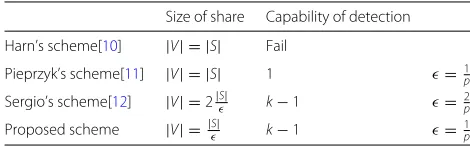
The cheating detection approach in our scheme is also efficient with other cheating detectable secret sharing schemes. Table 1 shows the comparisons between our scheme and other schemes in cheating detection. When comparing to those cheating detectable secret image shar-ing schemes [16–19], our scheme achieves much stronger capability. It can detect cheating from up tok−1 cheaters, while other schemes work only when there are less thank2 cheaters.
5 Conclusions
In this paper, we consider the well-known cheating problem in polynomial-based (k,n) secret image shar-ing scheme, such that a group of malicious partici-pants submit fake shadows during image reconstruction. In order to prevent such cheating behavior, we con-struct a (k,n) secret image sharing scheme with cheat-ing detection under the model of cheatcheat-ing detectable secret sharing scheme. Our scheme is capable of detect-ing the cheatdetect-ing from up to k − 1 cheaters with only Lagrange interpolations. In addition, the pro-posed scheme is based on the landmark Thien-Lin’s polynomial-based secret image sharing which can be eas-ily extended into other polynomial-based secret image sharing schemes. The size of shadow in our scheme is only k−11 times of the secret image, which is almost
Table 1Comparisons between cheating detectable secret sharing schemes
Size of share Capability of detection
Harn’s scheme[10] |V| = |S| Fail
Pieprzyk’s scheme[11] |V| = |S| 1 =1p
Sergio’s scheme[12] |V| =2|S| k−1 =2p
Proposed scheme |V| =|S| k−1 =1p
same as the shadow size in original (k,n) secret image sharing scheme.
6 Method
In this work, we aim to solve the cheating problem in polynomial-based secret image sharing scheme. Since polynomial-based secret image sharing is extended from traditional secret sharing scheme, we also used a cheat-ing detection algorithm in traditional secret sharcheat-ing in the field of secret image sharing. The experimental results are generated using Matlab software.
Funding
The research presented in this paper is supported in part by the China National Natural Science Foundation (No. 61502384, 61571360), Shaanxi Science and Technology Coordination and Innovation Project (No. 2016KTZDGY05-09), and the Innovation Project of Shaanxi Provincial Department of Education (No. 17JF023).
Availability of data and materials
Data sharing is not applicable to this article as no datasets were generated or analyzed during the current study.
Authors’ contributions
Y-XL contributed in algorithm designing; Q-DS was responsible for experiment and analysis; and C-NY took part in correctness checking. All authors read and approved the final manuscript.
Competing interests
The authors declare that they have no competing interests.
Publisher’s Note
Springer Nature remains neutral with regard to jurisdictional claims in published maps and institutional affiliations.
Author details
1Department of Computer Science and Engineering, Xi’an University of
Technology, Xi’an, China.2Department of CSIE, National Dong Hwa University,
Hualien County, Taiwan.
Received: 8 March 2018 Accepted: 21 March 2018
References
1. A Shamir, How to share a secret. Commun. ACM.22(11), 612–613 (1979) 2. YN Liu, C Cheng, JY Cao, T Jiang, An improved authenticated group key
transfer protocol based on secret sharing. IEEE Trans. Comput.62(11), 2335–2336 (2013)
3. CC Thien, JC Lin, Secret image sharing. Comput. Graph.26(5), 765–770 (2002)
4. CN Yang, YY Chu, A general(k,n)scalable secret image sharing scheme with smooth scalability. J. Syst. Softw.84(10), 1726–1733 (2011) 5. YX Liu, CY Yang, PH Yeh, Reducing shadow size in smooth scalable secret
image sharing. Secur. Commun. Netw.7(12), 2237–2244 (2014) 6. YX Liu, Scalable secret image sharing scheme with essential shadows.
Signal Proc. Image Commun.58, 49–55 (2017)
7. RZ Wang, Region incrementing visual cryptography. IEEE Signal Proc. Lett. 16(8), 659–662 (2009)
8. CN Yang, HW Shih, CC Wu, L Harn,kout ofnregion incrementing scheme in visual cryptography. IEEE Trans. Circ. Syst. Video Technol.22(5), 799–809 (2012)
9. CN Yang, YC Lin, CC Wu, inProc. IWDW2012, LNCS. Region in region incrementing visual cryptography scheme, vol. 7809, (2013), pp. 449–463 10. L Harn, C Lin, Detection and identification of cheaters in(t,n)secret
11. J Pieprzyk, XM Zhang, inProceedings of ACISP, LNCS 2384. Cheating prevention in linear secret sharing. (Springer, Heidelberg, 2002), pp. 121–135
12. C Sergio, P Carles, S German, Secret sharing schemes with detection of cheaters for a general access structure. Des. Codes. Crypt.25(2), 175–188 (2002)
13. K Kurosawa, S Obana, W Ogata, inProceedings of CRYPTO, LNCS 563.t-cheater identifiable(k,n)secret sharing schemes. (Springer, Heidelberg, 1995), pp. 410–423
14. S Obana, inProceedings of EUROCRYPT, LNCS 6632. Almost optimum t-cheater identifiable secret sharing schemes, (2011), pp. 284–302 15. YX Liu, Efficientt-cheater identifiable(k,n)secret sharing scheme for
t≤ k−22. IET Inf. Secur.8(1), 37–41 (2014)
16. CC Lin, WH Tsai, Secret image sharing with steganography and authentication. J. Syst. Softw.73, 405–414 (2004)
17. CN Yang, TS Chen, KH Yu, CC Wang, Improvements of image sharing with steganography and authentication. J. Syst. Softw.80, 1070–1076 (2007) 18. CC Chang, YP Hsieh, CH Lin, Sharing secrets in stego images with
authentication. Pattern Recog.41, 3130–3137 (2008)
19. CN Yang, JF Quyang, L Harn, Steganography and authentication in image sharing without party bits. Optics Commun.285, 1725–1735 (2012) 20. M Tompa, H Woll, How to share a secret with cheaters. J. Cryptol.1(3),