R E S E A R C H
Open Access
A fourth-order accurate difference Dirichlet
problem for the approximate solution of
Laplace’s equation with integral boundary
condition
Adiguzel Dosiyev
1*and Rifat Reis
1*Correspondence:
1Department of Mathematics, Near
East University, Nicosia, via Mersin 10, TRNC, Turkey
Abstract
A new constructive method for the finite-difference solution of the Laplace equation with the integral boundary condition is proposed and justified. In this method, the approximate solution of the given problem is defined as a sequence of 9-point solutions of the local Dirichlet problems. It is proved that when the exact solution u(x,y) belongs to the Hölder calssesC4,λ, 0 <
λ
< 1, on the closed solution domain, the uniform estimate of the error of the approximate solution is of orderO(h4), wherehisthe mesh step. Numerical experiments are given to support analysis made.
Keywords: Finite difference method; Nonlocal integral boundary condition; Laplace’s equation; Uniform error
1 Introduction
Different finite-difference problems as approximations of the nonlocal problems with in-tegral boundary condition have been studied by many authors (see [1–5] and references given therein). They all were basically focusing on the following difficulties related to the existence of a quadrature approximation of the integral condition on the side of the do-main where nonlocal condition was given: (i) finding an approximate solution by solving the obtained system of equations which are non-band matrices, (ii) determining the rate of convergence of the approximate solution by appropriate smoothness conditions on the given data. In [1], a system of finite difference equations for the Poisson problem has been studied for the spectrum of the matrix to apply an iterative method. Moreover, the author obtained some conditions, under which this system has a unique solution. In [2] and [3], for the error of approximate solution, the order of estimation ofO(h2) in the differenceW1 2
metric is obtained, wherehis the mesh step. In [4], the radial basis function collocation technique is used to find an approximate solution of an elliptic equation with nonlocal in-tegral boundary condition. In [5], a finite-difference approximation for the problem with integral boundary conditions is constructed by reducing the given problem to the prob-lem with nonlocal conditions containing derivatives. The authors proved that when the fourth-order partial derivatives of the exact solution are continuous on the closed
tion domain, the uniform estimate of orderO(h2|lnh|) is obtained for the error of the
approximate solution.
In this paper, we propose and justify a new constructive method to solve a system of non-local 9-point finite-difference problem for the Laplace equation with the integral boundary condition. The solution of this nonlocal difference problem is defined as a solution of the 9-point Dirichlet problem by constructing approximate values of the solution on the side where the integral condition was given. Therefore, the approximate solution is obtained by solving a system with 9 diagonal matrices, for the realization of which many fast al-gorithms have been proposed (see [6,7]). Moreover, the uniform estimate of the error of approximate solution is of orderO(h4) when the given boundary functions on the sides
be-long to the Hölder classesC4,λ, 0 <λ< 1. Finally, numerical experiments are demonstrated to support the theoretical results.
The proposed method with the 5-point scheme was announced in [8].
Other nonlocal boundary value problems are stated and developed in numerous papers (see [9–20] and references therein).
2 Nonlocal boundary value problem
Let
R=(x,y) : 0 <x<a, 0 <y<b
be an open rectangle,γm,m= 1, 2, 3, 4, be its sides including the endpoints, numbered in
the clockwise direction, beginning with the side lying on they-axis, and letγ =4m=1γm
be the boundary ofRandR=R∪γ. LetC0denote the linear space of continuous functions of one variablexon the interval [0,a] of thex-axis, and vanishing at the pointsx= 0 and
x=a. For a functionf∈C0, we define the norm
fC0=max 0≤x≤af(x).
It is clear that the spaceC0with this norm is complete.
Consider the following nonlocal boundary value problem:
u= 0 onR, u= 0 onγ1∪γ3, u=τ onγ2, (1)
u(x, 0) =α
b
ξ
u(x,y)dy+μ(x), 0 <x<a, 0 <ξ<b, (2)
where ≡∂2/∂x2+∂2/∂x2 is the Laplacian,τ =τ(x) and μ=μ(x) are given functions
which belong toC0, andαis a given constant which satisfies the following inequality:
|α|< 1
b–ξ. (3)
3 Nonlocal finite-difference problem and its reduction to the Dirichlet problem
We define a square mesh with sizeh=Na =Mb∗, whereN,M∗> 2 are integers, constructed
with the linesx,y=h, 2h, . . . . LetDhbe the set of nodes of this square grid and letRh=
R∩Dh,Rh=R∩Dh. We putγhm=γm∩Dh,m= 1, 2, 3, 4, andγ h=
4
Let
[0,a]h=
x=xi,xi=ih,i= 0, 1, . . . ,N,h= a
N
be the set of points divided by the step sizehon [0,a]. LetC0
h be the linear space of grid functions defined on [0,a]h that vanish atx= 0 and x=a. The norm of a functionfh∈C0
h is defined as
fhC0
h=x∈max[0,a]h
|fh|.
We introduce the operatorBhby
Buh(x,y)≡ u(x+h,y) +u(x–h,y) +u(x,y+h) +u(x,y–h)/5
+ u(x+h,y+h) +u(x+h,y–h) +
+u(x–h,y+h) +u(x–h,y–h)/20.
For the approximate solution of the nonlocal problem (1)–(2), we consider a solution of the following system of difference equations (see [1]):
uh=Buh onRh, uh= 0 onγh1∪γh3, uh=τh onγh2, (4)
uh(x, 0) =α
M
k=1
ρkuh(x,ηk) +μh onγh4, (5)
where equation (5) is obtained by approximating the integral in (2) and using Simpson’s rule withρ1=ρM=3h,ρj=h3(3 + (–1)j) forj= 2, 3, . . . ,M– 1,ηj=ξ+ (j– 1)h,j= 1, 2, . . . ,M, h= a
N, (M– 1)h+ξ=b,μhis the trace ofμonγ
4
h, and
ξ
his an integer.
We reduce a solution of the nonlocal differential problem to the solution of the local Dirichlet problem.
Letvhbe the solution of the finite-difference Dirichlet problem
vh=Bvh onRh, vh=τh onγh2, vh= 0 onγh/γh2, (6)
and we put
ϕi,h(x) =vh(x,ηi), i= 1, 2, . . . ,M, (7)
whereτhis the trace ofτ onγh2.
Letwhbe a solution of the following finite difference Dirichlet problem:
wh=Bwh onRh, wh= 0 onγh/γh4, wh=fh onγh4, (8)
wherefh∈Ch0, is an arbitrary function.
We define a linear operatorBh
i fromCh0toCh0as follows:
Bhifh(x) =wh(x,ηi), i= 1, 2, . . . ,M, (9)
Let
w∗h(x,y) = 1
bfhCh0(b–y) onRh.
We have
wh(x,y)≤w∗h(x,y), (x,y)∈γh. (10)
Sincew∗h=Bw∗honRh, from (9)–(10) and by a comparison theorem (see [21, Chap. 4]),
we have
BhifhC0
h≤ fhC0
h
1 –ξ+ (i– 1)h
b
, i= 1, 2, . . . ,M, (11)
and then for the norm of operatorBh i, we get
Bhi< 1, i= 1, 2, . . . ,M. (12)
Let
ϕh=α M
k=1
ρkϕk,h(x), x∈[0,a]h, (13)
whereϕk,h(x) is the function from (7).
In the view of inequality (3), we have
|α|
M
k=1
ρk=q0< 1. (14)
Inequalities (12) and (14) yield
q0Bh1=q< 1. (15)
Lemma 1 A solution of the finite difference problem(4)–(5)can be represented as
uh=vh+wh, (16)
where vhis the solution of problem(6)and whis the solution of problem(8)withfhbeing a solution of the following nonlinear equation:
fh=ϕh+μh+α M
k=1
ρkBhkfh onγh4. (17)
From (13) and (17), it follows that
Thus, the unknown function onγh4in problem (8) is a solution of the nonlinear equation (17).
Theorem 2 There exists a unique solutionfhof the nonlinear equation(17).
Proof Consider the following sequences inC0
h:
From this, for the positive integersmandnwithm>n, we get
Applying inequality (11), we reach
ψim,h–ψin,hC0
h≤q
ψim,h–1–ψin,h–1C0
h, (19)
whereqis defined by (15). In a similar way, from (19) we obtain
ψim,h–ψin,hC0
which shows that sequences (18) are Cauchy. SinceCh0is complete, there are limits
lim n→∞ψ
n
By using (11) and (15),
In view of relations (17) and (22), we obtain a solution of the nonlinear equation (17) as
fh=ϕh+μh+α
Then, we obtain the following inequality:
fh,1–fh,2Ch0=
4 Convergence of the finite-difference problem
We say that F∈Ck,λ(E), ifF haskth derivatives onE satisfying Hölder condition with
Hence, for the approximate solution of the nonlocal problem (1)–(2), we define the fol-lowing difference problem:
unh=Bhunh onRh, unh=τh onγh2, unh= 0 onγh1∪γh3, (24) unh=fhn onγh4. (25)
Theorem 3 The following estimate holds:
whereunh is a solution of problem(24)–(25),u is the exact solution of nonlocal boundary value problem(1)–(2),c1and c∗are constants independent of h,q0is defined by(14),and
q1= 1 –ξb.
Proof LetUbe the exact solution of the system of the following problem:
U= 0 onR, U=τ onγ2, U= 0 onγ1∪γ3, (27)
U(x, 0) =α
M
k=1
ρkU(x,ηk) +μ(x), 0≤x≤a. (28)
LetVbe a solution of the Dirichlet problem
V= 0 onR, V=τ onγ2, V= 0 onγ/γ2, (29)
and denote by
ϕk(x) =V(x,ηk) fork= 1, 2, . . . ,M, (30)
whereηk=ξ+ (k– 1)h,k= 1, 2, . . . ,M. We define the function
ϕ=α
M
k=1
ρkϕk. (31)
Consider the Dirichlet problem
W= 0 onR, W= 0 onγ/γ4, W=f onγ4, (32)
wheref is an unknown function fromC0. The linear operatorBi:C0→C0is defined as
Bif(x) =W(x,ηi)∈C0, i= 1, 2, . . . ,M.
Then following inequality holds for the norm|Bi|:
|Bi|<
1 –ξ+ (i– 1)h
b
, i= 1, 2, . . . ,M.
By analogy with the results in [18], it is shown that a solutionUof problem (27)–(28) can be represented asU=V+WwhereVandW are the solutions of problem (29) and (32), respectively, whenf is defined by
f =ϕ+μ+α
M
k=1
ρkψk. (33)
Here the functions ψ1,ψ2, . . . ,ψM are fromC0, and are defined as the solutions of the
nonlinear equations
ψi=Bi
ϕ+μ+α
M
k=1
ρkψk
Therefore, the nonlocal problem (27)–(28) is reduced to the following Dirichlet problem:
U= 0 onR, U=τ onγ2, U= 0 onγ1∪γ3, (35)
U(x, 0) =f, 0≤x≤a, (36)
wheref is defined by (33). The solutionψi,i= 1, 2, . . . ,M, of system (34) is found as a limit
of the infinite sequence of functions{ψin}∞n
=0inC
0defined by
ψi0= 0, ψin=Bi
ϕ+μ+α
M
k=1
ρkψkn–1
,
i= 1, 2, . . . ,M;n= 1, 2, . . . . (37)
Sinceτ(x) in (29) belongs toC4,λ(γ2) andτ(2m)(0) =τ(2m)(a) = 0,m= 0, 1, 2, it follows from
[22] that
max
(x,y)∈Rh|
vh–Vh| ≤c2h4, (38)
wherevhis a solution of problem (6),Vhis the trace of the solution of (29) onRhandc2is
a constant independent ofh. Letϕh,ψi,h, andψin,hbe the trace ofϕ,ψi, andψinon [0,a]h,
respectively, and let (Bi(F))hbe the trace ofBi(F) on [0,a]hfor any functionF∈C4,λ[0,a].
By (7), (13), (30), (31), and (38), we obtain
ϕh–ϕhCh0≤c3h4, (39)
where c3 is a constant independent ofh. By using (18) and (37), we have, for all i=
1, 2, . . . ,M,
ψi1,h–ψi1,hC0
h≤
Bhi(ϕh–ϕh)C0
h
+Bhi(ϕh+μh) – Bi(ϕ+μ)
hCh0. (40)
Applying (11) and (39), it follows that
Bhi(ϕh–ϕh)C0
h≤c4h
4, i= 1, 2, . . . ,M, (41)
wherec4is a constant independent ofh. Similar to inequality (38), we have
Bhi(ϕh+μh) – Bi(ϕ+μ)
hCh0≤c5h
4, (42)
wherec5is a constant independent ofh. From the relations (40)–(42), we have
ψi1,h–ψi1,h
C0h≤c6h
wherec6is a constant independent ofh. Forn≥2, we have
By analogy with (54) in [20], it follows that
max
1≤k≤M
Bhiψkn–1– Biψkn–1
hCh0≤c7h
4, (45)
wherec7is a constant independent ofh. From (45), we find that
wherec10andc11are constants independent ofh. According to (37), it follows that
ψin–ψin–1
C0≤ |Bi||α|
M
k=1
|ρk|ψin–1–ψin–2C0, i= 1, 2, . . . ,M, (50)
whereϕis defined by (31). From (49) and (50), we have
ψin–ψin–1
C0≤q1n ϕC0+μC0, i= 1, 2, . . . ,M,
whereq1= 1 –ξb. Moreover, for anym= 1, 2, . . . , we obtain
ψin+m–ψinC0≤qn1+1
1 –qm1
1 –q1
ϕC0+μC0
, i= 1, 2, . . . ,M. (51)
Since
ψin–ψiC0≤ψin+m–ψinC0+ψin+m–ψiC0, i= 1, 2, . . . ,M, (52)
by taking the limit asm→ ∞, from (51) and (52), it follows that
ψin–ψiC0≤
qn1+1
1 –q1
ϕC0+μC0
, i= 1, 2, . . . ,M. (53)
From (48) and (53), we have
ψin,h–ψi,hC0
h≤c11h
4+ qn1+1
1 –q1
ϕC0+μC0
, i= 1, 2, . . . ,M. (54)
LetUh(x,y) be the solution of the system of grid equations
Uh=BhUh onRh, Uh=τ onγh2, Uh= 0 onγh1∪γh3, (55)
Uh=fh onγh4, (56)
which approximates problem (35)–(36) whenfhis the trace off on [0,a]h. Sinceτ,μ,ϕ,
andψi,i= 1, 2, . . . ,M, belong toC4,λ, 0 <λ< 1, on the interval 0≤x≤1, and the (2m)th
order derivatives vanish at the endpoints form= 0, 1, 2 (see [20]), by [22], we have
max
(x,y)∈Rh|
Uh–U| ≤c12h4, (57)
whereUis the solution of problem (35)–(36) andc12is a constant independent ofh. In
view of inequalities (39) and (54), we obtain
fhn–fhC0
h≤c13h
4+q 0
qn1+1
1 –q1
ϕC0+μC0
, (58)
whereq0is defined by (14) andc13is a constant independent ofh. By the grid maximum
principle and from (58), we have
max
(x,y)∈Rh
unh–Uh≤c13h4+q0
qn1+1
1 –q1
ϕC0+μC0
whereunhis the solution of problem (24)–(25) andUhis the solution of problem (55)–(56). According to estimates (57) and (59), the following inequality holds:
max
whereUis the solution of problem (35)–(36) andc14is a constant independent ofh.
Using the estimate (60) and by the maximum principle for the Laplace equation with the truncation error of Simpson’s rule, which is order ofO(h4), we obtain the final estimate
max
From (62) it follows that
Table 1 Solutions on the liney= 0 of Problem1
h= 1/16 h= 1/32 h= 1/64 h= 1/128
1.06874E–003 1.06873E–003 1.06874E–003 1.06877E–003
2.09641E–003 2.09639E–003 2.09641E–003 2.09647E–003
3.04351E–003 3.04350E–003 3.04352E–003 3.04361E–003
3.87366E–003 3.87364E–003 3.87366E–003 3.87378E–003
4.55494E–003 4.55491E–003 4.55495E–003 4.55508E–003
5.06118E–003 5.06115E–003 5.06119E–003 5.06134E–003
5.37292E–003 5.37289E–003 5.37293E–003 5.37309E–003
5.47818E–003 5.47815E–003 5.47819E–003 5.47835E–003
5.37292E–003 5.37289E–003 5.37293E–003 5.37309E–003
5.06118E–003 5.06115E–003 5.06119E–003 5.06134E–003
4.55494E–003 4.55491E–003 4.55495E–003 4.55508E–003
3.87366E–003 3.87364E–003 3.87366E–003 3.87378E–003
3.04351E–003 3.04350E–003 3.04352E–003 3.04361E–003
2.09641E–003 2.09639E–003 2.09641E–003 2.09647E–003
1.06874E–003 1.06873E–003 1.06874E–003 1.06877E–003
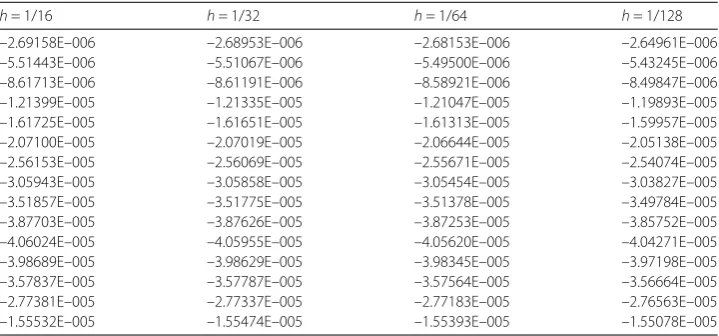
Table 2 Solutions on the liney= 0 of Problem2
h= 1/16 h= 1/32 h= 1/64 h= 1/128
–2.69158E–006 –2.68953E–006 –2.68153E–006 –2.64961E–006
–5.51443E–006 –5.51067E–006 –5.49500E–006 –5.43245E–006
–8.61713E–006 –8.61191E–006 –8.58921E–006 –8.49847E–006
–1.21399E–005 –1.21335E–005 –1.21047E–005 –1.19893E–005
–1.61725E–005 –1.61651E–005 –1.61313E–005 –1.59957E–005
–2.07100E–005 –2.07019E–005 –2.06644E–005 –2.05138E–005
–2.56153E–005 –2.56069E–005 –2.55671E–005 –2.54074E–005
–3.05943E–005 –3.05858E–005 –3.05454E–005 –3.03827E–005
–3.51857E–005 –3.51775E–005 –3.51378E–005 –3.49784E–005
–3.87703E–005 –3.87626E–005 –3.87253E–005 –3.85752E–005
–4.06024E–005 –4.05955E–005 –4.05620E–005 –4.04271E–005
–3.98689E–005 –3.98629E–005 –3.98345E–005 –3.97198E–005
–3.57837E–005 –3.57787E–005 –3.57564E–005 –3.56664E–005
–2.77381E–005 –2.77337E–005 –2.77183E–005 –2.76563E–005
–1.55532E–005 –1.55474E–005 –1.55393E–005 –1.55078E–005
The exact solutions of Problems1and2are unknown. The approximate values of Prob-lems1and2on the liney= 0 obtained by the proposed method are given in Tables1and2, respectively. According to repeated digits, for the decreasing mesh stepsh=161,321,641,1281 , it follows that the maximum error on this line decreases asO(h4). To obtain these results,
14 iterations are run for the construction offhnwith the successive error which is less than 10–16.
Problem 3
u= 0 onR, u(0,y) =u(1,y) = 0, 0≤y≤2,
u(x, 2) =e2πsinπx, 0≤x≤1,
u(x, 0) = 1 100
2
1 16
u(x,y)dy+μ(x), 0 <x< 1,
whereu=eπysinπxis the exact solution,μ(x) = [1 +α π(1 –e2
Table 3 Maximum errors for the solution of Problem3
h Max error Order of reduction
1/16 1.40629393×10⁻⁹
1/32 8.77042882×10⁻¹¹ 16.03449
1/64 5.47739631×10⁻¹² 16.01203
1/128 3.42279360×10⁻¹³ 16.00270
Table 4 CPU times (in seconds) for Problem1
h Discrete Fourier Gauss–Seidel
with reducing
Gauss–Seidel without reducing
1/16 0.10125 0.13325 0.65250
1/32 1.58375 2.27125 6.70625
1/64 19.87500 25.15375 81.11175
1/128 284.72625 467.22025 1325.14725
Table 5 CPU times (in seconds) for Problem2
h Discrete Fourier Gauss–Seidel
with reducing
Gauss–Seidel without reducing
1/16 0.19115 0.23565 0.71300
1/32 2.00135 3.97115 8.12375
1/64 26.6875 37.35625 90.72425
1/128 355.62775 580.22315 1798.54315
Table 6 CPU times (in seconds) for Problem3
h Discrete Fourier Gauss–Seidel
with reducing
Gauss–Seidel without reducing
1/16 0.11375 0.12125 0.62500
1/32 1.28437 2.18375 5.78125
1/64 17.96875 24.35625 79.23375
1/128 278.82815 443.0125 1243.84875
In Table3for Problem3, the maximum error for each steph=21k,k= 4, 5, 6, 7 and the
reduction orders are given. From the third column it follows that the convergence order isO(h4).
In Tables4,5, and6, the results of the CPU times (in seconds), when solving Problems1, 2, and3, respectively, are given. In columns 2 and 3, the CPU times for the realization of the proposed approaches by the discrete Fourier method and by the Gauss–Seidel method are given. For the construction of the local functionfhnfor Problems1and2, just 14 iterations are used. Problem3needs 11 iterations. In column 4, the Gauss–Seidel method is used to solve the given problems without reducing to the Dirichlet problem. From these results it follows that the discrete Fourier method, which cannot be used on the problem without reducing to the Dirichlet problem, is faster than others. The third and fourth columns show that for the method which is applicable for both approaches (as Gauss–Seidel), the CPU times with reducing are less than the CPU times without reducing to the Dirichlet problem.
6 Conclusion
A new constructive method for the approximate solution of the nonlocal boundary value for Laplace’s equation with integral boundary condition is given. In the proposed method, the system of finite-difference equations is defined as the 9-point solution of the Dirich-let problem by constructing the function on the side of the rectangle where the nonlocal boundary condition was given. This function is defined by using thenth term of the con-vergent simplest fixed point iteration (18) for the solution of the nonlinear system of (21). A uniform estimate for the error of the approximate solution of the nonlocal problem by using thenth term forn=max{[(lnh4(1 –q1))/lnq1], 1}is of orderO(h4), wherehis the
step size.
The proposed method gives an opportunity to solve nonlocal problems by using differ-ent fast algorithms constructed for the local Dirichlet problem by many authors (see [6] and the references therein).
Funding
Not applicable.
Competing interests
The authors declare that they have no competing interests.
Authors’ contributions
All authors contributed equally to the writing of this paper. All authors read and approved the final manuscript.
Publisher’s Note
Springer Nature remains neutral with regard to jurisdictional claims in published maps and institutional affiliations.
Received: 11 February 2019 Accepted: 1 August 2019 References
1. Sapagovas, M.P.: Difference method of increased order of accuracy for the Poisson equation with nonlocal conditions. Differ. Equ.44(7), 1018–1028 (2008)
2. Berikelashvili, G.K.: On the convergence of difference schemes for the third boundary value problem of elasticity theory. Comput. Math. Math. Phys.41(8), 1182–1189 (2001)
3. Berikelashvili, G.K., Khomeriki, N.: On the convergence of difference schemes for one nonlocal boundary value-problem. Lith. Math. J.52(4), 353–363 (2012)
4. Sajavicius, S.: Radial basis function method for a multidimensional linear elliptic equation with nonlocal boundary conditions. Comput. Math. Appl.67(7), 1407–1420 (2014)
5. Zhou, L., Yu, H.: Error estimate of a high accuracy difference scheme for Poisson equation with two integral boundary conditions. Adv. Differ. Equ.2018, 225 (2018)
6. Samarskii, A.A., Nikolaev, E.S.: Numerical Methods for Grid Equations, Vol. I, Direct Methods. Birkhäuser, Basel (1989) 7. Samarskii, A.A., Nikolaev, E.S.: Numerical Methods for Grid Equations, Vol. II, Iterative Methods. Birkhäuser, Basel (1989) 8. Dosiyev, A.A., Reis, R.: An approximate grid solution of a nonlocal boundary value problem with integral boundary
condition for Laplace’s equation. ITM Web Conf.22, 01016 (2018)
9. Bitsadze, A.V., Samarskii, A.A.: On some simplest generalizations of linear elliptic problems. Dokl. Akad. Nauk SSSR
185(4), 739–740 (1969)
10. Gurbanov, I.A., Dosiyev, A.A.: On the numerical solution of nonlocal boundary problems for quasilinear elliptic equations. In: Approximate Methods for Operator Equations, pp. 64–74. Baku State University, Baku (1984) 11. II’in, V.A., Moiseev, E.I.: Two-dimensional nonlocal boundary value problems for Poisson’s operator in differential and
difference variants. Math. Model.2, 139–150 (1990)
12. Gordeziani, N., Natalini, P., Ricci, P.E.: Finite-difference methods for solution of nonlocal boundary value problems. Comput. Math. Appl.50, 1333–1344 (2005)
13. Skubachevskii, A.L.: On necessary conditions for the Fredholm solvability of nonlocal elliptic equations. Proc. Steklov Inst. Math.260(1), 238–253 (2008)
14. Ashyralyev, A., Ozturk, E.: On Bitsadze–Samarskii type nonlocal boundary value problems for elliptic differential and difference equations. Well posedness. Appl. Math. Comput.219, 1093–1107 (2012)
15. Ashyralyev, A., Ozturk, E.: On a difference scheme of fourth order of accuracy for the Bitsadze–Samarskii type nonlocal boundary value problem. Math. Methods Appl. Sci.36, 936–955 (2013)
16. Volkov, E.A.: Approximate grid solution of a nonlocal boundary value problem for Laplace’s equation on a rectangle. Comput. Math. Math. Phys.53(8), 1128–1138 (2013)
17. Volkov, E.A., Dosiyev, A.A., Buranay, S.C.: On the solution of a nonlocal problem. Comput. Math. Appl.66, 330–338 (2013)
19. Volkov, E.A., Dosiyev, A.A.: On the numerical solution of a multilevel nonlocal problem. Mediterr. J. Math.13, 3589–3604 (2016)
20. Dosiyev, A.A.: Difference method of fourth order accuracy for the Laplace equation with multilevel nonlocal conditions. J. Comput. Appl. Math. (2018).https://doi.org/10.1016/j.cam.2018.04.046
21. Samarskii, A.A.: The Theory of Difference Schemes. Dekker, New York (2001)