R E S E A R C H
Open Access
Low complexity precoding codebook
design based on DFRST for limited feedback
precoded OSTBC systems
Han Hai
1, Xue-Qin Jiang
2, Yongchae Jeong
1and Moon Ho Lee
1*Abstract
Precoding techniques can be used in multiple input multiple output (MIMO) system to assign resources such as power and information optimally. This paper is concerned with limited feedback in precoded orthogonal space time block code (OSTBC) systems, which is a precoding technique for incomplete channel information response. The conventional approach to design the precoding codebook is based on the discrete Fourier transform (DFT) matrix, which has high computational complexity. In this paper, a new approach to design the precoding codebook for the limited feedback precoded OSTBC systems is proposed, which is based on the discrete fractional sine transform (DFRST) matrix. The proposed DFRST-based precoding codebook design approach has lower computational complexity comparing to that of the DFT-based design with very similar bit error rate (BER) performance.
Keywords: MIMO, OSTBC, Precoding, Codebook, DFRST
1 Introduction
Multiple input multiple output (MIMO) systems are widely used in many practical wireless communications system [1–4]. MIMO systems can increase channel capac-ity gain (multiplexing gain) by using multiple transmit antennas and receive antennas. Some techniques have been developed to improve the performance at transmit-ter and the receiver by using appropriate signal processing techniques, e.g., the V-BLAST [5] scheme.
MIMO systems with precoding for orthogonal STBC (OSTBC) by using limited feedback was proposed in [6] and then investigated in [7–10]. This precoding technique for the MIMO system can improve the system perfor-mance significantly by using the channel state information (CSI) [11–14] at the transmitter. This system model with limited feedback studied by Love and Heath in [7] has been adopted in many communication systems, such as the Long Term Evolution (LTE) [1–4] and spatial modula-tion [15, 16]. The CSI at the transmitter should be updated
*Correspondence: [email protected]
1Division of Electronics and Information Engineering, Chonbuk National University, 567 Baekje-daero, deokjin-gu, Jeonju 54896, Korea Full list of author information is available at the end of the article
with the channel varying in a time varying channel. How-ever, the feedback channel capacity is always limited in the practical system; therefore, it is impossible to use full CSI to select precoder. Hence, the index of the precoder can be obtained based on the CSI. Then, the corresponding index can be fed back to the transmitter instead of full CSI.
The conventional precoding codebook design approach proposed by Love and Heath is based on discrete Fourier transform (DFT) matrix, which is called unitary precod-ing. The idea of unitary precoding is as follows: a pre-coding codebookP = P1,P2,. . .,PQ
is first designed based on the DFT matrix. The optimal precoderPi can
be chosen from the codebookP. Then, the correspond-ing precodcorrespond-ing index i can be determined based on the optimal precoderPiand feed the indexiback to the
trans-mitter. Obviously, the quality of precoder improved with the increase of the codebook sizeQ. AndL = log2Q feedback bits determine the codebook size Q. The con-ventional approach to design the codebook is based on the DFT matrix [17]. However, this design approach is of high computational complexity.
In this paper, we propose a new approach to design the precoding codebook. Differing from the conventional approach, this new design approach is based on the dis-crete fractional sine transform (DFRST) matrix [17]. We
show that the DFRST-based codebook design approach has lower computational complexity than that of the con-ventional approach without bit error rate (BER) perfor-mance loss.
Notations: Bold lowercase and capital letters are used for vectors and matrices, respectively.(·)Hdenotes Hermitian transposition. A complex Gaussian distribution with meanuand varianceσ2 is denoted byCN(u,σ2).·is used for flooring operation. A hat over the variable name is used to signify the detected signals; E{·} denotes the expectation.U(Mt,M)denotes the set ofMt×M
matri-ces with orthonormal columns. · Fis used to represent
the Frobenius norm of a vector, andλi{A}denotes thei-th
largest singular value of the matrixA.
2 Preliminary
In this section, we introduce some background concepts that will be used throughout this paper.
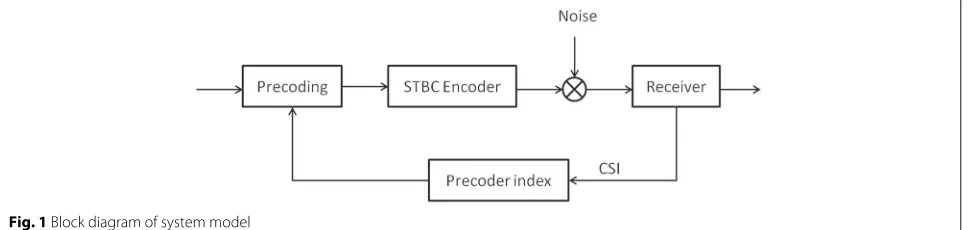
Consider a limited feedback precoded OSTBC system with Mt transmit antennas and Mr receive antennas,
shown in Fig. 1, over a Rayleigh fading channel [18, 19]. Assume thatP = P1,P2,. . .,PQ
is constructed before the transmission at both the transmitter and the receiver, and there is an L-bit error-free feedback channel from the receiver to the transmitter. First, an optimal precod-ing matrix Pi in the codebookP can be selected based
according to the following formula [7]
Pi=arg min Pi∈PHPi
2
F. (1)
Then, the index iof Pi is conveyed to the transmitter
from the receiver by using theL bits feedback channel. Then, theMdata symbols are mapped intoMt transmit
antennas via the precoding matrixPi at the transmitter.
LetX=[x1,· · ·,xT] be anM×T space-time codeword
whoset-th columnXtspecifies the OSTBC encoder
out-put at the t-th time slot. The received signal can be formulated as
Mt channel matrix with independent entries distributed
according to CN(0, 1), and Z is an Mr × T noise
matrix with independent entries distributed according to
CN(0, 1). Finally, the receiver performs the maximum likelihood (ML) decoding on the received signals by
ˆ
The discrete fractional sine transform matrix was pro-posed in [17], which is given by
SN=
whereNis the size of DFRST kernel. This DFRST matrix will be used in the proposed design approach which has lower computational complexity compared to the conven-tional approach.
3 Codebook design approach based on DFRST
In this section, we propose a new approach to design the precoding codebookPbased on the DFRST matrix.
3.1 Problem formulation
Consider the total effective power HPi2F in (2), where
Pi ∈ P. The loss in received channel power is expressed
as minP∈PHPopt2F− HPi2F
, wherePoptis the
opti-mal precoding matrix. As a measure of distortion, the average of the loss in received channel power is given as EminP∈PHPopt2F− HPi2F
.
SinceHPopt2F ≥ HPiF2 for allP ∈ U(Mt,M), the
loss in received channel power is always non-negative and upper-bounded by [7] in received channel power can be minimized by doing
the minimization E
This minimization problem equivalents to maximize the minimum subspace distance between any pair{Pk,Pt}of
codebook column spaces [8, 20, 21]. In another word, the codebookP = {P1,P2,. . .,PQ}is designed to maximize
3.2 Proposed codebook design approach
In this subsection, we propose a new codebook design approach as follows.
Firstly, construct the precoding matrix PR. TheMt×M
matrixPRis formed by anyMcolumns of theMt ×Mt
DFRST matrix as follows,
PR=
the set that contains all the possible combinations ofu=
u1,u2,. . .,uMt−1, for anyk∈[1,Mt−1],uk∈[0,Q−1] .
The precoding codebook P can be stored at the transmitter/receiver using(Mt−1)log2Q
bits as only u1,u2,. . .,uMt−1must be stored. Then, the chosen
pre-coding matrixPiat the transmitter, corresponding to the
feedback index i, can be easily calculated by computing
i−1P
R,i = 2, 3,. . .,Q. The proposed codebook design
approach can be described by Algorithm 1. Note that the
proposed approach is to design the codebook for the pre-coding system, and this procedure can be completed off-line. Therefore, the proposed approach can be applied into the different scenarios, including different transmit anten-nas, receive antenanten-nas, and modulation scheme. Hence, the proposed approach can be applied for vast number of data transmission.
Algorithm 1Proposed codebook design
1: Initialization: Set DFRST matrixSN,and the size of
precoding matrixMt,M.
2: Construct the precoding codeword matrix PR:
3: fork=1 toMtdo
33: Construct the codebook:
34: P = {P1,P2,. . .,Pi,. . .,PQ},wherePi= i−1PR,i=
1, 2,. . .,Q.
4 Performance and complexity analysis
of the OSTBC system with the DFRST precoders is very similar to that with the conventional one. How-ever, from the complexity analysis, we can see that the proposed precoding codebook design approach has lower computational complexity. The OSTBC system with the DFRST precoders have been simulated in the following examples. For comparison, the OSTBC with the DFT precoders has also been simulated [7]. The channel models in all the schemes are Rayleigh fading channels.
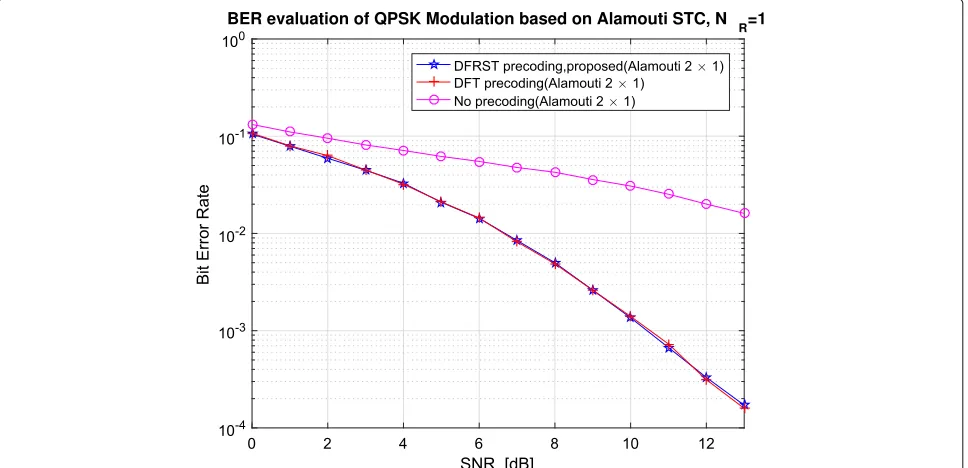
Example 1The first example compares the OSTBC with the DFRST precoders and DFT precoders on a 2 × 1 MIMO system. Both of them use Alamouti codes [22] and QPSK. The BER performance for the2×1Alamouti code is also shown for comparison. The simulation results are shown in Fig. 2. In all simulations, 6 bits feedback and the ML detection are used. It can be seen that the BER performance of DFRST-based precoding code-books is very similar to that of the DFT-based precoding codebooks.
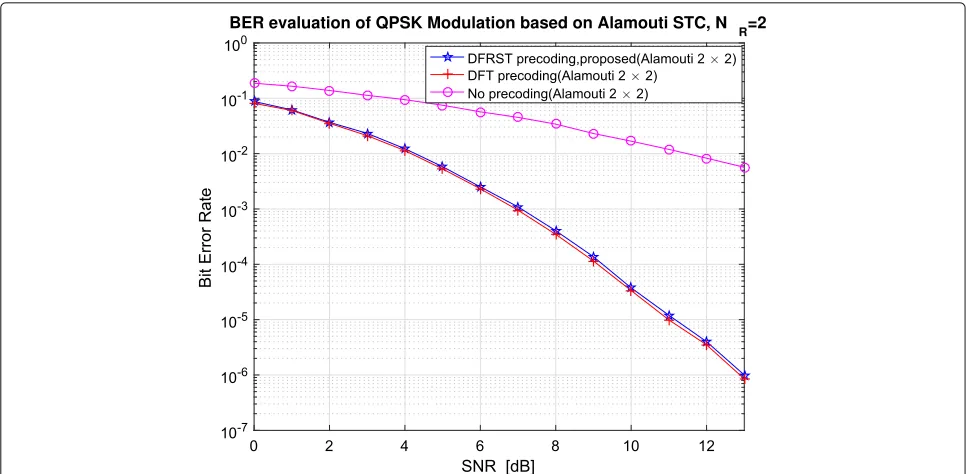
Example 2Figure 3 considers a 2 × 2 OSTBC sys-tem using the precoded Alamouti code and QPSK mod-ulation. Three cases are considered: the OSTBC with the DFRST precoders, the OSTBC with the DFT pre-coders, and the OSTBC system without precoding. The feedback rate is 6 bits and the simulation results are shown in Fig. 2. In all simulations, the ML detection is used. It can be seen that the BER performance of DFRST
precoding codebooks is very similar to that of the DFT codebooks.
Let us analyze the computational complexity of the proposed precoding codebook design approach. In order to construct the rotation matrix , we must determine the integers u = [u1,. . .,uMt−1] from (10). Based on
the equation , we compute (10) for every possible val-ues of u1,. . .,uMt−1 and i. For each ui ∈ u,i =
1, 2,. . .,Mt − 1, there are Q different possibilities that
must be considered, which means that there are QMt−1 different possibilities for . Moreover, there are Q− 1 different possibilities for i that must be considered. It is possible to do an exhaustive search over all possibil-ities of u in set Z if the transmit antennas number or low feedback bits is small. Therefore, exhaustive search can be employed for designing codebookP. This method tests all the possible values of u in the set Z to opti-mize the cost function (10). Therefore, the computa-tional complexity of DFRST codebook design approach is QMt−1(Q− 1). However, the conventional precoding codebook design approach must determine the integers u1,. . .,uMt, which means that there are QMt different
possibilities for the rotation matrix in conventional codebook design approach. Therefore, the computational complexity of conventional codebook design approach is QMt(Q − 1). To measure the computational complex-ity of proposed approach, we define the computational complexity reduction ration (CCRR), which is given by the formula:
Fig. 3BER evaluation of QPSK Modulation based on Alamouti code(2×2)with 6 bits feedback
β = Cc−CP
CC =
1− CP CC
, (11)
whereCP denotes number of computations in proposed
approach and CC denotes number of computations in
conventional approach.
Table 1 shows the comparison of the computational pay-load for the precoding codebook design approach. We compare the computational complexity in 4× 4, 8×8, and 16×16 MIMO systems with 4, 6 and 8 bits feedback, respectively. Comparing with the DFT-based precoding codebook design approach, our DFRST-based approach reduce 93.75% of the computational complexity when 4 transmit antennas with 4 bits feedback are used. It can be seen that the CCRR increases as the number of antennas also increased as the number of feedback bits increases.
Table 1Comparison of the computational payload for
codebook design approach
MIMO Feedback DFT DFRST CCRR
4×4 2 bits 768 192 75%
4 bits 983,040 61,440 93.75%
6 bits 1.057×10⁹ 1.652×10⁷ 98.44%
6×6 2 bits 12,288 3072 75%
4 bits 2.517×10⁹ 1.573×10⁷ 93.75%
6 bits 4.329×10¹² 6.765×10¹⁰ 98.44%
8×8 2 bits 196,608 49,152 75%
4 bits 6.443×10¹⁰ 4.027×10⁹ 93.75%
6 bits 1.773×10¹⁶ 2.771×10¹⁴ 98.44%
Note that DFRST is proposed based on the DST in [17]. In this paper, we used the kernel matrix (8) of DFRST to design the codebooks. Based on the special structure of DFRST, the kernel matrix of DFRST is different from the kernel matrix of DFT. More specifically, DFRST has a smaller size of kernel matrix [17]. Therefore, the pro-posed approach can reduce the computational complexity comparing to the conventional DFT approach.
5 Conclusions
In this paper, we have proposed a new approach to design the precoding codebook for the precoded OSTBC systems with limited feedback. The proposed approach was based on DFRST matrix. Since DFRST matrix has a simpler structure than that of the DFT matrix, this can reduce the computational complexity of codebook design approach fromQMt(Q−1)toQMt−1(Q−1)than that of the DFT matrix with very similar BER performance.
Acknowledgements
This work was supported by the Brain Korea 21 PLUS Project, NRF, Korea; MEST (2015R1A2A1A05000977), NRF, Korea; and National Natural Science Foundation of China (61671143).
Competing interests
The authors declare that they have no competing interests.
Publisher’s Note
Springer Nature remains neutral with regard to jurisdictional claims in published maps and institutional affiliations.
Author details
Received: 16 February 2017 Accepted: 22 May 2017
References
1. D Astely, E Dahlman, A Furuskar, Y Jading, M Lindstrom, S Parkvall, LTE: the evolution of mobile broadband. IEEE Commun. Mag.47(4), 44–51 (2009) 2. O-S Shin, SE Elayoubi, YK Jeong, Y Shin, Advanced technologies for LTE
advanced. EURASIP J. Wirel. Commun. Netw.2013, 25 (2013) 3. T-T Tran, Y Shin, O-S Shin, Overview of enabling technologies for 3GPP
LTE-advanced. EURASIP J. Wirel. Commun. Netw.2012(1), 54 (2012) 4. D Martin-Sacristan, JF Monserrat, J Cabrejas-Penuelas, D Calabuig,
S Garrigas, N Cardona, On the way towards fourth-generation mobile: 3GPP LTE and LTE-advanced. EURASIP J. Wirel. Commun. Netw.2009, 354089 (2009)
5. G Foschini, Layered space-time architecture for wireless communication in a fading environment when using multielement antennas. Bell Labs Tech. J.1(2), 41–59 (1999)
6. V Tarokh, H Jafarkhani, AR Calderbank, Space-time block codes from orthogonal designs. IEEE Trans. Inf. Theory.45, 1456–1467 (1999) 7. DJ Love, RW Heath Jr, Limited feedback unitary precoding for orthogonal
space-time block codes. IEEE Trans. Signal Process.53(1), 64–73 (2005) 8. DJ Love, RW Heath, Limited feedback unitary precoding for spatial
multiplexing systems. IEEE Trans. Inf. Theory.51(8), 2967–2976 (2005) 9. P Cheng, Z Chen, Y Rui, Limited feedback unitary precoding for MIMO full
stream transmission. IEEE Trans. Veh. Tech.63(8), 4092–4096 (2014) 10. A Medra, TN Davidson, Flexible codebook design for limited feedback
systems via sequential smooth optimization on the Grassmannian manifold. IEEE Trans. Signal Process.62(5), 1305–1318 (2014) 11. A Gran, Rayleigh fading multi-antenna channels. EURASIP J. Adv. Signal
Process.2002(3), 260208 (2002)
12. B Makki, T Eriksson, Multiuser diversity in correlated Rayleigh-fading channels. EURASIP J. Wirel. Commun. Netw.2012(1), 38 (2012) 13. SK Chronopoulos, V Christofilakis, G Tatsis, P Kostarakis, Performance of
turbo coded OFDM under the presence of various noise types. Wirel. Personal Commun.87(4), 1319–1336 (2016)
14. SK Chronopoulos, V Christofilakis, G Tatsis, P Kostarakis, Preliminary BER study of a TC-OFDM system operating under noisy conditions. J. Eng. Sci. Technol. Rev.9(4), 13–16 (2016)
15. MC Lee, WH Chung, T-S Lee, Limited feedback precoder design for spatial modulation in MIMO systems. IEEE Commun. Lett.19(11), 1909–1912 (2015) 16. Z Bouida, A Ghrayeb, KA Qaraqe, Adaptive spatial modulation for
spectrum sharing systems with limited feedback. IEEE Trans. Comm.
63(6), 2001–2014 (2015)
17. S Pei, M Yeh, The discrete fractional cosine and sine transforms. IEEE Trans. Signal Process.49(6), 1198–1207 (2001)
18. G Li, S Blostein, J Qin, Performance analysis of two-hop OSTBC transmission over Rayleigh fading channels. EURASIP J. Wirel. Commun. Netw.2010, 649541 (2010)
19. Q-T Vien, L-N Tran, E-K Hong, Distributed space-time block code over mixed Rayleigh and Rician frequency-selective fading channels. EURASIP J. Wirel. Commun. Netw.2010, 385872 (2010)
20. JH Conway, RH Hardin, NJA Sloane, Packing lines, planes, etc.: packings in Grassmannian spaces. Experiment. Math.5(2), 139–159 (1996) 21. A Barg, DY Nogin, Bounds on packings of spheres in the Grassmann
manifold. IEEE Trans. Inf. Theory.48(9), 2450–2454 (2002) 22. SM Alamouti, A simple transmit diversity technique for wireless