R E S E A R C H
Open Access
Hidden node aware routing method using
high-sensitive sensing device for multi-hop wireless
mesh network
Shamsad Parvin
*and Takeo Fujii
Abstract
Throughput maximization is one of the main challenges in multi-hop wireless mesh network (WMN). Throughput of the multi-hop WMN network seriously degrades due to the presence of the hidden node. In order to avoid this problem, we use a combination of the high-sensitive sensing function and beacon signalling at the routing. The purpose of this sensing function is used to avoid the hidden node during route formation in the self flow. This function is considered to construct a route from the source node to the destination node without any hidden node. In the proposed method, high-sensitive sensing device is utilized in both route selection and in the media access. The accuracy of our proposed method is verified by numerical analysis and by computer simulations. Simulation results show that our proposed method improves the network performance compared with the conventional systems which do not take account of the hidden node.
1 Introduction
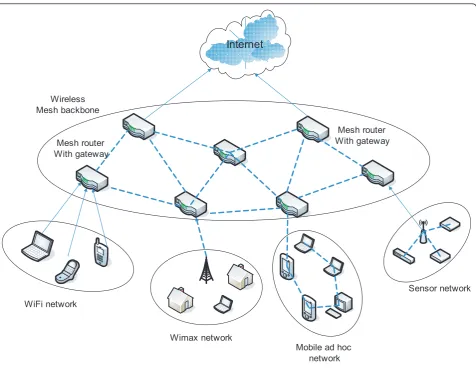
Wireless Mesh Networks (WMN) are emerging as a new attractive communication paradigm owing to their low cost, easy maintenance and rapid deployment. The application scenarios for WMN include wireless broad-band internet access, intelligent transportation systems, transient networks in convention centers, and disaster recovery. In WMNs, nodes are comprised mesh routers and mesh clients [1]. Wireless mesh routers are inter-connected as a multi-hop backbone to provide mesh cli-ents, network access. As shown in Figure 1, among all mesh routers, some have client connectivity (mesh access points), and some have internet gateway capabil-ity. The mesh backbone then supports multi-hop
com-munication among mesh routers. WMNs are
dynamically self-organized and self-configured, with the nodes in the network automatically establishing and maintaining mesh connectivity among themselves and compatible with conventional WLAN. Many research challenges still remain open in the design of the WMNs [1,2]. Routing in multi-hop WMNs has been a hot research area in recent years, with the objectives to
achieve as high throughput as possible over the network [3,4]. Typically, the source and the destination nodes for a particular data packet are not within direct communi-cation range. This leads to a multi-hop scenario where the packet must be routed and forwarded through other nodes in the network on the way to the destination nodes. Many routing protocols have been studied for sending data from the source node to the destination node [5,6]. These protocols ignore the Effect of the hid-den node problem. The hidhid-den node is related to the Transmission range, Carrier sense range and Interfer-ence range of a station [7,8]. The hidden nodes refer to the nodes within the interference range of the intended destination and out of the carrier sense range of the source node [8]. Then packet collision occurs at the intended destination node due to the hidden node. Moreover, compared with the infrastructure Basic Ser-vice Set (BSS) WLAN networks, the wider coverage area in WLAN mesh networks causes more frequent packet collision thus limits the network capacity. IEEE 802.11 standard adopts a CSMA/CA protocol as the main body of Distributed Coordination Function (DCF) in the MAC layer [9]. However, the performance of CSMA/CA networks is severely affected by hidden node problem. Although the IEEE 802.11 standards employ the Request to Send/Clear to Send (RTS/CTS) mechanism to solve
* Correspondence: [email protected]
Advanced Wireless Communication Research Center (AWCC), The University of Electro-Communications, 1-5-1 Chofugaoka, Chofu-shi, Tokyo 182-8585, Japan
the hidden node problem, it increases overhead for communication and is not used for short-sized packet [10].
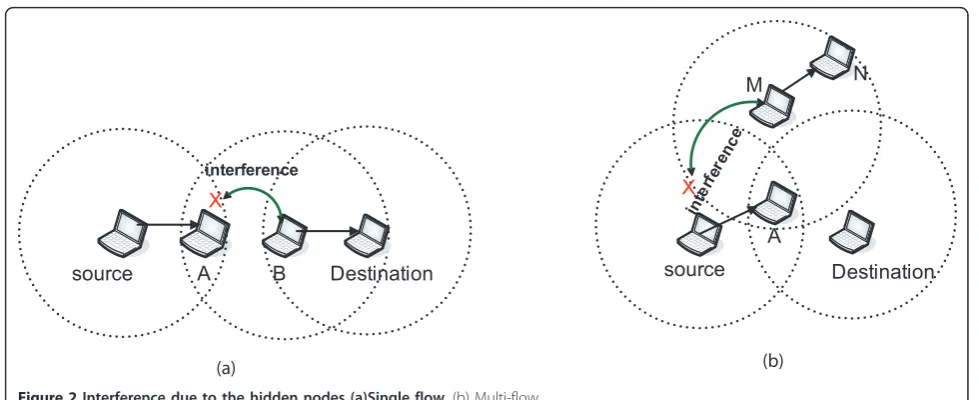
A fundamental problem of the multi-hop WMN is the degradation of performance with the increasing the number of hops [11]. The limitation is mainly because of the self flow and multi-flow interference caused by the hidden node in the multi-hop network. In this paper we classify the interference due to the hidden node into two types: self flow interference and multi-flow interfer-ence. Self flow interference is caused by the hidden nodes in the same flow. On the other hand, multi-flow interference is caused by the other flow of the neighbor node. In these interference, self flow interference is a serious problem because their own transmitted packets are collide each other in the flow. The self flow interfer-ence and multi-flow interferinterfer-ence caused by the hidden node are shown in the Figure 2. Some works have been done to improve the network throughput and to decrease the number of packet collision by optimizing
the carrier sense range [12-19]. Vaidya [15] shows that the MAC overhead, bandwidth dependent and band-width independent have a significant effect on the choice of carrier sensing range. Zhai [16] identify the optimum carrier sensing range for different data rates. However, they did not consider the next hop selection of the routing protocol.
Therefore, in this paper we focus on the hidden node avoidance technique for the self flow interference. The aim of this paper is to select a route between the source node and the destination node that is protected from the hidden node of the self flow. This is accomplished using a high-sensitive sensing function in the route con-struction. In the proposed routing method, it is consid-ered that every node utilizes high-sensitive sensing devices like the secondary terminal in the cognitive radio [20-22]. Every node senses the medium for select-ing the route as well as for the medium access control. In the proposed routing method, we uses beacon signal to select the next hop node. The beacon signal is used
Internet
WiFi network
Wimax network
Mobile ad hoc network
Sensor network Mesh router
With gateway Wireless Mesh backbone
Mesh router With gateway
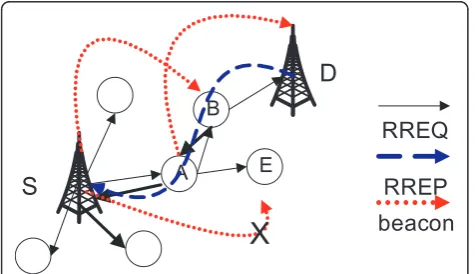
for selecting the next hop node. First a node broadcast a Route Request (RREQ) packet. In the next frame, the same node transmits the beacon signal to inform all neighbor nodes about its presence. All the nodes that receive the beacon signal from that node relay the RREQ packets. The node will be selected as the next node of the route. Such operation is repeated from the source node until the RREQ packet arrives at the desti-nation node. The destidesti-nation node then sends the Route Reply (RREP) packet toward the source node. Since all nodes in the route can detect the beacon signal of its previous hop node, the route can be selected as to remove the self flow interference due to the hidden nodes.
Different types of routing metrics are proposed in the multi-hop WMN to find the best possible paths between the source and the destination node [6,23-25]. In [23], the Expected Transmission Count (ETX) was proposed to minimize the expected total number of transmissions required to successfully deliver a packet over a wireless link. The Expected transmission time (ETT) [24] metric is an extension of ETX which considers Different link routes or capacities. ETT is the expected time to suc-cessfully transmit a packet at the MAC layer. The Air-time routing metrics specified in IEEE 802.11s [25] is based on the ETT with additional consideration given to channel access and the protocol overhead to reflect the amount of channel resources consumed by transmitting the data packets over a wireless link. Hop count is the traditional routing metric used in most of the common routing protocols like DSR [5] and AODV [6] designed for multi-hop wireless networks. It finds paths with the shortest number of hops. These metrics unfortunately fail to address directly the impact of the hidden node problem in WMN. This means the path selected by
these metrics unable to remove the self flow interference in a flow due to the hidden node problem and causes frequent data collisions. Therefore, in this paper, we propose a routing method that selects a path without any hidden node. For this purpose we chose a node as a next node of the route that is not a hidden node using beacon signaling. The aim of the proposed routing method is to construct a route without any hidden node. The proposed routing method can mitigate the hidden node, no matter which routing metrics is used for the route selection. As the conventional routing pro-tocol, AODV uses hop count metric to choose the shortest hop length path we also use hop count metric for path selection. However, the proposed routing scheme also works well if it use other routing metrics such as ETX and ETT for path selection. This is because most of the routing metrics does not concern about the hidden node collisions due to the self flow interference.
In the proposed routing method, spectrum sensing is considered to detect the beacon signal of the previous hop node. Several spectrum sensing methods have been studied [26,27]. Energy detection is one of the very pop-ular methods because of its simplicity and adequate per-formance [26]. The sensing function of our proposed method is based on this energy detection method. This method detects unknown signals embedded in the noise by comparing the observed received signal power level with a threshold. After constructing the route, data transmission will be performed using the IEEE 802.11 DCF as the MAC protocol. The only change of the IEEE 802.11 DCF on the data transmitting period is just to change the carrier sensing level to the appropriate lower sensing level. With low sensing level, a node can detect the existence of a hidden node. On the other hand, with
A B
X
interference
source Destination source
A
Destination
M N
X
inte rfer
enc e
(a) (b)
high sensing level, the node often miss the detection of the hidden node. Since the conventional wireless LAN uses CSMA/CA MAC protocol with high sensing level, the hidden node problem cannot be removed. The pro-posed method combines the beacon signal and the high-sensitive sensing function at routing to remove the self flow hidden node problem. During the route construc-tion, beacon signaling is used to inform the nodes (that are not hidden node) the presence of previous hop node. In this way, our proposed route avoids the self flow hidden node collision in the multi-hop WMN. Hid-den node collision between the multi flows is also mini-mized with appropriate low sensing level. Therefore, the hidden node problem is removed because all the nodes utilize a cognitive radio sensing technique for detecting the beacon signal of the hidden node. In the proposed routing method, a hidden node does not start its trans-mission as it senses the medium as busy. Thus the hid-den node problem is removed during the routing method. So that it can avoid redundant packet collision or redundant transmission termination among self flow nodes.
The rest of the paper is organized as follows. In Sec-tion 2 we present a brief overview of the background. The proposed method is described in Section 3 and the network model and the analysis of the proposed method is explained in Section 4. The performance evaluation through simulation is present in the Section 5. Finally, we conclude the paper in Section 6.
2 Background
In cognitive radio, a spectrum sensing system is consid-ered for detecting the signal of the primary system at the secondary system to improve the spectrum sharing efficiency [22]. The sensing function for cognitive radio can be defined as a technique where the secondary transmitter senses the surrounding wireless channel and checks the other active primary transmitter around it before transmission. If the signal of the primary trans-mitter is detected, the secondary transtrans-mitter prevents the transmission. The proposed routing method is based on such kind of sensing function. In general, the sensing device of the primary system is a conventional carrier sensing device used in the wireless LAN. The sensitivity of the sensing used in such legacy wireless LAN is low and the sensing level is relatively high compared with that considered in the secondary system of the cognitive radio. In the proposed routing method, we assume that all the relay node is equipped with a high-sensitive sen-sing device alike the secondary terminal. The sensen-sing range is an area in which a node can detect the signal of the other node. A high-sensitive sensing device with low sensing level detects the farthest hidden node as com-pared with the low sensitive sensing device. This is
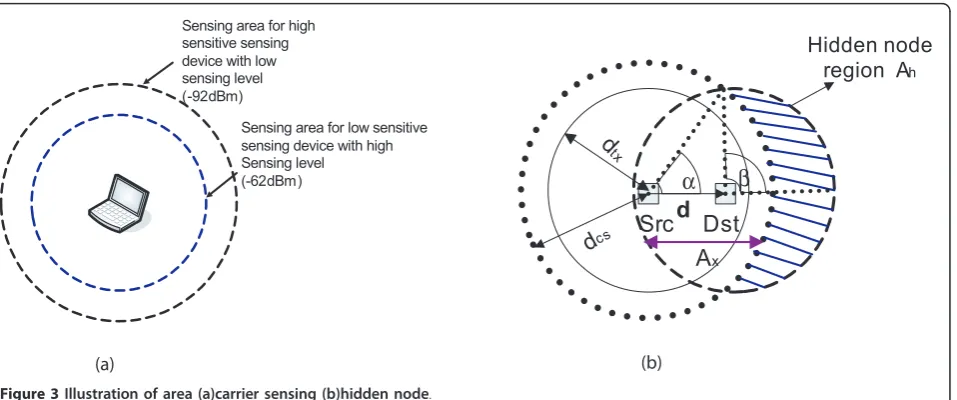
because the carrier sensing area of the high-sensitive device with low sensing level is larger than the low sen-sitive sensing device. In this paper, such kind of high-sensitive sensing device with low sensing level for route construction as well as for the medium access is used. Figure 3a shows the carrier sensing area of high-sensi-tive sensing device and low sensihigh-sensi-tive sensing device.
2.1 Hidden node problem
Multi-hop networks are naturally vulnerable by the hid-den node. This problem was first mentioned by Tobagi and Kleinrock in [28]. Any node within the communica-tion range of the intended destinacommunica-tion but outside the carrier sense range of the transmitter is potentially a hidden node [28]. The hidden node region to the source
node, denoted by Ahshown in Figure 3b can be easily
calculated using geometry as:
Ah=
In this section we explain the proposed method using a simple graph model. The detail explanation of our pro-posed method also explained in this section with example.
3.1 Graph model
In this paper, we consider a multi-hop WMN. All nodes communicate using identical, half duplex high-sensitive sensing device based on IEEE 802.11 DCF mode. Our objective is to construct a route with high throughput capacity for a given source and destination pair. We can
model the network with two undirected graph G and
G*.G(V, E), represents the set of all nodesVin the net-work and the set of edgesE. An edgeeijexists between
transmitter nodes niand the receiver nodes nj(eijεE) if
the two nodes are within the transmission rang of each other. InG*(V*,E*), V* is the number of nodes within
the carrier sensing area and E*is the edge between the
nodes within the carrier sensing area. To illustrate our proposed routing method consider the network topology in Figure 4. The solid circle represents the transmission range of the node which is located in the centre of the circle. The dotted circle in Figure 4a represents the car-rier sense area of the conventional method. In Figure 4b, the dotted circle is the carrier sensing area of the
proposed method. A route between the node Sand the
v(i): Set of neighbors of the node
v*(i): Set of nodes within the sensing range of the node
h(i): Set of hidden nodes of the node
The undirected graphG(V, E) for the network topol-ogy of Figure 4 is shown in Figure 5a. By considering the graph,G(V,E);v(S) is referred to the nodeA;h(S) is referred to the nodesBandE. v(A) is referred to nodes
B, E andS. The network using the proposed sensing
area of Figure 4b is represented by the graphG*(V*,E*) shown in Figure 5b. According to this graph, v*(S) is referred to the nodes Aand B,v*(A) is the nodesS,B,
DandE. In the proposed routing method,B node can
sense the previous hop nodeS. The nodeBi.e., (v*(S)∩
v(A)) is selected as the next hop node of the route.
However, nodeE can not sense the previous hop node
S. Next, node Dcan sense the previous hop node A,
nodeDi.e., (v*(A)∩ v(B)) is the next node of the path. A route [S, A, B, D] is established between the source
and destination pair (S, D) without any hidden node.
The proposed route is constructed using the following formula as:
Ni=v∗(i−2)∩v(i−1). (2)
Here,iis the hop number andNiis theith hop
candi-dates node of the route.
In order to realize the route with avoiding the hidden node, the proposed routing method uses beacon signal Sensing area for low sensitive
sensing device with high Sensing level
(-62dBm) Sensing area for high sensitive sensing device with low sensing level (-92dBm)
(a) (b)
Src
Dst
d
csd
txd
Hidden node
region A
hAx
α
β
Figure 3Illustration of area (a)carrier sensing (b)hidden node.
Carrier sensing area of A
Carrier sensing area of S
Carrier sensing area of B E
S A B D
F
link1
link2
link3 Carrier sensing
area of A Carrier sensing
area of S Carrier sensingarea of B
E
S A B D
F
(a) (b)
during the route construction. If each node after the transmission of the RREQ packet receives the same RREQ packets in the next time frame, the node trans-mits a beacon signal to the surrounding nodes. The bea-con signaling is used for the detection of a node that is not hidden node. The beacon transmission timing is
shown in Figure 6. Here the nodeStransmits the RREQ
packet. If the nodeSreceives the same RREQ packet in
the next time frame (from first hop nodeA), it transmits a beacon signal to all of its surrounding nodes. This
beacon signal transmitted from the node S, used to
inform the existence of nodes without hidden node situation. All the nodes that can receive the beacon of
the node S are selected for the candidate of the next
hop node for the route.
When a source node has a data packet to transmit to a destination, it checks the routing table for the destina-tion entry. If the route is unknown it generates a RREQ packet and broadcasts to its neighbor nodes. Each RREQ packet contains an ID, source and destination IP addresses, sequence number, hop count, and time out
field. The ID field uniquely identifies each RREQ packet and the sequence number indicates the freshness of the packets. The hop count represents the path length between the source and the destination. The time out field indicates the time duration, during which each intermediate node waits for sensing the beacon of the previous hop node. When an intermediate node receives RREQ packet, it checks the source IP and ID pair. If any intermediate node receives two RREQ packets with the same source and ID pair then it will drop the duplicate RREQ packet. If the node receives multiple RREQ from different nodes, it forwards the first received RREQ and drops the others RREQs. After receiving the RREQ packet, the intermediate node senses the spectrum to detect the beacon of the previous hop node. If it cannot detect the beacon signal within the time out field dura-tion it drops the RREQ. The RREQ packet is rebroad-cast by the intermediate node if the node can detect the beacon signal and increment the hop count. The inter-mediate nodes also create and preserve a reverse route to the source node for a certain interval of time. There may be several RREQ packets finally arriving at the des-tination node along different paths. The route selection is made at the destination node. The destination node can use a routing metric to select the best route between the source and the destination node. Many routing metrics are proposed for this purpose. The pro-posed routing method will avoid the hidden node, no matter which routing metrics it uses for the route selec-tion. In this paper, we use hop count routing metric to select a route. However, the proposed routing method can also perform well with other routing metrics such
Figure 5Undirected graph. (a)G(V,E), (b)G*(V*,E*).
RREQ Be
S
A
(1
st
hop node )
B
(2
nd
hop node )
time
time
time RREQ
RREQ
Send to all of its
neighbour nodes
Beacon
signal
as ETX and ETT. In order to evaluate the numerical analysis, we use the hop count metric for the path selec-tion. It simply chooses the route with minimum hop count. The destination node then generates a RREP packet, which contains the route record in RREQ and sends back to the source node via the reverse path.
3.2 Route construction example
The proposed route establishment procedure is explained below in details with an example. The image of the selected route is shown in Figures 7 and 8. The source node transmits the RREQ packet toward the
sur-rounding nodes. Here, in Figure 7 the node Areceives
the RREQ from the source node and relay the RREQ to
its entire surrounding nodes B, Eand the source node
S. When the source nodeS receives the RREQ packet
from the nodeA, the source node sends the beacon
sig-nal. This beacon signal is used to inform the nodes that are not hidden nodes of the nodeSto be selected as the candidate node for the route. All the nodes surrounding
the node Asense the beacon signal of the source node.
If any node can sense the beacon signal of the source node, that node forward the RREQ to its surrounding
nodes. In Figure 8, the nodeBcan sense the beacon of
the source nodeSand forward the RREQ packets to its
surrounding nodes. However, nodeE cannot receive the
beacon of the source node and it drops the RREQ pack-ets. This is because, the nodeEis located outside of the carrier sensing area of the source nodeS. In the similar
way, when the node A receives the RREQ from the
nodeB, it broadcasts a beacon signal. All the
surround-ing nodes of the nodeB sense the beacon of the
pre-vious hop node A. This process will repeat until the
destination node receives the RREQ. When the destina-tion node receives the RREQ, it transmits the RREP to the source node by tracing the reverse path of the RREQ. Therefore, [S, A,B,D] route is constructed using
the proposed method. When the nodeSis transmitting
data to the nodeA, the second hop node Bdoes not
start its transmission because the nodeBcan sense the
signal from the node S. In the conventional system,
AODV routing protocol does not use any beacon trans-mission and sensing criteria during the route
construc-tion. Therefore, the relay node E may be in the route
from the source to the destination. In this case, since
the node S and the nodeE are the hidden node, the
flow throughput degrades. The proposed routing method can avoid above self flow hidden node problem.
4 Network model and analysis
In this section first the successful transmission probabil-ity is derived. The next hop selection of the proposed routing method and the convention routing method (AODV) is calculated. Finally, we calculate the through-put performance of the proposed routing method and the conventional method.
4.1 Propagation model
In this paper, the propagation model we use only con-siders the distance attenuation due to path loss. For simplicity in analysis and in simulation we neglect the
multi-path fading, or fading due to obstacles. Let Pt
denote the transmit power, d is the distance between
the transmitter and the receiver, lis the wavelength of
the signal, do is the reference distance and g is the
path loss exponent. The received power Prcan be
writ-ten as:
Let, CSth denote the carrier sensing threshold. We can
drive the carrier sensing rangedcsof each station based
on the propagation model as:
CSth =Pt+ 20 log10
In this paper, we make some assumptions:
•Nodes are randomly distributed on a 2-D plane
according to the Poisson distribution with densityμ. In an area A, the probability of there beingN, sta-tions is:
Pn=
(μA)N
N! e
−μA. (5)
• We assume all the stations in the network use
fixed transmit power. We also assume the
S
transmission range dtxand the interference range di
are equal for all nodes.
• Packet generation follows the Poisson distribution
with densitylp/s.
•The receiver can decode the packet correctly if the Signal to interference and noise ratio (SINR) at the Receiver exceeds the minimum required SINR:
SINR = Pr
Pi+ noise ≥φ
(dB), (6)
where Pi is the interference power and noise is the
background noise.
4.3 Successful transmission probability
For an active node letPais the transmission probability
andPcis the collision probability. The packet
transmis-sion probability at a randomly chosen time slot can be given by [29,30]
Pa=
2 1 + CW +PcCW(2P
m
c−1)
2Pc−1
, (7)
where CW is the minimum back off window size and
mis the retry limit. A transmission attempt probability
may collide by one or more nodes within regionAxas
shown in Figure 2b when their back off counter reaches
0 at the same time. One or more node in the regionAh
also caused collision. LetPx andPhbe the probability of
this two collision events, respectively. Therefore, the probability of collisionPcis given by
Pc =Px+Ph−PxPh. (8)
In our analysis, we assume for simplicity that the con-tention window size is held constant andPxis fixed for
simplicity. From [29], this is given by
Px=
2
CW + 1. (9)
Probability of hidden node collision can be expressed as
Ph= 1−(1−Pa)μAhe–μAh. (10)
By plugging Eqs. (8), (9) and (10) into Eq. (7) we can calculate the value ofPaandPc. Therefore, the
probabil-ity of successful transmission can be obtained as
Psuc=Pa(1−Pc). (11)
Let the probability that a time slot is a successful transmission slot, an idle slot and a collision slot asPsuc,
Pidle, andPc, respectively, and the corresponding
dura-tion asTsuc, TidleandTc, respectively. The mean
dura-tion required to transmit a packet successfully,Tcan be expressed as
RREQ
Source S
relay
node A
relay
node B
Destination
D
be
be
Time
Transmitted signal
Received signal
be.=beacon signal
relay
node E
RREQ RREQ
X
RREP
RREP
RREP
Time
Time
Time
Time Drop
T=PsucTsuc+PidleTidle+PcTc. (12)
The probability that a node is idle in a time slot is,
Pidle= 1−Psuc−Pc. (13)
The time duration can be expressed as
Tsuc=H+P+ DIFS + ACK + SIFS
Tc=H+P+ DIFS + SIFS
Tidle=θ,
(14)
where H and P are the time for the packet header
(PHY and MAC headers) and the payload, respectively, andθis the physical slot time.
4.4 Next hop selection
4.4.1 Proposed routing
If a node can sense the beacon signal of its previous nodes it can be a candidate for the next hop node of the route. LetPcand denote the probability of the
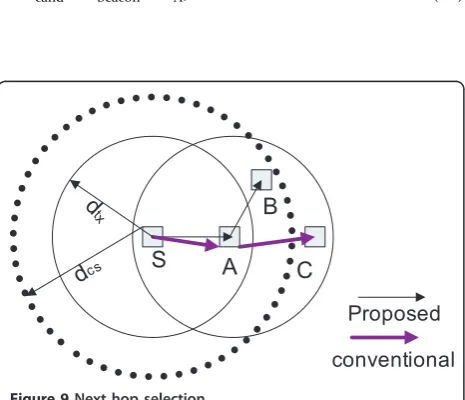
candi-date node that can be select as the next hop of the route. In our proposed method every node sense its pre-vious hop node’s beacon signal. The probability of the number of node that can sense the beacon of the node S as in Figure 9 is given by,
where,Sbeis the number of the nodes that can sense
the beacon of the nodeS, dis the distance between the
nodeS and the nodesSbeandPSis the transmit power
of the nodeS(all nodes have same the transmit power,
Pt). CSthis the carrier sensing threshold. Probability of
the number of candidate node for the next hop node can be expressed as
Pcand=Pbeacon∩PA, (16)
where, PA=μdtxe−μdtx is the probability of the
num-ber of node exist within the node A’s communication
region. Let Psel denote the probability that a node is
selected as the next hop node of the route, it is given by:
Psel=PsucPcand. (17)
4.4.2 Conventional routing
We use AODV routing protocol as a conventional rout-ing method to select the route between the source and destination pair. In the AODV routing protocol, the further stations have higher priority for the selection of the next hop node without considering hidden node. The probability of the candidate node for the next node in AODV is given by
Pcand=PA. (18)
Psel=PcandPsuc. (19)
4.4.3 Throughput
Finally, we can use the value ofPa,Pc,T, andPselto
cal-culate the throughput of the proposed and the conven-tional routing method as,
TH=PselPa(1−Pc)Payload
rate
T . (20)
where Payload is the packet payload size and rate is the data rate of the network.
5 Performance evaluation
In this section, we evaluate the performance of the pro-posed routing method using analysis and computer simulation. Furthermore, we compare it with the con-ventional AODV routing method.
5.1 Simulation set up
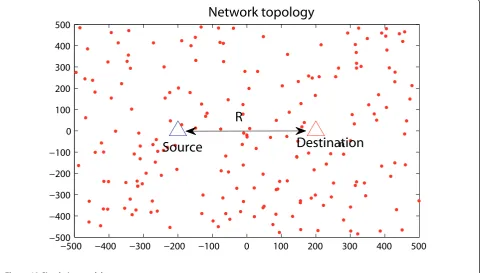
The simulation is carried out using MATLAB simulator. In our simulation, we adopt free space model as the pro-pagation model. AODV routing protocol is chosen as the conventional routing protocol. The simulation parameters for MAC are identical to IEEE 802.11a standard listed in Table 1. The relay stationsNare randomly distributed in 1,000 × 1,000 simulation area follow the Poisson tion. Packet generation also follows the Poisson distribu-tion. Each packet size is fixed to 1,500 bytes. The beacon packet size is 106 bytes. The source node and the
destina-tion node pairs are separated by Rmeter distance as
shown in Figure 10. The carrier sensing threshold CSthfor
the conventional system is set as -62 dBm. The proposed method uses appropriate lower sensing level which can be changed as a parameter. We measure the network throughput, collision probability and the network delay as the main evaluation metrics. Their definition as follows
S
A
Network throughput It is defined as the amount of packets received successfully by the destination per unit time (in Mb/s).
Collision probability The ratio of the total number transmission failures over the total number of transmis-sion attempts.
Network delayIt is defined as the total time taken by the destination node to receive the packet successfully
sent from the source node. It consists of two parts: route establishment delay and data transmission delay. Route establishment delay means the time required to transmit the RREQ from the source node to the destina-tion node. Data transmission delay is the time that the packet spends in the wireless medium.
5.2 Appropriate sensing level
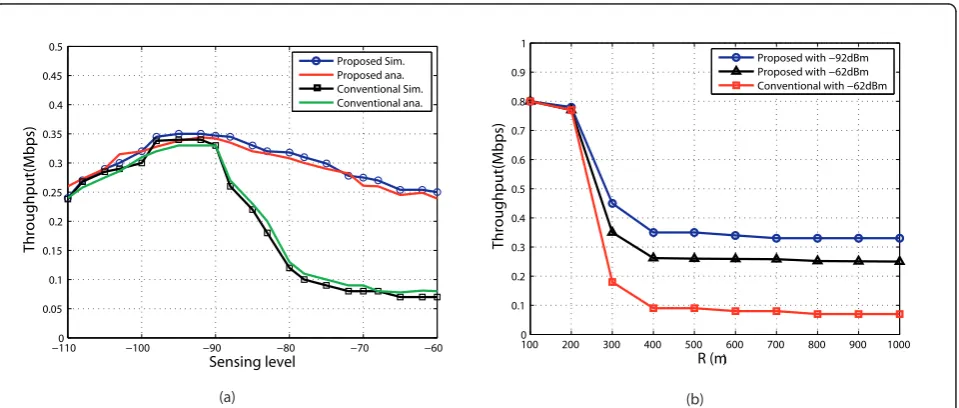
In order to find out the appropriate sensing level for the proposed method, the network throughput is derived by varying the sensing level. In this case, both the Proposed and conventional method uses hop count metric for
route selection. We set N= 200 andR= 400 m. Figure
11a shows the throughput of the network using the pro-posed and conventional method by varying the sensing level from -110 to -60 dBm. We give both analysis and simulation results. It is seen from Figure 10a, in the pro-posed method the throughput is slightly decreasing as the sensing level is increasing from -91 to -60 dBm. This is because, the sensing range becomes smaller with the higher sensing level. In our proposed routing method, since the number of hop will increase with small sensing range, throughput becomes small. On the other hand, the throughput is also slightly decreasing with decreasing the value of the sensing level from -94 to -110 dBm. With this low sensing level the throughput is reduced because of lower frequency reuse in the flow. It is concluded that the proposed method achieves
Table 1 Simulation parameters.
Frequency 5 GHz
Transmitter power 10 dBm
Required SINR (data packet) 10 dB
Routing SINR 20 dB
Noise level -95 dBm
Path loss exponent 2
Reference distance 1
Data rate 11 Mbps
Packet size 1,500 bytes
Que size 10
Slot time 9 us
DIFS 34 us
SIFS 16 us
ACK 5 us
CWmin-CWmax 15-1,023
Retry limit 3
Simulation time 800 ms
−500 −400 −300 −200 −100 0 100 200 300 400 500
−500 −400 −300 −200 −100 0 100 200 300 400 500
Network topology
Source
Destination
nR
highest throughput when the sensing level is between -96 and -90 dBm. Therefore, in this paper we select -92
dBm as the appropriate sensing threshold, CSthfor the
proposed method. With lower sensing level, the pro-posed and the conventional method performs the same. The reason is that the distance between each hop node in the route is fixed (SNR for routing is fixed to 20 dB) and the conventional method can avoid hidden node collision with lower sensing level. However, the through-put of the conventional method is rapidly decreasing compared with the proposed method with higher sen-sing level. This is because the conventional routing pro-tocol AODV does not consider the existence of the hidden node during the route construction. In the media access CSMA/CA with higher sensing level can-not remove the hidden node. Therefore, the conven-tional method has lower throughput performance with higher sensing level. From Figure 11a, we can confirm that the proposed method has robustness against differ-ence of sensing level. This is because the proposed method can avoid the hidden node even if the sensing level is higher. In general, the sensing level is decided as the receiver detection device ability. The robustness to the sensing level is very important for the realization of the wireless mesh network without effect of hidden node problem.
5.3 Results and discussions
5.3.1 Impact on network throughput
We first study the impact of single flow on throughput. Figure 11b depicts the impact on the network through-put for a single flow. In this case,Ris varied from 100 to 1,000 m between the source and the destination pair.
The number of data packet is fixed to 200. The pro-posed method uses the appropriate sensing level -92 dBm and the conventional sensing level -62 dBm. According to Figure 11b, we can see that with small dis-tance like 100-200 m, the throughput is almost the same for both the proposed system and the conventional sys-tem. The reason behind this is, direct communication can be established from the source to the destination with small distance and both systems do not have any hidden node i.e., the performance of both the proposed method and the conventional method is the same with the small distance between the source and the destina-tion. However, the proposed method performs better than the conventional method with increasing distance due to the presence of hidden node. The proposed method also performs better even if it uses the conven-tional higher sensing level, -62 dBm. In the convenconven-tional system AODV does not consider the existence of the hidden node during the routing process and the media access CSMA/CA MAC protocol uses high sensing level of, -62 dBm so that it can not avoid hidden node problem.
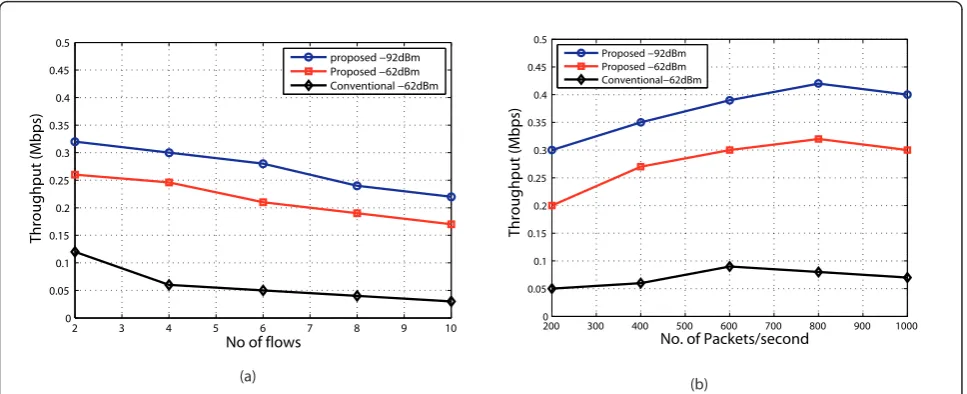
Next we examine the throughput performance for high density networks, by changing the number of flow. Since the network area is fixed the more flow makes the network denser. The number of relay nodes is set to 200. The source and destination pairs are randomly selected. The distance between each source and destina-tion is fixed as 400 m. The traffic load is fixed to 200 packets/s for each flow. The impact of the network den-sity on the throughput is shown in Figure 12a. As the number of flow increases our proposed method per-forms better than the conventional method. The reason
100 200 300 400 500 600 700 800 900 1000 0
is that with appropriate sensing level of the proposed method can remove the self flow interference as well as the multi-flow interference due to the hidden node. With high sensing level, -62 dBm, the proposed routing method also performs well. This is because of the hid-den node collision absence in the self flow. However, as the number of flow continues to increase, the conven-tional method suffers a throughput drop due to more collision resulting from the hidden node.
In order to examine the impact of traffic load on the throughput we change the packet generation rate from 200 to 1,000 packets/s. The traffic flow is set to 4. The throughput under different traffic load is shown in the Figure 12b. The throughput of the proposed method with appropriate sensing level -92 dBm and conven-tional sensing level -62 dBm keeps increasing with traf-fic loads. This is because with high traftraf-fic load our proposed method does not have collisions due to hidden node. However, the throughput of the conventional method decreases as the traffic load increases. The rea-son for this is the collisions due to the high traffic load can not overcome.
Moreover, we can see the performance of the pro-posed method by changing the routing metrics for the route selection. In this case, we use other two routing metrics ETX and ETT. The throughput performance of the proposed method and the conventional method by changing the routing metrics is shown in Figure 13. In this case, both the proposed and the conventional meth-ods use the conventional sensing level -62 dBm. When we used the routing metrics ETX and ETT, the pro-posed method performs better than the conventional routing method that also uses ETX and ETT. The rea-son is that, these routing metrics do not affect the
influence of the hidden node. However, the proposed routing method avoids the hidden node during the route formation. It can achieve a significant throughput improvement, no matter which routing metrics is used for the route selection.
5.3.2 Impact on collision probability
We first compare the probability of collision between the proposed method and the conventional method for single flow shown in Figure 14a. In this case, the pro-posed method uses the appropriate sensing level -92 dBm and the conventional sensing level -62 dBm. The probability of collision due to the hidden node in our proposed method is zero. This is because our proposed method chooses a route without hidden node. The self flow inference due to the hidden node can be avoided in the proposed method. However, in the conventional method with increasing the number of hop in the route, the probability of collision due to the hidden node also increases.
The proposed method achieves a significant through-put improvement compared with the conventional method because it efficiently eliminates the collision from hidden node. This can be observed in Figure 14b, which shows the collision probability under different network density. In this case we fix the traffic load to 200 packets/s for each flow. As shown in the figure, the proposed method has the lowest collision probability compared with the conventional method. We can also observe from this figure that the collision probability of the conventional method increases sharply when the network becomes denser (e.g., more than four flows). This is because when the network becomes busy, self flow and multi-flow collisions occur due to the presence of the hidden node. The proposed method with -62
200 300 400 500 600 700 800 900 1000 0
dBm sensing level provides better performance because it removes the self flow interference. However, with appropriate sensing level -92 dBm the proposed method can minimize the multi-flow interference due to the avoidance of hidden node. Therefore, the proposed methods possess a leading performance in both aggre-gate throughput and collision probability even in dense networks. Compared with Figure 12b, we can find that the impact of traffic loads on collision probability is similar to that of network densities. More specifically, the collision probability increases with the traffic loads, and the proposed method also has the lowest collision probability under all the different traffic loads which is shown in Figure 15a.
Beacon signal is used in our proposed method during the route construction. Every node transmits beacon sig-nal after the transmission of the RREQ packet. For high density network there is some probability of beacon col-lision. In order to investigate the effect of the network density on the beacon signal, the probability of the bea-con collision is calculated by varying the number of the multi-hop flow is shown in Figure 15b. In this case, the traffic generation rate is fixed to 200 packets/s for each flow. The number of relay node is 200. The source node
and the destination node are randomly generated within the simulation area. We assume all pairs start routing phase simultaneously and we check the collision of bea-con signal. It is observed from Figure 15b, the probabil-ity of beacon collision is very low. Because the duration of the beacon packet is very small and the beacon packet takes priority over the data packet transmission. Thus the beacons are rarely collide.
In addition, to observe the impact on the probability of collision we change the routing metrics from hop count to the ETX and ETT. In this case we change routing metrics for both the proposed and the conven-tional method. From Figure 16, we can see that the pro-posed method yields the lowest collision probability compared with the conventional method, with all rout-ing metrics. This is due to the absence of the hidden node in the proposed routing method.
5.3.3 Impact on network delay
Figure 17a shows the route establishment delay of the proposed routing method against the conventional rout-ing method. Compared with the conventional routrout-ing, the proposed routing yields larger delay. This is because, the proposed routing uses the sensing function to sense the beacon signal of the previous hop node. It took
200 300 400 500 600 700 800 900 1000
0 0.1 0.2 0.3 0.4 0.5 0.6 0.7 0.8 0.9 1
No. of Packets/second
Throughput (Mbps)
Conventional+HopC Proposed+HopC Conventional+ETX Proposed+ETX Conventional+ETT Proposed+ETT
some extra time for constructing the route compared with the conventional routing method. However, Figure 17b illustrates that the proposed method performs much better than the conventional method in terms of the data transmission delay. This is caused by the hid-den node problem avoidance. During the data transmis-sion, the packet collision occurs in the conventional method due to the presence of the hidden node. How-ever, in the proposed method, there is no data collision due to the hidden node. That is why, our proposed method has lower data transmission delay. Figure 18 shows the overall network delay comparison. From this simulation result, we can conclude that the proposed method has lower network delay than that with the con-ventional method.
6 Conclusions
In this paper, we present a novel routing method using a high-sensitive sensing function for a multi-hop
wireless mesh network. Using the sensing function, all nodes sense the medium of the interfered nodes before constructing the route. Beacon signal is used to avoid the existence of a self flow hidden node. During the route construction, all nodes sense the beacon of its previous hop nodes. The next node of the route is selected depending on this beacon signal sensing result. In this way, the proposed method choose a node as the next hop node for the route which is not a hidden node. Thus the constructed route in this way is a hidden node free route. Due to this sensing technique, the hidden node does not start its transmission if its previous hop node is busy. Using appropriate lower sensing level high end-to-end network throughput is achieved. We use the hop count routing metric for numerical analysis. How-ever, the proposed method also performs well with other routing metrics such as ETX and ETT checking with computer simulation. From the computer simula-tion, it is confirmed that the proposed routing method
Figure 14Impact on collision probability (a) single flow (N= 200). (b) Multi-flow (N= 200,R= 400 m).
2 4 6 8 10 12 14
0 0.01 0.02 0.03 0.04 0.05 0.06 0.07 0.08
No of flow
probabilty of beacon collision
200 300 400 500 600 700 800 900 1000 0
0.1 0.2 0.3 0.4 0.5 0.6 0.7 0.8 0.9 1
No of packets/second
Probability of collision
Proposed −92dBm Proposed −62dBm Conventional −62dBm
(a) (b)
improves the network throughput as well as reduce the probability of collision with ETX and ETT routing metrics. Our numerical and simulation results agree quite well. It is concluded that the network throughput
has been significantly improved due to the absence of the hidden node. This is because, the proposed method can avoid the hidden node problem by combining the sensing criteria and beacon signal during the route
200 300 400 500 600 700 800 900 1000
0 0.1 0.2 0.3 0.4 0.5 0.6 0.7 0.8 0.9 1
No of packets/second
Probability of collision
Conventional+HopC Propose+HopC Conventional+ETX Propose+ETX Conventional+ETT Propose+ETT
Figure 16Impact on Probability of collision with Hopcount, ETX and ETT routing metrics (N= 200).
100 200 300 400 500 600 700 800 900 1000 0
0.5 1 1.5 2 2.5 3
R (m)
delay(ms)
Proposed −62dBm Proposed −92dBm Conventional−62dBm
100 200 300 400 500 600 700 800 900 1000 0
0.5 1 1.5 2 2.5 3 3.5 4 4.5 5
R (m)
delay(ms)
Proposed −62dBm Proposed −92dBm Conventional−62dBm
(a) (b)
construction. It can be confirmed that the proposed routing method achieves better performance compared with the conventional method, because the proposed system can avoid the hidden node problem. The numer-ical analysis of the proposed routing method with rout-ing metrics ETX and ETT is our future works. Moreover, we will evaluate the performance of the pro-posed routing method with other routing metric like Airtime in the future.
Acknowledgements
This work is partially funded by Japanese Ministry of International Affairs and Communications under Strategic Information and Communication R&D Promotion Program (SCOPE).
Competing interests
The authors declare that they have no competing interests.
Received: 14 November 2010 Accepted: 29 September 2011 Published: 29 September 2011
References
1. IF Akyildiz, X Wang, W Wang, Wireless mesh networks: a surveys. IEEE Comput Netw.47(4), 445–487 (2005)
2. R Bruno, M Conti, E Gregori, Mesh networks: commodity multihop ad hoc networks. IEEE Commun Mag.43(3), 123–131 (2005)
3. Y Zhang, L Jijun, H Honglin,Wireless Mesh Networking, (Auerbach publication, Boca Raton, 2007)
4. MS Gast,802.11 Wireless Networks: The definitive Guide, (O’Reilly & Associate, USA, 2002)
5. DB Johnson, DA Maltz,Dynamic Source Routing in Ad Hoc Wireless Networks, ed. by Imielinski T, Korth H, Proceedings of Mobile Computing,chapt. 5 (Kluwer Academic Publishers, Dordrecht, 1996), pp. 153–181
6. C Perkins, EM Royer, SR Das,Ad Hoc On-Demand Distance Vector (AODV) routing, inIETF RFC 3561(Jul 2003)
7. S Khurana, A Kahol, AP Jayasumana, Effect of Hidden Terminal On The Performance of IEEE 802.11 MAC Protocol, inProceedings of IEEE LCN’98, 12–22 (Oct 1998)
8. Z Hadzi-Velkov, L Gavrilovska, Performance of the IEEE 802.11 Wireless LANs Under Influence Of Hidden Node, inProceedings of IEEE PWCS, 221–225 (Feb 1999)
9. ANSI/IEEE Std 802.11, Part II: Wireless LAN Medium Access Control (MAC) and Physical Layer (PHY) Specifications. (1999)
10. K Xu, M Gerla, S Bae, Effectiveness of RTS/CTS handshake in IEEE 802.11 based adhoc networks. Ad Hoc Netw J.1, 107–123 (2003)
11. P Gupta, PR Kumar, The capacity of wireless networks. IEEE Trans Inform Theory.46(2), 388–404 (2000)
12. J Deng, B Liang, PK Varshney, Tuning the Carrier Sensing Range of IEEE 802.11 MAC, inProceedings of IEEE Globecom’04.5, 2987–2991 (Dec 2004) 13. R Hekmat, PV Mieghem, Interference in Wireless Multi-hop Adhoc Networks
and its Effect on Network Capacity, inProceedings of Med-hoc-Net
(Sept 2002)
14. J Zhu, X Guo, LL Yang, WS Conner, Leveraging Spatial Reuse in 802.11 Mesh Networks with Enhanced Physical Carrier Sensing, inProceedings of IEEE ICC(June 2004)
15. X Yang, NH Vaidya, On the Physical Carrier Sense in Wireless Ad Hoc Networks, inProceedings of IEEE Infocom(Mar 2005)
100 200 300 400 500 600 700 800 900 1000
0 1 2 3 4 5 6 7 8 9 10
R (m
)
delay(ms)
Proposed −62dBm Proposed −92dBm Conventional−62dBm
16. H Zhai, Y Fang, Physical Carrier Sensing and Spatial Reuse in Multirate and Multihop Wireless Ad Hoc Networks, inProceedings of IEEE Infocom
(Apr 2006)
17. TS Kim, H Lim, JC Hou, Improving Spatial Reuse Through Tuning Transmit Power, Carrier Sense Threshold, and Data Rate in Multihop Wireless Networks, inProceedings of ACM MobiCom(Sept 2006)
18. Z Zeng, Y Yang, JC Hou, How Physical Carrier Sense Affects System Throughput in IEEE 802.11 Wireless Networks, inProceedings of IEEE Infocom
(Apr 2008)
19. J Fuemmeler, N Vaidya, VV Veeravalli, Selecting the Transmit Powers and the Carrier Sensing Thresholds for CSMA Protocols, inProceedings of Wicon, 1321–1329 (Aug 2006)
20. E Hossain, VK Bhargava,Cognitive Wireless Communication Networks, (Springer, Berlin, 2007)
21. D Cabric, SM Mishra, RW Brodersen, Implementaion issues in spectrum sensing for cognitive radios. Proc Signals Syst Comput.2, 772–776 (2004) 22. J Mitra, GQ Maguire Jr, Cognitive radio: making software radios more
personal. Proc IEEE Pers Commun.6(4), 13–18 (1999)
23. D De Couto, D Aguayo, J Bicket, R Morris, A High-Throughput Path Metric for Multi-Hop Wireless Routing, inProceedings of ACM MobiCom(Sept 2003) 24. J Padhye, R Drave, B Zill, Comparison of routing metrics for static multi hop
wireless networks. inProc ACM SIGCOM(Sept 2004)
25. Wireless Medium Access Control (MAC) and physical layer (PHY) specifications: Amendment: ESS Mesh networking. IEEE P802.11s/D1.00 (Nov. 2006)
26. H Uchiyama, K Umebayashi, Y Kamiya, Y Suzuki, T Fujii, F Ono, K Sakaguchi, Study on Cooperative Sensing in Cognitive Radio Based Ad-Hoc Network, inProceedings of IEEE Pimrc(Sept 2007)
27. H Urkowitz, Energy Detection of unknown deterministic signals. Proc IEEE.
55(4), 523–531 (1967)
28. F Tobagi, L Kleinroack, Packet Switching in radio channels: Part II—The Hidden Terminal Problem in carrier Sense Multiple-Access and the Busy-Tone Solution. IEEE Trans Commun.23, 1417–1433 (1975)
29. G Bianchi, Performance analysis of the IEEE 802.11 distributed coordination function. IEEE J Sel Area Commun.18(3), 535–547 (2000)
30. F Cali, M Conti, E Gregori, Dynamic tuning of the IEEE 802.11 Protocol to Achieve a Theoretical Throughput Limit. IEEE/ACM Trans Netw.8(6), 785–799 (2000)
doi:10.1186/1687-1499-2011-114
Cite this article as:Parvin and Fujii:Hidden node aware routing method using high-sensitive sensing device for multi-hop wireless mesh network.EURASIP Journal on Wireless Communications and Networking
20112011:114.
Submit your manuscript to a
journal and benefi t from:
7Convenient online submission
7 Rigorous peer review
7Immediate publication on acceptance
7 Open access: articles freely available online
7High visibility within the fi eld
7 Retaining the copyright to your article