Volume 2010, Article ID 386319,8pages doi:10.1155/2010/386319
Research Article
Dynamic Object Tracking Tree in Wireless Sensor Network
Min-Xiou Chen,
1Che-Chen Hu,
2and Wen-Yen Weng
21Department of Computer Science and Information Engineering, National Dong Hwa University, 974 Hualien, Taiwan 2Department of Computer Science and Information Engineering, Chung Hua University, 300 Hsinchu, Taiwan
Correspondence should be addressed to Min-Xiou Chen,[email protected]
Received 30 October 2009; Accepted 30 March 2010
Academic Editor: Xinbing Wang
Copyright © 2010 Min-Xiou Chen et al. This is an open access article distributed under the Creative Commons Attribution License, which permits unrestricted use, distribution, and reproduction in any medium, provided the original work is properly cited.
Recent advances in embedded microsensing technologies and low-energy cost sensors have made wireless sensor networks possible. Object tracking is an important research of wireless sensor networks. However, most object tracking tree is constructed based on a predefined mobility profile. When the real object movement behaviors are very different to the predefined mobility profile, the object tracking tree performance will become worse. In the paper, we will propose a dynamic adaptation mechanism, referred to as “Message-Tree Adaptive (MTA)” procedure, to improve the object tracking tree when the predefined mobility profiles do not match. From the simulation results, the performance of the object tracking tree can be significantly improved, when the MTA procedure is performed.
1. Introduction
Recent advances in embedded micro-sensing technologies and low energy cost sensors, the sensors are smaller, cheaper and more intelligent. These sensors are equipped with RF communication module and make the killer application for object tracking in wireless sensor network possible. These wireless sensors have the ability to collect process and store environmental information and can be accessed from the network. Thus, the wireless sensor networks are used in environmental monitoring, military surveillance, and home and industrial security.
With the sensor’s low price and the ability of detecting at anytime and anywhere, large-scale wireless sensor networks can be developed with a great number of compact sensors. Object tracking is an important research of wireless sensor networks [1–11]. The key functions of wireless sensor node involve the object detection, object identification, object clas-sification, object location estimation, and object monitoring. In order to efficiently collect the object information, a special node, referred to as sink, is introduced to collect the object location information from the sensors.
Some researches [4–11] proposed constructing a col-lection architecture using a tree according to the mobility profile. The mobility profile is used to denote the event rate of
each link. Thus, these researches construct the effective data collection architecture based on the graph model transferred from the predefined mobility profile. However, most of these mobility profiles are obtained based on historical statistics, such as the city mobility model. The real object movement behavior usually does not match the predefined mobility profile. These differences will significantly affect the performance of the collection architecture. Thus, in the paper, we propose a Message-Tree Adaptive procedure (MTA) to dynamically adapt the object tracking tree to improve the performance of the object tracking tree when the predefined mobility profiles do not match. The simulation results show that it is evident that the MTA procedures can provide good performance.
The rest of this paper is organized as follows: The related literatures are given in Section 2. The problem statement and the Massage-Tree Adaptive procedure are presented in Section 3. Performance studies are conducted inSection 4. This paper concludes withSection 5.
2. Related Works
main approaches, cluster-based tree [1–3], hierarchy-based tree [4–11].
The cluster-based tree will organize all sensors into clusters and an election of cluster heads will determine which node takes responsibility for collecting the object informa-tion within the same cluster and report that informainforma-tion back to the sink. This node is called the cluster head. When the distance between the cluster head and sink is more than one hop, a multiple hop path is created between the cluster head and sink. Due to the limitation in sensor power, the sensors near the sink will use up their power, and the wireless sensor network will not work.
In [1], the authors proposed the LEACH algorithm to build a hierarchy tree. The LEACH algorithm has two phases. The setup phase will randomly select a local cluster head. The sensor nodes will send the information to the sink through their cluster heads. However, the LEACH algorithm assumes that all nodes have enough power to communicate directly with the base, but in fact, the power of the sensor nodes is limited. The LEACH algorithm concentrates only on finding an efficient way to forward the data report to the data center but does not construct robust and reliable reports in an energy efficient manner.
In [2], the authors proposed a dynamic cluster structure to efficiently collect the object information. The proposed structure is used to track enemy vehicles, wild fires, toxic gases, biological activity, and so on. To provide efficient object tracking, the boundary nodes located near the track-ing object must be identified first. The boundary nodes should report the tracking information to the sink. The authors used the dynamic cluster structure to collect the boundary node information and report to sink using cluster heads.
The authors proposed a Heterogeneous tracking model (HTM) for object tracking in [3]. They used Variable memory Markov (VMM) to predict the patterns of moving objects and used these patterns to construct the cluster tree. The drawback is the higher computation complicity of VMM. Moreover, when the prediction patterns are wrong, the performance of the cluster tree will become worse.
The hierarchy-based tree can improve the cluster-based tree drawback. The root of the hierarchy-based tree is the sink. Kung and Vlah in [4] proposed a tree-structuring algorithm, referred to as “drain-and-balance (DAB)” tree that uses a hierarchy-based tree for object tacking. The DAB tree is a logical tree and is constructed based on the event rate cost. Thus, the DAB tree is not constructed based on the physical structure of a wireless sensor network. Some edges in the DAB tree may consist of multiple hops. The drawback of DAB is that it is a binary tree, so that the tree will increase when the number of sensor nodes increases.
The object tracking information can be divided into two basic actions. The first is the update action and the second is a query action. When an object moves from one sensor node into another sensor node, the update action is triggered in both these sensor nodes. The query action is invoked when a user wants to find the location of an object of interest. The update action cost was considered in [4], but the query action cost was not considered in the DAB algorithm. To improve
the drawback of DAB, Lin et al. in [5] proposed Deviation-Avoidance Tree (DAT). The DAT is a multiway tree that uses a greedy tree-structuring algorithm to construct a hierarchical tree based on the physical structure of a wireless sensor network. All of the sensor nodes in the DAT should be used to detect objects, store detected information and make update reports. The query cost reduction is also considered in the DAT algorithm. The DAT can be updated using the Query Cost Reduction (QCR) method. Thus, the DAT performance is better than that of DAB. In [6], the authors also proposed a multisink tree to track objects. The multi-sink concept reduces the query cost and also reduces the communication cost.
In [7], the authors also proposed a protocol to track an object in a wireless sensor network. In the proposed protocol, the sink can quickly find a target object along a shortened path and effectively obtain the track and position of the target object. The performance of their proposed protocol can be better than that of flooding-based query methods. In [8], the TMP (Temporal Movement Patterns)—Tree was proposed to efficiently discover the temporal movement patterns of objects in wireless sensor networks. The data mining algorithm was introduced in the TMP. The location prediction strategies were also considered to reduce the prediction errors to save power.
In [9], Liu et al. proved that establishing a minimum object-tracking tree cost is a NP complete problem. They also proposed the addition of a shortcut mechanism into the existing object-tracking tree. The shortcut mechanism adds some other edges into the object tracking tree to improve the update and query costs. The shortcut link is downward directed and the leaf node cannot be connected using the shortcut link. Although the shortcut mechanism can be used to reduce the update and query costs, the query cost for the shortcuts mechanism is not better than that of DAT.
In [10], we proposed a tree adaptation procedure (TAP) to improve the update cost of the object tracking tree. The bottom-up approach was introduced in the TAP. The TAP selects a candidate node based on the bottom-up rule and computes the update cost using the edge connected to the target node, but was not included in the object tracking tree. If the update cost of the modified object tracking tree is lower than that of the original object tracking tree, the modified object tracking tree will be set as the new object tracking tree. The TAP will compute the update cost for the modified object tracking tree until all nodes except the sink in the object tracking tree have been considered. The simulation results show that the TAP application achieves good performance.
2
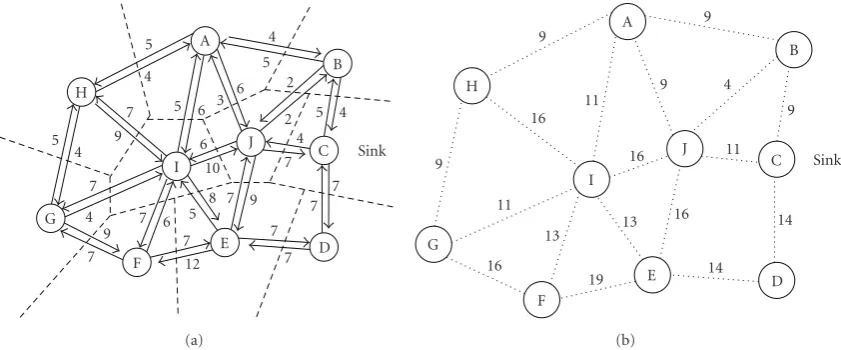
Figure1: Voronoi Graph and Object Movement Model.
very different from the mobility profile. The object tracking performance may be worse when the mobility profile is not correct.
3. System Architecture
3.1. Problem Statement. When the deployment region is fully covering the sensing field area, the sensing area of each sensor node can be modeled using a Voronoi graph [12], as depicted inFigure 1(a). In the Voronoi graph, when nodeiand node jshare a common border in the Voronoi graph, these nodes are called neighbors, and a link can be connected between the neighbors. Thus, a graphG(V,E)can be obtained as the Figure 1(b), whereVis the set of wireless sensor nodes and linke(i,j)∈Efor alli,j∈Vifiandjare neighbors.
When an object moves in the sensing range of a node, an arrival message is reported by the sensor node. Similarly, a departure message should also be reported by the sensor node, when an object moves out of a sensor node’s sensing range. The arrival message and departure message are involved in the updated message. Thus, when an object moves between the neighbor nodesiandj, these neighboring nodes should report the updated messages to the sink. We call this the event rate, which is the sum of the departure rate from the node i to node j, and the arrival rate from the nodejto nodei. The event rate of the linke(i,j), is denoted asw(i,j). As shown inFigure 1(a), the departure rate from nodes B to C is 4, and the arrival rate from nodes C to B is 5. The event rate between nodes B and C is 9.
According to the definition in [5], the root of the object tracking tree is the sink, and all the intermediate nodes and leave nodes have the ability to track object. The intermediate nodes also have to store a detected object set, and to forward the updated reports. According to the aggregation model proposed in DAB, when an object moves from a sensor node to its neighbor’s sensor node, the update messages will be forward to the lowest common ancestor of these two sensor nodes.
These researches proposed in [4–11] require an input mobility profile that describes the object crossing rate
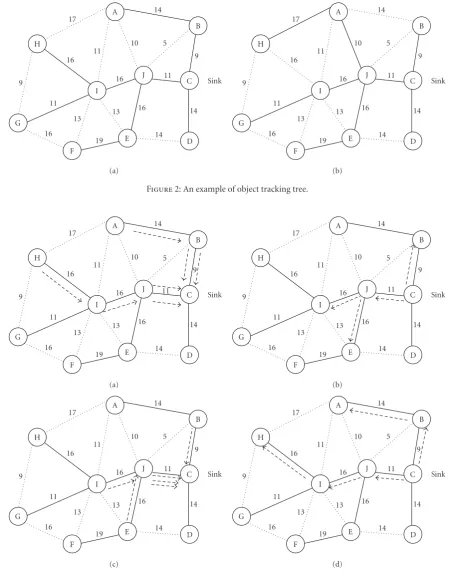
between the neighbor sensor nodes. Most of these mobility profiles are obtained based on historical statistics, such as the city mobility model. But the movements of physical objects are unpredictable, and the real object movement behaviors may not match the mobility profile. The performance of object tracking may be worse due to these differences. For example, an assumptive object movement model is shown inFigure 1(a), and the DAT can be constructed based on the Figure 1(b), and is shown in theFigure 2(a). Suppose that the event rates of w(A,B), w(A,H), w(A,J), and w(B,J) different between the Figure 1(b) andFigure 2(a), the updated cost of the original DAT is increased from 418 to 468. However, suppose the object tracking can be reconstructed using DAT, as shown inFigure 2(b), the updated cost can be improved from 468 to 452. Thus, a dynamic adaptive mechanism for tracking tree can improve the performance of object-tracking tree.
3.2. Message-Tree Adaptive Procedure. From the discussion in previous section, we know that a dynamic adaptive mecha-nism for object-tracking tree can improve the performance of object-tracking tree. In this section, we propose the Message-Tree Adaptive (MTA) procedure. The basic concept of the MTA procedure is that when the sensor node finds the real object movement behaviors not matching the mobility profile, the sensor node should perform the MTA procedure. Thus, each sensor node should store the event rate of each link, and has the predefined event rate of each link. When the actual event rate and the predefine event rate are not match, the MTA procedure will be triggered. As shown in theFigure 2(a), the actual event rate of w(A,H) is 17, and the predefine event rate w(A,H) is 9. Thus, the MTA procedure will be triggered in nodes A and H.
5
Figure2: An example of object tracking tree.
5
Figure3: An example of MTA procedure.
need to send the collection message to all the intermediate nodes in the object tracking tree to get the each link’s actual event rate in the wireless sensor network. As shown in Figure 3(b), the sink first sends the collection message to all the intermediate nodes B, E, I, and J. When the intermediate
When the sink has the actual event rates in the wireless sensor network, the sink will reconstruct the object tracking tree based on the actual event rates. The object tracking tree can be reconstructed by DAT [5] or TAP [10]. Finally, the sink should announce the nodes which are changed in the new object tracking tree. As shown inFigure 3(d), the sink should send the announced messages to the nodes A, B, H, I, and J. The reconstructed object tracking tree is shown in the Figure 2(b).
It is obvious that the MTA procedure cost is very high, and should be measured. We introduce the adaptation cost to measure the overhead of the MTA procedure. The adaptation cost can be divided into three parts. The first one is the number of the adaptive messages, the second part is the number of collection and report messages, and the last one is the number of announce message. The adaptive s is sent from the sensor nodes, which need to perform the MTA procedure, to the sink. The number of the adaptive message of node I, denoted by Report (I), is the hub counts between node I, and the sink. As shown inFigure 3(a), the nodes A, B, H, and J will send the adaptive messages to the sink, and the number of the adaptive message is 7.
The collection messages are sent from the sink to the intermediate nodes, and the report messages are sent from the intermediate node to the sink. The number of the collection messages and report message of node I, denot by Collection(I), is two times the hub counts between node I and the sink. As shown in Figures3(b), and3(c), the sink first sends the collection message to all the intermediate nodes B, E, I and J, and the intermediate nodes B, E, I and J sends their aggregation messages to the sink. Thus, the number of the collection message and report messages is 10. The Announce(I) can be used to denoted the hub counts between the node I and the sink, when the sink send the announce message to the node I. As shown inFigure 3(d), the sink send the announce messages to the nodes A, B, H, I and J, and the number of announce message is 7. Therefore, the adaptation cost can be defined as follows:
Adaptation cost= i∈SR
Report (i) + i∈SC
Collection (i)
+
i∈SA
Announce (i), i∈N,
(1)
whereSRrepresents the set of the sensor nodes which should send the adaptive message,SCis the set of sensor nodes which receives the collection messages sent from the sink or the subroot, andSA denotes the set of sensor nodes that need to change after the MTA procedure.
It is obvious that the adaptation cost is very high. Thus, suppose the difference between the actual event rate and the predefined event rate is very small. The MTA procedure will then be not necessary to perform. The ratio of change is introduced to decide when the MTA procedure should be performed. The ratio of change is defined as follows:
ratio of change=new even trate−original event rate
original event rate
.
(2)
All sensor nodes record event rate of each links and calculate the ratio of
change
Ratio of change
≥θ? Does not report
Responds the request to the sink
Sink querys the event rate of links from all branches and receives these information
from these branches
Sink processes the adaptation algorithm
Sink sends adaptation messages to the nodes which need to be
adapted Step 1
Step 2
Step 3
Step 4
Step 5
Step 6
Yes
No
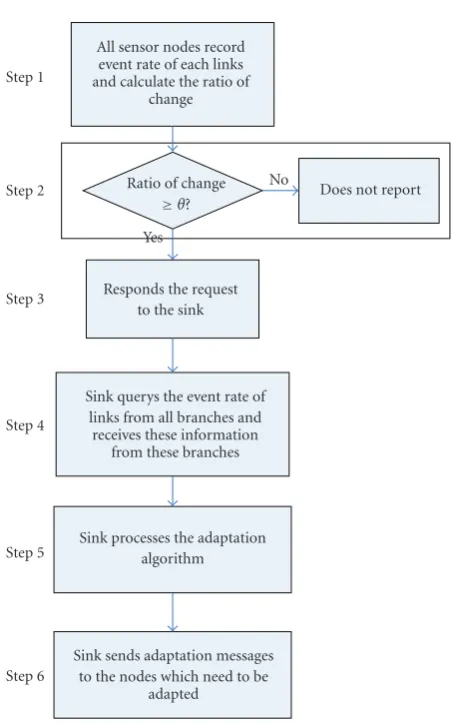
Figure4: Flow chart of MTA procedure on sink.
The minimal original event rate should be 1. We can define a threshold valueθ. When the link’s ratio of change exceedsθ, the sensor node will perform the MTA procedure. Otherwise, the MTA procedure will not be performed. The detailed MTA procedure flowchart is shown inFigure 4.
4. Simulation Results
We implement a simulator to evaluate the performance of the Message-Tree Adaptive procedure on a sensing field of 256×256. The number of deployed sensors varied from 100 to 1000, which are randomly and uniformly deployed in the sensing field. The mobility profiles are generated based on the city mobility model in [4]. To ensure that the mobility profile was statistically significant, the object made 200,000 moves in each mobility profile. Each simulation ran 100 mobility profiles to ensure stable results.
1 9 17 25 33 41 49 57 65 73 81 89 97 143
145 147 149 151 153 155 157 159
Modify links
U
pdat
e
co
st
Without MTA With MTA
×104
Figure5: The average update cost (1–100 links).
1 6 11 16 21 26 31 36 41 46 51 56 61 66 71 76 81 86 91 96 25
45 65 85 105 125 145 165 185 205 225
×102
Modify links
Ad
ap
ta
ti
o
n
co
st
With MTA
Figure6: The Average Adaptation Cost using MTA Procedure (1– 100 links).
some links to randomly set its new event rate. The average updated cost is defined in [5], and the average adaptation cost are considered in this study.
In the figures and tables, the results denoted without MTA are the results of the original object tracking tree affected by the changed mobility profile. The results denoted by MTA are the results of the MTA procedure running. In the Figures5,6,7and8, the number of change links event rate is from 1 to 100. Theθs is 20%, and the number of sensor node is 1000. First, as shown in Figure 5, we observe the advantage of using MTA procedure to significant reduce the update cost. TheFigure 6shows that the adaptation cost of the MTA procedure is slightly increased when the number of modify link increased. InFigure 7, we observe the improved percentage is decreased when the number of modify link is more than 6. From the Figure 8, we can find that the total overhead (average update cost + average adaptation cost) is still lower than the average update cost without using the MTA procedure.
1 6 11 16 21 26 31 36 41 46 51 56 61 66 71 76 81 86 91 96 0.9
0.91 0.92 0.93 0.94 0.95 0.96 0.97 0.98 0.99 1
Modify links
Im
pr
o
vement
rat
io
With MTA
Figure7: The Improvement Percentage using MTA Procedure (1– 100 links).
1 9 17 25 33 41 49 57 65 73 81 89 97 143
145 147 149 151 153 155 157 159
Modify links
Ov
er
head
Without MTA With MTA With MTA (total)
×104
Figure8: The total average overhead (1–100 links).
In Figures 9,10and11andTable 1, show performance at differentθand different MTA procedures. We randomly selected 20 links to change its event rate. The number of sensor nodes is 1000. FromFigure 9andTable 1, when theθ is increased, the improvement percentage for the update cost is slightly increased. This is because when theθincreases, the number of times the MTA procedure is triggered decreases and the average update cost will increase. InFigure 10, we observe that when θ is increased the average adaptation cost is slightly decreased. It is also because that the number of times the MTA procedure is triggered decreases when θ increases.
0.05 0.15 0.25 0.35 0.45 0.55 0.65 0.75 0.85 0.95 141
141.5 142 142.5 143 143.5 144 144.5 145
×104
Threshold
U
pdat
e
co
st
Without MTA With MTA
Figure9: The average update cost.
0.05 0.15 0.25 0.35 0.45 0.55 0.65 0.75 0.85 0.95 1
2 3 4 5 6 7 8 9 10 11
×103
Threshold
Ad
ap
ta
ti
o
n
co
st
With MTA
Figure10: The average adaptation cost using MTA procedure.
0.05 0.25 0.45 0.65 0.85
0 2 4 6 8 10 12
×103
Threshold
Ad
ap
ta
ti
o
n
co
st
Collection Announce Report
Figure11: The adaptation cost analysis.
Table1: The Improvement Percentage using MTA Procedure.
Threshold with MTA on sink
5% 0.985587
10% 0.985587
15% 0.985587
20% 0.985587
25% 0.985587
30% 0.985587
35% 0.985587
40% 0.985587
45% 0.985587
50% 0.985587
55% 0.985587
60% 0.985587
65% 0.985587
70% 0.985587
75% 0.985587
80% 0.985587
85% 0.985587
90% 0.985602
95% 0.985602
the collection and report messages. With the aggregation procedure in the sub root, the adaptation cost can be greatly improved using the Subroot Message-Tree Adaptive procedure.
From these results, we can see that the MTA procedure can significantly improve the update cost when the actual mobility model is very different from the mobility profile.
5. Conclusion
Most object tracking is constructed based on a predefined mobility profile. When the actual object movement behav-iors do not match the predefined mobility profiles, the object tracking tree performance will become worse. This paper proposed a Message-Tree Adaptive (MTA) procedure to improve the object tracking tree structure when the predefined mobility profiles do not match the actual object movement behaviors. From the simulation results, the performance of the object tracking tree can be significantly improved using the MTA procedure. Moreover, the adapta-tion cost is also considered in the paper. From the simulaadapta-tion results, the adaptation cost is high when the MTA procedure is performed. In the near future, we will propose new strategy to improve the adaptation cost.
Acknowledgment
References
[1] W. R. Heinzelman, A. Chandrakasan, and H. Balakrish-nan, “Energy-efficient communication protocol for wire-less microsensor networks,” in Proceedings of the 33rd Annual Hawaii International Conference on System Siences (HICSS ’00), pp. 3005–3014, Maui, Hawaii, USA, January 2000.
[2] X. Ji, H. Zha, J. J. Metzner, and G. Kesidis, “Dynamic cluster structure for object detection and tracking in wireless ad-hoc sensor networks,” in Proceedings of IEEE International Conference on Communications, vol. 7, pp. 3807–3811, Paris, France, June 2004.
[3] W. C. Peng, Y. Z. Ko, and W. C. Lee, “On mining moving patterns for object tracking sensor networks,” inProceedings of the 7th International Conference on Mobile Data Management (MDM ’06), p. 41, May 2006.
[4] H. T. Kung and D. Vlah, “Efficient location tracking using sen-sor networks,” inProceedings of IEEE International Conference on Wireless Communications and Networking, 2003.
[5] C. Y. Lin, W. C. Peng, and Y. C. Tseng, “Efficient in-network moving object tracking in wireless sensor networks,” IEEE Transactions on Mobile Computing, vol. 5, no. 8, pp. 1044– 1056, 2006.
[6] C. Y. Lin, Y. C. Tseng, and T. H. Lai, “Message-efficient in-network location management in a multi-sink wireless sensor network,” inProceedings of IEEE International Conference on Sensor Networks, Ubiquitous, and Trustworthy Computing, pp. 496–502, 2006.
[7] H. W. Tsai, C. P. Chu, and T. S. Chen, “Mobile object tracking in wireless sensor networks,”Computer Communications, vol. 30, no. 8, pp. 1811–1825, 2007.
[8] V. S. Tseng and K. W. Lin, “Energy efficient strategies for object tracking in sensor networks: a data mining approach,”Journal of Systems and Software, vol. 80, no. 10, pp. 1678–1698, 2007. [9] B. H. Liu, W. C. Ke, C. H. Tsai, and M. J. Tsai, “Constructing a
message-pruning tree with minimum cost for tracking moving objects in wireless sensor networks is NP-complete and an enhanced data aggregation structure,”IEEE Transactions on Computers, vol. 57, no. 6, pp. 849–863, 2008.
[10] M.-X. Chen and Y.-D. Wang, “An efficient location tracking structure for wireless sensor networks,”Computer Communi-cations, vol. 32, no. 13-14, pp. 1495–1504, 2009.
[11] L. H. Yen and C. C. Yang, “Mobility profiling using Markov chains for tree-based object tracking in wireless sensor networks,” inProceedings of IEEE International Conference on Sensor Networks, Ubiquitous, and Trustworthy Computing, vol. 2, pp. 220–225, 2006.