Volume 2010, Article ID 618016,14pages doi:10.1155/2010/618016
Research Article
An Optimal Adaptive Network Coding Scheme for
Minimizing Decoding Delay in Broadcast Erasure Channels
Parastoo Sadeghi,
1Ramtin Shams,
1and Danail Traskov
21Research School of Information Sciences and Engineering, The Australian National University, Canberra ACT 0200, Australia 2Institute for Communications Engineering, Technische Universit¨at M¨unchen, D-80290 M¨unchen, Germany
Correspondence should be addressed to Parastoo Sadeghi,[email protected]
Received 31 August 2009; Accepted 3 March 2010
Academic Editor: Heung-No Lee
Copyright © 2010 Parastoo Sadeghi et al. This is an open access article distributed under the Creative Commons Attribution License, which permits unrestricted use, distribution, and reproduction in any medium, provided the original work is properly cited.
We are concerned with designing feedback-based adaptive network coding schemes with the aim of minimizing decoding delay in each transmission in packet-based erasure networks. We study systems where each packet brings new information to the destination regardless of its order and require the packets to be instantaneously decodable. We first formulate the decoding delay minimization problem as an integer linear program and then propose efficient algorithms for finding its optimal solution(s). We show that our problem formulation is applicable to memoryless erasures as well as Gilbert-Elliott erasures with memory. We then propose a number of heuristic algorithms with worst case linear execution complexity that can be used when an optimal solution cannot be found in a reasonable time. We verify the delay and speed performance of our techniques through numerical analysis. This analysis reveals that by taking channel memory into account in network coding decisions, one can considerably reduce decoding delays.
1. Introduction
In this paper, we are concerned with designing feedback-based adaptive network coding schemes that can deliver high throughputs and low decoding delays in packet erasure networks. We first present some background on existing work and emphasize that the notion of delay and the choice of a suitable network coding strategy are highly entangled with the underlying application.
1.1. Motivation and Background. Consider a broadcast packet-based transmission from one source to many des-tinations where erasures can occur in the links between
the source and destinations. Two main throughput optimal
schemes to deal with such erasures are fountain codes [1]
and random linear network codes (RLNC) [2]. In the latter
scheme, for example, the source transmits random linear mixtures of all the packets to be delivered. It is well-known
that if the random coefficients are chosen from a finite field
with a sufficiently large size, each coded packet will almost
surely become linearly independent of all previously received
coded packets and hence, innovative for every destination
[2]. The scheme is therefore almost surely throughput
optimal. Another benefit of fountain codes and RLNC is that they do not require feedback about erasures in individual links in order to operate.
However in these schemes, throughput optimality comes at the cost of large decoding delays, as the receiver needs, in general, to collect all coded packets in a block before being able to decode. Despite this drawback, there are applications which are insensitive to such delays. Consider, for example, a simple software update (file download). The update only starts to work when the whole file is downloaded. In this case, the main desired properties are throughput optimality and the mean completion time and there is often little or no incentive to aim for partial “premature” decoding. The completion time performance of RLNC for rateless
file download applications has been considered in [3]. In
[3], the mean completion time of RLNC is shown to be
much shorter than scheduling. Reference [4] considers time
transmissions before waiting for acknowledgement on the received number of degrees of freedom.
There are applications where partial decoding can cru-cially influence the end user’s experience. Consider, for example, broadcasting a continuous stream of video or audio in live or playback modes. Even though fountain codes and RLNC are throughput optimal, having to wait for the entire coded block to arrive can result in unacceptable delays in the application layer. But, we also note that partial decoding of packets out of their natural temporal order does not necessarily translate into low delivery delays desired by
the application layer. The authors in [5, 6] have proposed
feedback-based throughput-optimal schemes to deal with the transmitter queue size, as well as decoding and delivery delays at the destinations. When the traffic load approaches system capacity, their methods are shown to behave “grace-fully” and meet the delay performance benchmark of single-receiver automatic repeat request (ARQ) schemes.
There is yet another set of applications for which partial decoding is beneficial and can result in lower delays irrespective of the order in which packets are being decoded. Consider, for example, a wireless sensor network in which there is a fusion/command center together with numerous sensors/agents scattered in a region. Each sensor/agent has to execute or process one or more complex commands. Each command and its associated data is dispatched from the center in a packet. For coordination purposes, each agent needs to know its own and other agents’ commands. There-fore, commands are broadcast to everyone in the network. In this application, in-order processing/execution of commands may not be a real issue. However, fast command execution may be crucial and therefore, it is imperative that innovative packets arrive and get decoded at the destinations as quickly as possible regardless of their order. As another example, consider emergency operations in a large geographical region where emergency-related updates of the map of the area need to be dispatched to all emergency crew members. In such situations too, updates of different parts of the map can be decoded in any order and still be useful for handling the emergency.
Finally, some applications may be designed in such a way that they are insensitive to in-order delivery. This can be particularly useful where the transport medium is unreliable.
In such a case, it may be natural to usemultiple-description
source coding techniques [7], in which every decoded packet
brings new information to the destination, irrespective of its order. In light of the emergency applications described above, one can perform multiple-description coding for
map updates, so that updates of different subregions can be
divided into multiple packets and each packet can provide an improved view of one region in a truly order-insensitive fashion.
1.2. Contributions. In this paper, we are inspired by the last set of order-insensitive packet delivery applications and hence, focus on designing network coding schemes that, with the help of feedback, can deliver innovative packets in any order to the destination and also guarantee fast
decoding of such packets. As a first step towards such goal, we limit ourselves to broadcast erasure channels, but emphasize that the ideas can be extended to other more complicated
scenarios. We also consider the class of instantaneously
decodable network coding schemes, in which each coded transmission contains at most one new source packet that a receiver has not decoded yet. The rationale is that in an order-insensitive application, any innovative packet that cannot be decoded immediately incurs a unit of delay. Obviously, one other source of delay is when a coded packet does not contain any new information for a receiver and hence, is not innovative. A similar definition of the decoding delay
was first considered in [8], where the authors presented a
number of heuristic algorithms to reduce order-insensitive decoding delay. In this context, our main contributions are the following.
(i) In Section 1.1, we have motivated the problem in
light of possible applications in sensor and ad hoc networks. To the best of our knowledge, such application-dependent classification of network cod-ing delays did not previously exist in the literature.
(ii) In Section 3.1, we present a systematic framework
for the minimization of decoding delay in each transmission subject to the instantaneous decodabil-ity constraint. We show that this problem can be cast into a special integer linear programming (ILP) framework, where instantaneously decodable packet
transmission corresponds to a set packing problem
[9] on an appropriately defined set structure.
(iii) InSection 3.2, we provide a customized and efficient
method for finding the optimal solution to the set packing problem (which is in general NP-hard).
Our numerical results in Section 6 show that for
reasonably sized number of receivers, the optimum solution(s) can be found in a time that is linearly proportional to the total number of packets.
(iv) InSection 4, we discuss decoding delay minimization
for an important class of erasure channels with memory, which can occur in wireless communication
systems due to deep fades and shadowing [10]. We
show that the general set packing framework in
Section 3can be easily modified to account for the
erasure memory. Our results inSection 6reveal that
by adapting network coding decisions based on chan-nel erasure conditions, significant improvements in delay are possible compared to when decisions are taken irrespective of channel states.
(v) In Section 5, we provide a number of heuristic
variations of the optimal search for finding (possibly suboptimal) solutions faster, if needed. Our results in
Section 6 show that such heuristics work very well and often provide solutions that are very close to the search algorithm. Moreover, they improve on the
2. Network Model
Consider a single source that wants to broadcast some data
toN receivers, denoted byRi fori = 1,. . .,N. The data to
be broadcast is divided intoK packets, denoted bymj for
j=1,. . .,K. Time is slotted and the source can transmit one (possibly coded) packet per slot.
A packet erasure link Li connects the source to each
individual receiver Ri. Erasures in different links can be
independent or correlated with each other. Different erasures in a single link can be independent (memoryless) or correlated with each other (with memory) over time.
For memoryless erasures, an erasure in linkLican occur
with a probability of pe,iin each packet transmission round
independent of previous erasures.
For correlated erasures, we consider the well-known
Gilbert-Elliott channel (GEC) [11], which is a Markov model
with a good and abadstate. If the channel is in the good
state, packets can be successfully received, while in the bad state packets are lost (e.g., due to deep fades or shadowing in the channel). The probability of moving from the good
stateG to the bad stateBin link Liis bi Pr(Ci, = B |
Ci,−1=G) and the probability of moving from the bad state
B to the good stateG is gi Pr(Ci, = G | Ci,−1 = B),
whereis the time slot index. Steady-state probabilities are
given by PG,i Pr(Ci = G) = gi/(bi+ gi) and PB,i
Pr(Ci = B) = bi/(bi+gi). Following [12], we define the
memory content of the GEC in link Li as 0 ≤ μi = 1−
bi−gi < 1, which signifies the persistence of the channel
in remaining in the same state. A smallμmeans a channel
with little memory and a largeμmeans a channel with large
memory.
Before transmission of the next packet, the source collects error-free and delay-free 1-bit feedback from each destination indicating if the packet was successfully received or not. A successful reception generates an acknowledgement (ACK) and an erasure generates a negative acknowledgement (NAK). This feedback is used for optimizing network coding decisions at the source for the next packet transmission round, as described in future sections.
In this work, we consider linear network coding [2] in
which coded packets are formed by taking linear combi-nations of the original source packets. Packets are vectors
of fixed size over a finite field Fq. The coefficient vector
used for linear network coding is sent in the packet header so that each destination can at some point recover the original packets. Since in this paper we are only dealing with
instantaneously decodable packet transmission, it suffices
to consider linear network coding over F2. That is, coded
packets are formed using binary XOR of the original source packets. Thus, network coding is performed in a similar
manner as in [13].
Definition 1. A transmitted packet is instantaneously
decod-able for receiver Ri if it is a linear combination of source
packets containing at most one source packet that Ri
has not decoded yet. A scheme is called instantaneously decodable if all transmissions have this property for all receivers.
Definition 2. At the end of transmission round in an instantaneously decodable scheme, the knowledge of receiver
Ri is the set consisting of all packets that the receiver has
decoded so far. The receiver can therefore, compute any linear combination of the packets that it has decoded for decoding future packets.
Definition 3. In an instantaneously decodable scheme, a
coded packet is called non-innovative for receiverRiif it only
contains source packets that the receiver has decoded so far. Otherwise, the packet is innovative.
Definition 4. A scheme is called rate or throughput optimal if all transmissions are innovative for the entire set of receivers.
Definition 5. In time slot, receiverRiexperiences one unit of delay if it successfully receives a packet that is either non-innovative or not instantaneously decodable. If we impose instantaneous decodability on the scheme, a delay can only occur if the received packet is not innovative.
Note that in the last definition, we do not count channel inflicted delays due to erasures. The delay only counts “algorithmic” overhead delays when we are not able to provide innovative and instantaneously decodable packets to a receiver.
As an example, if the knowledge ofR1 is {m1,m2,m3},
receivingm1⊕m2 will causeR1 to experience one unit of
delay, whereasm1⊕m2⊕m5is innovative and instantaneously
decodable, hence does not incur any delay.
We note that a packet that is not transmitted yet or transmitted but not received by any receiver can be transmitted in an uncoded manner at any transmission slot without incurring any algorithmic delay. In fact, this is
how the transmission starts: by sending m1 uncoded, for
example.
A zero-delay scheme would require all packets to be both innovative and instantaneously decodable to all receivers. Thus zero-delay implies rate optimality, but not vice versa. As
the authors show in [8, Theorem 1] for the case ofN=2 and
N=3 receivers, there exists anofflinealgorithm that is both
rate optimal and delay-free. ForN≥4 the authors prove that
a zero-delay algorithm does not exist. By offline we mean that the algorithm needs to know future realizations of erasures in
broadcast links. In contrast, anonlinealgorithm decides on
what to send in the next time slot based on the information received in the past and in the current slot. In this paper, we focus on designing online algorithms.
3. Optimization Framework
3.1. Problem Formulation Based on Integer Linear Program-ming. Instantaneous decodability can be naturally cast into the framework of integer optimization. To this end, let us
fix the packet transmission round to and consider the
knowledge of all receivers, which is also available at the source because of the feedback. The state of the entire system
the receivers) can be described by anN×Kbinary receiver-packet incidencematrixAwith elements
ai j=
1 ifRineedsmj,
0 otherwise. (1)
Columns of matrix Aare denoted bya1to aK. We assume
that packets received by all receivers are removed from the
receiver-packet incidence matrix. Hence,Adoes not contain
any all-zero columns.
Example 1. Consider N = 2 receivers andK = 3 packets. Before the transmission begins, the receiver-packet incidence
matrixAis an all-one 2×3 matrix. If we send packetm1in
the first transmission round = 1 and assuming that only
receiverR2successfully receives it,Awill become
A=
If we send packetm2 in the next transmission round =2
and assuming that only receiverR1successfully receives it,A
will then be
The condition of instantaneous decodability means that at any transmission round we cannot choose more than one
packet which is still unknown to a receiverRi. In the example
above, at=3, we cannot sendm1⊕m3because it contains
more than one packet unknown toR1.
Let x represent a binary decision vector of length K
that determines which packets are being coded together. The transmitted packet consists of the binary XOR of the source
packets for which xj = 1. More formally, we can define
the instantaneous decodability constraint for all receivers as
Ax ≤ 1N, where1N represents an all-one vector of length
Nand the inequality is examined on an element-by-element
basis (Note that although x is a binary or Boolean vector,
Axis calculated in real domain. Hence,Ax ≤ 1N is in fact
a pseudo-Boolean constraint.). This condition ensures that a transmitted coded packet contains at most one unknown
source packet for each receiver. A vectorxis calledinfeasible
if it does not satisfy the instantaneous decodability condition.
In other words, x is called infeasible if and only if there
exists at least one p for which bp > 1 in Ax = b =
[b1,. . .,bp,. . .,bN]T. A vectorxis called asolutionif and only
if it satisfiesAx≤1N. In the rest of this paper, “Ax≤1N” and
“xis a solution” are used interchangeably.
Now consider setsM1,. . .,MK⊂ {R1,. . .,RN}, whereMj
is the nonempty set of receivers that stillneedsource packet
mj. Note that these sets can be easily determined by looking
at the columns of matrixA. The “importance” of packetmj
can be, for example, taken to be the size of setMj, which is
the number of receivers that still needmj.
We now formally describe the optimization procedure that should be performed at the transmitter. Maximizing the number of receivers for which a transmission is innovative,
subject to the constraint of instantaneous decodability, can be posed as the following (binary-valued) integer linear program (ILP):
in combinatorial optimization, usually calledset packing[9].
Here the universe is the set of all receivers and we need to find disjoint (due to instantaneous decodability condition)
subsetsMjwith the largest total size. In the (most desirable)
case when equality holds inAx ≤1N for every receiver, we
also speak of aset partition. This is equivalent to a zero-delay
transmission.
InSection 4, we will consider other measures of packet
importance and discuss the role ofw in tailoring the
opti-mization problem according to the application requirements or channel conditions, such as memory in erasure links.
We assume that elements of w, which signify packet
importance, are all positive. If one has already found a
solution such as x1 = [x1,. . .,xp−1, 1,xp+1,. . .,xK] with
thatgivensolutionx1,x0is clearlysuboptimaland hence, can
be discarded in an algorithm that searches for the optimal solution(s).
3.2. Efficient Search Methods for Finding the Optimal Solution
of (4). It is well known that the set packing problem is
NP-hard [9]. Here, we present an efficient ILP solver designed
to take advantage of the specific problem structure. Later, we will see that for many practical situations of interest, our method performs well empirically. Based on this framework,
we will also present some heuristics inSection 5to deal with
more complicated and time-consuming problem instances. We begin presenting our method by first defining constrained and unconstrained variables.
Definition 6. Two binary-valued variables are said to be constrainedif they cannot be simultaneously 1 in a solution.
Or formally,xiandxjare constrained if for anyxsatisfying
Ax ≤ 1N, xi +xj ≤ 1 (Again, note that the addition of
variables takes place in real domain.). We also say thatxj is
constrained toxiand vice versa. It can be proven thatxiand
xj are constrained if and only if there exits at least one row
indexpinAfor whichapi=ap j=1.
Definition 7. The set of all variables constrained toxiis called theconstrained setofxiand is denoted byCi. That is,
elements in the same row position. That is, for each row
Solve (Pk)
Save solution
Combine the solution with previously resolved variables
Solve (Pk−ku−ks−1)
Resolve constraints
xj=0 forxjinCs
ks= |Cs|
xs=1
Resolve unconstrained set
xj=1 forxjinU
ku= |U| Unconstrained set
U = {xi| |Ci|=0} Most constrained
s=argmax|Ci|
i
Constrained set
Ci= {x|i=j,Ax≤1N⇒
xi+xj≤1} N Initialize
k=K
k=1?
Y x1=1
Return [solution]
Return [solution(s)]
Combine the solution with previously resolved variables
Solve (Pk−ku−1)
xs=0
Figure1: A schematic ofAlgorithm 1with greedy pruning for finding the optimal network coding solution of (4). Note that the algorithm is recursive as it callsPk−ku−ks−1andPk−ku−1within itself.
Definition 8. A variablexiis said to beunconstrainedifCi=
∅. The set of all unconstrained variables is denoted byUand
is referred to as theunconstrained set.
Ifxiis an unconstrained variable, then for each row indexp,
api =1⇒ ap j =0 for all j /=i(otherwise,xiandxj would
become constrained).
Example 2. Consider the following receiver-packet incidence
matrixA
A= ⎡ ⎢ ⎢ ⎢ ⎢ ⎢ ⎢ ⎢ ⎢ ⎢ ⎣
1 0 1 0 0 0 1 1 0 0 0 0 0 0 1 0 0 0 0 0 1 1 0 0 0 0 0 0 1 0 0 0 0 0 0 1 0 0 0 0 0 1 ⎤ ⎥ ⎥ ⎥ ⎥ ⎥ ⎥ ⎥ ⎥ ⎥ ⎦
. (6)
One can easily verify the relations defined above. For
example, variables x1 and x3 are constrained because for
p = 1, ap1 = ap3 = 1. Variables x1 and x4 are not
constrained to each other because columnsa1anda4do not
have a nonzero element in the same row position. Variable
x6is unconstrained because no other column has a nonzero
element in rows 6 or 7. In summary,C1 = {x2,x3},C2 =
{x1},C3= {x1,x4},C4= {x3}andC5=C6= ∅.
To design an efficient search algorithm, one needs to efficiently prune the parameter space and reduce the problem size. We make the following observations for pruning of the parameter space.
(1) Unconstrained variables must be set to 1. In other words, setting those variables to 0 does not contribute
to the optimal solution (note that the elements inw
are positive). In the above example,x5 andx6 must
be set to 1 because no other variable is constrained to them (we will make this statement formal in the optimality proof of the algorithm in the appendix).
(2) If a constrained variable is set to 1 all members of its constrained set must be set to 0. In the above
(3) At a given step, the parameter space can be pruned most by resolving the variable with the largest constrained set.
Application of the third observation, in a search algorithm results in greedy pruning of the parameter space. We note that greedy pruning is only optimal for a given step of the algorithm and is not guaranteed to result in the optimal reduction of the overall complexity of the search.
We now make a final remark before presenting the search algorithm. In particular, we have observed that finding constrained sets for each variable in each step of the algorithm can be somewhat time consuming. A
very effective alternative is to first sort matrix A,
column-wise, in descending order of the number of 1’s in each
column. Setting the “most important” head variablex1(with
the highest |M1|) to 1 is likely to result in the largest
constrained set (because it potentially overlaps with many other variables) and hence, many variables will be resolved in the next recursion. We will refer to the approach based
on finding the largest constrained set as thegreedy pruning
strategy and to the alterative approach as thesorted pruning
search strategy.
The greedy pruning search strategy is shown inFigure 1,
which with appropriate modifications can also represent the
sorted pruning variation. Let Pk denote the problem of
size k whose input is an N ×k receiver-packet incidence
matrixAkand whose output is a set of solutions of the form
x of lengthk which satisfy the instantaneous decodability
condition Akx ≤ 1N. The algorithms can be described as
shown inAlgorithm 1.
In the appendix, we prove by structural induction that
Algorithm 1 is guaranteed to return all optimal solutions
of (4). However, we note that not every solution returned
by Algorithm 1 is optimal. The nonoptimal solutions can be easily discarded by testing against the objective function
(4) at the end of the algorithm. We also note that in
Algorithm 1, we can simply remove those packets received
by every receiver from the problem. If there are K0
such variables, we can start step (1) above from k =
K − K0 instead of K. The Matlab code for both the
greedy and sorted pruning algorithms can be found at
http://users.rsise.anu.edu.au/∼parastoo/netcod/.
We conclude this section by a brief note on the
computa-tional complexity ofAlgorithm 1. Let us denote the number
of recursions required to solve the problem of sizekbyCk.
According toAlgorithm 1, this problem is always broken into
two smaller problems of sizek−ku−ks−1 andk−ku−1.
Therefore, one can find the number of recursions required to
solvePkby recursively computingCk=Ck−ku−ks−1+Ck−ku−1.
The recursion stops when one reaches a problem of size 1
(only one packet to transmit) whereC1=1.
4. Adaptive Network Coding in the Presence of
Erasure Memory
Here, we present a generalization of the set packing approach for coded transmission in erasure channels with memory.
The idea is that the importance of a packet mj is no
longer determined by how many receivers needmj, but by
the probability thatmj will be successfully decoded by the
receivers that need it. In computing this probability, one can use the fact that successive channel erasures in a link are usually correlated with each other and hence, their history can be used to make predictions about whether a receiver is going to experience erasure or not in the next time slot. To present the idea, we focus on the GEC model for representing channel erasures. More general memory models for erasure can also be incorporated into our framework.
We define the reward piof sending a packet to receiver
Rias the probability of successful reception byRiin the next
time slot:pi =Pr(Ci, =G|Ci,−1), whereCi,−1is the state
of Ri in the previous transmission round (Statements like
“state ofRi” should be interpreted as the state of the physical
link Li connecting the source toRi.). The total reward or
importance of sending packetmjis then
wj=
i∈Mj
pi. (7)
The above weight vector gives higher priority to a packetmj
for which there is a higher chance of successful reception,
because the receivers that needmj are more likely to be in
good state in the next time slot. With this newly defined weight vector, one can try to solve the optimization problem
given in (4) under the same instantaneous decodability
condition.
Remark 1. We conclude this section by emphasizing that the
optimization framework in (4) is very flexible in
accom-modating other possibilities for the weight vectorw, which
can be appropriately determined based on the application. For example, instead of allocating the same weight to a packet needed by a subset of receivers, one can allocate
different weights to the same packet (looking column-wise
atA) depending on the priorities or demands of each user.
In the map update example described in the Introduction, different emergency units can adaptively flag to the base station different parts of the map as more or less important depending on their distance from a certain disaster zone. The task of the base station is then to send a packet combination that satisfies the largest total priority. One can also combine user-dependent packet weights with the channel state prediction outcomes in a GEC. One possibility
is to multiply the probabilitiespiby the receiver priority. It
could then turn out that although a receiver is more likely to be in erasure in the next transmission round, it may be served because of a high priority request.
5. Heuristic Search Algorithms
In Section 3.2, we proposed efficient search algorithms for
finding the optimal solution(s) of (4). However, there may
be situations where one would like to obtain a (possibly suboptimal) solution much more quickly. This may be the case, for example, when the total number of packets to
be transmitted is very large. Therefore, designing efficient
(1)Start with the original problem of sizek=K.
(2)ifsorted pruning strategy is desiredthen
(3) Rearrange the variables inAkin descending order of packet importance (number of 1’s in each column).
(4)end if
(5)Solve(Pk):
(6)ifk=1then
(7) Returnx1=1(since the variable is not constrained).
(8)else
(9) ifgreedy pruning strategy is desiredthen
(10) Determine the constrained set for all variablesx1toxk.
(11) Denote the index of the variable with the largest constrained set bysand the cardinality of its constrained set byks.
(12) else
(13) Determine the constrained set for the head variablex1with cardinalityk1and also the set of unconstrained variables (Note that we have overused index 1 to refer to the head variable in the reordered matrix at each recursion.). Sets=1.
(14) end if
(15) Denote the cardinality of the unconstrained setUbyku.
(16) Set all the unconstrained variables to 1.
(17) Setxs=1and the variables in its corresponding constrained setCsto 0.
(18) Reduce the problem by removing resolved variables. ReduceAkaccordingly.
(19) Solve(Pk−ku−ks−1)(Note thatkuunconstrained variables are set to one,xs=1andksvariables constrained byxs
are set to zero, hence a total of ks+ku+ 1variables are resolved.).
(20) Combine the solution with previously resolved variables. Save solution.
(21) Setxs=0.
(22) Reduce the problem by removing resolved variables. ReduceAkaccordingly.
(23) Solve(Pk−ku−1)(Note thatkuunconstrained variables are set to one andxs=0, hence a total of ku+ 1variables
are resolved.).
(24) Combine the solution with previously resolved variables. Return solution(s).
(25)end if
Algorithm1: Recursive search for the optimal solution(s) of (4).
important. In this section, we propose a number of such heuristics.
5.1. Heuristic 1—Weight Sorted Heuristic Algorithm. The idea behind this recursive algorithm is very simple. As in
Algorithm 1, we start with the original problem of size
k = K. We then rearrange the columns of the matrix A
in descending order of|wj| (starting from the packet with
the highest weight). Note that this is different from the
sorted pruning version of the Algorithm 1, in which the
columns of A were sorted in descending order of|Mj| to
potentially result in large constrained sets. We then set the
head variablex1=1 and find its corresponding constrained
set C1 to resolve k1 = |C1| variables that are to be set
to zero. We then solve the smaller problem of size Pk−k1
and continue until the problem cannot be further reduced.
One main difference between Heuristic 1 andAlgorithm 1is
that at each recursion, the head variable is only set to one;
the other possibility of x1 = 0 is not pursued at all. In a
sense, this heuristic algorithm findsgreedysolutions to the
problem at each recursion by serving the highest priority
packet. In this heuristic algorithm, all ku unconstrained
variables are naturally set to 1 in the course of the algorithm. The computational complexity of this method is at worst
proportional to K, which can happen when there is no
constraint between packets.
5.2. Heuristic 2—SearchAlgorithm 1 with Maximum Recur-sions/Elapsed Time. It is possible to terminate the recursive
searchAlgorithm 1prematurely once it reaches a maximum
number of allowed recursions/elapsed time. If the algorithm reaches this value and the search is not complete, it performs atermination procedurewhereby it heuristically resolves the remaining unresolved packets in the current incomplete solution. That is, it performs Heuristic 1 on a smaller problem, which is yet to be solved. It then returns the best solution that has been found so far. We note that due the extra termination procedure, the actual number of recursions/elapsed time can be (slightly) higher than the preset value.
Two comments are in order here. Firstly, Algorithm 1
is designed to sort the matrix A based on the number of
receivers that need a packet. It only reverts to sorting the
unresolved variables based on the vectorwin the termination
process. Secondly, if the maximum number of recursions is
set to one,Algorithm 1just performs the termination process
and becomes identical to Heuristic 1.
recursion (effectively run Heuristic 1). If the throughput (Let
Q⊂ {1,. . .,N}denote the index of receivers that still need at
least one packet andRQdenote such receivers. The achieved
throughput at time slotis defined aswTx/ f(R
Q), wherex
is the found solution and f(RQ) is an appropriate function
of receivers’ needs. For memoryless erasures f(RQ)= |RQ|
and for GEC’s f(RQ)=
q∈Q|pq|(refer toSection 4and
(7)).) is higher than a desired value, there is no need to
proceed any further. Otherwise, we can gradually increase the number of recursions by an appropriate step size. This heuristic stops when it either reaches the maximum allowed recursions or when increasing the number of recursions does not result in a noticeable improvement in the throughput.
6. Numerical Results and Secondary
Coding Considerations
We start this section by presentingend-to-enddecoding delay
results for memoryless erasure channels. We then specialize to erasure channels with memory. The end-to-end problem
is the complete transmission of K packets. End-to-end
decoding delay of a receiver is the sum of decoding delays for the receiver in each transmission step. In the following, when we say “the delay performance of method X”, we are referring to the delay performance of the end-to-end transmission, where method X is applied at each step.
In the course of presenting the results and based on the observed trends, we will discuss some secondary coding techniques and post processing considerations that can improve the decoding delay. Throughout the analysis of this section, we assume independent erasures in different links
with identical probabilities. Hence, we can drop subscripti
when referring to link erasure probabilities.
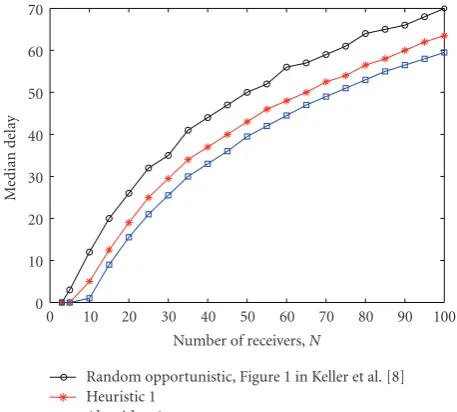
Figure 2 shows the median of decoding delay for the
transmission of K = 100 packets to N = 3 to N =
100 receivers. Channel erasures are memoryless and occur
with a high probability of p = 0.5 independently in
every link. The median of delay is computed across all receivers and is, in fact, also the median across many stochastic runs of the algorithms. The first curve from below
shows the delay obtained fromAlgorithm 1(Throughout the
numerical evaluations, we used the sorted pruning version ofAlgorithm 1.). The middle curve is the delay obtained by performing Heuristic 1. The top curve shows a reproduction
of delay results reported in [8] which are based on arandom
opportunistic instantaneous network coding strategy. In this case, the transmitter first selects a packet needed by at least one receiver at random. Then, it goes over other packets in some order and adds a packet to the current choice only if their addition still results in instantaneous decodability. In comparison, Heuristic 1 performs noticeably better than that
in [8] and more importantly, is not much far away from the
results ofAlgorithm 1. This is specially important since for
some number of receivers, Heuristic 1 can run considerably
faster thanAlgorithm 1, which will be shown in the coming
figures shortly.
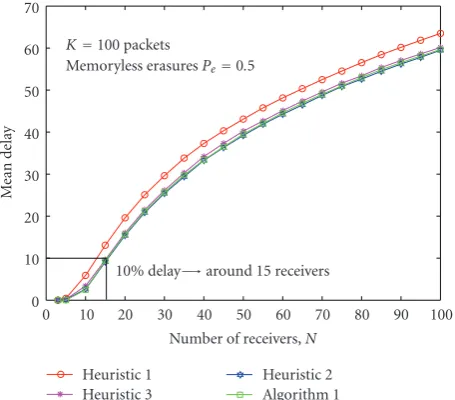
Figure 3 compares the mean delay performance of
different heuristics presented in Section 5 with that of
0 Number of receivers,N
Random opportunistic, Figure 1 in Keller et al. [8] Heuristic 1
Algorithm 1
Figure2: Median of decoding delay for the transmission ofK =
100 packets toN = 3 toN = 100 receivers. Channel erasures are memoryless and occur with a high probability of p = 0.5 independently in every link.Algorithm 1, Heuristic 1 and random Heuristic [8] are compared with each other.
Algorithm 1. Similar to the previous figure, mean delay is computed across all receivers. The delay performance of
Heuristic 2, Heuristic 3, andAlgorithm 1are close, whereas
Heuristic 1 results in the largest delay. A careful reader may notice that the end-to-end performance of Heuristic 2 is
at times better than Algorithm 1. While the difference is
practically insignificant, this deserves some explanation. The end-to-end transmission problem involves making packet transmission decisions at each step. While all algorithms start with the same packet incidence matrix (all-ones), due to packet erasures and as they make decisions about transmission of packets at each step, they take diverging paths
in the solution space. As a result, they end up with different
packet incidence matrices to solve over time. Hence, it is conceivable for an algorithm to make suboptimal decisions at one or more steps and yet end up with a better end-to-end
delay thanAlgorithm 1that strictly makes optimal decisions
at every step. Intuition suggests that an algorithm such as Heuristic 1 that consistently makes suboptimal decisions is
unlikely to outperform Algorithm 1 end-to-end, which is
confirmed by the numerical results. However, an algorithm such as Heuristic 2 which almost always makes optimal decisions with only infrequent exceptions, may outperform
Algorithm 1. According toFigure 3, these perturbations in end-to-end performance are practically insignificant and the intuitive choice of the optimal or a largely optimal algorithm at each step will result in the best end-to-end performance.
We note that the delays presented here (and also in the
following figures) are, in fact,excess median or mean delays
beyond the minimum required number of transmissions,
which isK. For example, a mean delay of 10 slots forK =
0 Number of receivers,N
Heuristic 1 Heuristic 3
Heuristic 2 Algorithm 1 10% delay−→around 15 receivers
K=100 packets
Memoryless erasuresPe=0.5
Figure3: Mean decoding delay for the transmission ofK =100 packets toN =3 toN =100 receivers.Algorithm 1is compared with Heuristics 1–3. Both Heuristics 2 and 3 perform very closely to Algorithm 1. The maximum number of recursions for both Heuristic 2 and 3 is set to 100.
price for guaranteeing instantaneous decodability. In other
words, one measure of throughput is th1 = K/(K +d),
wheredis the mean delay across all receivers. An example
is shown in Figure 3. For up to around 15 receivers in the
system,Algorithm 1, Heuristics 2, and 3 ensure an average
throughput loss of 10%.
It is quite possible that Algorithm 1 returns multiple
network coding solutions all of which have the same
objective valuewTx. A natural question that arises is whether
systematic selection of a solution with a particular property is better than others in the presence of erasures in the channel. Our experiments verify that indeed some secondary post processing on the solutions can improve the end-to-end delay. In particular, we compare two post processing techniques: (1) selecting a solution which involves minimum amount of coding (lowest number of 1’s in the solution
vectorx) and (2) selecting a solution with maximum amount
of coding (highest number of 1’s in the solution vectorx).
Figure 4shows the effects of such processing on the overall
decoding delays. It is clear that maximum coding is not a
reasonable choice and results in worse delays compared with minimum coding. We attempt to explain this behavior by means of an example and intuitive reasoning. Let us assume
that there are K = 3 packets to be transmitted to N =
3 receivers and at the beginning of the third transmission
round, matrixAis given as follows
A=
It is clear that there are two optimal solutions: we can either
send packetsm1⊕m2or packetm3by itself, where the former
involves coding and latter is uncoded. Now let us assume that
0 Number of receivers,N
Heuristic 1
Algorithm 1 using first returned answer Algorithm 1 using minimum coding Algorithm 1 using maximum coding
K=100 packets
Memoryless erasuresPe=0.5
Figure4: The effect of post processing on mean delay. Whenever
Algorithm 1 returns multiple solutions, minimum amount of coding should be chosen. Heuristic 1 is shown for reference.
we select the maximum coding strategy and sendm1⊕m2. If
in the third transmission round onlyR2successfully receives,
Awill become
and clearly the optimal solution is sending packetm3. If in
the fourth transmission round onlyR1successfully receives,
Awill become
where it is evident that in the fifth transmission round, we cannot find a packet which is innovative and instantaneously decodable for all the three receivers. On the other hand, one can verify that if we adopt a minimum coding strategy
and send packet m3 in the third transmission round, we
can always find innovative and instantaneously decodable packets for all three receivers in the future regardless of erasures in the channel. In summary, solutions with less coding tend to cause less constrains on the problem in the future.
It is noted in Figure 4 that the first solution returned
byAlgorithm 1performs almost the same as the minimum
coding solution. The reason for this is thatAlgorithm 1first
0 Number of receivers,N
Heuristic 1
Figure 5: Average number of recursions in Algorithm 1 and
Heuristics 1–3. The maximum number of recursions for both Heuristic 2 and 3 is set to 100. By referring toFigure 3, we observe that for small number of receivers, Heuristics 2-3 can provide same decoding delays at a fraction of computational complexity.
section, unless otherwise stated, we have shown the delay
results based on the first returned solution ofAlgorithm 1.
It is interesting to analyze the actual number of
recur-sions that the search in Algorithm 1 takes to find the
optimum solution. This is shown inFigure 5forK = 100
packets along with the number of recursions required in
Heuristics 1, 2, and 3. Algorithm 1 shows three modes of
behavior: low, medium, and high number of recursions.
When the number of receivers is larger than N = 20,
Algorithm 1 finds the optimal solution very quickly and the number of recursions is very close to the number of
packetsK. However, when the number of receivers is lower,
the constraints that each receiver imposes on the network coding decisions cannot limit the search space enough and hence, a large number of combinations have to be tested. Obviously, Heuristic 1 has the lowest number of recursions. Compared to Heuristic 2 with 100 fixed recursions, dynamic Heuristic 3 can almost halve the number of recursions
with negligible effect on delay performance (see Figure 3).
By referring to Figure 3, we conclude that for the system
under consideration, the excessive number of recursions in
Algorithm 1 is not warranted as it does not result in any noticeable delay improvement compared to Heuristics 2 or 3.
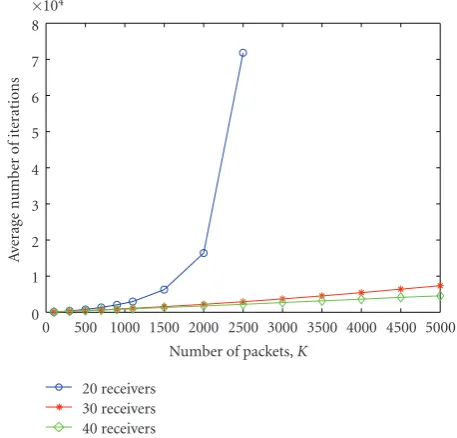
Figure 6 shows the effect of increasing the number of
packets on the computational complexity ofAlgorithm 1in
terms of number of recursions to complete the search. Three
different numbers of receiversN = 20,N = 30, andN =
40 are considered. The complexity remains linear with the number of packets for well-sized receiver populations (30 and 40 receivers). This is in agreement with observations in Figure 5. When the number of receivers is not so large
0 500 1000 1500 2000 2500 3000 3500 4000 4500 5000 Number of packets,K
0
Figure6: The effect of increasing the number of packets on the computational complexity ofAlgorithm 1in terms of number of recursions. The complexity remains linear with the number of packets for well-sized receiver populations (30 and 40 receivers).
(see the blue curve inFigure 6forN=20), we see a sudden
growth in complexity, in terms of number of recursions,
whenK 700 packets. In such situations, truncating the
number of recursion to be linear with the number of packets (Heuristic 2) is a good alternative.
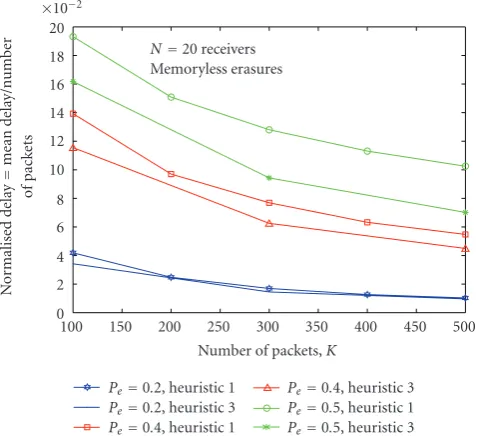
Figure 7 shows the impact of the number of packets and also erasure probability on the decoding delay. The
normalized mean delay versus number of packets K is
plotted for three different erasure probabilities Pe = 0.5,
Pe = 0.4, and Pe = 0.2, which are still high erasure
probabilities. The number of receivers is fixed to N = 20.
The delay performance of Heuristics 1 and 3 are shown. A few observations are made. Firstly, as expected, the delay (both absolute and normalized measures) decreases as the
erasure probability decreases. Secondly, the difference in the
delay performance between Heuristics 1 and 3 decreases as the erasure probability decreases. This trend has also been observed for other number of receivers. Moreover, the
difference between heuristics andAlgorithm 1decreases with
erasure probability, which is not shown here for clarity of figure. Finally, the normalized delay decreases as the number of packets increases. We noted, however, that the absolute delay may increase or decrease depending on the number of receivers in the system. We attribute possible decrease in the normalized delay to the fact that when there are more packets to transmit, the transmitter has more options to choose from and hence, encounters delays less often in a normalized sense. An important question that may arise in practical situations is how to choose the “block size” or the number of packets that are taken into account for making network
coding decisions. If one has a total ofKpackets to transmit,
0
N=20 receivers Memoryless erasures
100 150 200 250 300 350 400 450 500 Number of packets,K
Pe=0.2, heuristic 1
Figure7: The effect of number of packets and erasure probabilities on the normalized delay. The maximum number of recursions for Heuristic 3 is set to 100. As the erasure probability decreases, the delay decreases as expected. The normalized delay decreases withK
for this particularN(this is not always the case).
sizes or does it make sense to treat them as one single block of packets? The short answer is to include all “order-insensitive” packets in making transmission decisions and only break the packets into subblocks when the assumption of order insensitivity between subblocks breaks down. In the extreme case, an infinite number of order-insensitive packets provides an infinite pool of packets to choose from that can satisfy the demands of all receivers and are instantaneously decodable.
Figure 8 shows the end-to-end delay when the number of
packets in a block is finite andK=100 packets is chosen as
the reference for comparison. We can see that although the
delay of transmittingλKpackets,dλK, can be larger than that
of transmittingKpacketsdK, the delay does not increase by a
factor ofλ. That isdλK < λdKand one does not benefit from
breakingλKpackets intoλsubblocks of sizeKpackets each.
By treatingλsubblocks of sizeKas one block of sizeλK, we
add more degrees of freedom in making decisions.
Now we turn our attention to the delay performance of
our algorithms in channels with memory. Figure 9 shows
the mean delay of different algorithms forK =100 packets
andN = 3 receivers. The GEC parameters for all links are
identical withb=g. The horizontal axis shows the memory
content μ = 1 −2b. The first curve from above shows
the performance ofAlgorithm 1when the transmitter does
not take channel conditions into account in making coding
decisions. In other words,wj = |Mj|is used inAlgorithm 1
as if the channel states were memoryless. For relatively large memory contents, this method results in the largest mean delay. The next curve shows the delay performance of Heuristic 1. The next two curves, which are almost
10
100 150 200 250 300 350 400 450 500 Number of packets,K
Algorithm 1 Heuristic 1
Linear increase in delay
N=20 receivers
Memoryless erasuresPe=0.5
Figure8: The effect of block size on the mean delay. If the delay of transmittingK = 100 packets in Heuristic 1,d100, is taken as the
reference, we can see that the delay of includingλ×100 packets in transmission is less thanλd100. The same observation applies to
the delay ofAlgorithm 1. In general, it is recommended to include all “order-insensitive” packets in making transmission decisions and only break the packets into subblocks when the assumption of order insensitivity between subblocks breaks down.
indistinguishable, show the performance of Algorithm 1
which takes channel states into account (using (7)) and
Heuristic 2 with 100 recursions. The last curve shows the best delay that can be achieved by occasionally violating the instantaneous decodability rule for one receiver in favor of the other two receivers that are predicted to be in good state in the next transmission round. More details can be found in
[14].
Figure 10 shows the delay performance ofAlgorithm 1
using packet weights according to (7) forN =3 toN =15
receivers. Both the mean delay and mean delay plus one standard deviation of delay (across 1000 stochastic runs of the transmission) are shown. As expected, the delay increases as the number of receivers increases. Comparing the delay’s standard deviation with its mean, we observe that when the number of receivers is 3–5, the delay is relatively more variant than when the number of receivers is 10–15. For example,
forN=3 andμ=0.984, the ratio of standard deviation to
mean delay is around 3.225/0.81834, whereas forN=15
andμ = 0.94 this ratio reduce to only 7.35/22.49 0.33.
One should keep these variations in mind when designing the transmission system.
We conclude this section with a brief look at the effect of post processing on the delay performance in channels
with memory.Figure 11shows different delays forN = 15
receivers and K = 100 packets. The figure confirms our
earlier finding that selecting the maximum amount of coding
among the optimal solutions provided byAlgorithm 1can
result in larger end-to-end delays. We also note that serving
0
Identical GEC in each link withb=g
0 0.1 0.2 0.3 0.4 0.5 0.6 0.7 0.8 0.9 1 Channel memoryμ=1−2b
Algorithm 1, but blind to channel states (wj= |Mj|) Heuristic 1
Heuristic 2
Algorithm 1 with predictive weights using (7) Special case forN=3 receivers [14]
Figure 9: Delay performance of different algorithms in Gilbert-Elliott channels. The maximum number of recursions for Heuristic 2 is set to 100. By predicting next channel states and defining packet weights accordingly (see (7)), one can achieve considerably lower delays.
3 receivers mean + std dev 5 receivers mean + std dev 10 receivers mean + std dev 15 receivers mean + std dev
3 receivers mean 5 receivers mean 10 receivers mean 15 receivers mean
Figure10: Delay performance ofAlgorithm 1with weights defined using (7) for different number of receivers. As expected, the delay increases with the number of receivers. Both the mean delay (solid curves) and mean delay plus one standard deviation of delay (dashed-dotted curves) across 1000 stochastic runs of the transmission are shown.
Algorithm 1 with weights from (7) using max coding for max receivers
Algorithm 1 with weights from (7) using first returned answer
K=100 packets
N=15 receivers
Identical GEC in links withb=g
Figure 11: The effect of post processing on mean delay. As explained in the main text, wheneverAlgorithm 1returns multiple solutions, choosing the maximum amount of coding and serving maximum number of receivers can often have adverse effects on the delay.
on the delay in GEC’s. To explain this, consider an example
where there are K = 2 left packets to be transmitted to
N=100 receivers. Packet 1 is needed byR1toR99and packet
2 is needed byR99 andR100. Since both packets are needed
byR99, we can either send packet 1 or 2, but not both. Now
assume thatR1toR99are all predicted to be in good state with
probability 0.01 andR100is predicted to be in good state with
probability 0.98, so that w1 =w2 = 0.99 according to (7).
Therefore, transmission of either packet seems to be equally optimal. However, one can easily verify that the probability
of at least one receiver amongR1 toR99 receiving packet 1
is only 1−0.9999 = 0.63, whereas the probability of either
R99 orR100 receiving packet 2 is 1−0.99∗0.02 = 0.9802.
Therefore, it makes sense to satisfy only two receivers, one of which has a high priority due its good channel conditions.
7. Conclusions
to relax the instantaneous decodability condition toL-step decodability and investigate the delay-throughput tradeoff.
Appendix
Here we prove by structural induction that (a) every result
returned by Algorithm 1 is a solution of (4) and (b) the
set of solutions returned by the algorithm contains all the optimal solutions. We note that the algorithm is designed to discard infeasible vectors and those solutions that are clearly suboptimal at each recursion to improve performance. The
latter is based on positiveness of the elements of w as
explained below.
The algorithm generates a binary tree. Each node
rep-resents a problem of sizek andPk, and branches into two
subproblems of size Pk−ku−ks−1 and Pk−ku−1. The former
subproblem is a result of settingxs=1 and the latter a result
of settingxs=0. A leaf is reached when we need to solveP1.
Without loss of generality let us assume that the variable to be
examined is the first variable (s=1) which is followed byks
variables (x2toxks+1) that are constrained tox1,k−ku−ks−1
variables (xks+2 toxk−ku) that are constrained but not tox1,
and finallykuunconstrained variablesxk−ku+1toxk. This can
be easily accomplished by rearranging the columns ofA.
For k = 1, it is clear that the only optimal solution
to P1 is x1 = 1 which is returned by the algorithm.
Hence, the minimal structure of the algorithm returns the
optimal solution and our claim is true for k = 1. The
induction hypothesis is that the two subproblemsPk−ku−ks−1
and Pk−ku−1 have only discarded infeasible vectors and
some suboptimal solutions. We need to prove that the same
statement applies to the parent problemPk.
We first look at the left branch wherex1 =1. According
to the construction of the algorithm, any solution such asx1
of lengthk−ks−ku−1 provided by the left branchPk−ks−ku−1
is appended by the parent problemPkto form
x=
where the head variablex1is set to one, variables constrained
tox1are set to zero and all unconstrained variables are set to
one. We first prove thatxis indeed a solution and then show
that changing any element ofxresults in either an infeasible
or a clearly suboptimalx. We use Definitions6–8.
(i) For
we write the condition Ax as a weighted sum of
columns ofA. That is,Ax=1a1+Ax1+ 1ak−ku+1+
(iii) Using similar arguments, we can assert that no
column inA ora1 can have ones in the same row
positions asak−ku+1toakdo. Therefore, 1a1+Ax1+
1ak−ku+1+· · ·+ 1ak≤1Nandxis a solution.
(iv) We now argue that variables x2 to xks+1 cannot be
anything other than zero. This directly follows from
the fact that x1 is constrained with xi for 2 ≤ i ≤
ks+ 1 and hence, in any given solution they cannot be
simultaneously one.
(v) Since we have already found a solutionx where the
first and lastkuvariables are one, we know that any
other solution such as x with one or more zeros
in these positions becomes suboptimal and can be
discarded. That is,wTx < wTx due to positiveness
of elements ofw.
(vi) Finally, according to induction hypothesis, we know
thatx1 cannot be changed into anything other than
what Pk−ks−ku−1 provides without making it either
infeasible or suboptimal.
In summary, for each solution x1 provided by the left
branchPk−ks−ku−1, the constructed vector
is the only solution that is not trivially suboptimal.
Now we look at the right branch wherex1=0. According
to the construction of the algorithm, a given solution such as
x0of lengthk−ku−1 provided by the right branchPk−ku−1
is appended by the parent problemPkto form
x=
where the head variable is set to zero and all unconstrained variables are set to one. We need to show that for a given
x0 this is indeed a solution. We then show that changing
any element of x can only result in an infeasible vector, a
clearly suboptimal solution, or a duplicate solution already provided by the left branch and hence, can be discarded. We
use Definitions6–8.
(i) We writeAxasAx=0a1+Ax0+ 1aks+2+· · ·+ 1ak,
whereAis a submatrix ofAof sizeN×(k−ku−
1), which is input toPk−ku−1, and according to the
induction hypothesis Ax0 ≤ 1N. Similar to the
arguments for the left branch, we can assert that no
columnak−ku+1toakcorresponding to unconstrained
variables can have ones in the same row position.
Hence, 1ak−ku+1+· · ·+ 1ak≤1N. Furthermore, that
no column in A can have ones in the same row
positions asak−ku+1toak. Therefore,Ax0+1ak−ku+1+
(ii) Since we have already found a solutionx where the
last ku variables are one, we know that any other
solution such asx with one or more zeros in these
positions becomes suboptimal and can be discarded. (iii) Finally, we show that any vector of the form
x=
with a one in the first variable is either infeasible or is already constructed based on solutions from the left branch and hence, need not be
consid-ered twice. We consider two possibilities for x0 =
[x2,. . .,xks+1,xks+2,. . .,xk−ku]. Ifxi = 1 for any 2 ≤
i≤ks+ 1, then we have already shown in the analysis
of the left branch that
x=
is infeasible becausex1andxiare constrained to each
other. If none ofx2toxks+1are one, thenxwill be of
Hence, considering vectors of the form
x=
does not lead to any new solution.
In summary, for each solutionx0provided by the right
branchPk−ku−1, the constructed vector
is the only novel solution that is not trivially suboptimal. By combining the arguments of left and right branch, the induction claim is proven.
Acknowledgments
The authors wish to thank anonymous reviewers for their valuable comments which helped to improve the presen-tation of this paper. In the early stages of this work, the authors benefited from fruitful discussions with Ralf Koetter. This paper is dedicated to his memory. Preliminary results of this paper were presented in the 2009 Workshop on Network Coding, Theory and Applications (NetCod 2009), Lausanne, Switzerland. The work of P. Sadeghi was supported under ARC Discovery Projects funding scheme (Project no. DP0984950). The work of D. Traskov was supported by the European Commission in the framework of the FP7 Network of Excellence in Wireless COMmunications NEWCOM++ (Contract no. 216715).
References
[1] A. Shokrollahi, “Raptor codes,”IEEE Transactions on Informa-tion Theory, vol. 52, no. 6, pp. 2551–2567, 2006.
[2] T. Ho, M. Medard, R. Koetter, et al., “A random linear network coding approach to multicast,”IEEE Transactions on Information Theory, vol. 52, no. 10, pp. 4413–4430, 2006. [3] A. Eryilmaz, A. Ozdaglar, and M. Medard, “On delay
perfor-mance gains from network coding,” inProceedings of the IEEE Annual Conference on Information Sciences and Systems (CISS ’06), pp. 864–870, Princeton, NJ, USA, March 2006.
[4] D. E. Lucani, M. Stojanovic, and M. Medard, “Random linear network coding for time division duplexing: when to stop talking and start listening,” inProceedings of the IEEE Conference on Computer Communications (INFOCOM ’09), pp. 1800–1808, April 2009.
[5] J.-K. Sundararajan, D. Shah, and M. Medard, “Feedback-based online network coding,” Submitted toIEEE Transactions on Information Theory, http://arxiv.org/pdf/0904.1730v1. [6] J.-K. Sundararajan, P. Sadeghi, and M. Medard, “A
feedback-based adaptive broadcast coding scheme for reducing in-order delivery delay,” in Proceedings of the Workshop on Network Coding, Theory, and Applications (NetCod ’09), Lausanne, Switzerland, June 2009.
[7] V. K. Goyal, “Multiple description coding: compression meets the network,”IEEE Signal Processing Magazine, vol. 18, no. 5, pp. 74–93, 2001.
[8] L. Keller, E. Drinea, and C. Fragouli, “Online broadcasting with network coding,” inProceedings of the 4th Workshop on Network Coding, Theory, and Applications (NetCod ’08), Hong kong, January 2008.
[9] D. Bertsimas and R. Weissmantel,Optimization Over Integers, Dynamic Ideas, Belmont, Mass, USA, 2005.
[10] T. S. Rappaport, Wireless Communications, Principles and Practice, Prentice Hall, Upper Saddle River, NJ, USA, 2nd edition, 2002.
[11] P. Sadeghi, R. A. Kennedy, P. B. Rapajic, and R. Shams, “Finite-state Markov modeling of fading channels: a survey of principles and applications,”IEEE Signal Processing Magazine, vol. 25, no. 5, pp. 57–80, 2008.
[12] M. Mushkin and I. Bar-David, “Capacity and coding for the Gilbert-Elliot channels,”IEEE Transactions on Information Theory, vol. 35, no. 6, pp. 1277–1290, 1989.
[13] S. Katti, H. Rahul, W. Hu, D. Katabi, M. Medard, and J. Crowcroft, “XORs in the air: practical wireless network coding,” inProceedings of the ACM Computer Communication Review (SIGCOMM ’06), vol. 36, pp. 243–254, ACM Press, October 2006.