R E S E A R C H
Open Access
SEP performance of triangular QAM with
MRC spatial diversity over fading channels
Furqan Haider Qureshi
*, Shahzad Amin Sheikh, Qasim Umar Khan and Fahad Mumtaz Malik
Abstract
This paper presents the mathematical model for symbol error probability of triangular quadrature amplitude modulation in a single-input multi-output environment. The symbol error probability performance is evaluated over fading channels namely Rayleigh, Nakagami-m, Nakagami-n, and Nakagami-q. The maximal-ratio combining technique is considered as spatial diversity algorithm and unified moment-generating-function-based approach is applied to derive the results. The multiple channels considered are independent but not necessarily identically distributed. The results presented are valid for slow and frequency non-selective fading channels only. The symbol error probability expressions obtained contain single integrals with finite limits and integrand composed of elementary functions which help us evaluate our analytical expressions numerically. We also compare these expressions with the error performances obtained through computer simulation, which show excellent agreement. In addition, an example has been simulated to validate our derived mathematical expressions.
Keywords:Symbol error probability, Triangular quadrature amplitude modulation, Maximal-ratio combining, AWGN, Moment-generating function, Fading channel, Rayleigh, Nakagami-m, Nakagami-q
1 Introduction
An efficient signal constellation has always been an active research area since 1960s for the purpose of wired and wireless communication. Quadrature amplitude modula-tion (QAM) has become the dominant modulamodula-tion scheme in terms of power and bandwidth efficiency. It was first suggested by C. R. Cahn in 1960 [1]. Since then, many developments have been made in the geometry of QAM. The constellation was named QAM. Hancock and Lucky [2] expanded the work of Cahn. They suggested constellations with signal points taken on concentric cir-cles, with outer ring having more points than on the inner ring. Idea behind this was to remove errors due to phase shift. Later in 1962, Campopiano and Glazer [3] intro-duced a well-organized structure of even-bit signal con-stellation, which is presently known as square QAM (SQAM). In 1960s and 1970s, progressive research on the structure of a potent 16-ary constellation had been carried out. Since Square QAM retains a high minimum distance between constellation points and has simple detection
technique, plenty of the digital communication systems using high modulation orders with 16 or greater number of constellation points have been utilizing the SQAM. Little literature on constellation designs defeating the SQAM in terms of good transmission capability is avail-able since its birth. In [4], a honeycomb-like architecture of constellation whose signal points are taken at the origin and on the first and the second concentric hexagon has been advised. The authors named this constellation as Honeycomb Signal Set. In 1989, Shinjiro Oshita et al. [5] proposed another structure which had hexagonal packing; it was analyzed and named as triangular-shaped signal set (TSSS). In spite of the structures of constellations sug-gested in [4, 5] which give improved performance over the SQAM, they are not practicable because of the increase in detection complexity at the receiver end.
Recently, in 2007, Sung-Joon Park [6] presented a novel symmetrical structure named as triangular quadrature amplitude modulation (TQAM) in which vertices of the equilateral triangles were taken as constellation signal points. TQAM has a proven efficiency against SQAM in terms of error probability performance and detection complexity in [6, 7]. TQAM uses even number of bits to represent a signal point in the constellation. The key * Correspondence:[email protected]
Department of Electrical Engineering, College of Electrical and Mechanical Engineering, National University of Sciences and Technology, Islamabad, Pakistan
reason behind the efficiency of TQAM constellation is its compact geometry. In 2010, symbol error probability (SEP) of TQAM was evaluated by K. Cho, J. Lee, and D. Yoon for additive white Gaussian noise (AWGN) channel [8] and also, an approximation of SEP expression for TQAM was derived for AWGN and fading channels by T. T. DUY and H. Y. KONG [9], in which maximal-ratio combining (MRC) was used to analyze TQAM over Rayleigh fading channel with multipath reception. In [10], θ-QAM was introduced to incorporate SEP of SQAM and TQAM in a single analytical expression over AWGN and Nakagami-m channels; however, J. Lee et al. [11] proved their work incorrect for higher modulation order and pre-sented their own equations for exact SEP and bit error probability (BEP) over AWGN channel and also paved way for exact BEP over Rayleigh, Rician, and Nakagami-m channels. However, the SEP expressions provided in [10] are valid only for modulation order 16. In 2012, Sung-Joon Park analyzed the SEP performance of TQAM in AWGN channel using an approximate expression for the SEP [7]. Though an exact generalized mathematical SEP expression in the presence of AWGN channel is provided in [11], the mathematical model we provide in this article can be im-plemented easily when dealing with TQAM not only in AWGN, but also this model is extended to Rayleigh, Nakagami-m, Nakagami-n, and Nakagami-q channels. To the best of author’s knowledge, generalized SEP expres-sions for fading channels incorporating diversity reception have not been presented before in [7–11].
In this paper, TQAM has been analyzed in single-input multi-output (SIMO) environment with spatial diversity. We use spatial diversity to mitigate fading. Diversity com-bining is the most powerful way to cater the aftermaths of multipath fading. These combining techniques were intro-duced by Brennan [12]. Diversity is available whenever multiple, independently fading channels link the transmit-ter and receiver. Such multiple channels naturally occur in multi-input multi-output (MIMO) applications for which the transmitter or receiver use an antenna array. These di-versity combining techniques are actually the operations performed on an antenna array. The idea behind using diversity reception scheme is that, as the signal paths are independent, all of them have very low probability to ex-perience deep fades simultaneously. Thus, we transmit same signal over independently fading paths in diversity reception scheme. In this article, at receiving end these paths are then combined using MRC algorithm that the fading amount of the combined received signal decreases and consequently its signal-to-noise ratio (SNR) improves. MRC was first proposed by Kahn [13]. In MRC, if there are total L antennas at the receiving end, the received signals from all of theLbranches are weighted according to their individual SNR and then summed together to pro-vide single output.
The performance ofM-ary QAM with space diversity in various fading channels has been analyzed in [9, 14–24], on which light, is shredded in terms of comparison in Section 5. Recently in 2010, Xi-chun Zhang et al. [25] utilized the MGF-based approach to evaluate the performance of cross QAM over fading channels, and later in 2013, their work was extended by Hua Yu et al. [26] to SIMO systems with MRC reception. Here, based on the moment-generating function (MGF) method, average SEP of M-ary TQAM is analyzed, whereas, MRC is used as the spatial diversity technique at the receiving end. The fading channels consid-ered in this article are Rayleigh, Nakagami-m, Nakagami-n (Rice), and Nakagami-q (Hoyt). The results presented are valid for slow flat fading channels only. Moreover, we con-sider a coherent general order TQAM signal assuming per-fect channel estimation. We are using finite integral form of Gaussian Q-function and the unified MGF-based ap-proach to reach the final expressions. SEP closed-form ex-pression provided here consists of single finite range integrals, and the integrand is composed of elementary functions which provide easy numerical evaluation. More-over, the mathematical expressions are valid for general modulation order TQAM and are accurate and elem-entary enough that it becomes conducive and fast to quantify the SEP performance of TQAM with MRC.
The remaining article is organized in six sections. In Section 2, we show the SEP expression for AWGN channel. In Section 3, we present the channel model for MRC spatial diversity. In Section 4, we pursue the derivation of SEP ex-pression for M-ary TQAM with MRC. Section 5 presents numerical results with brief discussion. An example has been simulated in Section 6, which validates our results de-rived in Section 4, whereas, conclusion is given in Section 7.
2 SEP of TQAM over AWGN channel
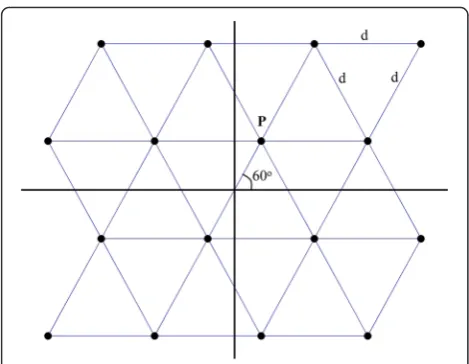
From Fig. 1, it is observed that unlike SQAM, in TQAM, all the nearest neighbors to any signal point in constellation are equidistant. This is the key reason that SEP expressions provided here give exact fit over the simulation curves. PointPis taken at Euclidean distanced/2from the origin at an angle of 60°, wheredis the length of one side of the triangle, or we can say distance between any two adjacent signal points is d. M-ary TQAM is an even-bit repre-sentation of constellation points, i.e.,M= 22mwherem= 2, 3, 4,…, andMis the modulation order of the constellation.
In Fig. 2, dotspjrepresentsjth signal point, wherej= 1,
Im(pj) are the real and imaginary values of signal
point pj, respectively. Average energy per symbol Es
for M-ary TQAM can be evaluated as:
Es¼
In (2), upper limit of the summation is always a positive integer. Solving summation of polynomial expressions using Faulhaber’s formula ([28]: p. 106):
Es¼ð7M−4Þd 2
48 ð3Þ
This leads us to minimum Euclidean distance d expression,
since symbol’s signal-to-noise ratioγcan be written as:
γ¼ Es
where σ2=NO/2 is the variance of Gaussian probability
distribution function and β is the normalized least dis-tance between adjacent symbols. Thus:
β¼
The SEP expressions in this section and Section 4 are derived in terms ofβ.
The main reason for using the MGF-based approach is to utilize the technique of writing Gaussian Q-function with finite integration limits. Now in this constellation, there are five types of signal points based on the number of neighbors each point has, and unlike SQAM, for this particular constellation, each symbol has all the neighbors as the nearest neighbors. Table 1 tells us about the number of nearest neighbors for M-ary TQAM, where SN means
number of signal points havingNnearest neighbors. Probability of correct symbol reception PC, N for a
symbol havingNnearest neighbors is written as:
PC;2¼ð1−Qð ÞβÞ2¼1−2Qð Þ þβ Q2ð Þβ ð8Þ
where Q(β) is the Gaussian Q-function and to evaluate it numerically, [29]: equation (9)] is used, which is its finite limit integral form. The exact probability of correct receiving symbol forM-ary TQAM is given as:
Fig. 1Signal constellation for 16-TQAM
Fig. 2Decision boundaries for 16-TQAM
Table 1Signal pointsSNhavingNnearest neighbors
S2 S3 S4 S5 S6
PCð Þ ¼β 1
Equation (15) gives us the exact SEP ofM-ary TQAM in the presence of AWGN channel. In Section 4, using (15), we evaluate the SEP over various fading channels with MRC reception after presenting channel model in Section 3.
3 MRC spatial diversity channel models
In SIMO system, the signal is transmitted overLdiversity paths where each copy of the signal struggles through in-dividual fading amplitude. The multipath receiver uses the algorithm of MRC diversity reception scheme to increase the SNR of the combined received signal by decreasing the SEP. For MRC, SNR of the combined output signalγ∑
at the receiver is expressed as ([30]: equation (5.98)):
γP¼ Es
whereγiis the instantaneous received SNR per symbol and
αiis the instantaneous fading amplitude at theith diversity
path. SEP evaluation of TQAM over fading channels while using MRC diversity receiver demands knowledge of prob-ability density function (pdf) of SNR γ∑ of the combined
signal at output. Before that, we take a look at the pdf of the instantaneous received SNR per symbolγiof theith
di-versity path over Rayleigh, Nakagami-m, Nakagami-n and Nakagami-q channels respectively, provided from [31] as:
pγi;Rayleighð Þ ¼γ
1
γi
exp −γ
γi
;γi≥0 ð18Þ
pγi;mið Þ ¼γ
mimiγmi−1
γimiΓð Þm exp − miγ
γi
;γi≥0;mi≥0:5 ð19Þ
pγi;nið Þ ¼γ 1þni 2e−ni2γ
iexp − 1þni2
ð Þγ
γi
I0 2ni
ffiffiffiffiffiffiffiffiffiffiffiffiffiffiffiffiffiffiffiffi 1þn2 ð Þγ
γi
s !
;γi≥0;ni≥0
ð20Þ
pγi;qið Þ ¼γ 1þqi2
ð Þ
2qiγi
exp −ð1þqi2Þ
2γ
4qi2γi
!
I0 1−qi4
ð Þγ
4qi2γi
;γi≥0;qi∈½0;1
ð21Þ
where γi¼E γi2 is the average received SNR per
symbol. E[.] is the expectation operator and I0(.) is the
modified Bessel function of the first kind and zero order.
Using (18)–(21) along with (22), the MGFs of Rayleigh, Nakagami-m, Nakagami-n, and Nakagami-q fading chan-nels are respectively given in [31] as:
Mγið Þ ¼s
Z ∞
0 e sγp
γið Þγ dγ ð22Þ
Mγi;Rayleighð Þ ¼s 1þγis
−1 ð
23Þ
Mγi;mið Þ ¼s 1þ γi mis
−mi
;mi≥0:5 ð24Þ
Mγi;nið Þ ¼s
1þni2
ð Þ
1þni2þsγ
i
exp ni
2
sγi 1þni2þsγ
i
;ni≥0 ð25Þ
Mγi;qið Þ ¼s 1þ2sγiþ
2sγi2qi2 1þqi2
ð Þ2
!−1=2
;qi∈½0;1 ð26Þ
From (23) to (26), we can observe that these are MGFs of the individual ith diversity path. As we are considering
multiple channels which are independent but not ne-cessarily identical, then the MGF of theγ∑is written as
the product of the individual MGFs ofγi:
MγPð Þ ¼s
YL
i¼1
Mγið Þs ð27Þ
Equation (27) gives us the MGF of the SNR of the combined signal at the output of the receiver.
4 SEP of TQAM with MRC spatial diversity
Now we attend our main objective, i.e., to find the SEP ex-pression forM-ary TQAM in MRC diversity scheme. This is achieved by averaging the SEP formula (15) over the pdf of the SNRpγPð Þγ of the combined signal at the output.
Pdiversity¼ Z∞
0
Peð Þγ pγPð Þγ dγ ð28Þ
Pe(γ) is the exact SEP for M-ary TQAM in AWGN
channel as provided in (15), whereas, from (6) we know thatβis a function ofγ.
Pdiversity¼6 1þ 1 3M−
4 3pffiffiffiffiffiM
Z∞
0
Qð Þβ pγPð Þγ dγ
−15 1þ 6 5M−
7 3pffiffiffiffiffiM
Z∞
0
Q2ð Þβ pγPð Þγ dγ
þ20 1þ 11
5M− 61 20pffiffiffiffiffiM
Z∞
0
Q3ð Þβp
γPð Þγ dγ
−15 1þ 46 15M−
53 15pffiffiffiffiffiM
Z∞
0
Q4ð Þβ pγPð Þγ dγ
þ6 1þ 11
3M− 23 6pffiffiffiffiffiM
Z∞
0
Q5ð Þβ pγPð Þγ dγ
− 1þ 4 M−
4
ffiffiffiffiffi
M
p
Z∞
0
Q6ð Þβ p
γPð Þγ dγ
ð29Þ
Ignoring the higher order terms Qi, i> 4, the average symbol error probability is approximately given as:
Pdiversity≈6 1þ 1 3M−
4 3pffiffiffiffiffiM
Z∞
0
Qð ÞβpγPð Þγ dγ
−15 1þ 6 5M−
7 3pffiffiffiffiffiM
Z∞
0
Q2ð ÞβpγPð Þγ dγ
þ20 1þ 11
5M− 61 20pffiffiffiffiffiM
Z∞
0
Q3ð ÞβpγPð Þγ dγ
−15 1þ 46 15M−
53 15pffiffiffiffiffiM
Z∞
0
Q4ð Þβp
γPð Þγ dγ
ð30Þ
In (30), we remove the infinite upper limit in the integrals by using a few mathematical tools. From [32: equation (2)], we can write Qð Þ ¼β 2Qaðβ;π=2Þ and from [33: equation (12)], we can write Q2ð Þ ¼β 2 Qaðβ;π=4Þ, both for β≥0. Where,
Qaðβ;φÞ ¼ 1
2π Z φ
0 exp − β2
2sin2θ
dθ ð31Þ
The form in (31) simplifies the evaluation of SEP per-formance over fading channels. For higher powers of the Gaussian Q-function, we refer to [31: Article 4.1.4]. The following relationships are applied:
Qð Þ ¼β 2Qa β; π 2
ð32Þ
Q2ð Þ ¼β 2Qa β;π
4
ð33Þ
Q3ð Þ ¼β Qð ÞβQ2ð Þβ
Q3ð Þ ¼β π12
Zπ=6
0
cos−1 3cos2θ−1 2cos32θ −1
exp − β
2
2sin2θ
dθ
þ 1
2π2 Z
sin−1ð1=pffiffi3Þ
0
π−cos−1 3cos2θ−1 2cos32θ −1
exp − β
2
2sin2θ
dθ
ð34Þ
Q4ð Þ ¼β Q2ð ÞβQ2ð Þβ
Q4ð Þ ¼β 1
π2 Zπ=6
0
cos−1 3cos2θ−1 2cos32θ −1
exp − β 2
2sin2θ
dθ ð35Þ
Still we have not eliminated the infinite upper limit in the integrals of (30). We have only simplified the evaluation of higher powers of the Gaussian Q-function yet. Now, if
Iðβ;φÞ ¼ Z∞
0
Qð ÞβpγPð Þγdγ ð36Þ
then from relationships provided in (6) and (32), we can write
I Dð ;φÞ ¼2 Z∞
0 Qa
ffiffiffiffiffiffiffiffiffi 2Dγ p
;φ
pγPð Þγdγ ð37Þ
This integral can be expressed in terms of MGF of γ (22). Using (31), we get
I Dð ;φÞ ¼
Z∞
0 1
π
Zφ
0
exp − Dγ sin2θ
dθpγPð Þγ dγ ð38Þ
I Dð ;φÞ ¼
Zφ
0 1
π
Z∞
0
exp− Dγ sin2θ
pγPð Þγdγdθ ð39Þ
I Dð ;φÞ ¼1 π
Zφ
0
Mγ D
sin2θ
dθ ð40Þ
Now (40) is applicable to 1st and 2nd power of the Gaussian Q-function. For 3rd and 4th power of the Gaussian Q-function, we defineIQ3(D,φ) andIQ4(D,φ) as:
IQ3 D;π 6
¼ Z∞
0
Q3ð Þβp
γPð Þγ dγ
IQ3 D;π 6
¼π12 Zπ=6
0
cos−1 3cos2θ−1 2cos32θ −1
Mγ D
sin2θ
dθþ 1 2π2
Z
sin−1ð1=pffiffi3Þ
0
π−cos−1 3cos2θ−1 2cos32θ −1
Mγ D
sin2θ
dθ
ð41Þ
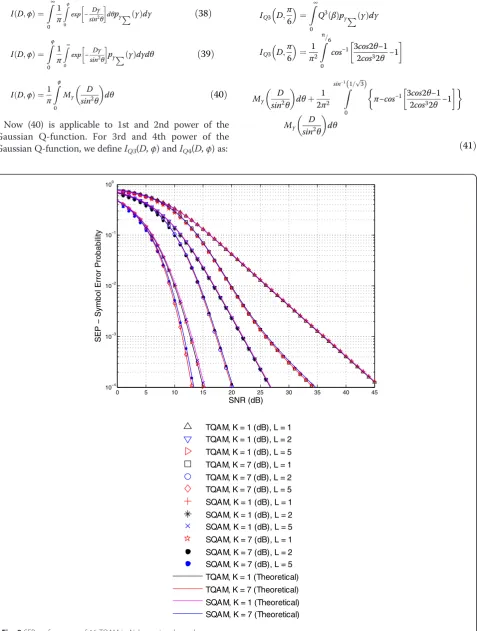
TQAM, K = 1 (dB), L = 1 TQAM, K = 1 (dB), L = 2 TQAM, K = 1 (dB), L = 5 TQAM, K = 7 (dB), L = 1 TQAM, K = 7 (dB), L = 2 TQAM, K = 7 (dB), L = 5 SQAM, K = 1 (dB), L = 1 SQAM, K = 1 (dB), L = 2 SQAM, K = 1 (dB), L = 5 SQAM, K = 7 (dB), L = 1 SQAM, K = 7 (dB), L = 2 SQAM, K = 7 (dB), L = 5 TQAM, K = 1 (Theoretical) TQAM, K = 7 (Theoretical) SQAM, K = 1 (Theoretical) SQAM, K = 7 (Theoretical)
IQ4 D;π
Now (30) can be expressed as:
Pdiversity≈6 1þ
The difference in (30) and (43) is that we have overcome the infinite limits of integration. The SEP expression (43)
is used to measure performance ofM-ary TQAM in diver-sity systems using MRC technique. On substituting MGF from (27) in (40), we get following four integrals with fi-nite limits for Rayleigh, Nakagami-m, Nakagami-n, and Nakagami-q fading mediums, respectively as:
IRayleighðD;φÞ ¼
IqðD;φÞ ¼1π
Similarly, on substituting MGF from (27) in (41), we get following four integrals with finite limits for Rayleigh, Nakagami-m, Nakagami-n, and Nakagami-q fading mediums, respectively as:
Treating (42) in similar fashion with (27), we get IQ4(D,φ) for the stated fading mediums.
Fig. 10SEP performance of 16-TQAM in Nakagami-q channel IQ4;m D;π
6
¼π12
Zπ=6
0
cos−1 3cos2θ−1
2cos32θ −1
YL
i¼1
1þγi
mi D sin2θ
−mi
dθ ð53Þ
IQ4;n D;π6
¼π12
Zπ=6
0
cos−1 3cos2θ−1
2cos32θ −1
YL
i¼1
1þni2
ð Þ
1þni2þDγ icsc2θ
exp ni
2Dγ i sin2θþni2sin2θþ
Dγi
Since the four integrals from (44) to (55) are finite range, single integrals and integrand composed of elementary functions only; using (43), the average SEP of general modulation order TQAM with MRC spatial diversity over fading channels can be conveniently assessed through nu-merical integration methods.
5 Numerical results and discussion
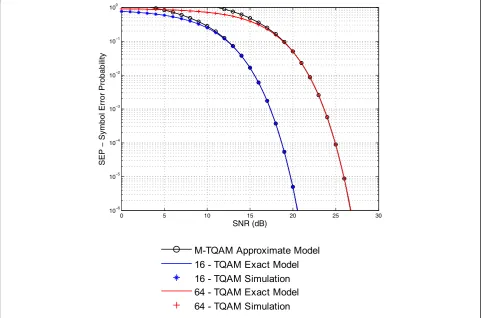
Here, we verify our analytical formulas using computer simulations. In Fig. 3, (15) is compared with the SEP ap-proximation provided in ([7]: equation (5)). Figure 3 shows the SEP of 16-TQAM and 64-TQAM against
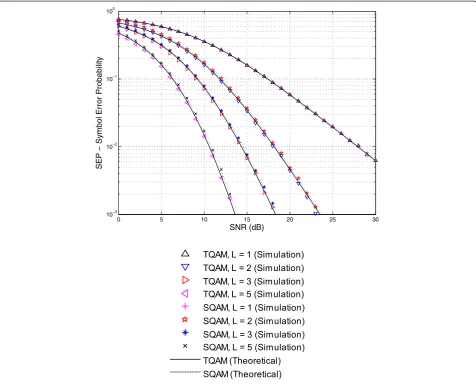
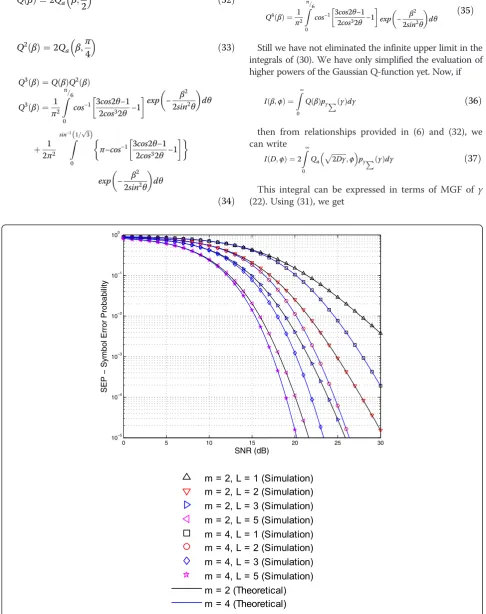
SNR in AWGN channel, and it is observed that our expression for exact SEP (15) completely agrees with the simulation curve. Figures 4 and 5 show symbol error rate performance of 16-TQAM and 64-TQAM over Rayleigh fading channel using MRC diversity scheme, respectively. In Fig. 4, comparison has been made with the SQAM results provided in [15]. We investigate the effect of m, the Nakagami-m fading parameter (m≥0.5), in Figs. 6 and 7, which displays the SEP performance of M= 16 and M= 64 for Nakagami-m channel against SNR with MRC recep-tion, where m= 2, 4. Figure 6 shows comparison with IQ4;q D;π
6
¼ 1 π2
Zπ=6
0
cos−1 3cos2θ−1
2cos32θ −1
YL
i¼1
1þ2γiD
sin2θþ
2qiγi
1þqi2
2
D2 sin4θ
!−1 2
dθ ð55Þ
Table 2Power gains for TQAM with MRC diversity scheme atPe= 10− 2
Modulation order (M) Fading channel Power gain ofL= 2
overL= 1, (dB)
Power gain ofL= 3 overL= 1, (dB)
Power gain ofL= 5 overL= 1, (dB)
16 Rayleigh 9.76 13.56 17.32
Nakagami-m (m= 1) 9.76 13.56 17.32
Nakagami-m (m= 2) 6.04 8.72 11.66
Nakagami-m (m= 4) 4.38 6.58 9.14
Nakagami-n (K= 1 dB) 9.25 12.69 16.08
Nakagami-n (K= 7 dB) 5.53 7.94 10.63
Nakagami-q (q= 0) 17.58 23.92 29.56
Nakagami-q (q= 0.3) 10.1 14.32 18.62
Nakagami-q (q= 1) 9.76 13.56 17.32
64 Rayleigh 9.76 13.62 17.42
Nakagami-m (m= 1) 9.76 13.62 17.42
Nakagami-m (m= 2) 6.12 8.84 11.79
Nakagami-m (m= 4) 4.44 6.66 9.22
Nakagami-n (K= 1 dB) 9.28 12.78 16.23
Nakagami-n (K= 7 dB) 5.61 8.05 11.16
Nakagami-q (q= 0) 16.64 22.96 28.65
Nakagami-q (q= 0.3) 10.1 14.34 18.7
Nakagami-q (q= 1) 9.76 13.62 17.42
SQAM [16]. Figures 8 and 9 explain the SEP per-formance in Nakagami-n channel, where K=n2 and various values of K considered are K= 1 dB, 7 dB. Here, n is the Nakagami-n fading parameter, which ranges from 0 to ∞. For comparison with SQAM, we apply the results of [17] in Fig. 8. Similarly from Figs. 10 and 11, we confirm analytical expression for Nakagami-q fading channel derived in (43) along with (47), (51), and (55) for q=0, 0.3, where q is the Nakagami-q fading parameter (0≤q≤1). Comparison with SQAM [22] is shown in Fig. 10 for Nakagami-q medium.
Table 2 provides power gains achieved because of using antenna array instead of single antenna in MRC scenario. We observe quite significant power gain, as L increases. The highest gain is obtained by going from single antenna to two-branch diversity. Now, as the di-versity paths are increased from two to three, the power gain lessens as it was for going from one to two, generally as we keep on increasing L, the power gain diminishes. The gains for Nakagami-m,m=1, and Nakagami-q,q=1, are same as for the Rayleigh fading channel. It is clearly observed that the system performance improves as the diversity order increases. The results illustrate the ad-vantage of diversity as a means for combating the fad-ing phenomena.
6 Example
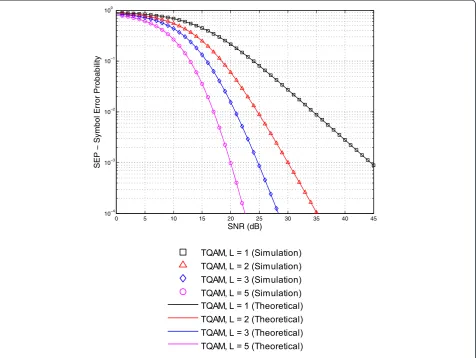
To further validate the analytical SEP expressions (43) to (55) forM-ary TQAM in MRC, we simulate an example. We take five diversity branches, each with different type of channel fading. The experiment is performed over both 16-TQAM and 64-TQAM, respectively. Following are the channel fadings being considered over different diversity branches:
First branch: Rayleigh fading
Second branch: Nakagami-m fading (m= 2) Third branch: Nakagami-m fading (m= 4) Fourth branch: Nakagami-q fading (q= 0) Fifth branch: Nakagami-q fading (q= 0.3)
Now to evaluate the analytical expression for this ex-periment, we use (43); however, the integrals are evalu-ated using (56), (57), and (58) as below:
I Dð ;φÞ ¼1π
The simulation result for this example is shown in Fig. 12. A good fit of SEP simulation curve over the the-oretical curve adds to the validity of our analytical expressions derived in Section 4.
7 Conclusion
consist of single integrals with finite limits and inte-grand composed of elementary functions only, which can be accurately evaluated numerically. The simula-tion results, along with the example, also confirm the efficacy of numerical expressions obtained for the abovementioned channels. So, by choosing only the modulation order of the constellation and the sity order of MRC, we can study the impact of diver-sity reception, which removes the need for Monte Carlo simulations to optimize any wireless system pa-rameters using TQAM.
Abbreviations
dB:deciBel; MGF: moment-generating function; MIMO: input multi-output; MRC: maximal-ratio combining; pdf: probability density function; QAM: quadrature amplitude modulation; SEP: symbol error probability; SIMO: single-input multi-output; SNR: signal-to-noise ratio; SQAM: square quadrature amplitude modulation; TQAM: triangular quadrature amplitude modulation.
Competing interests
The authors declare that they have no competing interests.
Acknowledgements
The authors would like to thank the anonymous reviewers for their valuable comments and suggestions to improve the quality of the paper.
Received: 2 June 2015 Accepted: 21 December 2015
References
1. CR Cahn, Combined digital phase and amplitude modulation communication system. IRE Trans. Commun. Syst.8(3), 150–155 (1960) 2. JC Hancock, RW Lucky, Performance of combined amplitude and phase
modulated communications system. IRE Trans. Commun. Syst.8(4), 232–237 (1960)
3. CN Campopiano, BG Glazer, A coherent digital amplitude and phase modulation scheme. IRE Trans. Commun. Syst.10(1), 90–95 (1962) 4. MK Simon, JG Smith, Hexagonal multiple phase-and-amplitude-shift-keyed
signal sets. IEEE Trans. Commun.21(10), 1108–1115 (1973)
5. O Shinjiro, Y Takaya, K Shoji,Performance evaluation of modified QAM and triangular shaped signal set(Paper presented at the Fourth IEEE Region 10 International Conference TENCON, Bombay, India, 1989)
6. S-J Park, Triangular quadrature amplitude modulation. IEEE Commun. Lett. 11(4), 292–294 (2007)
7. S-J Park, Performance analysis of triangular quadrature amplitude modulation in AWGN channel. IEEE Commun. Lett.16(6), 765–768 (2012) 8. K Cho, J Lee, D Yoon, Performance analysis of generalized triangular QAM. J.
Korea Inf. Commun. Soc. (in Korean)35(11), 885–888 (2010)
9. TT DUY, HY KONG, A simple approximation for the symbol error rate of triangular quadrature amplitude modulation. IEICE Trans. Commun.93-B(3), 753–756 (2010)
10. KN Pappi, AS Lioumpas, KK George,θ-QAM: a parametric quadrature amplitude modulation family and its performance in AWGN and fading channels. IEEE Trans. Commun.58(4), 1014–1019 (2010)
11. L Jaeyoon, Y Dongweon, C Kyongkuk, Error performance analysis of M-ary
θ-QAM. IEEE Trans. Veh. Technol.61(3), 1423–1427 (2012)
12. D Brennan, Linear diversity combining techniques. Proc. IEEE47, 1075–1102 (1959)
13. LR Kahn, Ratio squarer. Proc. IRE42(11), 1704 (1954)
14. C-J Kim, Y-S Kim, G-Y Jeong, J-K Mun, H-J Lee, SER analysis of QAM with space diversity in Rayleigh fading channels. ETRI J.17(4), 25–35 (1996) 15. J Lu, TT Tjhung, CC Chai, Error probability performance of L–branch diversity
reception of MQAM in Rayleigh fading. IEEE Trans. Commun.46(2), 179–181 (1998)
16. Manjeet S Patterh, TS Kamal and BS Sohi, Performance of coherent square M-QAM with Lthorder diversity in Nakagami-m fading environment. Paper
presented at the 52nd IEEE Vehicular Technology Conference, 24-28 September 2000. [doi:10.1109/VETECF.2000.886839]
17. Manjeet S Patterh, TS Kamal and BS Sohi, Performance of coherent square M-QAM with Lthorder diversity in Rician fading environment. Paper presented at the 54th IEEE Vehicular Technology Conference, 7-11 October 2001. [doi:10.1109/VTC.2001.956572]
18. A Annamalai, C Tellambura, Error rates for Nakagami-m fading multichannel reception of binary and M-ary signals. IEEE Trans. Commun.49(1), 58–68 (2001). doi:10.1109/26.898251
19. S Seo, C Lee, S Kang, Exact performance analysis ofM-ary QAM with MRC diversity in Rician fading channels. IEEE Electron. Lett.40(8), 485–486 (2004) 20. F Iyad Al, VK Prabhu,Performance analysis of MQAM with MRC over
Nakagami-m fading channels(Paper presented at the IEEE Wireless Communications and Networking Conference, Las Vegas, NV, 2006). doi:10.1109/WCNC.2006.1696480
21. F Iyad Al, VK Prabhu, Performance analysis of MQAM with MRC over Nakagami-m fading channels. IEEE Electron. Lett42(4), 231–233 (2006). doi:10.1049/el:20062629
22. L Xianfu, F Pingzhi, C Hongyang,SEP of general rectangular QAM signal with MRC diversity over Nakagami-q (Hoyt) fading channels(Paper presented at IET 2nd International Conference on Wireless, Mobile and Multimedia Networks (ICWMMN 2008), Beijing, China, 2008). doi:10.1049/cp:20080976 23. K Young Gil, NC Beaulieu, A note on error rates for Nakagami-m fading
multichannel reception of binary and M-ary signals. IEEE Trans. Commun. 58(9), 2471 (2010). doi:10.1109/TCOMM.2010.09.090164
24. WJL Queiroz, MS Alencar, WTA Lopes, F Madeiro, Error probability in multichannel reception with M-QAM, M-PAM and R-QAM schemes under generalized fading. IEICE Trans. Commun.E93-B(10), 2677–2687 (2010). doi:10.1587/transcom.E93.B.2677
25. X-c Zhang, H Yu, G Wei, Exact symbol error probability of cross-QAM in AWGN and fading channels. EURASIP J. Wirel. Commun. Netw.2010, 917954 (2010). doi:10.1155/2010/917954
26. H Yu, Y Zhao, J Zhang, Y Wang, SEP performance of cross QAM signaling with MRC over fading channels and its arbitrarily tight approximation. Wirel. Pers. Commun.69(4), 1567–1581 (2013)
27. B Sklar, D Communications,Fundamentals and applications, 2nd edn. (Prentice Hall, Upper Saddle River, NJ, USA, 2001)
28. JH Conway, RK Guy,The book of numbers(Springer, New York, USA, 1996) 29. JW Craig,A new, simple and exact result for calculating the probability of error
for two-dimensional signal constellations(Paper presented at IEEE Military Communications Conference (MILCOM), McLean, Virginia, USA, 1991) 30. GL Stuber,Principles of mobile communications(Kluwer Academic Publishers,
Norwell, MA, 1996)
31. MK Simon, M-S Alouini,Digital communication over fading channels, 2nd edn. (JohnWiley & Sons, NY, USA, 2005)
32. MK Simon, D Divsalar, Some new twists to problems involving the Gaussian probability integral. IEEE Trans. Commun.46(2), 200–210 (1998)
33. MK Simon, A simpler form of the Craig representation for the two-dimensional joint Gaussian Q-function. IEEE Commun. Lett.6(2), 49–51 (2002)
Submit your manuscript to a
journal and benefi t from:
7Convenient online submission 7Rigorous peer review
7Immediate publication on acceptance 7Open access: articles freely available online 7High visibility within the fi eld
7Retaining the copyright to your article