R E S E A R C H
Open Access
A lightweight payment scheme for real-time
services based on SIP
Antonio Ruiz-Martínez
*and C Inmaculada Marín-López
Abstract
In the session initiation protocol (SIP), payments have been proposed as a way for vendors to obtain profit from the services they provide. Payments in SIP have also been proposed for microbilling and even as a solution to SPAM in VoIP systems. Although several proposals exist for making payments in SIP, they present some limitations when we want to pay for access to real-time services: either they are not suitable for micropayments or they do not consider security in the payment information exchanged. As a response to these limitations, we propose a new SIP payment protocol,LP-SIP, that supports the payment according to different models like pay-per-time, session-based, etc. It also performs payments in SIP efficiently and takes into account the secure exchange of payment information, unlike other existing proposals. Thus, we provide a lightweight payment protocol that can be used for the payment of real-time services.
1 Introduction
Many multimedia services rely on session initiation pro-tocol (SIP) [1], which is a cornerstone of the next gen-eration networking and IP multimedia subsystem. Some of the most important real-time multimedia services based on SIP are telephone calls, video conferencing, Internet television, and instant messaging. Additionally, some other new, innovative services such as using the voice to compose e-mails, event notification, paying for parking spaces, etc., are becoming steadily available under this protocol.
As is usual on the Internet, multimedia service provi-ders want to obtain profits from the services they provide by SIP. There are two kind of solutions for charging these services: those based on authentication, authoriza-tion and accounting (AAA) infrastructures such as those based on RADIUS [2], Diameter [3] or SIPA/SIPA+ [4] and those based on SIP-based payment mechanisms such as Fischl and Tschofenig’s proposal [5], SIMPA [6], SIP-Coin [7], Fan’s et al. protocol [8], or Zhang’s et al. proto-col [9]. In AAA infrastructures the charging process is focused on the interaction between the vendor and pay-ment provider (a client-server architecture) [5,10]. On the hand, in SIP-based payment mechanisms the client is
involved directly in the transaction and exchanges pay-ment information with the vendor (a peer-to-peer architecture).
As stated in [5,10], the integration of payments in SIP can suppose several advantages over AAA-based mechanisms. First, the use of simpler pricing models that avoid the complexity of AAA protocols [5,10], which are less efficient for real-time and high available services [10]. Second, the support of different payment models. Third, scalability because there is no need to establish a direct trust-relationship between the client and the ven-dor. Furthermore, as there is no direct relationship, the risk can be an acceptable to the client, since the amount of money at risk is limited [5]. Finally, it overcomes the high costs of traditional payment mechanisms that may be suitable for a single payment during a transaction but not when low value payments have to be made or when the payment has to be made with a negligible delay.
The integration of payment information in SIP has two additional advantages. First, the client can ascertain the price of accessing the service during the session initiation, which facilitates price discrimination and avoids the client having to use other means to discover this information. This also gives vendors the support of different business models, which makes some vendors more attractive than others [11]. Second, the client does not need additional flows with the vendor or a payment system. The separa-tion of the flows of payment process and session access * Correspondence: [email protected]
Department of Information and Communications Engineering, Faculty of Computer Science, Regional Campus of International Excellence“Campus Mare Nostrum”, University of Murcia, 30100 Murcia, Spain
supposes that the payment process has to generate some payment information (token or receipt of payment) for subsequent inclusion in the SIP session to confirm the payment and for the SIP session to allow access [5]. With the inclusion of all payment information in SIP the pay-ment is made at the same time as the access and no addi-tional flows are needed, which can also improve efficiency.
Some interesting solutions have been proposed with the aim of supporting payments for multimedia services based on SIP [5-9,12]. The main drawbacks of these proposals are that they are either not suitable for micro-payments or they do not consider the secure and effi-cient exchange of payment information.
Another approach that we could have followed was the integration of some of the existing protocols. How-ever, this approach has two drawbacks: these micropay-ment protocols do not consider the confidentiality of the payment information exchanged and they use asym-metric cryptography in the payment phase [13-16], which is not suitable for real-time transactions due to the computational costs of these operations.
A payment protocol that supports making the pay-ment of real-time services based on SIP should satisfy two main requirements. First, the protocol should be a micropayment protocol since these kind of protocols allow payments of (very) low value amounts [13,17,18] and are characterized because they try to reduce the number of asymmetric cryptographic operations, the number of exchanges and the participation of third par-ties [13,17-20]. Thus, the protocol can be used to make payment of real-time services. Second, the incorporation of payment in SIP should be based on the extensibility mechanisms defined by this protocol [1,12,21] in order to avoid high costs of development and SIP overheads, that is, it should be based only on the introduction of new headers, contents for the body of the messages and tags [21].
In this article, we propose a new SIP extension for making micropayments that satisfies all the require-ments mentioned. We have also taken into account other interesting features. First, apart from supporting the payment for the whole session, we also support additional payments while the session is in progress. Thus, it is possible to make an initial payment for an initial period and then additional payments so as to con-tinue with the session without any interruption. For this purpose, the payment protocol should be efficient. Finally, our proposal guarantees that the exchange of payment information is made in a secure way and offers protection against forgery or double-spending.
The article is organized as follows. Section 2 examines background related to SIP and payment scenarios. These scenarios are useful to derive the requirements (defined in Section 3) to cover in SIP payment protocol.
In Sections 4 and 5, we describe in detail our payment protocol for SIP, named LP-SIP, which is analyzed in depth in Section 6. Section 7 analyzes related study. Sec-tion 8 provides an in-depth comparison between SIP-Coin and our proposal. Finally, Section 9 concludes the article and introduces future study.
2 Background
This section describes some proposals in which LP-SIP is based, namely, SIP [1], the model offer/answer [22] and the provisional response acknowledgement (PRACK) [23] method. Furthermore, in order to estab-lish the requirements our proposal should satisfy, we describe some possible scenarios for payments in SIP.
2.1 SIP
The SIP [1] is a protocol designed to help in the crea-tion and management of multimedia sessions such as a voice over IP call, a distributed conference, an instant message conversation or, in general, every type of data communication between peers, also called user agents. 2.1.1 Session set up
SIP uses a three-way protocol to carry out the session set up, unlike other SIP functions that are based only on the request-response pattern. The third message is used as a reliability mechanism.
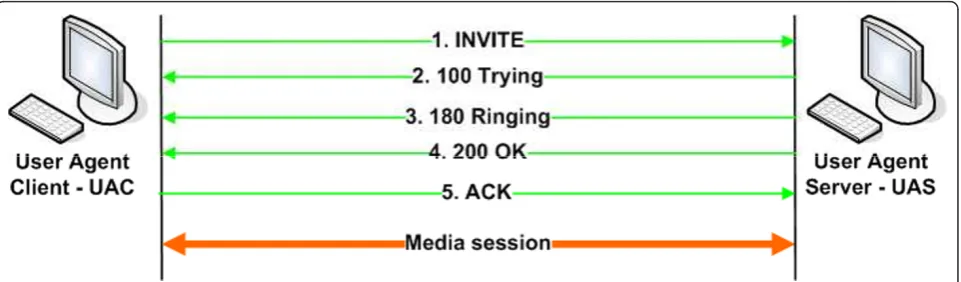
The three-way protocol works as depicted in Figure 1. It starts when a user agent sends anINVITE request, which contains a description of the type of session the user wants to take part in, the media and ports to be used and the codecs supported. This information is described by means of the session description protocol (SDP) [24]. As a response to the INVITE request, the callee answers with a provisional response (100 Trying). Next, the second provisional response (180 Ringing) is used so that the caller can know that the user agent contacted is running and trying to notify the callee. When the user answers the call, the 200 (OK)response code is sent to inform the acceptance of the call includ-ing codecs and parts. When this response is received, the caller ends the three-way protocol by anACK mes-sage. Finally, media transmission starts using the codecs exchanged during the three-way protocol. Usually, this transmission is made by using UDP. However, TCP or TLS could be used when a higher level of security is required.
2.1.2 Other functions
In SIP a session remains established until one of the peers starts its termination by the BYE message. This request can be sent at any moment during the session.
2.1.3 Extensibility
SIP offers different extensibility mechanisms - it is pos-sible to define new headers, new address schemes to support communication with new protocols and new option tags to establish new parameters for headers.
The Require header defined in SIP can be used for
User Agent Clients (UACs) to indicate user agent ser-vers the options expected.
2.2 Session negotiation based on the offer/answer Model
In this section, we introduce the different mechanisms we can use to achieve an agreement on the attributes of a session. First, we explain the basic offer/answer model and, next, thePRACKmethod.
2.2.1 Offer/answer model
The offer/answer model [22] defines a mechanism that allows two entities to agree on the attributes to use in a multimedia session. This process uses SDP to reach the agreement. According to this specification, a higher layer protocol like SIP is needed for the offer/answer exchange. In SIP the exchange of SDP descriptions is carried out during session establishment.
2.2.2 PRACK
The PRACK method [23] is an extension of SIP that allows peers to refine the offer/answer model by offering additional possibilities for these exchanges.
This extension includes three messages: a183 (Session
progress)provisional response, aPRACKand its
corre-sponding 200 (OK)response to the PRACK. The first message is issued by the server side to indicate that a
PRACK-200 (OK)cycle is about to start. Then, thePRACK
and200 (OK)messages let clients and servers exchange
offers and answers about the kind of media to be used in the session. When the negotiation is finished, the server issues the200 (OK)response code to theINVITEmessage.
2.3 Use case scenarios
This section presents different types of scenarios that our proposal tries to cover. These scenarios have been
used and mentioned in the literature as scenarios where the use of payment in SIP is suitable. In fact, our use case scenarios are a more detailed description of the scenarios mentioned in [5-7,9,12,25]. All of them use SIP to support the payment of real-time multimedia ser-vices and try to show the different possibilities that should be supported. It is important to point out that other different scenarios could have chosen. Our goal with these use case scenarios is twofold. On the one hand, to facilitate the understanding of the proposal and show when some of the features provided by the proto-col could be used. Although the scenarios presented are different, the features related to payment are similar and, therefore, the scenarios could represent a wide range of SIP-based real-time multimedia services that require a payment.
2.3.1 Scenario 1. Preventing SPAM in VoIP Systems
In the same way that spam has proliferated in e-mail systems, spam over the Internet telephony and instant messaging is expected to become even more important.
The solution proposed in [5,12] to this problem is that the first time a user receives an unsolicited call, the reci-pient, before accepting it, requests a payment whose amount is (very) small (micropayments), e.g., four cents. When the payment is made, the call is answered and the caller is included in a whitelist for future communica-tions. Furthermore, the payment made by the caller could be refunded, with the caller and the recipient exchanging their roles. In the refund the recipient makes the payment and the caller receives it.
2.3.2 Scenario 2. Real-time communications services in P2P networks
Let us suppose that a company wants to offer language-training services over a P2P network created for the pro-vision of multimedia services. These services could be provided by means of video, audio and/or instant mes-sages [5]. A user can access these services by making a payment. The services could be charged following a pay-per-time or flat free model. There are also other models
that could be followed, such as pay-per-volume, session-based or pay-as-you-watch [26].
If we suppose a pay-per-time model, the user would make an initial payment to start the session and one additional payment for each period of time (usually, this period of time is short, between 10 s and 1 min) the user is using the service. Thus, the user would pay only for the time she uses the service. We could suppose the initial payment could be one Dollar/Euro and each addi-tional minute five cents. The user would be notified some time before the time/data finishes and the pay-ment should be made quickly to avoid session interrup-tion. Thus, if the user spends 40 min in a session training, 40 payments are made.
2.3.3 Scenario 3. VoIP (Voice messages and calls)
Let us suppose that a VoIP company provides a service in which national calls are paid by a flat rate and other additional services such as international calls and listen-ing to voice messages by maklisten-ing a payment.
In the access to voice messages, the company charges an initial amount for the establishment of the call, e.g., 29 cents (Euros/Dollars) and a payment for each voice message, e.g., 13 cents. Thus, if a user were to listen to, e.g., three voice messages, she would have to make four payments.
The establishment of international calls could work in a similar way. The service provider could request an initial amount for the establishment, e.g., 30 cents (Euros/Dollars) and, after the establishment and before the time/data paid is finished, 25 cents for each minute or fraction. Thus, if a user established a call that lasted 4 min and 30 s, she would have to make six payments. In this scenario, it is also important that payments are made very quickly to avoid the interruption of the ses-sion, once started.
3 Requirements for supporting payments in SIP From the aforementioned use case scenarios and the requirements established in previous proposals that make payments in SIP [5-7,9,12,25], we can derive the different requirements that should satisfy a lightweight payment protocol for SIP. These requirements are (if a requirement maps directly with a use case scenario we identify it by the number of scenario between parenth-esis. Otherwise, the requirement is a generic one derived from previous proposals):
• Payment protocol based on extensibility
mechan-isms. The support of a payment protocol in SIP should be based on the extensibility mechanisms of SIP in order to facilitate the incorporation of pay-ments to the current developpay-ments of SIP. This also facilitates the acceptance of the solution.
•Different payment models. The vendor should be
able to support different payment models: time (sce-narios 2 and 3), volume (sce(sce-narios 2 and 3) and ses-sion-based charging (scenario 1) [5]. It could even support the pay-as-you-watch model [26] in which the session is initiated without any payment. Later, once some content has been sent, a payment is requested. The models supported should be indi-cated together with payment information. Further-more, we should provide the messages needed to request the payment when necessary (scenarios 2 and 3).
•Additional payments. The vendor should be able to receive incremental or additional payments [7]. That is, the client could make an initial payment for a part of the session instead of paying for the whole session. Later, before the session finishes, if the user is interested in it, she could make an additional pay-ment. It is important to point out that this addi-tional payment should be received without stopping the session in progress (scenarios 2 and 3).
•Time/Data notification. The merchant should be
able to notify the customer that the time/data she paid for is finishing. Thus, session interruption can be avoided (scenarios 2 and 3) [7].
•Lightweight and efficient protocol. The payment pro-tocol should allow the payment to be efficient by using lightweight cryptography (mainly based on symmetric cryptography instead of using asymmetric cryptogra-phy) and avoiding additional connections to make the payment, as well as the minimization of the participa-tion of trusted third party (TTP) entities [5,7]. Thus, the initiation of the session and the payment would be performed quickly (all the three scenarios) and the protocol would also make it more difficult for an inter-ruption to occur when an additional payment is requested (scenarios 2 and 3).
• Security in the payment process. The payment
information should be exchanged in such a way that the confidentiality and integrity is guaranteed against possible attackers. Furthermore, the protocol should guarantee that any entity (clients, vendors, or exter-nal attackers) cannot perform double spending with-out being detected, nor generate bogus payments, etc.
4 The LP-SIP protocol foundations
4.1 Roles
Three kinds of entities participate in the LP-SIP protocol: clients, vendors, and brokers.
Clients are entities that want to access real-time services and are willing to pay for them. Vendors (we could also name them service providers) are the entities that provide those real-time services based on SIP and charge clients that want to access them. These services can be offered by following different payment models such as pay-per-time, pay-per-data, etc. Payments are made by using e-coins that are minted by a broker.
A broker acts as a TTP and plays the role of financial service provider between customers and vendors. This role could be played by different kind of entities such as a bank, a payment service provider, network service pro-vider, a (mobile) network operator, an Internet Service Provider, a multimedia application provider, etc. This entity is responsible for registering clients and vendors, minting e-coins for making payments, charging the user for the e-money they withdraw, paying vendors from the e-coins they deposit, and key management that allows secure communications between clients and ven-dors, so guaranteeing confidentiality, integrity and authentication.
For the client and the vendor to perform a payment transaction both entities have to be registered at the same broker since each broker can only verify its own e-coins. But this does not mean that they have only to work with one broker since both client and vendor could be regis-tered at different brokers. Thus, they can purchase/sell real-time services to a broad number of vendors/clients, respectively. We could compare it with a client owning several credit cards from different companies and a vendor supporting the payment with different credit card brands.
4.2 Overview
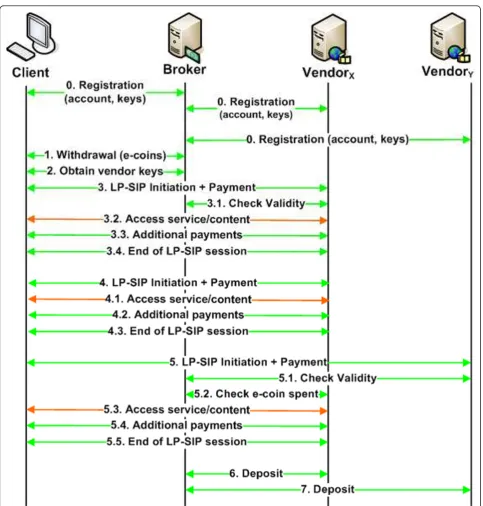
LP-SIP is based on the use of e-coins that are obtained prior to accessing the SIP-based real-time service. These e-coins are charged to the client’s account when she withdraws them. That is, our protocol is based on token and on prepayment. The client obtains e-coins from a broker and they can be used with any vendor registered with that broker. Thus, any entity has to carry out a registration process with the broker to take part in the system (see step 0 in Figure 2, hereinafter all the steps are referred to this figure).
In the client’s registration process (step 0), the client establishes an account that the broker uses to charge her for the different e-coins that she will obtain (in the with-drawal process) from the broker to make the payments. In this process she also obtains two symmetric crypto-graphic keys (for encryption and authentication), which are used to communicate with the broker in a secure, efficient way.
In the vendor’s registration process, the vendor estab-lishes some cryptographic keys (master keys) with the broker. The broker is responsible for increasing the bal-ance of the vendor’s account from the e-coins the vendor deposits.
Once the client has completed the registration process, she has to obtain one or more e-coins from the broker in order to be able to make purchases from the vendors (step 1). Each e-coin that the client obtains could be used with several vendors as long as the value of the purchases does not exceed the value of the e-coin. This is because during a purchase the portion of the e-coin to be paid can be specified. The control of the amount spent is per-formed between the broker and the vendor.
In the withdrawal request, the client can also request keys to communicate with the vendors she wants to carry out transactions with. In this process, the broker charges the amount of e-coins only at this moment or the charge could be made, at the end of some period established by the client and the broker (at the end of the day, the week, etc). At any subsequent moment, the client may need to request keys for communicating with new vendors, which is done by the client launching a vendor’s key request (see step 2).
The payment process starts at the same time the SIP session is initiated (step 2). Thus, the vendor requests a payment when the client initiates a SIP session to access a payment-based service. The payment requested could be for the whole session or for only some amount of time or data. Then, the client sends an e-coin to the vendor with the amount of the e-coin she wants to pay. For example, the e-coin value could be 1 Euro (€)/Dollar ($) and the cli-ent could want to pay only 0.2 Euros/Dollars.
All the information exchanged in the payment phase between the client and the vendor is protected by using authentication and ciphering so that the information related to the purchase cannot be modified without being detected, and is confidential between them.
It is important to point out that a specific e-coin issued by the broker can be used with several vendors in differ-ent transactions. Thus, we avoid two problems of e-coins that are issued for a specific vendor [27]. First, refunding processes when an e-coin is not completely spent and we are not going to perform any new transactions with a ven-dor. Second, handling many different e-coins, if we work with many vendors this, additionally, could suppose tidy-ing up an important of e-money that cannot be used with other vendors. Thanks to the possibility of defining the portion of the e-coin to be used, we also avoid the pro-blem of the e-coins that can be used with any vendor that is the establishment of a connection with the broker for each payment [27].
When the vendor (VendorX) receives an e-coin (let us
spent with that e-coin and if he does not, he queries the broker (step 3.1). With this information he can know whether the amount paid is valid or not. If the payment is valid then the vendor provides the client the access to the service (step 3.2).
If the payment is for the whole session, the vendor provides the access to the service until the session
finishes (when it has reached its end or when the client decides to finish it). Then, step 3.4 is executed.
In contrast, if the access is only for a limited amount of time or data, when the limit is about to be reached the vendor either requests a new payment to continue with the session or the session is finished. If the client supports receiving payment requests in an established
session a payment request with information about the data/time remaining is sent. Thus, after step 3.2, step 3.3 is executed. This optional feature is called additional
payments. For this payment it is not required to make
any check with the broker (see step 3). Otherwise, when the payment is not made, the session finishes (step 3.4).
Subsequent payments of new services can be made with e-coin e1 to this same vendor during a period of time pre-established by the broker (one day, one week, etc, usually, in micropayments, the period is established at one day [17,18], and this is the period that we con-sider) with no requirement to check the amount with the broker because the vendor can control it (see the access to a payment-based service in step 4). Thus, we avoid the vendor having to make many queries to the broker, which reduces overload for the system (both for the vendor and the broker).
On the other hand, if the e-coin e1 is used with a new vendor (V endorY) (step 5), this new vendor will check
the e-coin with the broker. The broker, as he knows that is being used by another vendor (VendorX ), will
request that he indicates the last amount that the ven-dor received as payment. Then, the broker informs the new vendor (VendorY ) and the rest of the process is
performed as we have just explained for the payment with a vendor for the first time.
In this description, we suppose that the payments are made sequentially in time. Thus, the same e-coin (e1) can be used. However, if we had to managen different concurrent payments,ndifferent e-coins would have to be used. In spite of this, the payment process would be the same as described. The only difference is that the e-coins used are different for each transaction (n trans-actions,n coins). For this reason we allow the user to request several e-coins (in the withdrawal process). Sub-sequently, the e-coins used in these concurrent payment transactions could also be used with the same or differ-ent vendors in the same way we have described above.
At the end of the period established by the broker, each vendor sends the broker the amounts of the differ-ent e-coins he has received so that the broker can pay the amounts into the account of each vendor.
4.3 SIP extensions to support LP-SIP protocol
This section describes the extensions we have defined in SIP to support the LP-SIP protocol. It is important to point out that our extensions are based on the extensibil-ity mechanisms defined in SIP. Namely, our proposal is based on three kinds of elements. Firstly, on the defini-tion of new opdefini-tions-tags for different headers of SIP mes-sages: Required, Supported, andAccept. Second, the definition of a new header namedLP-SIPfor conveying information related to a payment transaction. Finally, we have defined a new type of content for the body of the
SIP messages. This new content conveys the messages that we have defined for the different exchanges of LP-SIP. Next, we describe each of these elements in more detail.
4.3.1 New option-tags
Headers are used in SIP to convey different kinds of information during the session. In general, they specify the supported or required features by means of a list of option-tags. For this purpose, SIP uses the Required
header in order to indicate the required features; the
Supported header to specify some additional features
that are supported; and, finally, the Accept header, which indicates the kind of information that is sup-ported in the exchanges. For these headers we have defined the following option-tags:
•lpayment. This indicates that an entity supports LP-SIP. It has been defined for theSupportedheader and its use is mandatory when a payment is required. In this situation, if a client sends anINVITEand it does not contain it, the vendor answers with a402 (pay-ment required)response code.
• additionalpayment. Its use is optional and is
included in theSupportedheader so that the client can indicate she supports the reception of payment requests once the session is established. Hence, if the vendor also supports this feature, the client will receive a notification indicating that the amount of time or data she paid is about to finish and that a new pay-ment is due.
•application/lp-sip. In theAcceptheader it indicates that an entity supports the exchange of the LP-SIP messages in the body of SIP messages. This option-tag also defines a new content-type that indicates that the content of a SIP message is a payment message according to our protocol.
4.3.2 LP-SIP header
We have also defined a new header for SIP messages namedLP-SIP. This new header is used in the different messages to convey some basic information related to dif-ferent processes that are associated to our proposal, such as entity registration, withdrawal of e-coins, payments, etc., (see overview in Section 4.2).
The definition of theLP-SIPheader is according to the Backus-Naur Form (BNF) notation [28] (see below). The starting symbol is represented byLP-SIP-HEADER vari-able. In a SIP message our header is represented with the nameLP-SIP. Basically, the header contains the kind of exchange that is being performed. As presented above, there are ten kinds of exchanges:Vendor Registration,
Cli-ent Registration, Vendor Key, Withdrawal, Payment
Request, Payment, Check Validity,Ecoin Notification,
exchange, the header could also include some additional information, e.g., in the payment request exchange ( Pay-mentRequest), we can include the different prices of the service according to different payment models (data, time, etc).
<LP-SIP-HEADER> ::= “LP-SIP: “ <operation>
<operation> ::=“VendorRegistration”
|“ClientRegistration” |“VendorKey”
|“Withdrawal” |“KeyRequest”
|“PaymentRequest;” “PID=”<identifier> *(<modelInfo>)“Expiry=”<date>
|“Payment;” “DateTime=’ “<dateTime>“
‘ “ [ <encryptedkey> ] |“CheckValidity” |“EcoinNotification”
| “AdditionalPayment; “PID=” <identifier>
“TimeDataToStop=” <quantity> 1* (<AdditionalModelInfo>)
|“Deposit”
<encryptedKey> ::= \EncryptedKey=” <encryptedKeyValue>
<modelInfo> ::= <modelId> <brokers> <model> “unit=” <quantity> <initialPay-ment>
[ <additionalPayment> ]
<AdditionalmodelInfo> ::= <modelId> <model>“unit=”<quantity> <amounts>
<modelId> ::=“modID=”<identifier> <model> ::=“model=”<modelType>
<brokers> ::=“brokers=’”<identifier> * (”,”<identifier>)“ ‘ “
<modelType> ::= “pay-per-time” | “ pay-per-data”|“pay-as-you-watch”|“session” <quantity> ::= <numeric-value><unit-tag>
<unit-tag> ::=“seg”|“min”|“h”|“Mb”|
“Kb”|“b”|“session”
<initialPayment> ::= “initialPayment;” <amounts>
<amounts> ::= “amount=’” <amount> *(”,” <amount>)“ ‘ “
<additionalPayment> ::= “ additionalPay-ment;”1*(<modelId> <model>
“unit=”<quantity> <amounts>)
For the sake of simplicity we have not specified some elements in the BNF notation such as identifier, which is an alphanumerical string; numeric-value, which is a real number;date-time, which is a string representing a date and the time according to the extended form of International Organization for Standardization (ISO) 8601 [29]; and, amount, which is coded according to ISO 4217 [30], which allows us to express an amount where the quantity and the currency are coded as an alphanumerical string.
A simple example of theLP-SIPheader that would be included in a SIP message for the payment exchange would be the following:
LP-SIP: Payment; DateTime= ‘ 2010-04-05T14:30’
This header indicates withPaymentoperation that the payment is taking place and with the value ofDateTime
it indicates the time when the payment is being carried out.
4.3.3 Application/lp-sip content
The application/lp-sipcontent-type has been defined to
include a new type of content in the body of the SIP messages. This content is a message associated to some of the LP-SIP processes. These messages are defined in Abstract Syntax Notation One (ASN.1) and we make use of some existing structures, defined as X.509 certifi-cates or the PKCS#7/CMS format, to convey crypto-graphic information. The messages should be encoded according to distinguished encoding rules and then con-verted to its Base64 format in order to be conveyed in the body of the SIP message.
Since we have defined that the messages are included as a content in the body, we can combine the sending of payment information with other kinds of data such as text messages, images, etc.
The messages and responses codes of SIP that we use to convey some of the messages defined in our system
are: INVITE, 183 Session in progress, PRACK, 200 OK
andMESSAGE.
5 The LP-SIP protocol specification
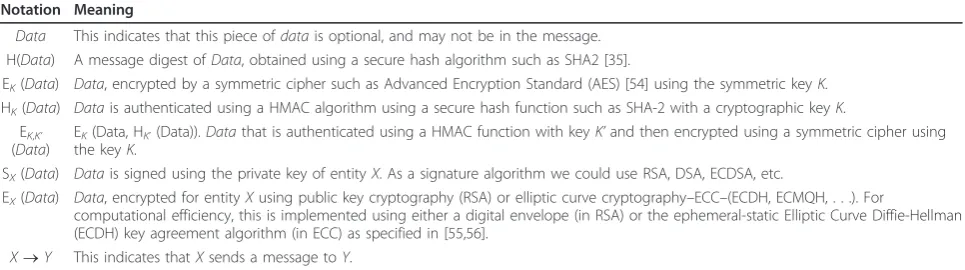
The notation that we have decided to use in order to specify the sequence of messages in our protocol specifi-cation is shown in Table 1. This notation is based on the notation that appears in [31].
5.1 Vendor registration process
The vendor makes a registration process with the broker in order to register the account where he wants to receive the amounts of the e-coins he receives from cli-ents. In this registration process the vendor also indi-cates to the broker a pair of master keys (KEnV
the clients with keys for establishing secure communica-tion with him.
The different messages exchanged in this process are:
1. V ®B: MESSAGE (VendorRegistration-Request)
This message denotes the vendor sends theMESSAGE
request defined in SIP. In brackets we indicate the kind of message that we include in the body of the message by means of the application/lp-sip content-type. Furthermore, in theLP-SIPheader we indicate the kind of process that is being performed. We follow this con-vention to represent the rest of the messages that will appear throughout the article.
In this exchange, in theMESSAGE request, the vendor includes a request for registration with the broker (VendorRegistrationRequest). This registration process is markedLP-SIPheader as below:
LP-SIP: VendorRegistration
Moreover, the message contains in the body (indicated with theapplication/lp-sipcontent-type):
EB(SV (V, B, VRID, KEnV BMasterKey, KSigV
BMaster-Key, VendorAccount))
where:
• V,B are the identifiers of theVendor and Broker, respectively. These party identifiers are the digest of the parties’public key and are used to avoid imper-sonation attacks [32].
•VRID (Vendor Registration Identifier). VRID identi-fies the registration process that is being performed between the vendor and broker. This identifier or label could be a randomly generated number. How-ever, due to the importance of this process and in order to provide a high level of security we have
decided to follow the principles proposed in [33]. These design principles recommend that the label has the following properties: verifiability, uniqueness and secrecy. Therefore, we have generated this iden-tifier as H(V, B, H(KEnV BMasterKey), H(KSigV
BMaster-Key), VendorAccount).
•KEnV BMasterKey(Master Encryption Key). This is a
symmetric master key generated by the vendor that will be used by the broker to provide the clients with encryption keys to communicate with the ven-dor confidentially. The default symmetric cipher to employ is AES.
•KSigV BMasterKey (Master Signature Key). This is a
symmetric master key generated by the vendor that will be used by the broker to provide the clients with symmetric signature keys to guarantee the integrity of the communication with the vendor. The default cryptographic checksum function to employ is hash-based message authentication code (HMAC) [34] with SHA2 [35].
•VendorAccount. The bank account number that
the broker will use to pay the vendor the amounts of e-coins he deposits. Each vendor has a unique account associated, which could be changed when needed.
This message allows the vendor to register his account with the broker as well as the master keys that the bro-ker will use to provide symmetric keys to the clients in order to communicate with the vendor in a way that guarantees authentication, integrity and confidentiality.
2. B® V: MESSAGE (VendorRegistration-Response)
In this message, theLP-SIPheader has the same con-tent as the previous message. In the body of the mes-sage, the content of theVendorRegistrationResponse is:
EKVB (SB(B, V, VRID, Confirmation)) Table 1 Cryptographic notation
Notation Meaning
Data This indicates that this piece ofdatais optional, and may not be in the message. H(Data) A message digest ofData, obtained using a secure hash algorithm such as SHA2 [35].
EK(Data) Data, encrypted by a symmetric cipher such as Advanced Encryption Standard (AES) [54] using the symmetric keyK. HK(Data) Datais authenticated using a HMAC algorithm using a secure hash function such as SHA-2 with a cryptographic keyK.
EK,K’
(Data)
EK(Data, HK’(Data)).Datathat is authenticated using a HMAC function with keyK’and then encrypted using a symmetric cipher using
the keyK.
SX(Data) Datais signed using the private key of entityX. As a signature algorithm we could use RSA, DSA, ECDSA, etc.
EX(Data) Data, encrypted for entityXusing public key cryptography (RSA) or elliptic curve cryptography–ECC–(ECDH, ECMQH, . . .). For
computational efficiency, this is implemented using either a digital envelope (in RSA) or the ephemeral-static Elliptic Curve Diffie-Hellman (ECDH) key agreement algorithm (in ECC) as specified in [55,56].
where:
• KVB. This symmetric key is generated from KEnV BMasterKey and broker identifier (B) in the following
way: KVB=HKEnV BMasterKey(B).
•Confirmation. This is a flag that indicates whether the process has been successful. This message is to confirm whether the registration process was per-formed successfully.
5.2 Client registration process
For a client to be able to make purchases in the sys-tem, she has to obtain e-coins from a broker. But, prior to this she needs to perform a registration with a broker. In this process the user establishes the account that will be used to charge her for the e-coins she requests.
As a result of this registration process, the user obtains some symmetric keys to communicate with the vendor during the purchase process. The different mes-sages exchanged in this process are:
1. C ® B: MESSAGE (ClientRegistration-Request)
For this message, the content of theLP-SIPheader is:
LP-SIP: ClientRegistration
In the body of this message, the ClientRegistration-Requestcontains:
EB(SC(C, B, CRID, KEnkey, ClientAccount))
where:
• C, B are the identifiers of theClient and Broker, respectively.
•CRID (Client Registration Identifier).CRIDidentifies the registration process that is being performed between client and broker. For the generation of this identifier or label we have followed the same approach as explained in the vendor registration process, i.e., CIRD=H(C, B, H(KEnkey), ClientAccount).
•KEnkey. This is a symmetric key that is generated by
the client. The key is only used to preserve the con-fidentiality of the response message.
•ClientAccount. The client’s bank account number.
This message allows the client to send her bank account information. In this message the client also
sends a symmetric key (KEnkey) that the broker uses to
send the response to the client.
2. B® C: MESSAGE (ClientRegistration-Response)
The header ofLP-SIP is the same as the previous mes-sage and in the body the content of ClientRegistration-Responseis:
EKEnkey (SB(B, C, CRID, KCB, KCB,
Confirmation))
where:
•KCB. This encryption symmetric key is generated
fromKEnC BMasterKey and client identifier (C) in the
following way: KCB=HKEnC BMasterKey(C). KEnC BMasterKey
is a master secret key that the broker uses to derive the different keys he will use to maintain the confi-dentiality of the following messages between broker and client.
• KCB. This signature symmetric key is generated fromKSignCBMasterKeyand client identifier (C) in the
following way: KCB =HKSignC BMasterKey(C). K
SignCBMaster-Keyis a master secret key that the broker uses to
derive the different keys he will use to guarantee the integrity and authenticity of the following messages between broker and client.
As a response to the client’s request, the broker sends a confirmation with two symmetric keys (KCB,KCB) that will be used by the client in future communications with the broker, e.g., for requesting an e-coin.
5.3 Withdrawal of e-coins
The client performs the withdrawal process of e-coins in order to obtain electronic money to make the payment of the purchases of the services she wants.
The e-coin(s) the client obtains can be used in dif-ferent transactions and with difdif-ferent vendors as long as the amount of the purchases is lower than the e-coin value. The amount of the e-e-coins withdrawn are charged to the client’s associated account that was provided during the registration process. This charge can be made at this very moment or at the end of a period established between the broker and the client.
When a client wants to obtain some e-coins, the dif-ferent messages exchanged in this process are:
1. C® B: MESSAGE (WithdrawalRequest)
TheLP-SIPheader contains:
LP-SIP: Withdrawal
The WithdrawalRequest included in the body
con-tains:
C, EKCB(HKCB (C, B, WID, Amount1[, . . . ,
Amountn], [VendorKeysReq]))
where:
• withdrawal identifier (WID). WID identifies the
withdrawal process that is being performed between client and broker. It is generated as WID=H(C, B, vCall-ID, Amount1[, . . . , Amountn]) using the value
of theCall-IDheader (denoted asvCall-ID) included in the message.
• Amount1 [, . . . , Amountn]. These indicate the
amounts of the different e-coins the client wants to withdraw. Thus, for each amount indicated, the bro-ker has to generate an e-coin of the quantity requested. The amount is expressed according to the ISO 4217 that indicates the quantity and the cur-rency. The client, at least, will request an e-coin. As an example, the user could want 3 e-coins with dif-ferent values: one of 1€, 1 of 1 $ and one of 3€.
• vendor keys request (VendorKeysReq). This a list
containing the identifiers of the vendors the user wants to communicate with. VendorKeysReq = V1, V2, . . . , Vn.
When the broker receives the request, from the client identifier, the broker obtains the keys the client used to cipher and symmetrically sign the message. For this pur-pose, the broker uses the same master keys that were used during the client registration. If the message is cor-rectly deciphered and the signature is valid, the broker mints the different e-coins requested.
For each amount indicated in the request an e-coin is generated as we show next.
e-coinX = IDX , B, Amount, C, Expiry, HKBCoin (IDX, B, Amount, C, Expiry)
wherex= 1, . . . ,n(the number of e-coins)
In the e-coin, theIDXis its identifier,Bis the broker’s
identifier that has minted it, theAmount indicates its
value,Cindicates the client the e-coin is generated for, and,Expiryindicates the validity of the e-coin.
This e-coin is specifically generated for a client and she can use it with different vendors and in different transactions as long as the value of the transactions does not exceed its value. Moreover, the amount spent in each transaction may be different, so we can consider the e-coin is divisible. This e-coin can only be validated by the broker. Later, we will explain when the broker has to participate in a transaction.
As a response to the client request, the broker sends the different e-coins in the following message:
2. B® C: MESSAGE (WithdrawalResponse) In this message, the broker includes the same LP-SIP
header as the previous message and, in its body, the
WithdrawalResponsecontains:
EKCB,KCB (B, C, WID, e-coin1 [. . . ,
e-coinn], VendorKeys)
where:
•VendorKeys. This represents the different keys the client can use to communicate in a secure way with the different vendors. Its value is:
V1, KCV1, KCV1,. . ., Vn, KCVn, K
CVn.
Apart from the e-coins, the broker provides a set of keys to communicate with the different vendors which the client requested in the previous step. Later, if the client needs keys for a new vendor, by using the keys provided in the registration phase, she can communicate with the broker to obtain them as we explain now.
5.4 Obtaining vendors keys
When a client wants to obtain vendor keys to communi-cate with them, the different messages exchanged in this process are:
1. C® B: MESSAGE (KeyRequest)
TheLP-SIPheader contains:
LP-SIP: KeyRequest
TheKeyRequestincluded in the body contains:
C, EKCB,KCB (C, B, KRID, VendorKeysReq)
• key request identifier (KRID). It identifies the key request process that is being performed between cli-ent and broker and is generated as KRID=H(C, B, vCall-ID, VendorKeysReq)
As a response to the client request, the broker sends the different keys in the following message:
2. B® C: MESSAGE (KeyRequestResponse) The body of this message contains:
EKCB,KCB (B, C, WID, VendorKeys)
This process can be used at any moment the user needs to establish a new relationship with a vendor that works with that broker. However, this process will be used seldom since the number of vendors a user, usually, works with is small and keys can also be requested at the same time the user withdraws e-coins.
5.5 Purchase protocol
Of the different processes described so far, the purchase process is the process that will be used more frequently. This process will be executed at the same time as the initiation of the SIP session, except for the pay-as-you-watch model, in which the payment is made once the session is initiated and some data is received.
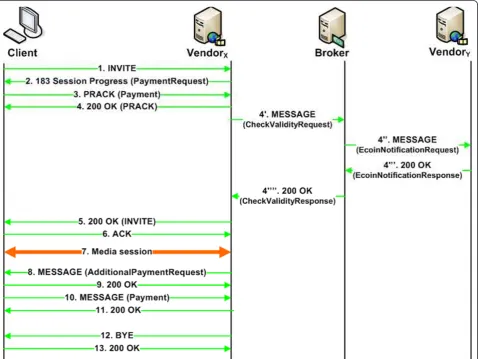
When the user wants to access a payment-based ser-vice, the messages exchanged are shown in Figure 3, and are explained below:
1. C® V: INVITE
The client sends this message to start the set up of the session. The message contains an SDP description of the session in the body. She also includes the lpayment
option-tag for theSupportedheader to indicate that LP-SIP is supported. The client could also specify the
addi-tionalpayment option-tag if it supports additional
pay-ments during the session. Also, the client should include
the application/lp-sipin the Acceptheader to signal the SIP messages that can support the exchange of the mes-sages of the LP-SIP protocol.
2. V ® C: 183 Session in Progress (PaymentRequest)
When the vendor receives an INVITEmessage, if the service requires a payment and thelpayment option-tag is not included in the Supported header, the vendor returns a402 (payment required)message.
Otherwise, the vendor returns this message with the
LP-SIPheader containing aPaymentRequestindicating
the prices of accessing the service in the different curren-cies and the models supported. The header indicates the different models supported and for each model the initial amount required to initiate the session and, if supported, the different prices for the additional payments. Thus,
theLP-SIPheader would be, simplified, as follows (the
whole specification is in Section 4.3.2):
LP-SIP: PaymentRequest; PID=pidv mode-lID=mID1brokers=‘B’model=modeltype
unit=quantity1initialPayment; amounts= ‘amount1, amount2, . . .‘
additionalpay-ment; modelID=mID2, brokers=’B’
model=-modeltype unit=quantity2 amounts= ’amount1, amount2, . . . Expiry=datetime
In this header payment request identifier (PID) is a identifier of the transaction generated by the vendor and
modelIDidentifies the model.
In a payment request there could be different payment models to choose (pay-per-view, pay-per-data, etc). These models could be based on the amount of time spent in the session (pay-per-time), on the amount of data received (pay-per-data), etc. For each model (the type is indicated in modeland identified by modelID) the vendor indicates the price (attributeamounts) based on different units (attributeunit), e.g., in a pay-per-time model the prices could be expressed in units of 5 min-utes that cost 0.5 €each unit. With thebrokersattribute he indicates from which brokers he accepts e-coins for the payment. This header also indicates until when this offer is valid, by means of theExpiryattribute. Similarly, the vendor also indicates the price of additional pay-ments with the information included from additional-paymentattribute.
3. C® V: PRACK (Payment)
If the client agrees to the payment, she sends the
PRACK message with theLP-SIPheader indicating the
exchange is a payment. The message also contains the payment message in its body with content-type applica-tion/lp-sip. The client indicates the following informa-tion in theLP-SIPheader:
SIPPayment: Payment; DateTime=date-time-value
In the content of typeapplication/paymentthe follow-ing message is included:
C, EKCV,KCV (C, V, B, vCall-ID1, pidv,
date-time-value, fKey, [flowKey,] mode-lIDY, e-coinX, Li, Ui, InfoToB)
where:
InfoToB = HKCB (C, V, B, IDX ,
date-time-value, Li, Ui)
This message containsvCall-ID1, which indicates that the value of Call-ID header is from message 1 (the
INVITEmessage) and that it is the same for all the mes-sages of the initiation process. Thepidvindicates thePID
value generated by the vendor for this transaction. The
modelIDYis chosen from thePaymentRequestmessage
with the e-coin.LiandUiindicate the portion of the
e-coin that is going to be spent. ThefKeyis a flag that the client can use to indicate to the vendor that, if possible, she wants to receive the flows of the service in a ciphered way with the keyflowKey. Besides the e-coins, the mes-sage also contains some information to the vendor to confirm the payment with the broker (InfoToB).
In a payment,Liindicates the amount of the e-coin
that has been spent so far and Uiindicates the limit to
spend in this payment. Thus, the amount to pay in the transaction isUi-Li. For example, with an e-coin of 1€,
the first time a payment is made, Li is 0 and if the
amount to pay is 0.2 €, then Ui is 0.2. In the next
pay-ment, Liwill be 0.2. For the sake of simplicity, we have
included the information of one e-coin, though different e-coins could be included if necessary. In this case, the client would include each e-coin and its respective parts of the e-coin to be used.
4. V® C: 200 OK (PRACK)
With this message the vendor confirms the reception of the e-coin. When the vendor receives the PRACK
message (message 3) with the e-coin there are two pos-sible situations:
time or he has had it but another vendor obtained it later. In both cases, the vendor has to contact the bro-ker to check whether the e-coin is valid, was minted by the broker and what portion has been spent. As a response, the broker indicates if the e-coin is valid and the amount that has been spent. Thus, the vendor can calculate whether the client can use the e-coin to make the payment.
2. The vendor has previously received an e-coin dur-ing the day and he has not received a notification that the e-coin is being spent with another vendor. In this case, the vendor does not need to check with the broker the amount spent because he knows it, since he was the last vendor to receive a payment with that e-coin.
In the first situation, the vendor (VendorX ), before
sending a response in the message 5, has to exchange the messages we describe next (from 4’ to 4’’’’). In the second situation, the vendor continues the process with message 5, explained below.
4’. V ® B: MESSAGE (CheckValidity-Request)
TheLP-SIPheader for this message is:
LP-SIP: CheckValidity
TheCheckValidityRequest contains:
V, EKVB,KVB (V, B, vCall-ID4’, C, IDX , Li,
Ui, e-coinIDX , date-time-value,
InfoToB)
Basically, in this message the vendor sends the e-coin to the broker with the information the broker needs to check it. If the e-coin has not already been used during this day, the broker checks the amount of the e-coin spent so far and whether the amount spent is consistent with that information, that is, the value spent has to coincide with the valued indicated inLi. In this case, the
broker registers that the vendor is receiving a payment with this e-coin and sends a confirmation to the vendor with message (4’’’’) as shown below. Thus, the exchange would be messages 4’and 4’’’’.
However, if the e-coin has already been used, the bro-ker has to contact the previous vendor (V endorY ) to
obtain the amount spent, as we see next:
4”. B® V’: MESSAGE (EcoinNotification-Request)
In this message, theLP-SIPheader is:
LP-SIP: EcoinNotification
TheEcoinNotificationRequestcontains:
B,EKVB,KVB (B, V’, vCall-ID4’’, IDX, C)
With this message, the broker requests theVendorYto
indicate to him the last portion of the e-coin that the client spent with him. This information is sent in the following message.
4"’. V’®B: 200 OK (EcoinNotification-Response)
In this message, theLP-SIPheader is the same as the previous message. In the body, the EcoinNotificationRe-sponsecontains:
EKVB,KVB (V’, B, vCall-ID4”, IDX, C, Ui)
In this message the VendorYsends the last portion of
the amount that the client spent with him (Ui). The Ui
value has to coincide with the initial portion of the e-coin (Li) that the new vendor is requesting.
Both if the broker has to check with the previous ven-dor the amount spent and if this step is not necessary, because the broker already knows it, as a response to the vendor request on the e-coin, the broker sends:
4"”. B® V: 200 OK
(CheckValidityResponse)
In this message, theLP-SIPheader has the same value as message 4’. As a response, in the CheckValidityRe-sponse, the vendor receives:
EKVB,KVB (B, V, vCall-ID4’, C, Li)
With this message the vendor receives the confirma-tion on the amount of the e-coin that has been spent (Li). IfAmountX- Li≥ Priceof the product/service, the
vendor accepts the payment and provides the access to the product or service requested by confirming the establishment of the session by sending message 5. Otherwise, the vendor would send an error indicating the payment is not valid.
5. V® C: 200 OK (INVITE)
With this message, in the header section the vendor includes the following header:
LP-SIP: Payment; DateTime=date-time-value, EncryptedKey=keyvalue
Thus, the vendor confirms the payment has been received correctly. Furthermore, with this header, the client could receive (if requested during the payment) a key (flowkey) that will be used to cipher the session flows that will be exchanged when the session is estab-lished. This key is received in a ciphered way in the
EncryptedKey attribute, whose value is: keyvalue=
EKCV,KCV (date-time-value, flowkey). Next, the client acknowledges the reception and the session starts. Thus, the client receives the access to the service.
6. C® V: ACK
This message finishes the establishment of the SIP session and, then, the different multimedia flows are exchanged. This message does not need any additional header or content.
7. C¬®V: Multimedia information This flow depends on the protocol and media agreed on during this session’s establishment. The flow is relayed until either the session finishes (messages 12 and 13) or the time/data paid for by the user is up. When the time/data the user paid is about to finish, if the user supports the additional payment mechanism, messages 8-11 are exchanged. Otherwise, the session finishes (messages 12 and 13).
8. V® C: MESSAGE (AdditionalPayment-Request)
This message is used by the vendor to request an additional payment (if this mechanism is supported) to the client when the time/data the client paid is about to finish.
In theLP-SIPheader, the vendor indicates the time or data that rests before the session finishes with the
Time-DataStop structure. It also contains information about
the prices to pay in a similar way as expressed in the
PaymentRequestmessage.
SIPPayment: AdditionalPayment; PID=-pidv TimeDataToStop=value modelID=maID
brokers=‘B’model=modeltype unit=quan-tity amount=amount1Expiry=datetime
Thus, the prices could be different according to the model (for the whole specification see Section 4.3.2).
The client sends a 200 OK as a response to this request to confirm the reception of this message.
9. C® V: 200 OK
This response does not contain any additional header or content. If the client decides to continue with the session and makes a new payment, she sends a MES-SAGE request with the e-coin previously used with this vendor and with a new payment portion, as long as the remaining value of the e-coin is greater than the amount to pay. Otherwise, the client would have to include an additional e-coin.
10. C®V: MESSAGE (Payment)
The content of this message is similar to message 3, previously explained. As a response to this message, the vendor sends the following message:
11. V®C: 200 OK
If the payment is correctly made, the session con-tinues during the time or the data the client has paid for. Otherwise, the vendor sends an error message and the session finishes (with messages 12 and 13).
This session finishes at the end of the time/data that the session lasts or when the client is not willing to make more payments. In both cases, the session finishes with the following messages:
12. C®V: BYE
This indicates the client wants to finish the session.
13. V®C: 200 OK
The vendor confirms the reception of the message and the session finishes.
5.6 Deposit protocol
At the end of the day, the vendor sends the broker the amounts received from the different e-coins. Thus, the broker can perform the deposit of value received by the vendor. The messages exchanged are:
In this message, theLP-SIPheader is:
LP-SIP: Deposit
TheDepositRequestcontains:
V, EKVB,KVB (V, B, vCall-ID1, IDX1, L1, U1
[, . . . , IDXn, Ln, Un, . . . ])
With this message, the vendor indicates, for each e-coin, the portion of the e-coin that he has received dur-ing all the day (Li indicates the starting position andUi
the last value received). As a response, the broker indi-cates with the flagX value if the payment deposit has
been correctly processed for each e-coin.
2. B® V: 200 OK (DepositResponse)
EKVB,KVB(V, B, vCall-ID1, IDX1, flag1[, . .
. , IDXn, flagn, . . .])
6 Analysis of the LP-SIP protocol
In this section, we make an analysis of the LP-SIP pro-tocol with regard to the requirements defined in Section 3 in order to show how this protocol satisfies them. We also describe how the protocol allows us to support the use of the case scenarios introduced in Section 2.3.
6.1 Payment protocol based on extensibility mechanisms
LP-SIP is based on the extensibility mechanisms defined in SIP [1]. We have defined new option-tags (lpayment,
additionalpayment,application/lp-sip, Section 4.3.1) and a new header,LP-SIP(Section 4.3.2). Thus, we facilitate LP-SIP being supported in current implementations of SIP and, therefore, its acceptability.
6.2 Payment models
The protocol can support different payment models: pay-per-time, pay-per-data, session-based charging and pay-as-you-watch. In general, these models are sup-ported because the protocol allows us to make a pay-ment at the beginning of the session (in the three-way protocol combined with thePRACK method, see mes-sages from 1 to 6 in Section 5.5) as well as at any moment once the session is initiated (with the addi-tional payment mechanism, see messages 8 to 11 in Section 5.5).
In the session-based charging model the payment is made for the whole session. Thus, there is only one pay-ment, made at the beginning of the session.
In the pay-per-time and the pay-per-data models, apart from a payment at the beginning of the session (messages from 1 to 6 in Section 5.5), it is required that
a payment is made from time to time (e.g., every thirty seconds, every minute, etc). Thus, the vendor has to control the time/the data sent and requires a payment once the unit of consumption (seconds or bytes) defined is spent. These payments are requested and made by using the additional payment feature (messages from 8 to 11 in Section 5.5).
The support of the pay-as-you-watch model is differ-ent from the models we have just presdiffer-ented. In this model, the session is initiated without a payment. Thus,
theINVITEmessage contains the headers indicating the
support of LP-SIP. However, the183 Session in progress
does not contain a PaymentRequest and the PRACK
method is not necessary, with the session being initiated on SIP as usual.
Once the session has been established and the user has received some data (during some time) a payment request is sent. Thus, in MESSAGE request, instead of sending an AdditionalPaymentRequest, a
PaymentRe-questwould be sent. The payment would be received in
the 200 OK. Once the payment is made, the session
would send some additional data during some time and a new payment request would be sent. All payments after the initial payment are requested using the
Addi-tionalPaymentRequestmessage.
Thus, thanks to the possibility of making payments both at the beginning of the session and once it is initiated, our proposal supports different payment models.
6.3 Additional payments
As shown throughout the article, LP-SIP supports mak-ing additional payments once the session is initiated. For this purpose and based on the SIP extensibility mechanisms, LP-SIP extends theMESSAGErequest and
the 200 OK response in order to support the request
and send additional payments without interrupting the session. Thus, we can support different models, as men-tioned in the previous section.
6.4 Time/data notification
In order for the user to be aware of the remaining time paid associated to the session, the LP-SIP protocol noti-fies users via the additional payments feature. Thus, at the same time the time is notified, a new payment is requested (if required). Therefore, we satisfy the time/ data notification requirement.
6.5 Lightweight and efficient protocol
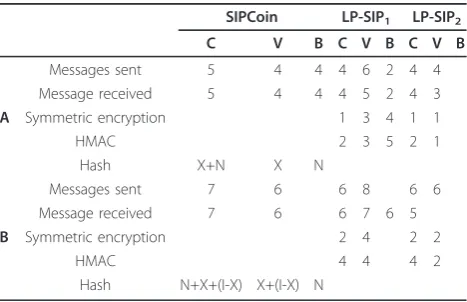
hash function, such as SHA-2), which is much more lightweight than asymmetric cryptography. We have also avoided the broker having to participate in the transac-tion for every payment. Furthermore, our protocol is more lightweight than previous studies, as presented in Section 8. Therefore, LP-SIP can be considered light-weight and efficient.
6.6 Security analysis
In this section we provide an analysis of the different properties that the protocol satisfies in terms of security. The main objective of the payment system is to provide security and efficiency during the highly used payment phase. As mentioned in the previous section, security is provided by means of symmetric cryptography. In other processes where there is no previous contact between entities, such as client and vendor registration processes, the asymmetric encryption and digital signatures are used. In this system there are two possible kind of attackers: internal and external.
On the one hand, external attackers of the transaction such as other entities that compete in the system as other brokers, vendors or clients (whose aim is for an entity to have a bad reputation and thus, the number of its users would be reduced in benefit of another entity in the system, e.g., a vendor could change the informa-tion exchanged between a client and another vendor so that the client has to pay more quantity for the product and the vendor could be seen to be cheating the client) or any other entity that wanted to obtain benefits from the payment transaction.
On the other hand, internal attackers of the transac-tion, i.e., the client, and the vendor (the broker is con-sidered a trusted party) could aim to obtain more benefits fraudulently from the transactions, e.g., the cli-ent trying to re-use an e-coin already spcli-ent to obtain new content, etc. In our justification of security proper-ties, instead of referring to them as internal attackers we will mention them by name in order to distinguish between the attacks that the client can try from those of the vendor.
In the following sections, we analyze in more detail the security properties and how we can avoid the differ-ent attacks that clidiffer-ents, vendors and external attackers (or simply attackers) can try to carry out.
6.6.1 Integrity and authentication
The integrity of all the messages is guaranteed by differ-ent mechanisms: in the vendor and clidiffer-ent registration processes by means of digital signatures, and in the withdrawal and deposit of e-coins and in the purchase process by means of HMAC checksums. Thus, any change made by an external attacker to the messages of the transaction will be detected by the entities partici-pating in the system.
In the transactions where a digital signature is used (registration processes), the recipient can be sure that nobody except the sender has signed the message. Thus, this digital signature guarantees non-repudiation.
In the messages where symmetric signature based on HMAC is used (withdrawal, purchase and deposit pro-cesses), although the signing key is shared between the entities, the recipient can be sure that the message comes from the other party (if we suppose that the sen-der has not revealed his/her key to another party, since this is against his/her own interests). With this sym-metric signature, non-repudiation is not guaranteed but it is not required, since the purpose is to guarantee that the information cannot be produced by an external attacker. Non-repudiation is analyzed in more detail below.
6.6.2 Replay attacks
An external attacker could copy a message exchanged between the client and the vendor and he could re-send it later in order to try to obtain the access to the service or that the client is charged more than once. However, if that attacker re-sends an old message the vendor will detect that the current identifier contained in the mes-sage for the transaction (PID value) does not match with the current transaction and that the e-coin and the amount indicated in the message has been already spent. Furthermore, if the vendor has previously received the e-coin, he knows the portion of the e-coin spent and he can check that this portion has already been spent. If the vendor does not know this information, he will query the broker. Therefore, the vendor can detect if the payment was made and in this case, the vendor will not charge the client and will not provide access to the service.
6.6.3 Confidentiality
In the LP-SIP protocol, we have used both symmetric and asymmetric cipher algorithms to ensure the confi-dentiality of the information exchanged. In the different messages, we have, as far as possible, used symmetric cryptography for the sake of efficiency. This is especially interesting in the purchase process since this will be used most frequently. In this process the real-time require-ments are fundamental so that access to real-time ser-vices is provided seamlessly. It is also used in other processes such as the withdrawal and deposit of e-coins.
As symmetric cipher we propose AES because since it was introduced no significant security problems have been revealed. In those cases where there had been no previous contact between the entities (client and vendor registration processes), it is necessary to use asymmetric cryptography.
Therefore, as all the communications are ciphered and if we suppose perfect cryptography, no external attacker can eavesdrop the information exchanged between the different parties.
6.6.4 Key distribution
The broker is the entity responsible for distributing to the clients, the keys that they will use to communicate with vendors. This distribution can be made in two dif-ferent processes: when the user withdraws e-coins (see Section 5.3) or at any moment after registration with the key request process (see Section 5.4).
In both processes the communication between the user and the broker is ciphered with the keys that the broker generated and distributed to the client
(KCB,KCB). These keys are only known by them and unless one of them reveals them, no external attacker can eavesdrop the vendors’ keys the client obtains. Thus, if we suppose perfect cryptography for the keys used in AES algorithm for ciphering and HMAC-SHA-2 for integrity, the information exchanged cannot be accessed by an external attacker.
Another possible attack that the client could try is to obtain the vendor’s master key in order to eavesdrop other communications between the vendor and other clients. There are two possible ways to obtain it. First, by eavesdropping the vendor’s registration process, since in this process the vendor sends master keys to the bro-ker. However, the communication is ciphered. Second, from a client key, calculating the master key by brute force or finding collisions in the hash function (SHA-2) used in the HMAC. But these attacks are not possible if we suppose perfect cryptography.
6.6.5 Non-repudiation
Non-repudiation aims to provide the evidences needed in the event that a party (client or vendor) denies his/ her participation in a transaction or having received the content. This feature is fundamental when the amounts involved in the transactions are large. However, as men-tioned in [36,37], in purchase transactions where it is expected that the amounts involved will be small or very small (micropayments) as in our payment system, non-repudiation could be considered unnecessary in order to save some computations and perform the transactions more efficiently.
As in most micropayment schemes, the model is based on the fact that the amount involved in the trans-actions is (very) small. Therefore, the profit the vendor
can obtain by cheating the user (not providing the access to the service or content) is very low and the consequence would be that he would obtain a bad repu-tation, which could suppose that no new customers decide to make purchases with him [5], as well as the broker possibly deciding to drop the vendor from the system. At the same time, the broker can check the amounts spent by each customer and control if a user is making frequent complaints to avoid the payment, in this case the user will be dropped from the system.
In the event of non-repudiation being needed, the purchase protocol could be extended by substituting the “signature” based on HMAC by an electronic signature based on public-key cryptography or using S/MIME headers to sign the SIP messages [38,39].
In registration and vendor keys, non-repudiation is guaranteed so that the broker can prove to the entity that manages client and vendor accounts (if it is not itself) that the client and/or vendor really provided him her/his account.
6.6.6 Bogus e-coin
The e-coins are only generated and verified by the bro-ker. Therefore, unless an (internal or external) attacker knows the keys used to mint the e-coins, it is not possi-ble to use bogus e-coins.
Each e-coin is protected by using a symmetric key that depends on the client identifier. If we suppose perfect cryptography, an (internal or external) attacker cannot obtain the key associated to generate e-coins for a parti-cular client. As an additional control measure, the bro-ker could control the serial numbers generated for the different clients in order to detect a possible attack on the key used to generate e-coins for a client. In this case, the identifier will be drawn.
Even if an (internal or external) attacker has managed to obtain the key for a client (not possible under the conditions we have just explained), if he wanted to gen-erate e-coins for a different client, he would have to obtain the broker’s master key. But this attack is not possible if we suppose perfect cryptography and it can also be detected in the same way as we have just men-tioned for a particular client master key.
6.6.7 Double spending/overspending
Double spending/overspending is an attack that the cli-ent can try during the paymcli-ent process. The control of whether an e-coin is double spent or not is performed between the broker and the vendors.