Directed genome engineering for genome optimization
KATHLEEN D’HALLUIN* and RENE RUITER
Bayer CropScience N.V., Gent, Belgium
ABSTRACT The ability to develop nucleases with tailor-made activities for targeted DNA double-strand break induction at will at any desired position in the genome has been a major breakthrough to make targeted genome optimization feasible in plants. The development of site specific nucleases for precise genome modification has expanded the repertoire of tools for the development and optimization of traits, already including mutation breeding, molecular breeding and transgenesis. Through directed genome engineering technology, the huge amount of information provided by genomics and systems biology can now more effectively be used for the creation of plants with improved or new traits, and for the dissection of gene functions. Although still in an early phase of deployment, its utility has been demonstrated for engineering disease resistance, herbicide tolerance, altered metabolite profiles, and for molecular trait stacking to allow linked transmission of transgenes. In this article, we will briefly review the different approaches for directed genome engineering with the emphasis on double strand break (DSB)-mediated engineering towards ge-nome optimization for crop improvement and towards the acceleration of functional genomics.
KEY WORDS:
DNA double strand break induction and repair, site-specific nuclease, genome editing, crop improvement
Introduction
During the past 100 years, the yield of agricultural crops has steadily increased. For generations, crop plants have been ge-netically improved using conventional breeding methods and spontaneous or induced mutagenesis. Plant biotechnology took off 30 years ago with the ability to create transgenic plants through
Agrobacterium-mediated transformation. Transgenesis dramatically
increased the possibilities for crop improvement by expanding the pool of traits that could be integrated into the plant genome. It broke the reliance of breeders on existing biodiversity or on the genes of close relatives of a particular crop for additional genetic diversity. Transformation technology allows for the introduction of exogenous genes including such that do not exist naturally in the target crop. However, conventional mutation breeding and transformation are non-specific: mutation and transgene insertion happen at random positions. As a consequence, they require a screening step for selection of the desired mutants, or for selecting transformants with a preferred performance.
Through the modern era of systems biology and genomics, a huge amount of information is becoming available which enhances our understanding on trait-related genes and variants, on gene functions and on fundamental development, and on physiological and molecular processes. This refined understanding creates new opportunities for crop improvement and trait development. Although
www.intjdevbiol.com
*Address correspondence to: Kathleen D’Halluin. Bayer CropScience N.V., Technologiepark 38, B-9052 Gent, Belgium. Tel +32 9 243 05 45; Fax +32 9 383 67 31.
e-mail: [email protected]
Final, author-corrected PDF published online: 16 October 2013.
ISSN: Online 1696-3547, Print 0214-6282 © 2013 UBC Press
Printed in Spain
Abbreviations used in this paper: Cas, CRISPR-associated (endonuclease); DSB, DNA
double-strand break; HR, homologous recombination; NHR, non-homologous recombination; TALEN, transcription activator-like effector nuclease; ZFN, zinc finger nuclease.
breeding and transformation have resulted in major achievements, these not always allow to fully capture all opportunities arising from the fast developments in systems biology and genomics. Precise modification of plant genomes could enable to exploit more effectively the ever-increasing knowledge for purposes of both gene discovery and crop improvement. It would not only allow the targeted modifications in native genes, but also the introduc-tion of foreign DNA into a predetermined locaintroduc-tion, the removal of undesired sequences or the optimization of a particular gene’s sequence or its regulatory elements (Fig. 1).
have made plant directed genome engineering feasible.
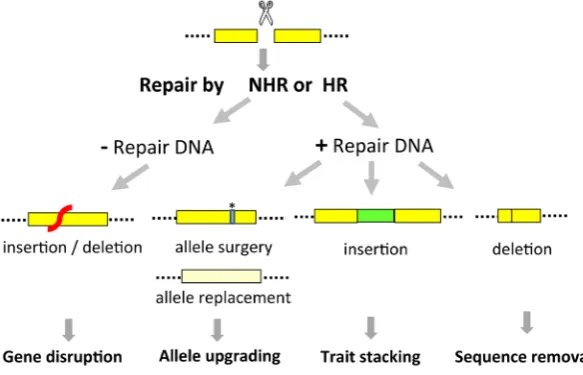
Directed genome engineering through the use of site-specific nucleases for targeted DSB induction is based on the repair of the DSB by the plant’s naturally occurring DNA repair pathways. Repair of the DSB by non-homologous recombination (NHR) will result mostly in non-precise repair with small insertions or deletions at the DSB site, a technology which is exploited for gene function discovery. Precise genome editing is possible through homologous recombination (HR)-mediated repair of the DSB. This requires the simultaneous introduction into the plant cell of the nuclease and the repair DNA that contains both the desired sequence modification and sequences homologous to those flanking the DSB site. The donor DNA, acting as a template for repair of the DSB, directs the modification of the chromosomal locus towards the desired changes (Fig. 1). Some excellent review articles on the use of designer nucleases for directed genome engineering in both model and crop plant species have been published (Tzifira et al., 2012, Curtin et al., 2012).
To create a DSB at a desired position in the genome, nowadays different tools are available and for all of them applications of agricul-tural relevance have been demonstrated. The zinc finger nucleases (ZFNs), consisting of a synthetic C2H2 zinc finger DNA-binding domain fused to the catalytic domain of the FokI endonuclease (Kim
et al., 1996), have been successfully used for directed genome
engineering in plants (Wright et al., 2005, Townsend et al., 2009, Shukla et al., 2009, De Pater et al., 2013). By the use of ZFNs, it has been possible to introduce specific mutations in the acetolactate synthase genes (SurA and SurB) conferring herbicide resistance in tobacco (Townsend et al., 2009). Shukla et al., (2009) used ZFNs to precisely target a herbicide tolerance gene into the IPK1 locus of maize resulting in both herbicide resistance and reduced seed phytate content by targeted disruption of the IPK1 gene, a gene involved in the phytate biosynthesis pathway.
The transcription activator-like effector nucleases (TALENs), consisting of a TALE DNA-binding domain fused to the cleavage domain of the FokI endonuclease, are a rapidly emerging alter-native for ZFNs as TALENs are easier to design (Cermak et al., 2011) and do have less constraints in their DNA binding ability (Bogdanove et al., 2010). TALENs have been successfully used in plants to generate disease resistance by targeted disruption of the rice bacterial blight susceptibility gene (Li et al., 2012).
The LAGLIDADG homing endonucleases, also called mega-nucleases, are a third class of nucleases for targeted DSB induction (Epinat, 2003). Meganucleases are considerably more challenging to re-engineer compared to TALENs and ZFNs (Taylor et al., 2012). The I-CreI homing endonuclease of Chlamydomonas reinhardtii (Thompson et al., 1992) has been successfully re-engineered for targeted mutagenesis by NHR in the ligueless locus in maize (Gao et al., 2010) and for targeted molecular trait stacking by HR in cotton (D’Halluin et al., 2013).
More recently, a new approach for RNA-guided genome editing was described based on the CRISPR-associated (Cas) endonucle-ase. In contrast to the previous designer nucleases, ZFNs, TALENs and meganucleases, the RNA-guided Cas endonuclease does not each time require protein re-engineering to target a new sequence; only a new RNA guide is required and not a new enzyme. Recent papers have already shown the feasibility of RNA-programmed Cas9-driven genome editing in human cells, zebrafish and plants (Jinek et al., 2013; Cong et al., 2013; Mali et al., 2013; Cho et
al., 2013; Hwang et al., 2013; Shan et al., 2013; Li et al., 2013;
Nekrasov et al., 2013; Jiang et al., 2013).
Directed genome engineering for trait stacking
To date, herbicide tolerance and/or insect resistance are the most widely used GM traits in crop plants. To cover for broad-spectrum combined weed and insect control, crops have to be engineered with multiple herbicide tolerance and insect resistance genes, with different modes of action. Beyond management for weed and insect control, there is a next wave of traits being developed to increase yield, quality, abiotic stress tolerance and disease resistance. Combining a large number of transgenic trait loci in one variety will become unmanageable through conventional plant breeding, as the size of the breeding populations increases exponentially with the number of trait loci to be combined. This requires the need to develop more efficient gene stacking technology to facilitate the combination of multiple trait transgenes into a single, genetic unit and as such to allow rapid introgression into commercially relevant germplasm.
Molecular trait stacks could be generated by transformation with a single construct carrying multiple trait genes, by co-delivery of single gene constructs or by re-transformation of an existing event
Fig. 1. Double strand break (DSB)-mediated genome engi-neering. A DSB is induced by a sequence-specific nuclease (scissor) in the target sequence (yellow box). The break can be repaired by non-homologous recombination (NHR) or ho-mologous recombination (HR). Repair of the DSB by NHR is non-precise and can introduce insertions/deletions (denoted by the red region), resulting in gene disruption. Repair of the DSB by HR in the presence of a repair DNA can be very precise. The repair DNA represents the sequence modifications to be incorporated in the chromosomal locus: a single or a few basepair substitution (allele surgery *) or a larger sequence replacement (allele replacement) for allele upgrading; inser-tion (green box) for trait stacking; and deleinser-tion for removal of sequences.
the technical challenge to identify an event with all stacked trait genes expressed as desired will increase with the number of trait genes included in the transformation vector, especially if stacked traits require very different promoters with different spatial and/ or temporal specificities (Que et al., 2010). In plants, enhancers present in promoters are able to change the activity of nearby promoters, resulting in loss of promoter specificity (Gudynaite-Savitch, 2009). Tandemly, divergently or convergently arranged genes may influence each other’s expression due to transcriptional interference between these genes (Eszterhas et al., 2002). In the cases of co-delivery of single gene constructs or re-transformation, an additional challenge is to select for plants with co-integrations that do not segregate in the following generations.
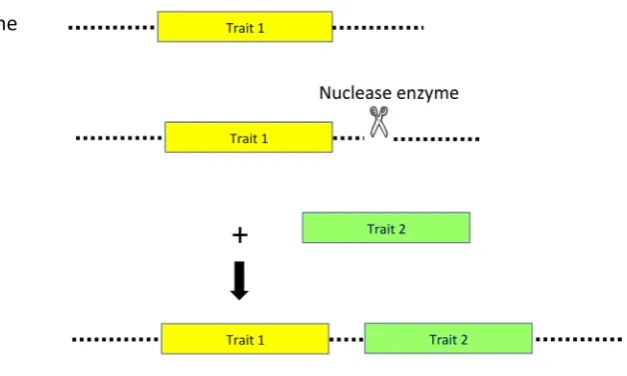
Targeted molecular trait stacking through targeted DSB induction could overcome some of the challenges associated with breed-ing stacks or molecular stacks. Through targeted molecular trait stacking, additional genes could be introduced in close vicinity of an already existing transgenic locus, within a genetic distance that would allow linked transmission, while the integration position
could be chosen such that the transcriptional interference between the stacked transgenes is minimal (Fig. 2). More recently, we reported on the feasibility of targeted molecular trait stacking in cotton (D’Halluin et al., 2013). We showed precise integration of herbicide toler-ance genes (hppd, epsps) in close vicinity of an already existing transgenic insect control locus (cry2Ae, bar) through the combination of targeted DNA cleavage by a custom-designed meganuclease and HR- mediated repair (Fig. 3). Hereto, a repair DNA was designed that carries the herbicide tolerance genes (hppd, epsps) flanked with cotton genomic sequences homologous to the DNA cleavage site. We further demonstrated that all genes in the resulting targeted molecular stack (hppd, epsps, cry2Ae, bar) were inherited as a single genetic locus, in a normal Mendelian manner. We observed that a large fraction of these precise stacked events did not contain additional random integrations of hppd or
epsps or the meganuclease somewhere
else in the genome. This is remarkable as our targeted molecular stacked events were
Fig. 2. Targeted molecular trait stacking. A double strand break (DSB) is induced by a sequence-specific nuclease (scissor) in the flanking genomic genomic sequence (dotted line) of an already existing transgene locus (Trait 1; yellow box). The DSB is repaired by targeted introduction of an additional trait gene (Trait 2; green box).
Fig. 3. Targeted molecular trait stacking in cotton through targeted double strand break induction. Precise integration of herbicide tolerance genes (hppd, epsps) (green boxes) in close vicinity of an already existing transgenic insect control locus (cry2Ae, bar) (yellow boxes) through targeted DNA cleavage by a sequence-specific nuclease (scissor) and HR-mediated repair. The red dotted lines show the regions of homology between the repair DNA and the target line. hppd,4-hydroxyphenylpyruvate dioxy-genase gene; epsps, 5-enol-pyruvylshikimate-3-phosphate synthase; bar, phosphinothricin acetyltransferase; cry2Ae, insecticidal crystal protein of Bacillus thuriengiensis.
produced through particle bombardment-mediated DNA delivery of both the meganuclease and the repair DNA. Usually DNA delivery by biolistics is characterized by higher copy number integration (Hansen and Chilton, 1996; Travella et al., 2005). We hypothesize that many of the repair proteins involved in DSB repair may be recruited to the nuclease-induced targeted DSB site thereby reduc-ing the frequency of random integration.
Site-specific integration for trait stacking could also be mediated by site-specific recombinases such as Cre or FLP (Ow, 2011). However, site-specific recombination in the plant genome has only been possible at a pre-engineered recombination site and did not allow precise engineering at will at any desired position in the plant genome. Successful targeting of transgenes to pre-engineered recombination sites was reported for crop plants such as rice (Srivastava and Ow, 2001, Srivastava et al., 2004, Chawla
et al., 2006) and soybean (Li et al., 2009). Recently, considerable
vantage over the recombinase-mediated approach to be also applicable for the selective removal of endogenous gene clusters or unwanted loci and also for the abolishment of gene function by site-directed mutagenesis as a result of small deletions by imperfect repair of a DSB.
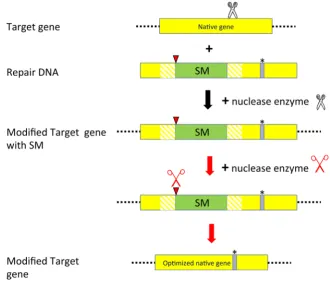
Marker removal by DSB-induced intrachromosomal HR (IHR) may also become a very useful tool for temporary selection of otherwise non-selectable genome editing events. As a protoplast-based regeneration system is not available for most crop plants, genome editing of non-selectable genes will only be possible by using multicellular tissue culture systems. This will require at least temporarily the use of a selectable marker gene to enrich for tis-sues where genome editing may have happened. Once genome editing events have been identified, the selectable marker gene can be removed. The selectable marker gene could be removed without leaving any footprint to allow proper expression of the “edited” gene(s). This is possible by flanking the selectable marker gene by direct repeat sequences developed through duplication of part of the target DNA sequence. Upon the induction of a DSB between the repeats, the DSB will be repaired by IHR between the repeat sequences, resulting in the removal of the selectable marker gene without leaving any footprint (Fig. 4). We showed that by such an approach the selectable marker gene could be efficiently removed. By placing the endonuclease under control of the NTM19 microspore-specific promoter (Oldenhof et al., 1996) we directly obtained progeny plants with precise removal of the marker gene and without leaving any footprint (WO06/105946).
Directed genome engineering for precise genome editing
DSB-induced HR-mediated repair is considered a useful tool
Fig. 4. Improving non-selectable native traits by temporal use of a selectable marker gene. A double strand break (DSB) is induced by a sequence-specific nuclease (black scissor) in the native gene (yellow box). The break is repaired by homologous recombination (HR) with a Repair DNA containing the desired se-quence modification (*) to be incorporated in the Target gene and a selectable marker gene (SM) (green box) flanked by direct repeat sequences through duplication of part of the target native gene sequence (hatched yellow box). Between the direct repeat sequences, a recognition site (red triangle) for a sequence-specific nuclease (red scissor) is included. Induction of a DSB by the sequence-specific nuclease (red scissor) between the direct repeat sequences (yellow hatched box) may result in the removal of the selectable marker gene by intrachromosomal homologous recombination, leading to an optimized native gene containing only the desired modification (= Modified Target gene).
family of serine recombinases and a custom-designed zinc-finger- or TALE- binding domain. These designer recombinases were able to recombine DNA in mammalian cells (Mercer et al., 2012; Gaj et
al., 2013). The feasibility of generating customized recombinases
will also broaden the application range to endogenous sequences in plants.
Minichromosome technology has also been considered as a technology that may offer opportunities for trait stacking in crop plants. Artificial minichromosomes in maize have been produced by telomere-mediated truncation (Yu et al., 2007) or by in vitro assembly from cloned centromeric like sequences (Carlson et al., 2007). The latter authors reported that these in vitro assembled minichromosomes in maize transformants were maintained as an autonomous chromosome next to the host chromosomes and that the genes carried by the minichromosome were expressed and transmitted through mitosis and meiosis. Performance of these minichromosome transformants under field conditions has not yet been reported. Minichromosome transformation could have advantages over random integration into native chromosomes by circumventing the risk of random gene insertion into an undesir-able chromosomal region which may result in linkage drag upon introgression of the transgene locus in other varieties.
Directed genome engineering for removal of sequences
Removal of sequences can be achieved by DSB-induced HR or NHEJ-mediated repair (Siebert and Puchta, 2002) or by site-specific intramolecular recombination (Odell et al., 1990). DSB-mediated recombination allows removal of both transgene and endogene sequences, whereas site-specific recombination has been limited to transgene sequences preconfigured with recombination sites (Nanto et al., 2009). An important application of
both technologies for crop improvement is the removal of selectable marker genes only needed for transformation (Petolino et al., 2010, Zhang
et al., 2003). The Cre/loxP recombination system
has also been used to resolve complex integration patterns in transgenic wheat and maize plants after particle bombardment by removal of surplus copies (Srivastava and Ow, 2001).
ad-for the introduction of precise, subtle changes in genes. ZFNs and TALENs have been used for specific mutation induction in the tobacco acetolactate sysnthase genes (ALS) (SurA and SurB) conferring tolerance to the ALS-inhibiting herbicides (Townsend et
al., 2009; Zhang et al., 2013). In these cases, the DSB was repaired
using a repair DNA template that contains sequences homologous to the ALS target sequence with the desired mutation(s). Endo
et al., (2007) successfully introduced two mutations into the rice ALS gene via HR-mediated gene targeting but not triggered by a
nuclease-mediated targeted DSB induction. These authors ascribe their success of gene targeting in absence of targeted DSB induc-tion, mainly to their very efficient tissue culture and transformation system in rice and they further speculate that the condition of the chromatin structure of rice callus cells might enhance HR.
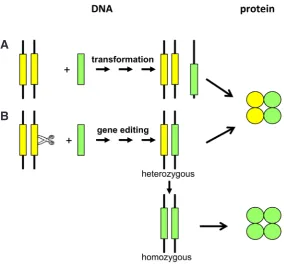
Rice plants with the two desired mutations introduced in the endogenous ALS gene showed hyper herbicide tolerance and were superior to “conventional” rice transformants that carried the same mutated ALS gene. Although the transformants had high expres-sion of the mutant ALS gene, their tolerance was lower than that of the plants carrying the edited ALS native genes. This could be explained by the fact that in the transformants both wild type and mutant ALS protein is present while the homozygous ALS edited plants only contain the mutant herbicide tolerance providing ALS protein. (Fig. 5). This example shows that for the generation of plants tolerant to the ALS-inhibiting herbicides, precise genome editing may be preferred above transformation.
Another technology being explored for the introduction of subtle,
site-directed changes in chromosomal DNA is based on the use of oligonucleotides. This includes single stranded and double stranded oligonucleotides with different chemistry, and DNA-RNA hybrid molecules. Although some success has been obtained by oligonucleotide-driven mutagenesis in crop plants such as maize (Zhu et al., 1999), rice (Koch-evenko and Willmitzer, 2003; Okuzaki and Toriyama, 2004), and canola (BASF, 2009), this approach has not yet become routine and modifications were not always as intended, both with respect to position and to the base change (Beetham
et al., 1999). At least a part of the observed sequence
modifications may also have been the result of spontaneous mutation (Ruiter et al., 2003). The utility of oligonucleotides is restricted to the introduction of small modifications of a single or a few base pairs and have most often been applied for the creation of mutations in selectable traits such as the
ALS genes to confer herbicide tolerance.
Directed genome engineering for structural
non-precise changes
Repair of DSBs by NHEJ can introduce mutations at target sites by the creation of small deletions or insertions, resulting most typically in loss of gene function. This ap-proach is technically relatively simple as it requires only the introduction of a targeted DSB and no repair DNA template is required. This makes it a powerful tool for gene function discovery. Targeted mutagenesis by targeted introduction of DSBs by designer nucleases and repair by NHEJ has already been described for several plant species, as in to-bacco (Maeder et al., 2008; Cermak et al., 2011; Mahfouz
et al., 2011; Zhang et al., 2012), and crop plants as soybean Fig. 5. Transformation versus genome editing for trait optimization.(A) Trait
optimization through the introduction of an improved allele (green rectangle) by transformation. The yellow rectangle depicts the native allele. In transformants both wild type protein (yellow circles) and mutant protein (green circles) is present.
(B) Trait optimization through genome editing by the induction of a targeted DSB (scissor) in the native allele and repair by homologous recombination. Homozygous genome editing events, contain only the mutant protein.
(Curtin et al., 2011), maize (Gao et al., 2010) and rice (Li et al., 2012; Shan et al., 2013). Recently it was shown that disease-resistant rice could be generated by site-directed mutagenesis of the rice bacterial blight susceptibility gene Os11N3 through TALEN-mediated disruption of the effector-binding element for the TAL effector AvrXa7 of Xanthomonas oryzae pv. Oryzae (Li et al., 2012). This is the first example of the development of a trait in a crop plant through just the induction of a targeted DSB and repair in a random manner by NHEJ.
Conclusion
Directed genome engineering enables precise genome modifi-cation. It will become a powerful tool for developing new traits for crops, and for understanding and optimizing gene function. More and more crop genomes are being, or will soon be fully sequenced and characterized. For some crops, even domestic and wild varieties have been sequenced to find specific genetic variation between wild type and cultivated strains. Together with the continuously increasing information from systems biology, key genes or networks of genes that determine certain high value agronomic features will be identified. When the desired biodiversity for trait development is naturally present within the species, (molecular) breeding will be the desired tool towards crop improvement. If trait development is dependent on the addition of genes from other species, standard transformation will be required. In some cases though, the ability to precisely modify the genome will be required for effective trait
A
development, e.g. for introducing amino acid substitutions in a native gene to confer herbicide tolerance or increased tolerance to biotic or abiotic stresses or to optimize metabolic pathways to produce a variety of specialty products, such as oils, carbohydrates and plant-made pharmaceuticals.
From this brief review, it is clear that DSB-induced directed genome engineering is a very promising and versatile approach towards precise engineering of plant genomes. It can be applied for both small and large modifications including insertion, deletion and replacement of sequences. Although site-specific recombi-nases such as Cre or Flp have been demonstrated to mediate recombination in plants for integration, replacement and deletion of sequences, it has still been restricted to transgene sequences preconfigured with recombination sites. However, recent progress in the development of designer recombinases will broaden the application range to endogenous sequence. Time will tell whether oligonucleotide-mediated genome engineering which is limited to small modifications consisting of single or a few base pair changes, and the minichromosome technology, which is limited to transgene stacking will become broadly applicable genome engineering technology.
To make directed genome engineering broadly applicable for crop species, efficient DNA delivery methods and efficient cell and tissue culture procedures allowing the efficient manipulation of large numbers of cells have to be available. For many crop species, these have still to be further developed or improved.
As more complex traits are being aimed for optimization, di-rected genome engineering technology will be needed to cleave at specific locations in the genome to disable or edit specific genes. The progress in the field of the site-specific nucleases has opened the door for genome editing of crop plants.
Acknowledgments
We thank Bayer CropScience N.V. colleagues who have contributed to the work described in this manuscript.
References
BASF (2009). BASF and Cibus achieve development milestone in CLEARFIELDR
production system. http://www.basf.com/group/pressrelease/P-09-119. BEETHAM P, KIPP P, SAWYCKY X, ARNTZEN C and MAY G (1999). A tool for
functional plant genomics: chimeric RNA/DNA oligonucleotides cause in vivo gene-specific mutations. Proc. Natl. Acad. Sci. USA 96: 8774-8778.
BOGDANOVE A, VOYTAS D (2011). TAL effectors: customizable proteins for DNA targeting. Science 333: 1843-1846.
CARLSON S, RUDGERS G, ZIELER H, MACH J, LUO S, GRUNDEN E (2007). Meiotic transmission of an in vitro-assembled autonomous maize minichromo-some. PLoS Genet 3: 1965-1974.
CERMAK T, DOYLE E, CHRISTIAN M, WANG L, ZHANG Y, SCHMIDT C, BALLER J, SOMIA N, BOGDANOVE A and VOYTAS D (2011). Efficient design and assembly of custom TALEN and other TAL effector-based constructs for DNA targeting. Nucleic Acids Res. 39, e82.
CHAWLA R, ARIZA-NIETO M, WILSON A, MOORE S and SRIVASTAVA V (2006). Transgene expression produced by biolistic-mediated, site-specific gene integration is consistently inherited by the subsequent generations. Plant Biotech. J. 4: 209-218. CHILTON M-D and QUE Q (2003); Targeted integration of T-DNA into the tobacoo
genome at double-stranded breaks: new insights on the mechanisms of T-DNA integration. Plant Physiol. 133: 956-965.
CHO S.W, KIM S, KIM J M and KIM J S (2013). Targeted genome engineering in huy-man cells with the Cas9 RNA-guided endonuclease. Nature Biotech. 31: 230-232. CONG L, RAN F, COX D, LIN S, BARRETTO R, HABIB N, HSU P, WU X, JIANG
W, MARRAFFINI A and ZHANG F (2013). Multiplex genome engineering using
CRISPR/Cas systems. Science 339: 819-823.
CURTIN S, VOYTAS D and STUPAR R (2012) Genome engineering of crops with designer nucleases. Plant Genome 5: 42-50.
CURTIN S, ZHANG F, SANDER J, HAUN W, STARKER C, BALTES N, REYON D, BAHLBORG E, GOODWIN M, COFFMAN A, DOBBS D, JOUNG K, VOYTAS D and STUPAR M (2011). Targeted mutagenesis of duplicated genes in soybean with zinc-finger nucleases. Plant Physiol. 156: 466-473.
D’HALLUIN K, VANDERSTRAETEN C, STALS E, CORNELISSEN M and RUITER R (2008). Homologous recombination: a basis for targeted genome optimization in crop species such as maize. Plant Biotech. J. 6: 93-102.
D’HALLUIN K, VANDERSTRAETEN C, VAN HULLE J, ROSOLOWSKA J, VAN DEN BRANDE I, PENNEWAERT A, D’HONT K, BOSSUT M, JANTZ D, RUITER R and BROADHVEST J (2013). Targeted molecular trait stacking in cotton through targeted DSB induction. Plant Biotech. J. doi:10.111/pbi.12085
DE PATER S, PINAS J, HOOYKAAS P and VAN DER ZAAL B (2012). ZFN-mediated gene targeting of the Arabidopsis protoporphyrinogen oxidase through Agrobacte-rium-mediated floral dip transformation. Plant Biotech. J. , doi: 10.1111/pbi.12040. ENDO M, OSAKABE K, ONO K, HANDA H, SHIMUZU T and TOKI S (2007). Molecular breeding of a novel herbicide-tolerant rice by gene targeting. Plant J. 52: 157-166. EPINAT J-C, ARNAULD S, CHAMES P, ROCHAIX P, DESFONTAINES D, PUZIN C, PATIN A, ZANGHELLINI A, PÂQUES F and LACROIX E (2003). A novel engineered meganuclease induces homologous recombination in yeast and mammalian cells. Nucleic Acids Res 31: 2952-2962.
ESZTERHAS S, BOUHASSIRA E, MARTIN D, FIERING S (2002). Transcriptional interference by independently regulated genes occurs in any relative arrange-ment of the genes and is influenced by chromosomal integration position. Molec. Cell. Biol. 22: 469-470.
GAO H, SMITH J, YANG M, JONES S, DJUKANOVIC V, NICHOLSON M, WEST A, BIDNEY D, FALCO C, JANTZ D and LYZNIK A (2010). Heritable targeted mutagenesis in maize using a designed endonuclease. Plant J., 61: 176-187. GAJ T, MERCER A, SIRK S, SMITH H and BARBAS C (2013). A comprehensive
approach to zinc-finger recombinase customization enables genomic targeting in human cells. Nucleic Acids Res. doi: 10.1093/nar/gkt071
GUDYNAITE-SAVITCH L, JOHNSON D, MIKI B (2009). Strategies to mitigate transgene-promoter interactions. Plant Biotech. J. 7: 472-485.
HANSEN G and CHILTON M-D (1996). Agrolistic tansformation of plant cells: integra-tion of T-strands generated in planta. Proc. Natl. Acad. Sci. USA 93: 14978-14983. HWANG WY, FU Y, REYON D, MAEDER M, TSAI S and SANDER D (2013). Efficient
genome editing in zebrafish using a CRISPR-Cas system. Nature Biotech. 31: 227-229.
JINEK M, EAST A, CHENG A, LIN S, MA E, DOUDNA J (2013). RNA-programmed genome editing in human cells. eLIFE2, e00471.
JIANG W, ZHOU H, BI H, FROMM M, YANG B, WEEKS D (2013). Demonstration of CRISPR/Cas9/sgRNA-mediated targeted gene modification in Arabidopsis, tobacco, sorghum and rice. Nucleic Acids Res. doi:10.1093/nar/gkt780 KIM Y G, CHA J and CHANDRASEGARAN S (1996). Hybrid restriction enzymes: Zinc
finger fusions to FokI cleavage domain. Proc. Natl. Acad. Sci USA 93: 1156-1160. KOCHEVENKO A and WILLMITZER L (2003). Chimeric RNA/DNA oligonucleotide-based site-specific modification of the tobacco acetolactate syntase gene. Plant Physiol. 132: 174-184.
LI J-F, NORVILLE J, AACH J, McCORMACK M, ZHANG D, BUSH J, CHURCH G, SHEEN J (2013). Multiplex and homologous recombination-mediatd genome editing in Arabidopsis and Nicotiana benthamiana using guide RNA and Cas9. Nature Biotech. 31: 688-691
LI T, LIU B, SPALDING M, WEEKS D, YANG B (2012). High-efficiency TALEN-based gene editing produces disease resistant rice. Nature Biotech. 30: 390-392. LI, Z, XING A, MOON B, MCCARDELL R, MILLS K and FALCO S (2009). Site-specific
integration of transgenes in soybean via recombinase-mediated DNA cassete exchange. Plant Physiol. 151: 1087-1095.
MAEDER M, THIBODEAU-BEGANNY S, OSIAK A et al., (2008). Rapid ‘open-source’ engineering of customized zinc-finger nucleases for highly efficient gene modifica-tion. Mol. Cell 31: 294-301.
USA 93: 5055-5060.
MALI P, YANG L, ESVELT K, AACH J, GUELL M, DICARLO J, NORVILLE J and CHURCH G (2013). RNA-guided human genome engineering via Cas9. Science 338: 823-826.
MERCER A, GAJ T, FULLER R and BARBAS C (2012). Chimeric TALE recombinases with programmable DNA sequence specificity. Nucleic Acids Res. 40: 11163-72. NANTO K, SATO K, KATAYAMA Y and EBINUMA H (2009). Expression of a transgene exchanged by the recombinase-mediated cassette exchange (RMCE) method in plants. Plant Cell Reports 28: 777-785.
NEKRASOV V., STASKAWICZ B, WEIGEL D, JONES J., KAMOUN S (2013). Targeted mutagenesis in the model plant Nicotiana benthamiana using Cas9 RNA-guided endonuclease. Nature Biotech. 31: 691-693
ODELL J, CAIMI P, SAUER B and RUSSELL S (1990). Site-directed recombination in the genome of transgenic tobacco. Mol Gen Genet 223: 369-378.
OKUZAKI A and TORIYAMA K (2004). Chimeric RNA/DNA oligonucleotide-directed gene targeting in rice. Plant Cell Rep 22: 509-512.
OLDENHOF M, DE GROOT P, VISSER J, SCHRAUWEN J and WULLEMS G (1996). Isolation and characterization of a microspore-specific gene from tobacco. Plant Mol Biol 31: 213-215.ETICS AND GENOMI
OW D (2011). Recombinase-mediated gene stacking as a transformation operating system. J. Integrative Plant Biol. 53: 512-519.
PETOLINO J, WORDEN A, CURLEE K, CONNELL J, STRANGE MOYNAHAN T, LARSEN C and RUSSELL S (2010). Zinc finger nuclease-mediated transgene deletion. Plant Mol Biol 73: 617-628.
PUCHTA H, DUJON B and HOHN B (1996). Two different but related mechanisms are used in plants for the repair of genomic double-strand breaks by homologous recombination. Proc. Natl. Acad. Sci USA 93: 5055-5060.
QUE Q, CHILTON M-D, DE FONTES C, HE C, NUCCIO M, ZHU T, WU Y, CHEN J and SHI L (2010). Trait stacking in transgenic crops: challenges and opportuni-ties. GM Crops 1: 1-10.
RUITER R, VAN DEN BRANDE I, STALS E, DELAURÉ S, CORNELISSEN M and D’HALLUIN K (2003. Spontaneous mutation frequency in plants obscures the effect of chimeraplasty. Plant Molec. Biol. 53: 715-729.
SHAN Q, WANG Y, CHEN K, LIANG Z, LI J, ZHANG Y, ZHANG K, LIU J, VOYTAS D, ZHENG X, ZHANG Y and GAO C (2013). Rapid and efficient gene modification in rice and Brachypodium using TALENs. Molec. Plant, Jan 22 Advance Access (PMID:23288864)
SHAN Q, WANG Y, LI J, ZHANG Y, CHEN K, LIANG Z, ZHANG K, LIU J, XI J, QIU J-L, GAO C (2013). Targeted genome modification of crop plants using a CRISPR-Cas system. Nature Biotech. 31:686-688
SHUKLA V, DOYON Y, MILLER J, DEKELVER R, MOEHLE E, WORDEN S, MITCH-ELL J, ARNOLD N, GOPALAN S, MENG X, CHOI V, ROCK J, WU Y-Y, KATIBAH
G, ZHIFANG G, MCCASKILL D, SIMPSON M, BLAKESLEE B, GREENWALT S, BUTLER H, HINKLEY S, ZHANG L, REBAR E, GREGORY P and URNOV D (2009). Precise genome modification in the crop species Zea mays using zinc-finger nucleases. Nature 459: 442-445.
SIEBERT R and PUCHTA H (2002). Efficient repair of genomic double-strand breaks by homologous recombination between directly repeated sequences in the plant genome. Plant Cell 14: 1121-1131.
SRIVASTAVA V, and OW D (2001). Single copy primary transformants of maize obtained through the co-introduction of a recombinase expressing construct. Plant Molec. Biol. 46: 561-566.
SRIVASTAVA V, ARIZA-NIETO M and WILSON A (2004). Cre-mediated site-specific gene integration for consistent transgene expression in rice. Plant Biotech. J. 2: 169-179.
TAYLOR G, PETRUCCI L, LAMBERT A, BAXTER S, JARJOUR J and STODDARD B (2012). LAHEDES: The LAGLIDADG homing endonuclease database and engineering server. Nucleic Acids Res. 40: W110-W116. doi:10.1093/nar/gks365. THOMPSON A, YUAN X, KUDLICKI W and HERRIN D (1992). Cleavage and recog-nition pattern of a double-strand-specific endonuclease (I-CreI) encoded by the chloroplast 23S rRNA intron of Chlamydomonas reinhardtii. Gene 119: 247-251. TOWNSEND J, WRIGHT D, WINFREY R, FU F, MAEDER M, JOUNG J, VOYTAS D (2009). High-frequency modification of plant genes using engineered zinc-finger nucleases. Nature 459: 442-445.
TRAVELLA S, ROSS M, HARDEN J, EVERETT C, SNAPE J and HARWOORD W (2005). A comparison of transgenic barley lines produced by particle bombardment and Agrobacterium-mediated techniques. Plant Cell Rep 23: 780-789. TZFIRA T, WEINTAL D, MARTON I, ZEEVI V, ZUKER A and VAINSTEIN A (2012).
Genome modifications in plant cells by custom-made restriction enzymes. Plant Biotech. J. 10: 373-389.
WRIGHT D, TOWNSEND J, WINFREY R, IRWIN P, RAJAGOPAL J, LONOSKY P, HALL B, JONDLE M, VOYTAS D (2005). High-frequency homologous recombina-tion in plants mediated by zinc-finger nucleases. Plant J. 44: 693-705. YU W, HAN F, GAO Z, VEGA J and BIRCHER J (2007). Construction and behavior of
engineered minichromosomes in maize. Proc. Natl. Acad. Sci USA 104: 8924-8929. ZHANG W, SUBBARAO S, ADDAE P, SHEN A, ARMSTRONG C, PESCHKE V,
GILBERTSON L (2003). Cre/lox-mediated marker gene excision in transgenic maize (Zea mays L.) plants. Theor Appl Genet 107: 1157-1168.
ZHANG Y, ZHANG F, LI X, BALLER J, QI Y, STARKER C, BOGDANOVE A and VOYTAS D (2012). TALENs enable efficient plant genome engineering. Plant Physiol. 161: 20-27.
5 yr ISI Impact Factor (2011) = 2.959
Interplay between DNA methylation, histone modification and chromatin remodeling in stem cells and during development
Kohta Ikegami, Jun Ohgane, Satoshi Tanaka, Shintaro Yagi, and Kunio Shiota Int. J. Dev. Biol. (2009) 53: 203-214
http://www.intjdevbiol.com/web/paper/082741ki
Many paths to one goal? The proteins that recognize methylated DNA in eukaryotes
Nobuhiro Sasai and Pierre-Antoine Defossez Int. J. Dev. Biol. (2009) 53: 323-334
http://www.intjdevbiol.com/web/paper/082652ns
Mechanisms of transcriptional repression by histone lysine methylation
Philip Hublitz, Mareike Albert and Antoine H.F.M. Peters Int. J. Dev. Biol. (2009) 53: 335-354