P78
Pudendal Nerve Stimulation Activates Spinal GABA-A Receptors to Inhibit Reflex Bladder Activity in Cats
Zhiying Xiao¹, Jeremy Reese², Marc J. Rogers², Zeyad Schwen², Jicheng Wang¹, James R. Roppolo¹, William C. de Groat², Changfeng Tai¹. ¹University of Pittsburgh, Pittsburgh, PA, USA, ²UPMC, Pittsburgh, PA, USA.
Background: Gamma-aminobutyric (GABA) is a major inhibitory
neu-rotransmitter at both spinal and supraspinal synapses and has been impli-cated in the control of micturition in animals. GABA-A agonists have been shown to inhibit reflex bladder activity and preganglionic neuron firing whereas antagonists facilitate bladder reflexes. Because pudendal nerve stimulation (PNS) also elicits inhibitory postsynaptic potentials in bladder parasympathetic preganglionic neurons in the cat, we hypothesized that PNS might inhibit bladder overactivity by stimulating spinal GABAergic inhibitory neurons. We investigated the role of GABA-A receptors in puden-dal inhibition of nociceptive and nonnociceptive reflex bladder activities in cats.
Methods: Cystometrograms (CMGs) were performed on 33 cats under
α-chloralose anesthesia using either 0.25% acetic acid (AA) or saline to stimulate nociceptive C-fibers or nonnociceptive Aδ-fibers, respectively. To inhibit bladder reflexes, PNS was applied at 5 Hz via a cuff electrode to the pudendal nerve at 2 and 4 times the threshold (T) intensity for inducing anal twitch. In the AA group, picrotoxin (a GABA-A antagonist) was administered in cumulative doses (0.01-0.3 mg/kg i.v) to determine the effect on pudendal inhibition (n=8). Alternatively in this group, 5 cats received only a single intrathecal (i.t.) dose of picrotoxin (0.4mg). This protocol was repeated in the saline group with picrotoxin administered either intravenously (n=15) or intrathecally (n=5).
Results: AA irritation significantly (P<0.01) reduced bladder capacity to
34.3 ± 7.1% of saline control capacity, while PNS at 2T and 4T significantly (P<0.01) increased AA bladder capacity to 84.0 ± 7.8 and 93.2 ± 15% of the saline control, respectively. Intrathecal picrotoxin did not change AA bladder capacity but completely removed PNS inhibition of AA-induced bladder overactivity. Picrotoxin (i.v.) only increased AA bladder capacity at a high dose (0.3 mg/kg) but significantly (P<0.05) reduced 2T PNS inhibition at low doses (0.01-0.1 mg/kg). During saline cystometry, PNS significantly (P<0.01) increased bladder capacity to 147.0 ± 7.6% at 2T and 172.7 ± 8.9% at 4T of control capacity. Picrotoxin (0.4mg i.t. or 0.03-0.3mg/kg i.v.) significantly (P<0.05) increased bladder capacity, but did not alter PNS inhibition during saline infusion.
Conclusions: These results indicate that spinal GABA-A receptors have
different roles in controlling nociceptive and nonnociceptive reflex blad-der activities and the PNS inhibition of these activities. Unblad-derstanding the neurotransmitter mechanisms involved in neuromodulation may help identify targets for new overactive bladder therapies.
P79
Pudendal and Tibial Neuromodulation of Spinal Reflex Bladder Activity in Cats
Zhiying Xiao¹, Marc J. Rogers², Jeremy Reese², Bing Shen¹, Jicheng Wang¹, James R. Roppolo¹, William C. de Groat¹, Changfeng Tai¹.
¹University of Pittsburgh, Pittsburgh, PA, USA, ²UPMC, Pittsburgh, PA, USA.
Background: C-fibers mediate a spinal bladder reflex under pathologic
con-ditions (ie: overactivity). Pudendal nerve stimulation (PNS) and tibial nerve stimulation (TNS) are effective in treating overactive bladder (OAB), but the central sites of action (spinal cord vs supraspinal) are currently unknown. The goal of this study was to determine whether bladder inhibition through stimulation of the pudendal or tibial nerves is still effective after removal of the supraspinal pathways.
Methods: Cystometrograms (CMGs) were performed on 12 cats under
α-chloralose anesthesia. Saline control capacity was established followed by spinal cord transection (SCT) at T9/T10. CMGs were then performed using 0.25% acetic acid (AA) infusions to activate bladder afferent C-fibers and induce the spinal reflex. PNS and TNS were applied under isovolu-metric conditions at different frequencies (0.5, 1, 5, 10, 20 and 40 Hz) via cuff electrodes and CMGs were performed. At the end of the experiment hexamethonium (10 mg/kg i.v.), a nicotinic ganglionic blocker, followed by 1-2mL of intrathecal lidocaine were given to block the spinal reflex bladder activity.
Results: Following SCT, saline infusions were unable to induce reflex
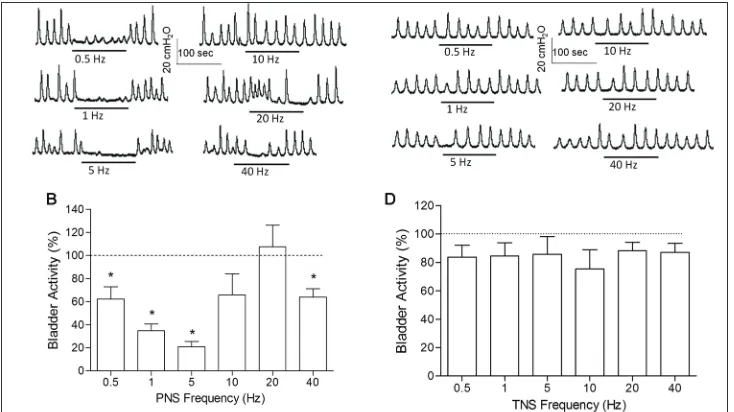
blad-der contractions. However, AA induced small amplitude (<30 cmH20) bladder contractions of short duration (<20 sec) and reduced bladder capac-ity to 60.8 +/- 6.4% of pre-SCT saline control (P<0.01). Both intravenous hexamethonium and intrathecal lidocaine significantly (P<0.01) reduced the amplitude of isovolumetric contractions indicating the involvement of spinal reflex activity. PNS suppressed spinal reflex contractions at 0.5, 1, 5, and 40 Hz. PNS (5 Hz) significantly (P<0.01) increased bladder capacity during CMGs from 65.2 ± 9.4% to 92.5 ± 12.0% and 107.6 ± 14.8% at 2T and 4T, respectively, (Fig. 1). In contrast, TNS failed to inhibit spinal reflex bladder activity at all tested frequencies.
Conclusions: This study demonstrated for the first time in cats that after
acute SCT reflex bladder contractions could be induced by activating affer-ent C-fibers using AA irritation. These contractions can be inhibited by PNS, but not TNS, indicating that TNS inhibition requires a supraspinal pathway to function. Understanding the location of action for pudendal and tibial neuromodulation may assist in the development of new overac-tive bladder therapies.
Moderated Poster Session 6: Basic Science, Education & Infertility
Friday, November 14, 2014
P80
WITHDRAWN
P81
An In-Vitro Animal Model of Ischemia-Reperfusion: Contractile Response of Bladder Detrusor is More Sensitive to Hypoxia than Pelvic Floor
Amy D. Dobberfuhl¹, Catherine Schuler², Robert E. Leggett², Elise De¹,
Robert M. Levin².
¹Albany Medical College, Albany, NY, USA, ²Stratton VA Medical Center, Albany, NY, USA.
Background: Weakness of the pelvic floor muscles (PFM) is well described
in stress urinary incontinence and pelvic organ prolapse. Periods of low blood flow, hypoxia and ischemia have been implicated as causes for pelvic floor and bladder dysfunction. It has been shown in the female rabbit that after ovariectomy low estrogen is associated with poor bladder compliance, decrease in blood flow to the bladder and uterus, thinning of bladder mucosa, and urothelial hypoxia. Replacement of estrogen and restoration of the eugonadal milieu has been shown to restore the in-vitro and in-vivo tissue mechanics of rabbit bladder detrusor muscle (BDM). The current experiment seeks to directly explore the dynamic contractile characteristics of the PFM and compare these characteristics to those of the BDM in the controlled laboratory setting of in-vitro ischemia.
Methods: Female adult virgin white New Zealand rabbits (~3.5 Kg)
were selected for their well developed pelvic floor. Five animals were habituated, anesthetized and euthanized. Bladder body and pelvic floor were excised en-bloc and isolated into 150mg strips of the following muscles: BDM, pubococcygeous (PC) and coccygeous (CC). Specimens were equilibrated in oxygenated Tyrodes solution 30 minutes and dose response assessed at 2, 8 and 32Hz of field stimulation. After 15 minutes of recovery, tissues were subjected to in-vitro ischemia using nitrogen and Tyrodes without glucose and duration response stimulated at 32Hz every 5 minutes for 1 hour. Strips were then incubated in oxygenated Tyrodes for 2 hours and stimulated at 2, 8 and 32Hz to assess recovery of contractile function as an in-vitro surrogate for post-ischemia reperfusion.
Results: PFM required 10 times the power to stimulate contractions at
baseline. Both the maximal contractile responses and rate of tension generation were significantly greater for the BDM than either PC or CC. However, the PC and CC were both significantly less sensitive to the effects of ischemia and continued to have stable contractile responses to field stimulation during the entire hour of ischemia. Ischemic conditions resulted in progressive and rapid decline of BDM contractile strength, with completely diminished response after 1 hour. Following the isch-emic period, PFM contractile recovery was significantly superior to BDM.
Conclusions: PFM required higher electrical stimulation to contract at
baseline. PFM contractions and recovery were significantly slower than BDM, yet not as sensitive to either in-vitro ischemia or the effects of post-ischemia reperfusion.
P82
Neurotransmitter Mechanisms Underlying Pudendal Inhibition of Spinal Reflex Bladder Activity in Cats
Marc J. Rogers¹, Zhiying Xiao¹, Jeremy Reese¹, Bing Shen¹, Jicheng
Wang¹, Zeyad Schwen¹, James R. Roppolo¹, William C. de Groat², Changfang Tai¹.
¹UPMC, Pittsburgh, PA, USA, ²University of Pittsburgh, Pittsburgh, PA, USA.
Background: Overactive bladder (OAB) is a significant clinical problem
that affects more than 30 million Americans. Pudendal nerve stimula-tion (PNS) has been previously shown to reduce bladder overactivity. However, the site of PNS action and the neurotransmitters involved in PNS inhibition are currently unknown. Understanding these mechanisms is important to improve the efficacy of pudendal neuromodulation therapy for OAB.
Methods: Cystometrograms (CMGs) were performed on α-chloralose anesthetized cats (N=10) before and after spinal cord transection (SCT) at T9/T10 by intravesical infusion of saline or 0.25% acetic acid (AA). PNS (5 Hz) was used to inhibit bladder activity at 2 and 4 times the threshold intensity (T) for inducing anal twitch. Propranolol (3 mg/kg i.v., a non-selective β-receptor antagonist) or naloxone (1 mg/kg i.v., an opioid receptor antagonist) were administered to determine the neurotransmitter mechanisms underlying PNS. Hexamethonium (10 mg/kg i.v., a gangli-onic blocker) was used at the end of the experiment to block the spinal
reflex bladder activity. Bladder capacity was normalized to the capacity measured during saline CMG before SCT.
Results: SCT eliminated the large amplitude (>30 cmH2O) supraspinal
micturition contractions mediated by bladder afferent Aδ-fibers during saline CMG. AA irritation activated nociceptive bladder afferent C-fibers and induced spinal reflex bladder contractions of amplitude 14.6 ± 3.3 cmH2O. Propranolol significantly (p<0.01) increased the contraction amplitude to 21.6 ± 3.7 cmH2O but did not affect the bladder capacity. Hexamethonium significantly reduced the contraction amplitude. Without propranolol PNS applied during CMG significantly (p<0.01) increased bladder capacity from 58.0±4.7% to 85.8±10.3% and 96.5±10.7% at 2T and 4T respectively. After propranolol treatment, the bladder capacity was significantly (p<0.05) reduced to 64.5±9.5% at 2T PNS and 64.7±7.3% at 4T PNS, but they were still significantly larger than control capacity. Naloxone had no effect on spinal reflex bladder contractions or PNS inhibition.
Conclusions: This study reveals that adrenergic β-receptors in the sym-pathetic pathway play an inhibitory role in spinal reflex bladder activity mediated by nociceptive afferent C-fibers and they are also involved in PNS inhibition of the spinal reflex but opioid receptors are not involved. In addition, PNS inhibition could also occur in the spinal cord without the adrenergic neurotransmitter mechanism.
P83
An Ex Vivo Invasion Assay of Collecting Duct Carcinoma: Developing a Chemotherapeutic Response Profile for a Rare Urologic Malignancy
Neal E. Rowe¹, Ryan McLarty¹, Penny Costello², Warren McDonald²,
Patrick P. Luke¹.
¹Western University, London, ON, Canada, ²Onco-Screen, London, ON, Canada.
Background: Collecting duct carcinoma is a rare and aggressive form of
renal cancer. While patients often present with advanced disease, the optimal systemic treatment is unknown. We report the utility of an ex vivo invasion assay of human collecting duct carcinoma in the evaluation of tumor growth and response to therapy.
Methods: Institutional review board approved our study. Viable
por-tions of tumor were obtained from radical nephrectomy specimens and implanted into wells containing collagen type I gel. Microscopic tumor invasion was measured over 5 days. Invasion distance was recorded for control wells (untreated) and wells with one of 11 chemotherapeutic regimens.
Results: 104 samples from 2 collecting duct carcinoma specimens
dem-onstrated viability. Tumor fragments in the control group demdem-onstrated a mean invasion distance of 950 +/- 220 um. While all tumor fragments in treated wells demonstrated a modest response to chemotherapy, this was most pronounced in the wells treated with paclitaxel alone (85%) and paclitaxel/sirolimus combination (89%). Inhibition of invasion was less effective in wells treated with sorafenib (38%) or sirolimus (42%).
Conclusions: Collecting duct carcinoma can successfully be evaluated
in an ex vivo invasion assay. Our data suggest that these rare tumors may respond better to paclitaxel-based therapy regimens than to targeted therapy. While ex vivo data provide valuable insight into the chemosen-sitivity of rare tumors, studies of clinical effectiveness are needed.
P84
Radiation Therapy Improves Immunogenicity of Human Renal Cell Carcinoma
Jason Muhitch, Mohammad Habiby Kermany, Lilia Heit, Alexander Wald,
Mary Hensen, Scott Abrams, Timothy Winslow, Anurag K. Singh, Thomas Schwaab.
Roswell Park Cancer Institute, Buffalo, NY, USA.
Background: Metastatic Renal Cell Carcinoma (RCC) is a lethal disease
and the only curative approach is highly toxic immunotherapy via high-dose IL-2 treatment. For anti-tumor immunotherapy to be effective, CD8 T cells must detect tumor-associated antigens (TAA) presented on tumor cells to initiate contact-dependent cell lysis. Radiation has been shown to induce TAA expression in a variety of malignancies and is generally well-tolerated compared to high-dose IL-2. The recent advent of Stereotactic Body Radiation Therapy (SBRT) allows delivery of high-dose radiation to a well-defined target area with limited damage to normal tissue and is being explored in the treatment of RCC. We therefore sought to determine if TAA expression was increased following SBRT treatment of metastatic RCC tumors in a first of its kind Phase I clinical trial where patients are treated with neo-adjuvant SBRT followed by surgical resection. These studies were complemented with in vitro studies that examined TAA expression in radiated human RCC cell lines.
Methods: RCC human cells lines (A498, A704, 769-P, 786-0, ACHN, and
Caki-1) were treated ± radiation (16 Gy). 24 h later, TAA and costimula-tory molecule expression was evaluated by flow cytometry. ELISPOT IFN-γ release assays were performed with NY-ESO-1 specific HLA-A2-restricted CD8+ T cell clones. Stage IV Renal Cell Carcinoma patients were treated ± SBRT and ~28 days later tumors were resected (clinical trial NCT01892930). Single cell suspensions of resected tumors were evaluated for TAA and costimulatory molecules by flow cytometry.
Results: Initial studies determined that high-dose radiation treatment
improved TAA expression (NY-ESO-1, MUC-1, CA9) and costimulatory molecule expression (CD80, ICAM-1) in six commercially available RCC human cells lines. NY-ESO-1 specific CD8 T cells secreted more IFN-γ
in response to radiated RCC cell lines (188.6 ± 26.8, mean ± SD per 50,000 cells) compared to control (135.3 ± 35.9, P < 0.10), suggesting that radiation improved immunogenicity of RCC. Surprisingly, we also found that RCC tumors from patients treated with SBRT and later resected also showed improved expression of MUC-1 (MFI: 4611 ± 3404, mean ± SD) and expression of the costimulatory molecule ICAM-1 (MFI: 1546 ± 1249) compared to age-matched RCC patient tumors (3063 ± 1560 and 890 ± 495, respectively).
Conclusions: By increasing TAA and costimulatory molecule expression,
SBRT treatment of RCC may unlock anti-tumor immune responses that can be further amplified with vaccination protocols and immune check-point inhibition.
P85
Local High-Dose Radiation Therapy Enhances CD8 T cell Intratumoral Infiltration and Systemic Anti-tumor Immune Responses in Renal Cell Carcinoma
Jason Muhitch, Lilia Heit, Timothy Winslow, Mohammad Habiby
Kermany, Alexander Wald, Michelle Romano, Graham Warren, Anurag K. Singh, Thomas Schwaab.
Roswell Park Cancer Institute, Buffalo, NY, USA.
Background: Metastatic Renal Cell Carcinoma (RCC) is a lethal disease
Methods: Murine Renal Carcinoma Cells (RENCA) were implanted into
BALB/c mice or severe combined immunodeficient (SCID) mice (5 x 10^5 cells s.c. into each flank). Once either tumor reached 5mm in diameter, it was treated with radiation (15 Gy) while the contralateral tumor was untreated. Tumor growth was monitored with an endpoint of 2 cm tumor diameter. CD8 T cell and suppressive T regulatory cell infiltration was evaluated at day 7 post-radiation by flow cytometry.
Results: Seven days after radiation treatment (15 Gy) both the radiated
RCC lesion and the untreated tumor on the opposite flank (abscopal effect, P < 0.001) were smaller in size than tumors in untreated mice. Tumor growth experiments performed in SCID mice, which lack functional T and B cells, demonstrated no significant change in growth following radia-tion suggesting that tumor growth control following radiaradia-tion is T cell-dependent. Surprisingly, radiation of tumors in wild-type Balb/c mice not only improved CD8 T cell intratumoral infiltration, which are battle-ready effector T cells capable of killing tumor targets, but also a concomitantly decreased immunosuppressive (CD4+, FoxP3+) T regulatory cell accu-mulation. Thus, radiation improved the endogenous intratumoral CD8+/ Treg ratio from less than 2:1 to more than 20:1 (P < 0.07).
Conclusions: Collectively our data strongly suggest that high-dose
radia-tion of RCC lesions initiates local and systemic CD8-dependent anti-tumor immune responses and might represent a potential adjuvant to other immune activating treatments.
P86
Ex-vivo Tumor Invasion Predicts Clinically Aggressive Subtype in Non-clear Cell Renal Cell Carcinoma
Neal E. Rowe¹, Jose GomezLemus¹, Ryan McLarty¹, Penny Costello²,
Warren McDonald², Patrick Luke¹.
¹Western University, London, ON, Canada, ²Onco-Screen, London, ON, Canada.
Background: Renal cell carcinoma (RCC) is the most frequent neoplasm
of the kidney. While most RCC is of clear cell (cc-RCC) histology, up to 25% of patients will be affected by non-clear cell cancer (ncc-RCC). Furthermore, the optimal therapy for ncc-RCC is not well established. Ex vivo models of tumor growth and invasion may provide an opportunity to study non-clear cell cancers. We report the successful growth and differential invasion pattern of ncc-RCC in an ex vivo invasion assay.
Methods: Institutional review board approved our study. Viable
por-tions of tumor were obtained from radical nephrectomy specimens and implanted into wells containing collagen type I gel. Microscopic tumor invasion was measured over 5 days. Invasion distance was recorded for 4 histologic subtypes of ncc-RCC: papillary type I, papillary type II, chromophobe and collecting duct.
Results: 64 samples from 15 tumors demonstrated viability and were
suc-cessfully grown in collagen media. Tumor fragments in the chromophobe group (n = 13) demonstrated a minimal mean invasion distance of 96 +/- 35.1 µm. Type II papillary RCC (n = 21) demonstrated greater distance of invasion (1011 +/- 535 µm) than type I papillary (n = 19, distance = 621 +/- 209 µm, p < 0.001). Tumor fragments from collecting duct cancer (n = 11) had a similar invasion distance (950 +/- 220 µm) as type II papillary.
Conclusions: Non-clear cell RCC tumor invasion can be evaluated in an
ex vivo assay. Tumor behavior in this model is consistent with known clinical aggressiveness of the various ncc-RCC subtypes. Distance of inva-sion is dependent on histologic type, with more aggressive subtypes (type II papillary and collecting duct) demonstrating farther tumor invasion than less aggressive subtypes. Our data suggest that an ex vivo invasion assay may be a valuable method to study tumor growth. This is an opportunity to determine the impact of systemic therapies on tumor growth and inva-sion in a laboratory setting.
P87
Synergistic Gene Expression Changes in Prostate Cancer Cells in Response to Valproic Acid and Flutamide
Raju Chelluri, Mark Woodford, Timothy Byler, Gennady Bratslavsky,
Jay E. Reeder.
SUNY Upstate, Syracuse, NY, USA.
Background: One of the current challenges in prostate cancer (PCa)
man-agement is the equivocal nature of treatment options for lower grade lesions. Given that many prostatic lesions are slow growing, low-grade, and unlikely to cause significant morbidity for the patient, we aim to investigate therapeutic methods that delay prostate cancer progression. Valproic acid (VPA) is a well-established anti-seizure medication that has histone deacetylase inhibition properties, which have been shown to infer anti-angiogenic effects. Our group has previously shown that VPA reduces bladder cancer cell proliferation in vitro and in vivo. We inves-tigated whether VPA would impact the growth of PCa cells, if there are synergies between VPA and androgen deprivation, and the broader effects of VPA administration in both angiogenesis and PCa specific signaling pathways. We hypothesize that treatment of LNCap cells with VPA will reduce proliferation and induce expression of anti-angiogenesis proteins such as thrombospondin-1 (TSP1).
Methods: The androgen-responsive prostate cancer cell line LNCap was
treated with VPA for a period of 3 days. Cell proliferation in 0, 1, 2.5, and 5 mM VPA was measured via Alamar Blue assay. RNA was extracted from cells treated with 0 or 1 mM VPA and gene expression was assessed using human angiogenesis and human prostate cancer PCR expression arrays. Genes with major alterations in expression were selected and RNA expression was measured in cells dosed with 0, 1, or 2.5 mM of VPA for 72 hours and/or Flutamide at 1 nM.
Results: VPA at 1 mM reduced proliferation by 40% compared to
untreated cells. Higher doses of VPA caused further decreases in prolif-eration. Expression array data revealed altered expression of numerous genes related to angiogenesis and PCa specific genes. These changes were confirmed for selected genes in cells treated with VPA and fluta-mide. There was a marked impact on secreted and extracellular matrix proteins including up-regulation of TSP1, TIMP1, TIMP2, and TGF while expression of IGF1 and HGF was reduced; supporting VPA as a potential regulator of angiogenesis, migration, and invasion in PCa. Several cell cycle transcripts were impacted as well including down-regulation of AKT1 and CCND1 while paradoxically CCND2 was increased.
Conclusions: VPA limits cellular proliferation of PCa cells in vitro and
affects gene expression in a pattern suggesting an anti-angiogenic effect while simultaneously limiting expression of proliferation related genes. VPA alone or in combination with anti-androgen therapy has potential for controlling progression of low grade and stage prostate cancer.
P88
The First Urologic Case Report: The Edwin Smith Surgical Papyrus
Ari M. Bergman.
SUNY Downstate College Of Medicine, Brooklyn, NY, USA.
Background: The Edwin Smith Surgical Papyrus is forty-eight surgical
cases from 1600 B.C.E. It was surveyed for urologic maladies treated by ancient Egyptians.
Methods: Translations of the Edwin Smith Surgical Papyrus were reviewed
for urologic diseases and symptoms.
Results: The Papyrus contains a case wherein a patient suffers “a
disloca-tion in a vertebra of his neck” with urinary incontinence and priapism.
Conclusions: The Edwin Smith Surgical Papyrus contains one of the
P89
Assessment of Disclosure Training of Urology Residents: Didactic versus Standardized Patient Training
Diana Cardona-Grau, Laura Chang-Kit.
Albany Medical Center, Albany, NY, USA.
Background: There is growing interest in training surgical residents in
communication skills especially in the disclosure of adverse events. Skills training must be efficient, effective and durable. This pilot study, sought to determine the effectiveness of formal didactic versus standardized patient training in teaching disclosure strategies to urology residents.
Methods: All 8 residents from the urology residency program at Albany
Medical Center (2 residents per year, excluding interns) were enlisted for the study conducted in August 2013. Residents were randomly assigned to two groups, stratified by year of training. The first group underwent a fifteen minute didactic group training session, which included a pow-erpoint presentation and two handouts on disclosure of medical errors. The second group did not receive any training and was not informed about the subject. One week later, all residents were tested with a 15 minute standardized patient scenario at the Albany Medical Center Patient Simulated Skills Center (PSSC). Each resident was assessed in real time by their respective standardized patient as well as one of two urology faculty members using five domains of the ACGME urology resident evaluation (PC4, ICS1, ICS2, P2, P6 - each domain scored from 1 to 5) as well as a twelve-point communication skills checklist (each skill scored from 0 to 2). Immediate individual critical feedback was given to each resident by the standardized patient and the faculty member after the encounter. Two weeks later, residents again underwent testing on the same day using the same format for the standardized patient scenario. Total scores for each
resident (out of 49) were transformed into a percentage. Mean scores and standard deviation for the two groups are presented.
Results: Mean scores in both patient scenarios were higher for residents
who underwent didactic training than for those who did not (88.3±12.3 versus 67.0±8.5 in the first scenario and 80.3±5.6 versus 75.3±17.0 in the second, respectively). In the second patient scenario, mean score decreased in the group who had undergone didactic training (from 88.3 to 80.3±5.6) and increased in the group who had not (from 67.0 to 75.3±17.0).
Conclusions: Both didactic and standardized patient training had a large
positive effect on the resident communication skills. However, on the second standardized patient session mean scores amongst all residents were similar. This may indicate that didactic training has a similar but less durable effect than standardized patient training. Larger, multicenter studies are needed to validate these results.
P90
Validation of a Novel Inanimate Ureteroscopy Training Model and a Simulation-based Flexible Ureteroscopy Training Course
Andrea G. Lantz¹, Udi Blankstein², J. Matthew Andrews¹, R. John D’A.
Honey², Michael Ordon², Kenneth T. Pace², Jason Y. Lee².
¹Dalhousie University, Halifax, NS, Canada, ²University of Toronto, Toronto, ON, Canada.
Background: Through a low-stakes learning environment that permits
deliberate practice and timely feedback, simulation-based training (SBT) modalities have grown in popularity over recent years. The educational value of surgical simulators, however, is only as good as the curricu-lum in which they are utilized. We designed a simulation-based flexible ureteroscopy (fURS) training course utilizing a novel inanimate training model (Cook® URS model). We set out to evaluate the new curriculum and validate the Cook® URS model.
Methods: A SBT curriculum was designed for Jr level (PGY1-3) urology
residents at the University of Toronto and Dalhousie university; the cur-riculum included a didactic lecture, focusing on fundamental urolithiasis management principles and basic fURS techniques, a hands-on demon-stration of the various instrumentation and skills required for fURS, and 3 independent practice sessions using the Cook® URS model. Both baseline pre-test and post-course assessment of fURS skill was conducted for a standardized task; fURS with basket manipulation of lower pole stone
Fig. 1. P88.
Table 1. P90. Construct validity evidence for the Cook URS model
Prior # of flex URS
Prior # of
flex cysto PGY level
Overall Score (p=0.003)0.527 (p=0.057)0.351 (p=0.015)0.441
Task Completion Time (min)
-0.412 (p=0.024)
-0.400 (p=0.029)
-0.379 (p=0.039)
Respect for Tissue (p=0.039)-0.379 (p=0.634)0.091 (p=0.201)0.240
Time and Motion Efficiency
0.635 (p<0.001)
0.416 (p=0.022)
0.576 (p=0.001) Instrument
Handling
0.559 (p=0.001)
0.413 (p=0.022)
0.602 (p<0.001) Handling of
Ureteroscope
0.275 (p=0.141)
0.213 (p=0.259)
0.222 (p=0.238) Flow of Procedure
and Planning
0.544 (p=0.001)
0.0.523 (p=0.003)
0.541 (p=0.002)
Use of Assistant (p=0.098)0.307 (p=0.411)0.156 (p=0.209)0.236
Knowledge of Procedure
0.423 (p=0.02)
0.459 (p=0.011)
into the upper pole. The pre- and post-test sessions were separated by a minimum of 2 weeks. Performances were video-recorded and later reviewed by 2 blinded, experts using a validated assessment device.
Results: A total of 15 residents participated in the fURS course. There
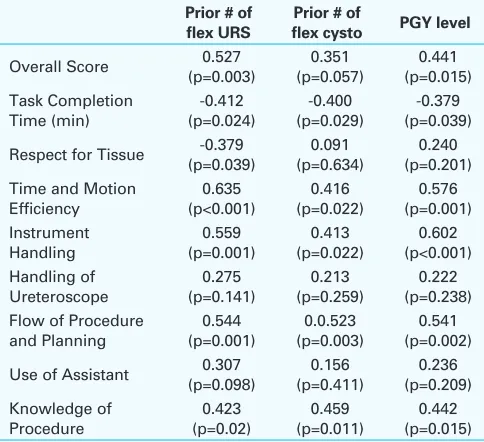
was a significant difference in mean pre- and post-course task comple-tion times (15.2 vs 9.1 minutes, p=0.001) and performance scores (18.1 vs 24.2, p<0.001). Eighty percent of participants rated the Cook® URS model as realistic (≥4/5, mean=4.1) and 5 independent endourology experts rated the model as useful as a training device (≥4/5, mean=4.90), providing both face and content validity. There was also a significant correlation (p<0.05) between prior fURS experience and mean overall performance scores, task completion times, passing ratings, movement efficiency, instrument handling, flow of procedure, and knowledge scores (Table 1), demonstrating construct validity for the Cook® URS model. The fURS global rating scale demonstrated good reliability, with a Cronbach’s alpha of 0.848
Conclusions: Our study demonstrated that a SBT curriculum for fURS
can lead to improved short-term technical skills amongst Jr level urol-ogy residents. The Cook® URS model demonstrated face, content and construct validity.
P91
Study Habits of Canadian Urology Residents
Thomas A. A. Skinner, Naji J. Touma.
Queen’s University, Kingston, ON, Canada.
Background: Urology residency in Canada consists of five years of
structured clinical training culminating in a summative licensing exam. Small studies have investigated resident study habits and performance on surgical in-training examinations but no data on Canadian Urology residents exists. We explored how Canadian Urology residents study during their training.
Methods: A cross-sectional survey was administered to all final-year
Canadian Urology residents over a two-year period (2013 and 2014). The participation rate was 100% and included 67 respondents. Survey ques-tions address study habits in each stage of training and focus on studying time, motivators, resources utilized, study methods and satisfaction with training environment.
Results: Respondents have indicated that the volume and structure of
their studying increased throughout residency. Over 60% of respondents denied dedicated study time in junior years, whereas 96% of respondents reported greater than 10 hours per week in their final year with 37% spending greater than 30 hours per week studying. Motivation for studying shifted with seniority, from preparation for clinical duties to Royal College exam preparation. In the final year of training, 99% of respondents indi-cated that exam preparation was the biggest motivator. Considerable variability exists in the studying methods used, especially amongst junior residents. While a variety of resources were utilized throughout train-ing, Campbell-Walsh Urology was the overwhelming choice for chief residents, with greater than 80% reporting that it was extremely useful. Interestingly, 46% of residents indicated that they would favor writing their exam a year earlier.
Conclusions: The Royal College licensing exam constitutes a great
moti-vator for trainees as indicated by the amount of studying and resources used at different levels of training. Consideration may be given to insti-tuting several exams throughout training to spur motivation for studying during the junior years of training.
P92
Use of Cardiowave Analysis in Patients with Erectile Dysfunction (ED)
Preeya Khandge¹, Joseph V. DiTrolio¹, Michael LaSalle².
¹Rutgers New Jersey Medical School, Newark, NJ, USA, ²St Barnabas Medical Center, Livingston, NJ, USA.
Background: The Cardiowave system, a new non-invasive test of
periph-eral vasculature function allows physicians to attain an accurate repre-sentation of the peripheral vasculature and autonomic nervous system (ANS) in patients with ED.
Methods: Retrospective review of 55 patients presenting to a single
urolo-gist. Patients were evaluated with a 3 minute evaluation performed with the patient sitting while attached to a pulse oximeter type device applied to the finger. Height, weight, blood pressure and abdominal circumfer-ence were measured. Demographical data and information regarding hypertension, diabetes, ED and smoking status were collected. The report generated by the device gives the biological arterial age calculated com-pared with the patient’s chronological age in the form of a “wave type”. Wave type scores range from 1-7 with 1 being indicative of arterial with minimal atherosclerosis and 7 indicating a high degree of atherosclerosis and decreased compliance. The analysis of ANS provides scores reflecting levels of mental stress, physical stress and stress resistance (one’s ability to cope with stressors). Scores from results were analyzed for potential association using Student’s T-test.
Results: Men with ED were found to have a higher wave type in
compari-son with men without ED (p < 0.01). The evaluation found that former smokers with ED had a higher wave type and therefore significantly bio-logically older arteries than those men with ED who were non-smokers (p < 0.05). When comparing men with ED diagnosed with either hyperten-sion or diabetes, there was a substantial decrease in their stress resistance (p< 0.01) if abdominal circumference was > 40 inches. For men with ED and no co-morbidities, mental and physical stress levels were elevated.
Conclusions: The ability to evaluate the vascular system quickly and
non-invasively gives the urologist a more complete evaluation of the ED patient. Our results demonstrated the device’s ability to determine if the etiology of ED in a particular patient was either related to the autonomic nervous system or the status of the vasculature. It also shows how reliably the system could evaluate the detrimental effects of smoking, obesity and other metabolic syndrome components on vasculature compliance, atherosclerosis and ANS fluctuations. This device allows for an improved and appropriate treatment selection in a cost effective manner. It also provides a method for monitoring of lifestyle and medical management with efficient reassessment of disease status. This system deserves further evaluation with application of treatment options such tadalafil followed by re-assessment with the Cardiowave system.
P93
Inter-institutional Variability in Testicular Volumes by Ultrasound: Implications for Adolescent Varicocele Repair
Igor Sorokin¹, R. Charles Welliver, Jr.¹, Leon Elebyjian², Paul J. Feustel¹,
Andrew McCullough¹.
¹Albany Medical Center, Albany, NY, USA, ²Urological Institute of North Eastern New York, Albany, NY, USA.
Background: Testicular size discrepancy is used as a proxy of testicular
damage and a 20% size discrepancy is an indication for varicocele repair in adolescents. Though ultrasound is thought of as a “gold standard,” it is subject to both intra- and inter-observer variability.
Methods: A retrospective review identified 146 testes in 73 patients (62
adult and 11 adolescents) that had testicular ultrasounds done at both our institution (UINENY) and an outside facility (OSH). At UINENY, testicular ultrasound was performed using a standardized routine by a single, uro-logic dedicated ultrasonographer. Results were then compared to assess variability with an intra-testicular size discrepancy ≥ 20% having “surgi-cal significance”.
Results: Although the mean values for testicular sizes were similar (19.1
vs. 19.0 cm3), there was a wide range in the limits of agreement. Subgroup analysis revealed that 38 of the 73 patients had a ≥ 20% volume difference making these patients hypothetical surgical candidates. Further analysis revealed 22 of these 38 patients that had both varicoceles and a ≥ 20% volume difference. Using the criteria of a 20% size discrepancy as an indication for surgery in the 44 patients with a varicocele, “surgical agree-ment” was found in only 59% and “surgical disagreeagree-ment” was found in 41% patients (Kappa for agreement was 0.02, indicating poor agreement).
Conclusions: This study shows a high rate of inter-observer variability in