ISSN 2348 – 7968
The Study of Taxi Subsidy Scheme based on Fuzzy Comprehensive
Comprehensive Evaluation of the Perspective of the Driver
Yan Long, Yuhang Pan, Yanhong Kang, Aimin Yang*
North China University of Science and Technology, Tangshan, 063000, China;
*Email:[email protected]
Abstract
In the study of taxi subsidy scheme for "ease taxi difficult" issue,from the driver’s angle,regard income levels, soliciting risk,self-selection, technical level these evaluation factors as an evaluation index.Fuzzy comprehensive evaluation model based on the law of entropy,analyze the date of drivers’ satisfaction before and after the taxi subsidy scheme,the conclusion of the implemented of the taxi subsidy programs have improve the driver's efficiency and satisfaction was put forward.In some degree,ease the problem of taxi issue.
Keywords:Fuzzy Comprehensive Evaluation;Entropy Method;Membership Function;Taxi Software.
1. Introduction
With the the rise of the mobile phone terminal application software about the taxi,breaking the traditional backdrop about the passengers’ behavior to search a taxi by their prediction subjective personal experience,as a novelty under the mobile Internet applications,socialization taxi software develop rapidly,batch drops like a taxi, fast taxi and other taxi software appear.So since the rise of the taxi software,it has become one of the most talked about mobile Internet software,it also caused a shock to the taxi market.Taxi software companies in order to expand the market, to seize market share, have introduced a series of subsidy policies,many scholars have studied and analyzed the behavior patterns of the software involved in the taxi.Cai Jiming, Jiang Ning[1] pointed out that the country's major cities’ difficult to travel, difficult to get a taxi to the daily work and life of the city residents become the norm, seriously affecting the well-being of residents and social productive efficiency.Cao Wei with other people[2] analyzes the impact of a taxi software usage on the rate of empty vehicle running.The balance between supply and demand of taxi operators in fixed demand is
analyzed by Bian Yang[3], and the balance model of urban taxi network is established. Tan Mingliang[4] based on swot analysis,establish strategic SWOT Analysis Matrix software, draw current taxi software in some extent solve the ubiquitous "taxi difficult" issue, but there are many problems and challenges.Kong Fanmin[5] with other people by establishing Multi-level evaluation about passengers’ and the drivers’ benefits,use fuzzy mathematics method to evaluate the economic benefits of a taxi.Zhou Lixia[6] with other people based on the practice of the United States on the Uber business model supervision,but at the same time, it also puts forward new challenges to government regulation,whether the implementation of a taxi software subsidy policy can effectively ease the taxi difficult problem needs to be further studied
2.
The Driver Satisfaction Model for Their
Own Benefit
When analysis the subsidy program was introduced before and after,"Taxi difficult" issue whether can get relief,from the driver's angle,subsidies for their satisfaction was carried out quantitative analysis before and after the quantitative .The fuzzy comprehensive evaluation method, which is based on the membership degree theory of fuzzy mathematics, transforms the qualitative evaluation into quantitative evaluation, and clearly and systematically solves the problem of fuzzy and difficult to quantify[7].
2.1 Set Factors which is for Determining the Datisfaction Degree of Drivers' Satisfaction
subsidy scheme,set income levels and soliciting risk as their evaluation factors.Set for the evaluation factor as:
u
2'=
(
y
5,
y
6)
.2.2 The Evaluation of the Drivers' Benefit and Their Satisfaction Degree
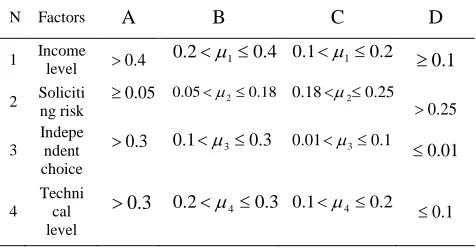
In order to measure the driver's satisfaction about the quality of the car, the driver is divided into four grades.The degree of satisfaction evaluation is as the table 1 below.
Table 1 Classifiy the evaluation sets of drivers traveling satisfied with the quality
N Factors A B C D
1 Income level >0.4
4 . 0 2 .
0 <µ1≤ 0.1<µ1≤0.2 ≥0.1
2 Soliciti ng risk
05 . 0
≥ 0.05<µ2≤0.18 0.18<µ2≤0.25
25 . 0 > 3 Indepe ndent choice 3 . 0
> 0.1<µ3≤0.3 0.01<µ3≤0.1 ≤0.01
4 Techni cal level 3 . 0
> 0.2<µ4≤0.3 0.1<µ4≤0.2 ≤0.1
2.3 Establish the Membership Function to Evaluation Factors
Establish the Soliciting risk drop half trapezoidal distribution and establish the income level, independent choice and technical level liter half trapezoidal distribution.
( )
≥
≤
≤
−
≤
≤
25
.
0
0
25
.
0
05
.
0
2
.
0
25
.
0
05
.
0
0
1
1
2 2 2 2 2µ
µ
µ
µ
µ
(1)
( )
2 2 2 2 2 2 2 0.05 0.05 0.18 0.13 0.252 0.18 0.25
0.07
0 0.05, 0.25
µ
µ
µ
µ
µ
µ
µ
− ≤ ≤ − ≤ ≤ ≤ ≥ (2)
( )
2 2 2 2 20.18
0.18
0.25
0.07
3
0
0.25
0
0.18
µ
µ
µ
µ
µ
−
≤
≤
=
≥
≤
(3)
2.4 Establish Weight Set of Evaluation Factors
Because of the income level, self selection, technical level, soliciting risk to affect the degree of satisfaction of drivers differently, each index should be given different weights. According to the factors that affect the degree of satisfaction of the driver, the weight of the principle to determine the size of the weight.
Calculate the i-th items’ proportion at the j-th index:
∑
==
m i ij ij ijr
r
p
2(4)
Calculate the j-th index’ entropy
e
jij ij
m
i
j
k
p
p
e
ln
1⋅
−
=
∑
=(5) Among them,
m
k
ln
1
=
Calculate the j-th index’ entropy weights
w
j:∑
==
n j j j je
e
w
1-1
-1
(6)
Determine the index of comprehensive weight
β
j=1
=
j jj m i i i
α ω
β
α ω
∑
(7)When considering the weight of four evaluation factors for the satisfaction of the drivers to their own benefit, the entropy weight method can be used to the weight vector
(
0
.
569
,
0
.
11
,
0
.
254
,
0
.
006
)
2
=
ω
.3.
Drivers Benefit Evaluation
Combining the weighting of evaluation factor with single factor matrix and getting fuzzy comprehensive results
1 ''
S
:s
1''=
(
0.070 , 0.242 , 0.220, 0.282, 0.224
)
. Similarly according to the above steps other evaluation factors of fuzzy comprehensive evaluation results can be got , fuzzy comprehensive evaluation matrix is:
Among them,
s
1'' is drivers’ income level;s
2'' issoliciting risk;
s
3'' is the ability to choose;s
4'' is the skill level. Whereby the fuzzy evaluation matrix of the drivers’ own income satisfaction level can be obtained:(
, , , ''4, 5'')
''' 3 '' 2 1 '' ''
S S S S S S =
Then based on fuzzy matrix composite calculation and normalization process to obtain drivers' satisfaction with their own earnings fuzzy comprehensive evaluation vector:Y2 =[0.202,0.274,0.203,0.186,0.135]
Before the subsidy program, The driver of their own income to measure satisfaction factor income levels and soliciting risks. Both evaluation factor fuzzy evaluation matrix as follows:
=
018 . 0 116 . 0 227 . 0 328 . 0 110 . 0
199 . 0 227 . 0 200 . 0 211 . 0 060 . 0
'' ' 2 '' ' 1
S S
Among them,
s
1'' is drivers’ income level;s
2'' is soliciting risk.Fuzzy matrix composite calculation and normalization process to obtain the subsidy on their own earnings driver satisfaction fuzzy comprehensive evaluation vector as is: ,
(
0.086,0.284,0.240,0.223,0.167)
2 =
Y . Select subsidy
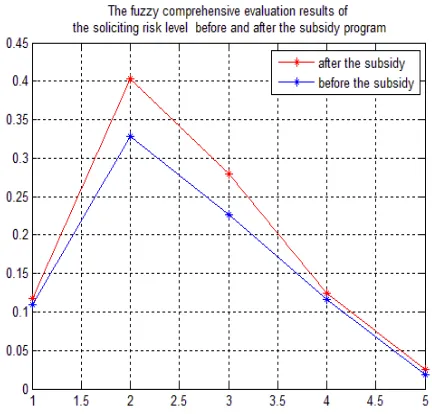
program before and after the implementation, the driver both income levels and soliciting risk factors, plotted compare see Figure 1.
Figure 1.Subsidy program before and after the driver income levels and soliciting comprehensive risk evaluation results
Combination of the above model, from the driver's point of view before and after the implementation of the subsidy program ride quality satisfaction rating:
Income levels: For comprehensive evaluation matrix by value drivers revenue blur before and after the implementation of the subsidy program, summed to obtain the subsidy policy adopted, the driver can raise income levels, stimulate the enthusiasm of drivers.
From soliciting risk:Since the driver using a mobile phone software grab one form time to time, it will result in lower safety factor, in the taxi software real name system is not perfect, the driver also face the risk of default of the passengers, so after the introduction of the subsidy scheme, the driver of soliciting also it will increase the risk. On the fuzzy comprehensive evaluation system for the first implementation of the program is reflected after each data is greater than the subsidy program implementation.
4. Conclusions
According to the above analysis can drawn, each company implemented subsidy programs solve the taxi driver’s high empty loading rate in a certain extent and the problem can not pull the guests. In addition, the income level of the driver has also been improved, too much enthusiasm was aroused. However, in the taxi software real name system is not perfect, the taxi driver also face the risk of default of the passengers, so after the introduction of the subsidy scheme, soliciting risk drivers also will be elevated.
References
[1]Zhenghong Guo ,Jie Yang ,Yang Zhao. “Double image multi-encryption algorithm based on fractional chaotic time series”,Open Mathematics, Vol13,n1,2015, pp.868-876.
[2]Yong-Mei Guo,Yang Zhao,Yao-Ming Zhou,Zhong-Bin Xiao,Xiao-Jun Yang.“On the local fractional LWR model in fractal traffic flows in the entropy condition”,Mathematical Methods in the Applied Sciences, 2015, PP.1-7.
[3]Jin-shuan Peng, Yang Zhao, Lizong Lin, Bin Gao.“Experiment and simulation research on sound insulation performance of magnesium alloy dash panel”,Journal of Vibroengineering, Vol.17 n7, 2015,pp.3404-3414.
[4]J Xie, Y Zhao.“STABILITY AND BIFURCATION OF A FOUR-NEURON NETWORK WITH MULTIPLE DISCRETE DELAYS”,International Journal of Innovative Computing, Information & Control, Vol.11 n5, 2015,pp.3404-3414.
[5]Q Ge, S Zheng, Y Zhao, M Chen.“Detection method of PCB component based on automatic optical stitching algorithm”, Circuit World, Vol.41 n4, 2015, pp.133 - 136.
[6]X Wang, T Zhou, Y Zhao, J Feng, J Zhang, H Zhang.“Multilevel Inverter Compensation System of the Single-phase Based on Instantaneous P-instantaneous Real Power and Q-instantaneous Virtual Power Theory”,International Journal of Online Engineering,vol.11 n7, 2015,pp.47-50.
[7]Yunyan Huang, Zhaoling Wang, Yang Zhao, Ning Hao.“Numerical Simulation of TSP Tunnel Fault Model of Seismic Prediction”,International Journal of Earth Sciences and Engineering,Vol.8, n1, 2015, pp.633-637.
[8]Liya Wang,Yang Zhao.“Research on the Dynamic Vibration Control of Underwater Robot”,Open Automation and Control Systems Journal,Vol.7,2015, pp.1231-1236.
[9]Xinya Chen,Zhen Chen, Yang Zhao.“Analysis of Sheet Fracture Failure Based on XFEM”,Open Mechanical Engineering Journal,Vol.9,2015, pp.887-891.
[10]N Qiang,Y Zhao.“Improvement Multidisciplinary Collaborate Optimization based on Simu-lated Annealing and
Artificial Neural Networks”,Open Cybernetics & Systemics Journal,vol.9,2015, pp.2306-2311.
[11]Z Chen, X Chen, Y Zhao.“Research on the Optimization of the Vibration Reduction Seat Based on Genetic Algorithm”,Open Mechanical Engineering Journal,Vol.9,2015, pp.882-886. [12]Y Hou, Y Zhao.“Workspace Analysis and Optimization of 3-PUU Parallel Mechanism in Medicine Base on Genetic Algorithm”,Open Biomedical Engineering Journal,Vol.9,2015, pp. 214-218.
[13]Yang Zhao, Defu Cheng.“The Study of Uncertain Interval Nonlinear Optimization based on Genetic Algorithm”,Pakistan Journal of Statistics 30 (6), pp.1541-1554.
[14]XF Niu, CL Zhang, ZB Li, Y Zhao.“Local Fractional Derivative Boundary Value Problems for Tricomi Equation Arising in Fractal Transonic Flow”,Abstract and Applied Analysis,2014,pp.1-8.
[15]C Zhang, Y Zhao, M Wang.“Heterogeneity of Dynamic Allocation Promotes Cooperation in Networked Public Goods Games”,International Journal of Applied Mathematics and Statistics™ ,43 (13), 110-116.
[16]Y Zhao.“Robust Predictive Control of Input Constraints and Interference Suppression for Semi-Trailer System”,International Journal of Control and Automation, Vol.7, n7, pp.371-382. [17]Y Zhao, D Baleanu, C Cattani, DF Cheng, Y Xiaojun.“Maxwell’s Equations on Cantor Sets: A Local Fractional Approach”,Advances in High Energy Physics,2013. [18]Y Zhao, DF Cheng, XJ Yang.“Approximation solutions for local fractional Schrödinger equation in the one-dimensional Cantorian system”,Advances in Mathematical Physics,2013. [19]Y Zhao, D Baleanu, C Cattani, DF Cheng, Y Xiaojun.“Local fractional discrete wavelet transform for solving signals on Cantor sets”,Mathematical Problems in Engineering,2013. [20]Y Zhao, D Baleanu, MC Baleanu, DF Cheng, Y Xiaojun.“Mappings for special functions on Cantor sets and special integral transforms via local fractional operators”,Abstract and Applied Analysis,2013.
[21]GFAN Zhifeng YANG, Yang ZHAO.“A NEW ITERATION ALGORITHM FOR SOLVING THE DIFFUSION PROBLEM IN NON-DIFFERENTIABLE HEAT TRANSFER”,Thermal Science 19, 105-108.
Vibroengineering ,Vol.17, n4,2015.
[25]T He, XQ Ye, Y Zhao.“Optimization design for ultrasonic horn with large amplitude based on genetic algorithm”,Journal of Vibroengineering,Vol.17, n3,2015,pp.1157-1168.
[26]L Song, Y Zhao, Y Zhou, H Xiang.“Thermal-stress analysis and calculation of single and dual chip set double-sided circuit board based on three-dimensional finite element algorithm”,Circuit World, Vol.41, n2,pp.49-54.
[27]W Geng, Y Zhao, Q Cheng.“A method for designing the brushless direct current system using FPGA based on fuzzy set similarity algorithm”,Metallurgical and Mining Industry,Vol.7, n4, pp.56-63.
[28]W Geng, H Zhang, Q Cheng, Y Zhao.“Distributed embedded system for communication based on ant colony optimization algorithm”,Metallurgical and Mining Industry, Vol.7, n4, pp.262-267.
[29]M Liu, Y Xue, Y Zhao, H Guo.“Research on the Distribution and Self-Similarity Characteristic of End-To-End Network Delay”,International Journal of Future Generation Communication and Networking,Vol.8, n3,2015,pp.291-302. [30]Y Zhao.“Study on Predictive Control for Trajectory Tracking of Robotic Manipulator”,Journal of Engineering Science and Technology Review ,Vol.7, n1, pp.45-51.
[31]Y Zhao.“Intelligent Control Technology Application Based on Wireless Sensor Networks”,International Journal of Digital Content Technology and its Applications,Vol.6, n23,2012,pp.81-87.