Secure Mutual Testing Strategy for
Cryptographic SoCs
Amitabh Das, Duˇsko Karaklaji´c and Ingrid Verbauwhede
Abstract
This article presents a secure mutualtesting strategy for System-on-Chips (SoCs) that implement cryptographic
functionalities. Such approach eliminates the need for an additionaltrusted component that is used to test security
sensitive cores in a SoC, like symmetric and public-key cryptographic modules. We combine two test approaches:
Logic Built In Self Test (BIST) and secure scan-chain based testing and develop a strategy that preserves the test
quality of the standard test methods, enhancing security of the testing scheme. In order to minimize the area overhead
of the presented solution, were-use the existing modules in different manners: a public-key cryptographic core to
build the BIST infrastructure and a symmetric one to authenticate a device under test to a test server, thus preventing
an unauthorized user from accessing the test interface. By doing so, we achieve both testability and security at the
minimal cost.
Index Terms
Secure Testing, BIST, Scan-chains, Test Wrapper, Cryptographic SoC.
I. INTRODUCTION
Embedded System-on-Chips (SoC) used in smart cards, cell phones or travel documents are increasingly employed
in applications that assume storing and transferring confidential and privacy sensitive data. In order to prevent a
malicious entity to misuse a device, it must implement cryptographic services such as encryption, decryption or
digital signing. Testing such a platform introduces an extra dimension to the process of digital testing – security.
The testing strategy must be developed in such a way that it prevents an adversary in revealing secret data through
the testing circuitry. On the other hand, testability and security are always at odds with each other: enhancing
the security level of a design comes at the cost of testability and vice versa. Moreover, the complexity and the
heterogeneous nature of a SoC, which is designed by embedding the pre-designed functional IP cores from different
vendors, requires a modular approach- testing every core separately and the combination of different testing methods.
Such a test scenario makes a security assurance even more challenging.
Many of the testing problems discussed above can be overcome by using a Built-In Self-Test (BIST). This
approach eliminates or reduces the need for an external tester by integrating active test infrastructure onto the
Department of Electrical Engineering, KU Leuven, ESAT/COSIC, Kasteelpark Arenberg 10, B-3001 Leuven-Heverlee, Belgium.
chip. Furthermore, it providesfield-test capability, which is essential for cryptographic cores and since the internal
registers of the device can not be accessed from the BIST I/O interface, it prevents an adversary in revealing the
secret data. However, BIST has relatively high area overhead and provides a good test quality only for a limited
types of logic. Moreover, it provides only a pass/fail signature which is not useful for diagnosis. On the other hand,
scan-chains provide the highest testability employing a more general and flexible approach.
Additionally, the IEEE 1500 Test Wrapper provides a standard for wrapping multi-vendor IP cores in a SoC
environment [1]. It is used to provide both test access and test isolation to the core and the external user-defined logic
during testing. However, the fact that scan-chains provide observability of the internal nodes from the I/O pins of a
device, can be exploited to mount several scan-based attacks to leak the secret keys in cryptographic hardware [2],
[3]. Scan attacks on a hardware implementation of AES and related countermeasures in the presence of various
commercial test schemes are presented in [4], [5], [6]. Differential scan attacks on hardware implementations of
public-key ciphers, RSA and ECC, in the presence of industrial Design-for-Test (DfT) schemes are presented in [7],
[8], [9], [10] respectively. In order to address this problem, there is ongoing research in developing a mechanism
that ensures that only authenticated users can have access to the test interface [11], [12]. Such a mechanism is
denoted as Secure Test Wrapper (STW) later in the paper.
In this article, we combine the two testing approaches – BIST and secure scan-chains and develop a modular
and secure testing strategy for cryptographic SoCs, i.e SoCs that are capable of running cryptographic protocols.
Symmetric cryptographic cores, such as symmetric ciphers and hash functions, expose very good random pattern
testability properties and can be very efficiently tested using BIST [13]. In order to minimize the introduced area
overhead, we do not implement standard BIST infrastructure, but re-use a modular multiplier from an existing
public-key core (RSA, ECC) and build BIST circuitry based on it. We show that the area cost in our scenario is
less compared to standard BIST. In order to test the public-key core itself and the other non-cryptographic modules
in the SoC, e.g. a microcontroller, we use a secure scan-chain method employing the STW. Instead of adding
a dedicated symmetric cipher to implement the authentication framework [12], we re-use the one that is already
available in a cryptographic SoC. By doing so, we additionally reduce the area overhead, still preserving the test
quality and security of a device.
The rest of the paper is organized as follows: Section II introduces the target platform for the presented testing
scheme, which then is described in Section III. Sections IV and V analyze the cost and the security of the proposed
testing method, respectively. Finally, we conclude in Section VI.
II. CRYPTOGRAPHICSOC
Security protocols combine many different cryptographic algorithms to establish and maintain a sufficiently secure
and privacy preserving connection between two communication parties. A hardware platform intended to run such a
protocol (e.g. a smart card) must be able to implement public key cryptographic primitives such as RSA [14], ECC
[15], [16] or El Gamal [17] and signature schemes (DSA [18], ECDSA [19]) in order to provide a key establishment
CPU
Secure RAM
RNG
On-chip bus
AES/ DES/ 3DES
SHA-1/ SHA-2
RSA/ ECC
Cryptographic SoC
(a) A Cryptographic SoC.
CPU
Secure RAM
RNG
On-chip bus AES/
DES/ 3DES
SHA-1/ SHA-2 RSA/ECC
Comparator
Unlock
Test Controller Test Wrapper
(b) Testing of Public-key Crypto Cores.
Fig. 1: Cryptographic SoCs.
ciphers (AES [20], DES [21], 3DES [22]) for implementing encryption/decryption operations and hash functions
(SHA-1 [23], SHA-2 [24]). In order to reduce the bottleneck they create, these computationally intensive and time
consuming algorithms are often realized as hardware co-processors. A typical architecture of a cryptographic SoC
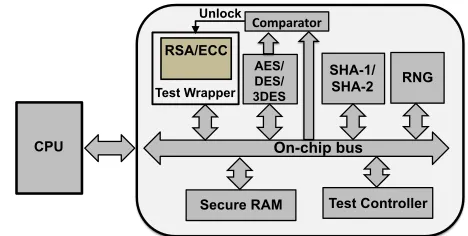
which supports different security protocols is depicted in Figure 1a.
The test scenario that we present in this paper aims at testing the shown SoC in an efficient and a secure manner.
The next section describes the proposed testing scheme in details.
III. SECURETESTINGSTRATEGY
A. Overall strategy
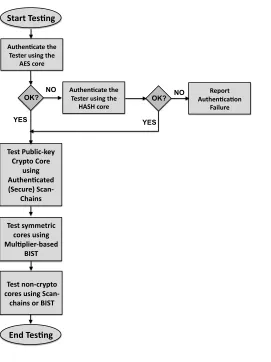
The overall test strategy is depicted in the flowchart in Figure 2. The test process starts with the execution of
the authentication protocol using the AES block cipher in order to check whether the testing server isgenuine. For
more details about the authentication protocol and its execution, we refer the reader to [12].
Only if the authentication succeeds, the test wrapper around the scan-chains of the public-key module is unlocked
for testing. Since it can be the case that the authentication protocol fails due to faults in the AES block itself, we
foresee the possibility to run it using the hash function block. Only if the authentication fails in that case as well,
the testing process is aborted and the failure is reported to the server. Otherwise, the testing continues. Section III-E
explains the fail-safe scenario in more details.
After proving that the test server authentic, testing of the public-key core is performed using the secure
scan-chains. Then, the multiplier from the tested core is re-used to perform the BIST of the symmetric-key cryptographic
cores, i.e. the AES and the hash module. Note that in the case that the initial authentication have failed because of
the errors in the AES core, its testing would not be necessary since the outcome of the pass-fail BIST would be
already known. However, at this testing stage it is not known weather the authentication was executed using the
AES or the hash module and hence testing of both modules has to be performed.
When the testing ofsecurity-criticalcores is finished, the other non-cryptographic modules are tested. Depending
Fig. 2: Secure and Efficient Testing Strategy Flow Diagram
Start Tes)ng
Authen)cate the Tester using the
AES core
Test Public-‐key Crypto Core
using Authen)cated (Secure) Scan-‐
Chains
Test symmetric cores using Mul)plier-‐based
BIST
End Tes)ng
OK? Authen)cate the Tester using the
HASH core OK?
Report Authen)ca)on
Failure YES
NO
YES NO
Test non-‐crypto cores using Scan-‐ chains or BIST
Fig. 1a, the RNG, needs to be tested. It is performed by examining the randomness of its output, using an online
NIST or DIEHARD tests.
In the rest of this section we describe testing of different classes of modules in more details.
B. Testing of Public-key Modules
The public-key cryptographic processor can be thoroughly tested using scan-chain Design for Testability (DfT). An
IEEE 1500 Test Wrapper, which has become the standard for SoC testing, is used in the form of a locking/unlocking
mechanism to disable/enable access to the scan-chains.
A similar approach using a lightweight block cipher to test the AES modul using Test Wrappers was presented
in [12]. A component under test (CUT) first sends a challenge to the test server. Using the a priori established
key, the server encrypts the received challenge using the AES algorithm and sends the ciphertext back to the CUT.
Using the same key stored in a non-volatile memory, the CUT calculates the same encryption using the existing
AES core. When the received and calculated encryptions match, only then an Unlock Wrapper signal unlocks the
is connected to the AND gates between the input and output wrapper boundary registers (IWBR and OWBR) and
the public-key core scan chains.
The AES block on the Crypto SoC has been used in this entity authentication mechanism in the form of a
challenge-response protocol (CRP) to allow access to the internal scan chains of the public-key processor only to
eligible testers. This requires an on-chip key storage and the AES running on the Test Sever. The data communication
between the SoC and the Test Server happens over a serial interface (for instance RS232) or the IEEE 1149.1
compatible JTAG port.
C. Testing of Symmetric-key Modules
The symmetric-key modules in a SoC from Fig. 1a, i.e., symmetric ciphers and hash functions, are tested using
a pseudorandom Built-In Self-Test (BIST). Specific structures and operations used for the implementation of these
modules provide high pseudorandom testability [13], which makes pseudo-random BIST a suitable test solution for
this purpose. Rather than adding thestandardBIST circuitry, we reuse an existing modular multiplier, which is an
inherent part of a public-key module, to build the BIST infrastructure. It is shown that such a solution introduces
less hardware overhead [25].
The standard BIST circuitry consists of a Test Pattern Generator (TPG), a Signature Analyzer (SA), and a BIST
control unit (BCU). The TPG is used to produce test patterns which are fed into the Circuit Under Test (CUT)
as a test stimulus. The SA compacts the CUT’s responses into a single signature, which is then compared to the
precomputed golden signature. The BCU is needed to activate the test and check the responses. If the two signatures
match, the CUT is assumed to be fault-free, otherwise, an error is reported. Efficient test pattern generators and
response compactors reusing the aithmetic functions shared with the main datapath have been proposed earlier in
[26], [27], [28].
In what follows, we show how a modular multiplier can be configured to act as a TPG and a SA and explain how
the presented testing strategy is applied to a cryptographic SoC. For more detailed description this testing strategy,
we refer the reader to [25].
• Multiplier as a TPG. Figure 3a depicts a modular multiplier configured to act as a TPG. By choosing a
proper modulusP, such a configuration implements theBlum Blum Shub(BBS) algorithm [29] and provides
a sequence of pseudorandom numbers at its output.
• Multiplier as an SA. When configured as shown in Figure 3b, the multiplier acts as a signature analyzer.
It collects the CUT’s responses on its input and provides the final signature at the output. [25] evaluates and
proves the good quality of a multiplier based signature analyzer.
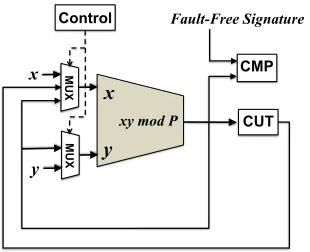
• Configurable Multiplier as a TPG/SA. By adding two multiplexers at its inputs and a simple controller, a
multiplier becomes configurable to act both as a TPG and SA (Figure 3c). The introduced hardware overhead
of such an architecture is smaller than if aregularBIST infrastructure would be added to a design.
• Testing Scenario.To make understanding easier, we hereby explain a possible test scenario in a cryptographic
TPG Output
x y
xy mod P
(a) Modular Multiplier as a TPG.
x
y xy mod P CUT Response
Final Signature
(b) Modular Multipler as a signature analyzer.
Fault-Free Signature
x
y xy mod P
MU
X
MU
X
CMP
CUT x
y
Control
(c) Configurable Modular Multiplier as both TPG
and SA .
Fig. 3: Multiplier based BIST strategy.
acts like a component under test (CUT). The modular multiplier from a public-key cryptographic core is
re-used to produce the test patterns, collect the CUT’s responses and create adigest of the final signature. The
BCU controls the testing process and compares the obtained final signature with the precomputed golden one.
The existing communication infrastructure in a SoC is used for data transfer between the modules involved in
the testing process.
The prime number used as the modulus can be a NIST recommended Pseudo-Mersenne number having efficient
modular reduction properties. It needs to be stored in an on-chip non-volatile memory and loaded at the beginning
of the authenticated testing process. In case a change in the modulus (to switch between different sizes for RSA
and ECC) is required, this non-volatile memory needs to be re-written with the new value.
D. Testing of other non-cryptographic modules
Depending on their testability properties, the non-cryptographic modules can be tested either using BIST or the
IEEE 1500 Test Wrapper. In case there is no security requirement for these modules, no activation mechanism would
be required. However, in case the non-cryptographic modules need to be protected (for instance, for IP protection),
they can also be subjected to the same authentication process using the multiplier-based BIST or Secure Test
Wrappers.
E. Test fail-safe scenario
In case the AES block that starts the testing process by initiating the authentication mechanism required for
enabling the wrapper around the public-key block (which eventually tests the other blocks) is erroneous, the whole
test process may fail. We have designed a fail-safe mechanism in case this happens.
If the AES block has some errors, the authentication mechanism fails. As a backup variant, the available hash
module would serve to run the authentication protocol required for enabling the Test Wrapper around the public-key
keyed-hashmode, using the same shared key as in the case of the AES-based authentication. The only difference
is that instead of the encryption of the generated challenge, both the chip under test and the test server calculate
its keyed-hash value. A test flag is maintained storing the information whether the AES or the Hash block was
used for the authentication procedure, and accordingly the other blocks are tested. This prevents redundant testing
of blocks which were tested and found erroneous earlier.
Only if both symmetric-key primitives are erroneous, the testing process is aborted and the failure is reported by
the server.
IV. COSTS
A. Time Overhead
Security and efficiency of the presented test scheme come at the cost of increased test time. We hereby discuss
the additional test time introduced by our secure testing methodology by splitting it into different test phases, as
shown in Fig. 2.
• Authentication phase.The authentication is performed using a simplechallenge-responseprotocol. The time
overhead of this testing phase consists of the time needed to generate a challenge from the on-chip RNG, the
time to encrypt it on both the test server and the chip and the time to transfer these values via the communication
interface.
• Testing public-key cores.Once the SoC under test is authenticated and the test wrapper isunlocked, a regular
scan-chain test process is used to test public key cores available in the SoC. Therefore, this testing phase does
not introduce the additional time overhead compared to the ”regular” testing process.
• Testing symmetric key cores.This testing phase assumes using the multiplier based BIST methodology. Since
the multiplier from the public-key core is reused for this purpose to act as both test pattern generator and the
signature analyzer, the time overhead consists of the following elements:
– Test pattern generation.The number of clock cycles needed to generate a test pattern,NP AT depends on
the multiplier architecture. In the case of the fully parallel implementation,NP AT = 1cycle per pattern.
– Signature analysis.The cycle count of this phase,NSIG, depends on the multiplier architecture as well.
If the multiplication is performed in a single clock cycle,NSIG= 1.
– Overall.The number of clock cycles required to test a symmetric cryptographic primitive,NSY M depends
on its actual hardware implementation. For instance, the number of pseudo-random patterns needed to test
AES presented in [30] is 2534. Overall, the number of clock cycles required to perform the multiplier
based BIST of a symmetric core isNSY M×(NP AT +NSIG).
B. Area Overhead
Besides security, the test methodology we propose aims at achieving low area overhead. This section analyses
Table I specifies the area overhead introduced by different components used in our testing scenario. All the
components are synthesized using Faraday 0.13µm CMOS standard cell library.
TABLE I: Area Overhead of the Secure Testing Method.
Design Area in # kGates
Security core 71.9
Security core with 10 scan chains 75.9
Security core with scan chains and Test Wrapper 96.4
Multiplier BIST Capabilities 0.4
Test Controller 1.8
Comparator 0.81
Overall area overhead 3.01
Even though the modular multiplier from the existing public-key core is re-used to build the BIST infrastructure, it
has to be slightly modified in order to provide the additional functionality. The overhead consists of two multiplexers
placed at inputs of the multiplier (Fig. 3c) which enable that the inputs can be supplied by the operands for a regular
multiplication, by the CUT responses for the signature analysis and by the data for the test pattern generation. Further,
a test controller that executes the test sequence from Fig. 2 and acts as the arbiter on the data bus (Fig. 1a) has
to be added to the system. Finally, the comparator used in the authentication protocol and in the BIST mode to
compare the golden and the calculated signature has to be added in a system. Considering the memory overhead,
the presented testing scheme requires the additional non-volatile memory space to store the secret key used in the
authentication protocol. Its size depends on the AES version used and typically is 128 or 256 bits.
Overall, if the total size of a cryptographic SoC is considered, it can be concluded that the area overhead introduced
by the testing scheme we present is very low - around 3 kGates (Table I). Note that the overhead here refers only
the modules that are added to provide a secure testing environment and that the standard test infrastructure, such
as IEEE 1500 test wrapper which has become the industry standard for SoC testing, is not taken into analysis.
V. SECURITYEVALUATION
Our analysis is based on some feasible security assumptions.
We take two types of attacker models into consideration: black box where the attacker has access only to the
peripherals of the SoC and lacking any access or knowledge of the internal modules, and grey box where the attacker
has access to the peripherals of the SoC and has knowledge of the internal modules. In the black box model, the
modules inside the SoC are taken to be trustworthy and hardware Trojans or malicious blocks are outside the scope
of the paper.
It is also assumed that the attacker does not have access to the Test Server or the key used to run AES in
software. The attacker cannot probe the Unlock Wrapper signal on the chip to enable the scan chains. This can
of probing attacks on it. The attacker cannot observe the bit patterns of the on-chip encryption signal. Otherwise,
he can just send a response matching with this sequence, to unlock the wrapper. This can also be achieved by a
similar approach as in the previous case.
Some attack scenarios are considered.
• Chosen plaintext attackis not feasible as the plaintext is a Random Number nonce.
• Replay attacks are not useful for an attacker, due to the same reason. The attacker can only eavesdrop on
the serial communication taking place between the secure chip and the test server. Since the random number
nonce is generated on-chip by the AES block and sent serially to the server, while the ciphertext on this nonce
is generated by the server, it makes no sense to replay it back, as each time, a new nonce is generated.
• Man-in-the-middle attackis feasible only if the attacker has physical access to the inside of the chip as well
as the communication taking place between the secure test server and the chip.
A more detailed security analysis of the authentication protocol can be found in [12].
VI. CONCLUSION
We have presented a novel model for testing cryptographic SoCs by integrating authenticated scan-based testing
through Test Wrappers and the pseudo-random Logic BIST. The security of the presented scheme is achieved by
mutually testing public and symmetric-key cryptographic modules, which ensures the authenticity of the test server
and the confidentiality of the key material. By re-using the public-key module to provide BIST infrastructure, we
minimize the introduced area overhead. Furthermore, rather than adding new cryptographic primitives to check the
authenticity of the testing server, the existing one is used. By doing so, we achieve the security of the testing
scheme at the minimal cost.
ACKNOWLEDGMENT
This work was supported in part by KU Leuven-DBOF/08/047, by the Research Council KU Leuven: GOA
TENSE (GOA/11/007), by the European Commission under contract number ICT-2007-216676 ECRYPT NoE
phase II, by the Flemish Government FWO G.0550.12N and by the Hercules Foundation AKUL/11/19.
REFERENCES
[1] IEEE, “Ieee standard testability method for embedded core-based integrated circuits,” inIEEE Std 1500-2005, 2005.
[2] B. Yang, K. Wu, and R. Karri, “Scan Based Side Channel Attack on Dedicated Hardware Implementations of Data Encryption Standard,”
International Test Conference, pp. 339–344, 2004.
[3] M. Agrawal, S. Karmakar, D. Saha, and D. Mukhopadhyay, “Scan Based Side Channel Attacks on Stream Ciphers and Their
Counter-Measures,” inProgress in Cryptology - INDOCRYPT, 2008, pp. 226–238.
[4] A. Das, B. Ege, S. Ghosh, L. Batina, and I. Verbauwhede, “Security analysis of industrial test compression schemes,”IEEE Trans. on
CAD of Integrated Circuits and Systems, vol. 32, no. 12, pp. 1966–1977, 2013.
[5] J. DaRolt, G. D. Natale, M.-L. Flottes, and B. Rouzeyre, “A novel differential scan attack on advanced dft structures,”ACM Trans. Design
Autom. Electr. Syst., vol. 18, no. 4, p. 58, 2013.
[6] A. Das, B. Ege, S. Ghosh, L. Batina, and I. Verbauwhede, “Security analysis of industrial test compression schemes,”IEEE Trans. on
[7] R. Nara, K. Satoh, M. Yanagisawa, T. Ohtsuki, and N. Togawa, “Scan-based side-channel attack against rsa cryptosystems using scan
signatures,”IEICE Transactions, vol. 93-A, no. 12, pp. 2481–2489, 2010.
[8] J. DaRolt, A. Das, G. D. Natale, M.-L. Flottes, B. Rouzeyre, and I. Verbauwhede, “A new scan attack on rsa in presence of industrial
countermeasures,” inCOSADE, 2012, pp. 89–104.
[9] R. Nara, N. Togawa, M. Yanagisawa, and T. Ohtsuki, “Scan-based attack against elliptic curve cryptosystems,” inASP-DAC, 2010, pp.
407–412.
[10] J. DaRolt, A. Das, G. D. Natale, M.-L. Flottes, B. Rouzeyre, and I. Verbauwhede, “A scan-based attack on elliptic curve cryptosystems
in presence of industrial design-for-testability structures,” inDFT, 2012, pp. 43–48.
[11] A. Das, U. Kocabas, A.-R. Sadeghi, and I. Verbauwhede, “Puf-based secure test wrapper design for cryptographic soc testing,” inDesign
Automation and Test in Europe (DATE), March 2012, pp. 866–869.
[12] A. Das, M. Knezevic, S. Seys, and I. Verbauwhede, “Challenge-response based secure test wrapper for testing cryptographic circuits,” in
IEEE European Test Symposium (ETS), May 2011.
[13] A. Schubert and W. Anheier, “On Random Pattern Testability of Cryptographic VLSI Cores,” inJournal of Electronic testing: Theory and
applications 16. Kluwer Academic Publishers, 2000.
[14] R. L. Rivest, A. Shamir, and L. Adleman, “A Method for Obtaining Digital Signatures and Public-Key Cryptosystems,”Communications
of the ACM, vol. 21, no. 2, pp. 120–126, 1978.
[15] N. Koblitz, “Elliptic Curve Cryptosystem,”Math. Comp., vol. 48, pp. 203–209, 1987.
[16] V. Miller, “Uses of Elliptic Curves in Cryptography,” in Advances in Cryptology: Proceedings of CRYPTO’85, ser. Lecture Notes in
Computer Science, H. C. Williams, Ed., no. 218. Springer-Verlag, 1985, pp. 417–426.
[17] A. Menezes, P. van Oorschot, and S. Vanstone,Handbook of Applied Cryptography. CRC Press, 1997.
[18] National Bureau of Standards, “Digital Signature Standard (DSS),”Federal Information, vol. Processing Standards Publication 186, May
1994.
[19] Cohen, Henri. and Frey, Gerhard. and Avanzi, Roberto., Handbook of elliptic and hyperelliptic curve cryptography. Chapman Hall/CRC,
Boca Raton : , 2006 .
[20] J. Daemen and V. Rijmen,The design of Rijndael, ser. Information Security and Cryptography. Berlin: Springer-Verlag, 2002.
[21] National Bureau of Standards, “Data Encryption Standard,”Federal Information, vol. Processing Standards Publication 46, January 1977.
[22] National Institute of Standards and Technology, “Recommendation for the Triple Data Encryption Algorithm(TDEA) Block Cipher,”
Federal Information, vol. Special Publication 800-67, May 2008.
[23] National Bureau of Standards, “Secure Hash Standard,”Federal Information, vol. Processing Standards Publication 180-1, April 1995.
[24] ——, “Secure Hash Standard,”Federal Information, vol. Processing Standards Publication 180-3, October 2008.
[25] D. Karaklaji´c, M. Knezevi´c, and I. Verbauwhede, “Multiplier based Bulit-in Self-Test for Cryptographic Applications,” KU Leuven, Tech.
Rep., 2010.
[26] F. Stroele, “Bit serial pattern generation and response compaction using arithmetic functions,” in16th IEEE VLSI Test Symposium (VTS),
1998, pp. 78–84.
[27] J. Rajski and J. Tyszer, “Multiplicative window generators of pseudorandom test vectors,” inEuropean Design and Test Conference, 1996,
pp. 42–48.
[28] ——, “Accumulator-based compaction of test responses,”IEEE Transactions on Computers, vol. 42, no. 6, pp. 643–650, June 1993.
[29] L. Blum, M. Blum, and M. Shub, “A Simple Unpredictable Pseudo-Random Number Generator,”SIAM Journal on Computing, vol. 15,
no. 2, pp. 364–383, 1986. [Online]. Available: http://link.aip.org/link/?SMJ/15/364/1
[30] M. Doulcier, M. L. Flottes, and B. Rouzeyre, “AES-Based BIST: Self-Test, Test Pattern Generation and Signature Analysis,” in4th IEEE