Performance Analysis of Secondary Users in
Underlay Cognitive Radio Networks Using
Binary Scheduling Algorithm (BSA) &Greedy
Algorithm
P.Caroline Priyanka Evelyne, V.Babu,
PG Scholar, Dept. of Communication Systems, Arunai College of Engineering, Tiruvannamalai, Tamilnadu, India
Assistant Professor, Dept. of ECE, Arunai College of Engineering, Tiruvannamalai, Tamilnadu, India
ABSTRACT: Cognitive Radio is a technology which extent the concept to include the interaction with the
environment and to address spectrum scarcity. The underlay network makes use of the secondary users (SU) is defined by primary users (PU) in order to meet the requirements by considering different activity SU protocol to limit SU’s. The proposed frame work is based on the binary search algorithm (BSA) to find the position of target value within a sorted array and greedy algorithm is used to compare the performance analysis and aims for global optimality by iteratively making a locally optimal decision. The performance includes the moment generating function (MGF) of the guard zone, co- operation and the threshold protocol as a special case. Hence the average number of active SU’s with protocols subject to the BSA algorithm and greedy algorithm is for the analysis of CR networks and utilization of SU users. The main consideration and motivation of the paper is to calculate the energy efficiency which increase the higher speed, accuracy and input performance by reducing energy consumption in each stages of the network.
KEYWORDS: cognitive radio, cognitive network, spectrum management, aggregate interference, outage probability,
BSA algorithm, greedy algorithm, optimal scanning algorithm ,secondary users, primary users, energy consumption, energy efficiency.
I. INTRODUCTION
Due to the fast pace of development in the world of wireless communication networks, the demand for wireless radio spectrum is rapidly on the increase. Hence it becomes necessary to find lasting solutions to the problems of spectrum scarcity and spectrum under-utilization. As a very promising solution to this problem, Cognitive Radio (CR) technique has been pursued as a potential paradigm to improve the effective utilization of limited spectrum resource [1]. Cognitive radio networks which allows the secondary users and access to the primary users. Depending on the spectrum access strategy, the network paradigms which defines the underlay network, SU concurrently use the spectrum occupied by PU guarantees that PU is below the requirement which allows to communicate with each other [2]where there is tight interaction and the active cooperation of the PU’s and the SU’S. The SU’s uses the signal processing to maintain the transmission which has additional bandwidth[2]
from SU with the cooperation protocol and the other protocols is derived. In addition, a closed form result for the average number of SU is derived. The system model and assumptions describes the performance of different SU activity protocols such as interference, outage probability, MGF, transmit power, energy consumption and the MGF are discussed[10]and conclusions are presented.
II. RELATED WORKS
Simon Haykin has proposed a novel approach for improving the utilization of a precious natural resource: radio electromagnetic spectrum. The cognitive radio, built on a software-defined radio is defined as an intelligent wireless communication system that is aware of its environment and uses the methodology of understanding- by-building to learn from the environment and adapt to statistical variations in the input stimuli, with two primary objectives in mind: Highly reliable communication whenever and wherever needed and Efficient utilization of the radio spectrum. Anita garwal has proposed a characteristic of CR system is to sense the electromagnetic environment to adapt their operation and dynamically vary its radio operating parameters, the technique of dynamically accessing the unused spectrum band is known as dynamic spectrum access (DSA) is a access technology helps to minimize unused spectrum bands.
Mansi Subhedar has proposed a fixed spectrum assignment has lead to under utilisation of spectrum as a great portion of licensed spectrum is not effectively utilised.
Chian- hanlee proposed a poisson hole process due to the interaction between the primary users and the cognitive users through exclusion regions, an exact calculation of the interference and the outage probability seems unfeasible. Instead, two different approaches are taken to tackle this problem.
Kusala dhama has proposed a aggregate interference analysis on a primary user caused by a random number of cognitive radio transmitters distributed in a finite ring. The exact closed- form moment generating function and an accurate approximation are derived by a gamma distribution and Christos politis has proposed the optimized sensing period is to minimize energy consumption in a diverse cooperative network in square law combining decision rule. The evaluation results confirm significant improvement in the sensing time, sensing task energy consumption. Jianwei Huang has proposed the energy efficient transmissions for MIMO cognitive radio networks in which the secondary users exist with the primary users. The optimized proper time allocations and the beam forming vectors for the secondary users is to be attained in order to minimize the total energy consumption of the secondary users while satisfying secondary users rate requirements and the primary receivers received interference constraints.
III.EXISTING SYSTEM
The underlay cognitive networks comprising of a PU
transmitter and a receiver separated by a distance[6]-[10].The location of the PU-Tx(Transmitter) and Rx(Receiver) and can be located anywhere inside the network. The SU’s decides depending on the activity for transmission where the users have a single antenna and the wireless communication channel[3].The nodes operates in the frequency division duplex mode. Let Ri(i=1,2,…m) is the random distance between the i- th SU and PU-RX with the PDF. Let the Gi represents the instantaneous power gain and interference at the PU-RX generated from the i-th SU given by Ii=PTiGiR−αi1(condition), (1)
1(condition) =1, if condition is true; 0, else if condition is false
Iagg = M∑i=1 (2)
PTiGiR−α i 1(condition).
Fig.1. Block diagram for performance analysis
A cognitive radio is that programmed and configured dynamically and its transceiver is designed to use the best wireless channels Such a radio automatically detects available channels in wireless spectrum and allows more spectrum band at one location. This process is a form of dynamic spectrum management [2]. Here the scheduling algorithms is used to determine the transmit power and the CR network comprises of SU &PU which deals the filled and unfilled users(i.e. acceptable users &unacceptable users)for finding the vacant of spectrum holes.
Fig.3.Utilization of the secondary users
A. Guard zone protocol
In this protocol, the SU’s are inside the guard zone region where it is prohibited from transmitting. This is illustrated in Fig.3. Consequently, the two SUs that are inside this region are inactive and do not generate any interference and can be written as Iagg=M∑i=1 (3)
Fig.4.Guard Zone Protocol and MGF of guard zone protocol
B. Threshold-Based Protocol
In this protocol, the range varies accordingly as that the outage depends on activation threshold and the zonal parameters where it is independent and can be written as
PTiGiR−α i 1(PTSHiR−α i ≤γ). (5)
Fig.5. Threshold Protocol and MGF of threshold protocol
C. Co-operation-based protocol
The basic idea of this protocol is inspired from the cooperative spectrum sensing interweave cognitive networks, where cooperation among nodes helps to improve the detection of licensed spectrum occupancy [3]. The notion of cooperation among SUs is also similar in spirit to base station cooperation in cellular networks broadcast to other SUs. we assume that, for each SU, it can only correctly receive the initial decisions from other SUs within a certain range, Finally, in order to decide whether it is active or not. Consequently, for a considered SU, it is permitted to be active as long as its preliminary decision s to be active, and the initial decision of all SUs which fall into this SU’s cooperation range is also to be active [6]-[10]. Thus the cooperation and threshold protocol is said to be efficient as that it depends on instant power rather than primary users compared to the guard zone protocol.
Fig.6.cooperation protocol and MGF of cooperation protocol
IV .PROPOSED SYSTEM
Cognitive radio plays an important role in improving
energy efficiency in wireless radio networks [1]. Recently, there have been a gradual rise in energy costs and harsh environmental standards that have led to an emerging trend of addressing “energy efficiency” aspect of wireless radio networks [10]. The proposed work is to analyze the energy consumption in each stage of the network such as transmitter and receiver sections of the CR network, before it access to the next channel. The total assumption of PU is analyzed and SU users if access it would be (blocked).
Finally, the energy efficiency can be calculated and can be improved by reducing energy consumption. The existing work deals with the performance such as outage and interference (MGF) which determines the value of signal.
Algorithm used: The Binary scheduling algorithm (BSA)and greedy algorithm is used, where BSA is used to
Fig.7. Flow diagram of energy consumption
Greedy algorithms aim for global optimality by iteratively making a locally optimal decision.
To show correctness, typically need to show the algorithm produces a legal answer, and an optimal answer and also called as Myopic, shortsighted decisions leads to an optimal solution. Hence the proposed work i.e., greedy algorithm gives the higher performance for SU protocols. Aditionally, energy consumption is analyzed and reduced by following stages in the flow diagram.
The main motivation of the paper is energy efficiency which is one of the parameter for overall performance analysis, so the energy consumption is proposed and analyzed. The flow diagram represents energy consumption analysis consisting of wireless nodes, transmitter, receiver, backoff and scanoff channels. Energy is consumed by these secondary
users in utilizing the licensed spectrum band before giving up access to the primary user.
The transmitter section deals with the secondary users w.r.to.total energy and the output represents that if node value increases, then energy value decreases. when node value decreases, energy value increases. The receiver section deals with the intended and non intended packets.The total consumption of each stage is analyzed before access into next section. In backoff channel, the energy spent between two successive decrement of a secondary node’s backoff counter is regarded as the energy consumed during tick period. The communicating channel describes the above stages and considers only the intended packets of k i.e….Here k=25 nodes or secondary users. The energy consumed in scanning for channels by a secondary user depends on the scanning algorithms used. For this work, we are using the optimal scanning algorithm which is described and analyzed below.
Finally energy efficiency is calculated by energy consumption analysis of the CR network from the above techniques and algorithms.
Hence the overall performance is improved and obtained. Additionally, SINR of every active SU is transmitted successfully.
V.EXPERIMENTAL RESULTS & DISCUSSION
received for the intended secondary users and Scenario two: when the received packet is not for the intended secondary user and has to be discarded. Back off countdowns are suspended, if the channel is sensed busy, and only resumes again when the channel is available. There are two scenarios that arises when a node is trying to transmit in a given tick time with other potential transmitters.
The energy consumed in scanning for channels by a secondary user depends on the scanning algorithms used. For this work, the optimal scanning algorithm which is described and analyzed. In this type of scanning algorithm, all the channels are scanned by the secondary user and the optimal channel among the scanned is chosen and greedy algorithm gives the higher results for overall performance. .
Fig.8. Energy consumption of a transmitter stage.
From the figure(8)., x axis represents as the number of SU’s.
Fig.10. Energy consumption of a scan channel
Fig.11.Greedy algorithm curve representation.
From the figure (11) X axis represents the No. of nodes/packets(n), y axis represents the transmit power, and the matlab values are generated and plotted.
From the figure(12), x axis represents d1/Ri and y axis represents I defines SINR. .As there is a difficulty in the SINR analysis, Here the fading parameter is considered and determined for input signal x& output signal y. To get snr,..z=snr(x,y), if dimension problem occurs.
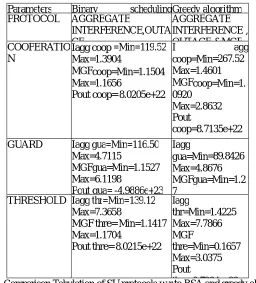
COMPARISON TABULATION FOR SU PROTOCOLs with SCHEDULING ALGORITHMS
Parameters Binary schedulingGreedy algorithm PROTOCOL AGGREGATE
INTERFERENCE,OUTA GE AGGREGATE INTERFERENCE , OUTAGE &MGF COOPERATIO N
Iagg coop =Min=119.52 Max=1.3904
MGFcoop=Min=1.1504 Max=1.1656
Pout coop= 8.0205e+22
I agg
coop=Min=267.52 Max=1.4601 MGFcoop=Min=1. 0920 Max=2.8632 Pout coop=8.7135e+22 GUARD Iagg gua=Min=116.50
Max=4.7115
MGFgua=Min=1.1527 Max=6.1198
Pout gua= -4.9886e+23 Iagg
gua=Min=89.8426 Max=4.8676 MGFgua=Min=1.2 7
THRESHOLD Iagg thr=Min=139.12 Max=7.3658
MGF thre= Min=1.1417 Max=1.1704
Pout thre= 8.0215e+22 Iagg thr=Min=1.4225 Max=7.7866 MGF thre=Min=0.1657 Max=3.0375 Pout thre=8.7234e+22
TABLE. 1.Comparison Tabulation of SU protocols w.r.to BSA and greedy algorithms.
The Table.1.shows the values of MGF w.r.to BSA & greedy algorithms. From the table, the performance of SU activity protocols yields the higher values in greedy algorithms.
VI.CONCLUSION
In this paper, the maximized secondary users enabled cognitive network is analyzed by using Binary Sequential Algorithm (BSA)and greedy algorithm. Further, the interference between the primary and secondary user is eliminated. This is different from the existing technology, as there is no interference created in primary user and traditional approaches based SU protocols can be used to increase the performance analysis of the different required parameters. Additionally, the energy efficiency is proposed by presenting an analysis of the total energy consumption in different state or activity of the secondary users. The numerical results reveal that the number of secondary users in the network and the time taken to scan channels has an effect on the energy consumption in the network. Further studies to the work presented in this
selecting channels, exploring other scanning schemes and optimization of the total energy consumption by users in the network. This should enable us to investigate further energy related issues in the network and also energy implications on techniques used by secondary users in the network, limiting the secondary users.
[2] Q. Zhao and B. Sadler, “A survey of dynamic spectrum access,” IEEE Signal Process. Mag., vol. 24, no. 3, pp. 79–89, May 2007.
[3] B. Wang and K. J. R. Liu, “Advances in cognitive radio networks: A survey,” IEEE J. Sel. Topics Signal Process., vol. 5, no. 1, pp. 5–23, Feb. 2011.
[4] A. Ghasemi and E. S. Sousa, “Interference aggregationspectrumsensingcognitivewirelessnetwor ks,”IEEEJ.Sel.TopicsSignalProcess., vol. 2, no. 1, pp.
41–56, Feb. 2008.
[5] M. Derakhshani and T. Le-Ngoc, “Aggregate interference and capacity outage analysis in a cognitive radio network,” IEEE Trans. Veh. Technol., vol. 61, no. 1, pp. 196–207, Jan. 2012.
[6] Rabbachin, A.; Quek, T.Q.S.; Hyundong Shin; Win, M.Z.,”Cognitive Network Interference,”IEEE J. Sel. Areas Commun.,Vol. 29 ,pp. 483-493.
[7] Suchismita Bhattacharjee,Dinamani Singh, “Channel Capacity of MIMO System over NAKAGAMI- m Fading Channel,” International Journal of Computing, Communications and Networking, Volume 1, No.1, July – August 2012.
[8] J. Mitola, “Cognitive radio,” Ph.D. dissertation, Royal Institute of Technology (KTH), 2000.