ONE STEP ACTIVATION USING POTASSIUM HYDROXIDE ON PREPARED ACTIVATED CARBON FO R BASE TRANSESTERIFICATION
REACTION
NOR W AJIHAN BINTI MUDA
ONE STEP ACTIVATION USING POTASSIUM HYDROXIDE ON PREPARED ACTIVATED CARBON FOR BASE TRANSESTERIFICATION REACTION
NOR WAJIHAN BINTI MUDA
A dissertation submitted in partial fulfillment of the requirements for the awards of degree of
Master of Science (Chemistry)
Faculty of Science Universiti Teknologi Malaysia
lll
T o r ? % y ...
To my ^e/&^^eJ/amiiy aKJ/rTeK^j f^af Mewr jfoppeJ*g!^^i^Mg o/f^emje/^^ej !^M coHMf/^jj w%yj, ^of^
Jirecf awJi^MJirecf. i w aj goi^Mg fo jfarf /Sjfi^Mg f^em a/T^ ^Hf rea/SzeJ*f^ey are jMjf foo maKy fo Jo
f^af j^Hjfice - jo ^/^aje accepf f^e_/acf f^af yoH are a/meMfiioMgJiiM my Jai<y grayer o/f^aK^j to a
iv
ACKNOW LEDGEMENT
All praise be to ALMIGHTY ALLAH, the omnipotent, the omnipresent, the most merciful and the most compassionate who blessed me with tolerant attitude, realistic thinking, family supporting, talented supervisor and enable me to complete this dissertation. This dissertation is the result of effort on my part, along with assistance of many others. Nevertheless, with the help of others, this work has finally come to fruition.
Upon completion of this project, I would like to express my gratitude to many parties. My special thanks and appreciation go to my supervisor, Prof. Dr. Abdul Rahim Yacob for his technical help, valuable suggestions and encouragement throughout my studies. This work would not have been completed without his keen interest. Beside that, I would also approach to thank to all the lecturers in Department of Chemistry and staff, especially to Physical Chemistry Lab II for the diligent advices, suggestions and solutions right the way through this study.
v
ABSTRACT
vi
ABSTRAK
vii
CH APTER TITLE PAGE
DECLARATION ii
DEDICATION iii
ACKNOW LEDGEMENT iv
ABSTRACT v
ABSTRAK vi
TABLE OF CONTENTS vii
LIST OF TABLES x
LIST OF FIGURES xi
LIST OF ABBREVIATIONS xiii
LIST OF APPENDICES xiv
1 INTRODUCTION 1
1.1 Background of study 1
1.2 Problem Statement 4
1.3 Significance of the study 5
1.4 Objective of the study 6
1.5 Scope of the study 6
2 LITERATURE REVIEW 8
2.1 Activated Carbon from Agricultural Waste 8 2.1.1 Palm Kernel Shell As Raw Material 9
2.2 Activated Carbon 10
viii
2.3 Preparation of Activated Carbon 11
2.3.1 Physical Activation 12
2.3.2 Chemical Activation 12
2.3.2.1 Activation With Potassium 13 Hydroxide
2.4 Catalyst 14
2.4.1 Homogeneous Catalyst 15
2.4.2 Heterogeneous Catalyst 15
2.4.3 Activated Carbon as Catalyst/Catalyst 16 Support
2.5 Biodiesel 19
2.6 Transesterification Process 21
2.7 Dimethyl Carbonate in Transesterification Reaction 23
3 M ETHODOLOGY 25
3.1 Materials 25
3.2 Methods 26
3.2.1 Preparation of AC/KOH Catalyst 26 3.2.1.1 One Step Activation Using 27
Potassium Hydroxide
3.2.2 Transesterification Reaction Process 28
3.3 Sample Characterization Techniques 29
3.3.1 Thermogravimetric Analyzer (TGA) 30 3.3.2 Fourier Transform Infrared (FTIR)-ATR 30
3.3.3 Nitrogen Adsorption Analysis 30
3.3.4 Field Emission Scanning Electron Microscope 31 (FESEM)
3.3.5 X-ray Powder Diffraction (XRD) 31 3.3.6 Carbon Dioxide - Temperature Program 32
Desorption (CO2-TPD)
3.3.7 Back Titration Analysis 33
3.3.9 Gas Chromatography 34
4 RESULT AND DISCUSSION 36
4.1 Introduction 36
4.2 Characterization Of The Prepared Potassium 37 Hydroxide Activated Carbon Catalyst (AC/KOH)
4.2.1 Thermogravimetric Analysis Of Raw Palm 37 Kernel Shell
4.2.2 Fourier Transform Infrared (FTIR) 39 4.2.3 X-Ray Fluorescence (XRF) Analysis Of 42
Prepared AC/KOH
4.2.4 Nitrogen Adsorption Analysis 43
4.2.5 Field Emission Scanning Electron Microscope 45 (FESEM)
4.2.6 X-Ray Diffraction (XRD) 49
4.2.7 Back Titration Analysis 50
4.2.8 Carbon Dioxide- Temperature Program 52 Desorption (CO2-TPD)
4.3 Transesterification of Palm Oil with DMC To 54 Biodiesel
4.4 Analysis and determination of transesterification 55 product
4.4.1 Gas Chromatography-Flame Ionize Detector 55 4.4.2 Gas Chromatography-Mass Spectrometer 57 4.5 X-Ray Fluorescence (XRF) Analysis of Oil 58
5 CONCLUSION 60
5.1 Conclusion 60
5.2 Recommendation 61
ix
REFERENCES APPENDICES
x
LIST OF TABLES
TABLE NO TITLE PAGE
2.1 Selected studies on the production of activated 9 carbon from palm kernel shell
2.2 Classification of pores sizes in activated carbon 11 2.3 Previous study in preparation of activated carbon by 14
chemical activation with KOH
2.4 Comparison of different technology to produce 21 biodiesel
2.5 Previous study on transesterification of vegetables 24 oil with DMC
3.1 Chemical reagent used throughout this study 26 4.1 FTIR band assignment of functional group of raw- 42
PKS and prepared catalyst
4.2 XRF analysis of prepared AC/KOH 43
4.3 CO2-TPD desorption peak assignment for all 53 prepared catalyst
4.4 List of fatty acid methyl ester components of 58 transesterification product
xi FIGURE NO. 1.1 1.2 2.1 2.2 2.3 2.4 3.1 3.2 3.3 4.1 4.2 4.3 4.4 4.5
LIST OF FIGURES
TITLE
Transesterification of triglyceride with alcohol Transesterification of triglyceride with DMC Schematic representation of the different types of pores in activated carbon
Schematic representation for preparation of carbon based catalyst an it utilization for biodiesel production
Preparation of carbon supported catalyst
Reaction mechanism for alkali-catalyzed transesterification
Flow diagram for the preparation of AC/KOH catalyst
Flow diagram transesterification reaction to produce biodiesel from palm oil and DMC
Overall methodology for potassium doped activated carbon as heterogeneous base catalyst in transesterification of palm oil with dimethyl carbonate
TGA curve of raw-PKS
Percentage of weight lost at different temperature region from TGA
FTIR spectrum of (a)raw-PKS (b)10%AC/KOH (c) 15%AC/KOH (d) 20% AC/KOH (e) 25%.AC/KOH Single point BET surface area of raw-PKS, AC-Com and prepared AC/KOH
xii
4.6 FESEM image of 10%AC/KOH with magnification of 47 2.50 KX
4.7 FESEM image of (a) 15% AC/KOH (b) 20% 48 AC/KOH (c) 25% AC/KOH with magnification of 2.50
KX
4.8 XRD pattern of AC/KOH catalyst: (a) 10%AC/KOH, 49 (b) 15%AC/KOH, (c) 20%AC/KOH. (d) 25%AC/KOH
4.9 Amount of basic site of prepared AC/KOH catalyst 51 4.10 CO2-TPD profile of prepared AC/KOH catalyst 52
4.11 Typical examples of GC chromatograms of producing 56 biodiesel using AC/KOH catalyst.
xill
ABBREVIATIONS
AC/KOH - Potassium hydroxide activated carbon
BET - Brunauer-Emmett-Teller
CO2-TPD - Carbon dioxide- Temperature Program Desorption
DMC - Dimethyl carbonate
FTIR - Fourier Transform Infrared
FID - Flame Ionization Detector
FAME - Fatty acid methyl ester
FAGs - Fatty acid glycerol carbonate
FESEM - Field Emission Scanning Electron Microscope GC-FID - Gas Chromatography-Flame Ionize Detector GC-MS - Gas Chromatography Mass Spectrometer
KOH - Potassium hydroxide
PKS - Palm kernel shell
TGA - Thermo-Gravimetric Analyzer
XRD - X-ray Powder Diffraction
xiv
APPENDIX
A
B
C
LIST OF APPENDICES
TITTLE
Calculation of molar ratio for oil and DMC
Calculation of basicity strength of AC/KOH
Chromatogram for blank and percentage conversion of palm oil
PAGE
72
73
CH APTER 1
INTRODUCTION
1.1 Background of study
Activated carbons (ACs) also known as activated charcoal or activated coal is a carbonaceous material, which is predominantly amorphous in nature with a large internal surface area and highly developed porosity resulting from several processes and treatment (Abechi e? 2013). Productions of the activated carbon depend mostly on the raw material and method used. ACs can be produced from different type of raw material, including coal, lignite peat and woods (Gua and Lua, 2001). Moreover, it is the most cost effective and environmentally conscious to produce ACs from agricultural by-product such as coconut shell (yang e? %A, 2010; Hu and Srinivasan, 1999) pistachio nut shell (Lua and Yang, 2004), sugar cane Bagasse (Kalderis e? %A, 2008) olive stones (Reinoso e? %A, 1995) macadamia nut-shell (Ahmadpour and Do, 1997) and etc.
2
e? %A, 2008; Daud e? %A, 2000). This indicates that a huge volume of kernel shell is being generated without consideration to their significant disposal problem. Therefore, in this study palm kernel shell was used as a raw material in the production of activated carbon, hence their utilization in the production activated carbon is a feasible solution to this environmental issue.
Activated carbons are important material, which have been widely used in various industrial applications, which include separation/purification of liquid and gas and removal of heavy metal. In the preparation of heterogeneous catalyst, activated carbon has proved to be highly effective as catalyst support. Its large surface area allows the active phase to disperse over it effectively and show inertness in acidic and basic media. ACs are an ideal carrier or supported for catalytic metal or indeed as a catalyst in its own right (Auer e? %A, 1998). Besides, there are various other reactions employing ACs as catalyst or catalyst support. One of the areas that employ carbon based catalyst is the production of biodiesel. In biodiesel production, catalyst plays an important role. Preparation of carbon based catalyst from agricultural waste and its utilization as heterogeneous catalyst not only reduces cost of biodiesel production but also could be used as "green catalyst".
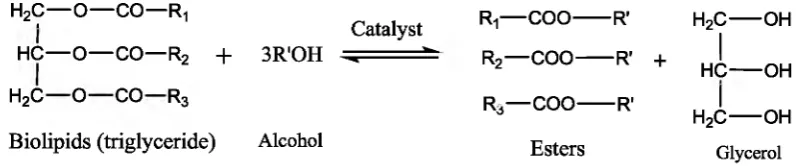
Due to environmental concerns, biodiesel has received many attentions as a replacement fuel since it has unique advantage such as being biodegradable, non toxic and suitable for domestic production. Biodiesel is defined as a mono alkyl ester of long chain fatty acids derived from a renewable lipid feedstock, such as vegetable oil or animal fat, other sources that can be used to produce biodiesel is from algae and waste cooking oil (Marchetti e? %A, 2007). There are several different methods can be used to produce biodiesel, but transesterification is the most favoured process in biodiesel industrial because of its simple process and low cost (Khalid and Khalid, 2011).
3
present of acid or base catalyst. The general reaction of this reaction is shown in Figure 1.1 (Ejikeme e? %A, 2010).
H,C— O— CO— R
Catalyst
HC— O — CO— Rz + 3R'OH - " Rg— COO--- R' +
2 ^ u u u — Ki ^ ^ ^ — CO O--- R' HgC---OH
)
HC---OH
HgC O CO Rg
^ — COQ---R.
I
^ HgC--- OH
Biolipids (triglyceride) Alcohol Esters Glycerol
Figure 1.1: Transesterification of triglyceride with alcohol (Ejikeme e? 2011)
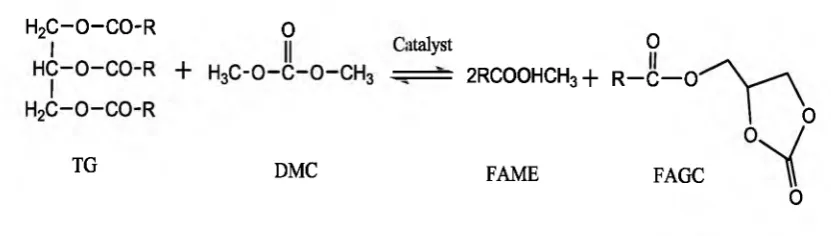
In particular, FAME is produced together with glycerol as undesired by product in transesterification reaction. This glycerol needs to be separated and refined for further used which are costly and technically difficult. To overcome the problem Dimethyl Carbonate (DMC) is used in this reaction as an alternative to alcohols, which produce free glycerol FAMEs. DMC could be used as a reagent for the transesterification reaction process because of its advantageous physical properties such as environmental inertness chemical reactivity and do not produce glycerol as by-product (Pandiangan and Simanjuntak, 2013; Fabbri e? %A, 2007).
4
HzC-O-CO-R 0
italyst 0
- 2RCOOHCH3+ R - C— 0
0
TG DMC FAME FAGC
0
Figure 1.2: Transesterification of triglyceride with DMC (Fabbri e? 2007)
1.2 Problem statem ent
Palm kernel shell is an abundant solid waste from oil processing mills in tropical countries like Malaysia, Thailand and Indonesia. Some of these wastes are either used as fuel, whereas a large portion of them burnt in the open air or dumped in the area adjacent to the mill, which will increase the area need for their landfill and create many environmental problems. The utilization of these agricultural by product as a prospective starting material for the production of the activated carbon will greatly help with environmental issues as an effective discharge of this waste material, which can reduce the area need for their landfill disposal.
5
Generally, in transesterification reaction, triglycerides react with alcohol, mostly methanol produce biodiesel or fatty acid methyl ester (FAME) with glycerol as undesired by-product. This glycerol needs to be separated and refined for further used which is costly and technically difficult. In this study, dimethyl carbonate (DMC) is used to perform the transesterification reaction with palm oil replacing methanol, which can overcome the problem. DMC is a green reagent because it is non-toxic, non-irritating, biodegradable, stable and easy to handle. With DMC, the reaction is free from the production of glycerol and can yield high purity biodiesel. Moreover, with DMC, alkali catalysed acted as a solid catalyst, which will not dissolve or leach out and therefore separation can be easily done through centrifugation or filtration (Dawodu e? %A, 2014).
1.3 Significance of study
6
1.4 Objective of the study
The objectives of this study are:
1. To prepare potassium hydroxide activated carbon catalyst (AC/KOH) via one-step activation using different percentage concentrations of potassium hydroxide on palm kernel shell and characterize the prepared AC/KOH.
2. To test the prepared AC/KOH as base heterogeneous catalyst in the transesterification of palm oil with dimethyl carbonate (DMC) towards production of biodiesel.
3. To analyze and characterize the composition of biodiesel produce from transesterification reaction.
1.5 Scope of the study
The scope of the study can be divided into 3 major aspects. The first aspect is to prepare activated carbon with KOH via one step activation by impregnate different percentage concentrations of 10%, 15%, 20% and 25% potassium hydroxide into the palm kernel shell and carbonized at 600°C for 2 h.
7
Emission Scanning Electron Microscope (FESEM) will analyze their surface morphology and the basicity and basic strength of the catalyst will be carried out by back titration method and via Temperature Programmed Desorption (CO2-TPD) for conformation. The possibility of catalyst leaching into biodiesel will be analysed by X-ray Fluorescence (XRF)
R E FE R E N C E S
Abechi, S. E., Gimba, C. E., Uzairu A., and Dallatu, Y. A. (2013). Preparation and
Characterization o f Activated Carbon from Palm Kernel Shell by Chemical
Activation. ^ese%rcA o / cAewz'c%f sciences, 3(7), 54-61.
Adinata, D., Daud, W. M. A., and Aroua, M. K. (2007). Preparation o f Activated
Carbon from Palm Shell by Chemical Activation. FzoresoMrce TecMofogy, 98,
145-149.
Ahmadpour, A., and Do, D. D. (1997). The Preparation o f Active Carbons from
Macadamia Nutshell by Chemical Activation. C%r^o^, 35(12), 1723-1732.
Arami-Niya, A., W an Daud, W. M. A. S., and Mjalli, F. (2011). Comparative Study
of The Textural Characteristics o f Oil Palm Shell Activated Carbon Produced by
Chemical and Physical Activation For Methane Adsorption. CAewz'c%f
F^gm eerm g ^ese^rcA Design, 89, 657-664.
Auer, E., Freund, A., Pietsch, J., and Tacke, T. (1998). Carbon as Supports for
Industrial Precious Metal Catalysts. ^ppfz'eJ C ^ f y ' s ^ Ge^emf, 173, 259-271.
Bagheri, N., and Abedi, J. (2009). Preparation o f High Surface Area Activated
Carbon from Corn by Chemical Activation Using Potassium Hydroxide. CAewz'c%f
F^gm eerm g ^ese%rcA Design, 87(8), 1059-1064.
Baroutian, S., Aroua, M. K., Raman, A. A. A., and Sulaiman, N. M. N. (2010)
Potassium Hydroxide Catalyst Supported on Palm Shell Activated Carbon for
63
Buasri, A., Ksapabutr, B., Panapoy, M., and Chaiyut, N. (2012) Biodiesel Production
from Waste Cooking Palm Oil Using Calcium Oxide Supported on Activated
Carbon as Catalyst in A Fixed Bed Reactor. X orea^ JoMr^af o / CAewzcaf
E^gmeermg, 29(12), 1708-1712.
Buasri A., Chaiyut, A., Loryueenyong, V., Phakdeepataraphan, E., Watpathomsub,
S., and Kunakemakorn, V. (2013). Utilization o f Biodiesel Wastes as a
Bioresource for the Preparation o f Palm Oil. i^em a% o^af JoMr^af o /^^p fz'eJ
PAyz'cs a ^ J Ma^Aewa^zcs, 3(3), 173-177.
Cao, Q., Xie, K. C., Lv, Y. K., and Bao, W. R. (2006). Process Effects o f Activated
Carbon with Large Specific Surface Area from Corn Cob. Fz'oresoMrce
TecA^ofogy, 97, 110-115.
Cotton, F. A., and Wilkinson, G. (1988). ^ J v a ^ c e J i^ o rg a^ 'c CA ew Sry (5th ed).New
York: John Wiley & Sons.
Dali, A. M., Ibrahem, A. S., and Hadi, A. (2012). General Study about Activated
Carbon for Adsorption o f Carbon Dioxide. JoMr^af o/PMrzYy, Mz'fzYy ^ e a c ? o a ^ J
E^vz'ro^we^^, 1(5), 236-251.
Daud, W. M. A., and Ali, W. S. W. (2004). Comparison o f pore development of
activated carbon produced from palm shell and coconut shell. Fz'oresoMrce
TecA^ofogy, 93(1), 63-69.
Dawodu, F. A., Ayodele, O. O., Xin, J., and Zhang, S. (2014). Dimethyl Carbonate
Mediated Production o f Biodiesel at Different Reaction Temperatures. ^e^ew aN e
Energy, 6 8, 581-587.
Demirbas, A. (2003). Biodiesel Fuels from Vegetables Oils via Catalytic and Non-
Catalytic Supercritical Alcohol Transesterification and Other Methods, a Survey.
Energy C o w e r s o a ^ J M a^agew e^, 44, 2093-210.
Dias, J. M., Alvim-Ferraz, M. C. M., and Almeida, M. F. (2008). Comparison o f the
Performance of Different Homogeneous Alkali Catalysts during
Transesterification o f Waste Virgin Oils and Evaluation o f Biodiesel Quality.
64
Doskocil, E. J., Bordawekar, S., and Davis, R. J. (2000). 7^ Spivey, J. J.,
(Ed.) Royal Society o f Chemistry (15). Cambridge.
Dossin, T. F., Reyniers, M. F., Berger, R. J., and Marin G. B. (2006). Simulation o f
Heterogeneously MgO-Catalyzed Transesterification for Fine-Chemical and
Biodiesel Industrial Production. ^_ppf/eJ CAewM/ry F, Fw /ro^w e^/^f, 67, 136
148.
Ehrburger, P. (1991). From Carbon-Supported Catalyst to Carbon/Ceramic Interface
Use o f ASA. Carbon, 29(6), 763-768.
Ejikeme, P. M., Anyaogu, I. D., Ejikeme, C. L., Nwafor, N. P., Egbuonu, C. A. C.,
Ukogu, K., and Ibemesi, J. A. (2010). Catalysis in Biodiesel Production by
Transesterification Processes-an Insight-Review. F-JoMr^%f o / CAew/^/ry,7(4),
1120-1132.
Ehteshami, M., Rahimi, M., Eftekhari, A. A., and Nasr, M. J. (2006). Kinetic Study
o f Catalytic Hydrolysis Reaction o f Methyl Acetate to Acetic Acid and Methanol.
o / ^c/e^ce & TecA^ofogy, T m M ^ c /o F, FMg/Meer/Mg, 30(B5).
Fabbri, D., Bevoni, V., Notari, M., and Rivetti, F. (2007). Properties o f a Potential
Bio Fuel Obtained from Soybean Oil by Transmethylation with Dimethyl
Carbonate. FMef, 8 6, 690-697.
Fan, M., Zhang, P., and Zhang, Y. (2011). Nay Zeolite-Supported Potassium Salt
Catalyst for Dipropyl Carbonate Synthesis from Transesterification Route.
CAew/c%f F^gm eerm g CowwMM/c^//o^^, 198(8), 1033-1040.
Foo, K. Y., and Hameed, B. H. (2011). Preparation and Characterization o f Activated
Carbon from Pistachio N ut Shells via Microwave-Induced Chemical Activation.
F/ow ^.y FMergy, 35(7), 3257-3261.
Gao, L., Xu, B., Xiac, G., and Lv, J. (2008). Transesterification o f Palm Oil with
Methanol to Biodiesel over KF/Hydrotalcie Solid Catalyst. FMergy FMef, 22,
65
Gomez-Serrano, V., Pastor-Villegas, J., Perez-Florindo, A., Duran-Valle, C., and
Valenzuela-Calahorro, C. (1996). FT-IR Study o f Rockrose and Char Activated
Carbon. JoMrM%f o/^M%fy%c%f ^MJ ^^pfz'es Pyrofyszs, 36, 71-80.
Gu, Z., and Wang, X. (2013). Carbon Materials from High Ash Bio-Char: a
Nanostructure Similar to Activated Graphene. ^werz'c%M Tr%Ms%c%oMs oM
FMgzMeerzMg & ^ p f z 'e J ^cz'eMces, 2(1), 15-34.
Gua, J., and Lua, A. C. (2003). Surface Functional Groups on Oil-Palm Shell
Adsorbents Prepared by H3PO4 and KOH Activation and Their Effects on
Adsorptive Capacity. Tr%Ms iCAewF, 81,585-590.
Guo, J., and Lua, A. C. (2000). Effect o f Heating Temperature on the Properties of
Chars and Activated Carbons Prepared from Oil Palm Stones. JoMrM%f o / TAerw%f
^M^fysz's %MJ C%forz'we?ry, 60(2), 417-425.
Guo, J., and Lua, A. C. (2003). Textural and Chemical Properties o f Adsorbent
Prepared from Palm Shell by Phosphoric Acid Activation. M<3?erz%fs C A ew sry
PAyszcs, 80(1), 114-119.
Guo, J., and Lua, A. C. (2000a). Characterisation o f Adsorbents Prepared from Oil
Palm Shell by CO2 Activation For the Removal o f Gaseous Pollutants. C%r^oM,
38, 1089-1097.
Hameed, B. H., Goh, C. S., and Chin, L. H. (2009). Process Optimization for Methyl
Ester Production from Waste Cooking Oil Using Activated Carbon Supported
Potassium Fluoride. FMef ProcesszMg TecAMofogy, 90, 1532-1537.
Hanapi, S. Z. (2011). Mz'crowwe ^sszs^eJ TMMgs^eM C%r^z'Je Frow ^%s?e XerMef
<SAeff F o r ^eweJz%%oM O / CAforoJ/Morowe?A%Me. Master o f Science (Chemistry)
Thesis. Universiti Teknologi Malaysia, Skudai.
Hayashi, J., Horikawa, T., Takeda, I., Muroyama, K., and Ani, F. N. (2002).
Preparing Activated Carbon from Various Nutshells by Chemical Activation with
66
Helwani, Z., Othman, M. R., Aziz, N., Fernando, W. J. N., and Kim, J. (2009).
Technologies for Production of Biodiesel Focusing on Green Catalytic
Techniques, a Review. EMef Processing TecAnofogy, 90, 1502-1514.
Hu, Z., and Srinivasan M. P. (1999). Preparation o f High Surface Area Activated
Carbon from Coconut Shell. MzcroporoMs a n J MesoporoMs Ma?erzafs. 27(1), 11
18.
Hu, Z., Srinivasan, M. P., and Ni, Y. (2001). Novel Activation Process o f Preparing
Highly Microporous and Mesoporous Activated Carbons, Carbon, 39, 877 -8 8 6.
Intarapong, P., Langthanarat, S., Luengnaruemitchal, A., and Jai-In, S. (2014).
Biodiesel Production from Palm Oil Using Potassium Hydroxide Loaded On ZrO2
Catalyst In a Batch Reactor. CAzang Maz JoMrnaf o / ^czence, 41(1), 128-137.
Intarapong, P., Langthanarat, S., Phanthong, P., Luengnaruemitchal, A., and Jai-In,
S. (2013). Activity and Basic Properties o f KOH/Mordenite for
Transesterification o f Palm Oil. JoMrnaf / E n e r g y CAewzs?ry, 2 2, 690-700.
Irmawati, R.., Shafizah, I., Nur Sharina, A., Abbastabar Ahangar, H., and Taufiq-
Yap, Y. H. (2014). Transesterification o f Palm Oil by Using Silica Loaded
Potassium Carbonate (K2CO3/SiO2) Catalyst to Produce Fatty Acid Methyl Esters
(FAME). Energy a n J Power, 4(1), 7-15.
Islam, A., Taufiq-Yap, Y. H., Chu, C. M., Ravindra, P., and Chan, E. S. (2013).
Transesterification o f Palm Oil Using KF and Nano3 Catalyst Supported on
Spherical M ilimiter y-Al2O3. ^enew aN e Energy, 59, 23-39.
Ivanoiu, A., Schmidt, A., Peter, F., Rusnac, L. M., and Ungurean, M. (2011).
Comparative Study on Biodiesel Synthesis from Different Vegetables Oils.
CAewzcaf FMffe^zn, 56, 94-98.
Iyagba, E. T., and Opete, O. S. E. (2008). Removal O f Chromium and Lead from
Drill Cuttings Using Activated Palm Kernel Shell and Husk, ^/Tzcan JoMrnaf o /
67
Jibril, B., Houche, O., Al-Maamari, R., and Al-Rashidi, B. (2008). Effects o f H3PO4
and KOH in Carbonization o f Lignocellulosic Material. JoMr^^f o / ^^^fy//c^f ^ ^ J
^p p f/eJ Pyrofys/s, 83(2), 115-156.
Jin, H., Lee, Y. S., and Hong. L. (2007). Hydrogen Adsorption Characteristics of
Activated Carbon. C%/%fys7s ToJ%y, 120(3-4), 399-406.
Kalderis, D., Bethanis, S., Paraskeva, P., and Diamadopoulo, E., (2008). Production
of Activated Carbon from Bagasse and Rice Husk by a Single-Stage Chemical
Activation M ethod at Low Retention Times. F/oresoMrce TecA^ofogy, 99(15),
6809-6816.
Khalid, K., and Khalid, K. (2008). Transesterification o f Palm Oil for the Production
of Biodiesel. ^wer/c%M JoMr^^f o /^ p p f/e J ^c/e^ces, 8(8), 804-809.
Khalil, H. P. S. A., Jawaid, M., Firoozian, P., Rashid, U., Islam, A., and Akil, H. M.
(2013). Activated Carbon from Various Agricultural Wastes by Chemical
Activation with KOH, Preparation and Characterization. JoMr^^f F /o M seJ
M2/er/%f %^J F/oe^ergy, 7(5), 1556-6560.
Kusuma, R. I., Hadinoto, J. P., Ayucitra, A., Soetaredjo, F. E., and Ismadji, S.
(2013). Natural Zeolite from Pacitan Indonesia, as Catalyst Support for
Transesterification o f Palm Oil. ^ p p f/eJ Cf%y ^c/e^ce, 74, 121-126.
Labeckas, G. and Slavonskas, S. (2006). The Effects o f Rapeased Oil Methyl Ester
on Direct Injection Diesel Engine Performance and Exhaust Emission. FMergy
C o w e r s o M2M%geweM/, 47, 1954-1967.
Lapuerta, M., Hernandez, J. J., and Rodriguez, J. (2004). Kinetics o f Devolatilisation
of Forestry Wastes from Thermogravimetric Analysis. F/ow%ss %^J F/oe^ergy,
27, 385-391.
Li, W., Yang, K., Peng, J., Zhang, L., Guo, S., and Xia, H. (2007). Effects of
Carbonization Temperatures on Characteristic o f Porosity in Coconut Shell Chars
and Activated Carbons Derived from Carbonized Coconut Shell Chars. T^JMs/r/^f
68
Lillo-Rodenas, M. A., Cazorla-Amoros, D., and Linares-Solano, A. (2003).
Understanding Chemical Reactions between Carbons and NaOH and KOH, an
Insight Into the Chemical Activation Mechanism. C%r^oM, 41(2), 267-275.
Lua, A. C., and Yang, T. (2005). Characteristics o f Activated Carbon Prepared from
Pistachio-Nut Shell by Zinc Chloride Activation Under Nitrogen and Vacuum
Conditions. JoMrM%f o / CoffozJ %MJ iM?er/ace ^cz'eMce, 290, 505-513.
Lua, A. C., and Yang, T. (2004). Effect o f Activation on the Textural and Chemical
Properties o f Potassium Hydroxide Activated Carbon Prepared from Pistachio-
Nut Shell. JoMrM%f o / CoffozJ %MJ 7M?er/ace ^cz'eMce, 274, 594-601.
Lua, A C ., and Guo, J. (2001). Microporous Oil-Palm-Shell Activated Carbon
Prepared by Physical Activation for Gas-Phase Adsorption. L%MgwMz'r, 17, 7112
7117.
Luangkiattikhun, P., Tangsathitkulchai, C., and Tangsathitkulchai, M. (2008). Non-
Isothermal Thermogravitmetric Analysis o f Oil-Palm Solid Waste. FzoresoMrce
TecAMofogy, 99, 986-997.
Ma, F., and Hanna, M. A. (1999). Biodiesel Production, a Review. FzoresoMrce
TecAMofogy, 70, 1-15.
Marchetti, J. M., Miguel, V. U., and Errazu, A. F. (2007). Possible Methods for
Biodiesel Production. ^eMew%Ne %MJ ^Ms^^z'M^^fe FMergy ^evzews, 11,1300 -
1311.
Marsh, H., Crawford, T. M., O'Grady, T. M., and Wennerberg, A. N. (1982).
Carbons o f High Surface Area. a Study by Adsorption and High Resolution
Electron Microscopy. C%r^oM, 20, 419-426.
Meher, L. C., Sagar, D. V., and Naik, S. N. (2006). Technical Aspects o f Biodiesel
Production by Transesterification-A Review. ^eMew%Ne %MJ <SMs?%z'M%Ne FMergy
69
Meteku, B. E., (2013), ProJMc?zon o / ^c?z'va?eJ Carbon /ro w Pafw Xernef ^Aeff /o r
GofJ ^Jsorp?z'on ^sz'ng LeacAa?es /ro w Cocoa NMs^ ^sA (CrMJe Po?asA) as
^c?z'va?z'ng ^gen?, Master, University o f Science and Technology, Kumasi, Ghana.
Mohammad, M. A. A., Salmiaton, A., Wanazlina, W. A. K. G., and Amran, M. S.
(2012). Gasification o f Oil Palm Empty Fruit Bunches, a Characterization and
Kinetic Study. Fz'oresoMrce TecAnofogy, 110, 628-636.
Nor Hayati, I., Man, C., Yaakob, B., Tan, C. P., and Nor Aini, I. (2009).
Physicochemical Characteristics of Soybean Oil, Palm Kernel Olein, and Their
Binary Blends. in?erna?zonaf yoMrnaf o / / o o J sczence & ?ecAnofogy, 44(1), 152
161.
Nik, W. B. W., Rahman, M. M., Yusof, A. M., Ani, F. N., and Adnan, C. M. C.
(2006). Production of Activated Carbon from Palm Oil Shell Waste and Its
Adsorption Characteristics on TAe 7s? in?erna?zonaf Con/erence on Na?Mraf
^esoMrces Engzneerzng a n J TecAnofogy, 24-25th July 2006; Putrajaya, Malaysia,
646-654.
Pandiangan, K. D., and Simanjuntak, S. (2013). Transesterification o f Coconut Oil
Using Dimethyl Carbonate and TiO2/SiO2 Heterogeneous Catalyst inJoneszan
yoMrnaf o / CAewzs?ry 13(1), 47-52.
Rodriguez-Reinoso F., Molina-Sabio M., and Conzalez, M. T. (1995). The use of
steam and CO2 as activating agent in the preparation of activated carbons.
Carbon, 33, 15-23.
Rohman, A., and Che Man,Y. B. (2011). Palm oil analysis in adulterated sesame oil
using Chromatography and FTIR spectroscopy. 113, 522-527.
Salame, I. I., and Bandosz, T. J. (2000). Comparison o f the Surface Features o f Two
Wood-Based Activated Carbons. inJMs?rzaf & engzneerzng cAewzs?ry researcA,
39(2), 301-306.
Sing, A.K., and Fernando, S. D. (2008). Transesterification o f Soybean Oil Using
70
Seader, J. D., and Henley, E.J. (2007). Sep%r%//oM Process Pr/Mc/pfes, (2nd ed) John
N. J, U. S. A.: Wiley and Sons.
Soriano, N.U.; Venditti, R., and Argyropoulos, D.S. (2009). Biodiesel Synthesis via
Lewis Acid-Catalyzed Transesterification. PMef, 88(3), 560-565.
Stuart, B. (2004). 7 / % r e J Spes/roscopy /MMJ%weM/%f %MJ ^ppf/c%//oM. John N. J,
U. S. A.: John Wiley and Sons, (71-94)
Su, E. Z., Zhang, M. J., Zhang, J. G, Gao, J. B., and Wei, D. Z. (2007). Lipase-
Catalyzed Irreversible Transesterification o f Vegetable Oils for Fatty Acid Methyl
Esters Production with Dimethyl Carbonate as the Acyl Acceptor. F/ocAew/c%f
FMg/Meer/Mg JoMrM^f, 36, 167-173.
Sudaryanto, Y., Hartono, S. B., Irawaty, W., Hindarso, H., and Ismadji, S. (2006).
High Surface Area Activated Carbon Prepared from Cassava Peel by Chemical
Activation. F/oresoMrce TecAMofogy, 97(5), 734-739.
Suhas, P. J. M., Carrot, M. M. L., and Ribeiro, C. (2007). Lignin-from Natural
Adsorbent to Activated Carbon, a Review. F/oresoMrce TecAMofogy, 98, 2301
2312.
Tariq, M., Ali, S., Ahmad, F., Ahmad, M., Zafar, M., Khalid, N., and Khan, M. A.
(2011). Identification, FT-IR, NM R (1H and 13C) and GC/MS Studies o f Fatty
Acid Methyl Esters in Biodiesel From Rocket Seed Oil. PMef Process/Mg
TecAMofogy, 92, 336-341.
Taufiq-Yap, Y. H., Abdullah, N.F., and Basri, M. (2011). Biodiesel Production via
Transesterification o f Palm Oil Using NaOH/Al2O3 Catalyst. S%/Ms M2f%ys/%M%,
406(6), 587-594.
Teng, H., and Hsu, L. Y. (1999). High-Porosity Carbons Prepared from Bituminous
Coal with Potassium Hydroxide Activation. iMJMs/r/%f & eMg/Meer/Mg cAew/s/ry
71
Wu, F. C., Tseng, R. L., and Juang, R. S. (2005). Comparison o f Porous and
Adsorption Properties o f Carbons Activated by Steam and KOH. JoMrnaf o /
CoffozJ a n J in?er/ace Sczence, 283, 49-56.
Xie, W., and Li, H. (2006). Alumina Supported Potassium Iodide as a Heterogeneous
Catalyst for Biodiesel Production from Soybean Oil. JoMrnaf o / .MofecMfar
Ca?afys? A.CAewcaf, 255, 1-9.
Yacob, A. R., Inderan, V., and Dasril, R. S. D. (2008). Comparison o f Various
Sources o f High Surface Area Carbon Prepared by Different Types o f Activation.
TAe Mafayszan JoMrnaf o/Anafy?zcaf Sczence, 12(1), 264-271.
Yang, K., Peng., Huaz, J., and Srinivasan M.P. (1999). Preparation o f High Surface
Area Activated Carbons from Coconut Shell. MzcroporoMs a n J MesoporoMs
Ma?erzafs, 27, 11-18.
Yang, K., Peng, J., Srinivasakannan, C., Zhang, L., Xia, H., and Duan, X. (2010).
Preparation of High Surface Area Activated Carbon from Coconut Shells Using
Microwave Heating. Fz'oresoMrce TecAnofogy, 101, 6163-6169.
Yeganeh, M. M., Kaghazchi, T., and Soleimani, M. (2006). Effect o f Raw Materials
on Activated Carbon. CAewzcaf Engzneerzng TecAnofogy, 29, 1-5.
Zhang, L., Sheng, B., Xin, Z., and Sun, S. (2010a). Kinetics o f Transesterification of
Palm Oil and Dimethyl Carbonate for Biodiesel Production at the Catalysis of
Heterogeneous Base Catalyst. Fz'oresoMrce TecAnofogy, 101, 8144-8150.
Zhang, L., Sun, S., Xin, Z., Sheng, B., and Liu, Q. (2010). Synthesis and Component
Confirmation of Biodiesel from Palm Oil and Dimethyl Carbonate Catalyzed By
Immobilized-Lipase in Solvent-Free System. TMef, 89, 3960-3965.
Zu, Y., Liu, G., Wang, Z., Shi, J., Zhang, M., Zhang, W., and Jia, M. (2010). CaO
Supported on Porous Carbon as Highly Efficient Heterogeneous Catalysts for
Transesterification o f Triacetin with Methanol. Energy & TMefs, 24(7), 3810