ISSN(Online) : 2320-9801
ISSN (Print) : 2320-9798
I
nternational
J
ournal of
I
nnovative
R
esearch in
C
omputer
and
C
ommunication
E
ngineering
(An ISO 3297: 2007 Certified Organization) Vol. 4, Issue 4, April 2016
Real Time Implementation for Broadcast
Video Using Optical Network by Streaming
Process
Nalina Kumara, Bhargav Rama Gowd, Dr. Preeta Sharan, Mohan M
Department of ECE, TOCE, Bangalore, Karnataka, India
ABSTRACT: The performance and analysis of Multicast groups using optical cable of 1KM distance network based on RTP(Real time Transfer Protocol) for the communication on real time connection oriented network Multimedia communication in internet need a large Bandwidth, Viewers or Peoples are more interested in watching live programs. Thus here we are using the RTP, During the transmission of the data from server to client systems redundant bit are introduced leading to buffering in order to overcome this streaming is adopted. Transmitting Broadcast data from one point of server to the interested receiver or groups receiver systems, The main aim of this project is to improve the life time of network, Qos, communication system, Increases Bandwidth and Essential to avoid packet loss, delay than the unicast and Multicast communication.
KEYWORDS: Broadcast, Optical Network, Addresses of IP, Videos, Streaming process.
I. INTRODUCTION
The popular application in internet is a Multimedia communication. It needs to larger bandwidth a unicast is a point to point communication and acts a single direction or single host to overcome this here we taken Multicast group communication, Broadcast environment consist of data is send server to multiple group of all receiver is called allpoint communication or Broadcast group, it gives packets are delivered high quality and The Qos(quality of service) is dependents on computer network. A Broadcast address starts from 192.168.1.0 to the 192.255.255.255. the membership of hosts. Local area network of a the translation address between multicast traffic is sent over a switched Ethernet network. In this we used IGMP (Internet Group Management protocol ) when TTL =1 then the IGMP is a joining the Multicast groups to hosts, and it is transmits the Membership Report Messages to the router system. For given broadcast packets. IGMP messages are never forwarded by routers provides a path to receiver groups of broadcast computer systems.
ISSN(Online) : 2320-9801
ISSN (Print) : 2320-9798
I
nternational
J
ournal of
I
nnovative
R
esearch in
C
omputer
and
C
ommunication
E
ngineering
(An ISO 3297: 2007 Certified Organization) Vol. 4, Issue 4, April 2016
Fig1.1: unicast communication.
Fig 1.2: Multicast communication.
Fig 1.3: Broadcast communication.
Fig 1.1, fig 1.2 and fig 1.3 Comparison of unicast , multicast communication and broadcast communication from server to client system a shown in above figs. Peoples are more want to watch live programs like audio, video conferences, cricket program, live News ect.. here broadcast results is more efficient than unicast and multicast
II. SCOPE AND MOTIVATION
To maintain an unwanted flow of data also Quality of service(Qos), it is to avoid packet delay in the broadcast data stream. Applying Qos and giving Multicast data packets priority over other packets. The Broadcast stream usually have some buffering built in so that losses are smoothed out than the unicast communication. The data is transfer from one point to point communication or single directions. A service where data is delivery from a sender to a all receiver groups is called broadcast communication. Main aim of this project is it eliminates redundant bits and gives the High quality of results, The more important gives the long distances communication by using Optical cable.
III.IGMP (INTERNET GROUP MANAGEMENT PROTOCOL) MULTICAST COMMUNICATION
ISSN(Online) : 2320-9801
ISSN (Print) : 2320-9798
I
nternational
J
ournal of
I
nnovative
R
esearch in
C
omputer
and
C
ommunication
E
ngineering
(An ISO 3297: 2007 Certified Organization) Vol. 4, Issue 4, April 2016
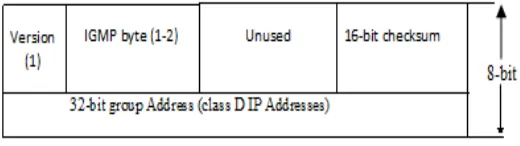
Fig 3.1: IGMP Packet.
IGMP consist of 32- bit as shown in the fig 3.1. it has the 32-bit group address of class D addresses. The class D is a higher – order four bits of 1110 and the range of IP Multicast group address is from 224.0.0.1 to address 239.255.255.255. Similarly the broadcast address is 192.168.1.57 to 192.255.255.255.
IV.IP BROADCAST GROUP
IP Broadcast point to group of all receiver points. IP Broadcast over ATM point to multipoint virtual circuits(VCs) as feature of dynamically. It creates the ATM point to multipoint is a switched virtual circuits gives the IP broadcast traffic more efficient. Components required are in hardware are Computer network, switches, Ethernet cable, optical cable, and software are Linux based on Ubuntu OS (version 14.04), Wireshark analyser to analyses the real time results. VLC Player to streaming the video and audio of Multimedia files. Because of live program connection oriented network used (RTP) Real time transport protocol like audio and video of Live conferences. RTP is Monitor transmission statistics and quality of service(Qos) and synchronization of Multiple streams.
Fig 3.1: Block diagram of IP Broadcast group.
ISSN(Online) : 2320-9801
ISSN (Print) : 2320-9798
I
nternational
J
ournal of
I
nnovative
R
esearch in
C
omputer
and
C
ommunication
E
ngineering
(An ISO 3297: 2007 Certified Organization) Vol. 4, Issue 4, April 2016
Fig3.2: Broadcast communication using 1KM distances of Optical cable.
IV ANALYSIS AND RESULTS OF REAL TIME APPLICATION
The above fig 3.2 Broadcast communication of using Optical cable for 1KM distance. Connecting the system network using switches by the desired Topology, configure the sever systems using linux based commands and also configure client systems. Similar to routers, then analysis the real time results of Audio, video. Comparison between the unicast and Multicast. Stored data is 2-3 Mbps in one second.
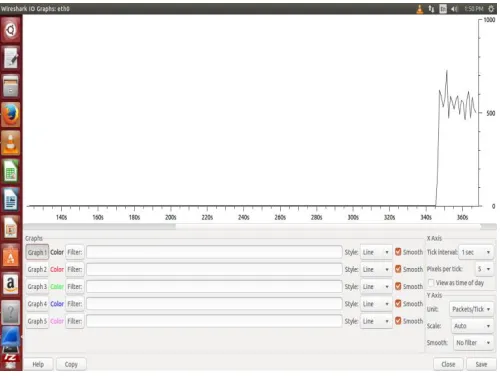
Fig 4.1 Broadcast video file using 1km of optical cable.
ISSN(Online) : 2320-9801
ISSN (Print) : 2320-9798
I
nternational
J
ournal of
I
nnovative
R
esearch in
C
omputer
and
C
ommunication
E
ngineering
(An ISO 3297: 2007 Certified Organization) Vol. 4, Issue 4, April 2016
Fig 4.2: summary of Broadcast video file via optical cable.
The above fig 4.2 shows the Broadcast video via optical cable results in wirshark packets analyser. Total number of packets are 284, first packet and last packet reached time is 1712.389 sec, averge per sec 0.166, average packets size 49.916 bytes, packets in bytes 284 *64= 14189.
Packet loss =
in Mbps.
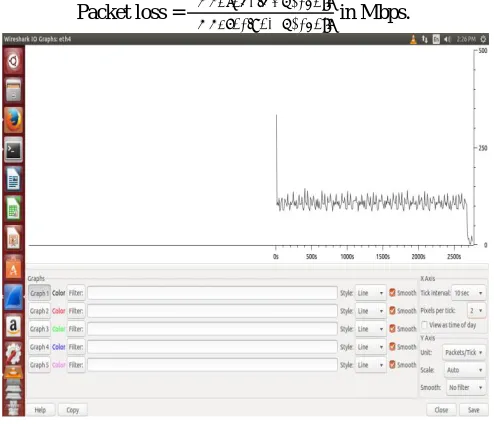
Fig 4.3: Broadcast video streaming file using optical cable.
A service where the data is delivery from sender to Multiple receiver network systems or Broadcast groups has shown in fig3.2. it consist of graph of long Y-axis Packets per interval and long X-axis time per seconds. By connected the etho and eth1(Ethernet 1). Video file denoted as .Mp3. one second of data is stored in rang of 2-3Mbps of quality of real time result.
ISSN(Online) : 2320-9801
ISSN (Print) : 2320-9798
I
nternational
J
ournal of
I
nnovative
R
esearch in
C
omputer
and
C
ommunication
E
ngineering
(An ISO 3297: 2007 Certified Organization) Vol. 4, Issue 4, April 2016
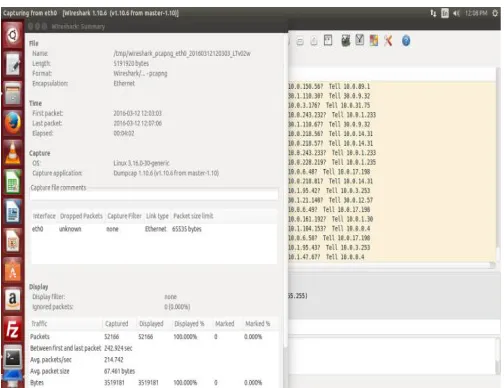
Fig 4.4 Summary of Broadcast Packets for streaming process via fiber optics.
The summary of Broadcast packets captured by 52166, Displayed 52166 and given packet displayed 100.00%, the average per sec is 241.742 average packet size 67.461bytes, Between first packet and last packet is 242.924 sec. Total number of packets in bytes written as 3519181.
Fig 4.5 Broadcast data streaming.
ISSN(Online) : 2320-9801
ISSN (Print) : 2320-9798
I
nternational
J
ournal of
I
nnovative
R
esearch in
C
omputer
and
C
ommunication
E
ngineering
(An ISO 3297: 2007 Certified Organization) Vol. 4, Issue 4, April 2016
The below table shows comparison of packets via fiber optics and streaming process.
Broadcast video files(.Mp4)
To reach at the client system
Time(sec) Packets
1.Video for optical cable
1712.389 284
2.Video for optical cable by streaming process
242.924 52166
Tab 1.1 The comparison of optical cable network and streaming of video.
V. CONCLUSION
The analysis and Implementation of a Broadcast group communication using optical cable 1KM based on real time transfer protocol presented in this paper. The Broadcast network is used in Live program communications like a cricket, live News, Audio, Video conferences without buffering the data. The main aim of this project is increases the life time of Network bandwidth and Avoids the delay than the Unicast communication. Achieve Wavelength is 1550nm and Bandwidth is 1.5Mbps. Unicast traffic is more than the broadcast communication.
VI.FUTURE SCOPE
The analysis is carried out Multicast communication better than the Unicast. In order to Improve the Network system or network communication. Network system proposed work is Broadcast communication through wireless oriented. The data transfer from sender to all Receiver systems or many Network computer.
REFERENCES
1. Adamson, Roca, “Security and Reliable Multicast Transport Protocols Discussions and Guidelines”, Internet draft.
2. Paul, S., Sabnani, K.k., lin. J,c., and Bhattacharyya, S.”Reliable Multicast Transport protocol(RMTP)” IEEE journal on Selected Areas in communications,April 1997
3. Peled and Vardi,”Formal Techniques for Networked and Distributed systems”
4. C.Kenneth Miller,” Reliable Multicast Protocols and Applications”, The Internet Protocol Journal –Volume 1,No.2 5. Gemmel et al,”The PGM Reliable Multicast Protocol”Wu, “Verification Analysis of Reliable Multicast Protocol” 6. Tanenbaum and Steen, “Distributed system Principle and Paradigms”
7. Internet Research Tsk Froce,Reliable Multicast Research Group http:// www.irtf.org/charter?gtype=old-rg&group=rmrg 8. Adamson et al, “NACK –Oriented Reliable Multicas Protocol (NORM)”, RFC 3940