An Improved Methodology to Optimize Four
Wave Mixing Effect in 32*40 Gbps DWDM
Optical Systems
Bandana Mallick1, Subhrajit Pradhan2, Bibhu Prasad3
Asst. Professor, Dept. of Electronics & Communication GIET, Gunupur, Odisha, India Asst. Professor, Dept. of Electronics & Instrumentation, GIET, Gunupur, Odisha, India Asst. Professor, Dept. of Electronics &Instrumentation, GIET, Gunupur, Odisha, India
ABSTRACT: Dense Wavelength Division multiplexing (DWDM) is a technology that utilizes a composite optical signal carrying multiple information streams. The performance of DWDM is degraded by non-linear optical effects. They are Cross phase modulation (XPM), Self phase modulation (SPM), four wave mixing (FWM), stimulated brillouin scattering (SBS) and stimulated Raman scattering (SRS).In this paper we analyze the performance of Dense Wavelength Division Multiplexing (DWDM) system for symmetric dispersion compensation scheme for 32 channel 40gbps at RZ modulation scheme for long distance optical transmission system. Depending on all these effects, an optimized DWDM system is designed using optisystem simulation tool to reduce FWM effects.
KEYWORDS: Dense Wavelength Division multiplexing, four wave mixing, Dispersion compensation fiber, RZ, EDFA,optisystem12, Bit error Rate (BER).
I. INTRODUCTION
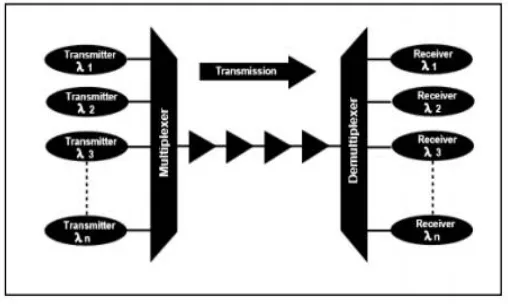
Fig 1: DWDM System of n Channel
II.THEORY
1.1 Optical Nonlinearities
The nonlinear interactions in optical fibres depend on the transmission length and the cross-sectional area of the fibre as shown in equation 1. The longer the link length, the more the interaction and the worse the effect of nonlinearity [3].
……… (1)
This effect is responsible for self-phase modulation (SPM),cross phase modulation (XPM) and four wave mixing (FWM). The other two important effects are stimulated Brillouin scattering (SBS) and stimulated Raman scattering (SRS).
1.2
Four Wave MixingFour wave mixing (FWM) is the important nonlinear effect arises when two or more pulses transmit through same fiber. FWM is a phenomenon that occurs in the case of DWDM systems in which the wavelength channel spacing are very close to each other. This effect is generated by the third order distortion that creates third order harmonics. Hence the name four wave mixing.
In general, the number of crossing product K, for N number of input channel is given by [3] K = N2 /2*(N-1) (2) …………(2)
Equation (2) shows that non linear effect FWM increase as number of channel in DWDM system increases. As N increases, K increasesrapidly. Two factors strongly influence the magnitude of the FWM products, referred to as the FWM efficiency. The first factor is the channel spacing; where the mixing efficiency increases dramatically as the channel spacing becomes closer. Fiber dispersion is the second factor, and the mixing efficiency is inversely proportional to the fiberDispersion, being strongest at the zero-dispersion point. In all cases, the FWM mixing efficiency is expressed in dB, and more negative values are better since they indicate a lower mixing efficiency.
The efficiency of FWM and noise performance is analyzed, taking into account the effects of difference channel spacing. To evaluate the efficiency of the FWM
To investigate the relationship between the efficiency and the power of the FWM [6] ………..(4)
WhereLeff is effective length, d is the degeneracy factor,αis the fiber loss coefficient and L is total fiber length.
III. SIMULATION SETUP
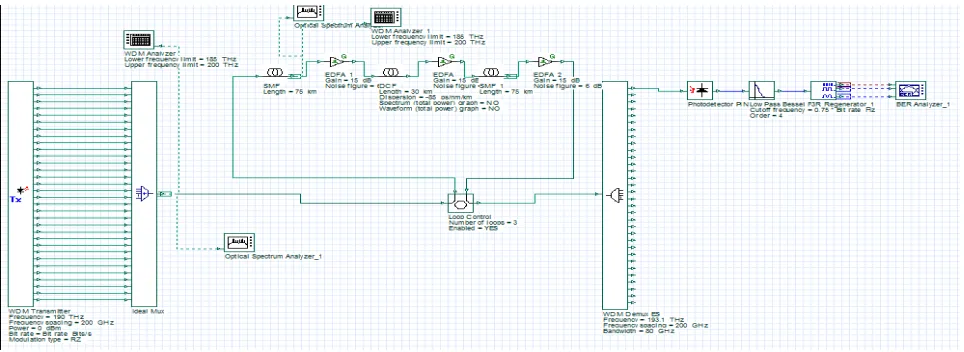
Our proposed system consists of WDM transmitter, WDM multiplexer, single mode fiber, dispersion compensation fiber, EDFA, WDM demultiplexer, optical receiver, bit error rate analyzer. It supports return-to-zero(RZ)modulation .The Single Mode Fiber (SMF) is used to long distance communication with an optical span of 480km and Dispersion Compensation Fiber (DCF) is used to neglect the negative dispersion and to introduce phase mismatching in the signals.
32 channels are used with the frequency starting from 190 THz having frequency spacing of 200Ghz. Ideal multiplexer is used to produce the multiplexed outputand transmitted through the single mode fiber(SMF) having attenuation coefficient and dispersion slope 2db/km and 0.075ps/nm/km. The signal is given to Erbium doped Fiber Amplifier-1 (EDFA) to boost the signal, with a gain of 15dB and noise figure of 6 dB respectively. EDFA’s are highly transparent to signal format and bit rate and highly immune to interference effects between different channels.To compensate the effect of four wave mixing dispersion compensating fiber (DCF) is used with attenuation, dispersion and dispersion coefficient 0.5db/km, -80ps/nm/km and -0.3ps/nm2/km respective. The effect of attenuation is minimized with the help of the EDFA-2 same as EDFA-1. Each span consists of 75 km of SMF and 30 km of DCF in order to fully compensate for the dispersion slope and accumulated dispersion in transmission fiber. Now again SMF -2 is connected having same parameters and length that of the SMF-1 . The one end of the SMF and another end of EDFA is given to loops control mechanism. The loop control system has 3 loop.The output of the loop control is given to the one end of the WDM demux[4] .if it is required to increase the transmitting distance then rotate the signal in the loop and increase the number of loops.The total length of the fiber channel is 450 km. In the receiver side the signal is passed through an WDM demux ,detected by photo detector(PIN) having dark current 10nA &resposivity 1A/W .Now this electrical signal is passed through Low Pass Bessel filter of order 4 to remove the noise.Then 3R generator & BER analyzer are used for eye diagram analysis of signal [6][2].
The simulation is performed with RZ modulation using Symmetric compensation technique.
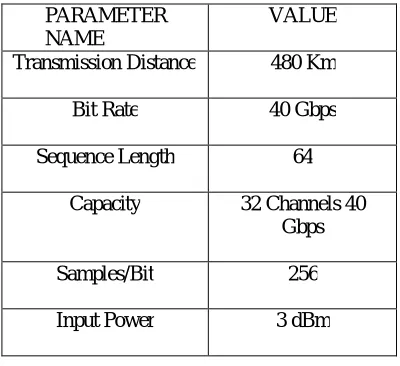
Table 1: Simulation Parameters PARAMETER
NAME
VALUE Transmission Distance 480 Km Bit Rate 40 Gbps Sequence Length 64
Capacity 32 Channels 40 Gbps Samples/Bit 256 Input Power 3 dBm
Table 2: Fiber Specifications Parameters SMF Value DCF Value Reference
wavelength
1550 nm 1550 nm Length 150 km 30 km Attenuation 0.25 db/km 0.5 db/km Dispersion 17 ps/nm/km 80 ps/nm/km Dispersion slope 0.08 ps/ /km 0.08 ps/ /km PMD coefficient 0.5 ps/km
Differential group delay
0.2 ps/km
IV. RESULT & DISCUSSION
The simulations are done in Optisystem 12.0 simulator& it has been observed that distance is increased three times, yet theperformance parameters (Q-factor, BER and Threshold Value and Eye-Height) possess better value compared to previous model.Thustheproposed technique is good for long haul communication system.
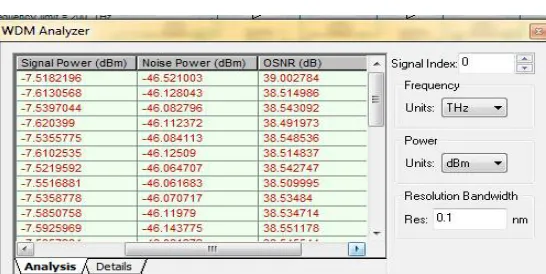
A.FWM effect for RZ modulation format:-
Fig3: WDM analyzer o/p for RZ modulation (wdmmux )
Fig4: WDM analyzer output for RZ modulation (at distance of 75km Length)
B. Eye diagram analysis:
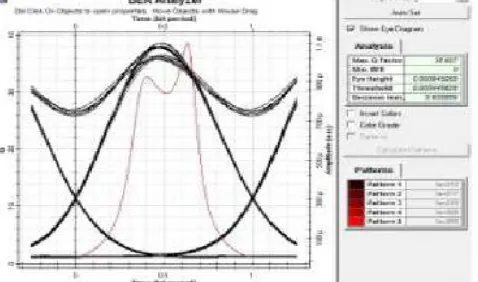
The eye diagram is also a common indicator of performance in digital transmission systems. The eye diagram is an oscilloscope display of a digital signal,repetitively sampled to get a good representation of its behavior. The eye diagram can also be used to examine signal integrity in a purely digital system—such as fiber optic transmission, network cables.
Fig 5: Eye Diagram and Q-value of link beforeoptimization (at the distance of 450 Km)
Fig 6: Eye Diagram and Q-value of link after optimization
C. Q-FACTOR &BER analysis:
The values of maximum Q factor for all channels decrease with the increase of transmission distance.The bit error rate (BER) is the most significant Performance parameter of any digital communications system. It is a measure of the probability that any given bit will have been received in error.
D. Analysis of FWM Effect on Various CrossSectional Areas of Fiber
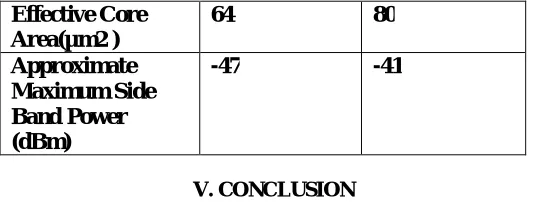
The used parameters areinput power 0dBm, laser line width 0 Hz,channel spacing 200GHz, no modulationformat is selected and the length of the fiberistaken 75 Km. By varying the effective corearea of fiber on 64 µm2and 80µm2
Table 3: Maximum Side Band Power with Respect to Various Effective Core Areas
Effective Core Area(µm2 )
64 80
Approximate Maximum Side Band Power (dBm) -47 -41 V. CONCLUSION
Above analysis conclude that 32 channel DWDM system gives the optimum performance if the input power is
3dBm, modulation format is RZ, channel spacing will not less than 200GHz, Effective core area of SMF is 70μm2, laser line width is 0Hz. After using these parameters we simulate the system then our systems performbetter than the previous one.we increase the reach of the DWDM system for long distance than the previous one and the power requirement is also lesser then that of the previous model.For our model Q value of the system is 39.027 which is greater than the previous value which is 38.607. This method offers improved value of performance parameters such as Q-FACTOR, MIN BER and THRESHOLD value.The proposed system may be further analyzed and can be used to obtain better signal at receiving endfor different combinations of SMF length, DCF length and EDFA gain
.
REFERENCES
1. Jameel Ahmed, AshiqHussain, M.Y. Siyal, HabibullahManzoor, Abdullah Masooda, “Parametric analysis of four wave mixing in DWDM systems”, Optik, vol. no (125), pp.1853– 1859, 2014.
2. SikhaMoniBhuyan, Prof. SarwarRaeen “Extending the Reach of DWDM ROF-PON Link with Optimization of Four Wave Mixing Effect with Comparative Analysis of Different Modulation Formats”,International Journal of Modern Engineering and Research Technology, Volume 2, Issue 2, April 2015
3.Gouri Deshmukh1, Prof.Santosh Jagtap2 “Four Wave Mixing In DWDM Optical System” International Journal of Computational Engineering Research||Vol, 03||Issue, 6||
4 .R. T. Chen and G. F. Lipscomb, Eds, WDM and Photonic Switching Devices for Network applications, Proceedings of SPIE, vol. 3949, 2009.
5. ManpreetKaur1 ,HimaliSarangal “Analysis on Dispersion Compensation with Dispersion Compensation Fiber (DCF)” (SSRG-IJECE) – volume 2 issue 2 Feb 2015.
6. BijayanandaPatnaik andPrasant Kumar Sahu “Optimization of Four Wave Mixing Effect in Radio-over-Fiber for a 32-Channel 40-GBPS DWDM System” 2010 International Symposium on Electronic System Design (ISED), pp.119-124, December 2010.
7. S.EstherJenifa1,K. Gokulakrishna”Performance Measures of DWDM System under the Impact of Four Wave Mixing “International Journal of Scientific Engineering and Research (IJSER),Volume 3 Issue 5, May 2015.
8. PrateekshaSharma,BipanKoushal ,Shrija Jain “Performance Analysis Of Dispersion Compensation Of Optical Fiber Using EDFA”, International Journal of Engineering Research & Technology (IJERT), Vol. 2 Issue 7, July – 2013.
9. V. Senthamizhselvan1, R. Ramachandran2, R. Rajasekar3 “Performance analysis of DWDM based fiber Optic communication with different modulation schemes and dispersion compensation fiber”IJRET: International Journal of Research in Engineering and Technology,Volume: 03 Issue: 03 | Mar-2014
10. G. Ivanovs, and S. Spolitis, “Extending the Reach of DWDM-PON Access Network Using Chromatic Dispersion Compensation,” 2011 IEEE Swedish Communication Technologies Workshop (Swe-CTW2011), pp. 29-33, 2011
11. Pelusi Mark D. (2013), “WDM Signal All-Optical Pre compensation of Kerr Nonlinearity in Dispersion-Managed Fibbers” IEEE Photonics Technology Letters, Vol. 25, No. 1, pp 71-74
12. G. Ivanovs, and S. Spolitis, “Extending the Reach of DWDM-PON Access Network Using Chromatic Dispersion Compensation,” 2011 IEEE Swedish Communication Technologies Workshop (Swe-CTW2011), pp. 29-33, 2011.
BIOGRAPHY
1.Prof. Bandana Mallick has completed her bachelor in Electronics& communication engg And Master’s in Electronics& communication engg from BijuPattanaik University of Technology respectively. She has 7 years of teaching experience and presently working as assistant professor Department of Electronics & communication engg. in GIET, Gunupur. Her interest field includes wireless communication and application of fiber optic communication in dispersion management.
2.Prof. SubhrajitPradhan has completed his bachelor in Electronics& Communication Engg. and master in tech. in Electronics &Communication Engg. fromBijuPattanaik university of technology respectively.He is perusing his Ph.D at Berhampur University,Berhampur. He has 8years of teaching experience & presently he is working as assistant professor in department of Electronics & Communication in GIET, Gunupur, Odisha, India. His interest filed of research is application of neural network for signal integrity analysis of high speed digital integrated circuits.