ISSN(Online): 2320-9801
ISSN (Print): 2320-9798
I
nternational
J
ournal of
I
nnovative
R
esearch in
C
omputer
and
C
ommunication
E
ngineering
(An ISO 3297: 2007 Certified Organization)
Vol. 4, Issue 4, April 2016
Energy Efficient Algorithm for WSN -
A Review
Mohnish Gupta1, Dr. Govind U. Kharat2
M.E. Student, Dept. of Electronics and Telecommunication, SPCOE, Savitribai Phule Pune University, India 1
Professor & Principal, SPCOE, Savitribai Phule Pune University, India 2
ABSTRACT: Technology plays important role in day today life as human concern. Because of technology life becomes simple. In terms of sensor, it also plays major role that is enhancing the computing capacity, reduces size as well as low power consumption. Now recently, as per studies, in past few years, sensors per human index increases significantly. And WSN (wireless sensor network) becomes the new trend and it enhances the capabilities of transmission. Low cost sensor node relays data to sink node but in traditional policy too much energy wasted because in network some redundancy available. But it also has some drawbacks like limited energy resources available at remote location where sensor is to be placed. So with limited energy in WSN, it requires LEACH (Low Energy Adaptive Clustering Hierarchy) protocol which enables life time of network in increasing manner. By modifying LEACH, improves network lifetime and communication done till last node dead as network reach-ability increases.
KEYWORDS: Wireless Sensor Network (WSN), LEACH
I. INTRODUCTION
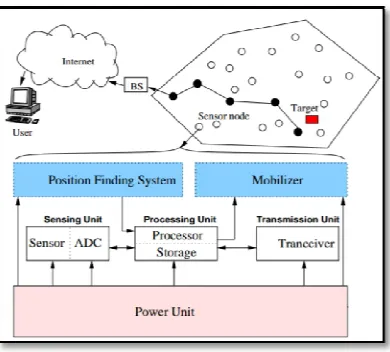
Wireless sensor network (WSN) is a network in which on field small sensor node is key elements of a network. Because of WSN new area of telecom industry enabled like in disaster management large number of sensor dropped from helicopter. Sensor node is smallest part of WSN. Sensor node tightly coupled with power, processing capability and transmission capacity. There is lots of work previously done which assumed that all sensors now are homogeneous means all sensor node having equal computation capacity work same battery life. Figure 1 shows architecture of sensor node consists sensing unit, radio unit, processing unit and most important is battery unit. Main question is that, with limited energy resource how entire network gives more output in terms of rounds where round is one transmission done between sensor node and base station or sink node at single time? Simple answer for above question is routing algorithm means for sending data form sensor node to base station requires energy. If distance between sensor nodes to base station is more, then energy requirement is also more. At sensor level, limited resources available and assumption for sensor node is all nodes are homogeneous while sink node or base station having proper energy supply [7].
II. RELATED WORK
ISSN(Online): 2320-9801
ISSN (Print): 2320-9798
I
nternational
J
ournal of
I
nnovative
R
esearch in
C
omputer
and
C
ommunication
E
ngineering
(An ISO 3297: 2007 Certified Organization)
Vol. 4, Issue 4, April 2016
Fig. 1 Architecture of sensor node shows sensor subsystem
For selecting cluster head, assumption is that all sensor nodes are homogeneous and sensor tightly coupled with energy constraint. Basically there are two phases for election of cluster head that is set-up phase and steady state phase.
A) Set-up Phase:
In set-up phase, sensor elects any random number from 0 to 1 and this random number compare with threshold value that is varies as rounds goes on further and formula for selection of threshold as per follows. Where p is probability for selection of CH; r, current round while processing and; G, node set in which in previous (1/ p) round not selected as CH. If random number is less than threshold then only sensor will selected as CH. This process done for all sensor nodes for each round and sensor node who is elected as cluster head don’t having chance to re-elect as cluster head [1]. Calculation of threshold done on the basis below equation. After deciding CH, they broadcast the message and depending on signal strength received by sensor, thus cluster formation completed in set up phase.
( ) = ∗
ifn ϵ G,
0 otherwise,
B) Steady State Phase:
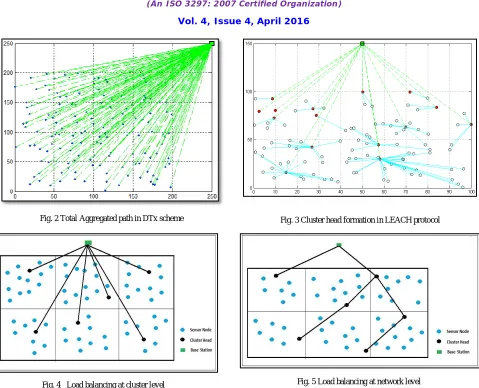
In this phase, after election of cluster head, each sensor send the data to nearest cluster head which is decided depending in signal strength. For data aggregation purpose small energy used at respective cluster head. For avoiding data collision it uses TDMA frame structuring and sensor data is time framed and fitted it into frame structure. After that cluster head send data to sink node or base station [3].Main advantage of using LEACH protocol over DTx scheme is that total aggregation path is significantly reduced and because of this, it affects total energy dissipation by sensor node is clearly reduces to great extent. One more thing is that, in DTx scheme flooding technique is used. So there is possibility of data collision due to at same time two or more sensor node sends data to sink node and it induces data loss. For doing it more sophisticated, then at sensor level more computational power is to be increased but due to this solution lack of energy resources, communication power in terms of round reduces and it affects on life time of network .
ISSN(Online): 2320-9801
ISSN (Print): 2320-9798
I
nternational
J
ournal of
I
nnovative
R
esearch in
C
omputer
and
C
ommunication
E
ngineering
(An ISO 3297: 2007 Certified Organization)
Vol. 4, Issue 4, April 2016
Fig. 4 Load balancing at cluster level
head and simply value of aggregated path is very much less than DTx scheme.
III. MP-LEACHANDMG-LEACH
In LEACH protocol, Cluster head formation having important task. Cluster formation also plays important role but it uses randomness. Means within a small area, numbers of cluster head are there. As shown in figure 3, within small area more than one cluster head present and at this point, not necessary and it’s called wastage of limited resources. In LEACH algorithm, some of the nodes have to select cluster heads that, in examining to them, have a longer distance to the BS. These nodes send their data to a further location and then their data has to go through a long distance to reach the BS. Such transmissions waste the network’s energy and are called extra transmissions. In order to figure out the extra transmission problem, we are to make a modification in the set-up phase of the LEACH algorithm. In this phase, once the cluster heads are selected, the other sensor nodes do not needed to select the closest node. Among the cluster heads that, in comparison to them, have a shorter distance to the BS, these nodes select the closest cluster head and inform it that it will become a member of the cluster. If such a cluster head does not exist, it will not be the member of any clusters and will send its data directly to the BS [4].The main aim of this protocol is to provide substantially energy-efficient and robust communication. The energy efficiency is achieved by load balancing at two levels.Network level, which involves traffic multiplexing over multiple paths and Cluster level, introducing rotation of the cluster-heads every given interval of time with knowledge of pre-known location of all sensor nodes.
Fig. 2 Total Aggregated path in DTx scheme
ISSN(Online): 2320-9801
ISSN (Print): 2320-9798
I
nternational
J
ournal of
I
nnovative
R
esearch in
C
omputer
and
C
ommunication
E
ngineering
(An ISO 3297: 2007 Certified Organization)
Vol. 4, Issue 4, April 2016
As per figure 3, there is no appropriate load balancing structure, because random selection of the cluster head it performs not necessary action regarding sensor node data collection and cluster head formation. To overtake extra transmission problem; make load balancing at cluster level. By which knowing the sensor location the field area is divided into small sub area. And for each sub area only one cluster head will be select. This type of routing and cluster head selection is nothing but multigroup LEACH (MG-LEACH) protocol. The main motto behind this idea is that too minimize the aggregated path value. And this is achieved by some number of calculations done at sensor node as well as sink node or base station. The hierarchical routing protocol adopts the clustering approach by grouping sensor node while location base information gathering utilizes the intelligible routed data and it becomes multigroup LEACH (MG-LEACH) [1].
Figure 4 explains proper description regarding MG-LEACH protocol. By forming multiple groups that is G1, G2, G3,…….,Gn formation done in set-up phase by knowing location of sensors which directly reported to sink node. All groups belonging to natural number system. And this group belonging to location based formation that is GPS. Group having known geographical boundary in such a way that low transmission energy required for sending data stream to cluster head. This becomes good solution for extra transmission problem.
= G + G + G +⋯… … + G where G, n ∀ N
As shown in figure 5 load balancing at network level. To balance overload energy consumption problem because of this at in some cases cluster head needs to cover larger region. This will lead the problem that some cluster member having much more distance at it consumes more energy to overcome this problem multipath routing is best solution [8]. Make clustering hierarchy in such a way that path discovery will done at higher level means at cluster head level and it provide better solution than MG-LEACH. At each round, new cluster head and new adequate path calculate which provide optimal power efficient routing protocol which uses advantage form LEACH protocol as well as multipath protocol. So it will become multipath LEACH (MP-LEACH) [5]. Since data transmission in wireless sensor networks is commonly performed through multi-hop data forwarding techniques, the main task of the route discovery process is to determine a set of middle nodes that should be selected to construct several paths from the source nodes in direction of sink node.
Main motto behind this idea is energy-saving which is based on clustering technique. It follows the following two considerations: firstly- maximizes the lifetime of the network. Secondly- maximizes the amount of data message received by the sink node. In place of enforcing transmission energy constraints on every individual node, the total energy consumption of the network should be considered. The cluster head node collects data from its neighbor nodes, then aggregate and send those data to the base station. MP-LEACH protocol become hybrid protocol uses benefits from LEACH as well as multipath routing. The LEACH is one of the algorithms for routing the packets in the network. In the LEACH it having several disadvantages like extra communication problem, not having load balancing structure and many others. Modifying the flowchart of LEACH, try to make more efficient routing protocol. In Multigrain LEACH the cluster head of each cell (groups) will communicate with the sink and selected from location based information by reducing the aggregated path. In Multipath LEACH, where the area is divided into cells and each area is having a cluster head, so the nodes of that area will communicate with that cluster head only. So now cluster head of each cell will communicate each other and hence finally sends to sink node then to the base station.
IV.CONCLUSION
ISSN(Online): 2320-9801
ISSN (Print): 2320-9798
I
nternational
J
ournal of
I
nnovative
R
esearch in
C
omputer
and
C
ommunication
E
ngineering
(An ISO 3297: 2007 Certified Organization)
Vol. 4, Issue 4, April 2016
REFERENCES
1. Muhammad Haneef, Zhou Wenxun, Zhongliang Deng, ”MG-LEACH: Multi Group Based LEACH an Energy Efficient RoutingAgorithm for wireless Sensor Network” ,ISBN 978-89-5519-163-9, Feb. 19~22, 2012 ICACT2012
2. W. Heinzelman, A. Chandrakasan and H. Balakrishnan, “Energy efficient communication protocol for wireless micro sensor networks,” Proceedings of the 33rd Hawaii International Conference on System Science, 2000.
3. MortazaFahimiKhaton Abad, Mohammad Ali JabraeilJamali ,”Modify LEACH Algorithm for Wireless Sensor Network” ,IJCSI International Journal of Computer Science Issues, Vol. 8, Issue 5, No 1, September 2011
4. Dr. Deepak Dembla, Shivam H. Mehta,” Analysis and Implementation of Improved - LEACH protocol for Wireless Sensor Network (I-LEACH)”,IJCSCIJ Volume 4 • Number 2 September 2013 pp.8-12 ISSN-0973-7391
5. ErfanArbab,VaheAghazarian, AlirezaHedayati, and NimaGhazanfariMotlagh, ”A LEACH-Based Clustering Algorithm for Optimizing Energy Consumption in Wireless Sensor Networks”,2nd International Conference on Computer Science and Information Technology (ICCSIT'2012) Singapore April 28-29, 2012
6. Konstantin Chomu, LiljanaGavrilovska, ”Data Timed Sending (DTS) Energy Efficient Protocol for Wireless Sensor Networks: Simulation and Testbed Verification”, Wireless Sensor Network, 2013, 5, 158-167 doi:10.4236/wsn.2013.58019 Published Online August 2013 (http://www.scirp.org/journal/wsn)
7. Jamal N. Al-Karaki, Ahmed E. Kamal,” Routing Techniques in Wireless Sensor Networks: A Survey”, ICUBE initiative of Iowa State University, Ames, IA 50011