Implementation on Overhead Reduction by
Spatial Reusability in Multi-Hop Wireless
Network
Pravin V. Junghare , Prof. U. R. Godase
Department of Information Technology, Sinhgad College of Engineering, Pune, India
ABSTRACT: Energy is a valuable resource in wireless networks. For many multi-hop networking scenarios, nodes require power for performing their operation, so requiring capable power management to make certain connectivity across the network. Though when wireless networks are attached outside power source due to obstruction between lively links the network may demand excessive energy per unit time (Power) due to this the overall performance is reduced. Since network life-time or network capacity is depend on the power efficiency, many efforts to study energy-efficient networks in the wireless network community. In multi-hop wireless networks well-organized routing algorithms are significant for network performance. We dispute that by carefully considering spatial reusability of the wireless communication media, we can reduce the overhead in multi hop wireless networks. To support our argument, propose Broadcast Tree Construction (BTC) and compare them with existing routing and multi path routing protocols, respectively. Our estimate outcome shows that proposed protocols significantly improve the end-to-end throughput compared with existing protocols. We also introduce the sleep scheduling approach for energy consumption and hybrid cryptography for security of data that can be prevent the data leakage and jammer attacks.
KEYWORDS: Routing, Wireless network, Hop to Hop to communication
I. INTRODUCTION
A. Wireless Sensor Network
The sensor network includes small and less cost sensing devices together with wireless radio transceiver for examining the environment. It involves the data gathering and transmitting the information to single or multiple sink nodes. The advantage of this network is that it is infrastructure less or external supply for data gathering. The main applications of WSN are wild habitat monitoring, forest fire detection, building safety monitoring, military surveillance and so on[1].
The characteristics of WSN, which have resulted in challenging issues, are as follows:
1. Sensor nodes are exposed to maximum failures.
2. Sensor nodes utilize the transmit message pattern and possess severe bandwidth restraint.
3. Sensor nodes hold scarce quantity of resources.
B. Multihop Wireless Network
Multi Hop use many wireless hops to communicate information from one sender to receiver. Mobile Multi-hop Ad Hoc Networks are collections of portable nodes joined mutually over a wireless medium. These hubs can move with no limitation and powerfully self compose into subjective and transitory in specially appointed system topologies permitting individuals and gadgets to consistently internetwork in zones with no prior correspondence foundation (e.g., disaster recovery environments).
The most straightforward specially appointed system is a shared system framed by a gathering of stations inside the scope of each other that progressively design themselves to set up a brief single-jump ad-hoc system.
functionalities that are typically given by the system foundation. Close hubs can impart specifically by utilizing a solitary jump remote innovation (e.g., Bluetooth, 802.11, and so on.) while gadgets that are not straightforwardly associated trade a couple of information by sending their activity by means of a grouping of middle gadget[2].
C. Spatial Reusability
It is an efficiency measure that allows use of same spectral link at the same time. Works on wireless routing matrices is done in traditional wireless sensor network. In wireless communication network it is essential to carefully find the high utility route in multi-hop wireless network protocols proposed for multi hop wireless networks. However a basic problem with presented wireless routing protocols is that reduces the number of transmissions to deliver a single packet from a source node to a destination node does not necessarily maximize the end-to-end throughput [3].
II. LITERATURE SURVEY
Atul Adya et al. [4] have proposed A Multi Radio Unification Protocol for IEEE 802.11Wireless Networks. In this, while constructing a multi-hop network using off-the-shelf 802.11 hardware, normally one uses a single ad-hoc network and therefore all nods that participate in that network end up using the same channel. Unfortunately, even when multiple 802.11 NICs are present on the host, each NIC converges on the same physical channel. As a consequence, because of contention only one NIC is used. MUP multiple radios such that frequency (channel) variety is achieved while ensuring that all nodes a reel. Current technique for estimating channel quality is to send probe messages across each channel on a periodic basis and then to compute the round-trip latency of these messages. For each neighboring node, a node computes its channel quality metric independent of its neighbors’ decision. Independent channel selection simplifies the protocol design because no agreement is required between the sender and the receiver on which channel to use.
C. E. Perkins et al.[3] This method allows a group of mobile computers, which may not be near to any base station and can exchange data along altering and random paths, to all computers among their number a (possibly multi-hop) path along which data can be exchanged. In addition, result must remain compatible with operation in cases where a base station is exist. By using the strategy outlined not only will routing be seen to explain the problems with ad-hoc networks, but in addition describe ways to perform such routing functions which traditionally has not been utilized as a protocol level for routing.
J. Broch et al. [4] proposed TORA protocol based on “link reversal ” algorithm. It is intended to discover the route on demand provides several routes to the destination establish route quickly and minimize overhead in transmission by localizing algorithmic reaction to the topological changes when possible.
S. Chachulski et al. [5] proposed Opportunistic routing has explains the possible throughput raise and the ExOR method as a way to achieve it. Shrewd routing has a place with a general class of remote calculations that make utilization of multi-client assorted qualities. These procedures utilize gatherings at various hubs to raise remote throughput. They may optimize the alternative of forwarder from those nodes that received a transmission or merge the bits received at different nodes to correct for wireless errors or allow all nodes that overheard a transmission to simultaneously forward the signal acting as a multi-antenna system. The work builds on this foundation but adopts a fundamentally different approach, it combines random network coding with opportunistic routing to address.
D. B. Johnson et al.[8] Dissimilar to routing conventions utilizing distance vector or link state algorithms, utilizes dynamic source directing which adjusts rapidly to routing changes when have development is visit, yet requires practically no overhead amid periods in which host move less. In view of results from a packet level simulation of versatile hosts working in an ad-hoc system, the gathering performs well over an assortment of ecological conditions, for example, host density and development rates. For everything except the most astounding rates of host development recreated, the overhead of the convention is very low, tumbling to only 1% of aggregate information bundles transmitted for direct development rates in a system of 24 moving hosts.
node to a given goal is viewed as an open issue. To understand it, we presented the EATT routing metric and in addition the Shortest Multirate Anypath First (SMAF) calculation and exhibited a verification of its optimality.
III. SYSTEM ARCHITECTURE
In this routing protocol planned is intended for WSNs in which the sensing nodes are static. Beside the applications running in the WSN require the information collected by the all sensor nodes and have to be send instantly to the sink. All the variables at the each node j are represented as follows.
CFj1 = Value of first cost field of node j CFj2 = Value of second cost field of node j PFj1 = Value of first parent node field of node j
PFj2 = Value of second parent node field of node j
Nj = jth node
REj = Remaining energy of Nj Cj =1
REj= each nodes cost to be added to a path
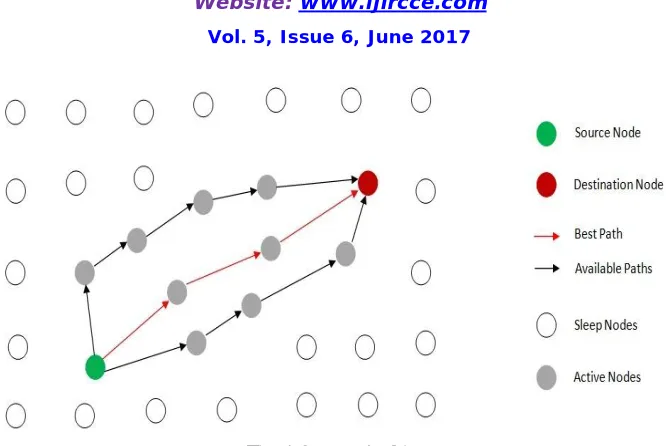
As shown in Fig. 1 the broadcast tree construction of the routing protocol is having of two stages. In the first stage, the sink node transmits an advertisement message ADV1. Upon reception of ADV1 message, each node of the WSN
executes the algorithm given in the procedureBTC-phase1and set its first parent field so that the path to the sink node
through it has least cost. Upon completion of the first stage, the sink broadcast a second advertisement message ADV2. Upon receipt of ADV2 message each node of the WSN is start executes the algorithm they are given in the procedure BTC-phase2 and set its second parent field so that the path to the sink node through it has the second least cost. Node j broadcast ADV1and ADV2 has the following parameters.
ADV 1 = (Nj, CFj1, PFj,1), ADV 2 = (Nj ,CFj,1)
BTC-phase1 describes the how to construct the initial tree which performs its task as follows. At the beginning of first period, each node except the sink node sets its both cost fields to and parent node fields to -1, but at the starting of the subsequent periods, the each node only sets its both of the cost field to and no change is made to the parent node fields. The sink node sets its both cost fields to 0 and set its parent node fields to its own ID. At the beginning of this phase, sink node transmit an ADV1 message to all its neighbours. When a node receives an ADV1 message, it does not broadcast its own ADV message to its neighbour immediately. Following steps are executed before sending the ADV1 message to its neighbors,
1. When a node receives the first ADV1 message, it sets backoff timer.
2. If the first ADV1 message comes from the sink node then node stores to the sink node ID in two parent node
field and computes the new cost by adding reciprocal of it’s the left over energy to the received cost and stores
the new cost in two cost field. If the first ADV1 message comes from the any other node in the network, then
the node is compare the new cost with the existing cost stored in the first cost field
3. Upon reception of any further ADV1 message from other neighbors, it is computes the newly cost in the same
manner as in the step 2. If the previous node has already stored the sink node ID in its parent node field, then it will discard the ADV1 message, otherwise, it compare this new cost with the presenting cost stored in its first cost field and updates its cost fields and parent node fields as in step2.
Once the back off timer expires, the node broadcasts ADV1message that contains its own ID, the value stored in
Fig. 1 System Architecture
Procedure: Construction of BTC
Input: Initial source node Sn, Destination node dn, Group of neighbor nodes nd [], each node id, each node energy eng. Output: Source to destination path when data received success.
Step 1: User first selects the Sn and dn
Step 2: choose the packet or file f for data transmission. Step 3: if (f! =null)
Step 4: read each byte b form fd when reach null Step 5: send data, initialize cf1,cf2,pf1,pf2 Step 6: while (nd[i] when reach NULL) Cf1=nd[i].eng
Pf1= nd[i].id Cf2=nsd[i+1].eng Pf2= nd[i+1].id Step 7: if (cf1>cf2) Cf2=null Pf2=null Else Pf1=pf2 Cf1=cf2; Pf2=null Cf2=null Step 8: end while
Step 9: repeat up to when reach at sink node
Hybrid Cryptography
Algorithm: Generate an RSA key pair. Input: Required modulus bit length, k.
until (p mod e) ≠ 1
repeat
q ← gen_prime(k - k/2) until (q mod e) ≠ 1
N ← pq
L ← (p-1)(q-1) d ← mod_inv(e, L) Return (N, e, d)
DES Encryption
Basically we use DES for data encryption single-mindedness. When a device send the data to sink first all the data will be translated with the proposed key and other end telephone will decrypt the same data using same key
Compositions of Encryption and Decryption: Encryption E = eL1 o eL2 ……… o eL16 Decryption D = dL16 o dL15 o ………o dL1 Leader L is derived from the Password. Here we have 16 rotations. Thus we need 16 Leaders (L1 to L16) from Password.
L1 = First two minutes of Password. L2 = Second two bits of Key
L3 = Third two bits of Password and so on Steps:
Get Plaintext. Get Password.
Translate the Characters in binary format.
Derive the Leaders (L1 to L16) from the Password.
Apply the Formula to get the converted and decrypted message.
IV. MATHEMATICAL MODEL
The proposed system used below mathematical approach. Now here S is the system which including the
S={S1,S2,S3,S4}
So, S is the main set and S1 to S4 all are subset. S1={S1i} this is the single sink node
S2= {S21, S22……….. S2n } this is the subset of sensor node.
S3 ={Inode1,Inode2…….Inoden} this is the subset of intermediate Running nodes S4={Snode1,Snode2…….Snoden} this is the subset of intermediate sleep nodes
Here S is proposed approach which handles the linier transmission, the result of transmission as well as receiving Fs={Aud,Vid,Img,txt} these are the file system which will support for data transmission
The system can handles the linier transmission with minimum 3 hops with sleep scheduling appraoch, the result of transmission as well as receiving
Fs={dp1,dp2dp3………….dpn} these are the file system which will support for data transmission as packets. Success condition
If(s1 !=null or network tree load success) Failure condition
If (s1==null and network tree loading failure) Nd={SN1,SN2,SN3…………SNn}
Ndi={SNk,Nd}
Ndi also denoted the group of nodes but all nodes having at least one sink node
V. RESULTS AND DISCUSSION
In this section we present the evaluation of proposed system as well as existing system. After describing our experimental setup, we quantitatively evaluate the analysis with respect to the different parameter used such as throughput, packet delivery ratio, cost, and time.
Experimental Setup
We run our experiments in NS2 simulator version 2.35 that has shown to produce realistic results. NS simulator runs TCL code, but here use both TCL and C++ code for header input. In our simulations, we use Infrastructure based network environment for communication. For providing access to the wireless network at anytime used for the network selection.
WMN simulate in NS2 .TCL file show the simulation of all over architecture which proposed. For run .TCL use EvalVid Framework framework in NS2 simulator it also help to store running connection information message using connection pattern file us1. NS2 trace file .tr can help to analyze results. It supports filtering, processing and displaying vector and scalar data. The results directory in the project folder contains us.tr file which is the files that store the performance results of the simulation. Based on the us.tr file using xgraph tool we execute graph of result parameters with respect to x and y axis parameters. Graphs files are of .awk extensions and are executable in xgarph tool to plot the graph.
This Parameters are defined and evaluated below:
1. Average End-To-End Delay
End-to-End Delay (E2ED) refers to time occupied by a data packet travel from a source to a destination in a network. Here only data that reaches successfully to the destination are considered. The minimum value of E2ED means good performance of the protocol. The smallest amount value of end-to-end delay states superior performance of the protocol.
E2ED=Sum( Data packet arrive time-Data packet send time)/Sum(Number of connections).
2. Packet Delivery Ratio
The packet delivery ratio (PDR) defined as a ratio of numbers of data packets reached to target over the network to number of packets generated. The greater amount value of packet delivery ratios states superior performance of the protocol.
PDR=Sum( number of packet receive)/ Sum( number of packet sent) 3. Throughput
Throughput can be defined as the ratio of the total bytes in data packets received by sink nodes to time from first packets generated at a source to last packet received by sink nodes. The greater value of throughput states superior performance of the protocol.
Throughput=(Total byte in data packet recived by sink node )/(Time from first packet genrated at source received by sink node)
4. Energy Consumption
Energy consumption is most important concepts in WSN. The lifetime of the sensor network is based on energy consumption of the sensor node. Total energy consumption of the node defined as the difference between initial energy and final energy of the node. The smallest amount value of energy consumption states superior performance of the protocol.
Total Energy Consumption=Sum(Initial Energy of node- Final energy of node ).
This Parameters are been evaluated and tested for different number of nodes and at different simulation time for knowing the performance of the proposed vs existing system.
For 100 Number of Nodes
Delay versus Simulation Time
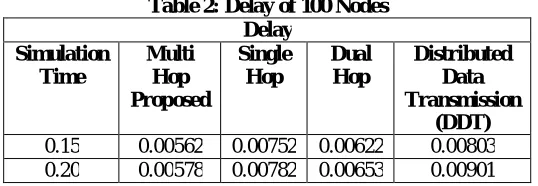
The end-to-end delay in SINGLE HOP , DUAL HOP and DDT with increase in Simulation time. However, increasing treads in DUAL HOP and SINGLE HOP is much higher than Proposed as shown in Table The smallest amount value of end-to-end delay states superior performance of the protocol. Figure shows, proposed system gives superior perform than other three protocols.
Table 2: Delay of 100 Nodes Delay
Simulation Time
Multi Hop Proposed
Single Hop
Dual Hop
Distributed Data Transmission
(DDT)
0.15 0.00562 0.00752 0.00622 0.00803
0
0.001
0.002
0.003
0.004
0.005
0.006
0.007
0.008
0.009
Single Hope
Dual Hop
DDT
Multi Hop
Figure: 2. Delay vs simulation time
Packet Delivery Ratio versus Simulation Time
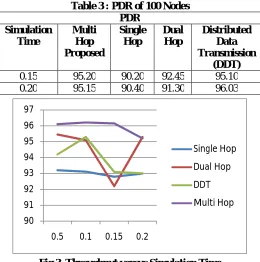
The packet delivery ratio of SINGLE HOP , DUAL HOP and and DDT than proposed system decreases with increase in Simulation Time as shown in Table 6.2. However, decreasing treads in SINGLE HOP and DUAL HOP is much smaller than proposed approach . The greater amount value of packet delivery ratios states superior performance of the protocol as shown in Fig 6.2.
Table 3 : PDR of 100 Nodes PDR
Simulation Time
Multi Hop Proposed
Single Hop
Dual Hop
Distributed Data Transmission
(DDT)
0.15 95.20 90.20 92.45 95.10
0.20 95.15 90.40 91.30 96.03
90 91 92 93 94 95 96 97
0.5 0.1 0.15 0.2
Single Hop
Dual Hop
DDT
Multi Hop
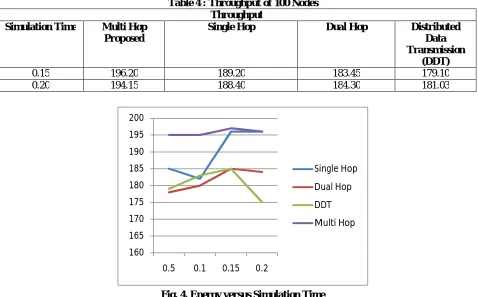
Table 4 : Throughput of 100 Nodes Throughput
Simulation Time Multi Hop Proposed
Single Hop Dual Hop Distributed Data Transmission
(DDT)
0.15 196.20 189.20 183.45 179.10
0.20 194.15 188.40 184.30 181.03
160 165 170 175 180 185 190 195 200
0.5 0.1 0.15 0.2
Single Hop
Dual Hop
DDT
Multi Hop
Fig. 4. Energy versus Simulation Time
The energy consumption of DUAL HOP , SINGLE HOP , DDT and Hybrid DUAL HOP decreases with increase in Simulation Time . However, decreasing treads in DUAL HOP and Proposed approach is much higher than SINGLE HOP , DDT as shown in Table . The smallest amount value of energy consumption states superior performance of the protocol as shown in fig.
Table 5 : Energy required for simulation of 100 Nodes (Jules) Energy
Simulation Time Multi Hop Proposed
Single Hop Dual Hop Distributed Data Transmission
(DDT)
0.15 755 1120 1320 1760
0 200 400 600 800 1000 1200 1400 1600 1800 2000
0.5 0.1 0.15 0.2
Single Hop
Dual Hop
DDT
Multi Hop
VI. CONCLUSION
To overcome the drawbacks of existing system we proposed the Broadcast Tree Construction method which is used to select neighbor node, for data security we used hybrid cryptography, and to improve the network lifetime we proposed the sleep scheduling algorithm. These methods contribute more for better energy efficiency, reduce energy consumption and increase throughput.
REFERENCES
[1] L. Bhasker, “Genetically derived secure cluster-based data aggregation in wireless sensor networks,” vol. 8, no. May 2013, pp. 1–7, 2014. [2] R. Draves, “Routing in multi-radio , multi-hop wireless mesh networks.”
[3] T. Meng, S. Member, F. Wu, and Z. Yang, “Spatial Reusability-Aware Routing in Multi-Hop Wireless Networks,” vol. 65, no. 1, pp. 244–255, 2016.
[4] A. Adyta, P. Bahl, J. Padhye, A. Wolman, and L. Zhou, “A multi radio unification protocol for IEEE 802.11 wireless networks,” in Proc. 1st Int. Conf. Broadband Netw.,2004, pp. 344–354.
[5] C. E. Perkins and P. Bhagwat, “Highly dynamic destination sequenced distance-vector routing (DSDV) for mobile computers,” in Proc. Conf. Commun. Archit., Protocols Appl., 1994, pp. 234–244.
[6] J. Broch, D. A. Maltz, and D. B. Johnson, “A Performance Comparison of Multi-Hop Wireless Ad Hoc Network Routing Protocols,” 1998. [7] S. Chachulski, M. Jennings, S. Katti, and D. Katabi, “Trading Structure for Randomness in Wireless Opportunistic Routing,”2007. [8] D. B. Johnson and D. A. Maltz, “Dynamic Source Routing in Ad Hoc Wireless Networks.”